Resume Bullet Point Formulas by Job Function: Sales, Ops, and Technical Roles
Resume bullet point formulas by job function: lead sales bullets with revenue, ops with efficiency, and technical with scale. Here's how to tune each one.


Most resume advice stops at "use numbers and action verbs." That's table stakes now that nearly every resume has them. This guide goes one level deeper: which numbers, in which currency, for sales, operations, and technical roles specifically.
Key Takeaways
- A bullet point is a unit of proof, not decoration. Its job is to prove the one result the hiring manager for that function actually cares about.
- The skeleton is constant: strong action verb + method + a quantified result. Only the currency of that result changes by function.
- Lead sales bullets with revenue and quota, ops bullets with efficiency and cost, and technical bullets with scale, reliability, and the exact stack.
- Keywords are function-specific too. Since 76% of recruiters filter on skills first, a strong bullet that misses the function's search terms can still go unseen.
- Job-title and language match drives interview rates up more than 10x, per Jobscan, so speak the target role's vocabulary on purpose.
- When you lack a clean number, estimate honestly or use a proxy. Never fabricate a figure you can't defend in the interview.
- Function-tuning only sticks if it's repeatable. AIApply's AI Resume Builder, Resume Scanner, and per-job tailoring exist to make it fast enough to do on every application.
The best resume bullet points follow a function-specific formula: open with a strong action verb, name the method behind the work, and close with the one result the hiring manager for that function actually scans for. In a sales role, that result is revenue or quota attainment. In an operations role, it's efficiency, cost, or throughput. In a technical role, it's scale, reliability, or performance. A bullet that reads well in the abstract still loses to one built around the metric that defines success in the specific job you're applying to.
Here's the pattern most job seekers miss. They write every bullet the same way, send the same resume into sales, ops, and engineering roles, and read the silence as a verb problem or a formatting problem. It usually isn't either. It's a proof problem. You're describing what you did instead of proving the result the reader is hiring for, and every function measures success differently. Tune the proof to the function, and the same career history starts earning callbacks it wasn't getting before.
Why generic bullet points fail in 2026, whatever your function
Sameness is the real enemy right now, not weak writing. As AI-assisted applications flood every opening, a senior LinkedIn hiring executive put the fix plainly in early-2026 guidance reported by CNBC: applying for roles you genuinely match will always outperform sending lots of generic applications, for both the AI screen and the human one. Generic bullets are the resume version of a generic application. They read as noise precisely because they could belong to anyone.
The data backs the instinct. In Jobscan's State of the Job Search 2025, 58% of recruiters said measurable achievements are what impress them most on a resume, and 76% start by filtering candidates on skills before anything else. The most striking number: candidates whose resume job titles matched the target role had an interview rate 10.6 times higher than those who didn't. Matching the language of the specific function isn't a nicety. It's most of the game.
So metrics and keywords both matter. The catch that generic advice skips is that they have to be the right metrics and the right keywords for the function. A revenue figure carries a sales resume and barely registers on a site-reliability one. Before you tune anything by function, it helps to see the parts that stay constant. If you want a broader library first, AIApply's resume bullet point examples and its guide to strong action verbs cover the raw ingredients this article then calibrates.
The universal bullet formula, before you tune it by function
Every strong bullet, in any function, has the same three-part skeleton: a strong action verb, the method or work behind it, and a quantified result stated in the function's currency. The verb sets the tone, the method proves the result wasn't luck, and the number is what a specific hiring manager is scanning for. Only that last part changes as you move between functions.
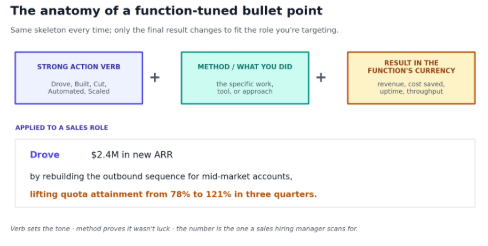
Two rules keep this honest. Lead with the verb and the result, not the responsibility, so the impact survives a fast skim. And keep each bullet to one clear idea; if you're unsure how many bullet points each role should get, give recent, relevant roles more and scale older ones down. Where those bullets sit on the page is a separate decision covered in AIApply's guide to picking the right resume format. With the skeleton set, here's how the currency shifts by function.
Sales resume bullet formulas: lead with revenue, quota, and pipeline
For sales roles, the currency is money and percentage-to-target. A sales hiring manager is scanning for one thing first: can you carry a number? So the formula is [verb] + [revenue or quota result] + [how, in one clause]. Put the dollar figure or the quota percentage as close to the front of the bullet as the sentence allows.
- Drove $2.4M in net-new ARR by rebuilding the outbound sequence for mid-market accounts, lifting quota attainment from 78% to 121% over three quarters.
- Grew a stalled territory 40% year over year by prioritizing the 20 accounts with the highest expansion signal, closing 6 of them within two quarters.
- Shortened the average sales cycle from 71 to 49 days by qualifying earlier on budget and authority, adding an estimated $600K to the pipeline that quarter.
Notice the keyword layer. A sales resume should carry the terms recruiters actually search: quota attainment, ARR, pipeline, close rate, win rate, ACV, expansion, net-new. Since 76% of recruiters filter on skills first, a sales bullet that never says "quota" or "pipeline" can be strong prose and still be invisible in the search. This is exactly where AIApply's Resume Scanner earns its place: it checks your bullets against a specific job description and flags the sales keywords the posting expects but your resume is missing, before you submit.
Operations resume bullet formulas: lead with efficiency, cost, and throughput
For operations roles, the currency is time saved, cost reduced, and throughput moved. The hiring manager wants proof you make a system run leaner and more reliably, so the formula is [verb] + [efficiency, cost, or volume result] + [the process you changed]. Percentages and absolute counts both work; pair them when you can (a percentage for scale, an absolute number for concreteness).
- Cut order-processing cycle time 34% by redesigning the fulfillment SOP, clearing a 5,000-order backlog in six weeks with no added headcount.
- Reduced annual vendor spend $310K by consolidating 14 suppliers to 5 and renegotiating terms, while holding on-time delivery above 98%.
- Automated a manual reconciliation that took two analysts three days a month, freeing roughly 140 hours a year and cutting error rate from 4% to under 1%.
The ops keyword layer looks different again: process improvement, cycle time, throughput, cost per unit, SLA, standard operating procedure, on-time rate, capacity. An operations resume that leads with revenue is aiming at the wrong target; an operations bullet that names cycle time and error rate speaks the language the function is searched by. AIApply positions the Resume Scanner and broader ATS optimization around this gap so your efficiency wins actually surface in a recruiter's keyword search.
Technical resume bullet formulas: lead with scale, reliability, and the stack
For technical roles, the currency is scale, reliability, and the exact tools you used. Here the keywords often are the metric: a recruiter searches "Snowflake" or "Kubernetes," not "modern data platform." So the formula is [verb] + [scale or performance result] + [the specific stack that delivered it]. Name the technology literally, and attach it to a number that shows the magnitude you operated at.
- Scaled the payments service to 40M daily requests by migrating from a monolith to event-driven microservices on AWS, holding p99 latency under 120ms.
- Cut data pipeline runtime 62% by re-architecting nightly jobs in Snowflake and dbt, delivering fresh dashboards to 300+ internal users by 6am.
- Raised service uptime from 99.2% to 99.95% by adding automated failover and Kubernetes health checks, cutting on-call pages roughly in half.
One guardrail matters more here than anywhere: never invent the numbers. AIApply's stance on AI-assisted materials is that they exist to sharpen real experience, not to fabricate it, and a technical interviewer will ask you to whiteboard the very system your bullet describes. If you don't have exact figures, estimate honestly and say so, which the next section walks through.
One accomplishment, three functions: a side-by-side view
The clearest way to internalize this is to hold the skeleton constant and swap only the currency. The same underlying work becomes three different bullets depending on which function you're proving yourself to.
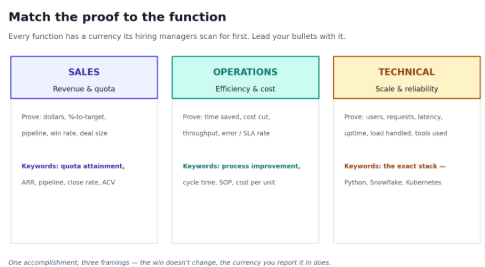
| Function | Core proof currency | Keyword type ATS scans | Example bullet opener |
|---|---|---|---|
| Sales | Revenue, quota %, pipeline, win rate | quota attainment, ARR, pipeline, close rate, ACV | "Drove $2.4M in new ARR by..." |
| Operations | Time saved, cost cut, throughput, error/SLA rate | process improvement, cycle time, SOP, cost per unit | "Cut cycle time 34% by..." |
| Technical | Scale (users/requests), latency, uptime, the stack | the exact tools — Python, Snowflake, Kubernetes, AWS | "Scaled the service to 40M daily requests by..." |
Read the table as a targeting map. Before you write a single bullet for an application, decide which column you're in, and let that column dictate the currency and the keywords you reach for.
What to do when you don't have a clean number
Plenty of real work doesn't come with a tidy metric attached, and that's not a reason to fall back on vague duties. You have three honest options. Estimate from what you know and label it as an estimate ("roughly," "approximately"). Use a proxy the function still values, such as time saved, headcount supported, or scope of ownership. Or state the before-and-after state qualitatively when no number exists, which still beats a responsibility. What you never do is fabricate a figure you can't defend in an interview.
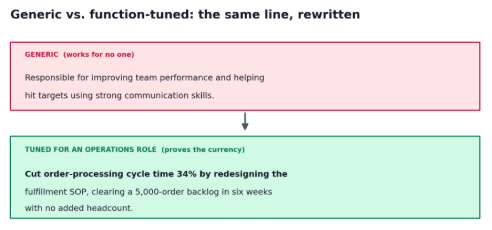
This is also why one master resume can't serve every function untouched. The strongest approach is a well-built base resume you tailor to each job description, shifting which wins you lead with and which currency you report them in. Tailoring isn't rewriting your history for each role. It's choosing, for each application, which true results to put first.
Make function-tuned bullets repeatable, not a one-time rewrite
Here's the honest reason most people revert to generic bullets: doing this by hand for every application takes time they don't have, so they ship the same resume everywhere and hope. That's the failure the system is built to remove. Function-tuning is only worth it if you can run it on every application without burning an evening each time.
This is where AIApply works as an operating layer rather than a single tool. The AI Resume Builder generates ATS-friendly, function-tuned bullets against a specific job description in minutes, so you start from a targeted draft instead of a blank page. The Resume Scanner then checks that draft for the exact keywords the posting is searched by and flags what's missing. Tailoring closes the loop per application. No one part fixes a job search on its own; the volume, the tailoring, and the keyword check working together are what make function-specific bullets sustainable across dozens of applications. For how bullet quality fits the wider funnel, AIApply's guide to building a full job-search system connects the pieces from resume to interview.
Frequently Asked Questions
What is a good resume bullet point formula?
A good resume bullet point formula is: strong action verb + the method or work behind it + a quantified result stated in the function's currency. For example, "Cut order-processing time 34% by redesigning the fulfillment SOP." The verb leads, the method proves it wasn't luck, and the number is what the hiring manager scans for first.
How are sales resume bullet points different from operations or technical ones?
Sales bullets lead with revenue and quota (dollars, percentage-to-target, pipeline), operations bullets lead with efficiency and cost (time saved, cost cut, throughput), and technical bullets lead with scale, reliability, and the exact stack (users, latency, uptime, named tools). The skeleton is the same; the metric you report changes to match what each function measures success by.
Do I need a number in every bullet point?
No, but you need proof of impact in every bullet, and a number is the strongest form of it. When a clean metric doesn't exist, estimate honestly and label it ("roughly 140 hours saved"), use a proxy the function values, or describe the before-and-after state qualitatively. Any of these beats a bullet that only lists a responsibility.
How many bullet points should each job have on a resume?
Most roles should have three to five bullet points, with recent or highly relevant roles getting more and older roles scaled down to one or two. Quality and relevance beat quantity; a role padded with generic bullets dilutes your strongest wins. AIApply's guide on how many bullets per job breaks down the variables in detail.
Will function-specific keywords help my resume get past the ATS?
Yes. Most recruiters filter candidates by skills and keywords first, so a resume needs the specific terms of the target function to surface in their search. A technical resume should name the literal stack ("Snowflake," not "data platform"); a sales resume should say "quota attainment" and "pipeline." Running the resume through AIApply's Resume Scanner against the job description flags which function keywords are missing.
Is it okay to use AI to write my resume bullet points?
Yes, when it sharpens real experience rather than inventing it. AI is well suited to drafting a function-tuned bullet from wins you actually achieved and to checking keyword alignment against a job description. It is not a license to fabricate metrics or experience, which an interviewer will expose quickly. Used to organize and strengthen true accomplishments, AI resume tools save time without crossing an ethical line.
How do I tailor bullet points for each job without rewriting my whole resume?
Keep one strong base resume with all your real accomplishments, then for each application choose which wins to lead with and restate the result in that role's currency. Tailoring is selection and reframing, not fabrication. AIApply's AI Resume Builder and tailoring workflow make this fast enough to repeat on every application instead of sending the same generic resume everywhere.
Turn your next application into a targeted one
Pick one role you're about to apply for and rewrite your top three bullets in that function's currency: revenue for sales, efficiency for ops, scale for technical. Then run them through AIApply's Resume Scanner against the actual job description to catch the keywords you missed. That's the whole method, and it works because it makes your resume unmistakably about the job in front of you instead of every job at once.