How Many Bullet Points Per Job on a Resume (2026)
Optimize bullet points per job on your resume with the 3-5 rule. AIApply's tools help you generate strong, ATS-friendly bullets in minutes.


If you're searching for this answer, you're not just asking about bullet counts. You're really asking: "How do I show impact quickly without looking like I'm padding or hiding things?"
Recruiters skim resumes in 6-7 seconds on first pass. ATS systems parse structure in milliseconds. Your bullet count is essentially your "signal-to-noise" setting for career impact.
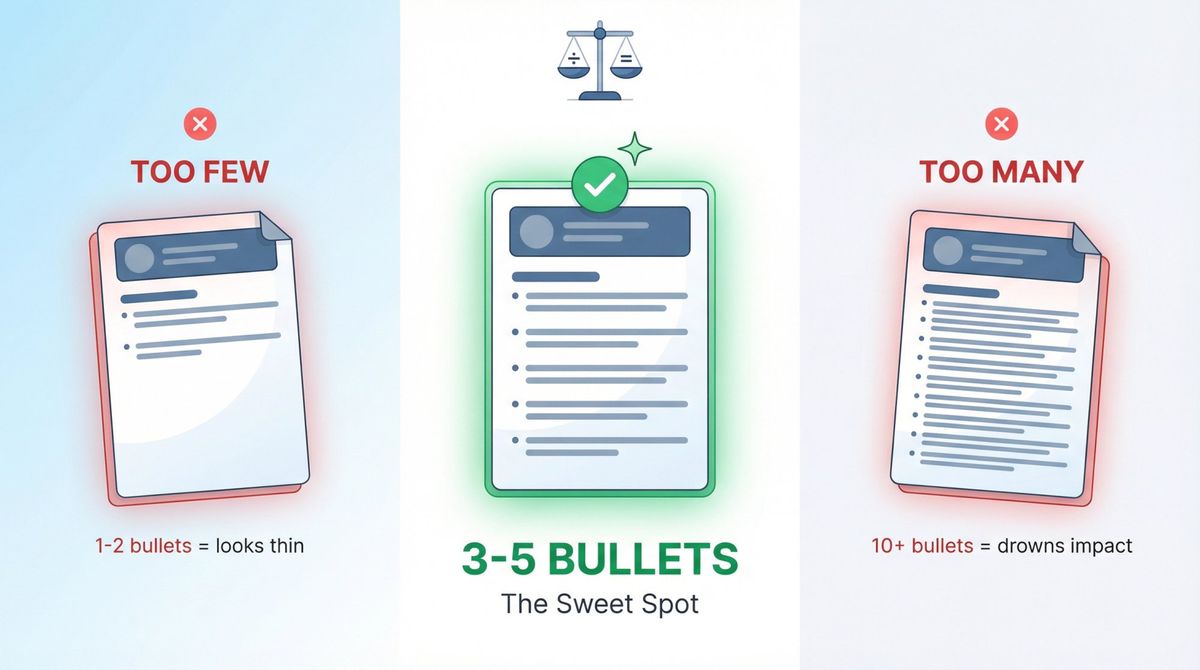
Too few bullets and you look thin. Too many and your best wins drown in a sea of filler.
So what's the right number? The short answer: most jobs should have 3-5 bullet points, with your most recent or relevant roles getting 4-6 bullets, and older positions scaled down to 1-3.
That range shifts based on four specific variables. Understanding those variables means you'll confidently know exactly how many bullets belong under each role on YOUR resume.
3-5 Bullet Points Per Job: What Works in 2026
3-5 bullets per job is standard, adjusted by recency and relevance to your target role.
This guidance appears consistently across current career resources and career advisors throughout 2024-2026. The sweet spot is narrow, but it works because it balances proof of competence with readability.
How Many Bullets Per Job Based on Experience Level
Current/Most Recent Job: 5-7 bullets (up to 6 recommended for most roles)
This role does the heavy lifting on your resume. It shows where you are now and what you're currently capable of. Every bullet should demonstrate distinct impact.
Recent Past Roles (2-5 years): 3-5 bullets
Focus on most relevant achievements. Skip routine duties that don't differentiate you. The recruiter already knows what a Marketing Manager or Software Engineer typically does.
Older Positions (5-10+ years): 1-3 bullets
Cover major wins or transferable skills only. Consider listing just title, company, and dates if the role isn't relevant to your target.
Entry-Level/Internships: 2-4 bullets
Minimum 2 to show you accomplished something meaningful. Include projects or relevant responsibilities that prove you can deliver.
Senior/Executive Roles: 5-8 bullets
The higher end is justified for leadership impact, but each bullet must demonstrate a distinct, significant achievement. Rarely more than 8 even for executives.
Why 3-5 Bullet Points Per Job Works
Attention Is the Bottleneck
Recruiters scan resumes in 6-7 seconds on first pass. Their job is triage: finding proof you can do this specific job.
Bullet points create scan-friendly hooks that let them grab your best wins instantly. They beat paragraphs for three reasons:
→ Skimmability for human readers who are moving fast
→ Easier ATS parsing because clear structure helps automated systems
→ Clean layout that highlights key achievements instead of burying them
Diminishing Returns Kicks In Fast
Bullets #1-3 typically carry most of your evidence. You know what happens after that? Bullets #7-10 often become repetitive.
"Collaborated with cross-functional teams." "Responsible for maintaining documentation." "Helped with quarterly planning."
The 3-6 range represents the sweet spot between enough evidence to be credible and not so much that it becomes a wall of text no one reads.
You're Placing Bets, Not Writing a Diary
Every bullet is a bet that the reader will think: "Interesting. I want to hear more about this in an interview."
If you can't defend a bullet conversationally in 30 seconds, it's not a bullet. It's resume decoration.
Each point should pass the "10-15 second test": can a recruiter understand your impact in 10-15 seconds? If not, rewrite it or cut it.
But the actual number depends on these four specific variables.
4 Factors That Determine How Many Bullets You Need
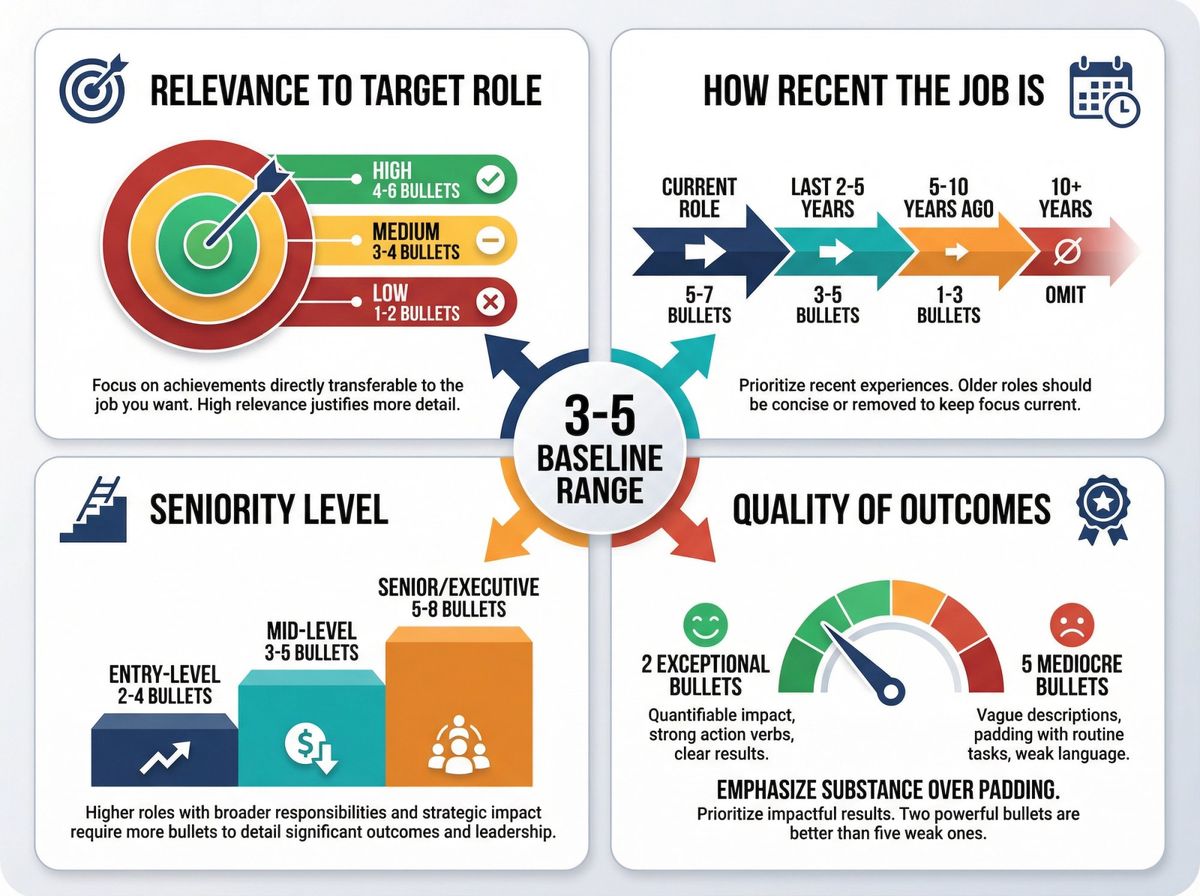
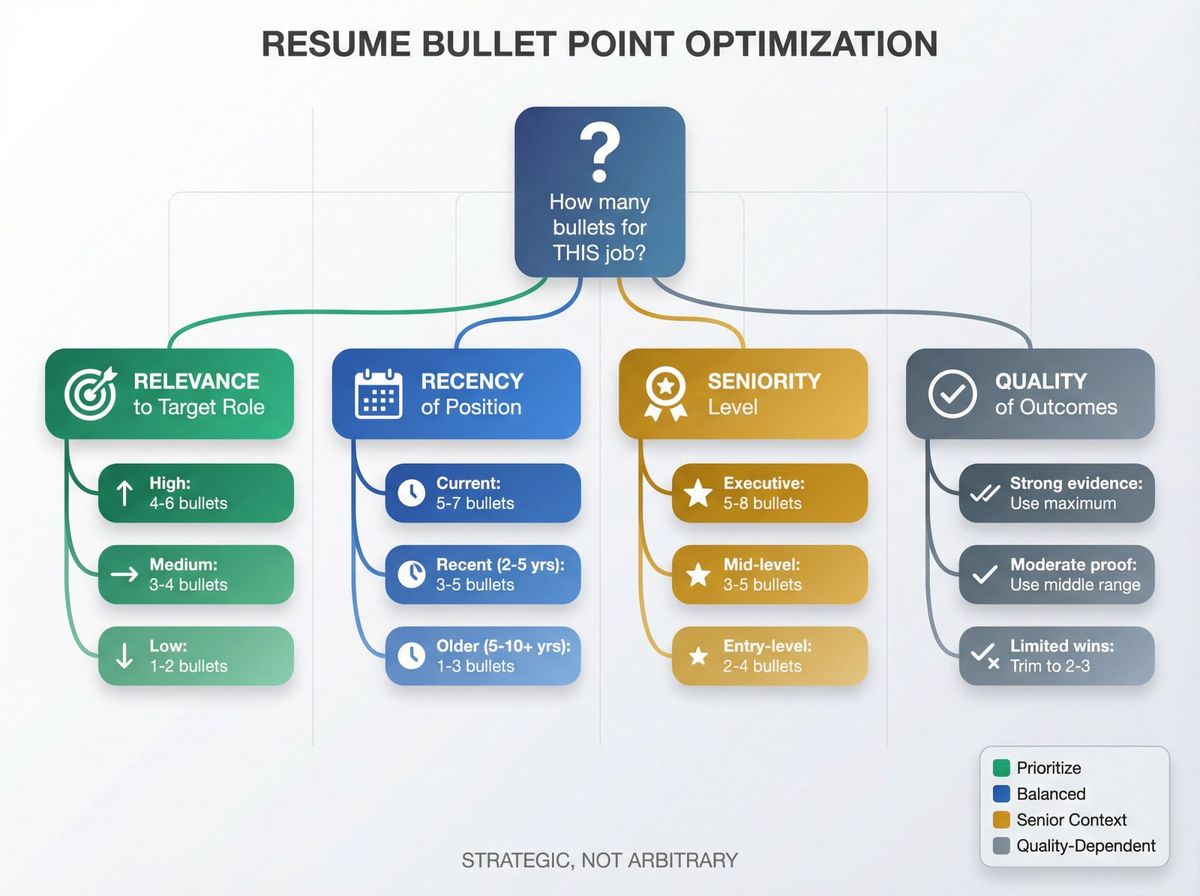
The 3-5 range is your baseline. But the actual number for each role on your resume depends on these four variables.
1. Relevance to Your Target Role
High relevance: 4-6 bullets
Jobs directly aligned with your target get more real estate. Similar responsibilities, matching tech stack, parallel industry experience? Give it room.
Medium relevance: 3-4 bullets
Transferable experience from adjacent industries or functions. You can connect the dots, but it takes a sentence of explanation.
Low relevance: 1-2 bullets or omit entirely
Unrelated field or early career work that you're only keeping to show employment continuity. One strong bullet that shows you're reliable is enough.
2. How Recent the Job Is
Recent roles do more "selling" because they show where you are now and what you're currently capable of. Older roles mostly provide credibility and continuity.
The recency hierarchy:
• Current role: Maximum detail (5-7 bullets)
• Last 2-5 years: Moderate detail (3-5 bullets)
• 5-10 years ago: Minimal detail (1-3 bullets)
• 10+ years: Consider omitting or title-only
Exception: Relevance can outweigh recency. If an older job is highly relevant to your target role, give it more bullets even if it's not recent.
A Product Manager from 2019 who's targeting another PM role? That 2019 role deserves 4 solid bullets, not 1.
3. Seniority Level
Senior roles can justify more bullets, but only if each demonstrates a distinct outcome:
① Revenue impact you drove
② Cost savings you negotiated
③ Risk reduction you implemented
④ Scale achievements (team size, budget, scope)
⑤ Leadership results (promotions, retention, culture)
Entry-level roles naturally have fewer major accomplishments, so fewer bullets are both expected and appropriate.
A junior analyst with 6 bullets under their first job looks like padding. A VP with 3 bullets looks like they didn't do much.
4. Quality of Outcomes You Actually Have
Harsh truth time: if you only have 2 meaningful wins, don't force 5 bullets.
Make those 2 bullets exceptionally strong and use remaining resume space for:
• Skills section with relevant technical proficiencies
• Projects that demonstrate capabilities
• Certifications that prove expertise
• Professional summary that positions you well
Better to have 2 exceptional bullets that make someone want to interview you than 5 mediocre ones that make them skim past your experience.
What to Include in Each Resume Bullet Point
Knowing how many bullets to use is half the battle. The other half is knowing what goes IN them.
The "1 Context + 2-5 Impact" Rule
Reserve one bullet for day-to-day context: scope, what you owned, what success meant in that role. Make the rest achievement-focused.
Example distribution:
| Purpose | Bullet Count | What to Include |
|---|---|---|
| Scope/Context | 1 bullet | Team size, budget, responsibilities, baseline |
| Outcomes | 2-5 bullets | What changed because you were there |
This approach gives recruiters the framing they need without wasting space on duties everyone in that role handles.
How to Write Strong Resume Bullet Points
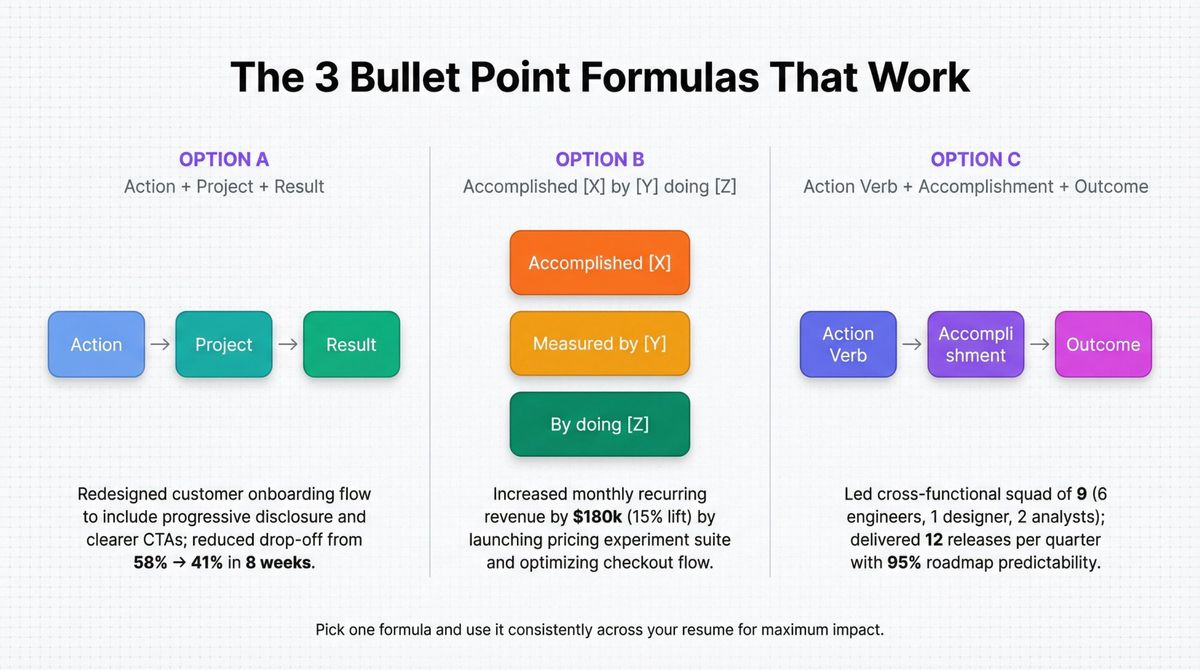
Don't wing your bullet structure. Use one of these proven frameworks:
| Formula | Structure | Example |
|---|---|---|
| Option A | Action + Project + Result | "Redesigned customer onboarding flow to include progressive disclosure and clearer CTAs; reduced drop-off from 58% to 41% in 8 weeks" |
| Option B | Accomplished [X] as Measured by [Y] by Doing [Z] | "Increased monthly recurring revenue by $180k (15% lift) by launching pricing experiment suite and optimizing checkout flow" |
| Option C | Action Verb + Accomplishment + Outcome | "Led cross-functional squad of 9 (6 engineers, 1 designer, 2 analysts); delivered 12 releases per quarter with 95% roadmap predictability" |
Why these work: They match how humans judge competence. Action leads to evidence leads to impact. That's the narrative recruiters are scanning for.
Keep Bullets Scannable
Length target: 1-2 lines maximum, roughly 10-20 words per bullet.
If a bullet creeps into a third line, you have two options:
- Break it into two bullets
- Trim unnecessary words and focus on the essence
Recruiters skim. Long bullets get partially skipped. You worked hard on those achievements. Don't let bad formatting bury them.
Must Include: Quantifiable Results
Numbers are your friend. They provide concrete evidence and grab attention immediately.
Good metrics to include:
| Type | Example |
|---|---|
| Percentages | "increased sales by 15%" |
| Time savings | "reduced processing time from 5 days to 2" |
| Dollar amounts | "managed $1M budget" or "saved $120k annually" |
| Volume | "served 30+ clients per week" |
| Scale | "led team of 5" or "oversaw 200 user accounts" |
If you can't quantify directly:
• Estimate ranges (be ready to back them up in interviews)
• Use qualitative impact: "improved team collaboration, resulting in faster delivery"
• Show scale: team size, customer volume, frequency of work
The presence of concrete results often separates average resumes from outstanding ones. It's the difference between "Managed social media accounts" and "Grew Instagram following from 2,400 to 12,000 in 6 months through targeted content strategy and engagement campaigns."
The Bullet Budget Method (Step-by-Step)
This framework stops overthinking and gets you to optimal bullet counts fast. AIApply's AI Resume Builder can help with Step 1, but the filtering logic is universal.
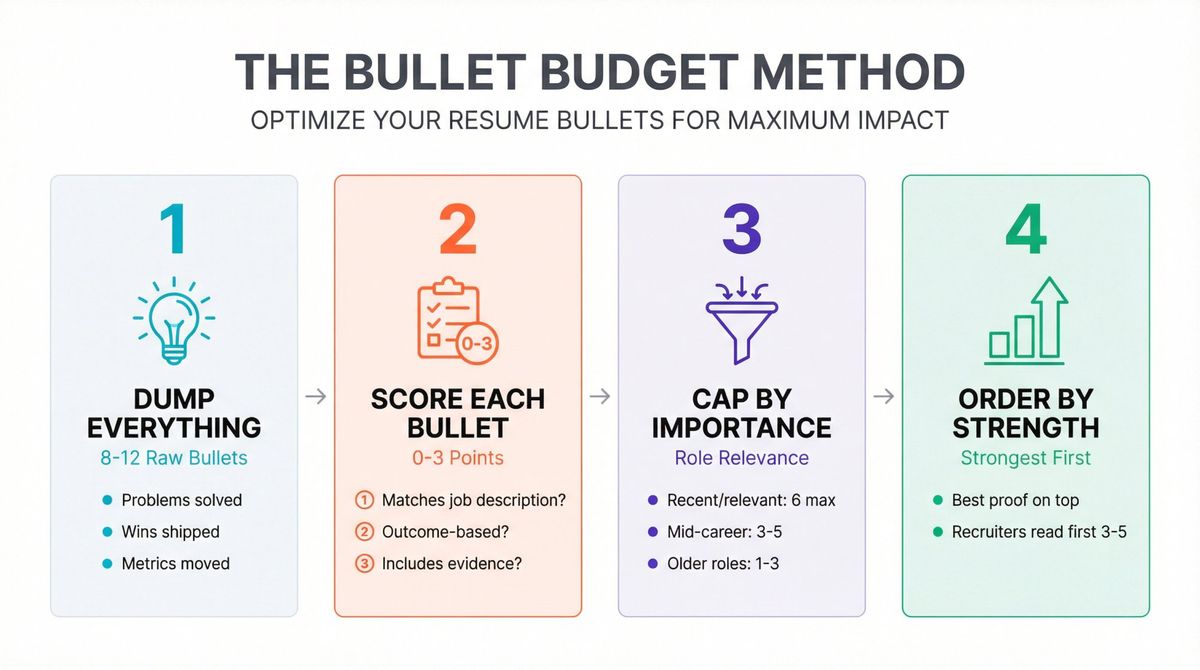
Step 1: Dump Everything (8-12 Raw Bullets)
Don't edit yet. For each role, write out everything you can think of:
• Problems you solved
• Wins you shipped
• Metrics you moved
• Tools you mastered
• Stakeholders you influenced
• Projects you led
Just get it all down. We're mining for gold here.
Step 2: Score Each Bullet (0-3 Points)
Give each bullet 1 point for each "yes":
① Does it match the target job description? Look for keywords, responsibilities, and tools the employer cares about.
② Is it outcome-based, not just duties? Does it show results, not just tasks?
③ Does it include evidence? Numbers, scale, baseline, timeframe?
Keep the top-scoring bullets. This naturally lands you around 3-6.
Step 3: Cap Based on Role Importance
Apply the recency and relevance framework we covered earlier:
• Newest/most relevant: Keep up to 6
• Mid-career/moderate relevance: Trim to 3-5
• Older/less relevant: Cut to 1-3
Step 4: Order by Importance
List bullets in order of importance, strongest first. Recruiters often only thoroughly read the first 3-5 bullets per job. Your sixth bullet might not even get a glance.
Put your absolute best proof at the top. Make it impossible for them not to notice your impact.
Resume Bullet Point Examples by Job Level
Let's look at what this actually looks like on a resume.
Example 1: Recent High-Relevance Role (6 Bullets)
Product Manager, Fintech App | May 2023 - Present
• Owned onboarding funnel; reduced drop-off from 58% to 41% by redesigning KYC flow and implementing progressive disclosure
• Shipped pricing experiment suite that increased ARPU 9% in 8 weeks while maintaining stable churn
• Led cross-functional squad (6 engineers, 1 designer, 1 data analyst); delivered 12 releases per quarter with 95% roadmap predictability
• Built event taxonomy and dashboards; reduced "unknown" user actions by 80% and accelerated decision cycles from weeks to days
• Negotiated vendor contract renewal; saved £120k annually while adding fraud detection features
• Scope: Managed discovery, roadmap, and delivery across onboarding, payments, and compliance workflows for 50k+ monthly active users
Why 6 works: This is the current role and highly relevant. Every line shows a different proof vector: conversion optimization, revenue growth, leadership capability, analytics infrastructure, cost management, and overall scope. No repetition. No fluff.
Example 2: Older But Still Relevant Role (3 Bullets)
Business Analyst | June 2018 - March 2020
• Automated monthly reporting in SQL and Excel; reduced close process from 5 days to 2 days
• Partnered with sales operations to rebuild territory model; improved forecast accuracy by 12%
• Delivered stakeholder workshops; aligned requirements across finance, sales, and operations teams
Why 3 works: It's an older role, but the experience is still relevant. We're focused on top achievements only and skipping routine duties. Three solid bullets prove competence without over-explaining.
Example 3: Older + Low Relevance (1 Bullet)
Barista | September 2016 - May 2017
• Trained 8 new hires; improved opening shift speed and reduced errors during rush periods
Why 1 works: This isn't the target job. It's just signaling reliability and people skills. One strong bullet is enough to show you were good at the role and moved on.
Example 4: Long Tenure at One Company
If you stayed at one company for 7+ years, split by promotions and cap each era appropriately:
Company X
→ Senior Product Manager (Jan 2022 - Present): 4-6 bullets
→ Product Manager (Apr 2020 - Dec 2021): 3-4 bullets
→ Associate Product Manager (Jun 2018 - Mar 2020): 1-3 bullets
This approach respects the recency/relevance framework while showing clear progression within the organization.
Common Resume Bullet Point Questions
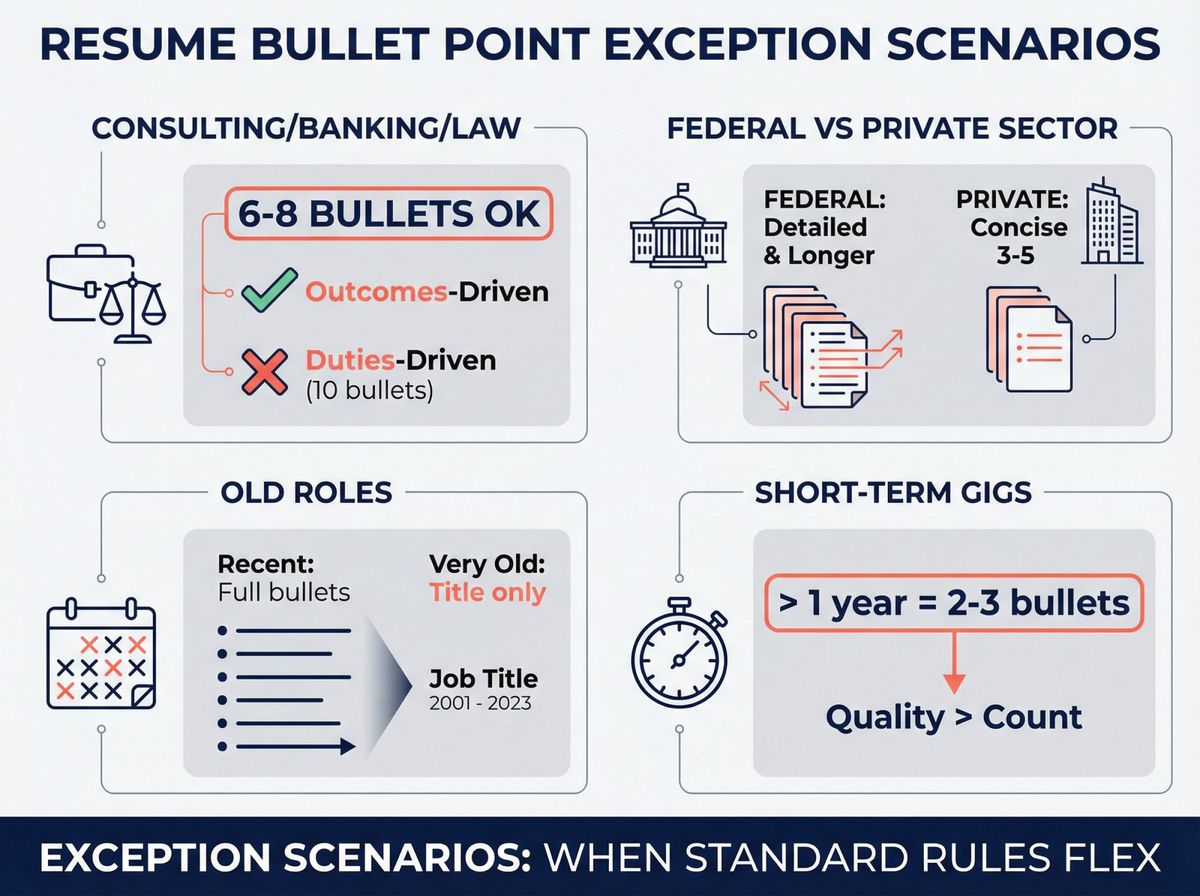
"I'm applying for consulting/banking/law. Can I have more bullets?"
You can, but don't confuse "competitive industry" with "longer resume."
If your bullets are all outcomes with clear scope and numbers, more can work. But 10 bullets of duties means you've already lost. Quality matters more than industry norms.
"What about federal resumes (USAJobs)?"
Federal resumes are different documents entirely. They can be longer and more detailed, often requiring specific information civilian resumes don't. This guide covers standard private-sector resumes.
"Do I need bullets for every job?"
For recent roles: Yes. Bullets show impact and give recruiters something to evaluate.
For very old roles: You can trim bullets or exclude them entirely if:
• You're still maintaining work continuity (no unexplained gaps)
• Space is tight and you need room for more relevant experience
• They're truly irrelevant to your target
The key is avoiding unexplained gaps while keeping focus on what matters to the employer.
"Can short-term gigs have fewer bullets?"
Absolutely. Contract roles or positions under a year typically warrant 2-3 focused bullets showing relevant contributions made in limited time. You don't need to justify every month with a bullet.
Making every bullet exceptionally strong matters more than hitting a specific count.
How to Write Better Resume Bullet Points
Let's upgrade bullet quality beyond just getting the count right.
Upgrade Pattern 1: Add Baseline + Change + Timeframe
Weak: "Improved customer satisfaction"
Strong: "Improved CSAT from 4.1 to 4.6 in 2 quarters by redesigning support triage flow and creating self-service knowledge base with 200+ articles"
The upgrade shows where you started, where you ended, how long it took, and what you actually did. That's a complete story in one bullet.
Upgrade Pattern 2: Name the "Lever" You Pulled
Weak: "Managed marketing campaigns"
Strong: "Launched 6 paid social experiments (creative variations + audience targeting + landing page optimization); decreased CPA by 22% while scaling spend from $15k to $40k monthly"
The upgrade shows the specific tactics, the result, and the scale. Now a recruiter knows exactly what you can do for them.
Upgrade Pattern 3: Turn "Responsible For" Into "Delivered"
Weak: "Responsible for onboarding new enterprise clients"
Strong: "Onboarded 25 enterprise clients per quarter; reduced time-to-value from 21 to 12 days using standardized implementation playbook and automated provisioning"
The upgrade shows volume, improvement, and the solution you built. It's proof of execution, not just a job description.
Resume Formatting for Bullet Points
Great content can still fail if the formatting looks sloppy.
Consistency Is Critical
Apply these rules uniformly:
• Use the same bullet style throughout (simple round bullets work fine)
• Align bullets properly with consistent indentation
• Use past tense for past roles, present tense for current role
• No personal pronouns ("I", "my", "we"). Start with the verb.
• Keep verb tense consistent within each job
Example consistency:
Past job: "Developed new onboarding process that cut training time by 50%"
Current job: "Lead team of 4 analysts to generate quarterly market reports"
Inconsistent formatting looks sloppy and signals lack of attention to detail. That's exactly what you don't want a recruiter thinking.
How to Use AIApply to Optimize Resume Bullets
Instead of spending hours manually deciding what to cut and keep, here's a systematic approach that works:
Step 1: Generate Master Bullet Set
Use AIApply's AI Resume Builder to generate comprehensive bullets for each role. Start with more bullets than you need.
The AI can help you articulate achievements you might not have considered. It pulls from successful patterns across millions of resumes and knows what hiring managers respond to.
Step 2: Apply the Framework
Trim to optimal count using the decision framework we covered:
• 3-5 typical range for most jobs
• Up to 6 for newest/most relevant role
• 1-3 for older positions
This is where you use your judgment based on the 4 variables: relevance, recency, seniority, and quality of outcomes.
Step 3: Scan for Issues
Run your resume through AIApply's Resume Scanner to catch:
• Keyword gaps between your resume and target job description
• Formatting problems that might break ATS parsing
• ATS compatibility issues you wouldn't spot manually
The scanner shows exactly where you're missing critical keywords and suggests fixes. It's like having a recruiter review your resume before you submit it.
Step 4: Reference Proven Structures
Look at AIApply's resume examples and templates to see what works. Look for patterns that include numbers, timeframes, and clear outcomes. Model what's already working.
Step 5: The 10-15 Second Test
For each bullet, ask: Can a recruiter understand my impact in 10-15 seconds?
If not, rewrite or cut it. This is your final quality gate before submission. AIApply's Auto Apply feature can handle the submission logistics once your resume is dialed in, but the quality has to be there first.
ATS and Bullet Points: What Actually Matters
ATS doesn't reward 10 bullets.
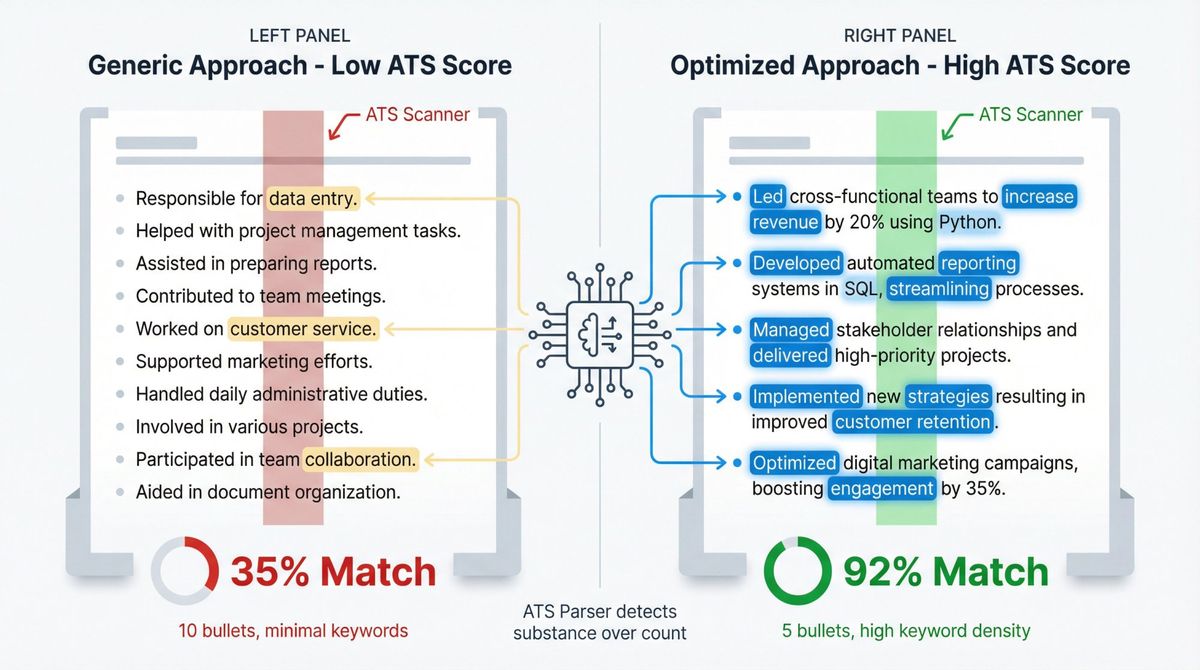
ATS systems reward:
• Clear structure with standard section headings
• Standard headings recruiters expect (Experience, Education, Skills)
• Relevant keywords that match the job description
• Readable formatting without weird fonts or graphics
Bullets help because they keep structure clean and make it easier for parsing algorithms to extract information. But the real ATS win is keyword alignment inside high-signal bullets, not padding with more bullets.
Critical insight: One bullet with 5 relevant keywords beats three bullets with generic language. Focus on substance, not count.
Want to check ATS compatibility quickly? AIApply's Resume Scanner analyzes ATS readiness, keyword optimization, and formatting issues in seconds. It spots problems before you waste applications on resumes that never reach human eyes.
Resume Bullet Point Quality Checklist
Before finalizing your resume, verify each bullet meets these standards:
What Every Bullet Must Include
| Element | Examples |
|---|---|
| Strong action verbs | Led · Implemented · Boosted · Designed · Optimized · Generated · Saved · Increased · Reduced · Built · Launched · Managed · Negotiated · Developed |
| Specific achievement or result | Not just duties, but what changed |
| Evidence where possible | Numbers, metrics, outcomes |
What to Avoid in Every Bullet
| Weak Pattern | Why It Fails |
|---|---|
| "Responsible for..." | Sounds like job description, not achievement |
| "Tasked with..." | Passive and duty-focused |
| "Helped with..." | Vague contribution, unclear impact |
| "Assisted in..." | Minimizes your actual role |
| Generic duties | Anyone in the role would do this |
| Vague accomplishments | No context for understanding impact |
| Bullets longer than 2 lines | Gets skipped during scanning |
| Irrelevant information | Doesn't support your target job |
Prioritization
• Order bullets by relevance to target job (not chronological order within each role)
• Strongest/most relevant bullets first
• Most impressive accomplishments get more detail
The Content Test (4 Questions Per Bullet)
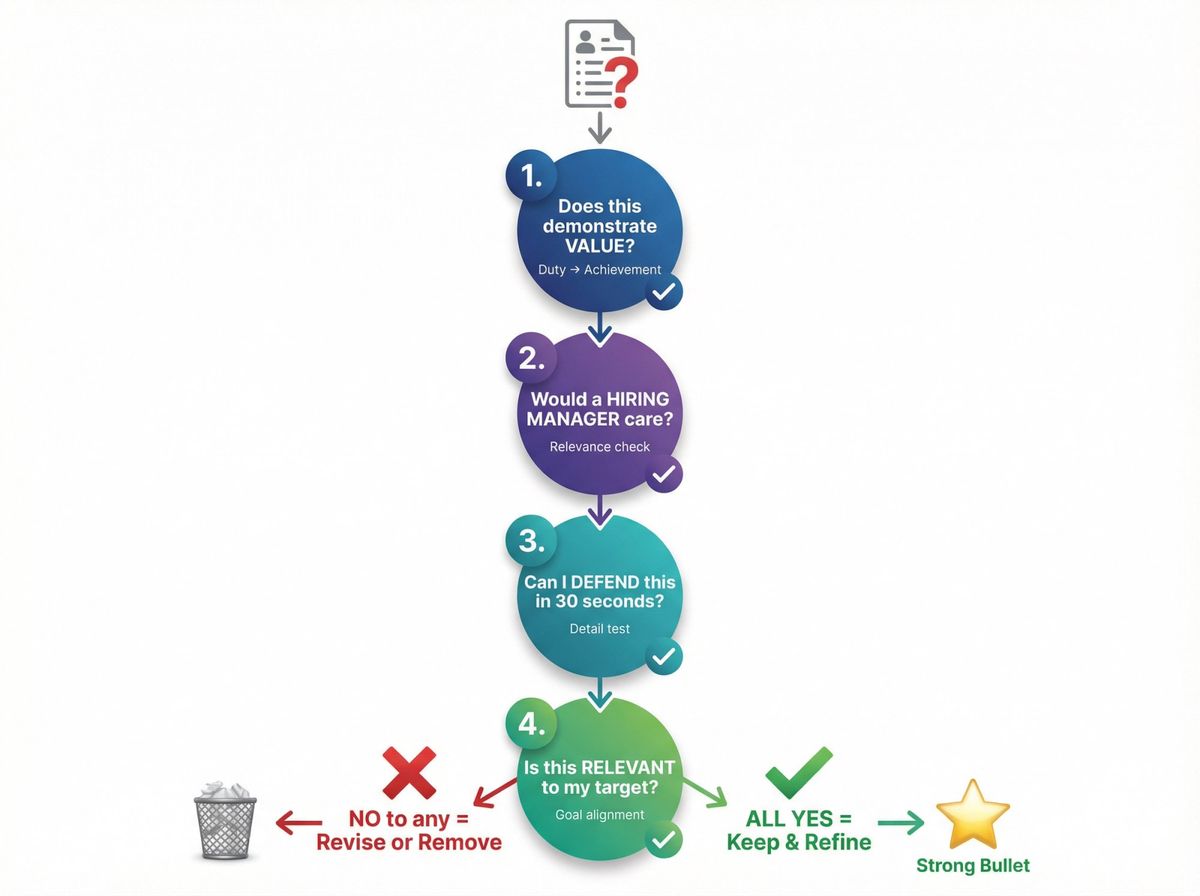
Before you commit to a bullet, ask yourself:
1. Does this demonstrate value?
If it's just a duty, cut it or reframe as an achievement. "Attended weekly team meetings" becomes "Led weekly sprint planning for 8-person engineering team, improving on-time delivery from 70% to 92%."
2. Would a hiring manager care?
If it doesn't help show you're a fit for the role they're filling, remove it. Every bullet needs to move you closer to the interview.
3. Can I defend this in an interview?
If you can't elaborate on a bullet for 30 seconds with specific details, it's probably fluff. You'll get asked about it. Be ready.
4. Is this relevant to my target?
Every bullet should connect to your goal somehow. Relevance beats recency if you have to choose.
If any answer is "no," that bullet needs revision or removal.
Resume Bullet Point Mistakes to Avoid
Let's talk about what NOT to do.
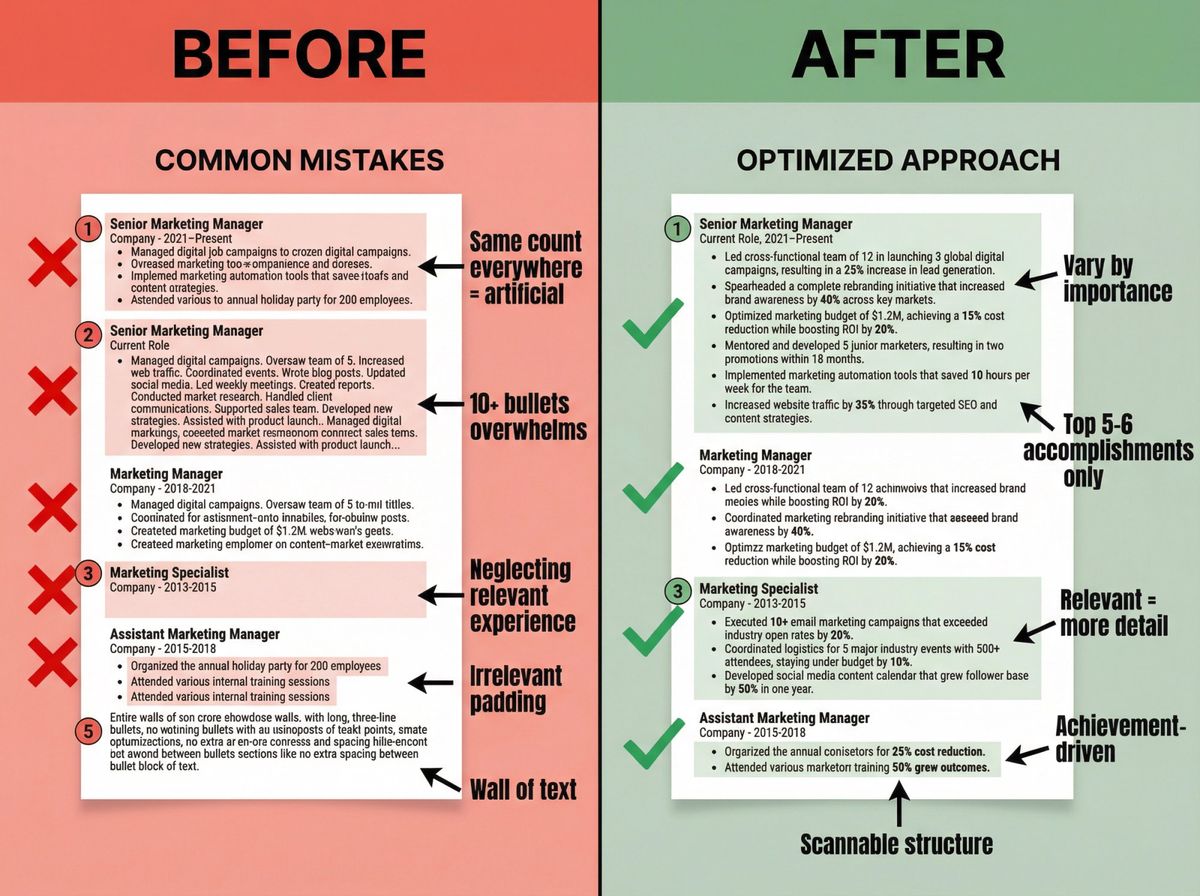
Using the Same Number for Every Job
Real experience isn't uniform. Having exactly 4 bullets under every job looks artificial, like you care more about symmetry than substance.
The fix: Vary naturally based on importance within the recommended ranges we covered. Your current role might have 6 bullets while a 2017 role has 2. That's normal and expected.
Overloading Your Current Job
Cramming 10+ bullets under one position overwhelms readers and buries your best material. Recruiters often skim past the 6th or 7th bullet.
The fix: Select your 5-6 most impressive accomplishments. Combine related points where possible. If you have 10 things to say, your bullets probably aren't focused enough.
Neglecting Important Older Experience
Don't shortchange a relevant past role just because it's old. If you crushed it in a role aligned with your target job, give it proper detail.
The fix: Balance recency with relevance. An older but highly relevant role deserves 3-4 strong bullets even if it was 8 years ago.
Irrelevant Bullet Padding
Bullets about organizing the holiday party, attending training sessions, or routine tasks waste space that should go to real achievements.
The fix: Every bullet should answer "Would this make them more likely to hire me?" If the answer is no, cut it.
Creating Walls of Text
Even bullet points can intimidate if there are too many with no white space. Seven bullets of 2-3 lines each creates a dense block readers avoid.
The fix: Ensure good balance of text and space. Consider if some points could move to your Skills or Projects sections instead.
Using Outdated Approaches
Old resume styles focused on duties, not results. Dense paragraphs. No metrics. Generic language. That doesn't work in 2026.
The fix: Update to achievement-driven bullets with quantifiable results and ATS-friendly formatting. If your resume is more than 2 years old, it probably needs this overhaul with AIApply's AI Resume Rewriter.
Frequently Asked Questions
Is 6 bullet points too much?
No, 6 bullets is fine for your most recent or most relevant role if every bullet shows distinct, outcome-driven impact. It becomes "too much" only if bullets are repetitive or duty-focused. Six strong bullets are better than four mediocre ones.
Is 10 bullet points per job ever okay?
Rarely. Even for executive roles, 10 bullets is typically excessive for a standard resume. The exception might be specialized federal formats, but for private sector, 6-8 is the practical maximum. Beyond that, you're testing the reader's patience.
Should I use paragraphs instead of bullets?
No for standard resumes. Bullets are faster to scan and universally preferred in modern resume guidance. Paragraphs get skipped. Recruiters are moving too fast to parse dense blocks of text. Make it easy for them to see your value.
Should every bullet have numbers?
Try to include numbers where possible, but not every single bullet needs them. Use quantifiable metrics when you can:
• Scale (team size, volume, frequency)
• Quality improvements (error reduction, faster turnaround)
• Stakes (risk managed, customers served, budget handled)
Even "small" numbers help when framed clearly. "Served 15 clients per week" is better than "Served multiple clients regularly."
What if I can't quantify my work?
Use these alternatives:
Scale: "Led team of 3" or "Managed 200+ customer accounts"
Quality: "Reduced errors by implementing 3-step verification" or "Improved turnaround time through streamlined approval process"
Stakes: "Handled confidential executive communications" or "Managed compliance for regulated financial data"
Comparatives: "First to implement automated testing in department" or "Only analyst supporting C-suite decision-making"
Provide baseline context whenever possible to show the change you created. Before-and-after comparisons work even without specific percentages.
How do I know if I have too many bullets?
Warning signs you've gone overboard:
• Resume looks like a wall of text when you zoom out
• Bullets become repetitive after the first few (multiple bullets about "collaborating" or "managing")
• You're listing duties instead of achievements ("Attended meetings," "Prepared reports")
• You can't defend every bullet conversationally without struggling
If you see these signs, cut the weakest bullets. Quality always beats quantity.
What about career changers?
For career changers, the normal rules shift:
• Highlight most relevant experience regardless of recency. A relevant older job might get more bullets than an unrelated current job.
• Focus bullets on transferable skills and outcomes that apply to your target industry.
• Tailor heavily to target industry keywords. You need to speak their language.
• Consider a functional or hybrid resume format if your chronological experience doesn't tell the right story.
Should older jobs have zero bullets?
Sometimes yes. If a role from 15+ years ago isn't relevant and you need space, list just:
• Job title
• Company
• Dates
This accounts for your employment timeline without wasting space on irrelevant details. Better to have 6 strong bullets on your recent relevant work than 1 weak bullet on an irrelevant job from 2009.
Do I need different bullet counts for different applications?
Not necessarily different counts, but you should:
• Reorder bullets by relevance to each specific job. Put the most relevant achievement first for Company A, even if it's your third bullet for Company B.
• Potentially swap in different achievements based on job requirements. If one role emphasizes leadership and another emphasizes technical skills, highlight different bullets.
• Adjust which past roles get more vs. less detail depending on what's relevant to that employer.
The count guidelines stay similar (3-5 range, etc.), but the content and ordering should be tailored. AIApply's Auto Apply feature can help you manage these customizations at scale when you're applying to multiple positions.
Your Action Plan: Getting Started Today
Stop overthinking. Here's exactly what to do:
1. Default to 3-5 bullets per job
This is your baseline for most positions. Start here unless you have a specific reason to deviate.
2. Push to 4-6 for newest/most relevant role
But only if every bullet shows real outcomes. Each must be distinct and defensible. No filler.
3. Cut to 1-3 for older or less relevant roles
Focus on top achievements only. Consider title-only for very old or irrelevant positions that you're keeping for timeline continuity.
4. Write bullets using a proven formula
Pick one and stick to it:
• Action + Project + Result
• Accomplished [X] by [Y] doing [Z]
• Strong verb + Accomplishment + Outcome
Don't mix formulas within the same resume. Consistency builds credibility.
5. Order bullets by importance
Most relevant and impressive first. Assume recruiters may only read the first 3-5 bullets per job. Put your best proof where they'll see it.
6. Apply the quality tests
For each bullet, ask:
• Does it show value?
• Would the hiring manager care?
• Can I defend it in an interview?
• Is it relevant to the target role?
If you answer "no" to any of these, revise or remove that bullet.
7. Check with tools before submitting
Use AIApply's Resume Scanner to verify:
• ATS compatibility (will your resume actually parse correctly?)
• Keyword alignment (are you using the language from the job description?)
• Formatting consistency (does it look professional and clean?)
Remember: The goal isn't to fill space. It's to make it easy for employers to see your value and want to learn more in an interview.
Every bullet is real estate on your resume. Use it wisely.