How to Tailor Your Resume to a Job Description (2026)
Tailoring a resume isn't about stuffing in keywords. It's about proving, in the top third of the page, that you've already done the job you're applying for. This guide covers the exact framework for doing that fast.


Tailoring a resume isn't about stuffing in keywords. It's about proving, in the top third of the page, that you've already done the job you're applying for. This guide covers the exact framework for doing that fast.
The best way to tailor a resume to a job description is to pull out the handful of requirements that actually decide the hire, prove each one with a real bullet, tool, or project from your background, and put that proof in the top third of the page, where a recruiter's first look actually lands. Tailoring works because it makes your fit legible in the few seconds a resume gets on a first pass, not because it tricks an applicant tracking system.
Most job seekers who tailor and still hear nothing had the right instinct and the wrong execution. They copied language from the job description instead of proving they'd done the work. They chased a phantom ATS score instead of making their fit visible to the human who eventually reads the resume. They tailored the parts that don't matter and left the parts that do untouched.
This guide breaks that down: what to pull out of any job description, how to prove you match it, and where to spend your limited editing time, at whatever volume you're applying.
Tailoring Works Because Recruiters Are Fast, Not Because ATS Systems Are Smart
Most resume advice treats tailoring as a keyword-optimization problem. It isn't. it's a visibility problem under time pressure.
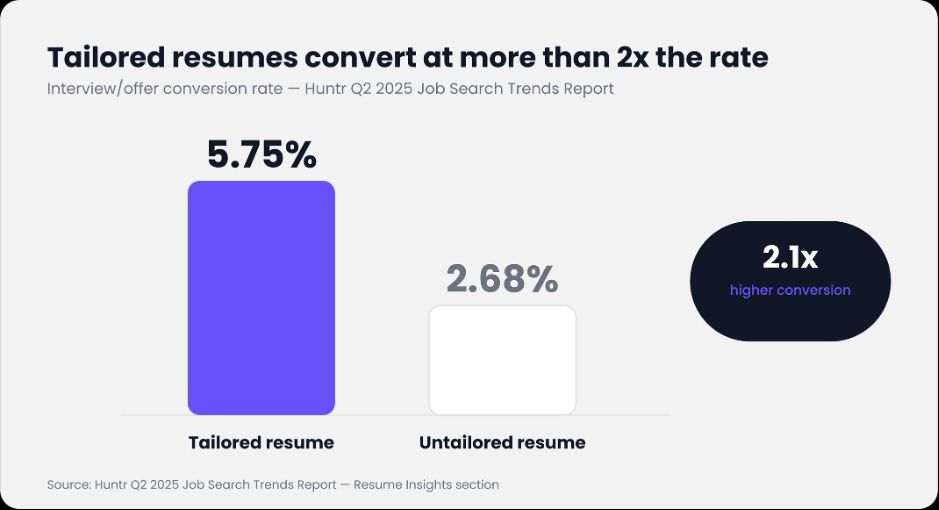
Huntr's Q2 2025 Job Search Trends report, which analyzed more than 59,000 resumes submitted between April and June 2025, found that customized resumes converted to interviews or offers at a 5.75% rate, compared with 2.68% for resumes that weren't tailored, better than double.
A separate InterviewPal data study from August 2025, based on 4,289 recorded resume reviews across 312 recruiters and hiring managers, found the average initial scan runs about 11.2 seconds, with a median total review time of roughly a minute and a half once a candidate clears that first look. That's longer than the old "six-second scan" folklore, but it's still not enough time for a recruiter to infer your fit from your job titles and hope your experience lines up.
Recruiters confirm they notice the difference directly, not just through funnel metrics. In Resume Now's 2025 AI and the Applicant Report, a survey of 925 U.S. HR workers, 78% of hiring managers said personalized details are what signal genuine interest and fit.
What does “obvious relevance” mean in practice? It means the top third of your resume, the part that gets the first look, directly reflects what the job description asked for. It means a recruiter can glance at your resume and build the pitch to the hiring manager without extra inference: "B2B SaaS customer success manager, four years, owns renewals, has QBR experience, Salesforce-certified."
ATS systems do filter and rank. They parse your resume, extract skills, support keyword search, and in some platforms run AI matching against calibration criteria. But almost every major platform also describes human review downstream. The ATS is a filter, not the decision. Tailor for the human's first pass, then confirm your keywords landed where they need to with a free check like AIApply's Job Description Keyword Finder.
How to Read a Job Description Like a Recruiter
Most job seekers read a job description as a wish list and try to check off as many boxes as possible. A stronger approach: treat it as a scoring document and work out which requirements actually matter.
The 5 buckets that matter
How to weight what you find
Not every line in a job description carries the same weight.
- Weight 3 (must-have): appears in the job title, in the first paragraph, under “Required Qualifications,” is repeated more than once, or is phrased as an outcome (“own renewals,” “build ETL pipelines”). Show this clearly and back it with proof.
- Weight 2 (important): tools, domain context, preferred experience. Include if truthful; place in skills and relevant bullets.
- Weight 1 (nice-to-have): generic soft-skill phrases and culture language. Show indirectly through outcomes rather than spending real estate on them.
Signals a requirement is probably weight 3: it's in the job title, it shows up in the first five to eight lines, it's listed under “Required” or “Must have,” it's a tool, certification, license, or clearance, it's phrased as a deliverable (“manage a $12M budget,” “own month-end close”), or it appears in an application knockout question.
A 10-minute extraction workflow
- Paste the full job description into AIApply's free Job Description Keyword Finder, which categorizes every requirement into hard skills, soft skills, certifications, tools, experience level, and industry knowledge in under a minute.
- Highlight every term that appears twice or more.
- Sort the requirements into the five buckets above.
- Assign a weight of 1, 2, or 3 to each.
- For every weight-3 item, ask: can I prove this with a bullet, a project, a tool, or a certification? AIApply's Resume Optimizer runs your current resume against the same job description and flags exactly which of those requirements it's currently missing.
That last question, whether you can actually prove each requirement, is where your real tailoring decisions get made.
The Match-Prove-Prioritize Framework
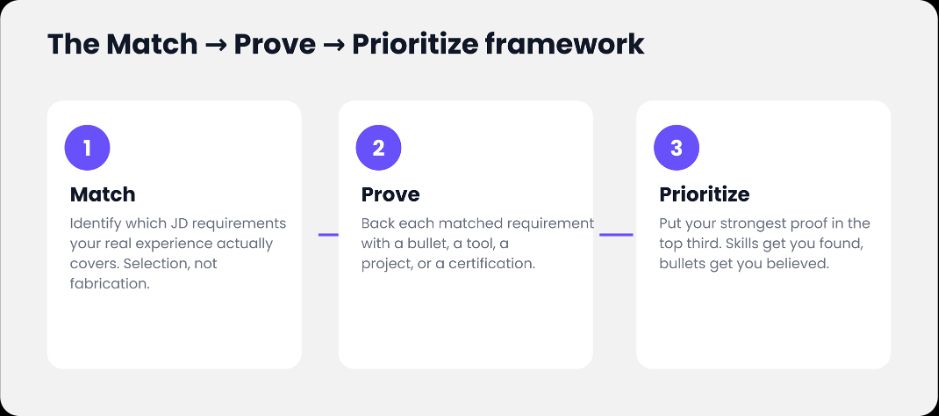
Resume tailoring isn't about becoming a different candidate for every application. It's about making the most relevant version of who you already are impossible to miss. The framework has three steps
Step 1: Match
From your extraction, identify the requirements your experience actually covers. This is a selection exercise, not a fabrication exercise. For each weight-3 and weight-2 requirement, ask: do I have real evidence for this?
If the job description says “Gainsight or similar CS platform” and you've used Totango and Salesforce for the same workflows, that's a match. If it says “Python required” and you've only done a half-finished tutorial, that's not a match. Be honest here — the moment a candidate loses trust with a hiring team is the moment they claim a tool or skill they can't defend on a call, and interviewers routinely test exactly that.
Step 2: Prove
For each matched requirement, find the strongest evidence you have.
If your past roles don't map directly onto the target title, work out your transferable skills before you draft a single bullet — it changes which proof points you lead with.
The standard isn't perfection. Job descriptions are routinely written as wish lists that combine what a role truly needs with what would be nice to have, and hiring managers know it. Not meeting every preferred requirement is not the same as not meeting a hard requirement.
Step 3: Prioritize
Put your strongest proof where it will be seen fastest. Recruiters skim the top third first — if your most relevant evidence is buried in a role from four years ago, it may never get seen.
- Target title or headline
- Summary or profile — AIApply's Resume Summary Generator drafts a JD-aligned summary in seconds so you can test different framings without starting from scratch
- Skills section
- First two to four bullets under your most recent relevant role
- Relevant projects
- Older roles, education, certifications
This is the part most people get wrong. Skills get you found. Bullets get you believed. The skills section tells the ATS and the recruiter that you know the tool; the bullet that shows what you did with it is what creates credibility. A resume with “Salesforce” in the skills section but no supporting context in the experience section gets flagged and skimmed past.
What the top third should show
How to Write Resume Bullets That Prove Your Fit
Four before-and-after examples across different roles.
Marketing Manager → B2B SaaS demand generation role
Before: “Managed social media and email campaigns.”
After: “Built LinkedIn and HubSpot email campaigns for B2B SaaS buyers, generating 1,240 MQLs and $410K in influenced pipeline over two quarters.”
Why it works: channel, tool, target audience, and a business-level metric — not just an activity.
Customer Success Manager → retention and expansion role
Before: “Helped customers and handled renewals.”
After: “Managed a 72-account SMB book, using health scores and QBRs to raise gross retention from 86% to 93% year over year.”
Why it works: “health scores,” “QBRs,” and “retention” all mirror expected JD language, and the metric is specific and defensible.
Data Analyst → revenue analytics role
Before: “Created dashboards and reports.”
After: “Built SQL and Tableau dashboards for weekly revenue forecasting, reducing manual reporting time by 12 hours per month.”
Why it works: exact tools, a business function, and an efficiency metric.
Software Engineer → Python backend role
Before: “Worked on backend APIs.”
After: “Designed FastAPI services in Python and PostgreSQL for order-processing workflows, cutting p95 response time from 900ms to 310ms.”
Why it works: exact stack, system context, and a concrete performance metric a hiring manager can evaluate.
When you don't have a metric
Not every bullet needs a number. Scope, complexity, frequency, and stakeholder level are all legitimate proof: “Managed weekly executive reporting for sales, finance, and operations leadership, consolidating pipeline data from Salesforce and Excel.” No metric — but clear scope, named tools, and a meaningful stakeholder context.
The over-tailored failure to avoid
There's a version of tailoring that goes too far:
“Dynamic, results-driven customer success professional with customer success, customer retention, QBR, renewals, upsell, expansion, SaaS, CRM, stakeholder management, and customer success strategy experience.”
That's a keyword pile — no action, no proof, no outcome. Recruiters recognize it immediately, and it signals the resume was optimized for a scanner rather than written by a person. AIApply's own workflow guide on using AI to write a resume walks through exactly how to spot and remove that pattern, keyword by keyword.
A useful test for every bullet you write: can you walk a recruiter through it in a 30-second phone call? If you can't, rewrite it or cut it.
Three formulas you can apply directly:
- Outcome-first: “Achieved [result] by using [JD skill/tool] to do [core responsibility] for [scope].”
- Responsibility-to-proof: “Owned [JD responsibility] across [scope], using [tools/process], resulting in [metric].”
- Transferable bridge: “Translated [past experience] into [target skill] by [action], producing [result].”
How to Tailor at Volume Without Burning Out
Job seekers describe tailoring 100 applications from scratch as brutal — and they're right. “Tailor every resume” and “tailoring every resume from scratch is unsustainable” are both true. They point toward a better system, not a contradiction.
The role-family resume
Instead of one generic resume or one custom resume per application, build three to five base resumes by role family. A marketing generalist might have separate bases for demand generation, content marketing, and lifecycle email. Choosing the right base format matters here too — a chronological, functional, or combination layout behaves differently once you start swapping in role-specific content.
Each base resume is already tailored to that role type: the core responsibilities, tools, and domain language are already right. What you customize at application time is the top third only: the headline, summary, skills order, and the first two bullets of your most recent relevant role.
Three tailoring levels
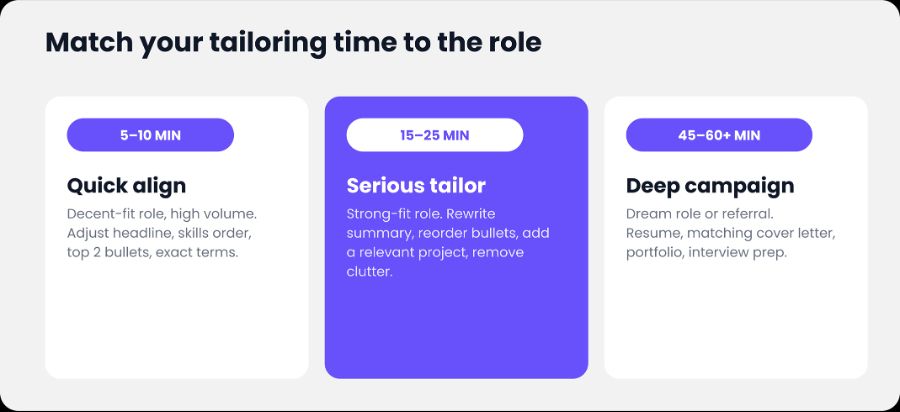
Most applications don't deserve 45 minutes. Most applications that might change your career trajectory do.
A fast 10-step workflow for quick-align cases
1. Paste the job description into your extraction table.
2. Circle the top 5-8 must-have terms.
3. Compare against your base resume.
4. Edit your headline to match the role family.
5. Reorder skills so the most relevant appear first.
6. Rewrite your top two bullets.
7. Add one missing but truthful keyword.
8. Remove one irrelevant line.
9. Save as FirstLast_TargetRole_Company.pdf.
10. Run the final draft through AIApply's AI Resume Checker to catch misparsed titles or missing keywords before a recruiter ever sees the record.
Triage: when not to tailor
The best tailoring system also tells you when not to apply. If you can't prove the top three to five weight-3 requirements, 25 minutes on that application is probably better spent on a role where your evidence actually fits. AIApply's Auto-Apply handles the volume tier — it submits applications automatically to matched roles pulled from AIApply's job board of over 1 million live postings, with credits sold in packs so the volume scales to what you actually need — which keeps your own time for the applications that deserve a deep campaign.
How AI Resume Tools Actually Help (and Where They Don't)
AI is now standard on both sides of hiring, but intentional tailoring with AI is still the minority behavior. Kickresume's analysis of its own 2025 platform data found that among more than 1.2 million job seekers using its AI features, about 64% used AI to check their resume's ATS compatibility, while only about 3.5% used AI specifically to tailor a resume to a job description. That gap is the opportunity: most job seekers are using AI to check their work, not to do the harder job of matching it to a specific role.
Hiring managers are using AI too. In Insight Global's 2025 AI in Hiring Survey Report, 99% of surveyed hiring managers reported using AI in some capacity in the hiring process, while 93% still emphasized the importance of human involvement. At the same time, TopResume's May 2025 survey of 600 U.S. hiring managers found that 19.6% would reject a candidate over an AI-generated resume or cover letter, and 33.5% said they could spot AI-written resumes in under 20 seconds. But 52% of the same group said proofreading or drafting support with AI is acceptable as long as the final product is human.
The distinction that matters is AI-assisted versus AI-authored. Whether hiring managers can actually detect the difference depends heavily on how much AI involvement there was — a light polish reads very differently from a fully generated document.
Where AI helps
- JD extraction: identifying repeated skills, exact tools, must-have requirements, and keyword priorities.
- Gap analysis: comparing your current resume against the JD and flagging what's missing.
Bullet rewriting: making bullets clearer and more aligned with JD language. AIApply's Bullet Point Generator does this from your job title, the JD, and your raw notes.
- Keyword sanity check: confirming your exact terms and reasonable synonyms are present, without stuffing.
Role-family versioning: creating and iterating on your base resumes. AIApply's Resume Rewriter refreshes language and terminology to match a new job description without changing your underlying facts.
Where AI hurts
- Fabrication: AI models can invent metrics, tools, or duties that don't match your actual experience. This collapses in a recruiter call.
- Generic tone: resumes processed heavily by AI start to sound alike.
- Inconsistency: AI edits can create mismatches with your LinkedIn profile, application fields, or interview answers.
- Loss of voice: your resume stops sounding like a person and starts sounding like a document.
For a deeper look at where AI genuinely helps versus where it quietly hurts, AIApply's comparison of AI-generated resumes against human-written ones covers the specific tradeoffs.
The rule: let AI surface the requirements. You decide what to include, based on what you can actually prove. If you can't defend it in an interview, it doesn't belong on the resume.
The 5 Mistakes That Undercut a Tailored Resume
Mistake 1: Tailoring only the skills section
If your skills section mirrors the JD but your experience bullets are still generic, you've done half the work. Skills tell the ATS you know the tool; bullets tell the recruiter you actually used it.
Mistake 2: Ignoring the top third
Recruiters see the top third in the first few seconds. If your headline reads “Experienced Professional,” your summary is generic, and your first bullet describes a duty rather than an outcome, you've lost the match before they reach the parts you actually tailored. AIApply's ATS-formatting guide covers exactly which formatting choices keep that top-third content parsing cleanly across different ATS platforms.
Mistake 3: Treating all JD requirements as equal
Some requirements are legal necessities. Some are genuinely the job. Some are nice-to-have culture language. Weighting them all the same wastes effort on generic soft-skill phrases and misses the harder-to-fake proof employers actually want.
Mistake 4: Copying JD language without proof
“Strategic cross-functional leader driving scalable operational excellence” tells a recruiter nothing. If the job description asks for executive stakeholder management and your bullet just says “managed executive relationships,” you've named the skill without proving it. Connect the language to real evidence: who the executives were, what you presented, what happened as a result.
Mistake 5: Over-tailoring until it stops sounding human
The keyword pile from earlier is the ceiling. The goal isn't keyword density — it's truthful match density: the share of your resume that proves you fit this specific job, in language a person would trust.
The Underlying Goal of Every Tailored Resume
Tailoring a resume isn't about tricking software or writing a different version of your career for every posting. The goal is to increase the amount of visible space on the page that proves you fit this specific job, honestly and specifically, in a way a person reading it under time pressure can act on.
More of the resume should prove the fit. Less of it should describe generic duties. Every line should answer the question a recruiter is already asking: have they done this work before?
A tailored resume isn't a different version of the truth. It's the most relevant version of the truth.
Every tailored bullet you write is also interview prep. If you can articulate exactly which JD requirement it meets, what you actually did, and what the outcome was, you've written your answer to the first five interview questions. When the invite lands, AIApply's Interview Buddy coaches you in real time during the call, using the same role context you used to tailor the resume in the first place. If you can't defend a bullet in an interview, it shouldn't be on the resume. If you can, it's your story — and that's the final test.
Your next step: run the 10-minute extraction on the job description in front of you, identify the weight-3 requirements, and check whether your current resume proves them in the top third.
Frequently Asked Questions
Should I tailor my resume for every single job application?
Not from scratch, and not with equal depth. Build three to five base resumes by role family so the core tailoring is already done, then invest based on fit: 5-10 minutes for decent-fit roles at volume, 15-25 minutes for strong-fit roles, and a full campaign for your top-priority targets. Yes, tailor every resume — just use a system that makes it sustainable.
Do ATS systems automatically reject resumes that don't match keywords exactly?
No — there's no universal keyword threshold or rejection algorithm. What happens varies by employer and platform: some use hard filters for specific requirements, some use keyword search, and some use AI matching that scores candidates against calibration criteria, but Greenhouse, iCIMS, Workday, and Ashby all describe human review as part of the pipeline. Exact keywords help for tools, job titles, and hard skills, but you don't need 100% keyword coverage to get through.
What if I don't have metrics for my resume bullets?
Use scope and context instead of numbers. The number of accounts you managed, the size of the team, the budget, the frequency of reporting, and the complexity of the stakeholders all communicate scale without a precise percentage. “Managed weekly executive reporting for sales, finance, and operations leaders, consolidating data from Salesforce and Excel” is a strong bullet without a single number.
How long should resume tailoring take?
It depends on the role: 5-10 minutes for a decent-fit application if you have a role-family base resume ready, 15-25 minutes for a strong-fit role, and 45-60+ minutes for a high-priority target, including resume, cover letter, and interview prep. If you're spending 45 minutes on every application regardless of fit, you'll burn out. AIApply's Interview Question Generator runs the interview-prep half of a deep campaign in parallel with the resume work, so the two don't compete for your time.
Can I adjust my job title on my resume?
Use your actual title. If your official title doesn't reflect what you did, add context in parentheses: “Operations Associate (Project Coordination Focus).” Don't replace your title with one you didn't hold — that kind of discrepancy surfaces in reference checks and can end a candidacy quickly. AIApply's guide to resume title strategies covers formats for framing a title that doesn't map cleanly onto your target role. Use the summary and bullets to do the rest.
Should I update my LinkedIn profile for every application?
No. Your LinkedIn profile should reflect your target role family, not be re-tailored per posting. For a significant career pivot, update your headline and About section so they don't contradict your resume — but for most applications within your role family, a strong LinkedIn profile that reinforces your resume is enough.