AI Resume Writer vs Human: Which Works Better? (2026)
Choosing between AI resume writer vs human? Compare speed, cost, quality, and success rates. Includes step-by-step workflow for both methods.


Your job search probably feels overwhelming right now. Maybe you've sent hundreds of applications and heard nothing back. Maybe you're staring at a blank resume template, paralyzed by the pressure to get it perfect. You're not alone in wondering whether AI or a human writer can actually help you break through.
This isn't a hype piece for AI, and it's not nostalgia for "only humans write well." This is a practical guide to choosing the right approach for your situation, backed by current data and real hiring trends. By the end, you'll know exactly which option works for your career stage, budget, and timeline.
What Your Resume Actually Needs to Do (Beyond Looking Good)
A resume isn't a biography. It's a filter-passing, trust-building sales document.
Think about hiring from first principles. Every employer faces the same uncertainty problem: Will this person perform? Will they ramp quickly? Will they stay? Your resume compresses your work history into credible signals that reduce that uncertainty fast.
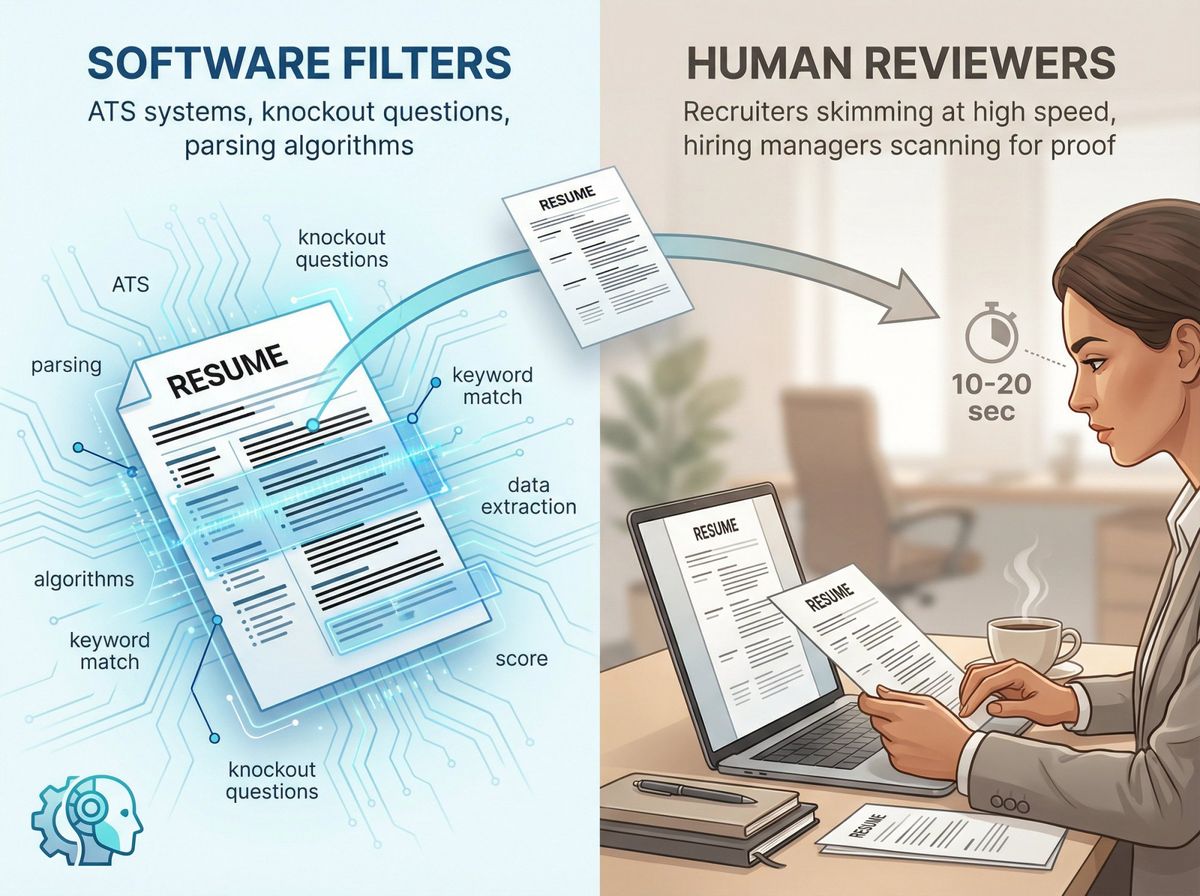
In 2026, you're being judged by two audiences:
Software filters (ATS systems, knockout questions, parsing algorithms, sometimes scoring)
Humans (recruiters skimming at high speed, hiring managers scanning for proof)
Here's the blind spot most job seekers have: they think "the ATS rejected me."
Actually, rejection is often still driven by people. According to Business Insider, hiring technology handles basics like knockout questions and routing, but humans still make the call on most resumes they actually review.
So the real game is this: pass the automated gatekeeping without sounding like a bot, then make a human say yes in 10 to 20 seconds.
Why More People Use AI Resume Writers Now Than Ever
AI didn't just change how resumes are written. It changed the volume and baseline quality of what recruiters receive.
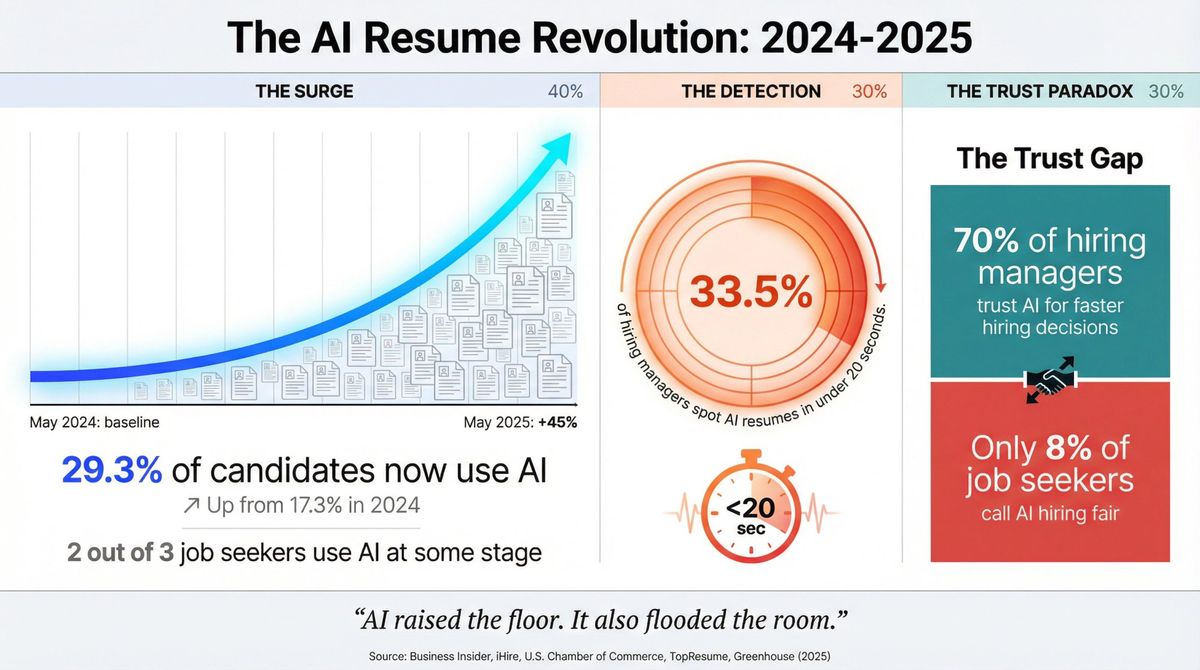
The data tells the story better than opinions:
| Year | Metric | Source |
|---|---|---|
| May 2025 | Job applications on LinkedIn up more than 45% year-over-year | Business Insider |
| 2025 | 29.3% of candidates reported using AI for resumes/cover letters (up from 17.3% in 2024) | iHire State of Online Recruiting 2025 |
| 2025 | About two-thirds of job seekers now use AI at some stage | U.S. Chamber of Commerce |
| May 2025 | 33.5% of hiring managers can spot AI-generated resumes in under 20 seconds | TopResume Survey |
| Nov 2025 | 70% of hiring managers trust AI for faster decisions, but only 8% of job seekers call it fair | Greenhouse AI in Hiring Report |
The takeaway is uncomfortable but useful:
AI raised the floor. It also flooded the room. So "a decent resume" is no longer a differentiator. It's table stakes.
What Is an AI Resume Writer and How Does It Work?
An AI resume writer is a digital tool (usually powered by advanced language models like GPT-4) that generates or enhances résumé content automatically. You typically input your current resume or key details, and the AI produces polished bullet points, summaries, and formatted resumes in minutes or even seconds.
Why people use AI for resumes: Speed and convenience. A human resume writer simply cannot create a resume in 30 seconds the way AI can.
How AI resume builders work: These tools analyze your input and the target job description to identify important keywords and requirements. Then they generate content that tries to highlight your relevant skills and achievements.
For example, AIApply's AI Resume Builder uses OpenAI's GPT-4 and advanced algorithms to match job descriptions seamlessly and suggest content that's both keyword-optimized and natural-sounding.
Many AI tools also ensure the format is clean, with standard section headings that won't confuse ATS scanners.
What AI Resume Writers Do Best (And Where They Fail)
Think of modern AI resume tools as two things: a language engine (rewriting, summarizing, polishing) and a relevance matcher (mapping your experience to job requirements).
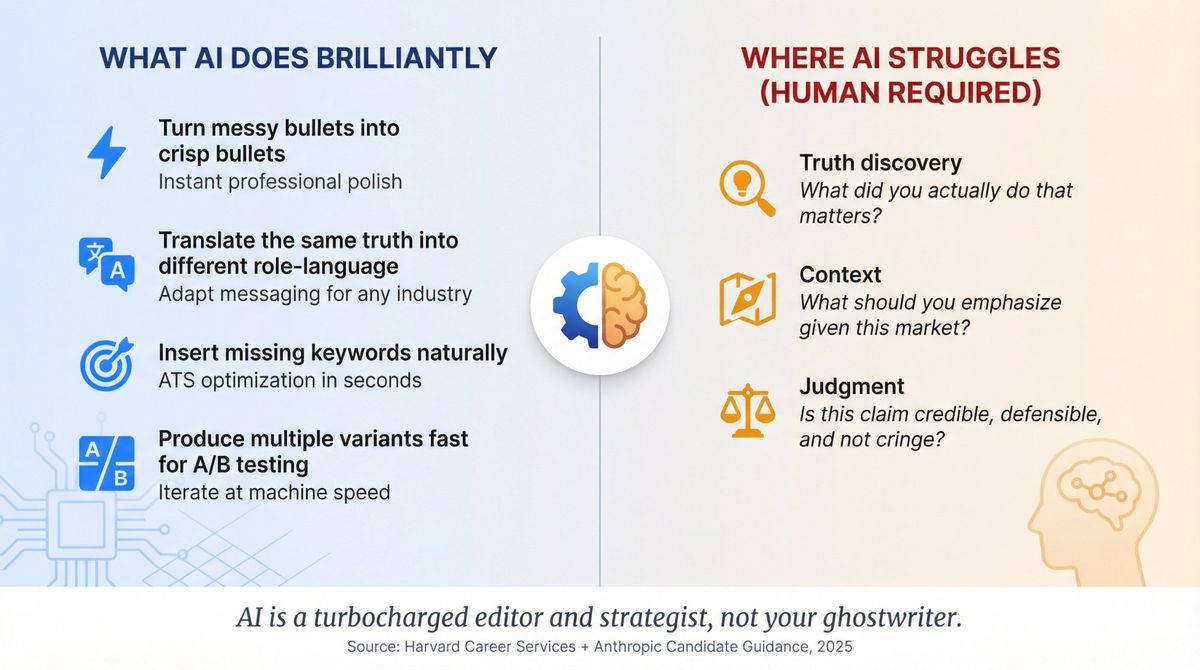
When AI Resume Writers Excel
→ Turn messy bullets into crisp bullets
→ Translate the same truth into different role-language
→ Insert missing keywords naturally
→ Produce multiple variants fast for A/B testing
Where AI Resume Writers Struggle Most
- Truth discovery (what did you actually do that matters?)
- Context (what should you emphasize given this market?)
- Judgment (is this claim credible, defensible, and not cringe?)
Harvard's career services guidance captures this perfectly: use AI as an editor and keyword helper, not the primary author, because the output can be generic and must remain authentic and accurate.
Anthropic (a company that literally builds AI) tells candidates to draft first, then use AI to refine, and explicitly warns against using AI to create experiences you haven't had. (Last updated July 10, 2025)
That's the healthiest mental model: AI is a turbocharged editor and strategist, not your ghostwriter.
Common AI Resume Mistakes to Avoid
AI often struggles with storytelling or highlighting what makes you unique. It tends to rely on buzzwords like "results-driven," "team player," and "detail-oriented" that hiring managers see on every resume.
And if the input data is limited, AI might make unwarranted assumptions. We've heard real cases of AI tools fabricating details to fill gaps. One career coach noted that if your actual experience doesn't perfectly match the job description you feed in, an AI may "start to lie" by inserting responsibilities or results that sound plausible but aren't true.
Why Human Resume Writers Still Matter in 2026
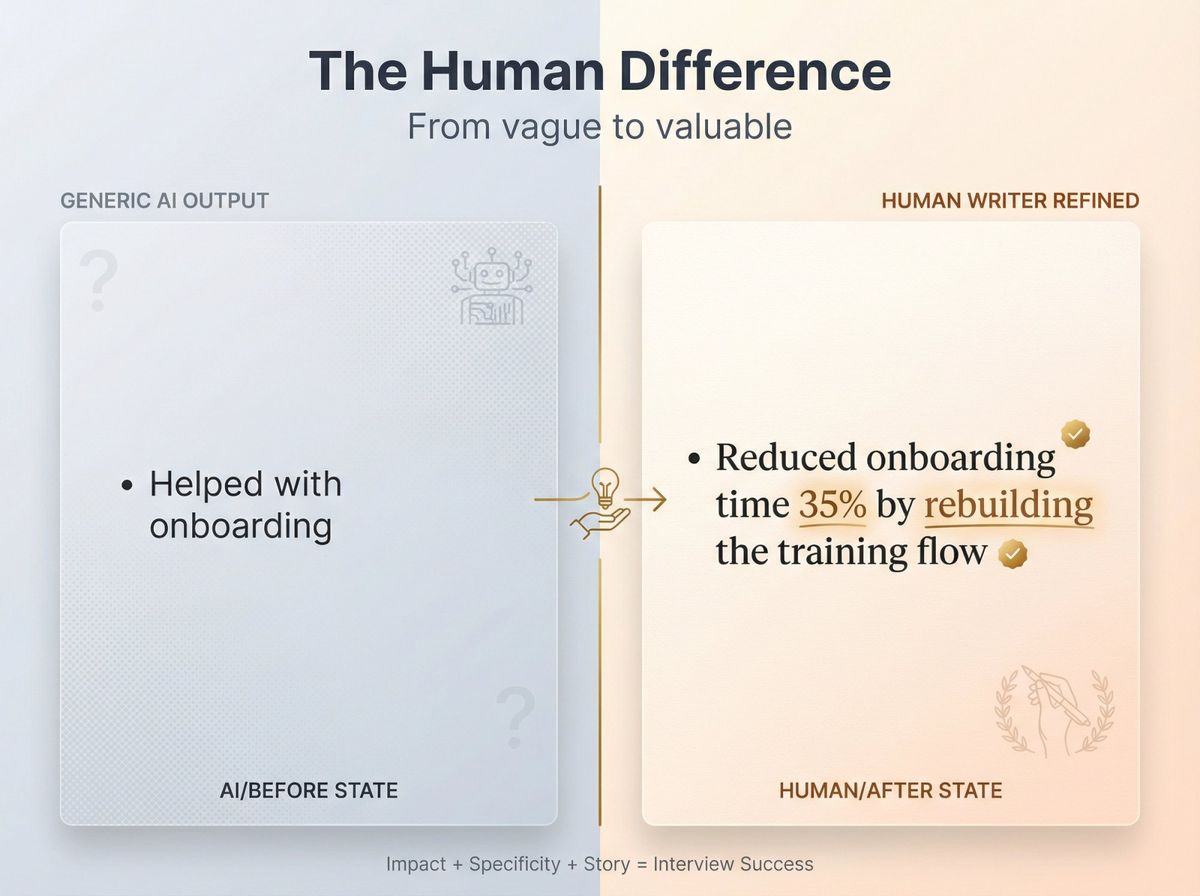
A strong human resume writer does three jobs that AI struggles with:
① How Human Writers Extract Your True Value
Most people undersell themselves because they describe tasks instead of outcomes.
A good writer will interrogate you until they can write bullets like:
"Reduced onboarding time 35% by rebuilding the training flow"
instead of
"Helped with onboarding"
Both versions convey similar facts, but the human-written line tells a story, shows impact, and adds specificity.
② How Human Writers Position Career Transitions
This is huge for:
- Career pivots
- "Non-traditional" paths
- Gaps, layoffs, contract-heavy histories
- Executive roles where leadership impact matters
A skilled human writer offers personalization and strategic storytelling that AI still struggles to replicate. Humans can interview you, understand your unique experiences, and highlight the nuances of your career in a way that feels authentic.
③ Why Human Writers Catch Risky Claims
A human can say:
"That claim won't survive an interview."
"That metric sounds inflated."
"This reads like a template."
Personal voice: Humans can also ensure the resume sounds like you (especially important if a hiring manager discusses something from your resume later). Professional writers will often interview you or use your own phrasing from those conversations to keep the tone authentic.
The downside is that humans vary wildly. Some are brilliant. Some are expensive template-farms with good marketing. Some quietly use AI anyway, then charge you premium rates for a light edit.
So you're not choosing "human vs AI." You're choosing judgment quality vs speed and iteration.
Does ATS Actually Reject AI-Written Resumes?
Here's what you need to know about applicant tracking systems:
If you apply online, ATS compatibility matters because parsing failures can destroy your chances before anyone sees your content.
How common is ATS?
Jobscan's analysis reports that in 2025, they detected an ATS for 97.8% of Fortune 500 companies (489 out of 500), similar to 2024 levels.
So ATS is not a niche concern. But here's the trap:
Why Keyword Stuffing Doesn't Beat ATS Anymore
It's not grading an essay. It's trying to structure data and help recruiters search.
Over-optimizing can backfire because humans still read these documents, and humans are increasingly allergic to generic AI phrasing. TopResume's research shows some hiring managers reject fully AI-written materials.
Also, some recruiters don't heavily rely on automated match scores anymore because candidates can optimize those scores easily with AI.
Your goal is not "beat the ATS." Your goal is: be parseable, searchable, and obviously relevant to a human.
| Aspect | AI Resume Writers | Human Resume Writers |
|---|---|---|
| ATS Optimization | Explicitly optimized by default with standard templates and section headings | Can optimize, but more room for error if not careful |
| Keyword Integration | Excellent at injecting exact keywords from job descriptions | Blend keywords into natural writing with more nuance |
| Risk | Over-optimization can make resumes sound robotic to humans | Better balance between ATS and human appeal |
Bottom line: Both approaches work for ATS compliance as long as you make it a priority. AI has a slight edge for the basics because it's built for this by default.
AI Resume Writer vs Human: Speed Comparison
How Fast Can You Get a Resume?
| AI Resume Writers | Human Resume Writers |
|---|---|
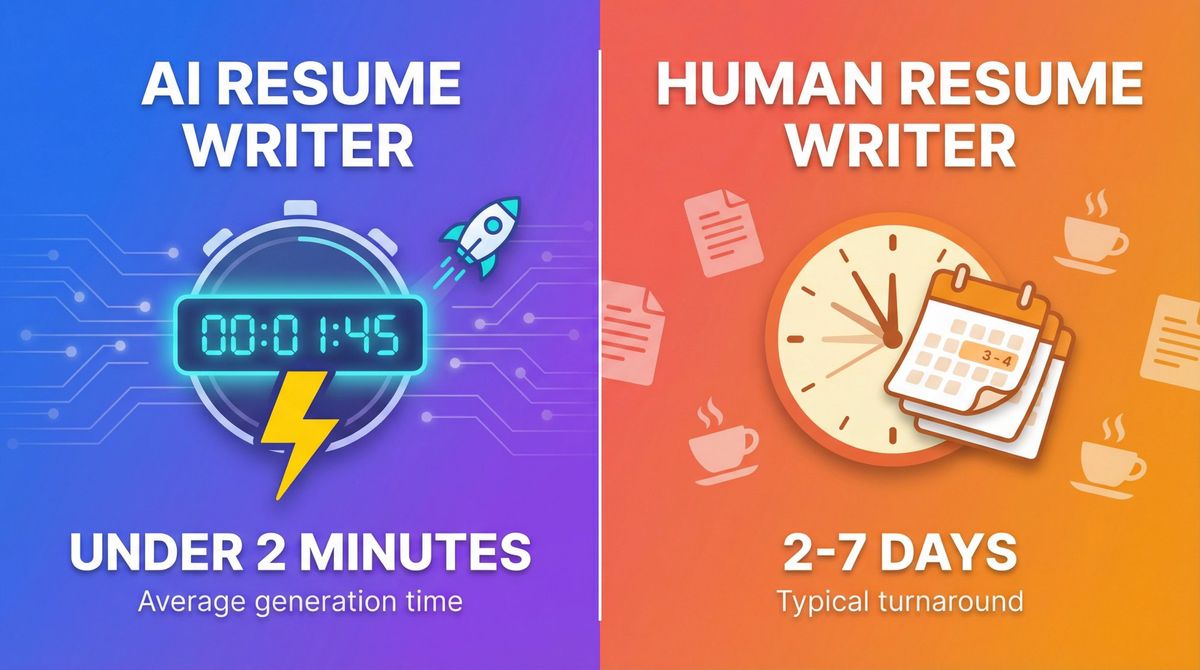
| Under 2 minutes on average (with tools like AIApply) | 2-7 days typical turnaround |
TopResume notes many writers take about 5 business days, and a strong resume can take around 10 cumulative hours when discovery and writing are done properly.
Bottom line: For raw efficiency, AI wins hands-down. Use it to save time on formatting and initial drafting. Just don't skip the crucial step of reviewing the AI's work before you hit send.
How Much Does Each Option Cost?
Here are current ranges from recent sources:
| Service Type | Price Range | What You Get |
|---|---|---|
| Human Writers (Entry-Level) | $200-$400 | Basic resume + light consultation |
| Human Writers (Professional) | $400-$700 | Tailored resume + LinkedIn + strategy |
| Human Writers (Executive) | $700-$1,000+ | Full branding package + interview prep |
| Upwork Freelancers | $100-$1,200 | Varies by scope and experience |
| AI Tools (Free Tier) | $0 | Basic resume generation with limits |
| AI Tools (Premium) | $20-$40/month | Unlimited resumes, advanced features |
| AIApply | $29/month | Full suite: builder, scanner, auto-apply |
Sources: TopResume pricing guide, Upwork rates, AIApply pricing
Verdict on cost: AI is the budget-friendly choice by far. Using AI resume builders typically costs under $50, whereas professional human services cost $100-$1,000+.
Which Creates More Personalized Resumes?
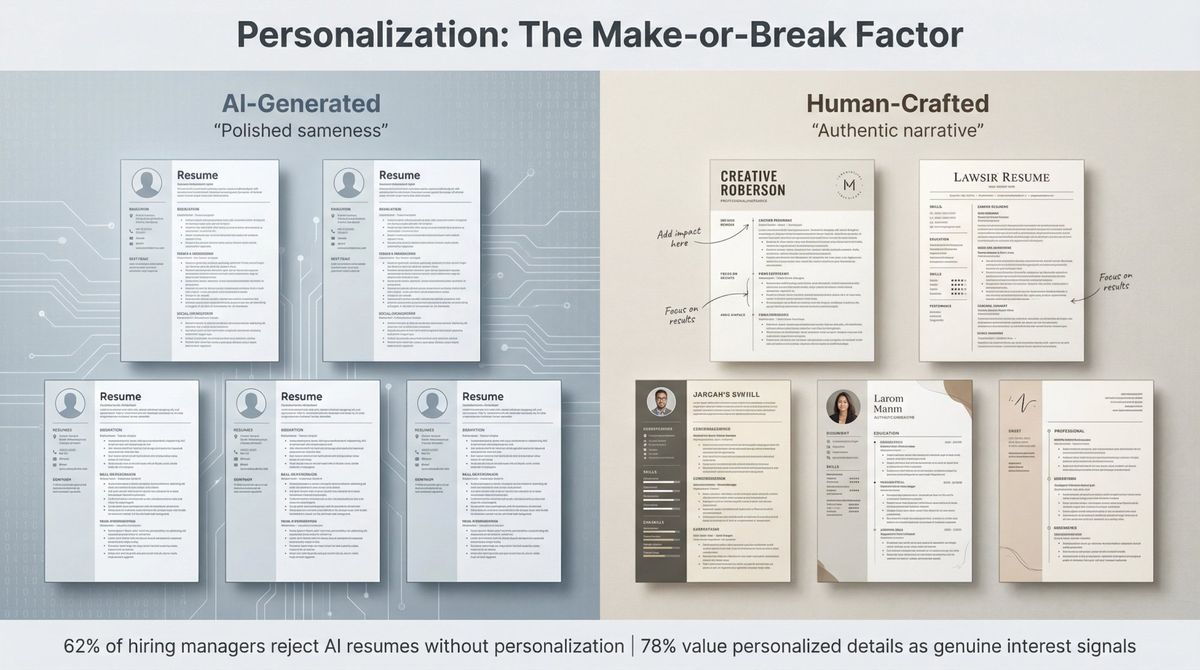
AI can mimic tone, but often produces "polished sameness."
Humans can make you sound like a real person with a coherent narrative.
Resume Now's 2025 report frames it bluntly: 62% of hiring managers say AI-generated resumes without personalization are more likely to be rejected, and 78% say personalized details signal genuine interest and fit.
As one recruiter put it, "I can totally tell when someone has used AI because suddenly I have six applications that all look the same."
Which Provides Better Career Strategy?
AI can suggest, but only as good as your inputs. Humans can spot market positioning issues and force clarity.
Emotional and strategic elements: Humans can deliberately highlight soft skills or fit. A human might note personal passions or motivations in a summary if relevant to the role (like "lifelong advocate for sustainability" or "passionate about bridging technology and education"). These are touches that make a candidate memorable. AI won't include that unless you explicitly prompt it to.
A human can also strategically address potential red flags in a way AI wouldn't, such as briefly explaining a career gap or framing a short job stint in a positive light.
Can You Iterate and Test Multiple Versions?
AI: Unbeatable. Multiple versions, multiple roles, multiple countries.
Human: Expensive to iterate, slower to rework.
Will Recruiters Reject AI-Written Resumes?
A major concern many applicants have: If I use AI to write my resume, will recruiters know or care? Could it backfire?
Can recruiters tell? According to research from the U.S. Chamber of Commerce, 33.5% of hiring managers say they can quickly detect AI-crafted resumes, sometimes in as little as 20 seconds of reading. They notice telltale signs like overly generic phrasing, identical wording across multiple applications, or unnatural language quirks.
That said, about 66% don't confidently claim they can spot AI. And even those who think they can could be wrong. If an AI resume is well-edited and personalized, it can be indistinguishable from a human-written one.
Do recruiters mind? Some do mind, but many are okay with AI assistance within limits. The same research found that nearly 1 in 5 recruiters (around 20%) said they would outright reject a candidate who they knew used an AI-generated resume or cover letter. Also, another 20% or so viewed it as a red flag even if not immediate rejection.
Why do they object? Primarily because they value authenticity and effort. According to Resume Now, 78% of hiring managers said they look for personalized details in resumes as a sign of genuine interest.
That said, many recruiters take a balanced view:
52% of hiring managers said it's acceptable to use AI for drafting or proofreading, as long as the final product is truly your own and reflects your voice.
How to Avoid Getting Caught Using AI
The biggest risk is if your resume is blatantly AI-generated and devoid of personalization. Recruiters may view that as you not caring enough, or worse, trying to "cheat" the process.
Some extreme stats: Resume.io published a study saying 49% of hiring managers would automatically dismiss a resume that they identified as AI-generated.
On top of that, by mid-2025, an estimated 78% of companies said they now actively check for AI-generated content in applications.
Real-world blunders to avoid:
- A recruiter shared that one applicant's cover letter included a bizarre sentence: "As artificial intelligence, I do not have emotions."
- Another hiring manager described seeing multiple resumes with the exact same phrasing for a particular job's duties (a clear sign those candidates all used the same AI template without editing)
So, should you avoid AI? Not necessarily. The key is how you use it. Many recruiters are fine with AI as a tool. They just want to see that you added value to the output.
The consensus among career experts: Use AI as an assistant, not as a crutch. Let it handle the tedious parts (formatting, basic phrasing, ATS tweaks), but always infuse your own insights and personality before submitting.
Do AI-Written Resumes Get More Interviews?
You want to know: Will an AI-written resume improve my chances of getting interviews and job offers, or not?
AI users seeing more interviews:
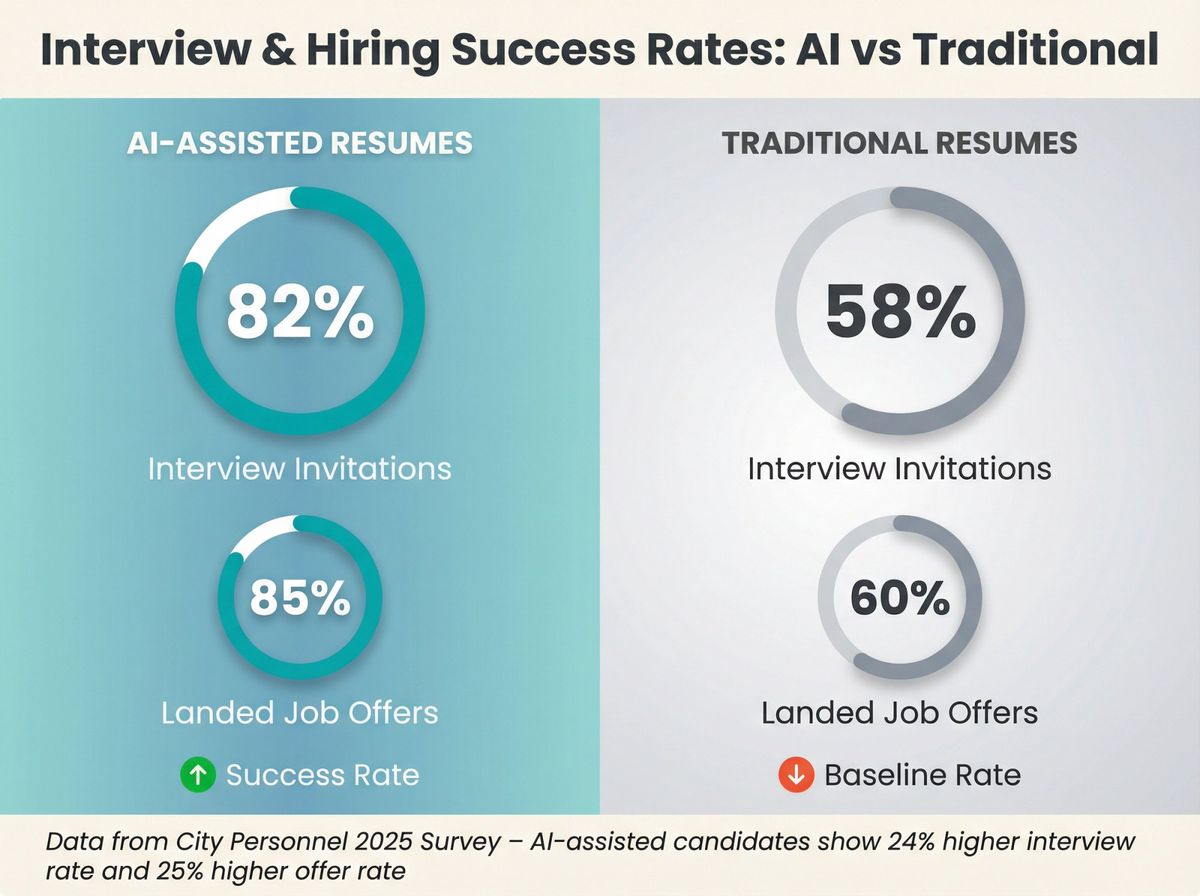
In a 2025 survey by City Personnel, 82% of job seekers who used AI in their applications reported receiving interview invitations, compared to just 58% of those who did not use AI assistance. That's a huge difference.
Likewise, 85% of AI-assisted candidates ultimately landed job offers, versus 60% among those who relied purely on their own writing.
Why the bump? Likely because AI-assisted resumes have fewer errors, more relevant keywords, and look more professional on average (even if they might be a bit generic, they clear the baseline competence bar easily).
Faster hiring: AI might also speed up the job search. According to data we've observed at AIApply, candidates who fully leverage AI job search tools tend to land opportunities faster. Our user data shows that 80% of users land at least one interview within the first month, and overall users report being 80% more likely to get hired compared to traditional job seekers.
Quality vs quantity: Be careful. AI makes it easy to apply en masse, but remember: 90% of hiring managers reported an increase in low-effort, spammy applications due to AI tools. Volume isn't everything. Quality and fit still matter.
Overall success verdict: When used thoughtfully, AI-written resumes can improve your chances of getting interviews, especially by beating ATS filters and presenting a polished first impression.
When Should You Use AI vs Human Resume Writers?
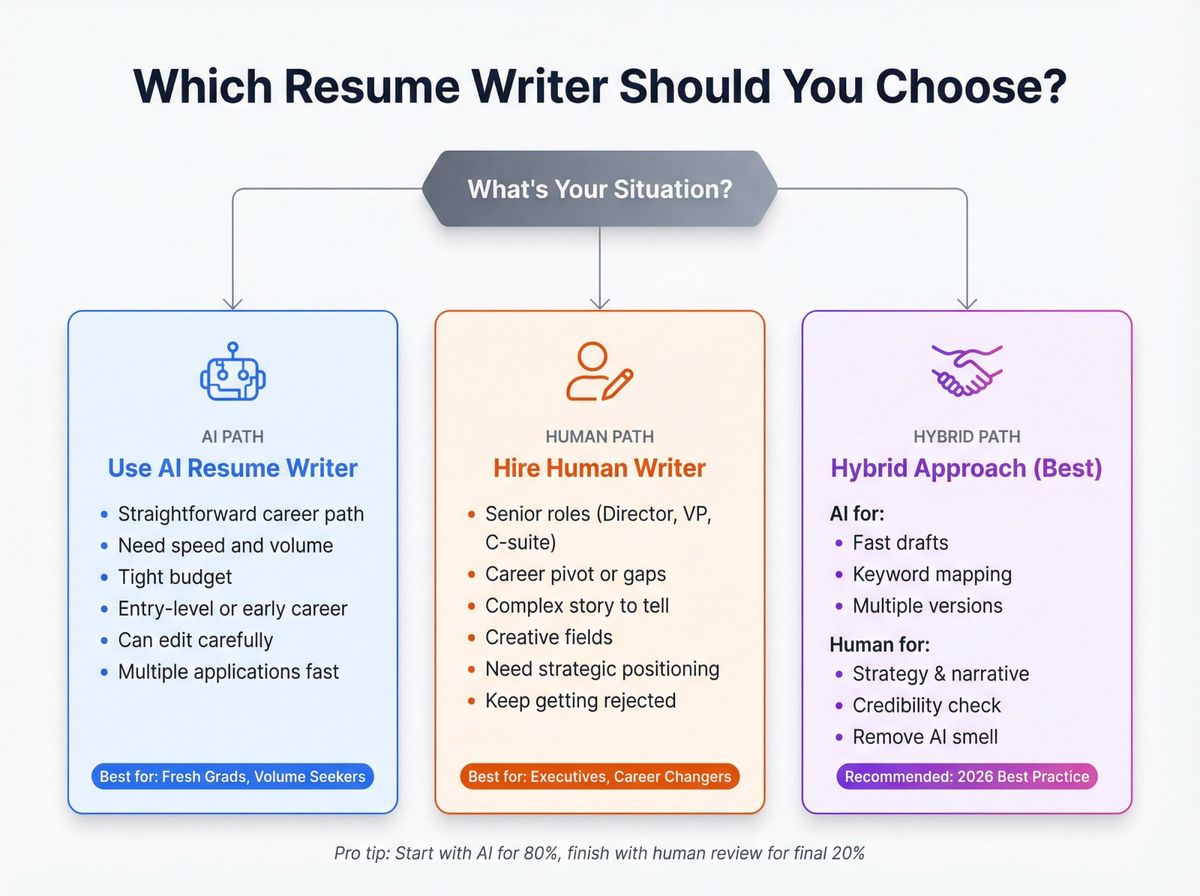
When to Use an AI Resume Writer
- You have a straightforward path (same function/industry)
- You need speed and volume (multiple roles)
- You can edit and fact-check carefully
- You want to run experiments (different headlines, different bullet emphasis)
- You're on a tight budget
- You plan to apply to many jobs quickly
- You want to ensure ATS optimization without learning all the nitty-gritty
This tends to align with fresh graduates, entry-level seekers, and those pivoting within similar roles. Career coaches often say AI resume builders are perfect for freshers and entry-level candidates who just need a clean, acceptable resume without spending money.
When to Hire a Human Resume Writer
- You're targeting senior roles where positioning matters (director, VP, C-suite)
- You're making a career pivot and need translation of skills
- Your story is "messy" (gaps, layoffs, contract-heavy, multiple industries)
- You freeze when writing about yourself and need deep extraction interviews
- You keep getting rejected and don't know why
- Your field values creativity or distinctive communication (marketing, writing, design, media)
- You need storytelling and branding
To sum up, senior executives, career changers, and those in creative/story-centric fields often benefit most from human expertise.
Why the Hybrid Approach Works Best in 2026
Use AI for:
- Fast drafts
- Keyword mapping
- Multiple tailored versions
Use a human (or at least a human reviewer) for:
- Strategy and narrative
- Credibility policing
- Removing "AI smell"
- Ensuring it reads like you
This hybrid approach also aligns with the guidance from Harvard and Anthropic: draft yourself first, then use AI to refine and tailor.
Why hybrid works: You basically combine AI's efficiency with human strategy. One career blogger summarized it well: "Let AI help you reach 80%. In the last 20%, let a human help you stand out."
The first 80% (core content, general structure) is relatively easy for AI and would be time-consuming for you. The last 20% (fine-tuning, differentiating) is hard for AI but easy for you because you know yourself.
Step-by-Step: How to Write a Resume Using AI and Human Review
This is the part most articles skip. They tell you "tailor your resume," then leave you alone.
Here's a workflow that works even in a crowded market.
Step 1: Build a Truth Bank (Non-Negotiable)
This is a private doc where you dump raw material.
For each role/project, write:
- What problem existed?
- What you did (actions)
- What changed (results)
- Evidence (metrics, before/after, scale)
- Tools/skills used
- Stakeholders
- Anything you can defend in an interview
If you don't have a Truth Bank, AI will "helpfully" invent confidence. That's where people get burned.
This matters because recruiters are reporting more deception, more spam, and more AI-driven application noise.
Step 2: Map the Job Description into a Role Requirements Grid
Open the job posting and extract:
- Must-haves (hard requirements)
- Nice-to-haves
- The "real job" behind the words (what problem are they hiring to solve?)
Write a one-line translation:
"They say 'stakeholder management.' They mean 'can handle chaos without escalating everything.'"
Step 3: Generate a Targeted Resume Draft Using AI
You can do this with general chat tools, but dedicated tools reduce friction because they structure the resume for you.
How to do a hybrid resume:
① Start with AI to generate a strong first draft. Input your experience and the target job into an AI resume builder. Let it produce the formatted resume with baseline content. This gets you, say, "80% there" in terms of having the right info and keywords on the page with correct formatting.
If you're using our tools at AIApply, you can use the AI Resume Builder to generate a role-specific resume draft.
② Edit and personalize the AI draft. Now the human brain kicks in. Go through each section and refine the wording. Add specific details or examples the AI left out. Adjust the tone so it sounds like you. Ensure any weak phrases are punched up with your unique achievements. Remove anything that doesn't actually apply or isn't truthful.
③ Optionally, get a human review. If you can, have someone else read the refined resume. This could be a mentor, friend in the industry, or even hiring a resume coach for an hour.
④ Iterate quickly with AI as needed. If you or your reviewer identify a weak area, you can actually feed it back to the AI for suggestions.
Step 4: Run an ATS Check (Parse + Keywords + Formatting)
This is where most people waste months: they keep rewriting without testing.
If you're using AIApply:
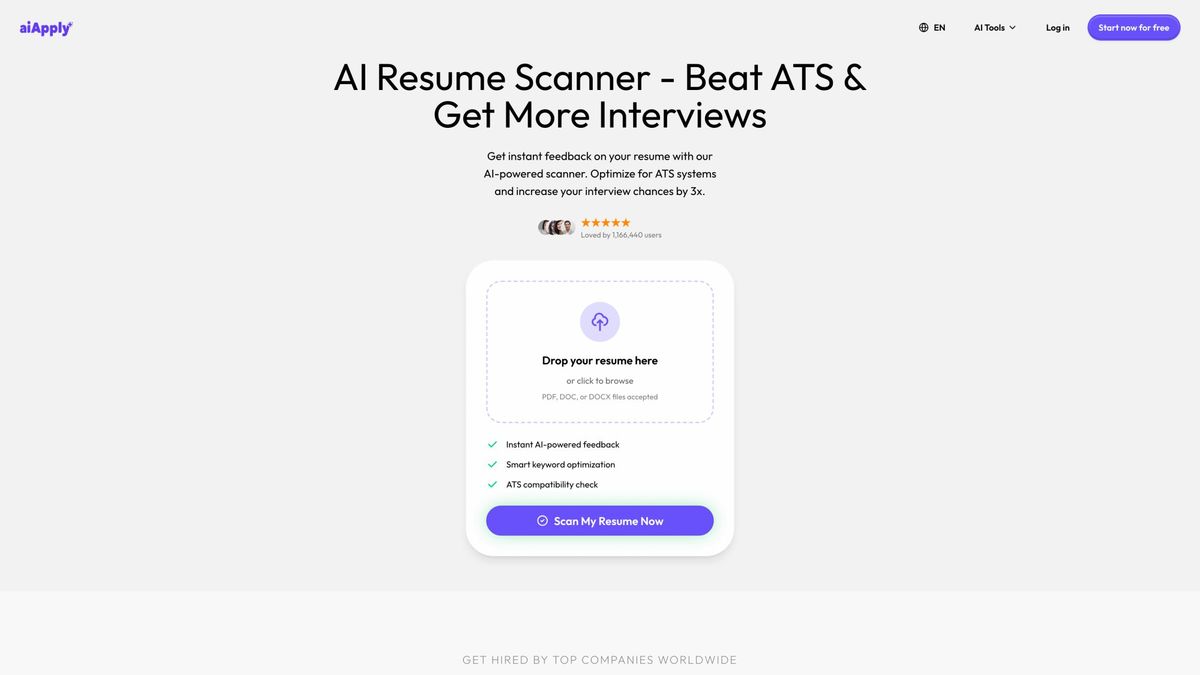
- Use our Resume Scanner for ATS and content feedback
- Or use our free Resume ATS Checker tool for quick compatibility testing
Also, follow ATS-safe formatting guidance. Indeed's ATS resume guidance focuses on clear structure, standard headings, and formatting that parses reliably.
Step 5: Do a Humanization Pass (The Make-or-Break Step)
This is how you stop sounding like everyone else.
Rules:
① Delete generic adjectives unless proven
Remove: "results-driven," "dynamic," "detail-oriented," "passionate"
Replace with proof: metrics, scale, named systems, outcomes
② Every bullet must pass the Interview-Proof Test
Ask: "If someone challenges this, can I defend it with specifics?"
③ Use specific nouns
"Reduced churn" beats "improved customer experience"
④ Prefer numbers, but only real ones
Estimates are fine if you can explain them
This is not optional. Humans can spot AI-generated resumes quickly, and a meaningful minority will reject them if they look fully AI-generated.
Step 6: Do a Plain-Text Readability Test (ATS and Humans)
Copy-paste your resume into a plain text editor.
If it becomes a mess, many systems will parse it badly.
Step 7: Build 2 Versions, Not 20
Here's a counterintuitive truth: more versions can reduce quality.
Make:
Version A: optimized for the exact role
Version B: optimized for a broader role family (in case the company routes you)
Track which version gets callbacks.
Step 8: Apply Like a Sniper, Not a Spam Bot
AI makes it easy to apply in bulk. That's why recruiters are drowning in low-effort applications.
If you want to use automation, keep the quality constraints:
- Only apply where you hit a minimum match threshold
- Only apply with a resume that passes the Humanization Pass
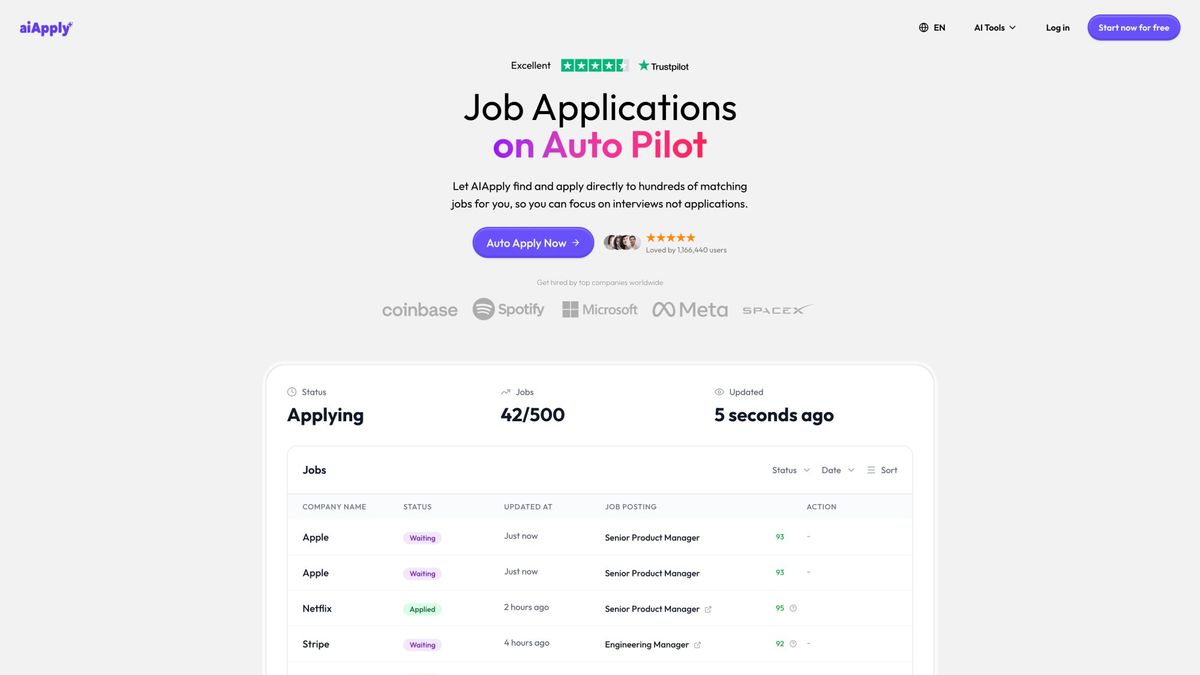
Our Auto Apply feature is designed for high-volume workflows, but it still depends on having strong inputs.
How to Choose a Human Resume Writer (Without Getting Scammed)
When It's Worth It
A human writer is most worth it when the value of "one more interview" is high.
A simple way to think: if your target job is a big salary jump, or the market is brutal, or your story is complex, paying for strategy can have a strong payoff.
What It Costs in Practice (So You Can Sanity Check Quotes)
- US ranges commonly sit in the $200 to $1,000 band depending on level
- Freelance markets show hourly and fixed-price ranges that can reach $1,200 for larger packages
- UK ranges cited by one London-focused review run up to £799 for writing packages
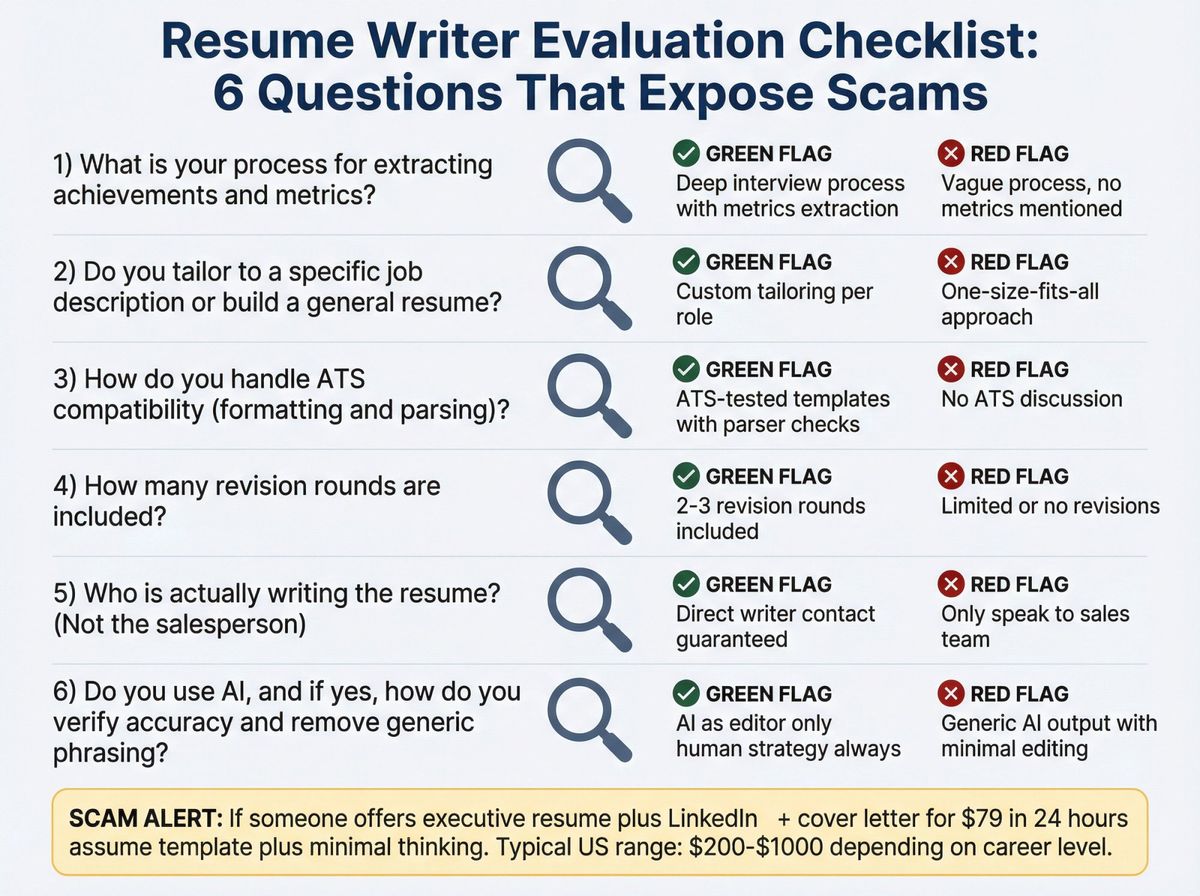
If someone offers you "executive resume + LinkedIn + cover letter" for $79 in 24 hours, assume template plus minimal thinking.
Questions to Ask Any Writer (Copy-Paste This)
① What is your process for extracting achievements and metrics?
② Do you tailor to a specific job description or build a general resume?
③ How do you handle ATS compatibility (formatting and parsing)?
④ How many revision rounds are included?
⑤ Who is actually writing the resume? (Not the salesperson)
⑥ Do you use AI, and if yes, how do you verify accuracy and remove generic phrasing?
TopResume explicitly warns about outsourced writing leading to communication breakdowns, and emphasizes collaboration and revisions.
Can AI Resume Lies Cost You the Job?
You'll see people online saying "everyone lies anyway." That advice is career poison.
Why?
Employers are already reporting more deception and even tactics like prompt injection hidden in resumes.
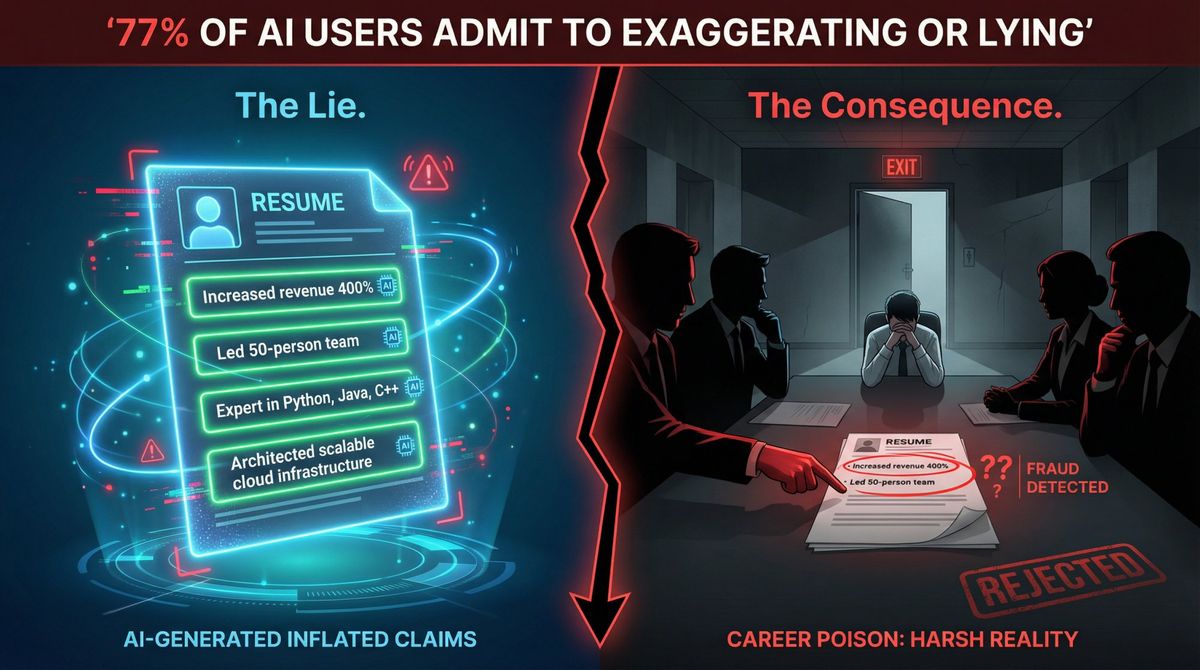
A UK-focused survey found that 77% of AI users said they used it to exaggerate or lie in applications.
In a market with rising suspicion, the winning move is not "lie better." It's "be more specific and more defensible."
A clean principle: Use AI to improve communication, not to invent competence.
Where AIApply Fits (Without the Cheesy Sales Pitch)
If you want AI help, the biggest risk is not "using AI." The risk is:
- Generic output
- Weak ATS parsing
- No feedback loop
- No system to iterate quickly
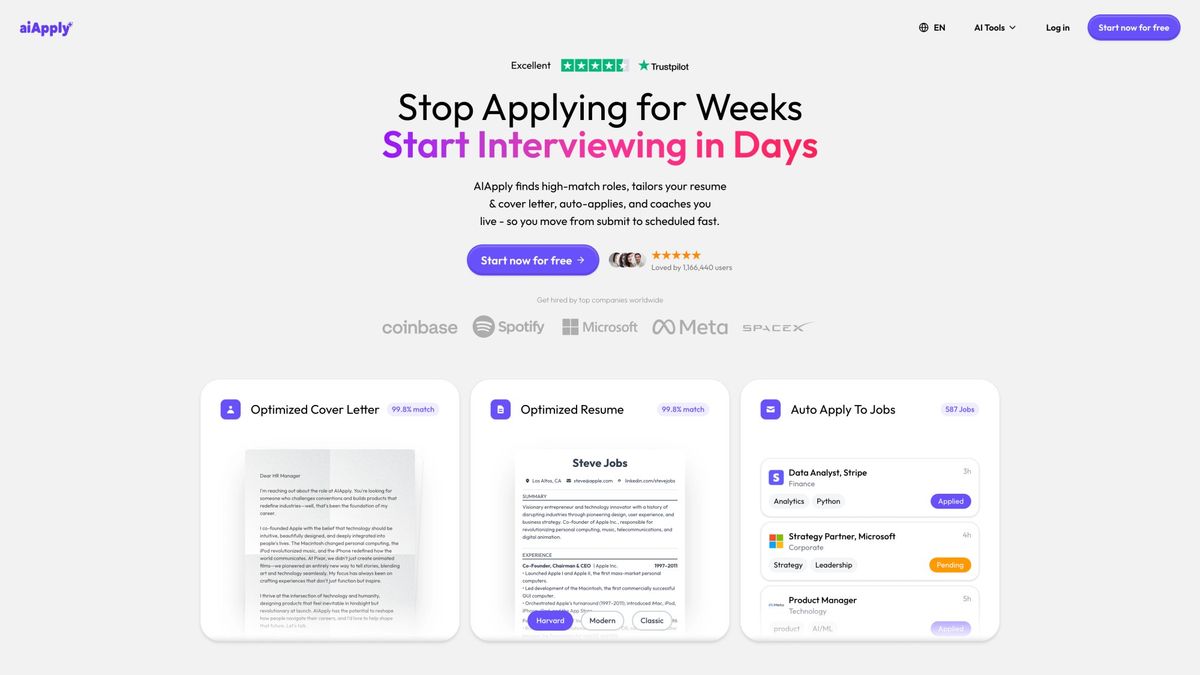
AIApply is built as a workflow rather than a single generator:
- Draft with our Resume Builder
- Test and fix with our Resume Scanner or ATS Checker
- Scale applications with Auto Apply once quality is locked
And our pricing is transparent as of January 2026 (Free option available; paid tier at $29/month monthly and a lower monthly equivalent for annual billing).
We also offer Interview Buddy for real-time interview coaching and AI Cover Letter Generator to complete your application package.
How to Use AI Resumes Without Getting Rejected
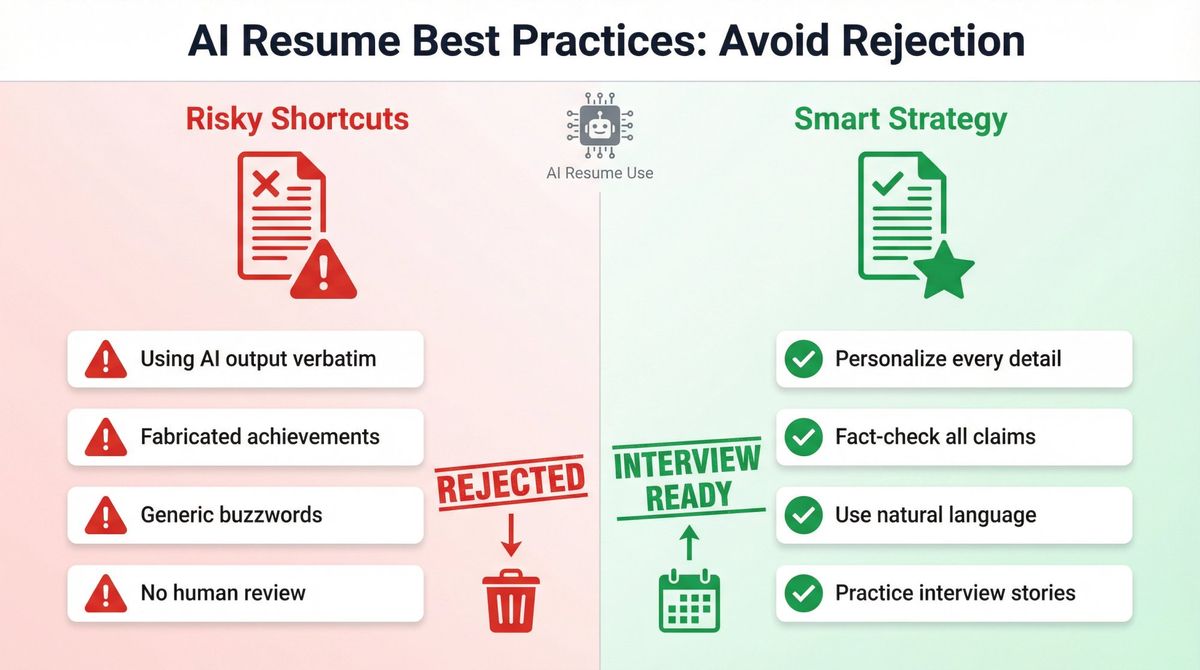
Regardless of which route you choose, here are some best practices if you leverage AI in your resume process:
→ Always personalize the output. Don't use the AI's draft verbatim. Customize it to include specific achievements, metrics, and wording that reflect you.
→ Double-check facts and consistency. AI can inadvertently produce incorrect info (dates, titles, even tasks). If it suggests you did something that you didn't, remove or correct it.
→ Incorporate keywords naturally. When editing, maintain those important keywords for ATS, but feel free to mix up phrasing a bit.
→ Maintain a human tone. Read your resume and ask: does this sound like something a person wrote? If it's too stiff or buzzword-heavy, loosen it up.
→ Don't neglect formatting and readability. AI tools usually handle formatting well. Still, check that the final layout is clean and easy to read. Remember, a recruiter spends 7 seconds on an initial skim on average.
→ Be mindful of AI detectors (but don't obsess). Some companies may use AI-detection. To be safe, after you finalize your resume, you could run it through an AI content detector yourself out of curiosity.
→ Leverage AI for cover letters and beyond. If AI helped with your resume, it can definitely help with a tailored cover letter for each application. The same rules apply: use the draft as a base, then personalize it heavily.
→ Practice your interview stories. If your resume is partially AI-written, be sure you're intimately familiar with everything on it. You should be ready to discuss and expand on each bullet point.
→ Keep learning and iterating. The job market evolves, and AI tools themselves are getting better. Stay updated on trends.
Frequently Asked Questions
Will ATS detect that my resume was written by AI?
Most ATS guidance focuses on parsing and keyword matching, not authorship detection. The larger risk is human reviewers rejecting generic, low-effort sounding content.
Should I disclose I used AI?
Unless an employer explicitly asks, the higher-order rule is: follow application instructions and keep everything accurate and defensible.
Also note: norms differ by employer. Some (like Anthropic) explicitly encourage AI for refinement in applications while setting boundaries.
If AI makes applying easier, should I apply to more jobs?
Not blindly. Application volume has risen sharply, and recruiters are actively reacting to low-effort, mass-generated applications.
A high-quality, well-targeted application still beats 200 sloppy ones.
Is a human resume writer always better?
No. A mediocre writer can be worse than a disciplined AI-assisted workflow. The key difference is not "human" but "judgment."
Can I use both AI and a human writer?
Absolutely. Many people use AI for the first draft and then hire a human for strategic review. This hybrid approach often produces the best results at a reasonable cost.
How do I know if my resume sounds too AI-generated?
Read it out loud. If it sounds stiff, uses lots of buzzwords, or doesn't sound like something you'd actually say, it needs more personalization. Ask a friend or colleague to read it and give honest feedback.
What if I don't have measurable achievements to list?
Focus on scope and context instead. Instead of "increased sales 30%," you might say "managed $500K product line" or "coordinated 5-person team across 3 time zones." Humans are better at extracting these nuanced stories from your experience.
Should I use different resumes for different jobs in the same field?
Yes, but don't overdo it. Create 2-3 versions maximum, each optimized for a specific subset of roles. Too many versions dilutes quality and makes tracking difficult.
How often should I update my resume?
Update your Truth Bank (your raw achievements document) quarterly, even when not job searching. This makes it much easier to create targeted resumes quickly when opportunities arise.
The One-Sentence Verdict
In 2026, the winning approach is usually: AI for speed and tailoring, plus human judgment (yours or a professional's) to make it specific, credible, and unmistakably real.