How to Change a Misleading Job Title on Your Resume
Your job title is a translation problem, not a wording problem. This guide covers the four ways titles mislead, the exact line format that fixes each one, and how to keep the fix consistent from your resume through to the background check.


To reframe a misleading job title without lying, lead with the functional title that describes the work you actually did, then put your official title beside it in parentheses on the same line: Customer Success Manager (internal title: Customer Advocate II). You are not replacing your title. You are translating it, and keeping the original on the page so the translation is verifiable. That single format solves the vast majority of misleading-title problems, and it is the only version that survives a background check.
The reason this matters is narrower than most advice admits. Your title isn't costing you interviews because it sounds unimpressive. It's costing you interviews because it doesn't contain the words a recruiter typed into a search bar, and because a hiring manager reading it for two seconds can't tell what you did. Those are two different failures, and "just use a better title" fixes one while quietly creating a much worse problem at the offer stage.
Why a Misleading Title Kills Your Application Before Anyone Reads Your Bullets
The title line is the highest-leverage sentence on your resume, and the data on this isn't subtle. Jobscan analyzed nearly one million job searches for its State of the Job Search 2025 report and found that resumes containing the job title received 10.6 times more interview invitations than resumes that did not. The same report found that 99.7% of recruiters use keyword filters inside their ATS to sort applicants, and that 76.4% of the 380-plus recruiters surveyed start their search with skills.
Sit with what that means for you. If your title is "Customer Advocate II" and the recruiter searches "Customer Success Manager," you are not a weak candidate in that search. You are not in that search. There is no pile you got sorted to the bottom of. The query ran, and your resume wasn't in the result set.
The pressure on the other side is real too. Greenhouse's The Hire Standard benchmark report (March 2026), built on 640 million applications across more than 6,000 companies, found that applications per job climbed from 116 in 2022 to 244 in 2025, while the average time to fill stretched from about 44 days to nearly 60. Nobody on the hiring side is going to work out what your title meant. They don't have the minutes.
AIApply's position on this is consistent: the fix is legibility, not decoration. LinkedIn's Skills-First research makes the point from the employer's angle, finding that talent pools expand roughly tenfold when companies search on skills rather than job titles alone, and that 88% of hirers acknowledge filtering out highly skilled candidates who lack traditional credentials like a matching past job title. The market knows titles are a bad signal. It screens on them anyway. You have to work with the system in front of you.
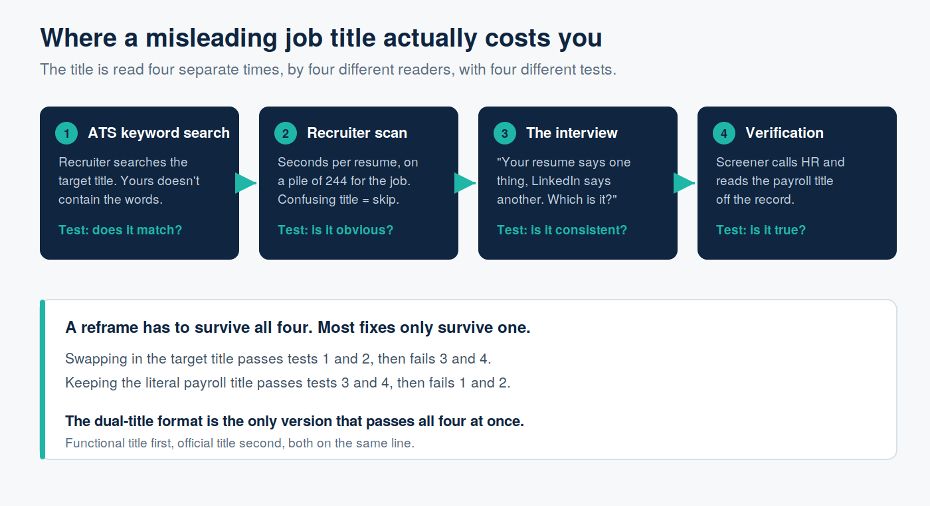
The same title line gets read four times, and each reader applies a different test.
Where Is the Line Between Reframing and Lying?
Reframing changes the words. Lying changes the facts. The test is one question: if your old manager read this line, would they say "yes, that's what she did"? If yes, it's a reframe, no matter how different it looks from the payroll record. If no, it's a lie, no matter how gently you've phrased it.
That test has teeth because titles get checked. HireRight states plainly in its candidate guidance that an employer will typically verify job titles and start and end dates for each job, contacting previous employers or their agents directly, and that discrepancies between what the candidate provided and what comes back are generally noted on the background report. Your title is not a matter of opinion at that stage. It's a field someone reads off a record.
This is exactly why the dual-title format works and the straight swap doesn't. A swap has to survive a phone call it cannot survive. A reframe that keeps the official title on the page has already disclosed the thing the screener is about to discover.
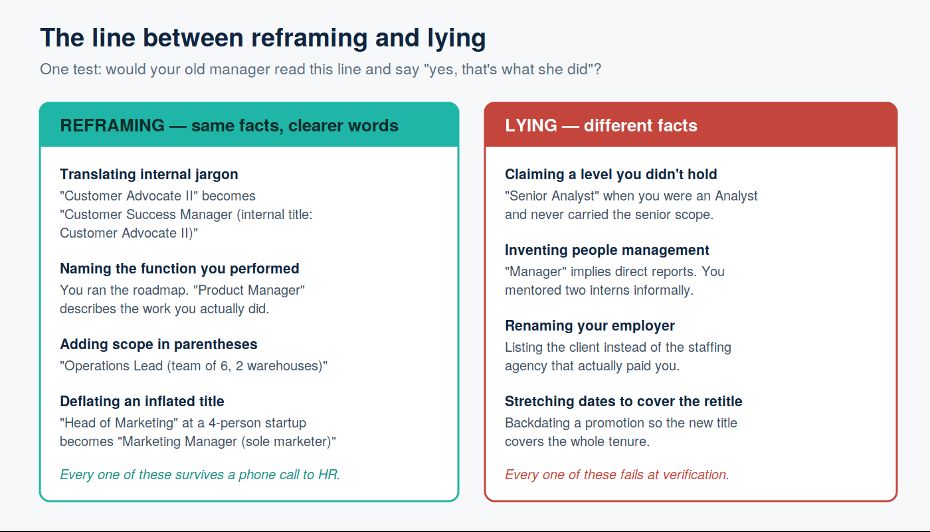
Reframing survives a call to HR. Lying is the thing that gets discovered at the offer stage.
The Four Ways a Job Title Misleads (and the Fix for Each)
Misleading titles fail in four distinct ways, and the fix is different for each. Find yours before you rewrite anything.
Internal jargon is the easiest fix and the one most people get wrong
The instinct is to swap the title entirely. Don't. Keep both, because the internal title costs you one line and buys you complete honesty. If your company genuinely uses a title nobody outside the building recognizes, the parenthetical is doing real work: it tells the recruiter you're translating rather than inflating. For the broader mechanics of how title lines get formatted and scanned, our guide to resume title strategies covers the formats that hold up across industries.
Deflated titles need proof, not just a better label
This is the case where people cross the line without meaning to. Calling yourself a “Product Manager” when the record says “Business Analyst” is defensible only if the bullets underneath make it obvious. If your bullets read "gathered requirements" and "produced reports," the functional title contradicts your own evidence and you've made things worse. The reframe has to be earned in the four lines below it. A tight opening block helps here too, and our breakdown of resume summaries versus objectives covers how to set the frame before the reader reaches your titles at all.
Inflated titles are a bigger liability than deflated ones
Almost nobody volunteers to downgrade their own title, which is why this one gets skipped. But an experienced hiring manager reading "VP of Engineering" on a resume with two years of experience doesn't think you're senior. They think you're either at a company where titles mean nothing or that you're stretching, and both readings cost you. Naming the real scope in parentheses reads as confidence. It says you know what the title is worth and you're not hiding behind it.
Function-hiding titles are a structure problem, not a title problem
If you spent three years at an agency as an "Associate" across eleven clients, the title line alone can't carry it. This one needs the entry restructured, not just relabeled — and the employer relationship has to stay accurate, because listing the client instead of the agency that paid you is the fastest way to fail verification. Our guide on how to list contract work on a resume walks through the four patterns this splits into. If you're changing fields entirely, the title is only part of the translation problem, and our career change resume examples show how to lead with transferable skills when your past titles don't signal fit at all.
The Five-Step Method for Rewriting a Misleading Title
Here's the actual sequence. It takes about ten minutes per role and you only do it once per target job type, not once per application.
1. Pull the target title from five live postings. Open five real job ads for the role you want and write down the exact title each one uses. The repeats are your functional title. Don't invent it, don't improve it, and don't use the version you think sounds better. Use the words that are already in the market.
2. Test it against the honesty question. Would your old manager agree you did that job? If the answer is "mostly, but not the people-management part," pick the version without "Manager" in it. Get this wrong and every later step is building on a lie.
3. Write the dual-title line. Functional title first, official title in parentheses, company on the right. Use "internal title:" or "official title:" as the label. It's four extra words and it removes any suggestion you were hiding something.
4. Rewrite the top two bullets to prove the functional title. If you're claiming Product Manager, your first bullet has to be something only a product manager does, with a number attached. Not "collaborated with stakeholders" — that proves nothing and belongs on the list of resume buzzwords to avoid. Something closer to "Owned the roadmap for two products, shipped 14 releases, cut time-to-first-value from 21 days to 9."
5. Make the same line true everywhere else. Your LinkedIn, your application forms, and your answer in the interview all have to match. A recruiter cross-referencing your profile is the single most likely place this falls apart.
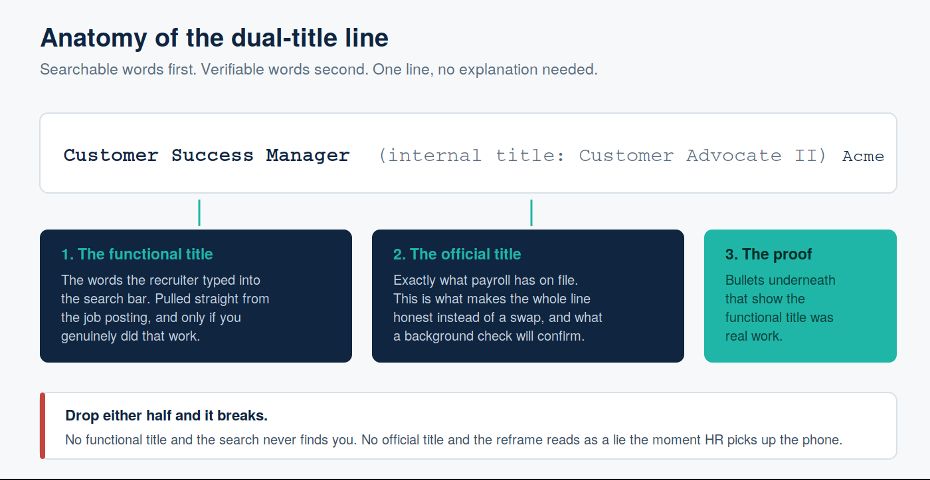
Searchable words first, verifiable words second. Both halves are load-bearing.
The format, in one line
> Functional title (official title: X) — Company | Location | Dates
Searchable + verifiable + provable. Drop any one of the three and the reframe breaks.
One caution on execution: this only works if the ATS can actually read the line. Parentheses, em-dashes, and pipes are fine in a standard single-column layout, but a title line buried in a text box or a two-column sidebar may never get parsed at all, which puts you right back where you started. Our guide to choosing an effective resume format covers the structural rules, and AIApply's Resume Scanner will show you in seconds whether your new title line is being read and whether it matches the target job description's language. That's the specific gap it closes: it tells you if the translation landed before you spend two weeks wondering why nothing changed.
Make the Reframe Consistent Across Every Layer
A reframed title on one document isn't a fix. It's a discrepancy waiting to be found. AIApply sees the same failure repeatedly: someone updates the resume, forgets the profile, and gets asked about it in the second-round interview with no answer prepared.
Your LinkedIn headline is where recruiters check first, and it has more room to work with than a resume line does. LinkedIn's own guidance is explicit that a headline doesn't have to be your current position title, which means the functional title belongs there too, as long as your Experience section backs it up. Our LinkedIn headline examples cover how to phrase this so it reads as positioning rather than a claim. On the profile's Experience entry itself, use the same dual-title convention you used on the resume.
Application forms are the one place to stop reframing. When a form asks for your title at a previous employer, put the official one. That field feeds the verification process directly, and a mismatch there is a discrepancy on a report rather than a translation on a resume. Same principle for anything you sign.
Then decide, in advance, what you'll say when it comes up. Because it will.
What to Say When They Ask About the Title Difference
The question is usually friendly and usually early: "So your resume says Product Manager but I see Business Analyst on LinkedIn — what was the actual role?" The answer is thirty seconds long and has three parts: the official title, why it didn't describe the work, and one piece of proof.
The thirty-second answer
"My official title was Business Analyst — that was the only ladder the company had at the time. In practice I owned the roadmap for two products and ran the release process end to end, which is why I lead with Product Manager on the resume. I've kept the official title on there too so nothing's ambiguous. The clearest example is the checkout rebuild, where I…"
Official title. Why it didn't fit. One proof point. Then stop talking.
Two things make this land. Volunteer the official title before they ask for it, because a candidate who names the gap unprompted reads as candid while a candidate who confirms it reluctantly reads as caught. And never criticize the old employer's title structure. "They were disorganized about titles" is a worse answer than "the ladder didn't exist yet." Our library of common interview questions with model answers covers the adjacent versions of this question, and AIApply's AI Mock Interview lets you rehearse this specific answer out loud against your actual job description, which is the point at which most people discover their reframe sounds shakier spoken than written. If the question lands live and you freeze, Interview Buddy provides real-time on-screen support during video interviews used responsibly, as a prompt for an answer you've already prepared honestly, not a script for one you haven't.
The system view matters here more than any single tactic. A reframed title, tailored proof underneath it, consistent profiles, and a rehearsed answer are four parts of one thing. Fix the title alone and you've moved the failure downstream rather than removed it. AIApply's AI Resume Builder handles the per-role tailoring so the translation stays honest across every version you send, rather than drifting a little further from the truth with each rewrite.
Your Title Is a Translation, Not a Verdict
You are not stuck with a title that undersells you, and you don't have to lie to fix it. You have to translate it into the words the market already uses, keep the original beside it so the translation is checkable, and prove it in the four lines underneath.
Do one thing today: open five postings for the role you want, write down the title they keep repeating, and rewrite one line on your resume in the dual-title format. Then run it through AIApply's Resume Scanner to confirm the new line is being read and matched. Ten minutes, one line, and the search that's been running without you in it starts returning your name.
Frequently Asked Questions
Can I change my job title on my resume?
You can change how your job title is worded, but not what it claims. Rewording an internal or unclear title into the industry-standard equivalent is standard practice and expected. Claiming a seniority level or scope you didn't hold is misrepresentation, and it's the version that fails when the title is verified with your former employer.
Will a background check catch a changed job title?
Yes, in most cases. HireRight's candidate guidance states that employers typically verify job titles and employment dates directly with previous employers, and that discrepancies between what you reported and what comes back get noted on the background report. This is exactly why the dual-title format exists: keeping the official title on your resume means there's nothing left to discover.
What if my job title is completely made up, like "Customer Happiness Ninja"?
Lead with the standard industry title and put the invented one in parentheses. "Customer Support Specialist (internal title: Customer Happiness Ninja)" is honest, searchable, and signals that the odd title was the company's choice rather than yours. Invented titles are the clearest case for the dual-title format because nobody is searching for the original.
Should I put my official title or my functional title on the job application form?
Put your official title on the application form and any document you sign. Application forms feed directly into employment verification, so a functional title there creates a formal discrepancy rather than a resume translation. Keep the reframe on the resume and LinkedIn, where it's presentation, and keep the record exact where it's a record.
My title was inflated at a startup. Should I keep it?
Keep it, but add the real scope in parentheses. "Head of Marketing (sole marketer, 4-person company)" is more credible than "Head of Marketing" alone, because an experienced hiring manager will assume the scope was small anyway and respect you for naming it. Removing an inflated title entirely creates a mismatch with your employment record, which is worse than the inflation.
Does the ATS actually read the parentheses in my title?
Most modern applicant tracking systems parse the full title line, parentheses included, as long as the resume uses a standard single-column layout with recognizable section headings. The bigger risk isn't the parentheses — it's title lines placed inside text boxes, tables, or sidebar columns that some parsers skip entirely. Run the resume through a scanner before you rely on it.
How do I explain a title change without sounding defensive?
State the official title first, give one sentence on why it didn't describe the work, then give one concrete proof point and stop. Volunteering the gap before you're asked reads as candor; confirming it after you're asked reads as damage control. Keep any criticism of the former employer out of it entirely.