How Many Bullet Points Per Job on a Resume?
How many bullets per job on resume? Use 3 to 5 as standard, and 4 to 6 for your current or most relevant role. Entry level jobs get 3 to 4, and jobs 5+ years old get 2 to 3. Cap most jobs at 6; recruiters' first scan averages 7.4 seconds (Ladders, 2018).

How Many Bullet Points for Your Current Job vs. Older Jobs?
Your current or most relevant job gets the most. Depending on your seniority, the answer to “how many bullet points for current job on resume” is between 3 and 6. In general, the older or less relevant the work experience is to the posting, the fewer you give it.
These counts are a guideline, not an applicant tracking system (ATS) rule. They’re aimed at human readers, because, as was mentioned above, you only get a few seconds to catch a recruiter’s attention on their first skim of your resume.
Relevance is also key. An older job may deserve more bullet points than your most recent one if, for example, you took a part-time retail job in between your full-time positions. In that case, the part-time job may only get 1 or 2 bullets, while your last career role gets 3 to 6.
Other guides you read may seem to disagree with those numbers. They don’t. Each gives its recommendation based on different variables, and each one fits a row of the table below. Here are the bullet point ranges for any job:
| Job | Entry level | Mid-career | Senior or executive |
|---|---|---|---|
| Current or most relevant | 3 to 4 | 4 to 6 | 4 to 6; 7 to 8 only by the rule below |
| Ended under 5 years ago | 2 to 3 | 3 to 4 | 3 to 4 |
| Ended 5+ years ago | rare at this stage | 2 to 3 | 2 to 3, or one line |
| Short, unrelated or side job | 1 to 2 | 1 to 2 | 1 to 2, or one line |
How Many Bullet Points Should Be on a Resume Total?
Aim for 10 to 15 bullet points across 3 to 4 jobs on 1 page. Simplify's study found a median of 21 bullet points per finished resume, but that is just what people write, not an actual best practice. If you’re early on in your career, you will land below, and that’s fine.
How long your resume should be, like the number of bullet points comes down to your seniority. For a junior role, 1 page will be plenty. Technical, senior, managerial and executive resumes may be 2 pages. Use 3 pages only when specifically asked.
If you go over the page’s limit, try to fill at least half of the second page by adding jobs rather than more bullet points. If you can’t, do the opposite and trim the resume to 1 page by removing bullet points, rather than jobs. The order in which you should remove them is:
- Oldest job bullet points: The oldest, least relevant information.
- Duty-only bullet points: Information without any specific results.
- Repeating bullet points: Results a newer role already shows.
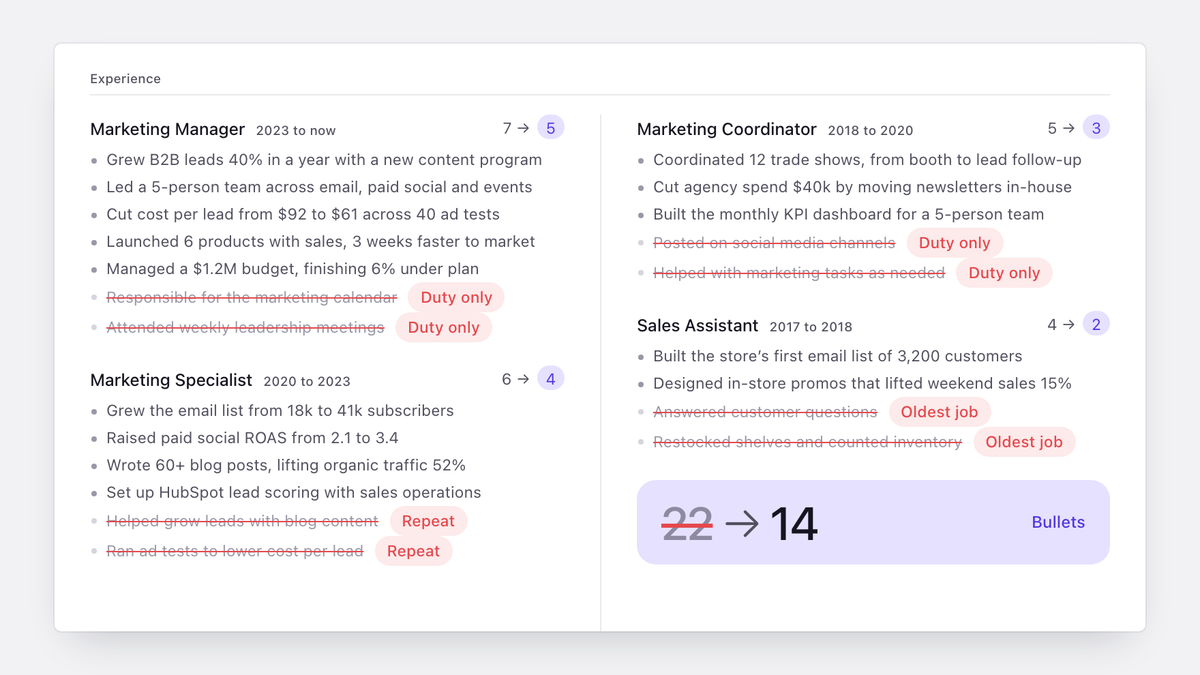
The process applied, shortening a marketing resume from 22 to 14 bullet points:
| Job | Before | After | What goes |
|---|---|---|---|
| Marketing manager, 2023 to now | 7 | 5 | 2 duty-only bullets |
| Marketing specialist, 2020 to 2023 | 6 | 4 | 2 repeats of a newer result |
| Marketing coordinator, 2018 to 2020 | 5 | 3 | 2 duty-only bullets |
| Sales assistant, 2017 to 2018 | 4 | 2 | 2: oldest job, cut first |
| Total | 22 | 14 | 8 bullets |
Is 6 Bullet Points Too Much for a Resume?
No, 6 bullets is fine for your most recent or most relevant role if every bullet shows distinct, outcome-driven impact. It becomes "too much" only if bullets are repetitive or duty-focused. Six strong bullets are better than 4 mediocre ones.
However, past 6 is where additional bullets start to become padding. And on older jobs, this happens even sooner, since they’re often less relevant to the job posting you’re applying to. Thankfully, there are several signs that can tell you a bullet point is unnecessary.
If it describes your duties, doesn’t give specific results, repeats results from a different bullet or gives lines that the job ad ignores, it can be cut. So, the answer to “is 6 bullet points too much for resume” is “no,” as long as they don’t do any of the above.
Is 5 Bullet Points Too Much on a Resume?
No, not for your current or most relevant job once you’re past entry level. Five sits inside that job’s range, so the bullets only need to pass the same test as above. Older jobs get fewer, as the first table shows, so 5 on a job from 2017 is usually too many.
Is 7 Bullet Points Too Much on a Resume?
Yes, on most jobs. Keep your best 6 and cut the weakest, as described earlier. The only exception is a senior role you’ve held for 5+ years, where the extra bullets cover a new team, product or market. If that isn’t you, then cut back to 6.
Is 2 Bullet Points Enough on a Resume?
Yes, for older, short or side jobs. Two bullets are enough to show what you did there without taking space from the jobs that matter more. Your current or most relevant job is different, however. Give it at least 3, so it shows more than one result.
Long Tenure, Promotions & Other Special Cases
Jobs don’t need to have a matching count of bullet points. Each role gets the appropriate number depending on how old and how relevant it is. That means a job with 5 bullets can be directly next to one with just 2. Below is how you deal with special bullet point cases:
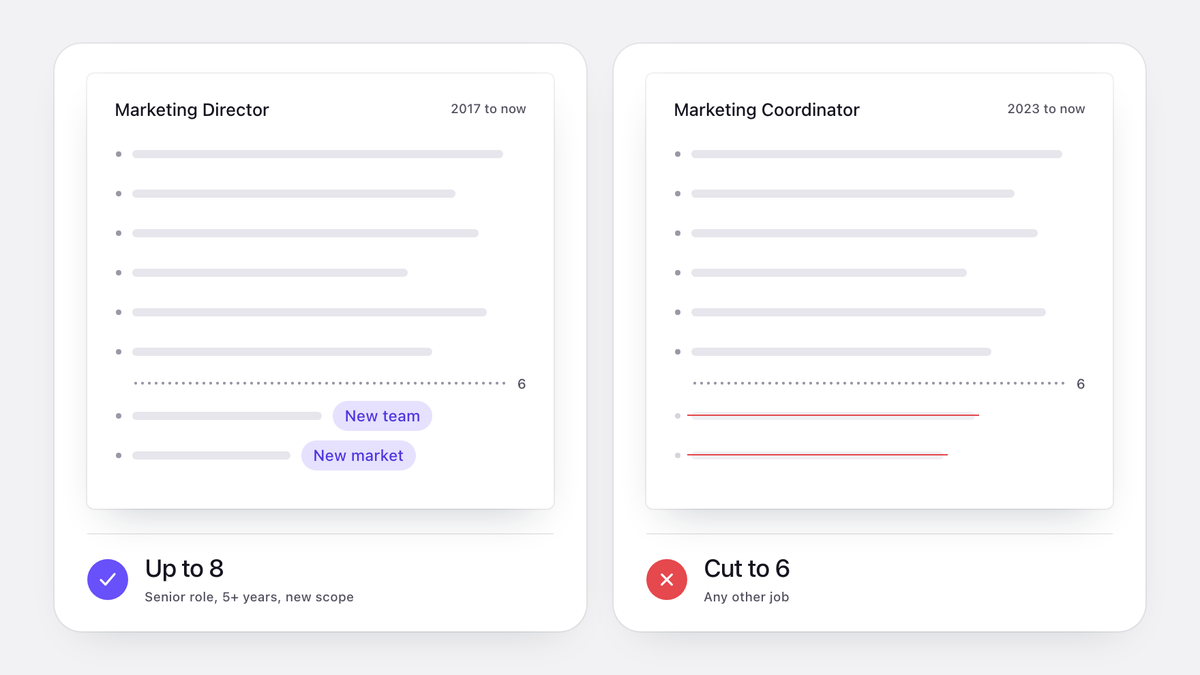
Over 6 bullets only for long senior roles with a new scope.
One Long Job in One Title
Use the bullet range from the first table, even if you’ve spent most of your career in one company. To keep the work experience legible at a glance, group the job’s bullet points under 2 or 3 short labels, such as projects, teams or results.
Promotions at One Employer
List each title with its own start and end dates under the employer, with the number of bullet points increasing with regard to recency and seniority. For example, Senior Product Manager 4 to 6, Product Manager 3 to 4, and Associate Product Manager 2 to 3 bullets.
Short, Contract, or Unrelated Jobs
These usually get a single line with the title, company and dates, with no bullets. However, they are still worth keeping, as long as they cover gaps in between roles. The exception is an internship that’s currently your most relevant experience. Then, treat it as any other job.
Federal Resumes & Academic CVs
There’s no set count for either. A federal resume has a length limit instead, making resumes over 2 pages ineligible for most federal jobs as of September 27, 2025, per the Office of Personnel Management (OPM). OPM recommends condensing the most relevant and recent experience into 2 pages.
An academic CV, on the other hand, follows the norms of its field, so check what’s standard in yours. The 3 to 5 rule in this guide is for job resumes, not CVs.
How Long Should Resume Bullet Points Be?
A bullet point should be 1 to 2 lines long. In Ladders’ 2018 study, longer sentences performed worse simply on the account of being difficult to read. A better resume bullet formula is to start with an action verb and end on a measurable result.
The verb tells the reader what you did at a glance, and the result is what they’ll remember. Everything in between is context, from the project to the tool or the team. If a bullet wraps into 3 lines, it’s usually trying to do too much. Split it into two or cut the context.
A popular alternative structure is the XYZ formula from Laszlo Bock, Google’s former head of people operations. “Accomplished [X], as measured by [Y], by doing [Z].” This formula leads with the result instead, so it’s the opposite of action first, result last.
Either option works, as long as it starts with a verb and the result is a real number you can defend. Scope numbers, such as team size, budget, customers or volume are often easier to prove than percentages. Here are the two formulas applied:
| Sample | Responsible for the company’s email newsletter. |
|---|---|
| Verb-First | Launched a weekly product roundup that grew newsletter subscribers from 4,000 to 11,000 in a year. |
| XYZ | Grew newsletter subscribers from 4,000 to 11,000 in a year by launching a weekly product roundup. |
How Do You Choose Which Bullet Points to Keep?
Keep the bullets that match the job ad and show a result. Every other line competes for the same few seconds of attention, so the best bullet points on a resume are the ones that answer what the employer asks for. The Bullet Budget Method turns that into 4 steps:
| Step | What to do |
|---|---|
| 1. Dump | 8 to 12 raw bullets per job; stuck? Draft them with the generator. |
| 2. Score 0 to 3 | 1 point each: matches the job description; shows a result, not a duty; has a number (scale, baseline, time) |
| 3. Cap | keep the top scores, up to that job's count in the first table |
| 4. Order | strongest first |
If you’re stuck at step 1, you can draft them from the job description with AI Resume Bullet Point Generator. It’s free, needs no sign-up and turns your job title, the job description and a few notes on your work into bullets you can edit.
Score honestly. A bullet that matches the job ad but has no result or number scores 1, and it’s usually the first to go when a job is over its count. Repeat the steps for every job you’re keeping, starting with your current one.
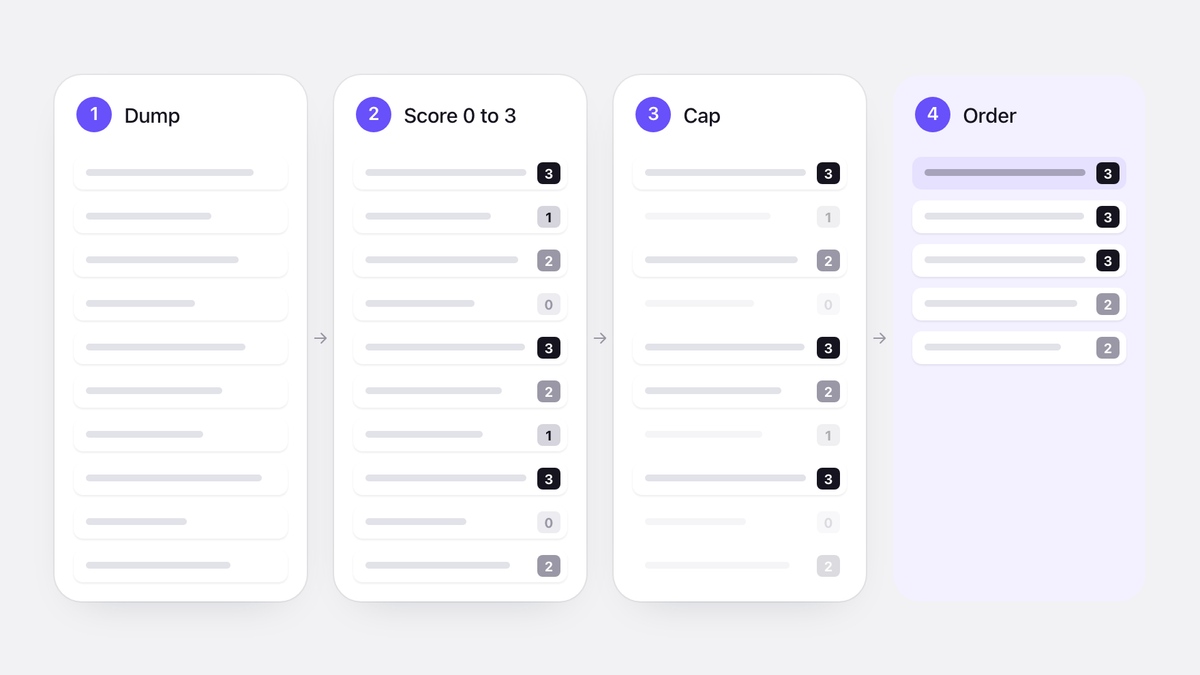
Step 3 caps are maximums; the first table gives your count.
Check Your Bullet Points Against the Job Ad
Before you send your resume, check it against the posting you’re applying to. AI Resume Scanner compares your resume with the pasted job description and flags missing skills and keywords, so you can see what your bullets don’t cover yet. A scan is free to try.
Scan your resume against a job ad
FAQ: Quick Answers on Resume Bullet Points
What is the 7 second rule in resume?
A 7.4-second first scan: clear job titles and your best result first. The rule comes from the Ladders eye-tracking study, which found recruiters spend an average of 7.4 seconds on their first scan of a resume. In that time, they focus on job titles more than anything else, so make yours easy to spot and put your strongest bullet at the top of each job.
Is it unprofessional to have bullet points on a resume?
No: in the Ladders study, bulleted results did well. Resumes that paired bold job titles with bulleted lists of accomplishments performed best, while those cluttered with long sentences performed worst. Use bullets for your work experience, and save full sentences for your summary.
How many bullet points per job on a software engineer resume?
Same counts; name project, tech stack and scale. Software engineers follow the same table as everyone else. What changes is the content: each bullet should name the project, the stack you used and the scale it operated at, such as users, requests or data volume. For example: “Rebuilt the checkout service in Go, handling 2 million requests a day.”