How Long Should a Resume Be (2026)
Wondering how long your resume should be? Learn why the 1-page rule is outdated, what recruiters prefer in 2026, and how to choose the right length.


You've probably heard the old "one page only" rule. And you've also probably heard that's outdated. So which is it?
Here's the straight answer: For most job seekers in 2026, your resume should be 1-2 pages, with a strong trend toward 2 pages if you have more than a few years of experience. Early-career professionals (0-2 years) can usually fit everything on 1 page, while mid-career and senior professionals (3+ years) typically need 2 pages to showcase their qualifications effectively.
But that's not the whole story. There are important exceptions and nuances that could make or break your application. Let me walk you through exactly how to determine the right length for your situation, backed by the latest data from recruiters and hiring professionals.
Why Does Resume Length Matter?
Resume length isn't some arbitrary tradition. It's rooted in practical realities about how hiring actually works.
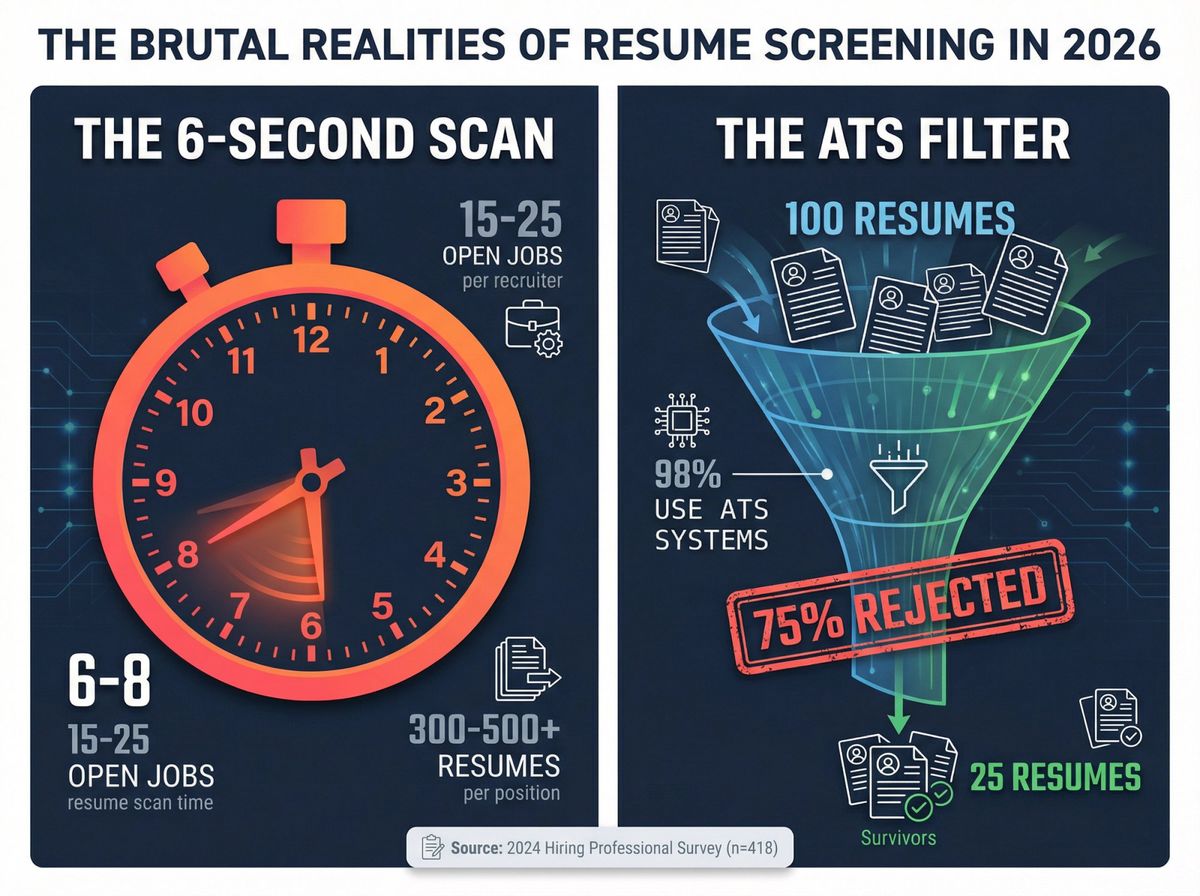
Recruiters spend an average of 6-8 seconds on an initial resume scan. That's it. In those few seconds, they're trying to determine if you're worth a closer look. And they're doing this while managing 15-25 open jobs and reviewing 300-500+ resumes per position, according to Tufts University Career Center.
This creates brutal triage conditions.
A 2024 survey of 418 hiring professionals found that 47% spend just 30 seconds to 1 minute on initial resume review, with another 33% spending only 10-30 seconds. Around 98% of large companies use Applicant Tracking Systems (ATS) to filter resumes, and approximately 75% of resumes get rejected by these systems before a human ever sees them.
So resume length matters because:
→ Humans skim relentlessly. Anything that looks like too much work gets punished.
→ ATS systems don't inherently hate 2 pages. But they do penalize messy formatting, weird layouts, and missing keywords. Length becomes an issue when it comes at the cost of readability or proper formatting.
→ Your best stuff needs to jump out immediately. If important qualifications are buried on page 3 or crammed into tiny font, they might as well not exist.
The real battle isn't "1 page vs 2 pages." It's signal per inch. Every line needs to earn its space by demonstrating something valuable about you.
What Resume Length Do Recruiters Prefer?
If you're still clinging to the one-page rule, you're working from outdated information. Modern hiring data tells a very different story.
The Research That Changed Everything
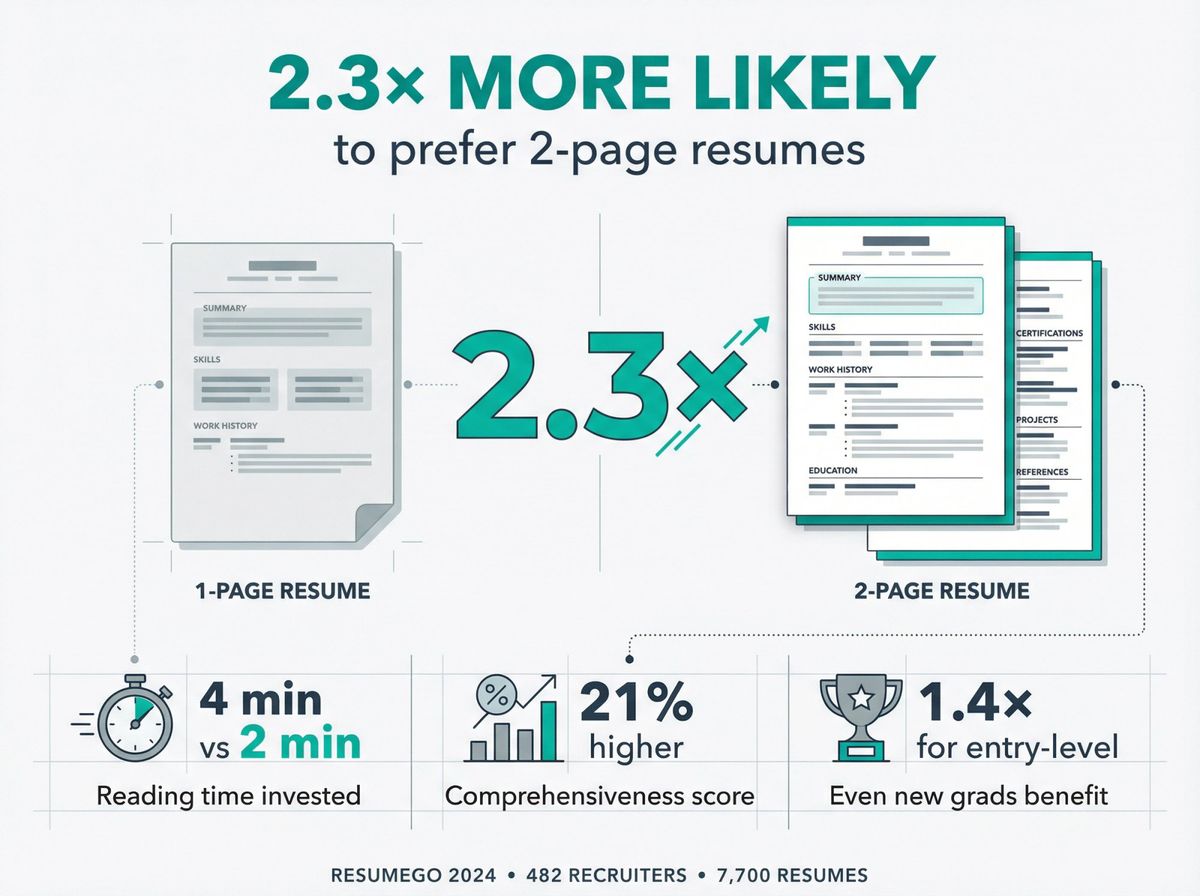
In a landmark 2024 study, ResumeGo ran a hiring simulation with 482 recruiters reviewing about 7,700 resumes. The results were striking:
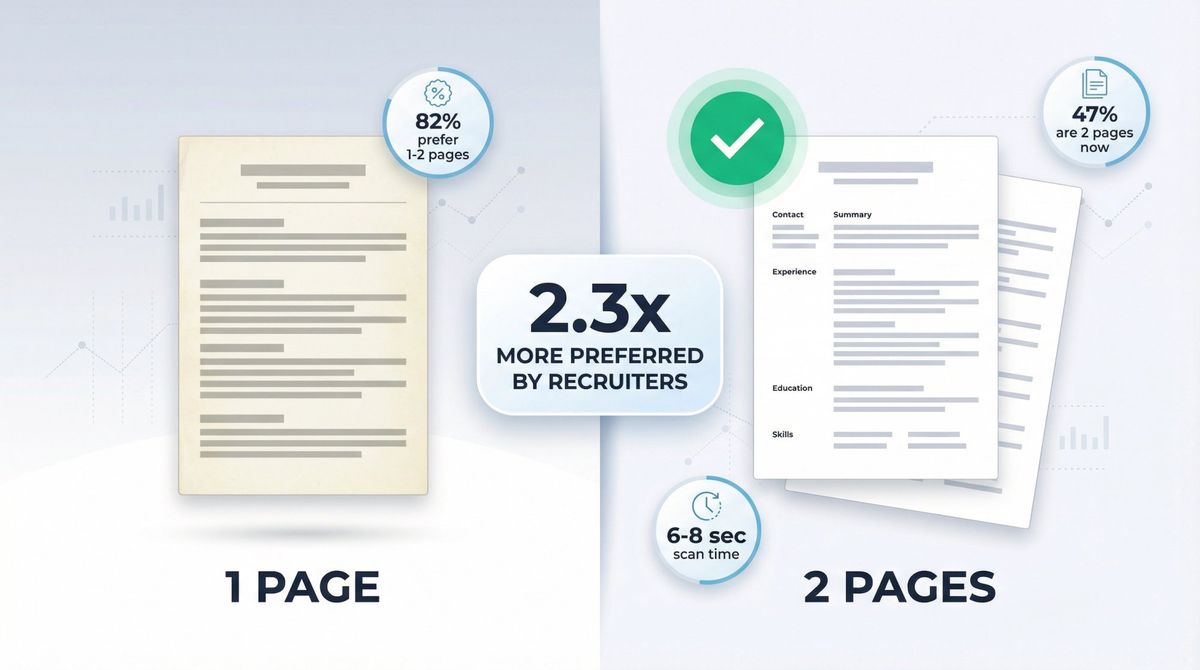
Recruiters were 2.3 times more likely to prefer two-page resumes over one-page resumes.
Even more surprising: for entry-level positions, employers were 1.4 times as likely to prefer two pages over one. This completely contradicts the old advice that new grads must squeeze everything onto a single page.
Why the preference for two pages? Two-page resumes:
• Scored 21% higher in recruiter ratings for "providing a comprehensive summary of the candidate"
• Had recruiters spending more than twice as long reading them (about 4 minutes vs. 2 minutes for one-pagers)
• Offered more breathing room for readable fonts and white space
Instead of skipping the second page, recruiters actually invested more time in those resumes. A well-filled two-pager held attention better than an abbreviated one-pager.
What HR Professionals Say Today
Recent surveys confirm this trend:
A 2025 survey of 1,013 HR professionals found that 82.1% say the ideal resume length is 1-2 pages, with 51% specifically preferring two pages. Only about 31% still said a single page is best.
Similarly, FlexJobs reported that 90% of recruiters actually prefer a two-page resume in general.
Analysis from Enhancv shows the current reality: nearly half of resumes (47%) are two pages, 43% are one page, and about 10% are longer.
The one-page resume rule is fading fast as a universal standard.
What This Means for You
Does this mean everyone should automatically use two pages? Not exactly.
It means you shouldn't fear a second page if you truly need it to showcase relevant experience. The old advice to truncate everything to one page is outdated, especially if you have more than a few years of work history.
Most mid-level and senior professionals will have a stronger resume at two pages than they would by cutting back to one. But if you're early in your career or your experience is very focused, forcing your resume to two pages when you only have enough great content for one would be counterproductive.
The goal isn't length for its own sake. It's using the right length to tell your professional story effectively.
How to Choose the Right Resume Length
Let's cut through the noise with a practical decision tree you can use right now:
Step 1: Check for Employer-Specific Requirements
If the job posting specifies a length, follow it. This is non-negotiable. Harvard Career Services emphasizes that employer specifications always supersede general advice.
Step 2: Identify Special Format Requirements
Applying to US federal jobs through USAJobs? There's now a hard 2-page maximum. The USAJobs help center confirms that federal agencies only accept resumes up to two pages, and the system won't let you upload or build anything longer. OPM guidance implemented this restriction starting September 27, 2025.
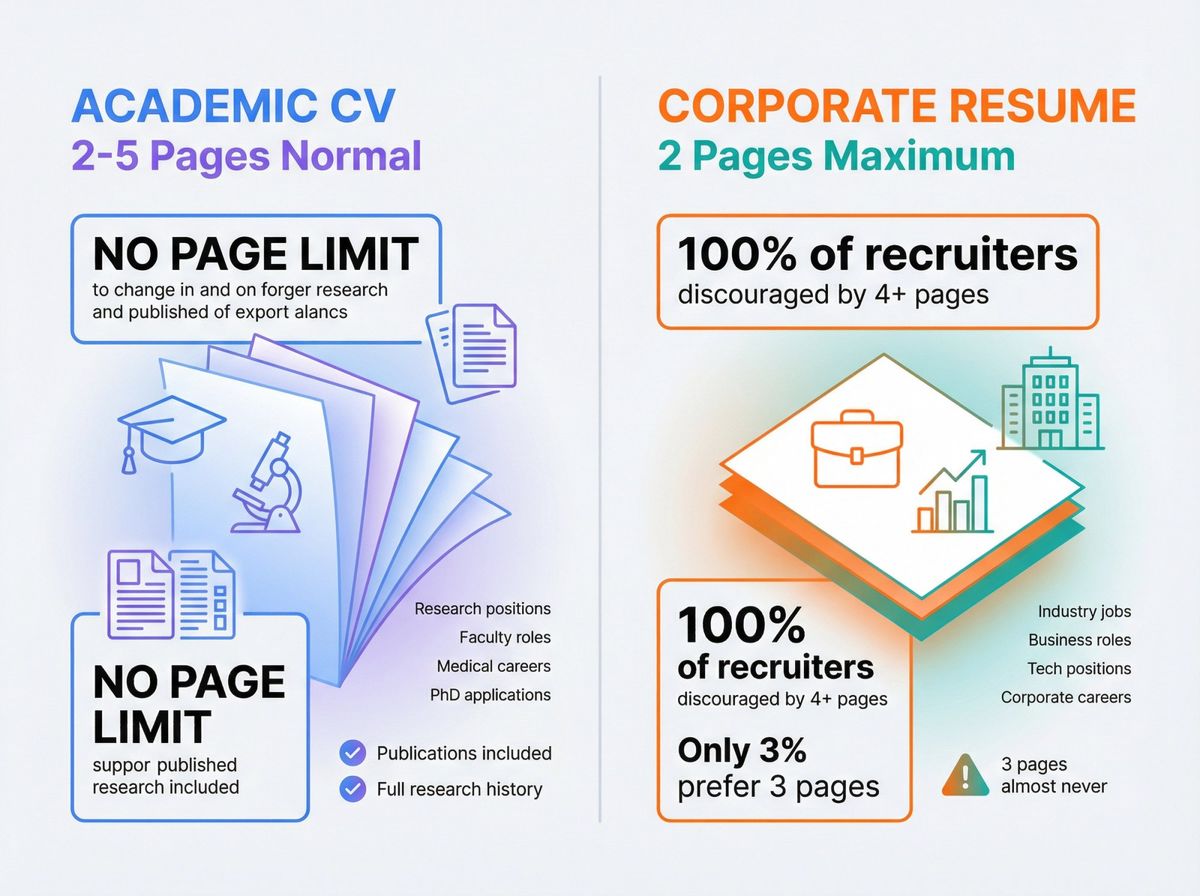
Applying to academic or research positions? You'll likely need a CV (Curriculum Vitae), not a resume. Harvard Career Services notes that academic CVs have no page limit, and "most graduate student CVs are two to five pages." In academia, being comprehensive is valued over brevity.
Step 3: Use This Experience-Based Guide
If no special format applies, use this table to determine your target length:
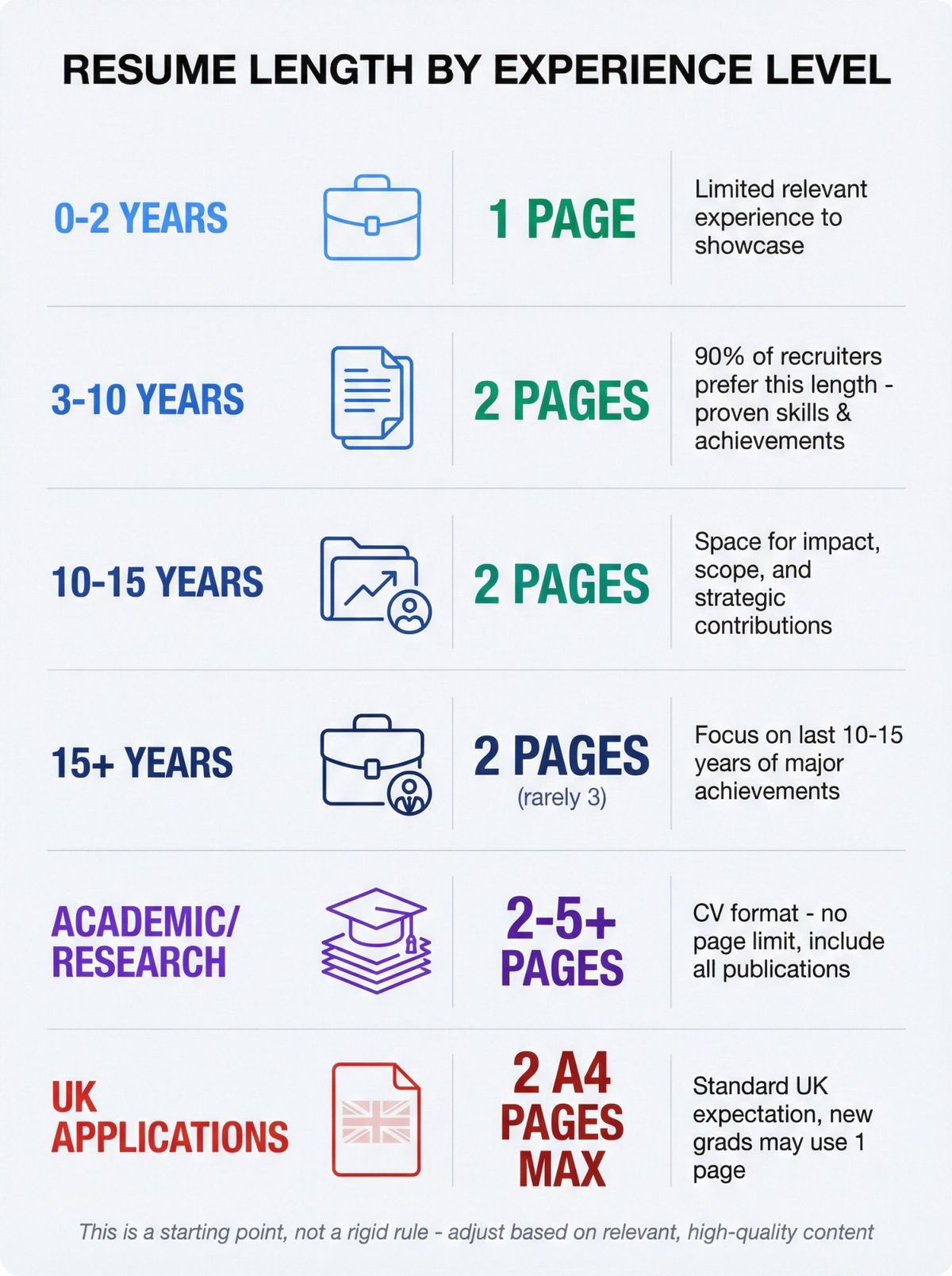
| Your Experience Level | Typical Resume Length | Why |
|---|---|---|
| 0-2 years (student, new grad, entry-level) | Usually 1 page | You typically don't have enough relevant experience to justify page 2 yet. Indeed confirms this is standard for students and new grads. |
| 3-10 years (mid-career professional) | Typically 2 pages | Around 90% of recruiters prefer two pages at this level. You've developed enough skills and accomplishments to warrant the space. |
| 10-15 years (senior professional, team lead) | Usually 2 pages | Coursera notes this is common for leadership roles. You need space to demonstrate impact, scope, and strategic contributions. |
| 15+ years (executive, C-level) | 2 pages (rarely 3) | Even senior leaders typically stick to 2 pages focused on the last 10-15 years of big achievements. Only use 3 pages if you have highly relevant accomplishments that truly require it. |
| Academic/Research | 2-5+ pages (CV format) | No page limit for academic CVs. Include all publications, research, grants, teaching, conferences, etc. |
| UK Applications | 2 A4 pages maximum | Indeed UK states this is the standard expectation, though new grads may use 1 page. |
This is a starting point, not a rigid rule. The right length depends on how much relevant, high-quality content you have to share.
When to Use a One-Page Resume
A one-page resume can be perfectly appropriate. And sometimes it's actually better than a mediocre two-pager.
You should strongly prefer 1 page if:
- You're a student, recent graduate, or in your first few years of career
- Your last 2-3 experiences already prove you can do the job you're applying for
- Your "extra" content consists mostly of generic skills lists, coursework that doesn't map to the role, old internships that repeat the same story, or hobbies that don't differentiate you
Harvard Graduate School of Arts and Sciences notes that one page is the norm for BA/BS, MA/MS, and MBA candidates.
What a Killer One-Page Resume Contains
When done right, a one-page resume is tightly focused and impactful:
1. Professional headline (2-3 lines)
Not an "objective statement." Think: your role + domain + 1-2 proof points that show you're worth talking to.
2. Skills section (targeted and honest)
Only include skills you'd be comfortable being tested on. No fluff.
3. Experience (most recent 1-2 roles get the spotlight)
Coursera recommends 3-5 bullets per role to avoid bloat. Your most recent position gets 4-5 bullets; previous role gets 3-4; older roles can be summarized or have just 1-2 bullets.
4. Education
Keep it short unless you're early career and it's your strongest asset.
5. Projects or leadership (optional)
Only include if it directly supports the job you're applying for.
How to "Earn" a Bullet Point
Every bullet should do at least one of these things:
• Show impact (metric, delta, outcome)
• Show scope (team size, budget, traffic, revenue, users, geography)
• Show hard skills you'll use on day 1
• Show leadership (decisions, influence, ownership)
If a bullet is just describing a job duty without demonstrating any of the above, it's probably wasting precious space.
When to Use a Two-Page Resume
For most professionals beyond the entry level, two pages isn't just acceptable. It's often the stronger choice.
Use two pages when page 2 adds new proof, not just "more words."
Good reasons to use 2 pages:
- You have 10-15 years of relevant experience and you're applying for leadership roles (Coursera explicitly notes this scenario)
- You have multiple roles with non-overlapping wins that matter for this job (for example: product management + growth + partnerships)
- You're in a field where proof takes space (engineering projects, consulting case impact, sales performance, security clearance history, certifications)
- You're a PhD candidate applying to non-academic roles and need to translate research into business outcomes
The "Page 1 Must Stand Alone" Rule
Even with two pages, the first page should be enough for someone to say:
• "This person can do the job"
• "This person has done similar work"
• "This person is worth a phone screen"
Page 2 should deepen the case (more wins, more scope, additional context), not introduce the core case for the first time.
Put your strongest and most relevant qualifications on page 1. Page 2 provides supporting detail for readers who want to dig deeper.
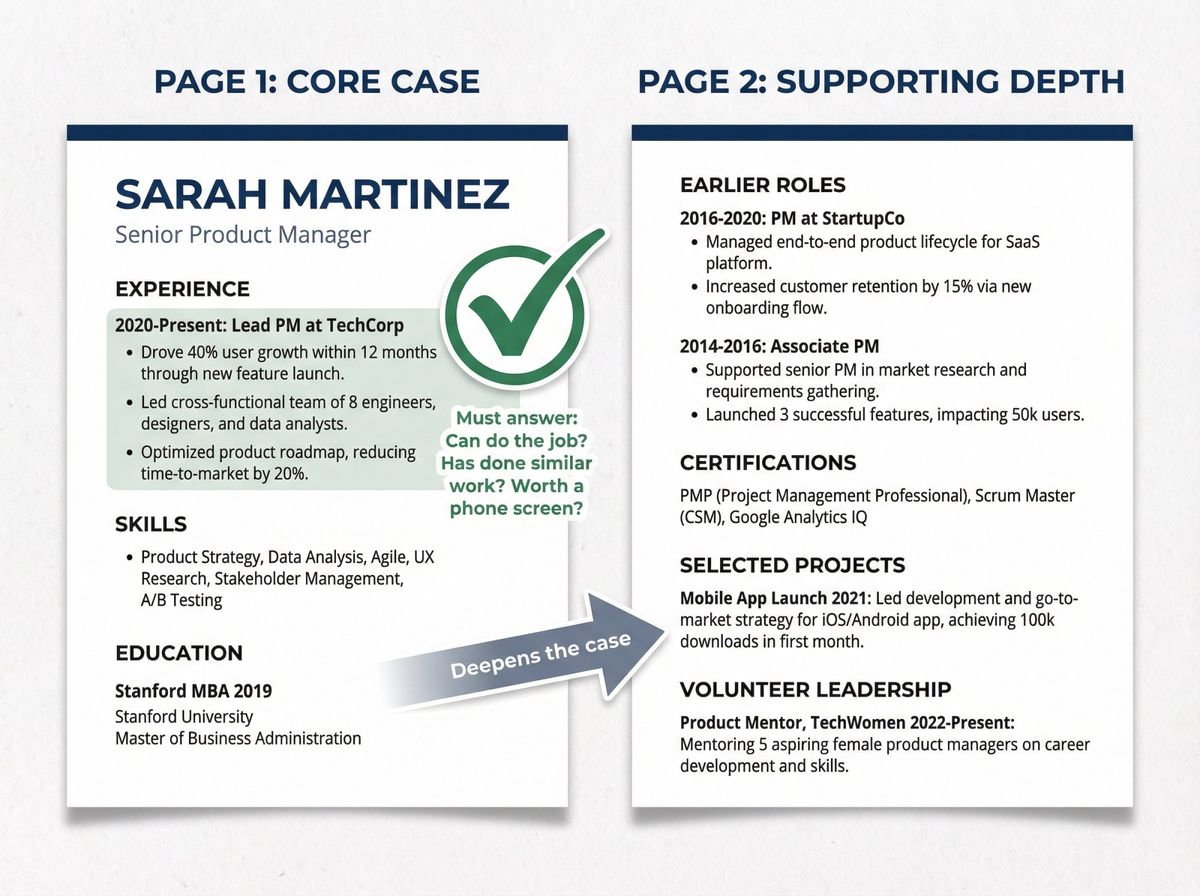
What Belongs on Page 2
Keep page 2 high-signal:
- Earlier roles (compressed versions focusing on key achievements)
- Selected projects (especially if portfolio matters)
- Relevant certifications and licenses
- Publications or patents (only if relevant, and usually summarized unless it's a CV)
- Awards, speaking engagements, leadership roles, or volunteer work (only if they align with the role)
Don't use page 2 for filler or a long list of references.
Is a 3-Page Resume Too Long?
Almost Never for a Standard Resume
Coursera is direct: you should almost never submit a 3-page resume unless your industry specifically expects it. Even with decades of experience, most non-executive professionals should target two pages.
In fact, 100% of recruiters are discouraged by resumes over 4 pages. And only 3% of recruiters said a 3-page resume is ideal in their survey data.
Many hiring managers stop reading after 2 pages for seasoned candidates, expecting a concise summary of highlights rather than an exhaustive chronology.
Yes for Academic CVs
If you're applying for academic, research, or medical roles that specifically request a Curriculum Vitae (CV), the length rules change completely.
Academic CVs have no page limit. Harvard notes that "most graduate student CVs are two to five pages." A five-page CV for a PhD with several publications is perfectly normal.
Critical distinction: If you're in academia, use a CV format and don't worry about page count. But if you're applying to industry jobs with a PhD, then create a 1-2 page resume that distills your most relevant accomplishments. Companies won't read a 10-page academic CV.
The Question to Ask Yourself
If your resume is approaching page 3 for a corporate job, ask yourself:
Is this actually a CV, or is this a resume that hasn't been edited?
Most of the time, it's the second one. The solution is selective editing, not justifying the length.
Federal Resume Page Limit: 2 Pages Maximum
This is important because it's not advice. It's a rule with consequences.
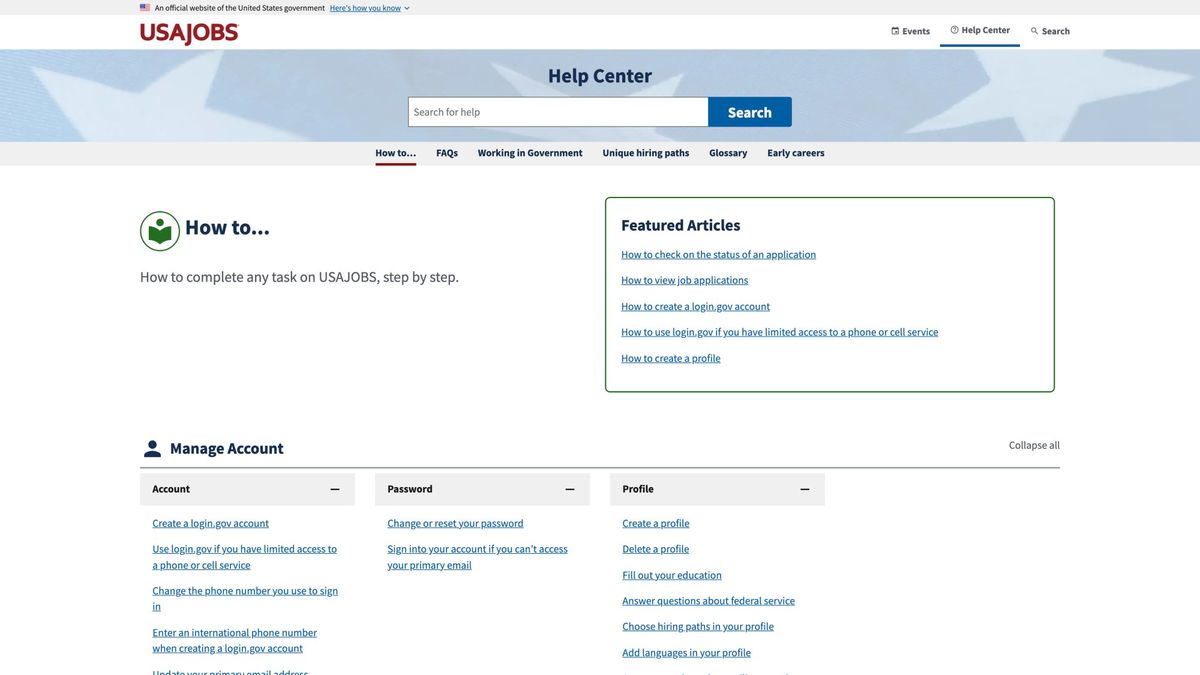
As of September 27, 2025, USAJobs restricts all resumes to two pages. OPM's official guidance states that the two-page limit applies broadly to Title 5 announcements, and USAJobs won't let you upload or build anything longer.
If you're applying to federal roles in 2026, treat two pages like a hard wall. You can still attach other documents if the announcement specifically tells you to, but don't try to sneak in a longer "resume" and hope it gets through. The system will block it.
This is a significant shift. Before 2025, federal resumes often ran 3-5 pages with exhaustive details (duties, hours per week, supervisor contacts, etc.). That's no longer possible through USAJobs.
Resume Length by Country: UK vs US Standards
Resume terminology and length expectations vary globally, which creates confusion.
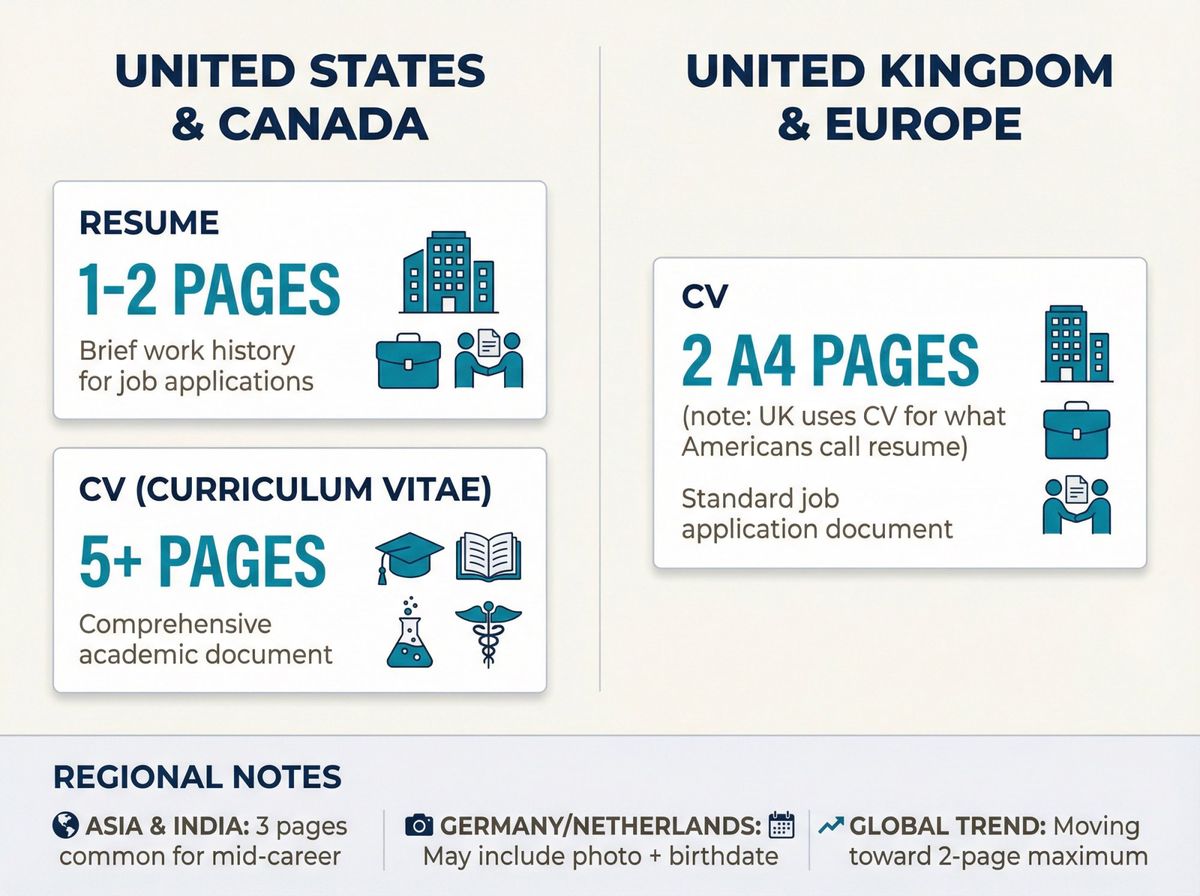
Understanding the CV vs Resume Distinction
In the United States and Canada, we use:
• Resume = brief 1-2 page work history document for job applications
• CV (Curriculum Vitae) = comprehensive academic document (often 5+ pages) used for faculty, research, or medical positions
But in the UK, Europe, and most other countries, they use "CV" to mean what Americans call a resume. It's the standard 1-2 page document for job applications, not an exhaustive academic record.
Prospects.uk clarifies that UK CVs are "generally no longer than two A4 pages." Reed.co.uk confirms the same: two pages is the norm in the UK, with one page acceptable for new grads and rarely three pages for very experienced candidates.
Regional Expectations
United States and Canada:
Expect a brief 1-2 page resume for nearly all industry jobs. Cornell University emphasizes that resumes here are "short, targeted documents designed to win interviews." Only academic or federal roles use different formats.
United Kingdom and Europe:
The standard "CV" for job applications is about 2 A4 pages. Some countries (like Germany or the Netherlands) may include a bit more personal information (photo, birthdate in some cases), which can extend length slightly. In some fields and countries, a 3-page CV isn't unusual for senior managers. But by and large, 1-2 pages is safe across Europe.
Other Regions:
Some countries have more tolerance for longer CVs. In India and parts of Asia, it's not uncommon to see 3-page CVs even for mid-career professionals. Similarly, in countries like Nigeria or South Africa, longer CVs (3-4 pages) have been more historically accepted.
That said, even in these markets, the global trend is moving toward conciseness. Multinational employers abroad still appreciate brevity. When in doubt, lean toward 2 pages maximum unless told otherwise.
Photos on Resumes
One note: in the US, 88% of recruiters reject resumes with photos due to bias concerns. Americans save that space for content.
But in many European, Asian, or Latin American countries, a small passport-style photo on your CV is standard. If you're applying in a country where that's expected, factor it into your layout so it doesn't push important content to an extra page unnecessarily.
Resume Readability vs Length: What Matters More?
The value of your resume is in its content, not its length.
A one-page resume that's unfocused or missing key information will flop. A two-page resume full of relevant, impactful achievements will win interviews. And a three-page resume full of fluff can hurt you more than a tight two-page version.
As AIApply's CEO puts it: "A resume should be as long as needed to prove you're qualified, and as short as possible to keep it skimmable.
Focus on Signal, Not Length
Indeed notes (updated December 3, 2025) that resume length is less important than readability and content quality. It's okay to go multi-page if the information is truly relevant, though page 1 still gets the most attention.
Some data backs this up: TalentWorks found that resumes around 500-600 words (roughly 1.5-2 pages) had the highest interview rates. But only 23% of resumes fell in that optimal range. Most candidates either provide too little or too much information.
The sweet spot tends to be two pages worth of targeted content. Enough to convey your value, but not so much that it dilutes your key qualifications.
Quality Principles
Prioritize relevance. Tailor your resume to the specific job. Include experiences, skills, and accomplishments that directly align with the job requirements. Remove or downplay anything that isn't helpful for this role.
Recruiters care most about what's relevant to them. Resumes that read like a "custom pitch" for the job tend to avoid length issues and get 3 times more interviews than generic ones.
Avoid filler and redundancy. Be ruthless about eliminating fluff. Common space-wasters: outdated skills (everyone assumes you know Microsoft Word), generic statements like "responsible for XYZ" without context, and over-detailed descriptions of very old or junior roles.
Focus on achievements and results, not tasks. This both tightens your resume and makes it more impressive.
Be concise and specific. Use bullet points with active language and concrete results. Numbers and specific outcomes let you cut explanatory fluff. Most bullets can be one to two lines.
Don't shrink the font to cheat the limit. Multiple credible sources agree on font size:
Indeed recommends keeping font size between 10 and 12. Harvard Graduate School of Arts and Sciences suggests 10-12 point font. Prospects similarly recommends 10-12 and warns against shrinking margins to cram more in.
If you're using 9-point font or smaller, that's a sign you should be using two pages (or cutting content), not a sign to grab a magnifying glass.
Clean, readable formatting with some white space is crucial: 98.8% of recruiters value clean formatting. They'd prefer you go onto a second page than create a cluttered, hard-to-read single page.
Actually, when recruiters read resumes, they ended up favoring the more spacious two-page layouts because they were easier on the eyes, even when they initially hypothesized they'd prefer one-pagers.
Make the first page count. Regardless of total length, page 1 is prime real estate. It should contain your most important selling points: contact info, professional headline, key skills, and your most recent and relevant experience.
If you have a second page, anyone skimming just the first page should still get the gist of your strongest qualifications. Front-load your resume with the content that matters most.
How to Shorten Your Resume Without Losing Value
Need to trim your resume? Here's how to do it while actually increasing quality.
Step 1: Build a Target Evidence List
Write down 8-12 things the job needs. Pull them straight from the job description: skills, tools, outcomes, experience types.
If a bullet doesn't support one of those needs, it's guilty until proven innocent.
Step 2: Convert "Duties" into "Results"
Coursera explicitly recommends focusing on achievements rather than duties. Indeed recommends 2-3 quantified achievements per role rather than listing every duty.
Example rewrite:
Before: "Responsible for managing social media accounts and creating content to increase engagement."
After: "Grew Instagram engagement 38% in 90 days by shipping 4x/week content plus weekly A/B tests."
Same truth. Way more signal.
Step 3: Cap Bullets Per Role
A sensible default:
• Most recent role: 4-6 bullets
• Previous role: 3-5 bullets
• Older roles: 1-2 bullets (or even just title/company if largely irrelevant)
Step 4: Compress Older Experience
Prospects suggests that if something is old detail from about 10 years ago, you should summarize it rather than detailing it fully.
You don't get infinite space for being alive. Compress or cut.
Step 5: Delete These Almost Every Time
- "References available upon request" (Prospects notes you can drop this if you need space; employers assume it anyway)
- Generic soft skills without proof ("hardworking", "team player")
- High school (once you're in or through university)
- Unrelated hobbies (unless they're a genuine differentiator for the role)
Step 6: Avoid ATS-Hostile Formatting "Hacks"
Some people try to "save space" with columns, tables, text boxes, or graphics. This can backfire.
AIApply's ATS checker explicitly flags common formatting issues like tables, text boxes, headers/footers with important info, images/graphics, and multiple columns. These elements can break parsing in Applicant Tracking Systems.
The meta-rule: Don't trade 2 inches of space for broken parsing.
How to Make Your Resume Longer (Without Adding Fluff)
If your resume feels thin, your goal isn't to make it longer. It's to make it more specific.
Easy ways to add substance:
- Add 1-2 more high-impact bullets per recent role (only if real)
- Add projects with measurable outcomes (especially valuable for students and career switchers)
- Add tools/stack that matches the job (but only if you can actually use them)
- Add leadership/ownership examples (mentoring, leading a launch, running a process)
- Add relevant certifications (only when they're requested or meaningful to the role)
Coursera's examples show how consolidating and rewriting bullets can make you shorter and stronger. But the same technique works in reverse: expand with proof, not prose.
Why 1.5-Page Resumes Look Unfinished
People obsess about "one vs two," but recruiters also react negatively to "weird" lengths.
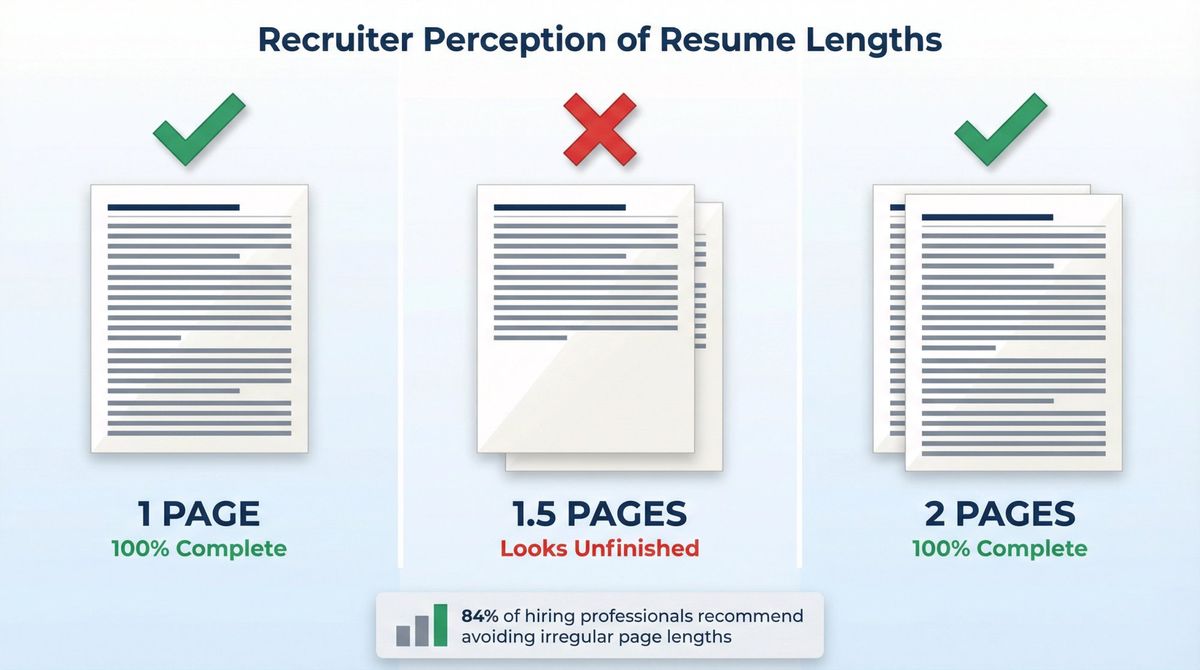
In ResumeGo's 2024 survey of 418 hiring professionals, 67% said they often see irregular lengths (like 1.1 or 1.5 pages). A majority said it hurts the candidate's image at least a little, and 84% recommended actively adjusting to avoid irregular page lengths.
Practical advice:
If you're at 1.1 pages, either cut to 1 or expand to 2 with real proof. Don't leave a sad half-page that screams "I didn't finish editing."
Resume Formatting Tips for Any Length
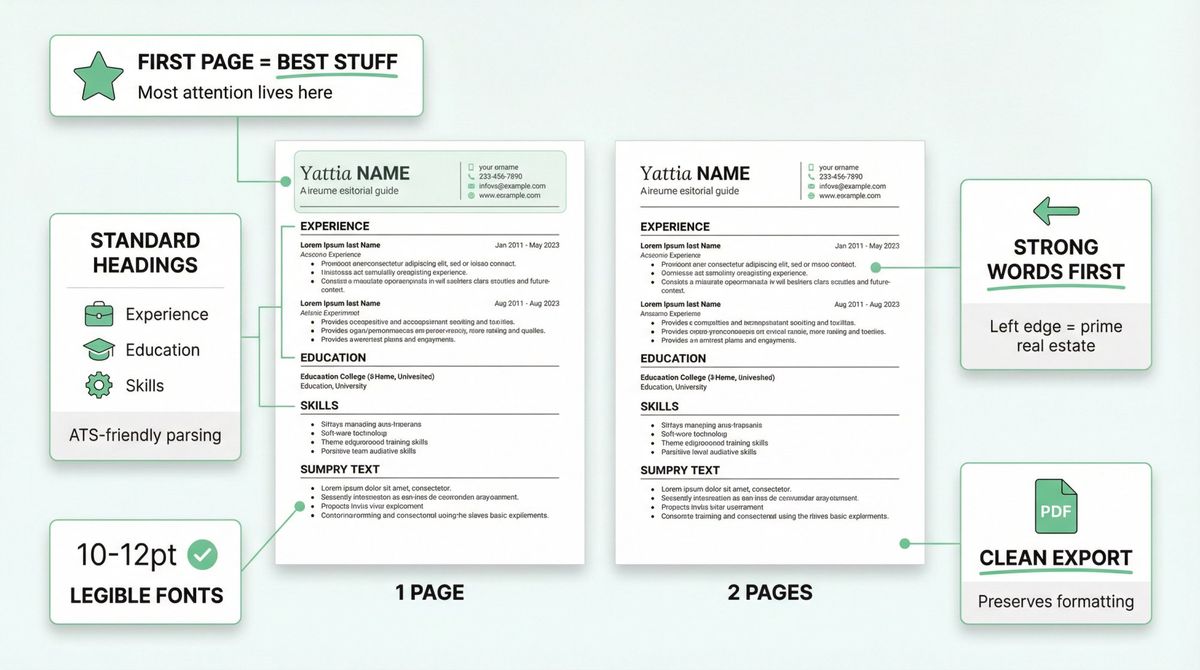
These principles apply regardless of whether you're writing 1 page or 2:
• First page = best stuff. Most attention lives there. (Indeed confirms page 1 gets the most focus)
• Keep section headings standard (Experience, Education, Skills). AIApply's ATS checker recommends this for optimal parsing.
• Put strong words early in each bullet. Tufts notes that recruiters often skim the left edge and first words of each line.
• Keep it legible: 10-12pt font, reasonable margins (0.5-1 inch is standard).
• Save/export cleanly. Usually PDF unless told otherwise. AIApply's format guidance notes PDF preserves formatting, but follow application instructions if they require DOCX.
How AI Resume Builders Help You Find the Perfect Length
The fastest way to hit the right length is to separate two things:
• A master resume (everything you've done; length doesn't matter here)
• A target resume (the one you actually submit: 1-2 pages, job-specific)
AIApply fits neatly into that workflow:
Start from a clean, ATS-friendly template. AIApply's resume templates ensure your page count is stable and parsing doesn't break. Professional formatting means recruiters can actually read your content, whether it's 1 page or 2.
Tailor to the job description. AIApply's ATS checker explicitly asks you to paste the job description to do keyword matching and compatibility analysis. This helps you trim bloat while ensuring you're not missing critical keywords that matter for this specific role.
Scan for missing keywords and formatting issues. AIApply's Resume Scanner is built for exactly that kind of "trim without losing relevance" loop. It identifies what's working and what's not before you submit.
Generate job-specific versions fast. AIApply's Resume Builder uses GPT-4 and Azure's Natural Language Processing to help you create tailored versions quickly. Then you edit like a human: cut filler, add proof, adjust length as needed.
The point isn't "AI writes your resume." The point is: you can ship more tailored, higher-signal versions without spending your life in formatting hell. You maintain control while automating the tedious parts.
And when you're ready to apply at scale, AIApply's Auto Apply can submit customized applications to hundreds of jobs while maintaining the right resume length and format for each one.
Resume Length FAQs
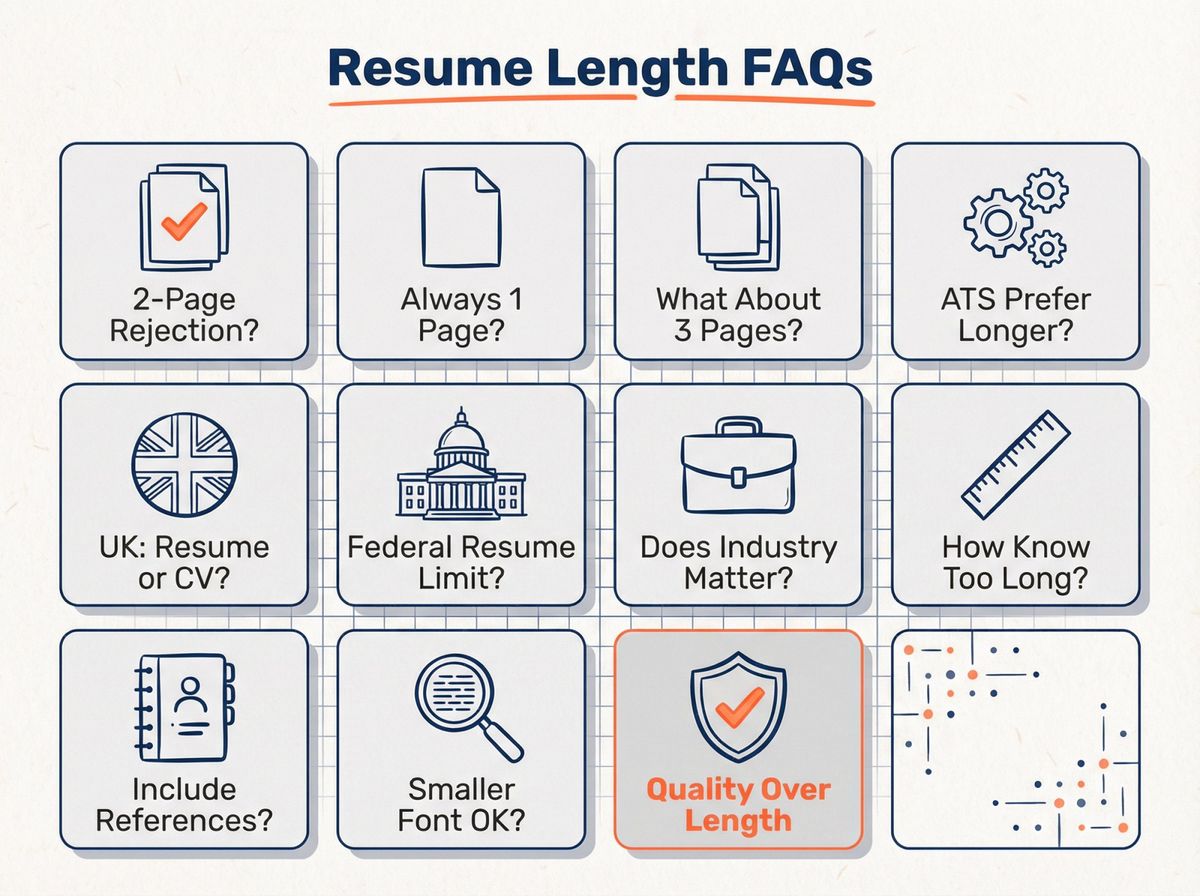
Resume Length FAQs
Will a 2-page resume get me rejected?
Not by itself. Indeed explicitly says multi-page is acceptable if it's relevant and organized (though page 1 gets the most attention).
You get rejected for wasting space, not for having a second page. If page 2 adds genuine proof of your qualifications, it strengthens your application.
Should I always keep it to one page?
If you're early-career, usually yes. Harvard Career Services calls one page the norm for BA/BS, MA/MS, and MBA candidates.
But if you're cramming text into microscopic font to "stay one page," you're doing it wrong. A readable two-pager beats an illegible one-pager every time.
What if my resume is 3 pages?
For most jobs: cut it. For research/academia: you probably need a CV instead. Harvard notes academic CVs have no page limit and typically run 2-5 pages for grad students.
If you're applying to industry roles, compress your 3-pager to a focused 2 pages highlighting the most relevant achievements.
Does ATS prefer longer resumes because of keywords?
ATS doesn't "prefer" length. But keyword coverage matters. Coursera notes some professionals like 2 pages because it can include more relevant keywords for automated systems, but still recommends erring toward focused and shorter.
The key is having the right keywords in a readable format, not just more words.
I'm applying in the UK. Resume or CV?
In the UK, people usually say "CV" for what Americans call a resume. The common expectation is no more than two sides of A4.
It's the same 1-2 page document, just different terminology.
I'm applying to the US government. Can I submit a long federal resume?
Not anymore. USAJobs says agencies only accept up to two pages, and the system won't allow longer uploads or builds. OPM guidance implemented this rule in September 2025.
Treat 2 pages as a hard requirement for federal applications through USAJobs.
Does industry matter for length?
Somewhat. Tech recruiters report they rarely see single-page resumes anymore, and may even ask candidates for more detail if they submit a sparse one-pager.
Creative fields might value portfolio links over extensive work history. But across most industries, the 1-2 page guideline holds steady.
How do I know if mine is too long?
Ask yourself: Could I remove this section without weakening my case for getting hired?
If yes, remove it. If no, it stays. Every line should prove you're qualified for this specific role. Generic information or old, irrelevant experience should be compressed or cut.
Also check the formatting. If you're using font smaller than 10 points or margins smaller than 0.5 inches, you're forcing too much content into too little space.
Should I include references or make room for them?
No. Don't waste precious space on "References available upon request." Employers assume you'll provide references when asked. Focus that space on accomplishments and skills instead.
Can I use smaller font to save space?
Don't go below 10 points. Multiple sources (including Indeed, Harvard, and Prospects) recommend 10-12 point font for body text.
If your content only fits with 8 or 9-point font, that's a sign you need to either cut content or use a second page. Readability matters more than squeezing everything onto one page.
Bottom Line
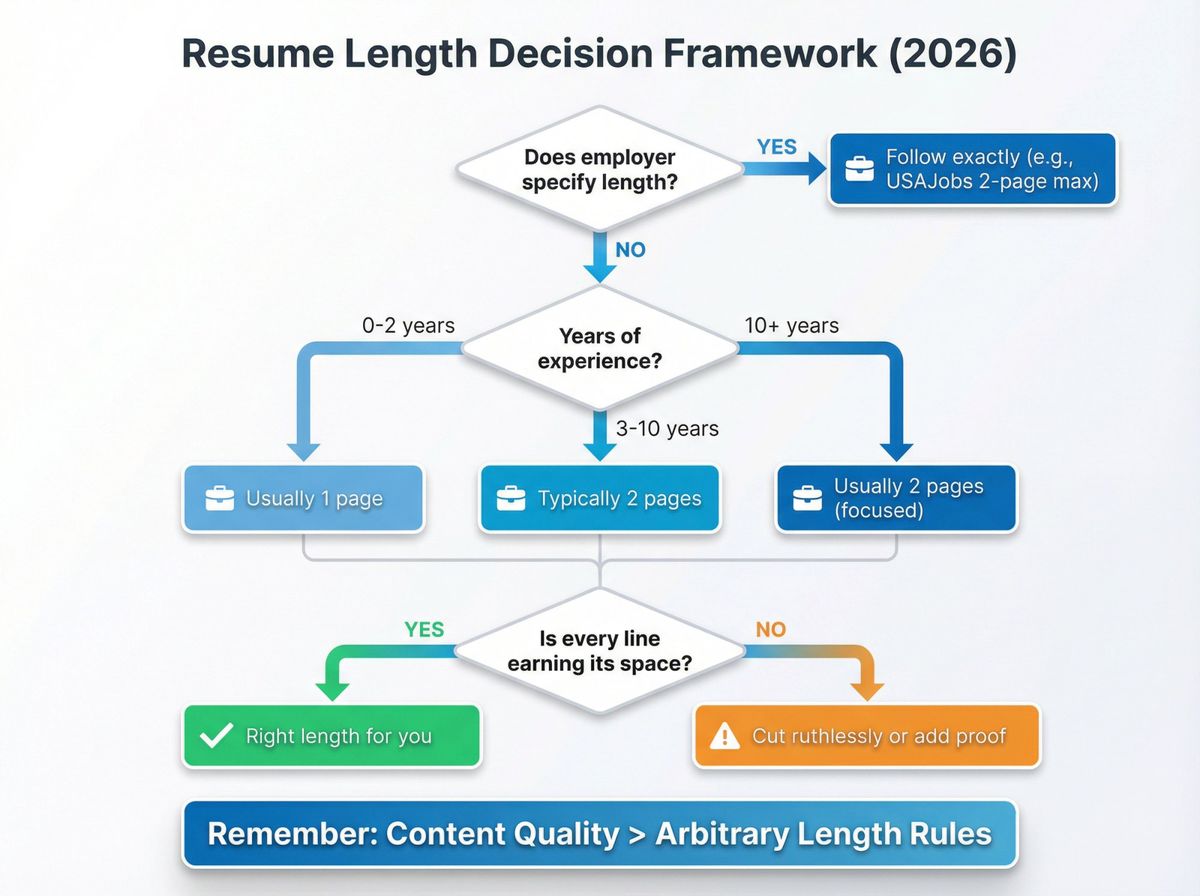
If you want the single-sentence answer: Pick 1 page unless you can justify page 2 with relevant proof. If you need page 2, make it worth reading. And if the employer gives a page limit (especially USAJobs), treat it like a hard requirement.
The modern reality is clear: most professionals with 3+ years of experience will have stronger resumes at 2 pages than at 1. The data backs this up. Recruiters prefer it. And it gives you the breathing room to showcase your qualifications without cramming or cutting important achievements.
But length alone doesn't determine success. Content quality does. A great two-page resume beats a weak one-pager. A sharp one-page resume beats a bloated two-pager. The goal is to use whatever length lets you prove you're the right fit, clearly and compellingly.
Focus on relevance. Cut ruthlessly. Format cleanly. And don't let outdated "rules" stop you from presenting your best self.
You've got this.