How Long Does It Take to Hear Back From a Job? A Day-by-Day Timeline
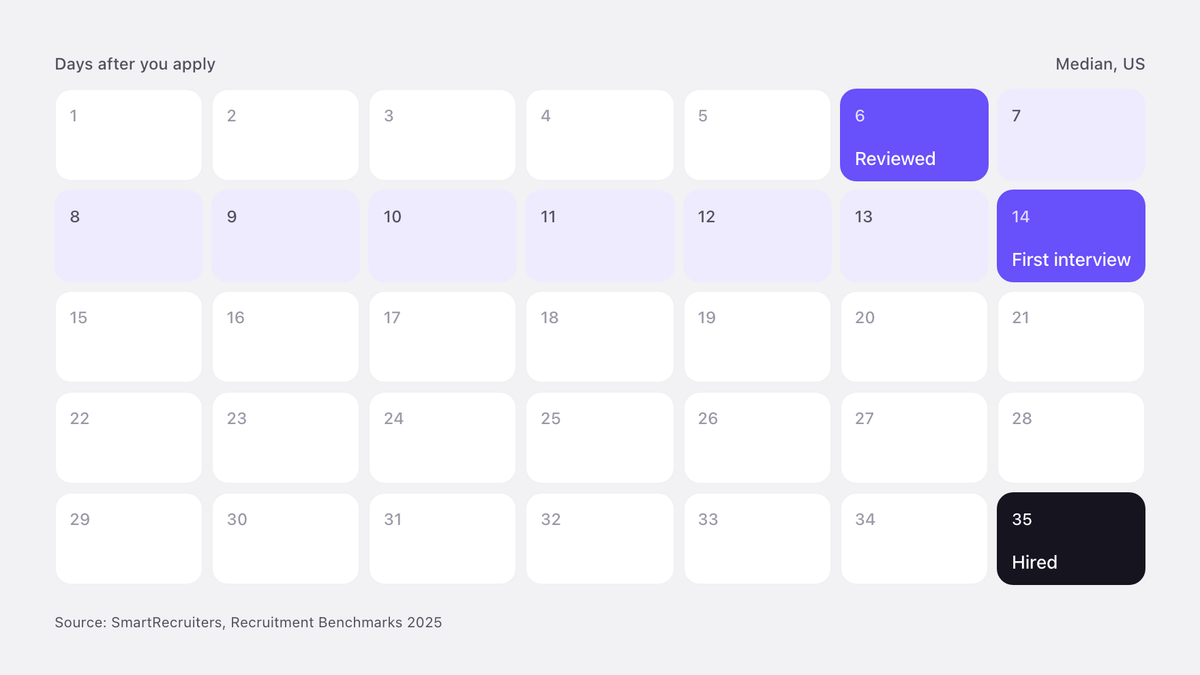
It typically takes 1 to 2 weeks to hear back from a job if you move forward; half wait longer. In SmartRecruiters' Recruitment Benchmarks 2025, US employers took a median 6 days to review an application and 14 days to a first interview; only 4.3% of applicants got one.

Tired of anxiously refreshing your inbox every hour? Find out what the silence means and when it’s right to worry.
Find what you’re looking for:
- The wait, stage by stage
- What your day count means
- Why it takes so long
- What your status means
- When to follow up
- What to do while you wait
How Long Does It Take to Hear Back from a Job Application?
If an employer moves you forward, 1 to 2 weeks is the typical answer to “How long to hear back from a job application?” SmartRecruiters found that employers take a median of 6 days to review an application. But don’t take the median for a guarantee. It only counts applicants who progress, and half of them wait longer.
So, how long do job applications take to process? That depends on how many resumes an employer receives, how much time the hiring team has and what the industry is. Either way, don’t write an application off at day 14; that’s when the median first interview happens.
With so few applicants reaching an interview, a quiet inbox says more about the numbers than about your application. So it’s best to err on the side of caution and apply to several roles at once.
How long does it take for jobs to get back to you at each stage? Here are the medians:
| Stage | US median (SmartRecruiters 2025) | Global median |
|---|---|---|
| Application reviewed | 6 days | 6 days |
| First interview | 14 days | 14 days |
| Hire | 35 days | 38 days |
How Long to Hear Back After an Interview
It takes around 3 weeks from the first interview to a hire, going by US medians. That’s the gap between 2 medians, not a measured wait, so treat it as a rough guide.
A week without hearing back doesn’t automatically mean a rejection; many companies are just slow. But if the timeline they gave you has passed or your follow-up goes unanswered, those may be signs you didn’t get the job after an interview.
How Long Should You Wait to Hear Back After Applying?
Two weeks of silence after submitting an application is normal. By day 6, only about half of applications have been reviewed. So, if you don’t get your first interview by day 14, that doesn’t necessarily mean you’re out of the running.
But equally, it doesn’t mean you should sit with your hands in your lap and wait. A little proactivity goes a long way, and a single follow-up around day 14 is good practice. Before you write, check your spam folder and the job portal in case you missed a reply.
If your follow-up goes unanswered, keep applying to other open positions, and don’t send a second follow-up email. If the employer is interested, they will get back to you.
And if they don’t, it’s safe to assume that opportunity is gone. So, unless you’re applying for a job in tech, manufacturing or the federal government, the answer to “how long to wait after submitting job application online?” is around 35 days, with one follow-up email sent around day 14.
Remember to count from the day you applied or the date that the job posting specifies as a cut-off, not from when the job was first advertised. The table below explains what’s likely happening and what you should do on a given day:
| Days since you applied or the closing date | What is likely happening | What to do today |
|---|---|---|
| Days 0 to 6 | Waiting for review; half are reviewed by day 6 | Nothing yet; apply to your next role |
| Days 7 to 14 | Reviews go on; first interviews get booked (median day 14) | Check spam and the portal; follow up once around day 14 if you have a named contact |
| Days 15 to 34 | Others may be interviewing | Keep applying; no second follow-up |
| Day 35 or later | Past the US median time to hire; tech, manufacturing and federal jobs run longer | Treat it as a no; reapply only if it is reposted and still fits |
Why Do Job Applications Take So Long to Hear Back?
Here’s what’s happening behind the scenes when you apply for a job: according to recruiters on Quora, postings collect applications for about a week. The majority of applicants miss some basic requirement, and the rejection emails are queued and sent a few days later.
“But why do jobs take so long to get back to you?” The reason for the wait isn’t you. It’s primarily the volume and the process, with company size and seniority adding to it.
SmartRecruiters found that US employers receive 74 applications per job opening. At that volume, recruiters can’t reply to everyone, whether that’s at a reasonable time or at all.
And then there’s the hiring process itself. Applications keep arriving for as long as a posting stays live, so recruiters review resumes, evaluate candidates across multiple stages and submit them for company sign-off, all at the same time.
Smaller companies are often able to do this faster with fewer open positions and fewer approvals to ask for. Larger businesses tend to screen in batches, which can take considerably longer.
Seniority also plays a part. For example, a managerial role has a bigger impact on the organization as a whole, and so it requires more careful consideration than hiring an intern.
Federal jobs are a case of their own, taking an average of 101.2 days to hire in fiscal year 2023, according to OPM data reported by FedManager. But what about industries?
How Long to Hear Back After Applying by Industry
Retail is the fastest across the entire hiring process, while manufacturing is the slowest. Hospitality is the odd one out: it reviews candidates quickly, but only 1.8% of applicants ever land an interview. See the global industry medians in the table below:
| Industry, global medians | Review | First interview | Hire | Applicants interviewed |
|---|---|---|---|---|
| Retail | 4 days | 11 days | 25 days | 5.3% |
| Hospitality | 6 days | 13 days | 39 days | 1.8% |
| Healthcare | 6 days | 16 days | 41 days | 5.3% |
| Technology | 7 days | 13 days | 48 days | 3.4% |
| Manufacturing | 8 days | 22 days | 55 days | 4.8% |
What Does It Mean When You Don’t Hear Back After Applying?
Silence after a job application means that the employer hasn’t decided yet or they’re not currently replying; it’s not a verdict on you. But if you applied through a job portal, you may be able to get some more clarity by checking the status of your application.
The status is a little label that you might see next to your application, such as “Active,” “Received” or “In Review.” It comes from the company’s applicant tracking system (ATS), and it only changes when the hiring team acts in their system.
However, depending on where and how you applied, there is no guarantee you will ever see a status label. For example, Greenhouse’s Candidate FAQs explain that to see the status:
- The company must opt in to sharing statuses
- You must apply through a Greenhouse-hosted application
- You must apply with the same email used in your MyGreenhouse profile
Even then, the label won’t tell you much. Greenhouse’s help pages for employers show that applications are “active” by default and only turn “inactive” after a rejection email, or 4 days after a rejection if no email is scheduled.
Applying for federal jobs on USAJOBS works much the same. The hiring agency controls the status, and USAJOBS itself has no say in it.
Labels also vary by employer, so treat any status as a rough guide: how long an application stays under review tells you more about the employer than about your chances. Match your status to the closest row:
| Status you see | What it usually means | What to do |
|---|---|---|
| Submitted / Received | The employer has it; nobody may have read it yet | Nothing; keep applying |
| In review / Under review | Screening is under way; the label can stay for weeks | Follow up once around day 14 |
| Under consideration (guide) | Still in the pool; not an interview invite | Keep applying |
| Reviewing applications (USAJOBS) | Federal: the posting closed; it can stay after hiring ends | Check "Track this application" |
| Not selected / Position filled | Someone else got it, or it closed | Apply to similar roles |
When to Follow Up After a Job Application
Follow up once, around day 14 (about 10 business days) after you apply, and only if you have a named recruiter or hiring manager to reach out to. If the posting lists a closing date, wait until it has passed before you write.
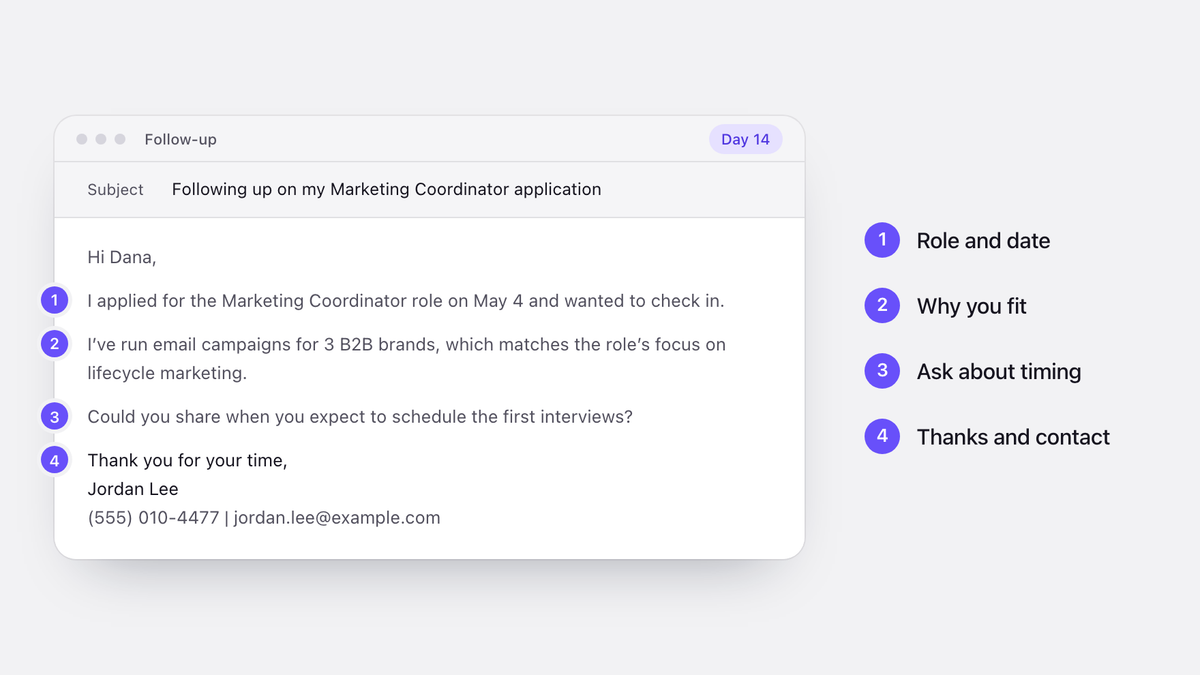
How you follow up matters as much as when to follow up on a job application. Keep your email under 100 words and cover:
- The role and date you applied
- One line on why you fit
- A question about the timeline
- A “thank-you” and your contact details
Subject: Following up on my Marketing Coordinator application Hi Dana, I applied for the Marketing Coordinator role on May 4 and wanted to check in. I’ve run email campaigns for 3 B2B brands, which matches the role’s focus on lifecycle marketing. Could you share when you expect to schedule the first interviews? Thank you for your time, Jordan Lee (555) 010-4477 | [email protected]
For more versions to adapt to your situation, see our follow-up email samples.
What to Do While Waiting to Hear Back from a Job
Follow up once, keep applying and track every application in a job application tracker. The best use of your time while you wait is to raise your odds of getting hired. And sometimes, that means sending out more applications. You can always reject an offer that you like less.
How to Hear Back from Job Applications Faster
You can’t speed up an employer, but you can make each application easier to say yes to. None of these levers guarantees a reply, but each one gives a screener one less reason to pass. Three levers that can help you hear back sooner:
| Lever | What to do | Why it helps |
|---|---|---|
| Relevance | Tailor your resume to each posting, in its words | Screeners compare your resume with the posting |
| Timing | Turn on job alerts; apply in a listing's first days | Reviews start within days (median 6) |
| Referral | Ask a contact to refer you | 7% of US hires came from referrals (SmartRecruiters) |
Keep Your Pipeline Full
Apply every week, and don’t pause your search while you wait on one employer. A single role can go quiet for reasons that have nothing to do with you, and a steady pipeline means one slow employer doesn’t hold up your whole search. To set a pace, see how many jobs to apply to per day.
AI Apply's Auto Apply finds jobs that match your criteria, tailors a resume and cover letter for each, and applies for you.
FAQ: Hearing Back After You Apply
How long after the application deadline should you hear back?
Count from the deadline and refer to the day table above. If the posting has a closing date, take that as your day 0. In some cases, such as federal jobs, employers only start reviewing applications once the job posting closes. Silence up until day 14 is normal.
How to tell if you didn’t get the job?
A rejection, a “Not selected” status or silence past day 35 usually means you didn’t get the job. Tech, manufacturing and federal jobs take longer, so give those a few more weeks before you move on, and keep applying in the meantime.
How long does it take to hear back from a fast food job application?
Fast food falls under hospitality, where the global median review takes 6 days but only 1.8% of applicants get interviewed. If you’re picked, you’ll likely hear within about 2 weeks; if not, you may never hear back. Apply to several locations at once.