Best Sonara Alternatives in 2026
Sonara is still running in 2026, so pick a replacement on merit. The best Sonara alternatives ranked by what each one actually fixes in your search.


The best Sonara alternatives in 2026 are AIApply for a complete application pipeline, JobCopilot for the closest like-for-like auto-apply experience, LoopCV for granular targeting control, Simplify for free form autofill, and Teal or Huntr if you would rather keep applying manually with sharper materials.
Sonara itself is still operating, which surprises most people searching for a replacement: it shut down abruptly in February 2024. But later it was acquired by BOLD and now runs under Bold Limited with a live jobs board. So the question is no longer whether Sonara exists. It is whether a tool that finds roles and fills in forms is enough.
It is usually not, and the reason is structural rather than a knock on any one product. An application has five stages: find the role, tailor your materials to it, submit, survive the screening layer, and then convert the interview. Volume automation covers two of them. If you have sent two hundred applications and heard back from four, the missing three stages are where your search is actually leaking, and no amount of extra submissions will patch them. This guide ranks eight replacements by what each one fixes.
Is Sonara still running in 2026?
Yes. Sonara is live as of August 2026, operated by Bold Limited, with an active job board, blog, and sign-up flow. That contradicts a lot of what currently ranks for this query. The confusion is understandable, because the shutdown was real: Sonara went offline on 1 February 2024 after failing to raise funding, and users lost access to their queues mid-search. Roughly six months later the brand was acquired by BOLD, the company behind Zety, LiveCareer, and MyPerfectResume, and the product was relaunched. Its current homepage carries a Bold Limited copyright notice and a Monster and CareerBuilder partnership badge.
Two practical things follow from that history. First, if you used the original Sonara and lost your data in 2024, the company running the product today is not the company you signed up with, so treat it as a new evaluation rather than a return. Second, the episode is a fair warning about any tool that holds your entire pipeline: before you commit, check whether you can export your application history. AIApply takes the same view, which is why its guidance leans on keeping your own record of where you have applied rather than trusting any single dashboard to survive.
If you have not been tracking outcomes anywhere outside the tool, fix that before you switch. AIApply's guide to the best job search tracker tools covers the options, including free ones.
Why job seekers still look for a Sonara alternative
People leave Sonara for four repeatable reasons, and only one of them is about reliability.
- It does not tailor per role. Sonara's workflow assumes you upload a resume that already converts, then multiplies how often it gets sent. AIApply's own AIApply vs Sonara comparison puts this plainly: Sonara automates form filling, not document quality.
- The billing model catches people out. Sonara runs a low-cost trial that converts to a subscription billing every four weeks rather than monthly, which works out to roughly thirteen cycles a year, and the renewal can be triggered by application count as well as by date.
- There is no interview layer. If your applications start landing and your interviews do not convert, Sonara has nothing for you. That is a common failure point once volume is solved.
- Data sharing is broader than people expect. Auto-apply tools handle your full work history, contact details, and sometimes work authorization status. Read the privacy policy of whichever tool you pick, including the one you are moving to.
Underneath all four sits the structural issue. Here is what a volume-only tool covers and what it leaves to you.
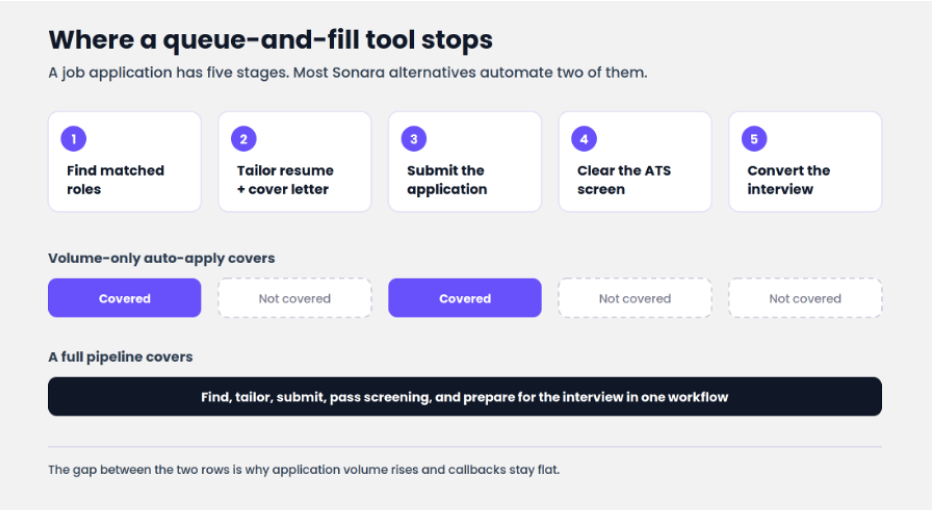
The market math that decides which alternative actually works
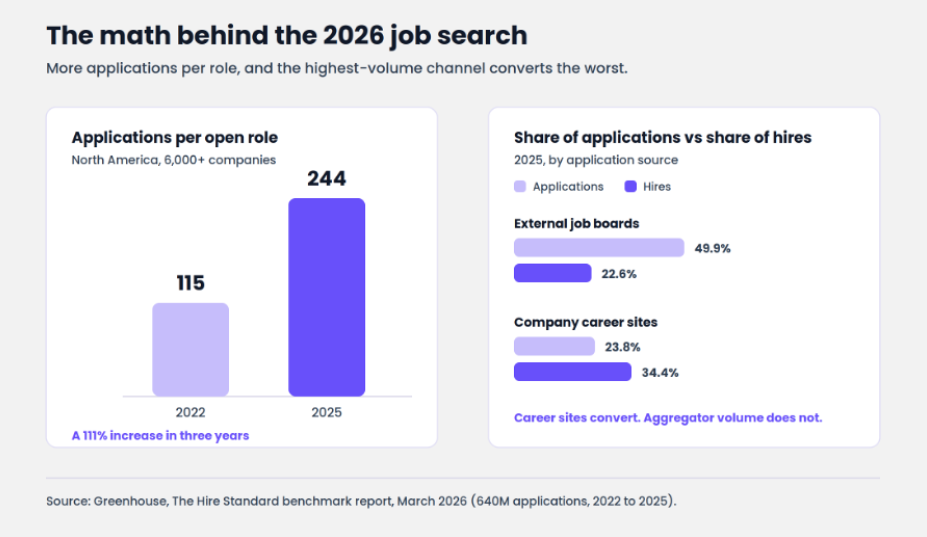
Applications per open role have more than doubled since 2022, which means the marginal value of one more untailored application is close to zero. Greenhouse analysed 640 million applications across more than 6,000 North American companies for its March 2026 benchmark report and found the ratio of applications per job rose 111%, from roughly 115 in 2022 to 244 in 2025. Applications per hire climbed to 203. Over the same period, the average recruiting team shrank by more than half.
The channel data is the part most auto-apply tools quietly work against. In Greenhouse's 2025 figures, external job boards generated about half of all applications but only 22.6% of hires, while company career sites produced 23.8% of applications and 34.4% of hires. Recruiter-sourced candidates were under 3% of applications and nearly 10% of hires. Volume tools that scrape aggregators are pouring effort into the worst-converting channel, which is exactly why AIApply's Auto-Apply is built to submit tailored applications to matched roles rather than to spray a static resume across boards.
The wider labour market context matters too. The U.S. Bureau of Labor Statistics reported 7.4 million job openings and 5.3 million hires in June 2026, a low-hire, low-fire pattern that has held since early 2025. Openings exist. Employers are just slower to convert them, and the queue in front of each one is longer. Greenhouse's chief executive described the resulting dynamic to Fortune in July 2026 as a loop in which candidates automate applying, recruiters automate filtering, and the applications start to look identical to each other. Looking identical is the specific risk you take on when you buy volume without tailoring.
How these Sonara alternatives were ranked
Five criteria, in priority order:
- Does it tailor each application, or send one resume everywhere? This is Sonara's central gap and the strongest predictor of reply rate.
- How much of the submission step is genuinely automated? Autofill and auto-apply are different products with different risk profiles.
- How much targeting control do you get? Loose filters turn automation into wasted credits and wasted recruiter impressions.
- Is the commitment shape reasonable? Free tier to test, transparent renewal terms, and no penalty for pausing a search that ends early.
- Does it cover anything past the submit button? ATS feedback and interview preparation are where most searches stall second.
Pricing moves constantly across this category, and several of these vendors run promotional rates that differ from their public pages. Treat pricing shape as the durable signal and confirm current numbers on each vendor's own pricing page before you pay.
The 8 best Sonara alternatives in 2026
1. AIApply: best overall Sonara alternative
AIApply is the strongest Sonara replacement because it is the only tool on this list that covers all five stages of an application in one workflow. Where Sonara finds roles and fills forms, AIApply builds the resume, tailors it and the cover letter to each posting, scans both against ATS criteria before anything goes out, submits through Auto-Apply, then carries you into interview preparation. The platform reports more than two million users and over 372,000 roles applied to.
The pieces that matter most for a switching Sonara user are the AI Resume Scanner and the AI Resume Builder. If your Sonara applications went out with a generic resume, that is almost certainly where your reply rate died, and the scanner tells you before you spend another credit. The AI Cover Letter Generator closes the other half of the same gap, since Sonara does not write one per posting at all.
Commercially, AIApply's structure inverts Sonara's. Auto-Apply runs on credits that do not expire rather than a subscription that renews every four weeks, so a search that ends in six weeks does not leave you paying for months you did not use, and a seasonal search picks up where you left off. There is a free plan for the core tools, and students get a discount with a verified email. For the interview stage, AI Mock Interview handles rehearsal and Interview Buddy gives live coaching during real interviews, which should be used as preparation support rather than a substitute for knowing your own material.
Trade-off worth naming: AIApply asks more of you at setup than Sonara does. You are building and tailoring materials, not just uploading and walking away. That front-loaded effort is the entire point, but if you genuinely want a hands-off queue and nothing else, entry two is the more honest fit.
2. JobCopilot: the closest like-for-like replacement
JobCopilot is the nearest functional match to what Sonara does. It matches your profile against roles sourced from a large index of company career pages, autofills applications, and can run in a fully hands-off mode that submits with minimal input, with higher tiers supporting up to fifty applications a day.
It also generates AI resumes and cover letters, so it tailors more than Sonara does, though reviewers consistently report that autofill misses context-specific screening fields and needs manual cleanup. There is no free tier, billing runs weekly or monthly depending on the plan you pick, and independent reviews in 2026 flagged that full autopilot mode can reach stale or low-quality listings when match thresholds are set loosely. Run it in review mode and keep the match strictness high.
Pick it if: you liked the Sonara experience, you understand the reply-rate trade-off, and you want the same shape of product with better job sourcing.
3. LoopCV: most control over targeting
LoopCV runs auto-apply in the cloud rather than through a browser extension, submitting across more than thirty job boards without your machine needing to stay open. Its distinguishing feature is control: campaign-level filters, per-campaign volume caps, and a dashboard that reports what actually went where.
Tailoring is campaign-level rather than per posting, so it sits below AIApply on application quality while sitting well above extension-based tools on targeting discipline. There is a free plan, which makes it genuinely testable before you pay.
Pick it if: your Sonara complaint was applications going to the wrong cities, wrong seniority, or wrong industry.
4. Simplify: best free autofill
Simplify is a browser extension that fills application forms across the major applicant tracking systems and logs what you submitted. The core autofill is free, with a paid tier adding AI-drafted answers to open-ended questions.
It does not apply for you, which is the point. You keep the judgement call on every submission and lose only the typing. For anyone who wants to apply directly on company career sites, the channel that Greenhouse's data shows converts best, Simplify is the cheapest way to make that sustainable.
Pick it if: you want speed without handing over the submit button, and you are applying mostly through employer sites.
5. Teal: best for a resume-first search
Teal is a job tracker and resume builder that scores your resume against each job description and shows the keyword gaps. Tracking and resume versions are free with no cap, and a paid tier adds deeper AI assistance.
Teal does not auto-apply at all. Every submission is yours. That makes it the opposite of Sonara rather than a replacement, and it is the right answer for a specific reader: someone whose real problem was never volume, and who was using automation to avoid confronting a resume that was not landing.
Pick it if: you are applying to a smaller number of high-fit roles and want each one to be strong.
6. Huntr: best visual tracker with tailoring attached
Huntr organises your search as a kanban pipeline and attaches tailoring to it: a base resume, job-specific tailored versions, application packets, and a match score per posting. Its extension autofills forms, but there is no mass-apply feature of any kind, so you open and submit every application yourself.
The free tier caps how many jobs you can track and limits AI-tailored documents, with the paid plan removing both. Huntr is the strongest option if you think visually about your pipeline and want tailoring in the same place.
Pick it if: you lose track of where you have applied and that disorganisation is costing you follow-ups.
7. Jobright: best for discovery and match scoring
Jobright leans on the discovery half of the problem. It surfaces roles matched to your profile and scores how well you fit each one, which is useful precisely because targeting discipline is what makes any volume tool work. Its automation features exist but reviewers in 2026 still described the agent side as immature, and its usage limits are not published.
Pick it if: you want a better shortlist to feed into a tailoring tool, rather than one product doing everything.
8. LazyApply: cheapest throughput, biggest caveats
LazyApply is a Chrome extension sold as one-time lifetime tiers rather than a subscription, and it can push very high application counts through Easy Apply style flows on major boards. That price structure is the appeal.
The caveats are substantial and worth stating plainly. It does not tailor your resume per role, so it is the purest expression of the strategy Greenhouse's data argues against. It runs inside your own browser session, meaning platform automation limits are enforced against your account rather than the vendor's. And user reviews across 2026 are heavily polarised, with recurring reports of broken sessions, incorrectly answered screening questions, and refund friction. Note also that "lifetime" means the product's lifetime, not yours, which is a lesson Sonara's own 2024 shutdown taught expensively.
Pick it if: you have a validated resume, you are targeting lower-competition listings, and you accept the reliability gamble for the price.
Sonara alternatives compared side by side
Pricing shifts often in this category, so this table compares the durable differences: what each tool automates, whether it tailors, and what kind of commitment it asks for.
| Tool | Automates submitting? | Tailors per role? | Pricing shape | Best for |
|---|---|---|---|---|
| AIApply | Yes, credit-based Auto-Apply | Yes, resume and cover letter per posting, plus ATS scan | Free plan, Pro subscription, credits bought separately and do not expire | Volume and quality in one workflow, plus interview prep |
| JobCopilot | Yes, from company career pages | Partial, AI resume and cover letter generation | Subscription, no free tier, weekly or monthly billing | The closest like-for-like replacement for Sonara |
| LoopCV | Yes, cloud-based across 30+ boards | Limited, campaign-level rather than per posting | Free plan, paid tiers by volume | Tight control over targeting filters |
| Simplify | No, it autofills and you submit | Partial on paid tier | Free core extension, paid tier for AI answers | Cutting form-filling time without giving up control |
| Teal | No, every application is manual | Yes, keyword gap analysis per job description | Free tracker and resume builder, paid Teal+ | A resume-first search you run yourself |
| Huntr | No, autofill only | Yes, tailored resumes and application packets | Free tier with a tracked-job cap, paid Pro | Visual pipeline tracking with tailoring attached |
| Jobright | Partial, agent features still maturing | Partial | Free tier, paid plan | Finding and scoring roles worth applying to |
| LazyApply | Yes, browser extension at high volume | No | One-time lifetime tiers | Cheap raw throughput, with real reliability trade-offs |
Why AIApply beats Sonara specifically
AIApply and Sonara differ on one axis that decides everything else: Sonara automates the mechanics of applying, while AIApply automates the pipeline that makes applying work. Sonara expects a pre-optimized resume as an input. AIApply treats improving that resume as part of the job. In practice that means a tailored resume and cover letter per posting, an ATS check before submission, and a review mode so you can approve what goes out under your name.
The commercial terms differ just as sharply. Sonara's subscription renews every four weeks and can be triggered by crossing an application threshold during the trial, which is easy to do in one evening of applying. AIApply sells Auto-Apply as credits that sit in your account until you use them, so pausing costs nothing. And Sonara has no interview tooling at all, while AIApply covers rehearsal and live coaching.
The full breakdown, including both platforms' privacy disclosures and a structured seven-day test for deciding between them, lives on the AIApply vs Sonara comparison page. If you want the wider category view first, AIApply's roundup of the best AI job search tools covers tools outside the auto-apply niche.
Pick by your bottleneck, not by the feature list
The most common mistake in switching tools is replacing like with like. If Sonara was not working, buying a faster version of Sonara reproduces the result. Diagnose what is actually failing first.
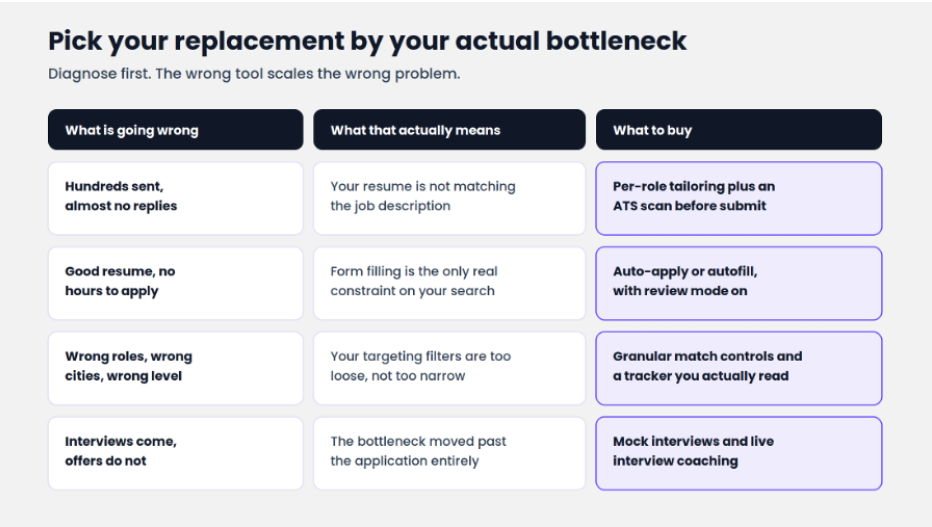
The diagnosis is usually visible in your numbers. If your reply rate is under 2% across fifty or more applications, the problem is materials or targeting, not volume. If you are getting screening calls but nothing past them, the problem has moved to the interview and no application tool will fix it. AIApply's guide to the best way to apply for jobs walks through scoring roles before you commit to them, and the 14-day plan for finding a job fast sets the daily rhythm if you are searching full time.
How to switch off Sonara without stalling your search
This sequence matters, because the usual failure is cancelling first and losing a week of momentum.
- Export or screenshot your application history before you cancel anything, including company names, roles, and dates applied.
- Cancel deliberately and check the renewal date rather than assuming a monthly cycle, since Sonara bills every four weeks.
- Run your current resume through an ATS scan before you send another application. AIApply's Resume Scanner flags the keyword and formatting gaps that were quietly filtering you out.
- Rewrite your target spec: two or three job titles, a seniority band, ten must-have keywords, location constraints, and a salary floor. Loose specs are what produce irrelevant automated applications.
- Run ten to fifteen tailored applications manually first and measure the reply rate. That is your baseline.
- Only then turn on automation, with review mode enabled, and compare the automated reply rate against your manual baseline.
One platform-specific note: some job sites prohibit third-party automated submissions in their terms. AIApply's guide to applying on Indeed covers how to stay inside those rules while still cutting the time each application takes, and the broader job application automation guide covers where automation helps and where it backfires.
The bottom line
Sonara did not disappear, so choose your replacement on merit rather than out of necessity. If your bottleneck is genuinely time, JobCopilot or LoopCV will do what Sonara did with better sourcing or better targeting. If your bottleneck is the silence after you apply, more submissions will not fix it, and AIApply is the only option here that treats tailoring, screening, and interview readiness as part of the same job as applying.
Start with the free diagnostic rather than the subscription: run your current resume through AIApply's Resume Scanner and see what the screening layer sees. If the gaps are obvious, you have found your answer before spending anything. If your resume is already clean, then volume really is your constraint, and Auto-Apply will scale a process that already works.
Frequently asked questions
Is Sonara shut down?
No. Sonara shut down on 1 February 2024 after failing to secure funding, but it was acquired by BOLD and relaunched, and it is operating in 2026 under Bold Limited. Pages claiming the service is permanently dark are out of date. The original company no longer runs it, so if you used Sonara before 2024, treat the current product as a new evaluation.
What is the best free Sonara alternative?
Simplify is the best genuinely free option, because its core form autofill works at no cost across the major applicant tracking systems. Teal's tracker and resume versions are also free without a cap, and AIApply offers a free plan covering the job board and core document tools. Free tiers rarely include automated submission, which is almost always the paid feature across this category.
Does auto-applying to jobs hurt your chances?
Auto-applying hurts your chances when it sends the same untailored resume to every role, and helps when it scales applications that were already well targeted. Greenhouse's 2026 data shows applications per role have more than doubled since 2022, so identical-looking applications are easier than ever for recruiters to dismiss. Automation is a multiplier, and it multiplies whatever quality you feed it.
How many jobs should I apply to per week?
Most active job seekers should target 10 to 20 tailored applications per week, with each one tracked so you can see what is working. If you are unemployed and searching full time you can go higher, particularly with automation handling the repetitive submissions, but raw count is the wrong metric to optimise. Reply rate per twenty applications tells you far more.
Is AIApply better than Sonara?
AIApply covers more of the job search than Sonara does: it tailors your resume and cover letter to each posting, scans both against ATS criteria, submits through credit-based Auto-Apply, and includes mock interviews and live interview coaching. Sonara finds matched roles and fills in application forms, and has no interview tooling. If your bottleneck is purely the time spent on forms and your resume already converts, Sonara can work. If you are applying and hearing nothing, that is a materials problem, and AIApply is built for it.
Do AIApply Auto-Apply credits expire?
No. AIApply sells Auto-Apply in credit packs that stay in your account until you use them, which is the main structural difference from Sonara's four-weekly subscription. If your search takes six weeks or runs seasonally, you are not paying for idle months.
Which Sonara alternative is best for interview preparation?
AIApply is the only tool in this ranking with interview preparation built into the same workflow as applying. Its AI Mock Interview tool generates role-specific questions and feedback before the interview, and Interview Buddy provides live prompts during one. Use live assistance as support for material you actually know, not as a way to represent skills you do not have.
What should I do if none of these tools improve my reply rate?
If tailored applications at reasonable volume still produce nothing after three to four weeks, the problem is target fit rather than tooling. That usually means you are applying a level above where your evidence supports, or into a function where your experience does not translate on paper yet. Referrals and recruiter-sourced routes convert several times better than job boards, so redirect some of the effort there. AIApply's guide to using AI across the job search covers the two-lane approach of manual high-priority applications alongside automated volume.