How to Apply to 100 Jobs a Day With AI (Without Wasting All 100)
Apply to 100 jobs a day with AI: the filter settings, resume variants, and review rules that keep high-volume applications from turning into noise.


Applying to 100 jobs a day stopped being the hard part once AI could fill the forms. Aiming those 100 is where searches are won or lost in 2026.
Key Takeaways
- 100 applications a day is mechanically trivial now. Auto-apply tools handle sourcing, form-filling, and cover letters on a credit basis. The bottleneck is your credit budget and the number of postings that genuinely match your filters, not the software.
- Volume stopped being an edge in 2022. Greenhouse's March 2026 benchmark: applications per posting up 111% (116 to 244), recruiters per org down 56%, applications per recruiter up 412%. You're not the 5th applicant anymore, you're the 245th, and the person screening has 5x the pile and half the team.
- Five layers, and automation only earns its speed on three. Targeting (1) and follow-up (5) are yours. Tailoring, submission, and tracking (2-4) go to software. Skip layer 1 and you scale noise; skip layer 5 and you scale silence.
- Targeting is the only layer that changes your odds. Three to five exact job titles, capped seniority, fixed geography, postings under 48 hours old. Everything downstream is execution.
- Never run bots on LinkedIn. Their help docs prohibit third-party automation outright and threaten account restriction. High-volume applying belongs on job boards and company career pages.
- Run a 20-application pilot before buying 100 credits. Open five submissions and read what actually went out. A bad configuration at 20 is a lesson; at 100 it's a wasted day.
- Accuracy is the real risk, not automation. 65% of hiring managers have already caught candidates misrepresenting themselves with AI. Recruiters can't tell that software submitted an application, they can tell when it wasn't aimed at the role.
- Under 2% response rate means stop, not scale. Scaling a broken funnel scales the breakage. 3-7% is healthy at volume.
- Match pace to circumstance. 60-100/day makes sense unemployed with income pressure; 5-15 makes sense employed and selective; 5-20 for senior or specialist roles where the addressable market runs out fast.
You can apply to 100 jobs a day with AI by narrowing your search to a few exact job titles, keeping two or three tailored resume variants on file, and letting an auto-apply tool source matching roles, fill the forms, and submit through job boards and company career sites. Setup takes about an hour. What decides whether those 100 applications turn into interviews is the filtering you do before the first one goes out, not the number itself.
Most people looking for a 100-a-day workflow have already spent months at 10 a day and heard almost nothing back. That instinct is sound. A bigger pipeline really does produce more callbacks. But the same tools that let you fire off 100 applications before lunch have let everyone else do it too, and the market absorbed that shift years ago. Volume stopped being an advantage and became the baseline. What separates a high-volume search that works from one that burns three weeks is whether the volume is aimed.
Can You Actually Apply to 100 Jobs in a Day?
Yes, and it is not close to a technical limit. A credit-based auto-apply tool can submit 100 applications in a few hours once your profile, base resume, and filters are configured, because the slow parts of an application are precisely the parts software is good at: finding the posting, retyping your work history, generating a cover letter, and clicking through a six-step portal. AIApply runs Auto-Apply on credits, where one credit equals one submitted application, so hitting 100 in a day is a budgeting decision rather than an engineering one.
What you should not do is push that volume through LinkedIn with a browser bot. LinkedIn's help documentation is unambiguous: it does not permit third-party software, crawlers, plug-ins, or browser extensions that scrape or automate activity on the site, and it states that members using them risk having their accounts restricted or shut down (LinkedIn Help, Prohibited software and extensions). A restricted LinkedIn profile in the middle of a job search is a self-inflicted wound that costs you far more than the applications saved. High-volume applying belongs on job boards and company career pages, which is where AIApply's Auto-Apply submits.
It also helps to be honest about the denominator. U.S. job openings stood at 7.6 million in May 2026, with 5.2 million hires that month, according to the Bureau of Labor Statistics JOLTS release. There is real hiring happening. There is not an infinite supply of roles that genuinely match you, and that ceiling ends up mattering more than your daily send rate. If you want the recommended number rather than the maximum, AIApply's guide to how many jobs to apply to per day works through the pipeline math.
What 100 Blind Applications Run Into in 2026
The reason blind volume stopped working is that hiring teams got flooded and shrank at the same time. Greenhouse analyzed more than 640 million applications across 6,000-plus companies for its March 2026 benchmark report and found applications per job posting rose 111% between 2022 and 2025, from 116 to 244. Over the same window, recruiters per organization fell 56%, from 10.4 to 4.6. The combined effect is that annual applications per recruiter jumped 412%, from 146 to 746.
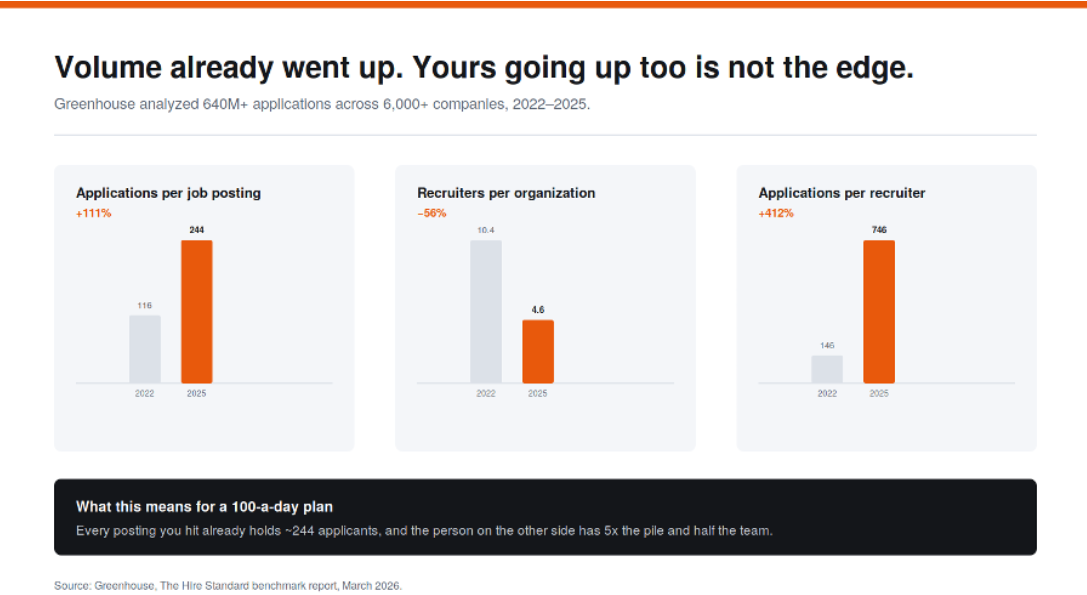
Read those three numbers together and the strategic picture changes. Every posting you hit already holds roughly 244 applicants. The person on the other side is working through five times the pile with half the team. In that environment, being the 245th generic application is not a neutral act. It is the specific thing the screening layer exists to remove.
The other half of the problem is trust. Greenhouse's 2025 AI in Hiring Report, which surveyed over 4,100 job seekers, recruiters, and hiring managers, found that 65% of hiring managers had caught applicants using AI deceptively, and 74% were more worried about fake credentials or misrepresented experience than a year earlier. Greenhouse CEO Daniel Chait described the result as a doom loop: candidates use AI to apply more, employers use AI to filter more, and neither side is happy. You cannot opt out of that loop, but you can decide which side of it your applications land on. An application that is accurate, specific, and clearly aimed at the role reads differently from one that was clearly sprayed, even at the same volume.
The Five Layers Behind a Working 100-a-Day System
A sustainable 100-a-day workflow has five layers, and automation only earns its speed on three of them. Layers 2, 3, and 4 are pure execution and should be handed to software. Layers 1 and 5 are judgment, and they are where the callbacks actually come from.
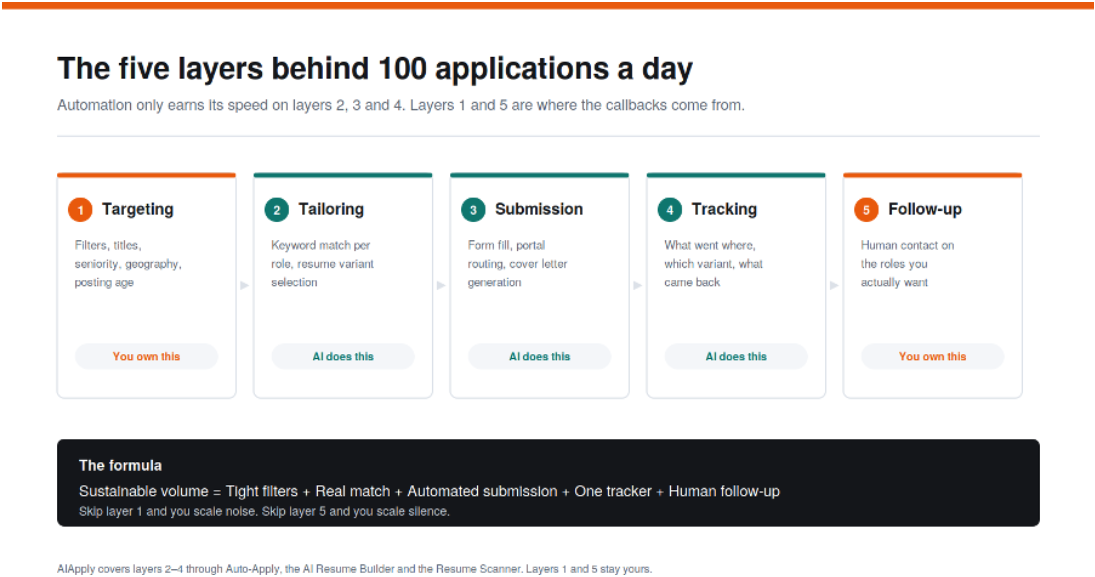
Sustainable volume = Tight filters + Real match + Automated submission + One tracker + Human follow-up
Layer 1: Targeting is the only layer that changes your odds
Set three to five exact job titles, cap the seniority band, fix the geography or remote status, and filter to postings from the last 48 hours. That is the whole layer, and it does more for your response rate than anything downstream. A 100-a-day run against three tight titles is a real campaign. The same 100 against "any title containing the word manager" is noise you paid for. Automation is only ever as good as the rules you hand it, which is why AIApply asks you to define preferences before Auto-Apply sends anything.
Layer 2: Tailoring is what keeps volume from reading as spam
You do not need 100 unique resumes. You need two or three variants that map to the two or three role clusters you are targeting, each one checked against the actual job description for keyword gaps. AIApply's Resume Scanner handles that check, and the AI Resume Builder generates the variants from one accurate base. Run the humanization pass before you scale: AIApply's breakdown of AI resume writing versus human writing covers the phrasing tells that make a resume look machine-produced, and those tells get multiplied by 100 when you automate.
Layer 3: Submission is the part you should never do by hand
Form filling, portal routing, and cover letter drafting are the hours that make manual high-volume applying impossible, and they contribute nothing to whether you get hired. This is the layer auto-apply tools exist for. AIApply's Auto-Apply sources matching postings, generates a tailored resume and cover letter for each, and submits, which is what makes 100 in a day physically achievable at all.
Layer 4: Tracking is what makes the next 100 smarter
Log what went where, which resume variant it used, and what came back. Without it you cannot tell whether a 2% response rate is a targeting problem or a materials problem, and you will end up rerunning the same failed configuration. With it, you can kill a title that never converts after 40 submissions and reallocate that budget. Every application AIApply sends is logged in the dashboard, which is the minimum viable version of this.
Layer 5: Follow-up is the only layer with no automated substitute
Pick the five or ten roles you actually want out of the 100 and do something human on those: find the hiring manager, send a short and specific note, mention one real thing about the team or product. This does not scale, and that is the point. It is the step almost nobody at high volume takes, which is exactly why it works. AIApply's guide to getting hired fast goes deeper on follow-up timing and what to say.
How to Set Up Your First 100-Application Day
This sequence takes about an hour up front and then runs on maintenance. Do it in order, because each step depends on the one before it.
- Fix your base resume first. Everything downstream is a copy of this document. If it has a formatting problem or a vague summary, you are about to replicate that 100 times. Build or clean it with the AI Resume Builder, then confirm every claim in it is true and defensible in an interview.
- Write down your three to five exact target titles. Not categories. Titles, as they appear on postings. If you cannot name them, you are not ready to automate.
- Build two or three resume variants, one per role cluster. Adjust the headline, the skills block, and the top three bullets. Leave your history and dates alone.
- Scan each variant against a real job description. Run it through the Resume Scanner and close the keyword gaps that are genuinely true of you. Skip the ones that are not.
- Set your filters tight, then set them tighter. Titles, seniority cap, location or remote, and posted within 48 hours. Resist the urge to widen the net to fill the daily quota.
- Run a 20-application pilot before you buy 100 credits. Open five of those 20 submissions and read what actually went out. If any of them look wrong for the role, your filters are wrong, and scaling would have multiplied the error.
- Scale to 100, then spend your freed-up time on layers 1 and 5. Review the tracker each morning, kill underperforming titles, and hand-work the top ten roles from yesterday's batch.
One warning about the pilot step, because it is the step people skip: the review is what stops a bad configuration from becoming 100 bad applications. AIApply's guide to automating job applications covers the setup mechanics in more detail if you want to work through it before committing credits.
The Rules That Keep High Volume From Backfiring
The dashboard number is identical in both columns below. Everything that determines whether the day was worth it sits in the configuration.
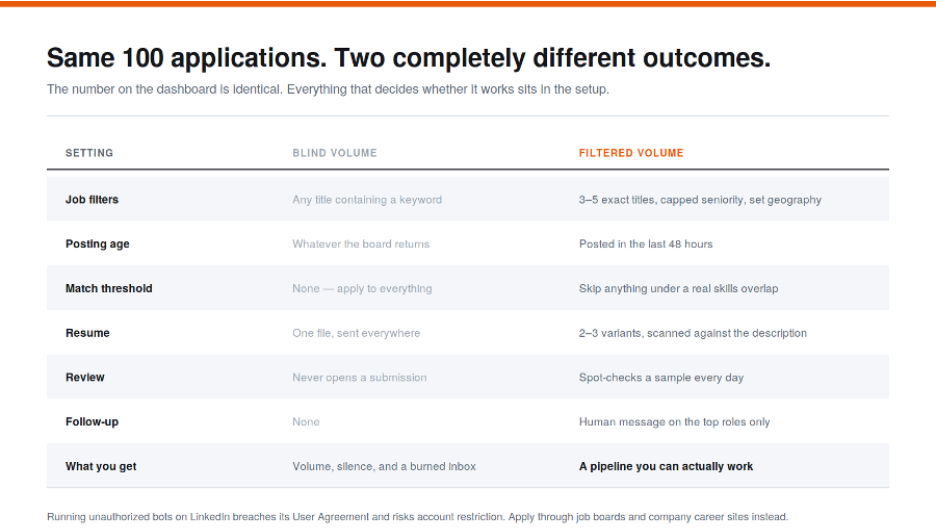
Three rules matter more than the rest. First, never let AI state something about you that is not true. Beyond the ethics, 65% of hiring managers in the Greenhouse survey had already caught candidates misrepresenting themselves with AI, and the verification layer is tightening in response. Second, do not automate the roles you actually want. If a job is in your top ten, it deserves 25 minutes and a human follow-up, not a credit. Third, keep the review habit. Reading five of your own submissions a day is the cheapest quality control available.
Volume also creates a downstream problem worth planning for. If the system works, interviews arrive in clusters, and 2026 interviews increasingly include an AI-screened round: Greenhouse's 2026 Candidate AI Interview Report, which surveyed 2,950 active job seekers, found 63% had been interviewed by an AI in the past year, up 13 points in six months. Treat those rounds as structured behavioral interviews and prepare accordingly. AIApply's Interview Buddy provides live coaching during interviews, and used responsibly it is preparation support, not a script to hide behind.
When 100 a Day Is the Right Call, and When It Isn't
High volume is a situational tool, not a default setting. Match the pace to your circumstances.
| Your situation | Sensible daily pace | Why |
|---|---|---|
| Unemployed, need income soon | 60 to 100, heavily filtered | Pipeline speed matters more than perfect fit. Cast wide within your real skill range and accept some adjacent roles. |
| Entry level or career changer | 40 to 80 | Larger applicant pools and weaker paper differentiation mean you need more shots, but targeting still decides the outcome. |
| Employed, searching selectively | 5 to 15 | You have leverage and no deadline. Depth beats reach, and you cannot manage 100 conversations around a full-time job. |
| Senior or specialist roles | 5 to 20 | The addressable market is small. Volume runs out of qualified postings fast, and referrals convert better. |
| Response rate already under 2% | Pause and fix first | Scaling a broken funnel scales the breakage. Fix targeting and materials before adding volume. |
For the fuller version of this calculation, AIApply covers how many applications you need to send to get a job and how many jobs to apply to per week, both of which put the daily number in the context of your actual conversion rates.
Start With the Filters, Not the Number
Pick your three target titles this afternoon, build two resume variants against them, and run a 20-application pilot before you commit to 100. Read five of those submissions. If they look right for the roles, scale up and spend the hours you just got back on the two layers software cannot touch: choosing better roles and following up like a person. If they look wrong, you just saved yourself 80 wasted applications, which is the entire point of the pilot. When you are ready to scale, AIApply's Auto-Apply handles the submission layer, and the full system for applying in 2026 covers everything around it.
Frequently Asked Questions
Is it bad to apply to 100 jobs a day?
Applying to 100 jobs a day is only bad when the applications are unfiltered. High volume with tight targeting, tailored resume variants, and a daily review habit is a legitimate strategy, particularly for entry-level, remote, and urgent searches. High volume with no filters produces a large number of applications that a screening layer is specifically designed to discard, and it burns your time and credits doing it.
Can AI really apply to 100 jobs a day for me?
Yes, credit-based auto-apply tools can submit around 100 applications a day once your profile and filters are configured. AIApply's Auto-Apply sources matching roles, generates a tailored resume and cover letter for each, and submits through job boards and company career sites, with one credit equal to one application. The constraint is your credit budget and the number of postings that genuinely match your filters, not the software.
Will recruiters know I used AI to apply?
Recruiters generally cannot tell that AI submitted an application, but they can tell when an application is generic or clearly not aimed at the role. Greenhouse's 2025 research found 65% of hiring managers had caught candidates using AI deceptively, so the risk is not automation itself but inaccuracy and obvious templating. Accurate, role-specific materials read as normal regardless of how they were produced.
Can I use auto-apply bots on LinkedIn?
No. LinkedIn's help documentation states it does not permit third-party software, crawlers, browser plug-ins, or extensions that scrape or automate activity on the site, and that members using them risk account restriction or closure. Run high-volume applying through job boards and company career pages instead, and keep LinkedIn for manual applications, research, and outreach.
How many applications does it take to get one job offer?
Most job seekers need roughly 75 to 150 applications per offer, though the range widens for entry-level, remote, and tech roles. The variable that moves it most is fit: 100 tightly targeted applications convert far better than 300 scattered ones. If you are past 150 with no interviews, the problem is almost always targeting or materials rather than volume.
What is a good response rate at high volume?
A 3% to 7% response rate is healthy at volume, and anything under 2% means you should stop and diagnose before applying to more. Below 2%, check whether your filters are pulling roles you are genuinely qualified for, whether your resume parses cleanly, and whether your keywords match the descriptions you are targeting.
Should I write a cover letter for all 100 applications?
No, generate cover letters automatically for the volume lane and write real ones only for roles you seriously want. A generic cover letter adds nothing and occasionally hurts. A specific one, referencing a real detail about the company and one relevant proof point from your background, is worth the 15 minutes on your top five to ten roles of the day.