Resume vs CV: What's the Difference? (2026)
Resume or CV? Understand the real difference by country and industry, learn when to use each document, and stop guessing on every job application.


Employers mean different documents by "CV" depending on the country and the job. This guide gives the short answer, the rules by region, and a two-minute way to choose.
Key takeaways
- A resume is a one-to-two-page summary of your work history, tailored to one job. A CV (curriculum vitae) is a longer record of your education, research, and career.
- In the US and Canada, "CV" usually means the long academic or research version. In the UK, "CV" is the normal word for a resume, and in Australia the two words are used interchangeably.
- Before you send anything, check the employer's country and the type of job. Academic, scientific and medical roles expect the long version.
- Keep one master record of everything you've done, then cut a tailored resume from it for each application.
A resume is a one-to-two-page summary of your work history, tailored to a specific job. A CV, short for curriculum vitae, is a longer record of your education, research, and career in the US and Canada. In the UK it's simply the normal word for a resume, and in Australia the two words are used interchangeably.
That split is why "Please submit your CV" stops people mid-application. Send the wrong document and you either bury a recruiter in pages they didn't ask for or hand a hiring committee a summary when they wanted a full record.
Choosing takes about two minutes once you know the rules by country and by job type. The harder, repeated work is making a tailored version for every posting without rebuilding your document from scratch each time.
What Is a CV vs a Resume?
A resume is a short, job-specific summary of your experience, while a CV is a fuller record of your education, research and career, and the two words overlap in some countries. The sections below define each term and then show how its meaning changes by region.
What Does CV Stand For?
CV stands for curriculum vitae, a Latin phrase meaning "course of life". The name fits the US academic version, which traces your whole education and career rather than one job's worth of proof.
What Is a Resume?
A resume is a one-to-two-page summary of your experience, education and skills, written for a specific job. Employers rarely spend more than a few minutes on one, so successful resumes are concise and leave enough white space to scan quickly. Each posting asks for different proof, so you rebuild the emphasis every time you apply. AIApply's AI Resume Rewriter takes the resume you already have and the job description you're targeting and reshapes the emphasis for that role, working from your real experience rather than adding anything you haven't done. For layout choices, see these resume format tips.
What Is a CV?
A CV is a longer synopsis of your education, teaching and research experience, publications, awards and presentations, used when you apply for academic, scientific or research positions. It can run from two pages to several, and professionals in science, higher education, research and healthcare typically use one. Cornell also notes that international employers often use CVs and that some positions overseas expect one.
Is a Resume the Same as a CV?
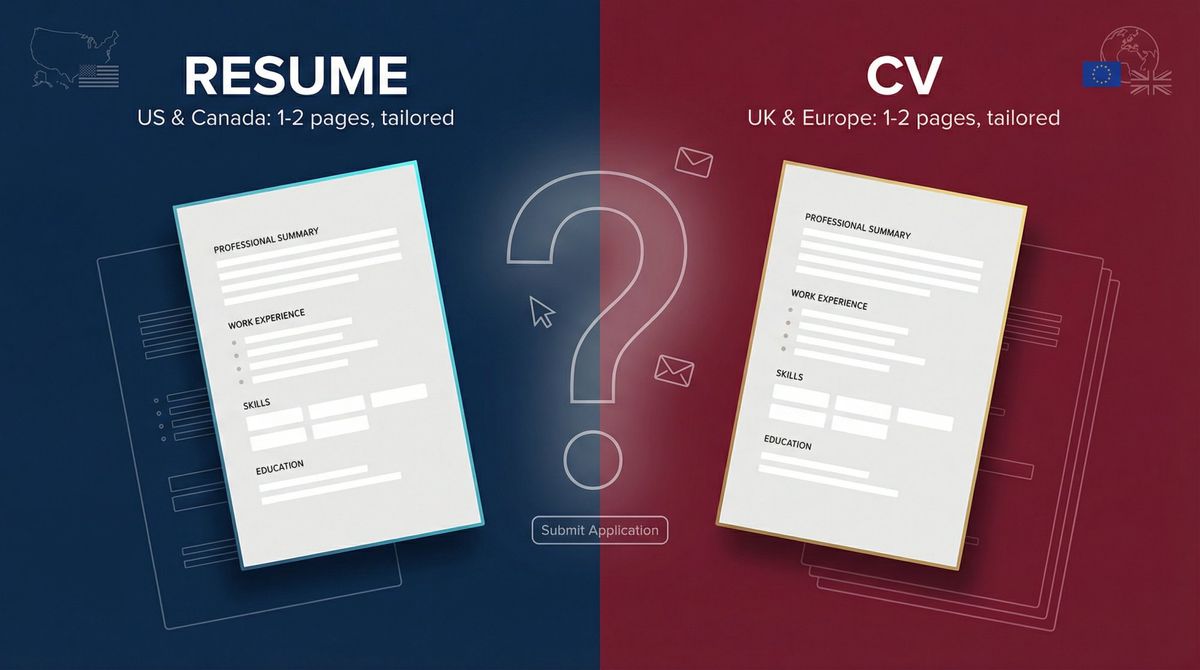
No in the US and Canada, where a resume is the standard job document and a CV is a longer academic or research record, but yes in the UK and Australia, where the words name the same document. The table shows how each region uses the term.
| Region | What "CV" means there | Source |
|---|---|---|
| US and Canada | A long record of academic, research and career history. "Resume" is the standard job application document. | Cornell, Prospects |
| UK | The standard job application document, usually up to two A4 pages. | Prospects, National Careers Service |
| Europe | A standard document for job, education, training and volunteering applications. The EU's Europass CV is a widely used format. | Europass |
| Australia | Used interchangeably with "resume". | University of Western Australia, Queensland Government |
When a posting is ambiguous, ask the recruiter one short question before you apply.
Is It CV or Resume in the UK?
In the UK it's CV: the term names the standard job application document, and most should stay at two A4 pages or fewer. Three pages can suit high-level roles or people with a lot of experience, and some medical and academic CVs run longer. The National Careers Service says a UK CV should include contact details, an introduction, education history and work history, plus references if someone has agreed to give you one.
What Should You Leave Off a UK CV?
Leave off your age, date of birth, marital status and nationality, according to the National Careers Service. Prospects adds that you don't need a photo unless you're applying for acting or modeling work. Anything that doesn't help an employer judge whether you can do the job can go.
Why Do Some Countries Call a Resume a CV?
Because "CV" and "resume" are regional names for overlapping documents. Prospects describes the UK CV as the job application document and says the US and Canada call that document a résumé, while Cornell uses "CV" in the US for the long academic record. The same word therefore names different documents depending on where the employer is based.
What Are the Main Differences Between a CV and a Resume?
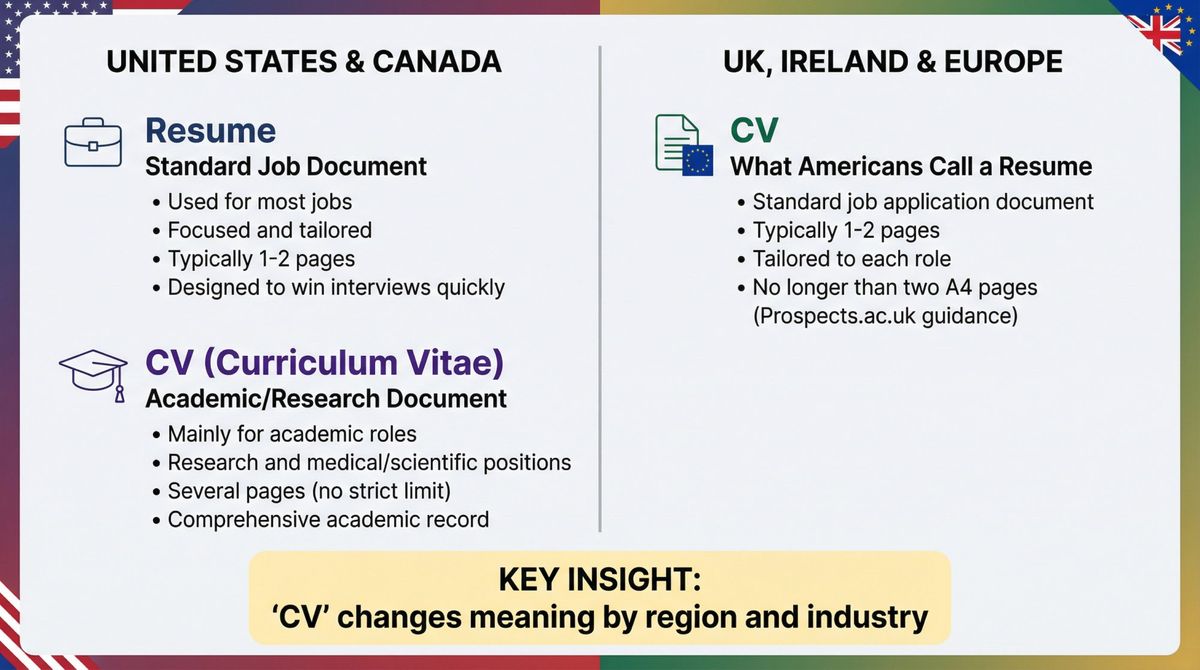
In a CV vs resume comparison, the biggest differences are length, purpose, content and how much you change the document for each job: a resume is short and rewritten per application, while a US-style CV is long and kept as one master record. The table uses the US academic meaning of "CV", because that's where the two documents genuinely differ.
| Region | What "CV" means there | Source |
|---|---|---|
| US and Canada | A long record of academic, research and career history. "Resume" is the standard job application document. | Cornell, Prospects |
| UK | The standard job application document, usually up to two A4 pages. | Prospects, National Careers Service |
| Europe | A standard document for job, education, training and volunteering applications. The EU's Europass CV is a widely used format. | Europass |
| Australia | Used interchangeably with "resume". | University of Western Australia, Queensland Government |
Sources: Cornell Graduate School and the University of Cincinnati career studio.
Which Is Better, a Resume or a CV?
Neither is better: the right document is the one the employer asks for, and most non-academic US employers expect a resume. A CV is the better choice for academic, scientific, research and healthcare roles and for fellowships and grants. Cornell also points out that sending the matching document shows employers you can tell academic and non-academic settings apart.
How Do You Decide Whether to Send a Resume or a CV?
Send what the posting names, then use the employer's country and the type of role to interpret the word "CV." Three checks cover nearly every case:
- Read the exact wording. If the posting says "resume," send a resume. If it says "CV," go to the next check.
- Check where the employer is based. In the UK, Europe and Australia, a CV request usually means a short, tailored job document. In the US and Canada, it often means the long academic version.
- Check the type of role. Academic, scientific and research positions, and non-academic positions in science, higher education, research and healthcare, typically use a CV. Most employers in industry prefer a resume.
If the signals conflict, send one short email asking which document the employer wants. A one-line question costs less than sending the wrong file.
Can You Use a Resume as a CV?
Yes, when the employer uses "CV" to mean a standard job application document, as in the UK. For US academic or research roles a resume isn't enough, because a CV adds categories such as publications, presentations, teaching experience and awards.
Can You Use a CV as a Resume?
Not as it stands, because a long CV buries the proof a resume needs to show at a glance. Convert it first, using the steps in the next section. Cornell also recommends rearranging a CV into a resume when you apply outside academia.
How Do You Convert a CV Into a Resume?
To convert a CV into a resume, choose one target job, keep only what proves you can do it, and compress the result to two pages or fewer. Seven steps get you there:
- Pick one target job title, not a vague field.
- List the six to ten requirements that appear in real postings for that role.
- Cut or compress every CV item that doesn't support those requirements.
- Lead with outcomes, not titles: what changed because of your work.
- Collapse your publications to the two to four most relevant, or drop the list if it isn't central to the job.
- Translate teaching and committee service into skills employers hire for, such as project management, leadership, teamwork and meeting deadlines.
- Keep the result to two pages or fewer and tailor it to the posting.
Keep the original CV as your master record so nothing you cut is lost, and copy the most relevant entries into each new resume. For layout choices once you've cut, see the guide to effective resume formats.
A conversion can fail in one place: the document looks right on screen but loses information when software reads it. Prospects notes that applicant tracking systems screen for keywords from the job description and can't read images, logos or graphics, so plain text matters. AIApply's AI Resume Scanner checks the converted document for formatting that trips ATS parsers and for keywords from the posting that are still missing, so you find the gap before the application goes in. For fixes, see these resume optimization techniques.
How Long Can a Federal Resume Be on USA JOBS?
A federal resume on USAJOBS can be two pages at most. Since September 27, 2025, USAJOBS restricts all resumes to two pages, and agencies review only resumes of two pages or fewer. For positions that require a CV, typically in the medical and research fields, agencies may ask you to submit it as an "other document." Check each announcement's How to Apply section before you upload.
How Do Medical Residency Applicants Submit a CV?
Residency applicants generally submit their CV digitally through the Electronic Residency Application Service (ERAS), often by copying it into the fields the system provides, according to the AMA (January 2025). A medical school dean quoted there advises starting with your education, then leading with your strongest area, such as leadership, research or service, and explaining any gaps in your timeline.
What Is a Europass CV?
A Europass CV is a standard CV format from the European Union that you build online and can use to apply for jobs, education or training, and volunteering. Europass lets you create, store and share CVs in 31 languages and describes the format as one of the best-known in Europe. Use it when an employer or institution asks for it.
What Else Do Job Seekers Ask About Resumes and CVs?
How Long Should a CV Be in the UK?
Most UK CVs should be two A4 pages or fewer, according to guidance from the University of Chester careers service quoted by Prospects. Senior roles can justify three pages, and academic and medical CVs can run longer.
How Long Should a Resume Be in the US?
A US resume should be one or two pages, and a federal resume on USAJOBS can't exceed two.
Do You Need Both a Resume and a CV?
You need both if you apply for academic and non-academic jobs. Cornell says you may need both during your job search. Keep the CV as your master record and cut resumes from it, as shown above.
What Should You Send When a US Company's Non-Academic Job Ad Asks for a CV?
Send a tailored resume of one to two pages unless the posting or recruiter says otherwise. Most employers in industry prefer a resume, and if you're unsure what the employer means, one short email to the recruiter settles it.
Can You Use AI to Write a Resume or CV?
Yes, as long as you use it sensibly. Prospects (May 2025) lists research, summarizing job descriptions, drafting and proofreading as responsible uses, and says AI shouldn't write your whole document or invent or embellish details. Check the employer's application instructions too, because some employers ban AI and others welcome ethical use.
How Often Should You Update a CV or Resume?
Update your CV whenever you add an achievement, and rewrite your resume for each application. The AMA says a CV should be updated frequently to reflect your career, and Prospects advises tailoring your document to each role and employer.
Final Thoughts
Check the posting's wording and the employer's country, send the matching document, and keep one master record you can cut down for each application. Choosing the document takes two minutes. The part that slows most searches is repeating the tailoring for every posting while still applying early and following up, which is the system the how to get hired fast guide walks through. When you're ready to build, AIApply's AI Resume Builder can pull your history in straight from your LinkedIn profile, so one master record becomes a tailored resume for each posting without starting from a blank page.
Choose the document the employer asked for, build it from your real experience, and keep moving.