How to List Freelance Work on Resume (2026 Guide)
How to include freelance work on a resume in 2026. Showcase projects, skills, and results the right way.


Freelance work is real work. But it can look chaotic on a resume if you're not careful about how you present it.
The problem isn't that freelance work doesn't count. It's that most job seekers list every single gig as a separate entry, creating a resume that reads like a fragmented timeline instead of a coherent professional story.
Hiring managers want to see: what you do, who you did it for (or what types of clients), and what results you delivered. ATS systems need clean formatting and standard section headings to parse your experience correctly.
This guide shows you exactly how to list freelance work on your resume in a way that passes ATS screening, reads professionally to humans, and positions your freelance experience as a strategic advantage (not something you need to explain away).
Why Freelance Work Belongs on Your Resume
Research shows that freelancers are typically classified as self-employed rather than traditionally employed. But that doesn't mean your work matters any less.
Freelance work absolutely counts as professional experience when it's relevant to the role you're targeting.
Think about what you actually did as a freelancer:
- You managed client relationships and expectations
- You scoped projects, set timelines, and delivered results
- You handled your own marketing, billing, and communication
- You adapted to different industries, tools, and working styles
Those are legitimate job skills that employers value. The key is presenting them in a format that ATS can parse and humans can quickly understand.
What Most People Get Wrong About Listing Freelance Work
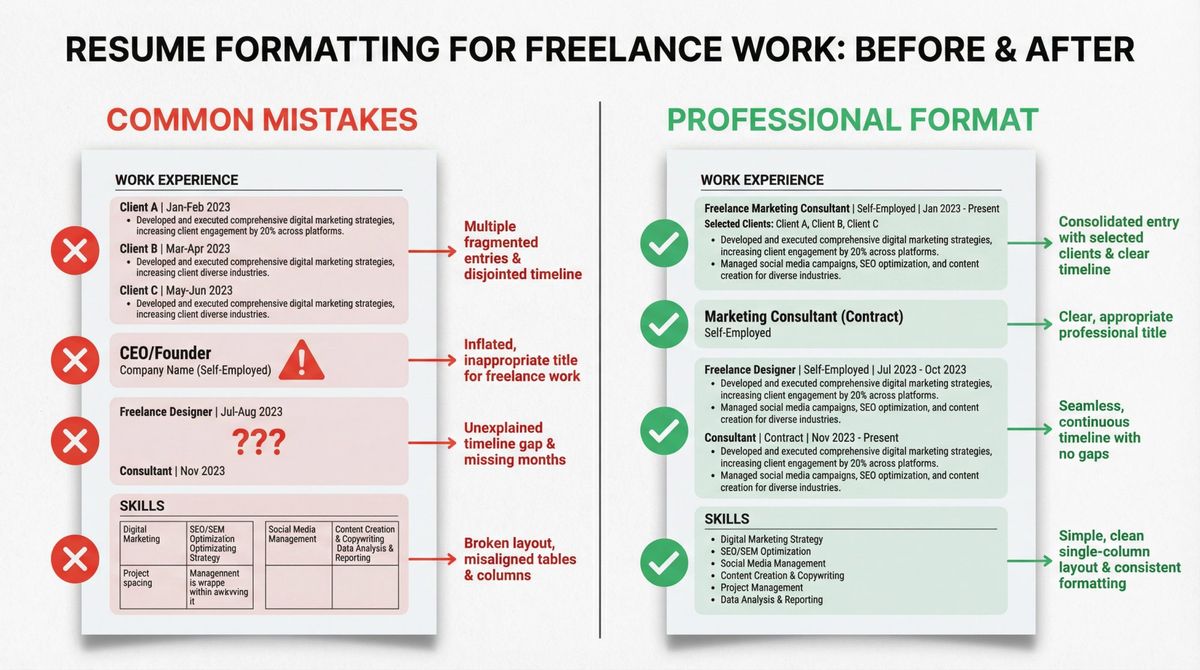
Most freelancers make one of these mistakes:
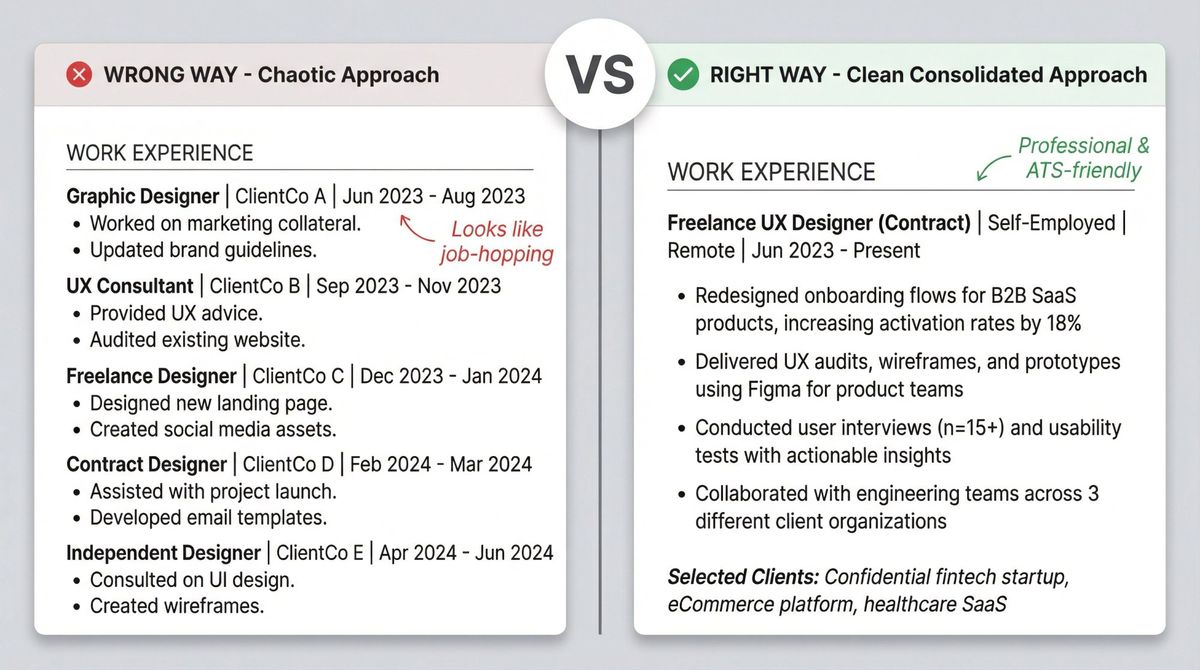
Mistake #1: Creating a separate entry for every single client or project
This fragments your timeline and makes you look like a serial job-hopper. If you worked with 15 clients over two years, you don't need 15 separate entries. You need one consolidated freelance role with a "Selected Clients" section underneath.
Mistake #2: Using inflated titles like "CEO" or "Founder" for basic freelance work
Resume experts warn that calling yourself "CEO/Founder" can make you look overqualified for non-leadership roles. It also raises questions about whether you'll be satisfied in a traditional employee position.
Mistake #3: Hiding freelance work completely and creating unexplained gaps
If you freelanced for six months or a year, leaving it off your resume just creates a gap you'll have to explain in interviews anyway.
Mistake #4: Using formatting that breaks ATS parsing
Critical fact: Studies show that 99.7% of recruiters use an ATS system. If your freelance section uses tables, columns, headers, or graphics, there's a good chance your experience won't get parsed correctly by ATS software.
Where to Place Freelance Work on Your Resume
You have two main options.
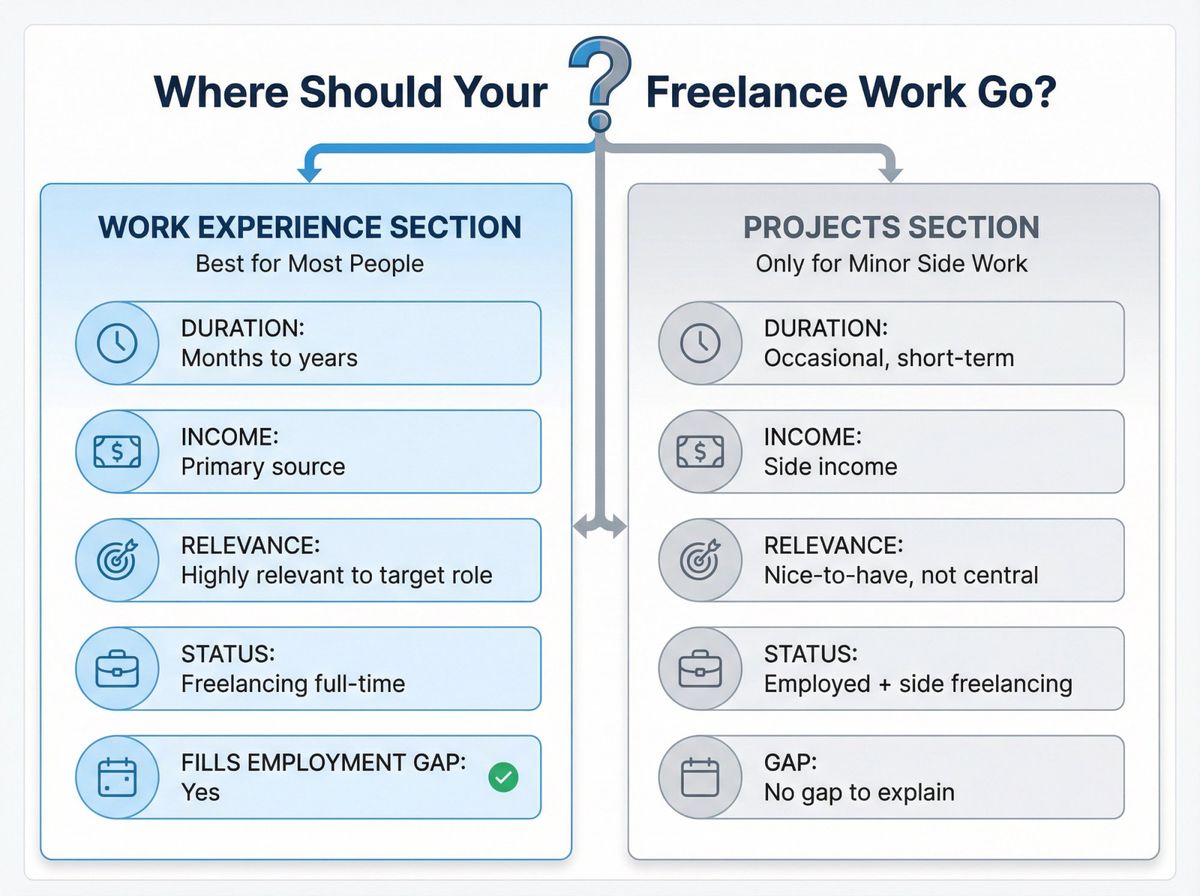
You have two main options.
Put It in Your Work Experience Section (Best for Most People)
Put freelance work in your main Work Experience section if it's:
→ Ongoing for months or years
→ Your primary source of income
→ Highly relevant to the job you're applying for
→ Filling what would otherwise be an employment gap
This is where most freelance work belongs. You're showing it as legitimate professional experience that deserves equal weight with traditional roles.
Create a Projects Section (Only for Minor Side Work)
Use a separate Projects or Additional Experience section if your freelance work was:
→ Occasional or short-term
→ Not central to your current career direction
→ Something you did while employed full-time (and it might create confusion about bandwidth)
Resume experts note that if you're currently employed full-time, you should only include freelance work if it strengthens your application without making you look overextended.
| Placement Decision | Use Work Experience | Use Projects Section |
|---|---|---|
| Duration | Months to years | Occasional, short-term |
| Income Level | Primary source | Side income |
| Relevance | Highly relevant to target role | Nice-to-have, not central |
| Current Status | Freelancing full-time | Employed + side freelancing |
| Resume Gap | Fills an employment gap | No gap to explain |
How to Format Freelance Work on Your Resume
There isn't one universal format. Choose based on how your freelance work actually happened.
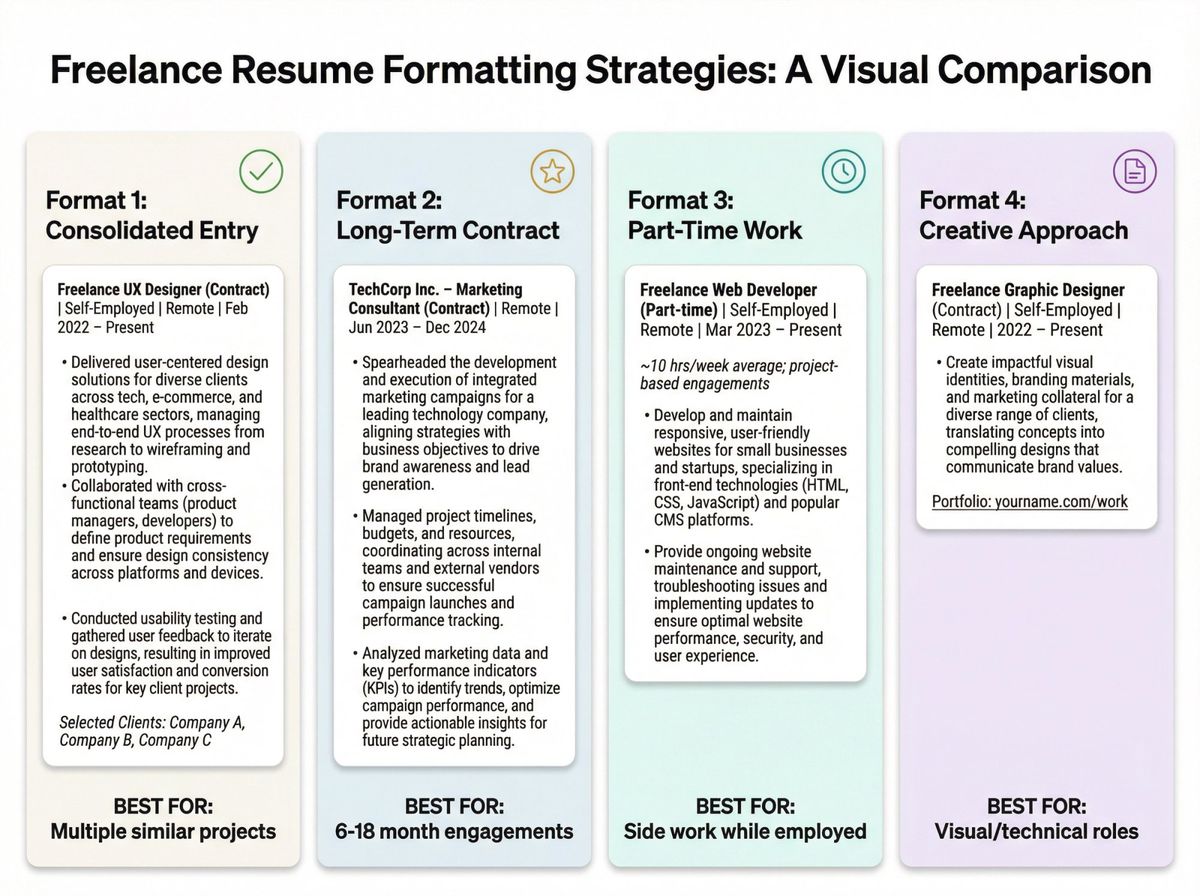
Format 1: One Role, Many Clients (Most Common)
Create one consolidated freelance entry and add a "Selected Clients/Projects" line underneath.
Why this works: It keeps your timeline clean and avoids the repetitive job-hopper look. You're not hiding anything. You're just organizing similar work under a single umbrella.
Example structure:
Freelance UX Designer (Contract) | Self-Employed | Remote | Feb 2022 – Present• Redesigned onboarding flows for B2B SaaS products, increasing activation rates by an average of 18%• Delivered UX audits, wireframes, and prototypes using Figma for product and engineering teams• Conducted user interviews (n=15+) and usability tests, translating insights into prioritized recommendationsSelected Clients: Confidential fintech startup, eCommerce subscription brand, healthcare SaaS platform
Format 2: List Client as Employer (For Long-Term Contracts)
If you had a 6 to 18 month contract that functioned like a full-time job (regular meetings, deep involvement, major outcomes), list it like this:
[Client Company Name] – Marketing Consultant (Contract) | Remote | Jun 2023 – Dec 2024• Built and executed paid search strategy, improving ROAS by 35% across three campaigns• Developed positioning and landing page messaging that increased conversion rate from 2.1% to 3.4%• Implemented reporting dashboards and weekly performance reviews with stakeholders
Industry guidance suggests placing the client in the employer spot and adding "Contract" next to your role when the engagement was substantial enough to stand alone.
Format 3: How to Show Part-Time Freelancing
If you freelanced part-time while working a full-time job, make that clear:
Freelance Web Developer (Part-time) | Self-Employed | Remote | Mar 2023 – Present~10 hrs/week average; project-based engagements• Completed custom WordPress sites for small businesses, delivering on schedule across 8 concurrent projects• Maintained full-time employment while managing client communication, scoping, and delivery timelines
Clarifying the time commitment prevents readers from assuming a small freelance gig consumed your entire schedule.
Format 4: Portfolio-First Approach (For Creative Roles)
Put freelance work in your Work Experience section, but make your portfolio or GitHub link do the heavy lifting.
Why it matters: Visual or technical work is hard to convey in bullet points alone. Recruiters expect to see samples when evaluating creative or technical freelancers.
Include your portfolio link in your resume header and reference it in your freelance entry if needed.
How to Choose a Job Title for Freelance Work
This is where most freelancers accidentally create red flags.
Pick a Title That Matches Your Work and Target Role
Your freelance job title should reflect what you actually did. Adding "Contract," "Consultant," or "Freelancer" helps clarify the nature of the work.
Good examples:
- Freelance Graphic Designer (Contract)
- Marketing Consultant (Independent)
- Software Engineer (Contract)
- Independent Content Strategist
Bad examples:
- CEO/Founder (unless you're applying for leadership roles)
- Owner (sounds like you ran a business, not did client work)
- Entrepreneur (too vague)
Career experts recommend matching your job title to the type of role you want next, as long as it's accurate and defensible.
Choose a Company Name That Won't Confuse ATS
You have three main options:
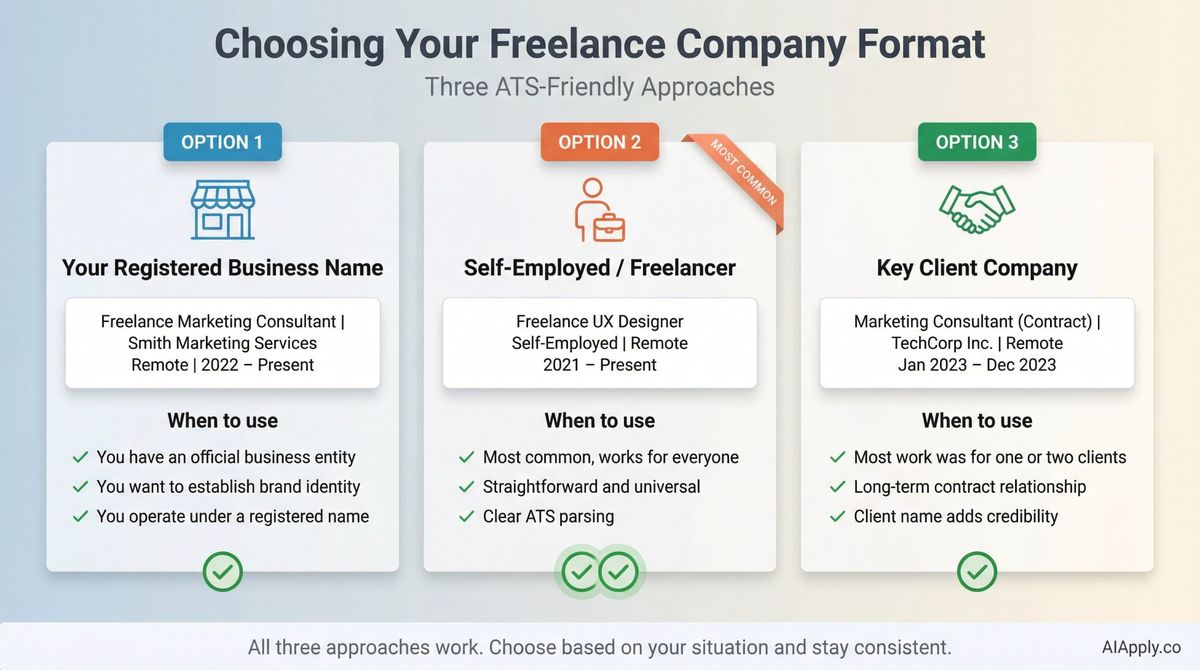
You have three main options:
| Option | Format Example | When To Use |
|---|---|---|
| Your registered business name | Freelance Marketing Consultant | Smith Marketing Services |
| Self-Employed / Freelancer | Freelance UX Designer | Self-Employed |
| Key client company | Marketing Consultant (Contract) | TechCorp Inc. |
All three approaches work. Just be consistent and make sure it's clear you were doing contract work (not a traditional employee).
How to Write Resume Bullets That Show Impact
Freelancers often undersell themselves by listing what they did instead of what they achieved.
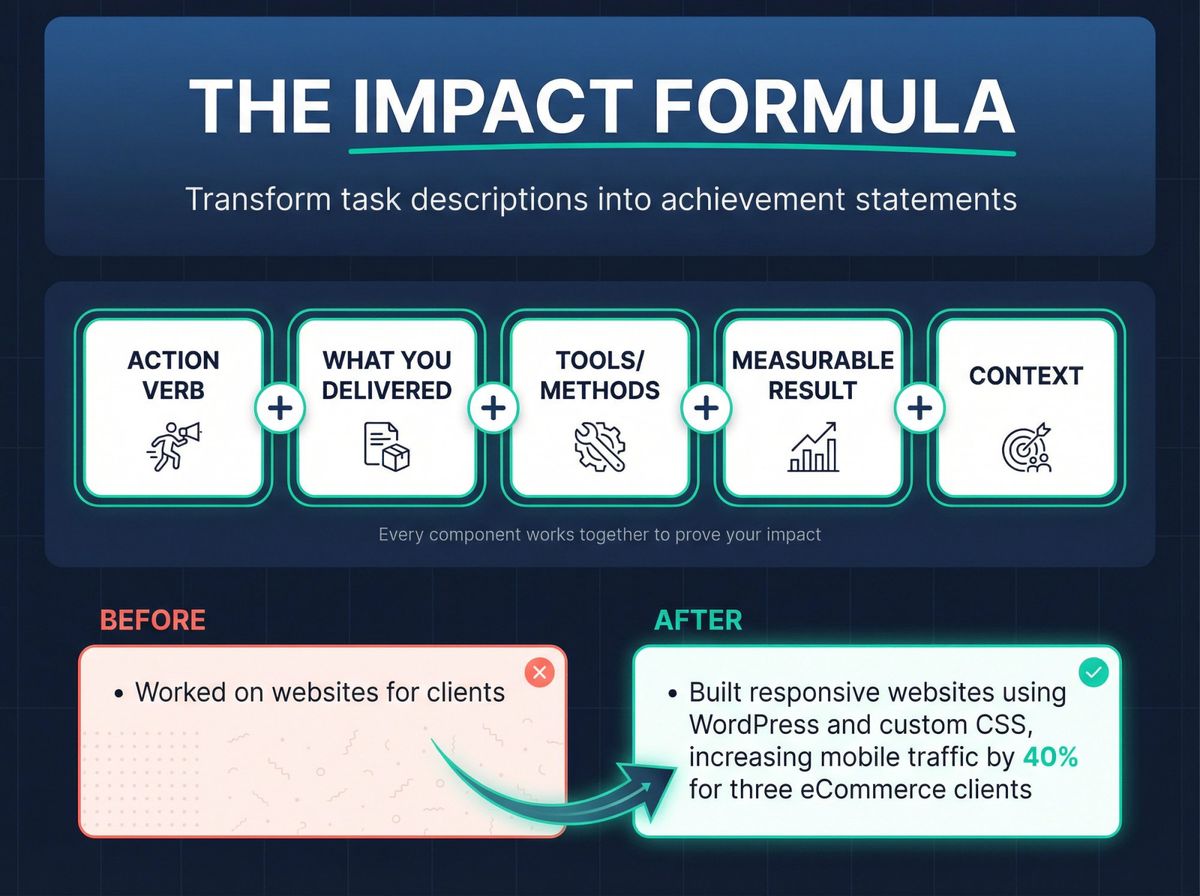
Employers evaluate candidates based on impact, scope, and outcomes. Resume experts emphasize focusing on quantifiable achievements whenever possible.
Use This Bullet Formula
Action verb + what you delivered + tools/methods + measurable result + context
Examples:
• Built responsive websites using WordPress and custom CSS, increasing mobile traffic by 40% for three eCommerce clients
• Led content strategy for B2B SaaS client, producing 24 blog posts that drove 15,000+ organic sessions within six months
• Optimized paid ad campaigns across Google and Meta platforms, reducing cost per acquisition by 28% while maintaining conversion quality
• Implemented automated workflows using custom scripts and API integrations, reducing manual data entry by 35 hours per month
Don't forget to include the "extras" like client communication, project management, and time management. Those are real job skills that translate directly to traditional roles.
How to Handle Client Confidentiality on Your Resume
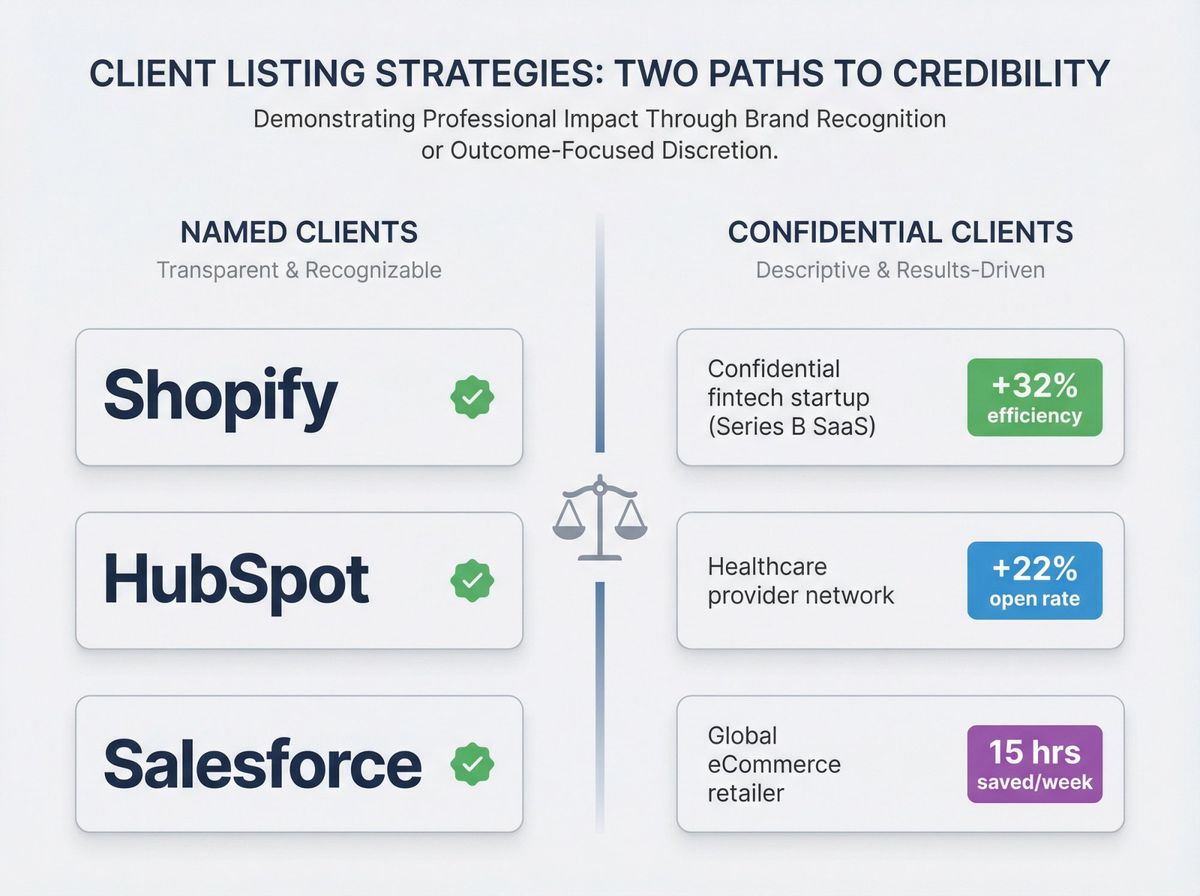
If you can name clients (and it strengthens your case), name them.
If you signed NDAs or worked with confidential clients, you can still show credibility without violating agreements.
When You Can Name Clients
Add a simple line:
Selected Clients: Shopify, HubSpot, Salesforce
or
Selected Projects: Product launch GTM campaign, retention email redesign, SEO content strategy
When You Can't Name Clients (NDA or Confidentiality)
Use client descriptors instead:
Selected Clients: Confidential fintech startup (Series B SaaS), healthcare provider network, global eCommerce retailer
Then back up your credibility with outcome-focused bullets:
• Reduced onboarding time by 32% through redesigned UX flow
• Improved email open rates by 22% across three campaigns
• Delivered custom integrations that saved 15+ hours per week in manual processing
The proof is in the results, not the client names.
How to Make Freelance Experience ATS-Friendly
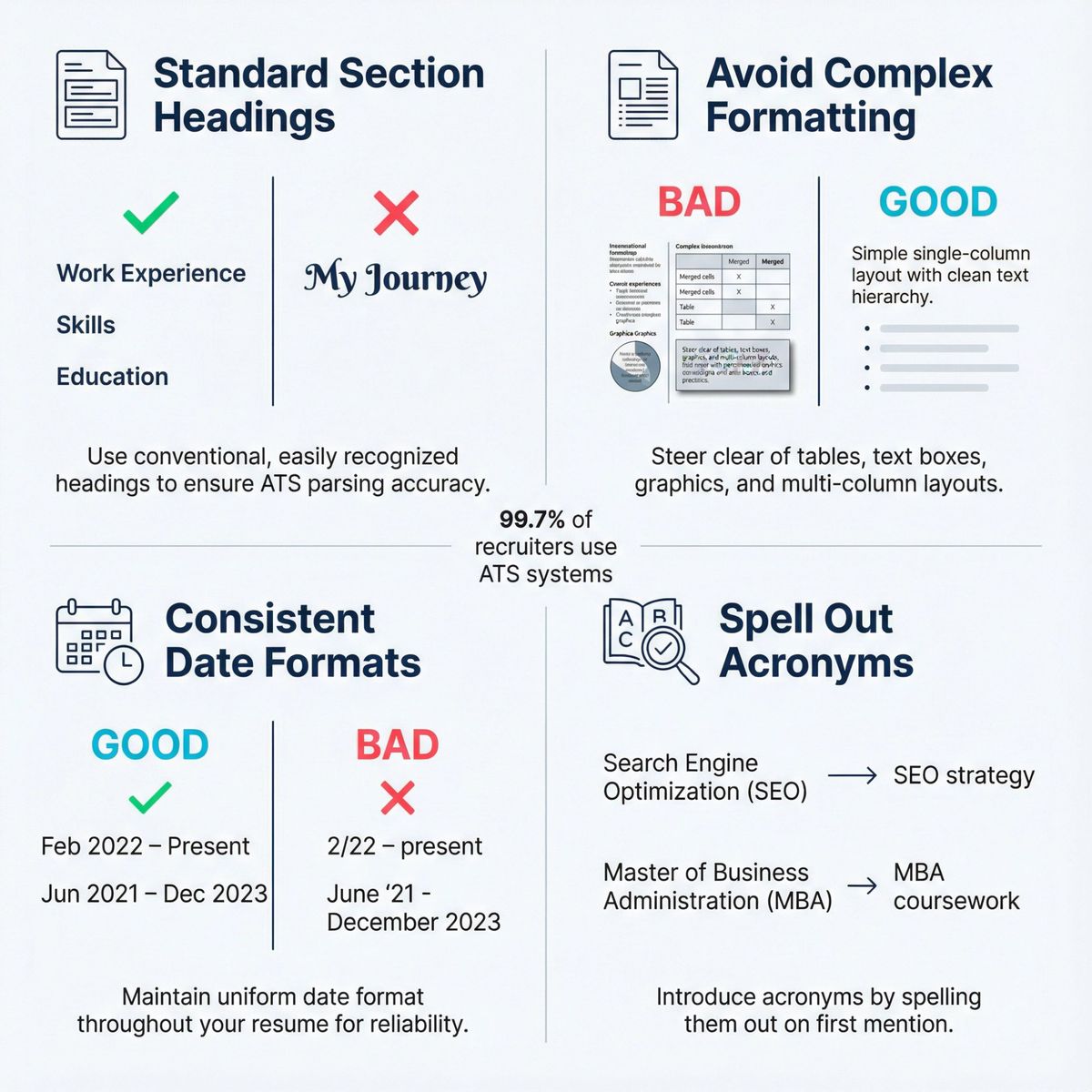
This is non-negotiable in 2026.
ATS systems parse your resume into structured fields (job titles, dates, skills, employers). If your freelance section uses weird formatting, it can get misread or skipped entirely.
ATS Rule #1: Use Standard Section Headings
Stick with headings like:
- Work Experience
- Professional Experience
- Skills
- Education
ATS guidance from career centers emphasizes using clear, conventional headings so the system can locate your information correctly.
ATS Rule #2: Avoid Tables, Columns, Headers, and Graphics
ATS software struggles with:
- Multi-column layouts
- Text boxes
- Headers and footers
- Embedded graphics or logos
- Complex tables
Multiple sources confirm that ATS can't reliably parse content in headers, footers, or tables.
Use a simple, single-column layout with standard fonts.
ATS Rule #3: Use Clean, Consistent Date Formats
If you freelanced while employed, or had overlapping projects, sloppy dates create confusion.
Good format:
Feb 2022 – PresentJun 2021 – Dec 2023
Bad format:
2/22 – presentJune '21 - December 2023
Keep it consistent throughout your resume.
ATS Rule #4: Include Both Acronyms and Full Terms
Career advisors recommend spelling out acronyms at least once, then using the acronym in later references.
Example:
• Search Engine Optimization (SEO) strategy
• User Experience (UX) research
• Customer Relationship Management (CRM) implementation
This helps ATS match your resume to job descriptions that might use either version.
| ATS Rule | What To Do | What To Avoid |
|---|---|---|
| Section Headings | Use "Work Experience", "Skills", "Education" | Creative headings like "My Journey" |
| Formatting | Simple single-column layout | Tables, columns, headers, graphics |
| Dates | Consistent format (Feb 2022 – Present) | Inconsistent formats (2/22, June '21) |
| Acronyms | Spell out first, then use acronym | Acronym-only or full-term-only |
Why ATS Compatibility Matters
Studies show that 99.7% of recruiters use an ATS system. That means if your resume isn't ATS-friendly, it probably won't get seen by a human.
Clean formatting isn't a nice-to-have. It's basic compatibility.
Ready-to-Use Freelance Resume Templates
Use these templates as a starting point, then customize with your details.
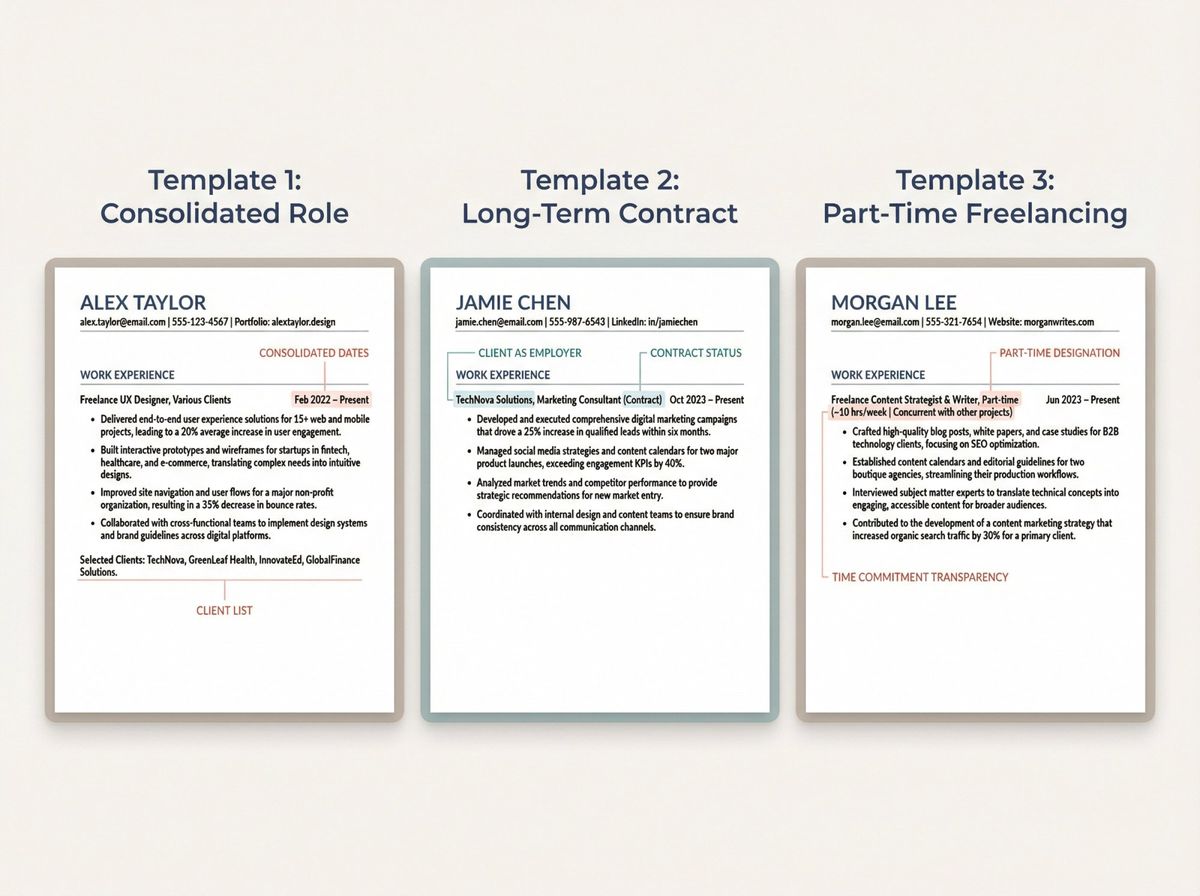
Template 1: One Role, Many Clients (Most Common)
Freelance [Job Title] (Contract) | Self-Employed | [City/Remote] | [Month Year] – PresentBrief scope: Provide [service] for [types of clients/industries]; typical projects include [X, Y, Z]• Delivered [specific project/outcome] for [client type], resulting in [metric] improvement in [KPI]• Built/managed [system/campaign/product] using [tools], driving [result] across [scale]• Led end-to-end delivery: scoping, stakeholder management, timelines, QA, handover• Improved [process/metric], reducing [cost/time/errors] by [X%] while maintaining [quality standard]Selected Clients: [Client A], [Client B], [Client C] (or "Confidential [industry] clients")
Template 2: Long-Term Contract (Client as Employer)
[Client Company Name] – [Job Title] (Contract) | [Location/Remote] | [Month Year] – [Month Year]• Owned [responsibility] across [team/department], delivering [outcome] within [timeline]• Implemented [solution], improving [metric] by [X%] and reducing [risk/cost] by [Y%]• Partnered with [stakeholders] to define requirements and ship [deliverable]
Template 3: Part-Time Freelancing While Employed
Freelance [Job Title] (Part-time) | Self-Employed | Remote | [Month Year] – [Month Year]~[X] hrs/week average; project-based engagements• Completed [deliverable] for [client type], achieving [result]• Maintained on-time delivery across [#] concurrent projects while working full-time
Real Freelance Resume Examples by Role
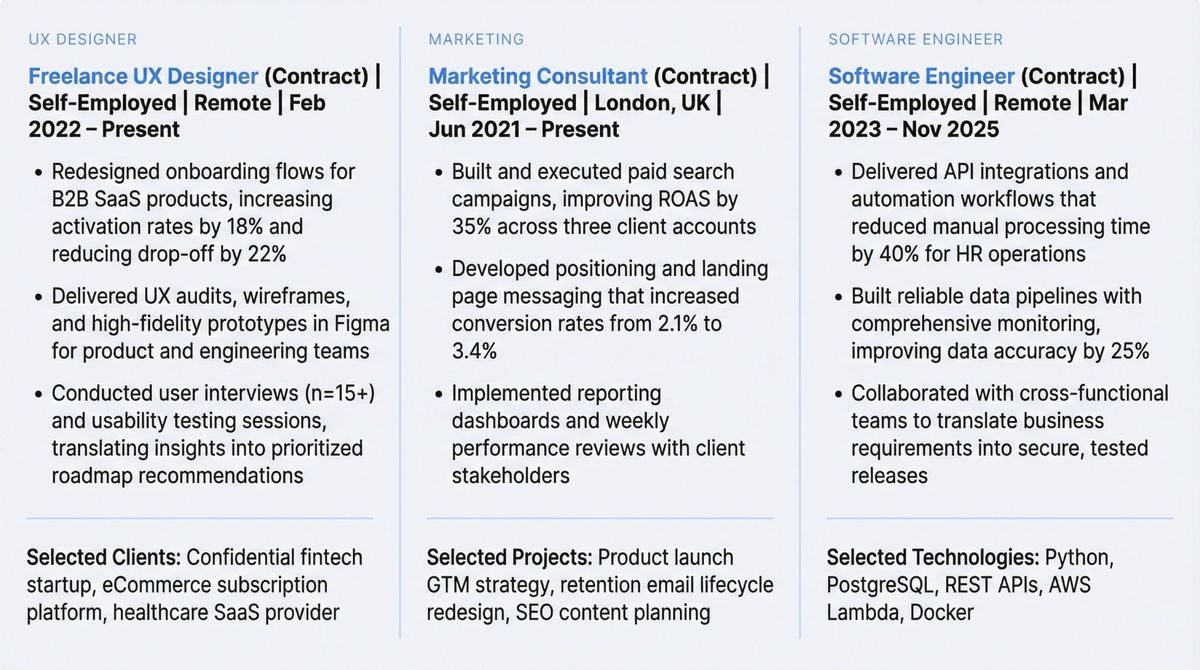
Freelance UX Designer Example
Freelance UX Designer (Contract) | Self-Employed | Remote | Feb 2022 – Present• Redesigned onboarding flows for B2B SaaS products, increasing activation rates by 18% and reducing drop-off by 22%• Delivered UX audits, wireframes, and high-fidelity prototypes in Figma for product and engineering teams• Conducted user interviews (n=15+) and usability testing sessions, translating insights into prioritized roadmap recommendationsSelected Clients: Confidential fintech startup, eCommerce subscription platform, healthcare SaaS provider
Marketing Consultant Resume Example
Marketing Consultant (Contract) | Self-Employed | London, UK | Jun 2021 – Present• Built and executed paid search campaigns, improving ROAS by 35% across three client accounts• Developed positioning and landing page messaging that increased conversion rates from 2.1% to 3.4%• Implemented reporting dashboards and weekly performance reviews with client stakeholdersSelected Projects: Product launch GTM strategy, retention email lifecycle redesign, SEO content planning
Contract Software Engineer Resume Example
Software Engineer (Contract) | Self-Employed | Remote | Mar 2023 – Nov 2025• Delivered API integrations and automation workflows that reduced manual processing time by 40% for HR operations• Built reliable data pipelines with comprehensive monitoring, improving data accuracy by 25%• Collaborated with cross-functional teams to translate business requirements into secure, tested releasesSelected Technologies: Python, PostgreSQL, REST APIs, AWS Lambda, Docker
Common Freelance Resume Mistakes to Avoid
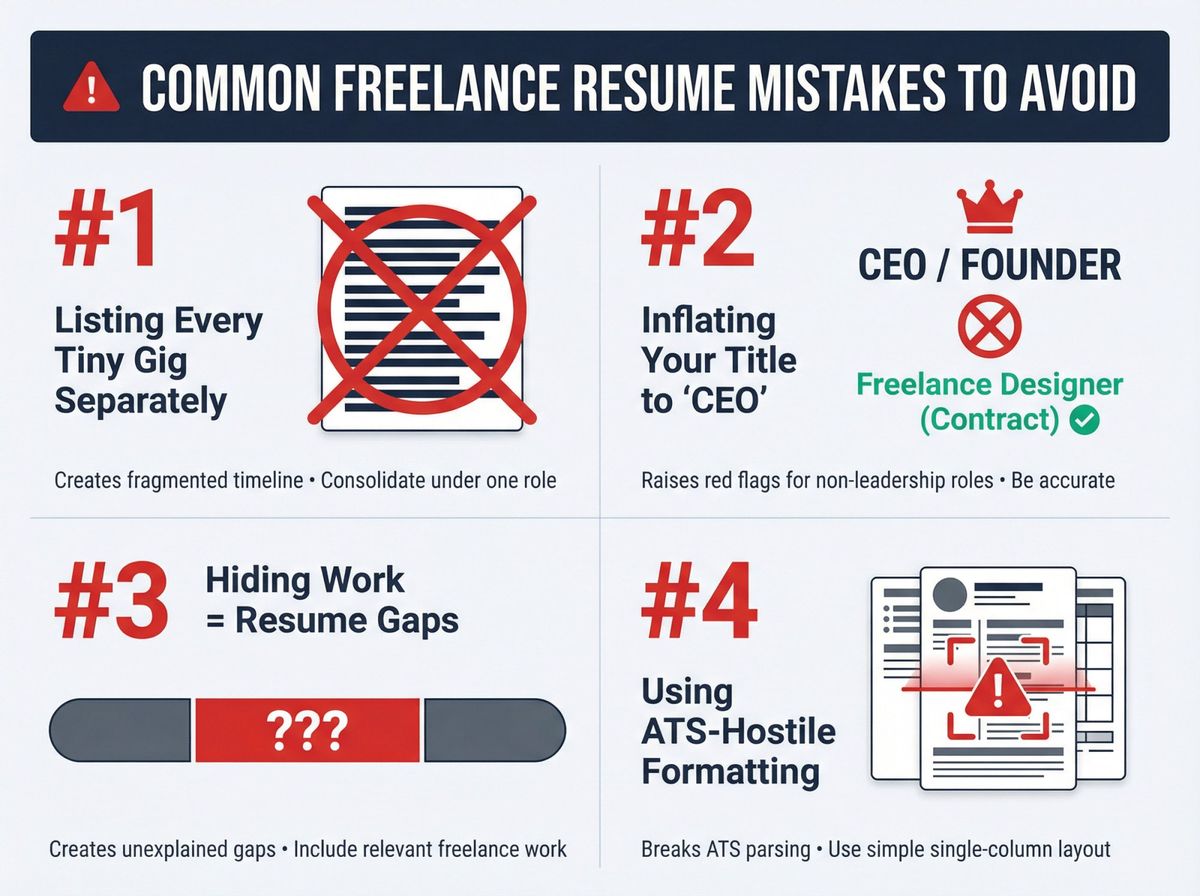
Mistake #1: Listing Every Tiny Gig Separately
This creates a resume that feels fragmented and unstructured. Consolidate similar work under one freelance role with a Selected Clients section.
Mistake #2: Inflating Your Title to "CEO" or "Founder"
Unless you're applying for leadership roles, calling yourself CEO for basic freelance work can make employers question whether you'll be satisfied in a traditional role.
Mistake #3: Hiding Substantial Work and Creating Resume Gaps
If you freelanced for six months or more, leaving it off your resume just creates a gap you'll need to explain anyway. Better to present it professionally from the start.
Mistake #4: Using ATS-Hostile Formatting
Career guidance is clear: avoid tables, columns, headers, footers, and graphics. Use simple formatting with standard section headings.
How to Tailor Freelance Work to Any Job Application
Here's a practical checklist we use when helping job seekers optimize their freelance sections:
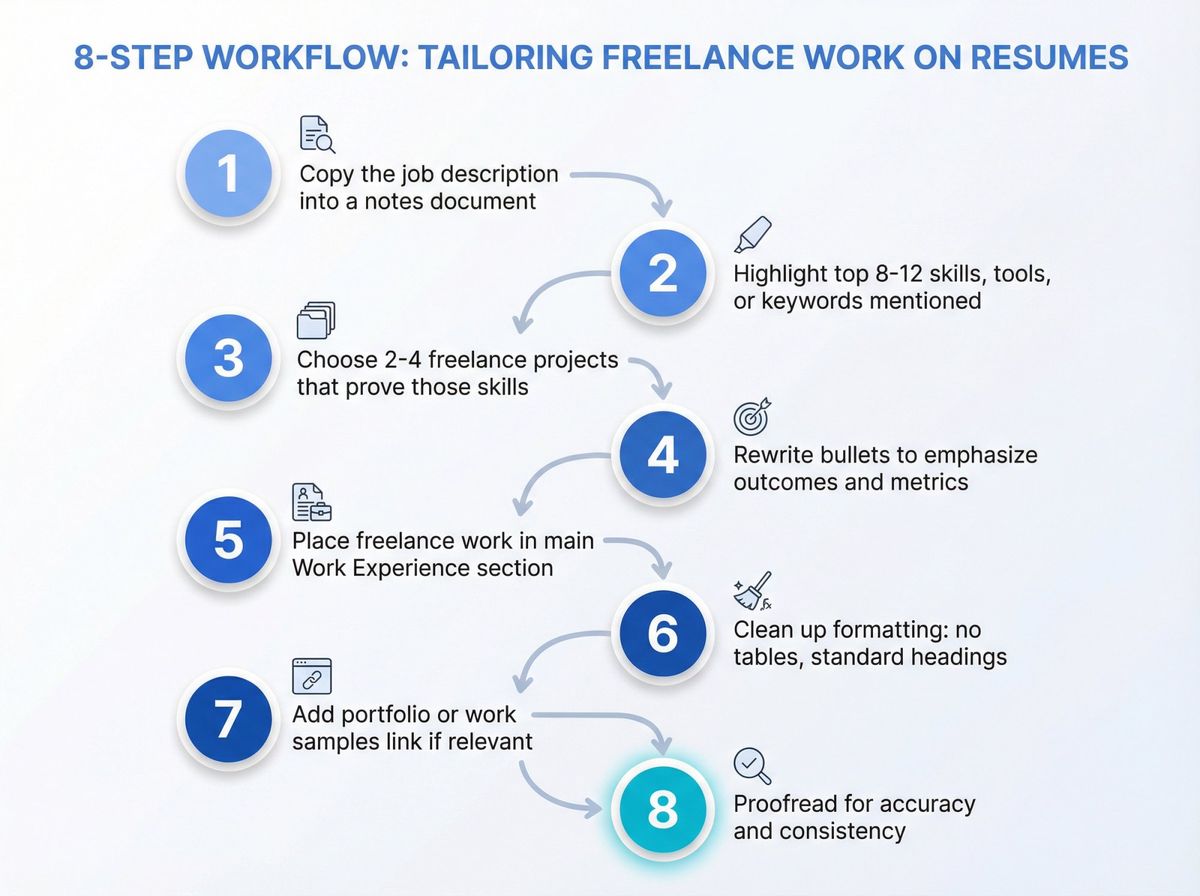
① Copy the job description into a notes document
② Highlight the top 8 to 12 skills, tools, or keywords mentioned
③ Choose 2 to 4 freelance projects that directly prove those skills
④ Rewrite your bullets to emphasize outcomes and metrics (even estimated percentages count)
⑤ Place freelance work in your main Work Experience section unless it's truly minor
⑥ Clean up formatting: no tables, no graphics, standard headings, consistent date formats
⑦ Add a portfolio or work samples link if it strengthens your case
⑧ Proofread for accuracy and consistency
Important note: AI-generated resume content can look generic if you don't customize it. Always review for accuracy and make sure it sounds like your actual experience.
How AIApply Helps Freelancers Build Better Resumes
If you're listing freelance work on your resume, your biggest challenges are probably:
① Messy structure that doesn't read cleanly
② Weak bullet points that don't show impact
③ ATS compatibility issues that get your resume filtered out
That's exactly what AIApply is designed to solve.
What AIApply Does for Freelancers
Our Resume Builder helps you create an ATS-friendly layout quickly, with templates specifically designed to pass parsing systems. You can consolidate freelance work under clean, professional entries without manually wrestling with formatting.
Our Resume Scanner analyzes your resume against the job description and flags keyword gaps, ATS compatibility issues, and formatting problems before you submit.
Our AI Resume Checker gives you structured feedback on content, bullet strength, and overall layout so you know exactly what needs improvement.
Our Resume Rewriter can help you transform weak bullet points into results-focused achievements that catch hiring manager attention.
Our Resume Editor makes it easy to refine and polish your freelance experience section with AI-powered suggestions.
Once your resume is ready, our Auto Apply feature can help you submit applications at scale. This is especially helpful for freelancers transitioning back to full-time roles who need to apply to dozens of positions efficiently.
We've helped over 1,000,000 job seekers optimize their applications. Users are 80% more likely to get hired faster when they use our tools to structure their experience and target the right opportunities.
The platform uses GPT-4 via Azure OpenAI for intelligent resume optimization, so you get specific, actionable suggestions (not generic templates).
You can also use our AI Cover Letter Generator to create tailored cover letters that complement your freelance resume and showcase your unique value proposition.
Frequently Asked Questions About Listing Freelance Work
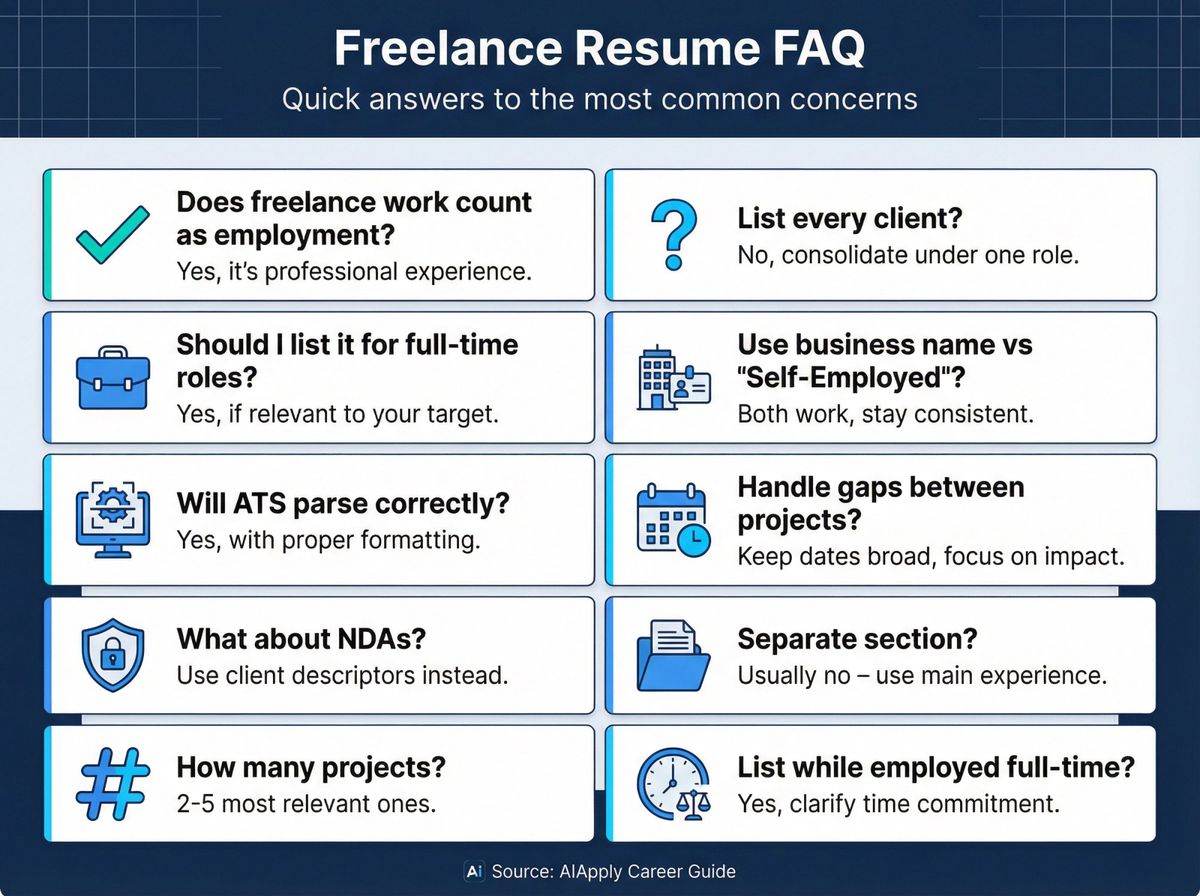
Does freelance work count as employment?
Freelance work is typically classified as self-employment rather than traditional employment. But it absolutely counts as professional experience and should be included on your resume when it's relevant to the role you're targeting.
Should I list freelance work if I'm applying for full-time roles?
Yes, if it supports your career direction or demonstrates transferable skills. But if the freelance work is unrelated and might make you look overextended or unfocused, consider leaving it off or minimizing it.
Do I need to list every client I've worked with?
No. Resumes aren't meant to be a complete work history. Focus on relevant work and consolidate similar projects under one freelance entry with a "Selected Clients" section.
Can I use my business name instead of "Self-Employed"?
Yes. Resume experts confirm you can use a business name if you operate under one. Just make it clear that you were doing contract work.
Will ATS systems parse freelance work correctly?
Yes, but only if you format it properly. Use standard section headings (Work Experience, Skills), avoid tables and graphics, keep date formats consistent, and spell out acronyms at least once. ATS formatting mistakes are the #1 reason resumes get filtered out.
What if I signed an NDA and can't name my clients?
Use client descriptors instead: "Confidential Series B fintech startup," "Healthcare provider network," "Global eCommerce retailer." Then prove your credibility through outcome-focused bullets with specific metrics.
How do I handle gaps between freelance projects?
If you had periods without active projects, just keep your main freelance entry dates broad (e.g., "Jan 2022 – Present") and focus on the most substantial work in your bullets. You don't need to account for every single week.
Should I create a separate "Freelance Experience" section?
Usually no. Most freelancers should put contract work in the main Work Experience section to give it equal weight with traditional roles. Only create a separate Projects or Freelance section if the work was truly minor or side activity.
How many freelance projects should I include?
Include 2 to 5 of your most relevant, substantial projects. You're not trying to list everything you've ever done. You're building a case for why you're qualified for this specific role.
Can I list freelance work if I'm still employed full-time?
Yes, but clarify the time commitment. Add "(Part-time)" or "~10 hrs/week" to show you weren't overextended. Be honest about whether including it strengthens your application or creates questions about bandwidth.