How to Answer "Why Should We Hire You?" (2026 Guide)
Structured answers win. Learn how to answer "Why should we hire you?" with impact, proof, and fit using examples for every career stage and role.


"Why should we hire you?"
This question lands differently than you think.
When hiring managers ask it, they're not looking for a cute answer or a recital of your resume. They're asking you to win a decision in real time.
You're competing against other qualified candidates, and this is your moment to prove you're the obvious choice. What makes this harder in 2026 is that hiring has become more structured, more skills-focused, and increasingly automated. A large field experiment with 70,000 applicants found that automated voice-AI interviews were more consistent and that applicants interviewed by AI agents were 12% more likely to receive job offers. Translation? Structured answers win. Rambling loses.
The job market has also shifted toward skills-based hiring. LinkedIn's recruiting research shows that focusing on skills can increase talent pools by 10x, and job postings omitting degree requirements jumped 36% between 2019 and 2022. What matters now is evidence you can do the work, not just credentials on paper.
So how do you answer this question in a way that actually wins interviews?

What Do Interviewers Look for When They Ask This Question?
When someone asks "Why should we hire you?", they're actually evaluating you on four levels:
→ What results will you produce here?
→ How do I know you're not bluffing?
→ Why you over the other qualified people?
→ Will you be easy to work with, stick around, and ramp fast?
Indeed's guidance for candidates is blunt about what employers listen for: passion plus proven ability, differentiated experience, drive, unique skills, ability to elevate the team, belief in the mission, and culture connection.
Your job is to compress all of that into a clear value proposition with proof. But first, you need to understand what a good answer actually looks like from the employer's perspective.
How Interviewers Score Your Answer
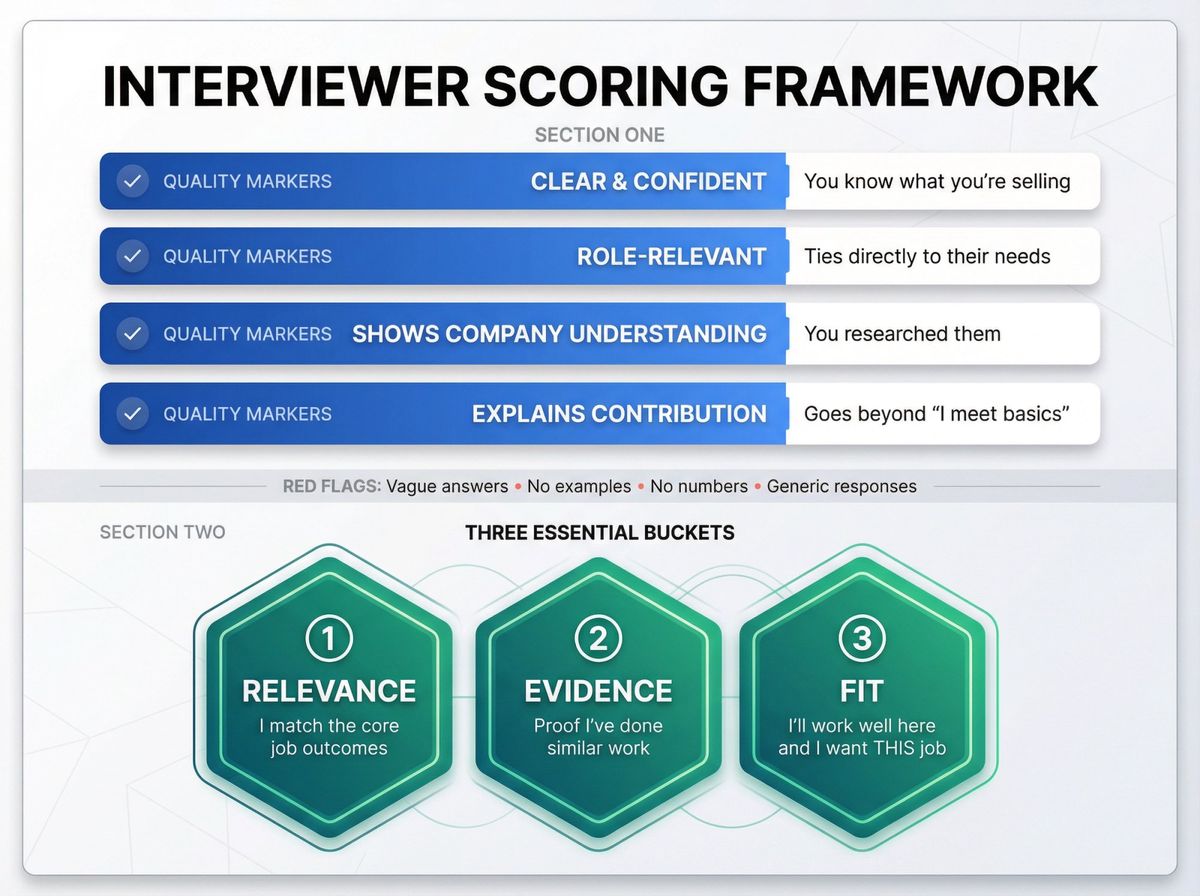
Indeed's employer-side guidance spells out what a strong response contains:
| Quality Marker | What It Means |
|---|---|
| Clear & confident | You know what you're selling |
| Role-relevant | Ties directly to their needs |
| Shows company understanding | You researched them |
| Explains contribution | Goes beyond "I meet basics" |
The red flags are predictable: vague answers, no examples, no numbers, generic answers that don't feel tailored.
So your answer must hit three buckets:
① Relevance (I match the core job outcomes)
② Evidence (proof I've done similar work)
③ Fit (I'll work well here, and I actually want this job)
Best Answer Framework: How to Structure Your Response
Here's the highest-signal structure that works across industries:
The 4-Part Formula: Impact, Proof, Fit, and Close
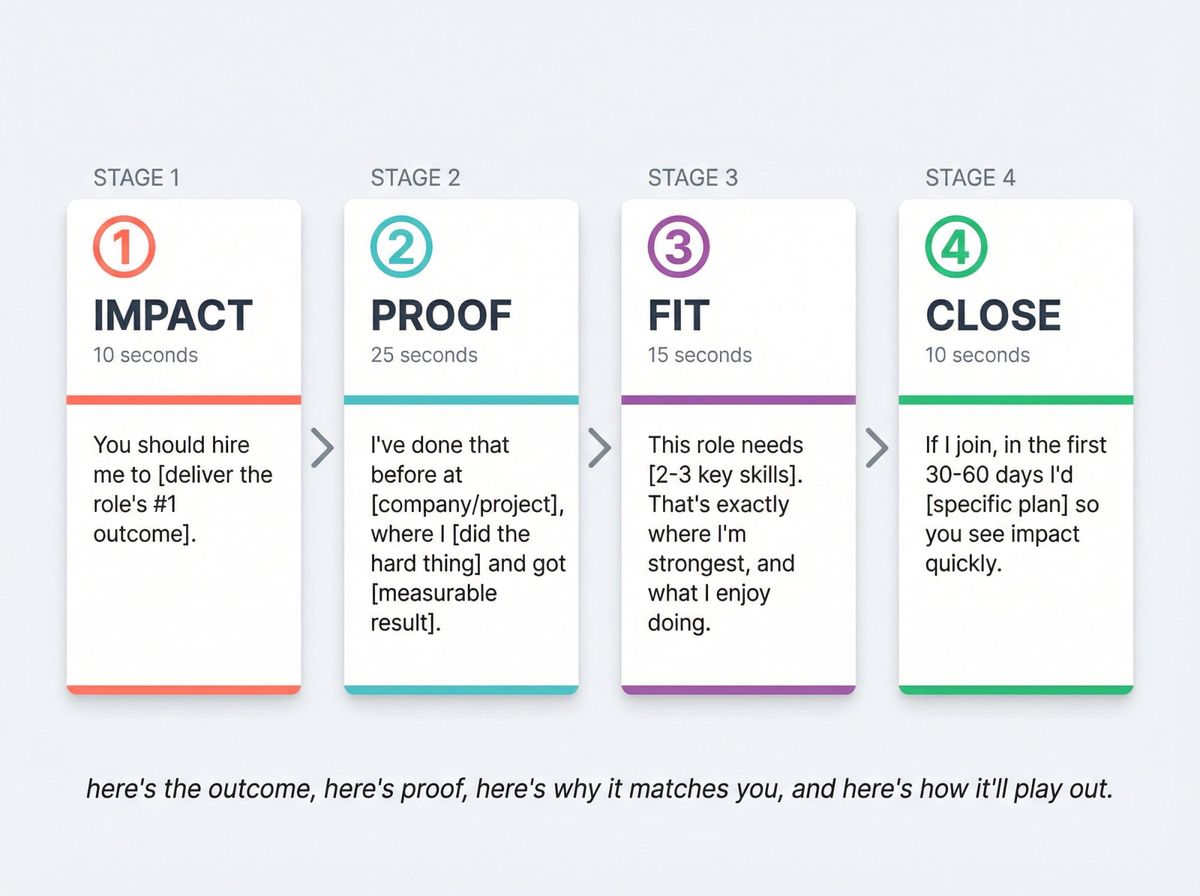
① Impact (10 seconds):
"You should hire me to [deliver the role's #1 outcome]."
② Proof (25 seconds):
"I've done that before at [company/project], where I [did the hard thing] and got [measurable result]."
③ Fit (15 seconds):
"This role needs [2-3 key skills from the job description]. That's exactly where I'm strongest, and it's also what I enjoy doing."
④ Close (10 seconds):
"If I join, in the first 30-60 days I'd [specific plan] so you see impact quickly."
You're telling them: here's the outcome, here's proof, here's why it matches you, and here's how it'll play out.
Answer Template You Can Customize in 10 Minutes
Use this structure to draft your answer fast:
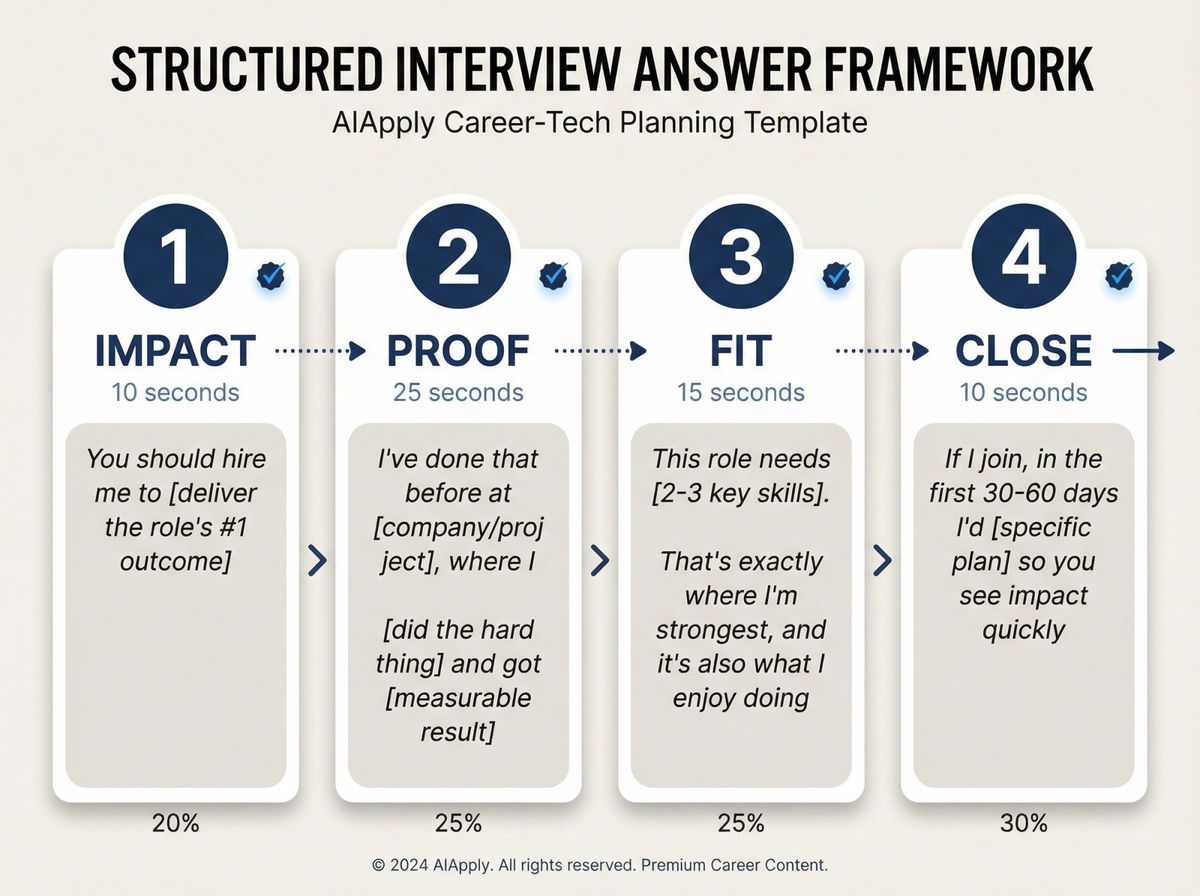
"You should hire me because I can help you [primary outcome from the job ad]. In my last [role/project], I [action] which led to [metric/result]. What makes me different is [your edge: speed, depth, domain, communication, process], and that matters here because [tie to their current goals/problem]. If I'm hired, I'd spend the first few weeks [30-day plan], then [60-day plan], so you get [measurable early win]."
How to Prepare Your Answer in 15 Minutes
Indeed's candidate guide says to study the posting, research the company, tie your background to the posting, quantify accomplishments, and add something extra that distinguishes you.
Here's how to do that efficiently:
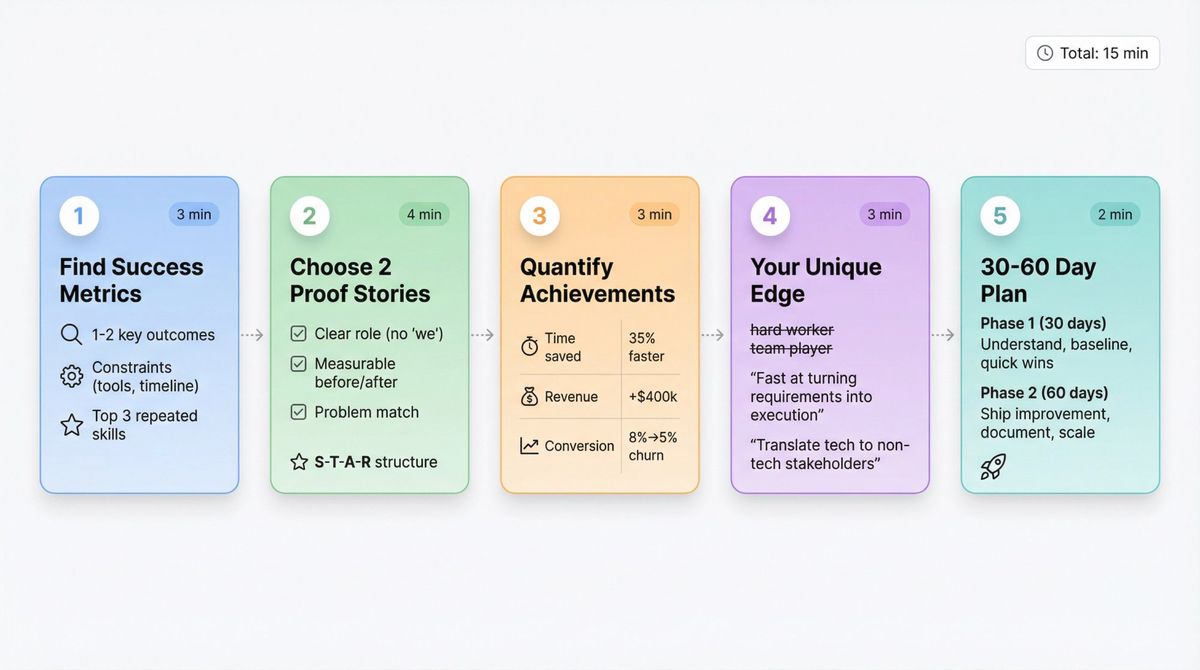
Step 1: Find the Job's Success Metrics
From the job description, write down:
→ The 1-2 outcomes they're hiring for (not duties):
- "Increase pipeline"
- "Reduce churn"
- "Ship features faster"
- "Improve close rate"
- "Run reliable ops"
→ The constraints: tools, domain, team size, compliance, budget, timeline
→ The top 3 skills they keep repeating: repeated words are basically the rubric
Step 2: Choose 2 Proof Stories
Choose stories where:
→ Your role is clear (no "we did..." fog)
→ There's a measurable before/after
→ The problem matches their problem
Use STAR method (Situation, Task, Action, Result) as your internal structure so you don't ramble.
Step 3: How to Quantify Your Achievements
You don't need insane numbers. You need credible signal (proof that you can deliver).
Pick 1-2 from:
| Metric Type | Examples |
|---|---|
| Time saved | Hours/week, cycle time reduction |
| Revenue influenced | Pipeline generated, deals closed |
| Cost reduced | Budget savings, efficiency gains |
| Conversion rate | Lead-to-customer, churn decrease |
| Speed to ship | Deployment frequency, time to market |
| Quality | Defects, rework, customer satisfaction |
| Scale | Users served, tickets handled |
| Reliability | Uptime percentage, incident reduction |
Step 4: What Makes You Different from Other Candidates?
Most people list "hardworking, team player, fast learner." Boring. Everybody says that.
Instead pick a specific edge:
→ "I'm unusually fast at turning messy requirements into a clear execution plan"
→ "I'm strong at translating technical tradeoffs to non-technical stakeholders"
→ "I've worked in this exact regulated environment"
→ "I've built this system at this scale before"
Step 5: Create Your 30-60 Day Plan
Keep it simple and believable:
- 30 days: understand, map, baseline metrics, quick wins
- 60 days: ship first real improvement, document, automate, scale
AIApply has a final-interview guide that includes a simple 30-60-90 template you can adapt.
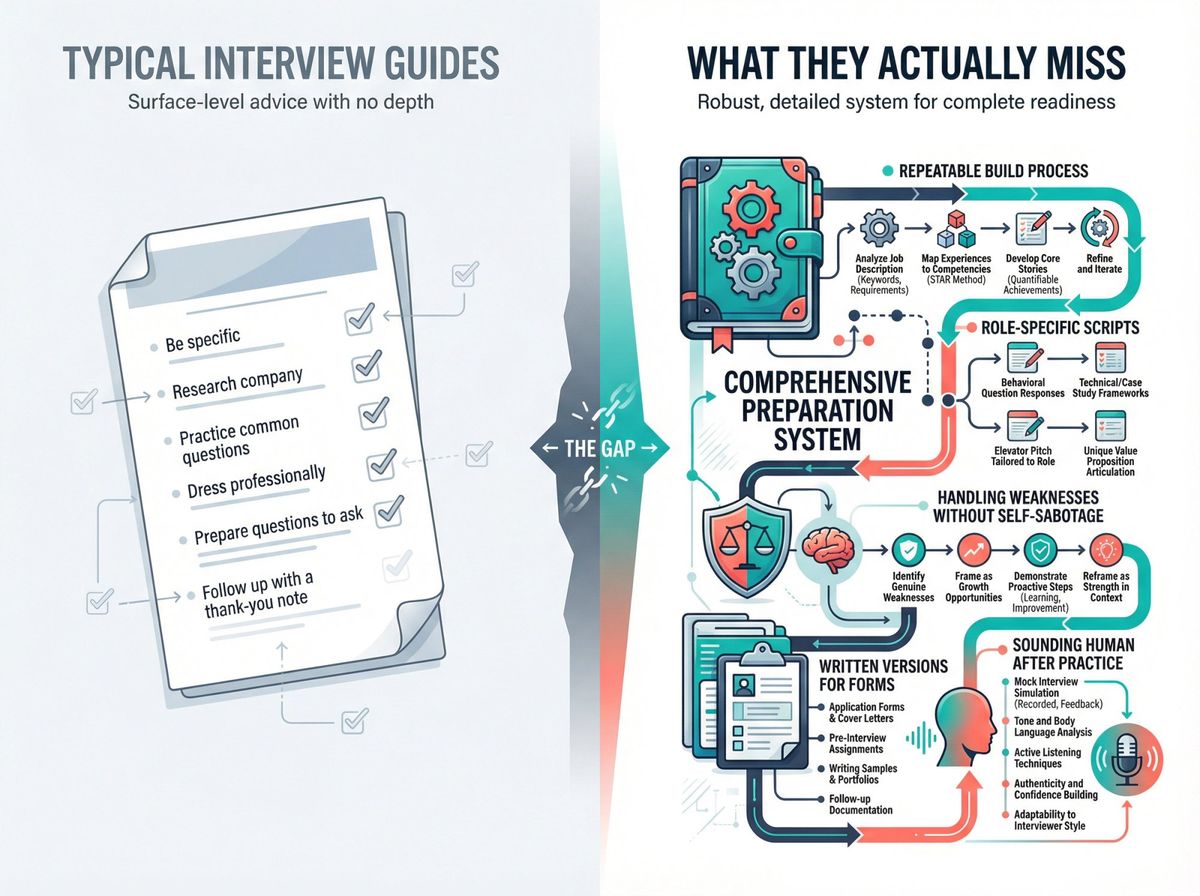
What Interview Guides Miss About This Question
| What They Cover | What They Miss |
|---|---|
| Be specific and relevant | A repeatable build process |
| Research the company | Role-specific scripts |
| Quantify achievements | Handling weaknesses without self-sabotage |
| Keep it under 2 minutes | Written version for application forms |
| Show enthusiasm | How to sound human when you've practiced a lot |
Most career guides cover the basics well but miss the tactical build process and role-specific variations. That's what we're covering next.
Now let's look at real examples you can adapt.
Example Answers for Different Career Stages
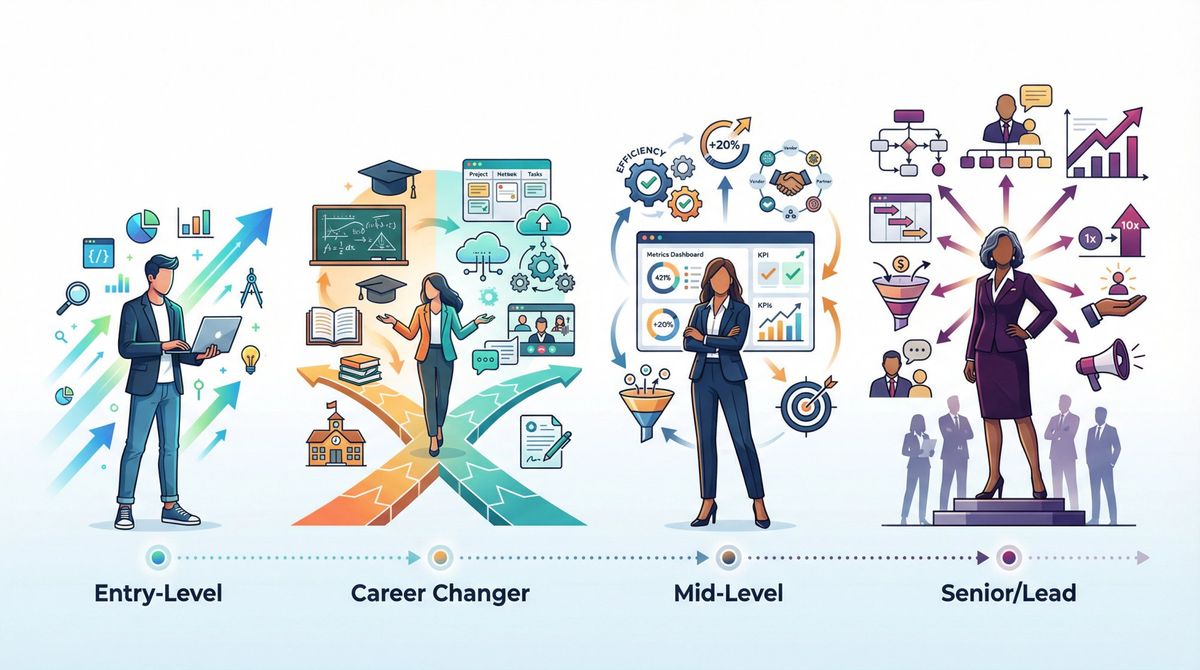
1) Entry-Level (No "Real Experience")
Goal: Prove competence via projects, learning speed, and work habits.
"You should hire me because I can help you [outcome] by being productive fast. In my capstone project, I built a customer analytics dashboard and got positive feedback from actual users. For example, three local businesses now use it for daily reporting. What makes me different is I don't just complete tasks. I document decisions, ask sharp questions early, and I'm consistent. If I join, I'll spend the first month learning your stack and shipping small but real improvements weekly, so you see momentum immediately."
Why this works: It doesn't apologize for being junior. It sells ramp speed plus proof of execution.
If you're writing a resume for your first job, focus on transferable skills from projects, internships, and coursework.
2) Career Changer
Goal: Make the skill transfer obvious.
"You should hire me because the core of this role is project coordination, and I've been doing the same thing in a different wrapper. In my last role as a teacher, I managed cross-functional teams of staff and parents which led to three successful school-wide events with zero delays. The tools are different, but the skills (organization, stakeholder communication, deadline management) are the same. I'm making this switch because I want to build my career in tech project management, and I've already completed a project management certification and freelance work so I'm not starting from zero."
Why this works: It reframes teaching experience as transferable coordination skills with proof.
Highlighting transferable skills is critical for career changers. Your resume for career change should emphasize these skills over job titles.
3) Mid-Level Specialist
Goal: Prove you can deliver without heavy supervision.
"You should hire me because I'm strong at reducing operational costs and I can do it with minimal hand-holding. In my last role, I owned supply chain optimization for 50+ vendors, and I improved delivery speed by 30% by renegotiating contracts and implementing automated tracking. What you're hiring for here is analytical thinking, vendor management, and someone who can work cross-functionally. Those are exactly my strengths. If I join, I'll align on success metrics in week one and ship a measurable improvement within the first 60 days."
Why this works: Specific outcome, specific proof, specific relevance to the role.
4) Senior / Lead
Goal: Show pattern recognition, judgment, and leverage.
"You should hire me because you're not just hiring output. You're hiring judgment. I've led teams through hypergrowth environments and delivered 40% cost reduction while maintaining quality. For example, at [previous company] I took a chaotic production process, set a clear execution plan, and we achieved 98% on-time delivery while keeping stakeholders aligned. What I bring is a repeatable way of turning vague goals into execution, plus coaching the team so the capability stays after I'm done."
Why this works: Shows leverage (improving systems, not just doing tasks) and leadership impact.
Answer Scripts for Different Job Roles

Software Engineer
"You should hire me because I can help you ship reliable features faster. Recently I built a caching layer that reduced latency by 45% and improved developer velocity by eliminating 200 repeated queries per day. I'm strong in Python and distributed systems, but my edge is I'm obsessive about clarity: tight specs, tests, and measurable outcomes. In the first month I'd learn your codebase patterns, then take ownership of a scoped feature or reliability issue and deliver a clean win."
Check out software engineer career pages for role-specific examples and software engineer cover letters to see how to position these skills on paper.
Product Manager
"You should hire me because I can turn customer pain into shipped product that moves a metric. In my last role I led a checkout redesign, aligned design/eng/stakeholders, and drove cart abandonment from 28% to 19%. I'm good at prioritization and crisp communication, which matters here because your role needs ruthless focus on impact. I'd start by validating your top user pain points and getting one measurable product improvement shipped within 60 days."
Explore product manager career paths and agile product manager roles to understand market expectations.
Sales (AE / BDR)
"You should hire me because I can create pipeline and close with discipline. I've consistently hit 120% of quota by doing better discovery and tighter follow-up. For example, I closed $400k in Q3 through better qualification and shorter sales cycles. What makes me different is I'm process-driven: I track conversion by stage and I improve the funnel instead of just 'trying harder.' If hired, I'd learn your ICP fast, build a targeted account list, and be producing qualified pipeline by week two."
See account executive and sales manager roles for industry benchmarks.
Marketing (Growth/Content/Performance)
"You should hire me because I can grow qualified leads with measurable experiments. In my last role, I ran a LinkedIn content campaign that improved inbound leads by 60%. My edge is I can write, analyze, and iterate, so ideas turn into results, not just slides. In the first month I'd audit your funnel, find the top leverage bottleneck, and run 2-3 tests to move it."
Review marketing manager positions to see what's expected in the industry.
Customer Success
"You should hire me because I can reduce churn by improving onboarding and customer outcomes. In my last role I managed $2M in ARR and improved retention by 15% by implementing proactive health scoring. My edge is I'm proactive and structured: health scoring, clear success plans, and tight follow-ups. In the first 60 days I'd identify at-risk accounts and ship a playbook that drives adoption."
Explore customer success manager roles to understand the landscape.
What if they ask the question differently?
How to Answer Tough Variations of This Question
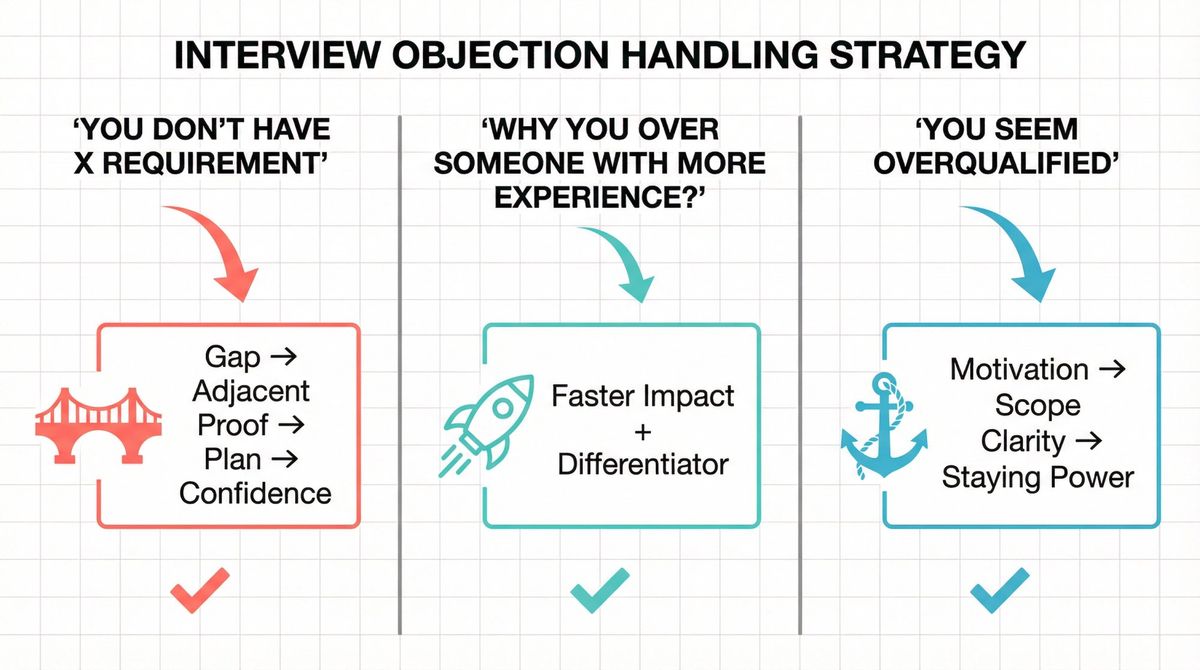
"You Don't Have X Requirement"
Say: Gap → Adjacent proof → Plan → Confidence
"You're right that I haven't done enterprise sales in production yet. What I have done is mid-market B2B sales, which is very similar because the discovery process and objection handling are identical. And I can show you results: $300k closed in six months. I've already started closing the gap by studying your enterprise playbook and shadowing calls, and I'm confident I can be effective quickly because I've ramped into new systems before."
"Why You Over Someone With More Experience?"
Say: Faster time-to-impact plus differentiator
"Someone may have more years in the title, but you should hire me because I can produce impact quickly in the exact areas you care about. I've already done mobile app optimization at scale, and my edge is I ship fast without sacrificing quality, which directly maps to what you need right now."
"You Seem Overqualified"
Say: Motivation, scope clarity, staying power
"I understand why it might look that way. I'm intentionally choosing this scope because I want to focus on hands-on execution instead of pure management. It's what I want to do day-to-day. I'm excited about your product and customer base, and I'm looking for a place where I can deliver high impact consistently, not just chase a bigger title."
How to Write This Answer for Application Forms
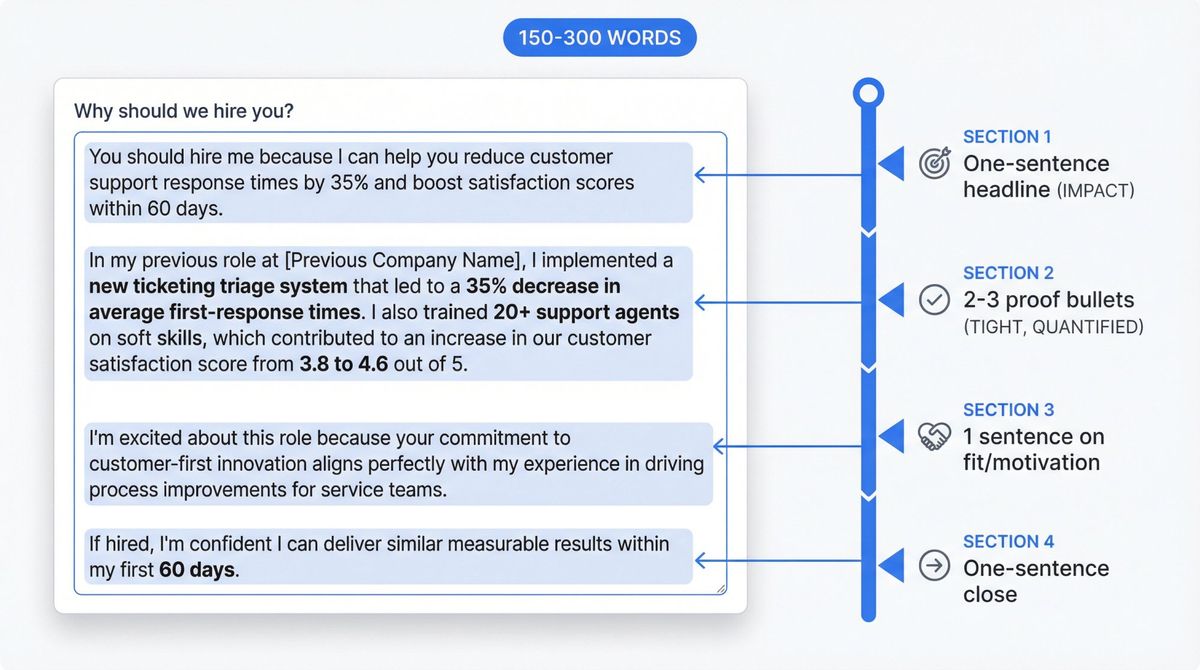
When the question appears in a form, you usually get 150-300 words. Use this structure:
① One-sentence headline (impact)
② 2-3 proof bullets (tight, quantified)
③ 1 sentence on fit/motivation
④ One-sentence close
Example (edit to your role):
You should hire me because I can help you reduce customer support response times by combining technical troubleshooting skills with clear communication. • At Acme Corp, I reduced average ticket resolution time by 35% by building a knowledge base and automating common workflows. • I led onboarding for 20+ new support agents, improving their first-month performance scores by 25%. • I improved customer satisfaction scores from 3.8 to 4.6 by redesigning our escalation process. I'm excited about this role because your mission to improve user experience aligns with my passion for solving customer problems. If hired, I'll focus on learning your context fast and delivering a measurable win in the first 60 days.
Before submitting, use AIApply's resume scanner to ensure your application materials are ATS-optimized and aligned with the job description.
How to Practice Without Sounding Robotic
The goal isn't to memorize. It's to own the structure.
The 3-Run Drill (15 Minutes)
① Run 1: Say it slow, read your bullets
② Run 2: Say it without reading (ok to stumble)
③ Run 3: Say it faster, like a real interview
Record yourself. If you sound like you're listing a resume, you're not done.
Build a "Story Bank" (The Unfair Advantage That's Actually Fair)
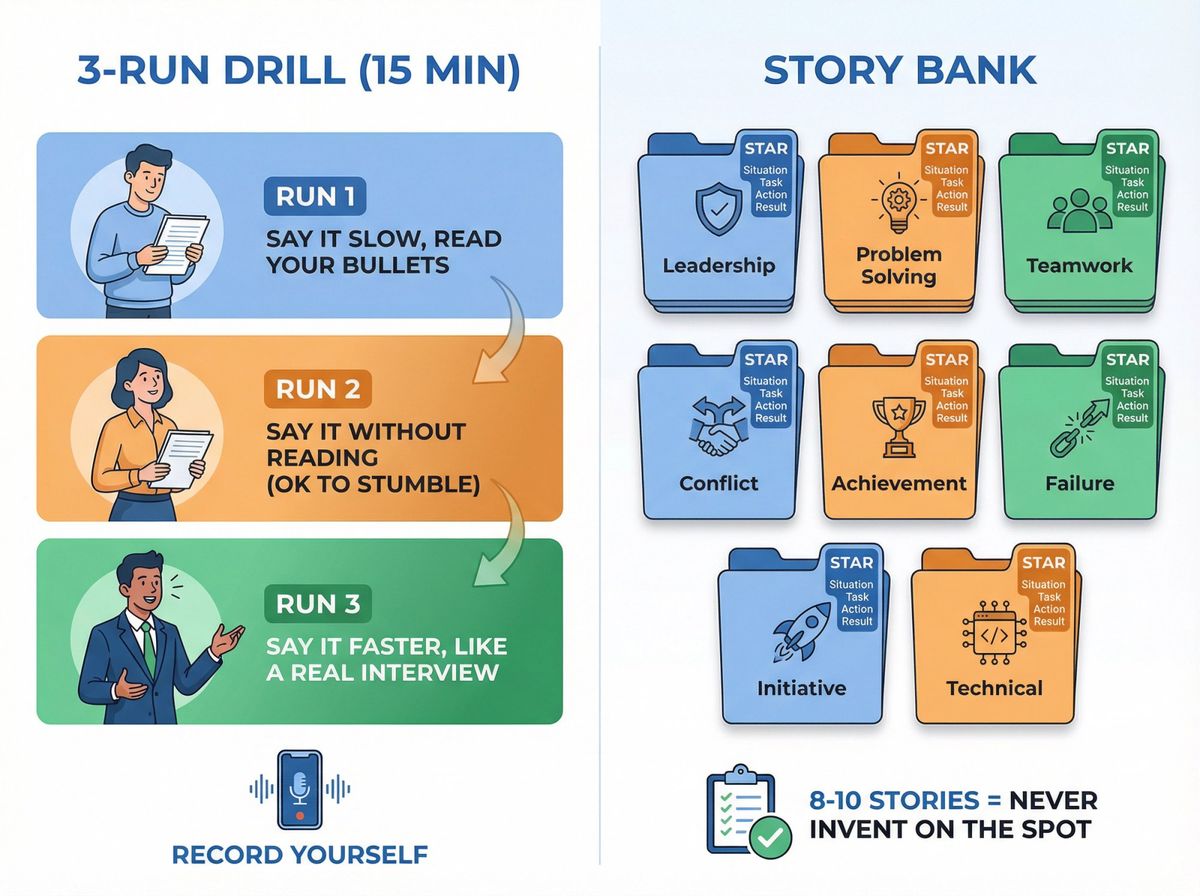
AIApply's STAR method guide recommends building 8-10 stories that cover most behavioral questions, so you're never inventing on the spot.
This matters because interview quality improves when answers are structured and evidence-based. A 2025 systematic review in F1000Research focuses on factors that affect interview validity and emphasizes how much structure matters.
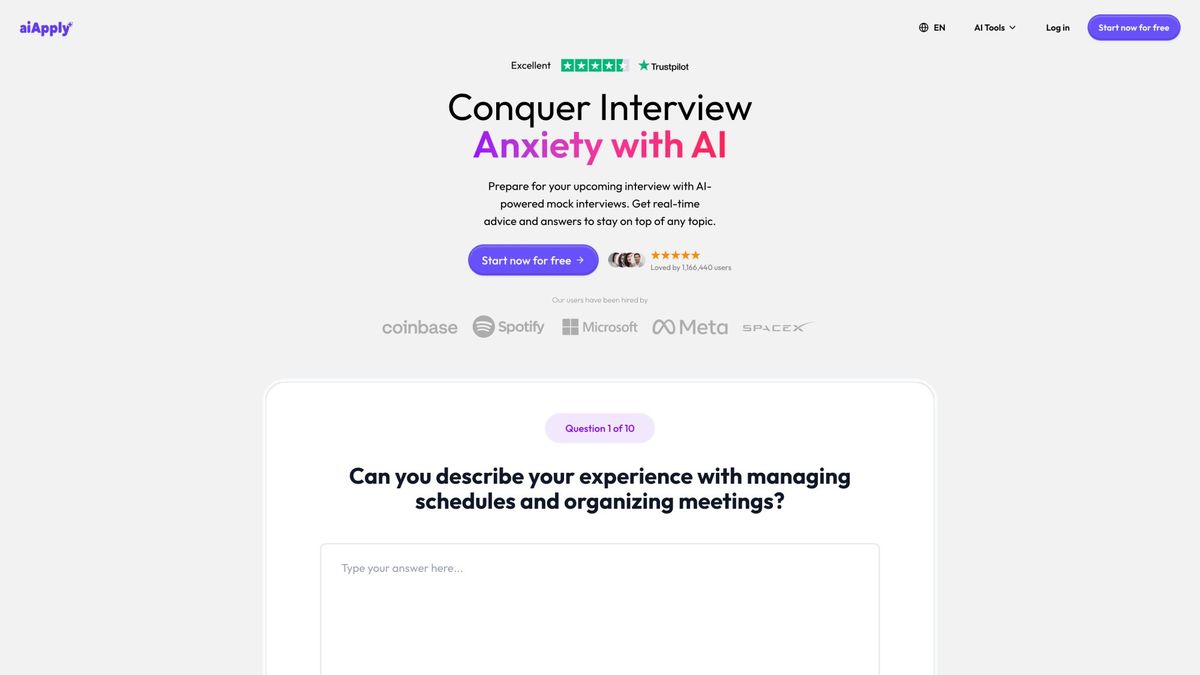
Practice these stories using AIApply's mock interview simulator to get real-time feedback before your actual interview.
AI Tools That Help Without Turning You Into a Robot
If you want a clean workflow:
① Generate role-specific questions from the job description using AIApply's mock interview tool.
② Practice your "why should we hire you" answer until it lands in 45-75 seconds
③ Convert your proof stories into STAR format using the story bank method.
④ If you use real-time assistance tools, use them responsibly: they should help you recall and structure your real experience, not fabricate it.
AIApply is a full-stack job search platform that helps you optimize your resume, auto-apply to hundreds of jobs, and practice interviews with AI-powered coaching. It's designed to accelerate your job search while keeping your answers authentic.
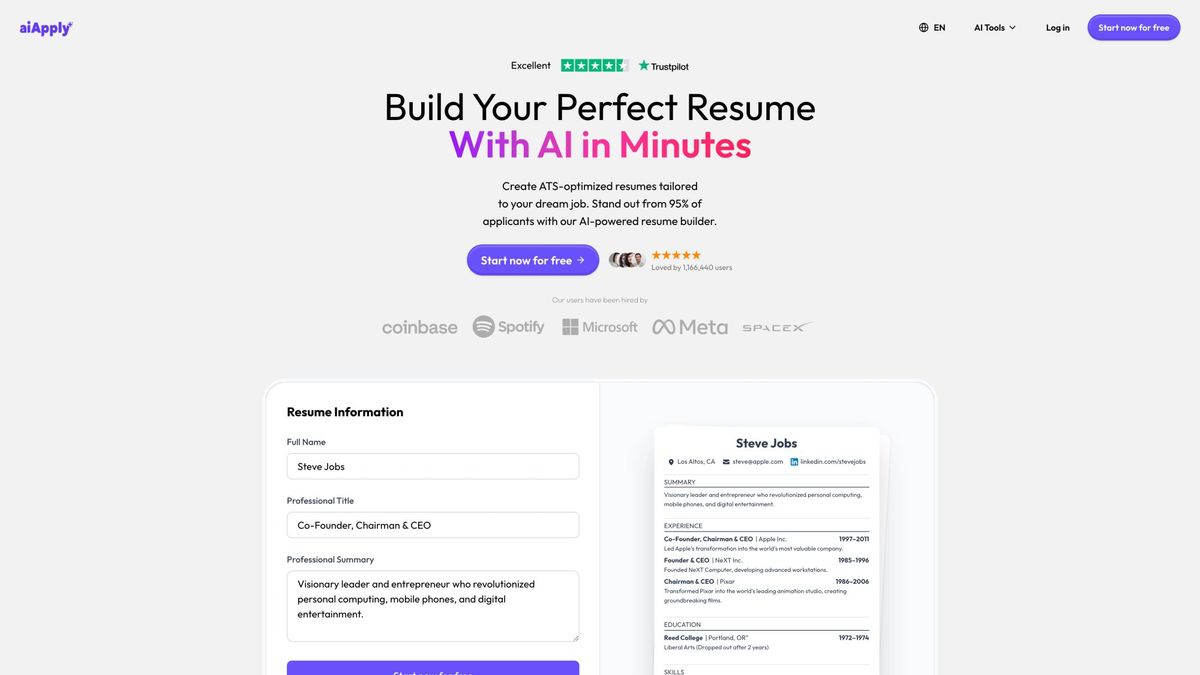
Our AI resume builder creates tailored resumes in minutes, while auto apply can submit hundreds of applications automatically. For interview prep, use Interview Buddy for live coaching during virtual interviews.
Here are the biggest traps to avoid.
10 Common Mistakes (And How to Fix Them)
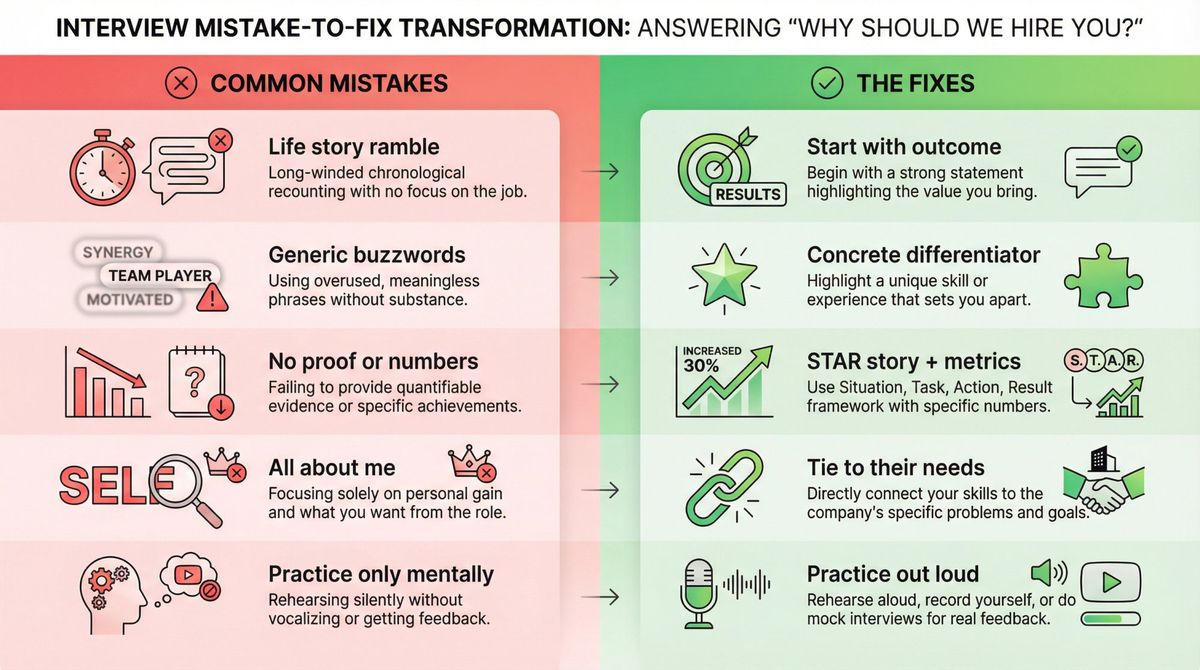
| Mistake | The Fix |
|---|---|
| Starting with your life story | Start with the job's outcome |
| Being generic ("hardworking") | Give one concrete differentiator |
| No proof | One STAR story beats five adjectives |
| No numbers | Quantify anything credible (time, quality, scale) |
| Talking only about you | Tie every claim to their needs |
| Sounding arrogant | Let results brag for you |
| Listing every skill | Choose 2-3 that match the posting |
| Forgetting motivation | One sentence on why this company/team |
| Rambling past 2 minutes | Keep it tight (and stop) |
| Practicing in your head only | Practice out loud, recorded |
One-Page Cheat Sheet (Save This)
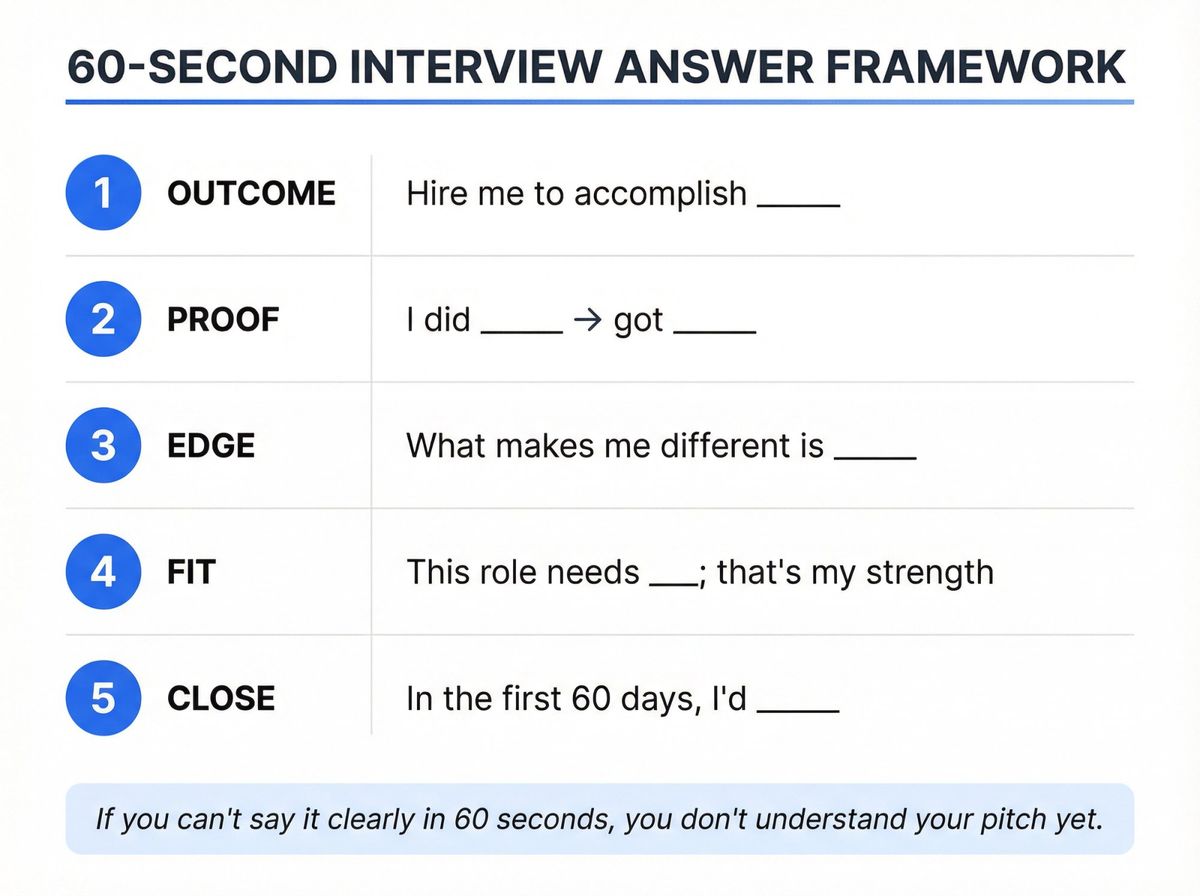
Your 60-second answer must include:
- Outcome: "hire me to accomplish ___"
- Proof: "i did ___ → got ___"
- Edge: "what makes me different is ___"
- Fit: "this role needs ___; that's my strength"
- Close: "in the first 60 days, i'd ___"
If you can't say it clearly in 60 seconds, you don't understand your pitch yet.
How to Tell a Story Instead of Listing Facts
One powerful way to make your answer memorable is to present it as a brief personal story. Humans are wired to remember stories, so this approach can be very effective when done well.
The Story Structure
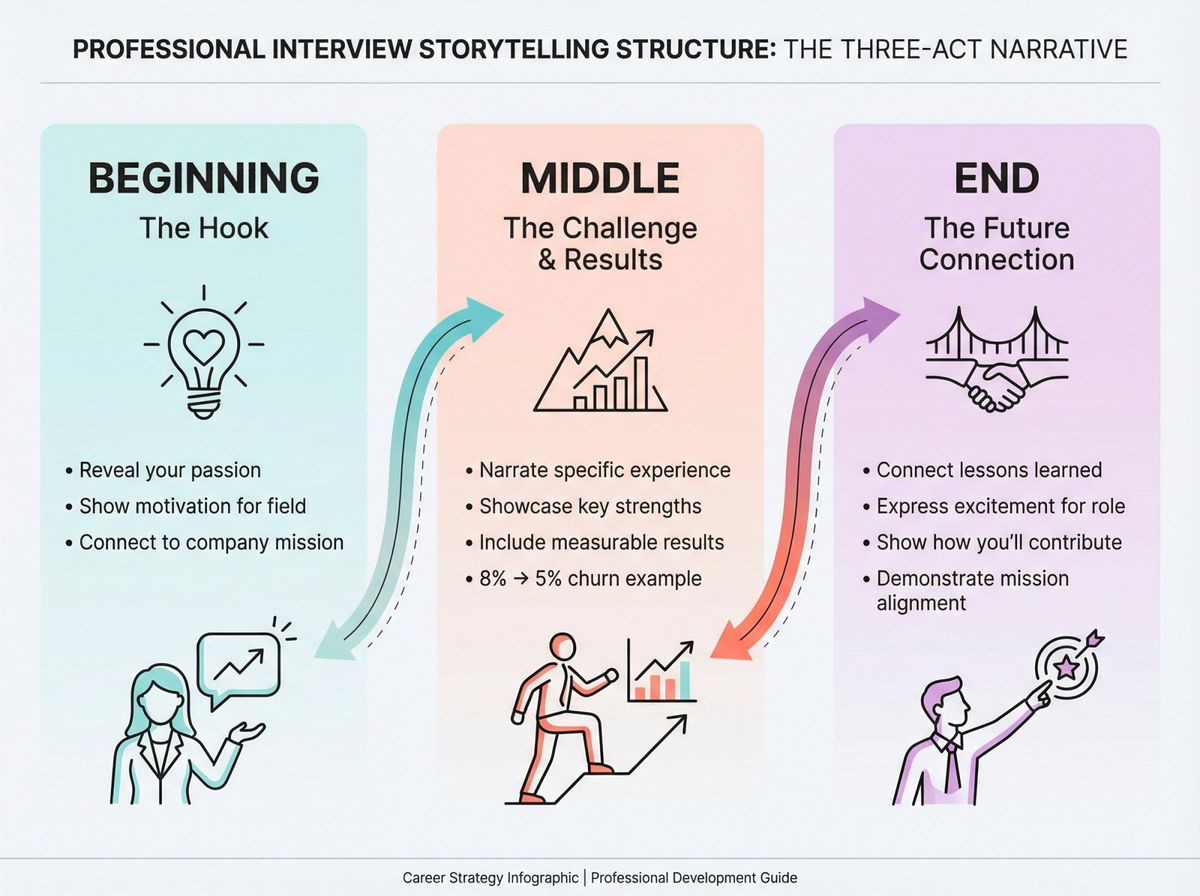
Beginning: Start with a hook that reveals your motivation or passion for the field, ideally connecting to the company's mission.
"Ever since I discovered how data could predict customer behavior, I've been obsessed with using analytics to drive business decisions. Seeing that your company uses data science to improve healthcare outcomes felt like the perfect match."
Middle: Narrate a specific experience or challenge you handled that showcases your key strengths. Choose a professional accomplishment that is relevant to the job you're applying for.
"In my previous job, I was tasked with reducing customer churn in our SaaS product. It was a challenge because we had limited data infrastructure. I built a predictive model from scratch, trained the CS team on early warning signals, and within six months we cut churn from 8% to 5%. That project taught me the power of making data actionable, not just accurate."
End: Connect that story to the future. Explain how the lessons or skills from your story make you excited and prepared to contribute to this company.
"That experience solidified my belief in data-driven customer success, which is why I'm so excited about this role at your company. I'm eager to bring that same approach here, combining my technical expertise with a mission-driven mindset to help improve patient outcomes through better data insights."
Mistakes That Make You Sound Less Credible
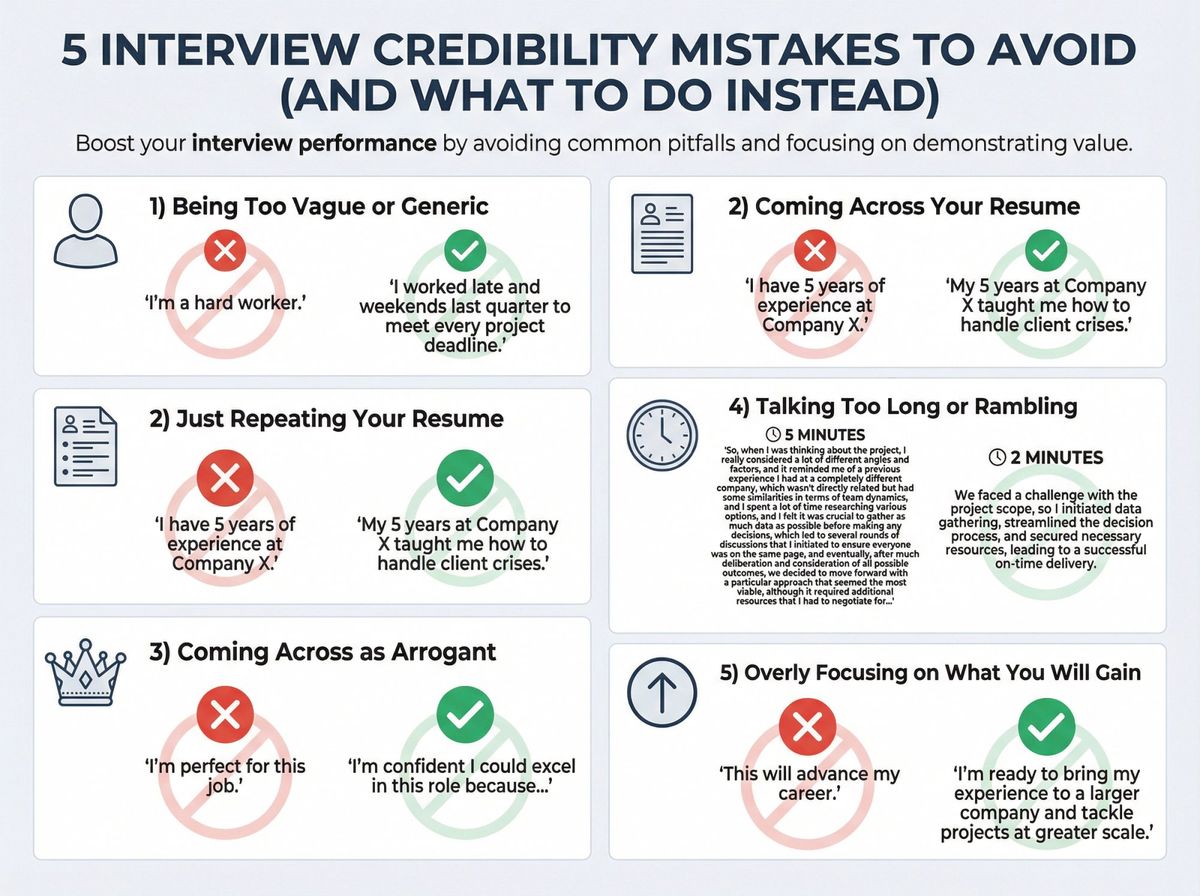
Being Too Vague or Generic
Don't answer with cliches like "I'm a hard worker" or "I'm friendly and I learn fast" without any specifics to back them up. Generic statements don't give the interviewer new information.
| Instead of this... | Say this... |
|---|---|
| "I'm a hard worker" | "I regularly worked late and weekends last quarter to ensure I met every project deadline, which taught me how to manage my time extremely effectively." |
Just Repeating Your Resume
The interviewer has likely read your resume already. This question is about connecting the dots. Don't assume they'll do that math for you.
| Instead of this... | Say this... |
|---|---|
| "I have 5 years of experience at Company X" | "My 5 years at Company X taught me how to handle client crises and negotiate solutions, experience that will be valuable in this client-facing support role." |
Make sure your resume is optimized and highlights the most relevant experiences for the role you're targeting.
Coming Across as Arrogant
There's a fine line between confidence and arrogance. Saying something like "Honestly, I'm the best person for the job" will likely rub interviewers the wrong way.
You want to imply you're the best candidate by demonstrating your value, not declare it without evidence.
Avoid: "I'm perfect for this" or "I'll be your top performer in no time"
Use: "I'm confident that I could excel in this role because..."
Talking Too Long or Rambling
Keep it under about 2 minutes. If you launch into a 5-minute monologue, you will lose the interviewer's attention.
Practice with a timer if needed. Aim to hit 2-4 main points in your answer, not 10 different reasons. Quality over quantity.
Overly Focusing on What You Will Gain
This question is about what the company gains by hiring you, not what you gain by being hired.
| Instead of this... | Say this... |
|---|---|
| "I would love to work here because it will advance my career" | "I'm ready to bring my experience to a larger company like this and tackle projects at a greater scale. I thrive on big challenges and I'm excited to contribute at this level." |
How to Deliver Your Answer with Maximum Confidence
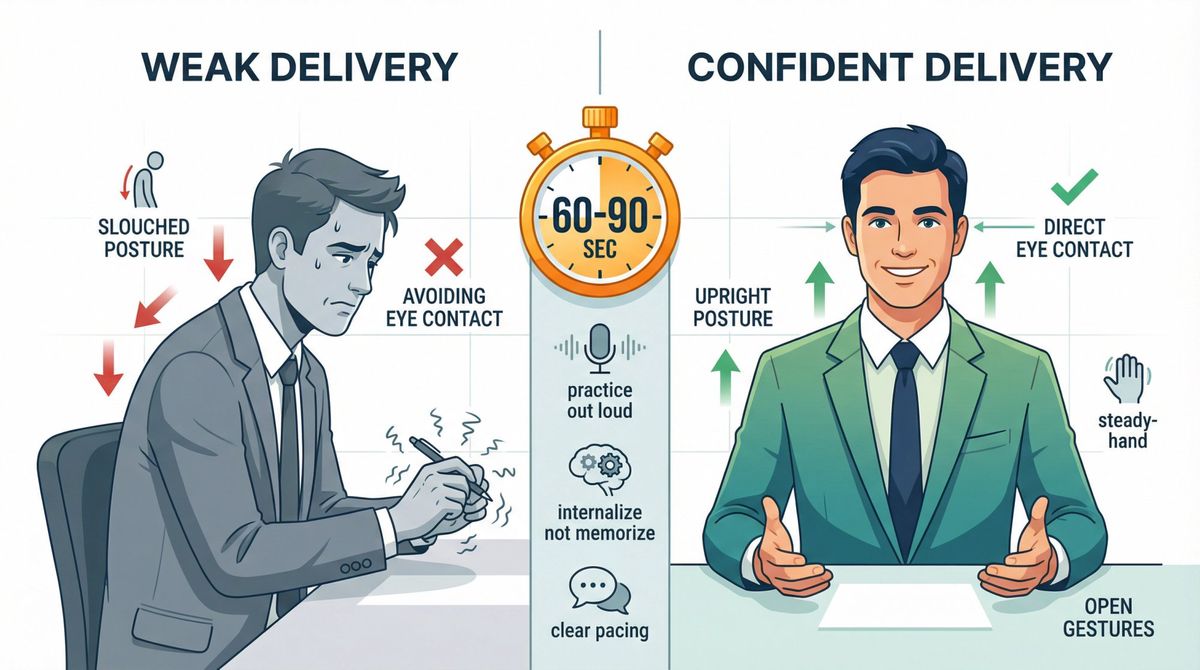
Practice Out Loud Multiple Times
Writing your answer bullet points is great, but you need to hear yourself say it. Practice in front of a mirror or record yourself. Notice if you sound natural and confident.
The more you practice, the more comfortable you'll become. Practicing aloud will help you stay within time frame while sounding natural and confident.
Use AIApply's interview practice tools to rehearse your answers with AI feedback.
Don't Memorize a Script Word-for-Word
You want to internalize the ideas but not deliver a rote recitation. Memorized answers often come out flat or overly fast, and if you get thrown off track, you might blank out.
Instead, memorize an outline: your key bullet points and the story/order you'll say them. This keeps you flexible and authentic.
Aim for 60-90 Seconds
Time yourself to ensure your answer is in that sweet spot. If you're much shorter, you might be underselling yourself. If you're much longer, trim it down.
A focused answer is more powerful than one that tries to cram in every single thing you've done.
Use Confident Body Language and Tone
Your words matter, but so does your delivery. Make eye contact with the interviewer when giving your answer. Keep your posture straight and avoid nervous fidgeting.
Smile and show enthusiasm when appropriate (especially when talking about being excited to join them). Speak clearly and at a measured pace.
Learn more about being confident in an interview to master your delivery.
Leverage AI Tools for Practice
In 2026, don't hesitate to use technology to your advantage. Tools like AIApply's Interview Buddy can be incredibly helpful. It's an AI-powered app that listens to you answer interview questions and provides real-time feedback and suggested improvements.
If you get stuck on what to say for a tricky question, it can offer prompts or sample answers instantly. By the time you walk into the real interview, you'll have said your answer dozens of times and refined it, so it'll roll off your tongue much more smoothly.
Frequently Asked Questions
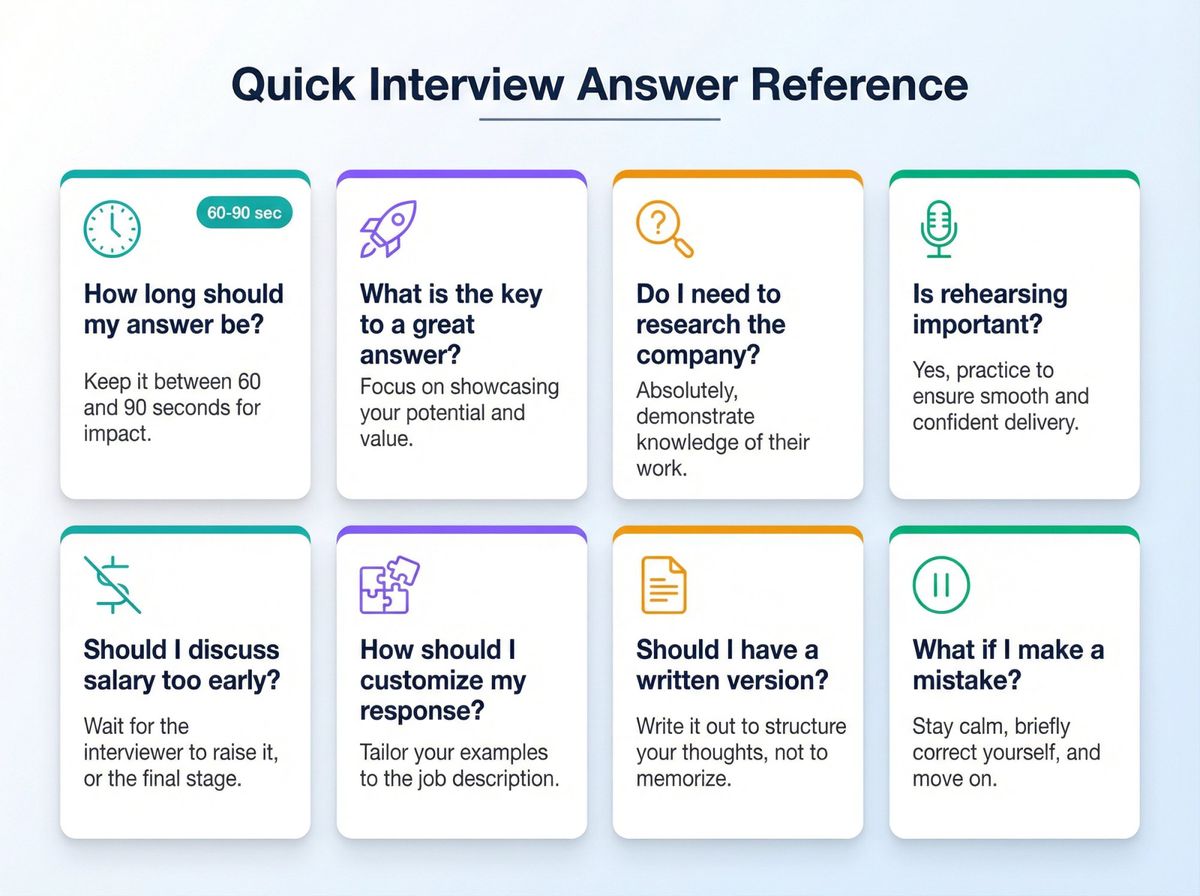
How long should my answer be?
Aim for 60-90 seconds (roughly 1-2 minutes of speaking time). This is long enough to hit your key points without losing the interviewer's attention. Two minutes is generally the upper limit before minds start wandering.
Should I mention salary or benefits?
No. This question is about what value you bring to the employer, not what you hope to get from them. Focus on your skills, achievements, and fit for the role. Save compensation discussions for later in the process.
What if I don't have much work experience?
Focus on projects, internships, coursework, or volunteer work that demonstrates relevant skills. Emphasize your learning speed, adaptability, and enthusiasm. Show that you have potential and proactiveness, which employers often value as much as experience.
Build a strong resume for your first job that highlights these assets.
Can I use the same answer for every interview?
You should have a core structure that you adapt for each role. The key is to tailor your answer to match the specific job description and company. Change your proof stories and differentiators based on what each employer values most.
Use AIApply's resume rewriter to quickly customize your materials for each application.
What if the job description is vague?
Do your research on the company, look at similar roles in the industry, and make educated guesses about what outcomes they care about. Focus on transferable skills and ask clarifying questions early in the interview process.
Research the company thoroughly before your interview to fill in the gaps.
Should I prepare a written version?
Yes. Many applications include a written "Why should we hire you?" question. Prepare a 150-300 word version that follows the same structure: headline, proof bullets, fit statement, and close.
How do I avoid sounding rehearsed?
Don't memorize your answer word-for-word. Instead, memorize the structure and key points, then practice saying it naturally. Record yourself and listen back. If it sounds robotic, loosen up your delivery.
What if I make a mistake while answering?
It's okay to pause, collect your thoughts, and continue. You can even say "Let me rephrase that" if you need to. Interviewers understand that candidates get nervous. What matters is how you recover and deliver the rest of your answer confidently.
Final Thoughts
"Why should we hire you?" is one of the most direct questions you'll face in an interview, but it's also one of the best opportunities to make your case. It's your moment to summarize your value and leave a strong impression.
By researching the role and company, tailoring your strengths to match, backing up your claims with evidence, and delivering your answer with confidence, you'll provide a compelling response that can win over any hiring manager.

Your answer should convince them that their team will be better off with you on it. If you prepare thoughtfully (using this guide, practicing diligently, and perhaps leveraging AIApply's tools to polish your performance), you'll be ready to knock this question out of the park.
Now take a moment to jot down your own key points for why you should be hired for the jobs you're targeting. Craft that narrative, practice it, and walk into your next interview ready to show them exactly why you're the ideal choice.
Start by building a professional resume that showcases your strengths, practice with AI interview tools, and use cover letter generators to complement your applications.
Good luck. You've got this.