Why Do You Want to Work Here? Best Answer (2026)
Get the 3-Proof Framework for answering "Why do you want to work here?" with templates, examples, and a 10-minute prep system that actually works.


Most people Google this question because they don't want theory or "interview tips." They want actual words to say that don't sound cringe, aren't generic, and actually help them land the job.
This guide gives you exactly that. You'll get reusable templates, a repeatable system to build a specific answer for any company in about 10 minutes, plus examples that show you what "good" actually looks like in practice.
What Interviewers Look for When They Ask "Why Here?"
When a hiring manager asks "why do you want to work here?", they're not fishing for compliments. Research shows this question could be the deciding factor in whether you get a job offer or not. Employers almost always include it (often near the start to set the tone, or at the end to confirm your enthusiasm) because they want someone who's genuinely excited about their job, not just any job.
They're really trying to reduce risk by checking three things:
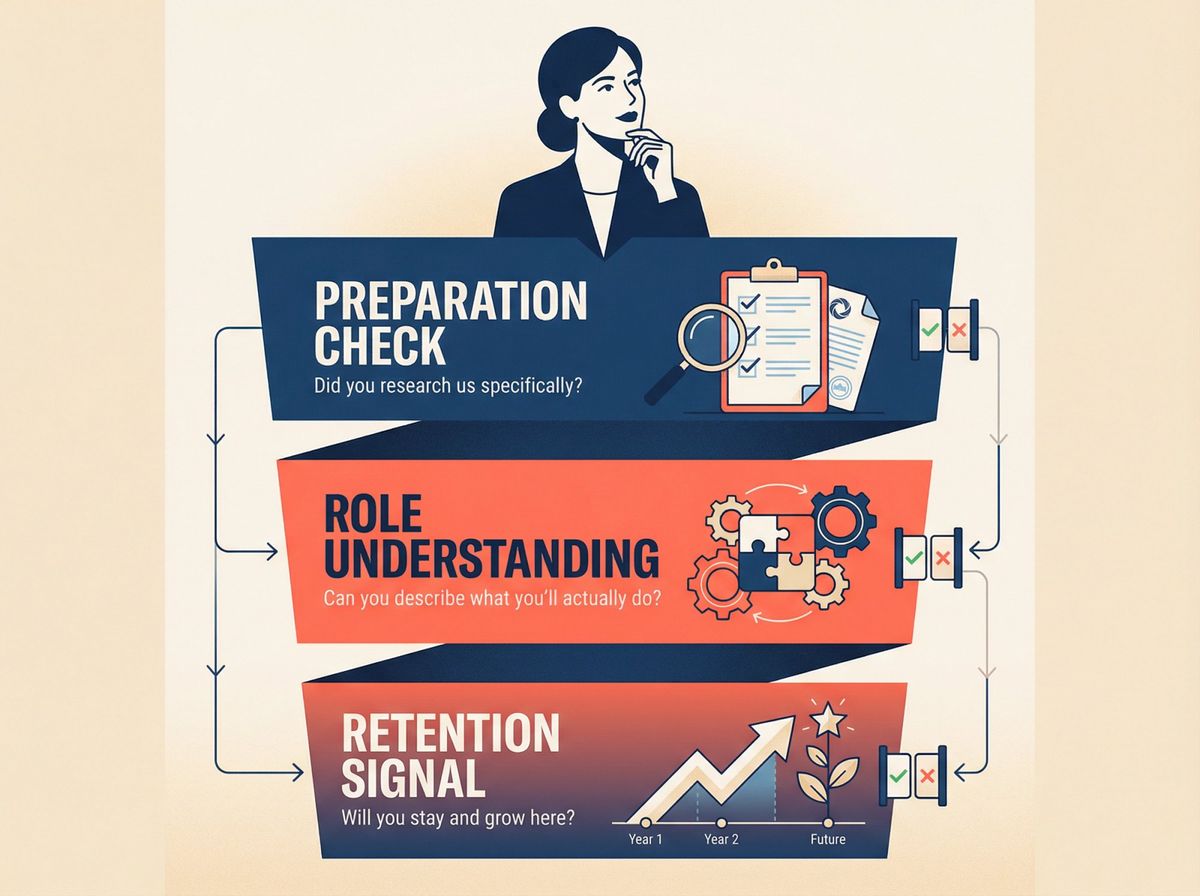
1. Did you do your homework, or are you spamming applications?
If your answer could be said to any company, it screams "I didn't prepare." Studies show that "lack of preparation" and "generic answers" consistently show up on hiring manager red-flag lists. Interviewers want to see you're applying specifically to them, not just mass-applying to everything.
2. Do you understand what this role actually is?
They want to see you can connect the job description to reality (what you'll do week-to-week) and that you're excited about those specific things. Career experts frame this as checking for fit and alignment between what you want and what the job offers.
3. Will you stay long enough to be worth the cost?
Hiring and onboarding are expensive. Research shows that "this is a stepping stone" vibes are a fast no. Companies also check whether your values align with the company's values and goals. One career expert from Harvard Business Review notes that "value congruence is a key aspect companies look for to ensure a good culture fit and stronger intentions to stay."
Key insight: This question reveals your motivation and attitude. Firms want to hire people who are passionate about the work, eager to contribute, and envision a future there.
How to Structure Your Answer (3-Proof Framework)
You win this question by making the interviewer think:
"This person wants US, wants THIS ROLE, and can prove they'll deliver."
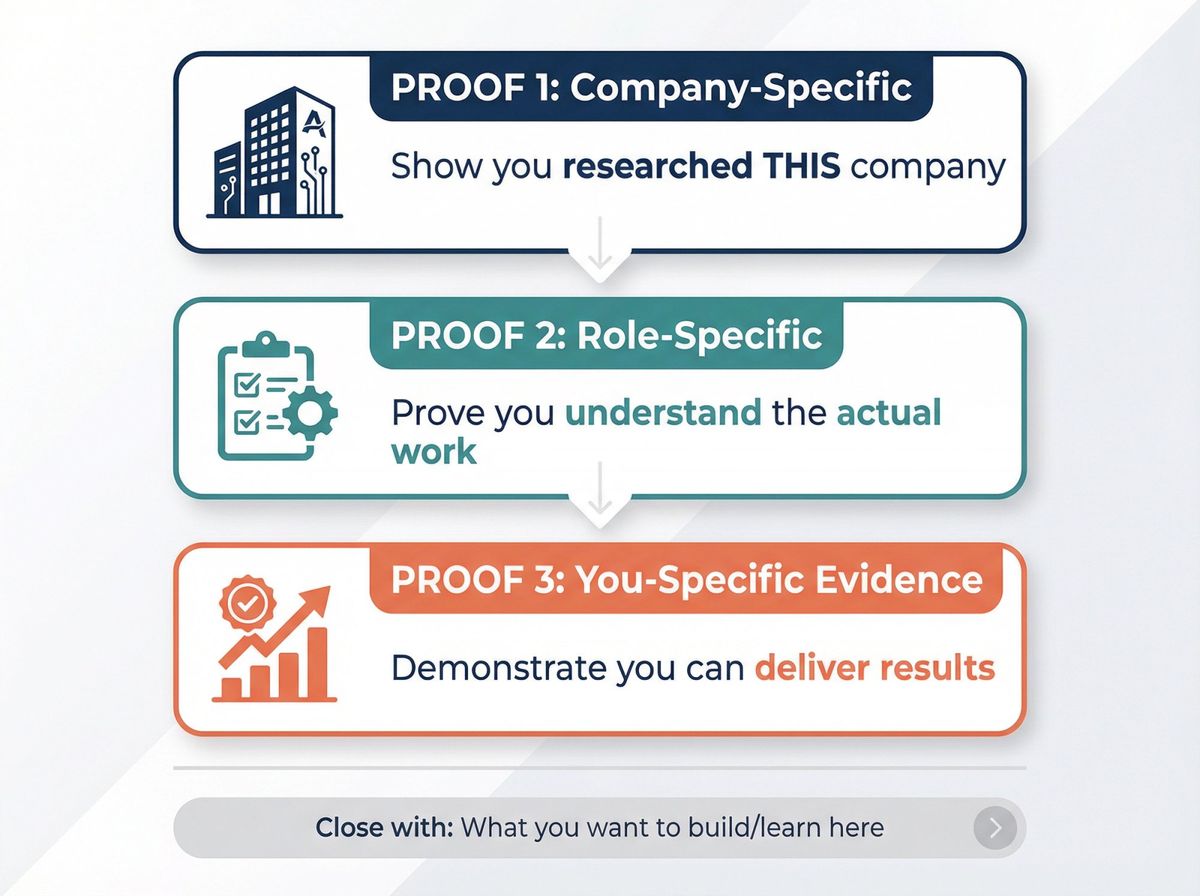
So the best answer has three proofs, in this order:
The 3-Proof Framework (Steal This)
| Proof Type | What to Include | Purpose |
|---|---|---|
| Proof 1: Company-specific | Something true about them (product, mission, market position, recent move, or culture) | Shows you researched this company |
| Proof 2: Role-specific | Something true about the job (responsibilities, problems you'll own, day-to-day work) | Proves you understand the actual work |
| Proof 3: You-specific evidence | One credible proof you can execute (metric, mini story, tangible result) | Demonstrates you can deliver results |
| Close with: | What you want to build/learn here | Future-oriented and confident |
This lines up with what interview preparation best practices recommend: research the company, study the job description, and connect it to your values and goals.
Best Answer Template (Copy and Customize)
Use this as your base. It's designed to sound human, not like a motivational poster.
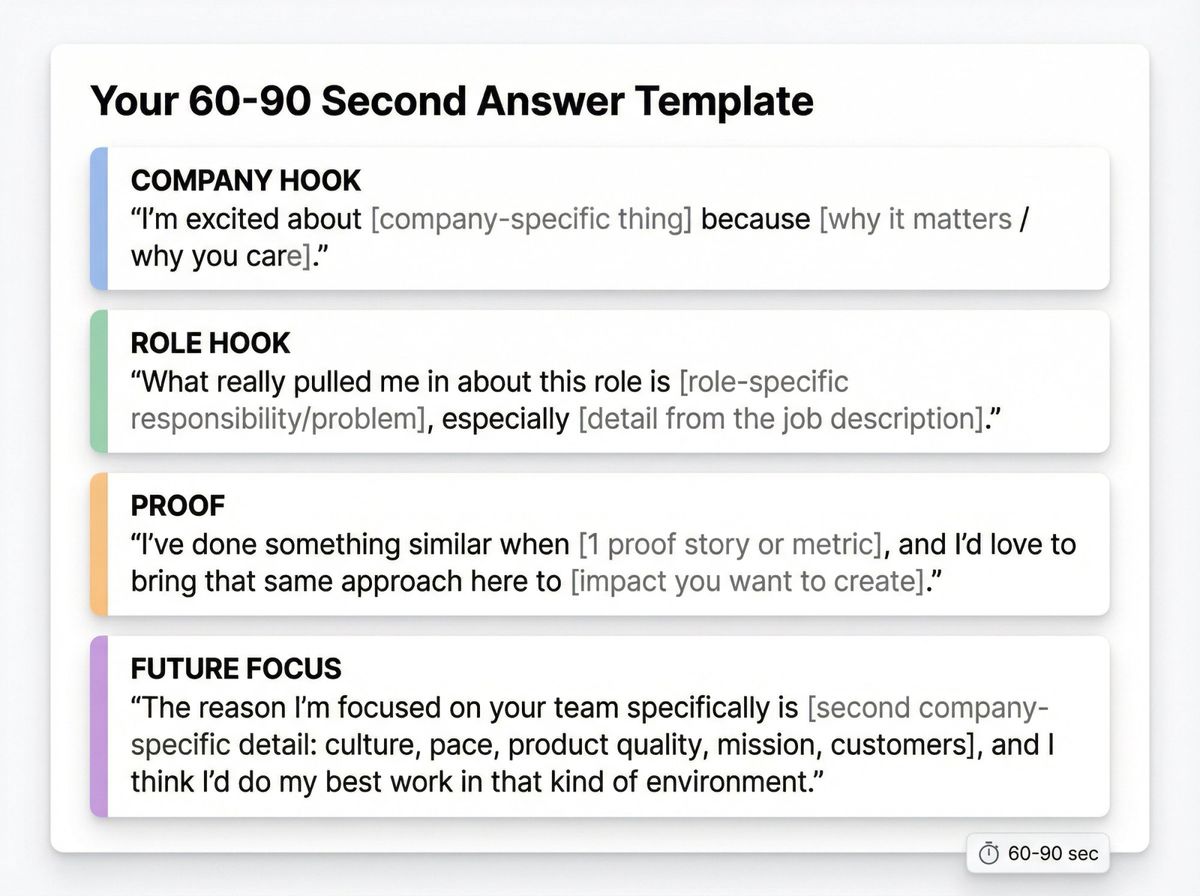
60-90 Second Version (Ideal for Most Interviews)
"I'm excited about [company-specific thing] because [why it matters / why you care]. What really pulled me in about this role is [role-specific responsibility/problem], especially [detail from the job description]. I've done something similar when [1 proof story or metric], and I'd love to bring that same approach here to [impact you want to create]. The reason I'm focused on your team specifically is [second company-specific detail: culture, pace, product quality, mission, customers], and I think I'd do my best work in that kind of environment."
That's it. No rambling. No begging. No "ever since I was a child…"
How Long Should Your Answer Be?
For most versions of this question, aim for around 45 to 90 seconds. If you go longer, you risk sounding unfocused.
General guidelines suggest that interview answers should typically land 30 seconds to four minutes depending on complexity (updated December 2025). This question usually sits on the shorter end unless you're adding a quick story.
Research also notes that being overly talkative is a red flag and suggests about a minute to a minute and a half as a good target for a single response (December 2024).
How to Prepare Your Answer in 10 Minutes
If you only do one thing from this guide, do this.
Minute 0-2: Grab 2 "Company Facts" That Aren't Cringe
Pick two from this list:
→ A product feature you actually understand
→ A customer type they serve
→ A recent launch, update, or expansion
→ A visible value or culture statement
→ A clear market problem they solve
Interview preparation experts recommend starting with the company site (about/careers), then products/services, blog, social media, and reviews.
Minute 2-5: Read the Job Description Like a Scoring Rubric
Don't read it like a human. Read it like an interviewer building a checklist.
Do this:
• Highlight 3 repeated words (example: "ownership," "stakeholders," "fast-paced")
• Highlight 2 core responsibilities
• Highlight 1 business outcome (example: "increase retention," "reduce cycle time," "grow pipeline")
Minute 5-8: Attach Proof (One Metric or One Story)
Pick one:
① A number: "cut onboarding time 30%"
② A before/after: "from x to y"
③ A mini STAR fragment: situation → action → result (keep it tight)
Structure matters more than people think. A 2025 systematic review on employment interview validity flags format, preparedness, and bias as major factors (published December 2025). You can't control the whole system, but you can control clarity and structure in your answer.
Minute 8-10: Write 4 Sentences, Then Simplify
Write your answer as:
① Company hook
② Role hook
③ Proof
④ Future contribution
Then delete adjectives until it feels sharp.
What NOT to Say (And What to Say Instead)
These "bad answers" show up everywhere for a reason: they kill trust.
1) "Because I Need a Job / Money"
Money-focused answers signal desperation and "any job is fine." Career experts say steer clear of saying you're excited for pay; every job pays, they want to know why this one.
Better:
"I'm looking for a role where I can do more of [responsibility] and own [outcome], and this job is one of the clearest matches I've seen."
2) "This Is a Stepping Stone"
Career advice explicitly lists "stepping stone" and "salary/perks" as things to avoid saying.
Better:
"I'm looking for a place where I can grow in [skill/track] by doing real work on [problem], and I see a long runway for that here."
3) Anything Generic ("Great Culture," "Innovative," "I'm a Hard Worker")
Survey data (December 2024) includes "providing generic answers" as a hiring-manager red flag. The survey also warns that over-relying on AI-generated answers can make you sound robotic and insincere.
Better: Replace generic praise with one observable detail.
Instead of "innovative," say:
"I noticed you shipped [feature] and it changes [user workflow] because [reason]."
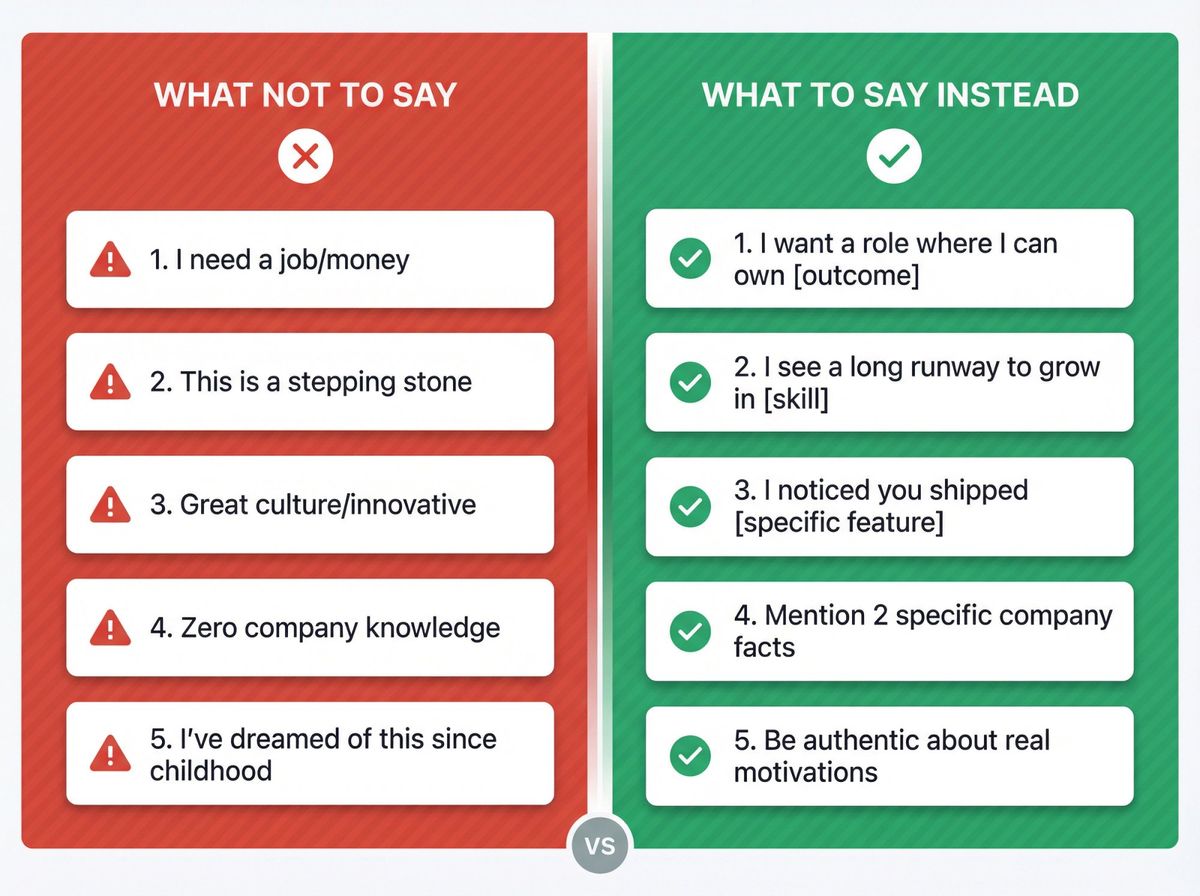
| What NOT to Say | Why It Fails | What to Say Instead |
|---|---|---|
| "I need a job/money" | Signals desperation | "I want a role where I can own [outcome]" |
| "This is a stepping stone" | Shows you won't stay | "I see a long runway to grow in [skill]" |
| "Great culture/innovative" | Generic and meaningless | "I noticed you shipped [specific feature]" |
| Zero company knowledge | No preparation | Mention 2 specific company facts |
| "I've dreamed of this since childhood" | Sounds dishonish | Be authentic about real motivations |
What Hiring Managers Look for in Your Answer
If you want a cheat code: build your answer to hit what hiring managers say they like.
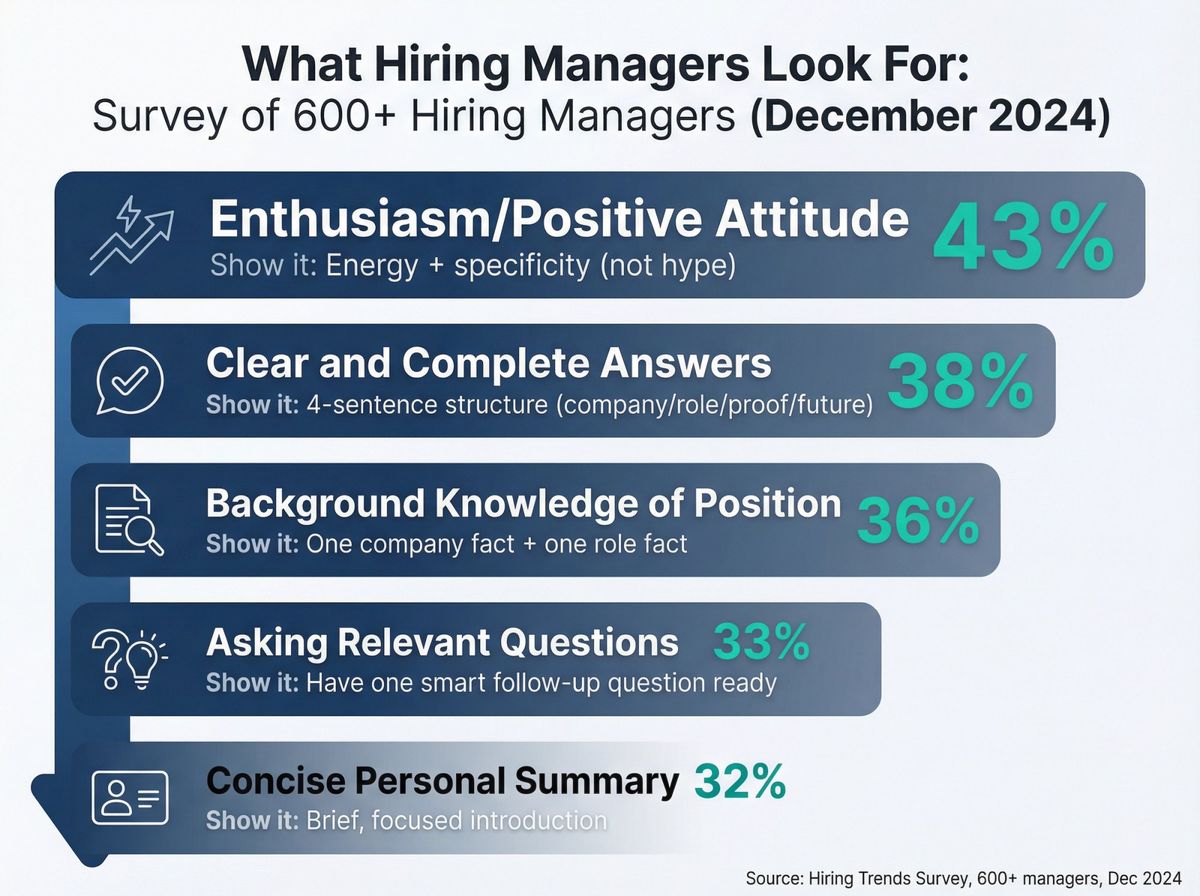
In hiring trends surveys (over 600 hiring managers, December 2024), top green flags include:
• Enthusiasm/positive attitude (43%)
• Clear and complete answers (38%)
• Background knowledge of the position (36%)
• Asking relevant questions (33%)
• Concise personal summary (32%)
Translate that into your answer:
| Green Flag | How to Show It in Your Answer |
|---|---|
| Enthusiasm/positive attitude | Energy + specificity (not hype) |
| Clear and complete answers | 4-sentence structure (company/role/proof/future) |
| Background knowledge | One company fact + one role fact |
| Asking relevant questions | Have one smart follow-up question ready |
Best Answer Examples (By Situation)
Don't copy these word-for-word. Steal the structure and swap in your real details.
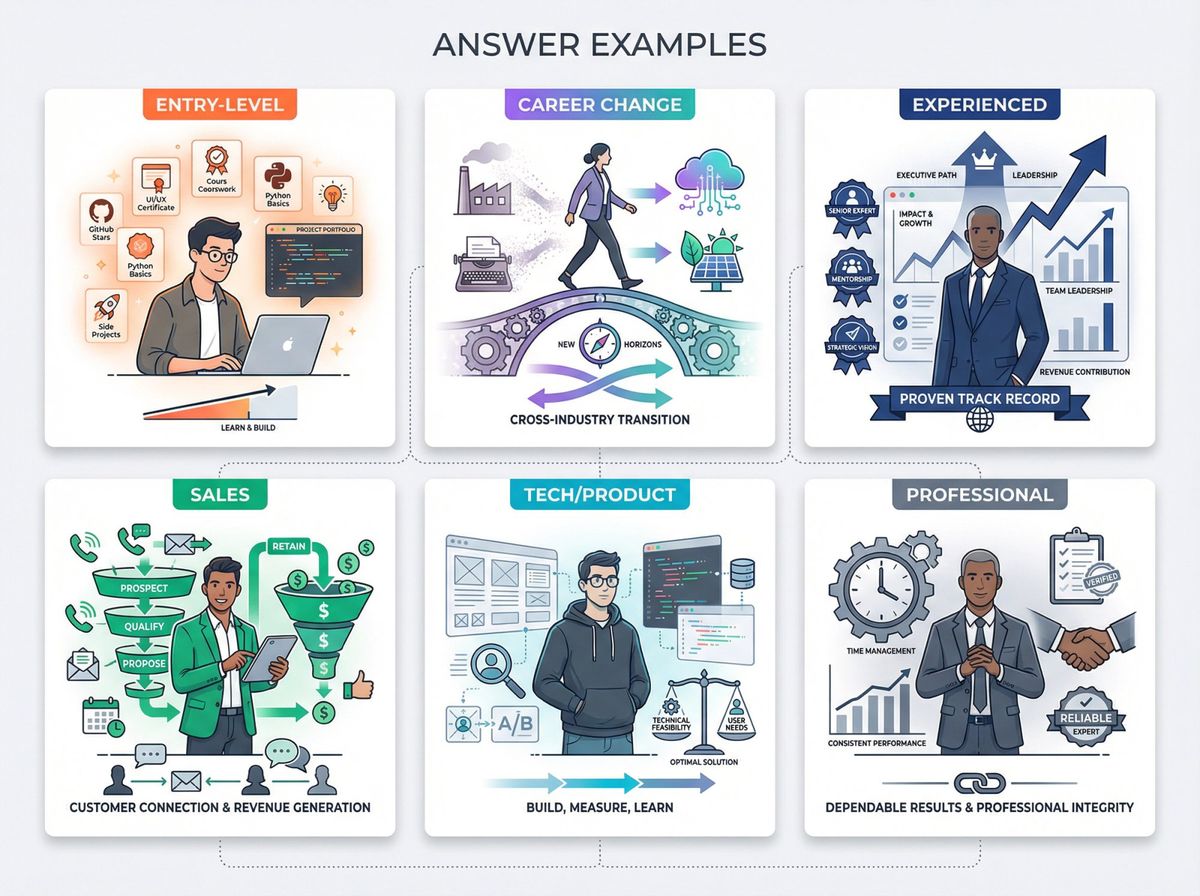
Example 1: Entry-Level / Internship (No "Real Experience" Yet)
"I'm excited about your team because [specific thing they do] is exactly where I've been building skills through [project/course/portfolio]. This role stood out because it's heavy on [responsibility], and I like work where I can [outcome] fast. For example, in [project] I [did x] which led to [result]. I'm looking for a place where I can learn quickly with high standards, and from what I've read about your work, that's the environment."
Why this works: Focuses on project-based proof instead of traditional experience. Shows eagerness to learn while demonstrating you can deliver results.
For entry-level positions, explore our guides for roles like administrative assistant, data entry clerk, or customer service representative. You can also check out resume examples for entry-level positions to strengthen your application.
Example 2: Career Switcher
"I'm moving into [new field] because I'm strongest when I'm doing [type of work] and solving [type of problem]. I'm interested in your company specifically because [company-specific fact] shows you take [principle] seriously. In my last role, I did [transferable proof], which maps directly to [responsibility in new role]. I'm excited about this role because it's a clear path to apply what I already do well while leveling up in [new skill]."
Why this works: Addresses the career change directly. Emphasizes transferable skills and shows how previous experience applies to the new role.
If you're switching careers, tailor your resume and cover letter to highlight transferable skills. Our AI tools can help you reframe your experience for a new industry.
Example 3: Experienced Hire (Tight, Confident)
"I want to work here because [specific company direction] matches the kind of problems I'm best at. This role is attractive because it's centered on [responsibility] and success looks like [outcome]. I've driven that outcome before by [metric/story], and I'm confident I can replicate that here. What excites me most is doing that in a team that values [culture detail you can actually point to]."
Why this works: Brief and confident without arrogance. Focuses on proven track record and culture fit.
For experienced professionals, check salary benchmarks for roles like project manager, software engineer, or marketing manager to ensure your expectations align with market rates.
Example 4: Sales / SDR / BDR
"I'm excited about your company because you're solving [pain] for [customer], and the way you position [value prop] is strong. I want this role because it's not just dialing (it's about building pipeline through [channels/process], which is where I perform best. In my last role I [metric: meetings booked / quota / conversion] by focusing on [one method]. I'd love to bring that playbook here and learn your market fast."
Why this works: Shows you understand the product and sales process. Backs it up with specific metrics that matter in sales roles.
If you're targeting sales positions, explore our resources for sales development representative, account executive, or business development manager roles. Learn about sales skills employers look for.
Example 5: Product / Engineering (Avoid Fluff, Show Taste)
"I want to work here because the product is clearly optimized around [user outcome], and that's the kind of product work I care about. This role stands out because it involves [ownership area] and tradeoffs across [speed/quality/privacy/reliability]. I've shipped [thing] where we had to balance those same constraints, and the result was [metric]. I'm excited to build in an environment where shipping matters and the work connects directly to users."
Why this works: Demonstrates product taste and technical judgment. Shows understanding of real engineering tradeoffs without jargon.
For tech roles, explore positions like software developer, product manager, or data scientist. Check out skills needed for software engineers and review resume examples for your target role.
Example 6: "I Don't Have a Deep Reason... It's a Normal Job"
Cool. Don't fake passion. Do professionalism.
"I'm interested in this job because it's a strong match for my strengths in [skill] and the day-to-day work ([responsibility]) is work I genuinely do well. I'm also interested in your company specifically because [one real reason: schedule, training, reputation, product, team]. I've proven I can deliver here through [proof], and I'm looking for a stable role where I can be reliable and grow."
Why this works: Honest without being cynical. Shows professionalism and reliability, which many employers value just as much as passion.
For practical roles, browse positions like office administrator, receptionist, or warehouse manager. See what skills are essential for these positions.
How to Sound Like a Human (Not a Rehearsed Robot)
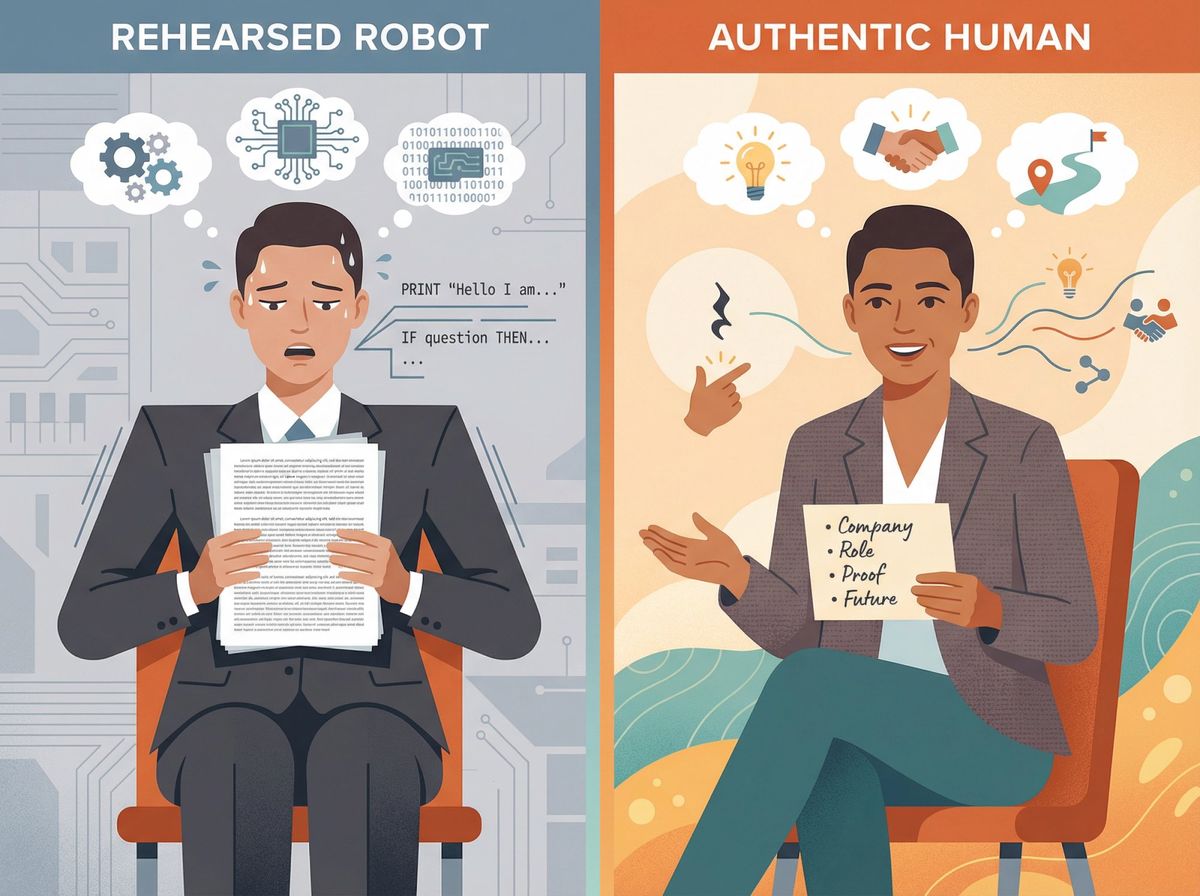
1) Don't Memorize Paragraphs. Memorize 4 Bullets.
Interview experts point out that notes can help (especially in phone interviews), but reading a full script is obvious.
Write bullets like:
• Company: "x product + y mission"
• Role: "z responsibility"
• Proof: "metric"
• Future: "impact"
2) Take a Short Pause Before Answering
Career advisors suggest thinking for around 10 seconds or less before speaking and even starting with a brief phrase like "that's a great question" to buy a beat.
3) End With a Clean Landing
Your last sentence should be forward-looking (what you want to build) so you don't fade out awkwardly.
Using AI for Interview Prep in 2026: What You Need to Know
AI is everywhere in hiring now. Candidates use it, recruiters use it, and the "arms race" is public.
Key statistics:
- Employ's 2025 Job Seeker Nation report (June 2025) says 31% of job seekers used AI to support their job search in 2025
- 66% reported job-search burnout
- There's also increasing attention on AI being used to "cheat" in live interviews (The Atlantic, October 2025)
- Companies have responded by tightening interview policies and even shifting back toward in-person rounds
One example: India Today reported Google moving toward in-person components due to concerns about AI-assisted cheating (August 2025).
So here's the rule that keeps you safe:
Use AI to prepare your thinking and structure, but follow the employer's rules during the interview. If they ban tools, don't use them. If they allow notes, use notes. If they ask for a skills test, do it clean.
Also: AI-generated answers often sound generic if you don't add real specifics (hiring managers notice).
How AIApply Fits (Without Making Your Answer Fake)
AIApply is built for exactly the part people struggle with: turning a job ad + your background into crisp, role-matched language.
Here's a clean workflow that keeps the answer authentic:
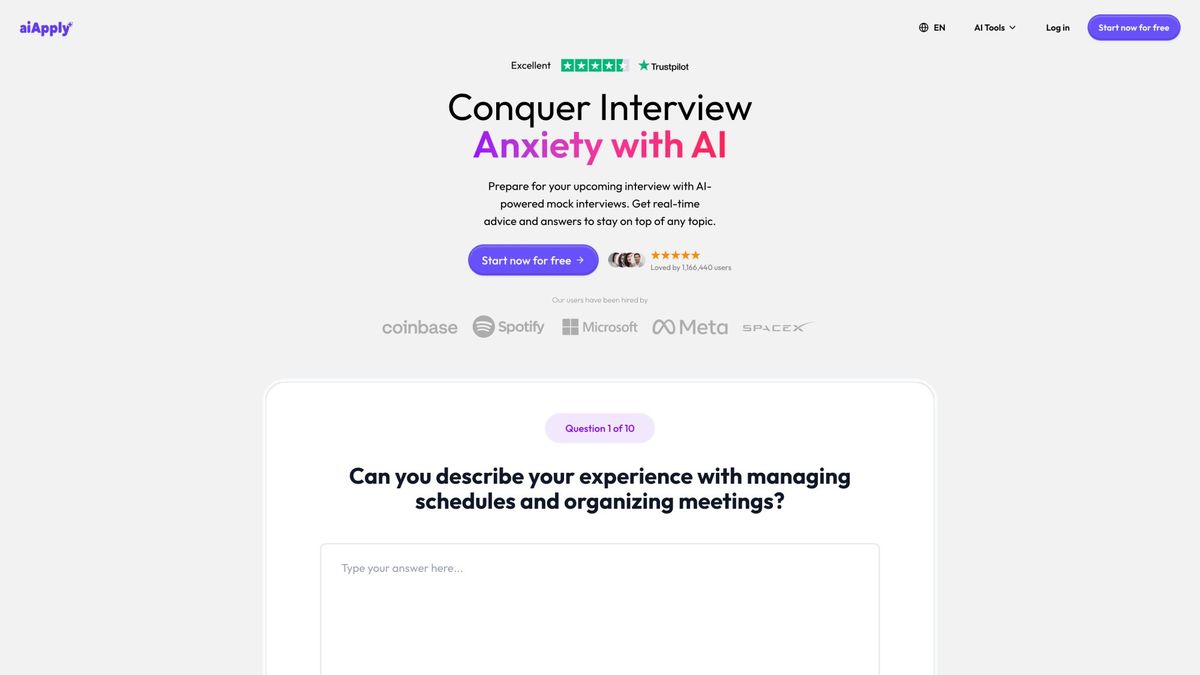
1) Generate Role-Specific Practice Questions
AIApply's AI Mock Job Interview lets you paste a job description (or job post URL) and get tailored interview questions + feedback.
Use it to force specificity: if your "why here" answer is generic, the simulator will basically expose it.
2) Build Your Proof Bank
Use the same job description to list 5-8 proof bullets you can reuse (metrics, projects, wins). Then practice converting them into 1-2 sentence "proof chunks."
Our AI Resume Builder can help you identify and articulate these achievements from your work history.
3) Rehearse the Exact Question Under Time Pressure
Set a timer to around 60-90 seconds and repeat until you can hit all three proofs cleanly.
AIApply's interview prep resources lean on the same fundamentals: go beyond surface research, deconstruct the job description, understand who you're speaking to, and prepare insightful questions.
Note on Real-Time Tools
AIApply also offers tools positioned as real-time interview support. For example, Interview Answer Buddy describes on-screen coaching and instant answers.
Use these only in ways that match the employer's rules and your own ethics. If a company expects unaided responses, treat real-time assistance as practice, not as something to run in a live evaluation.
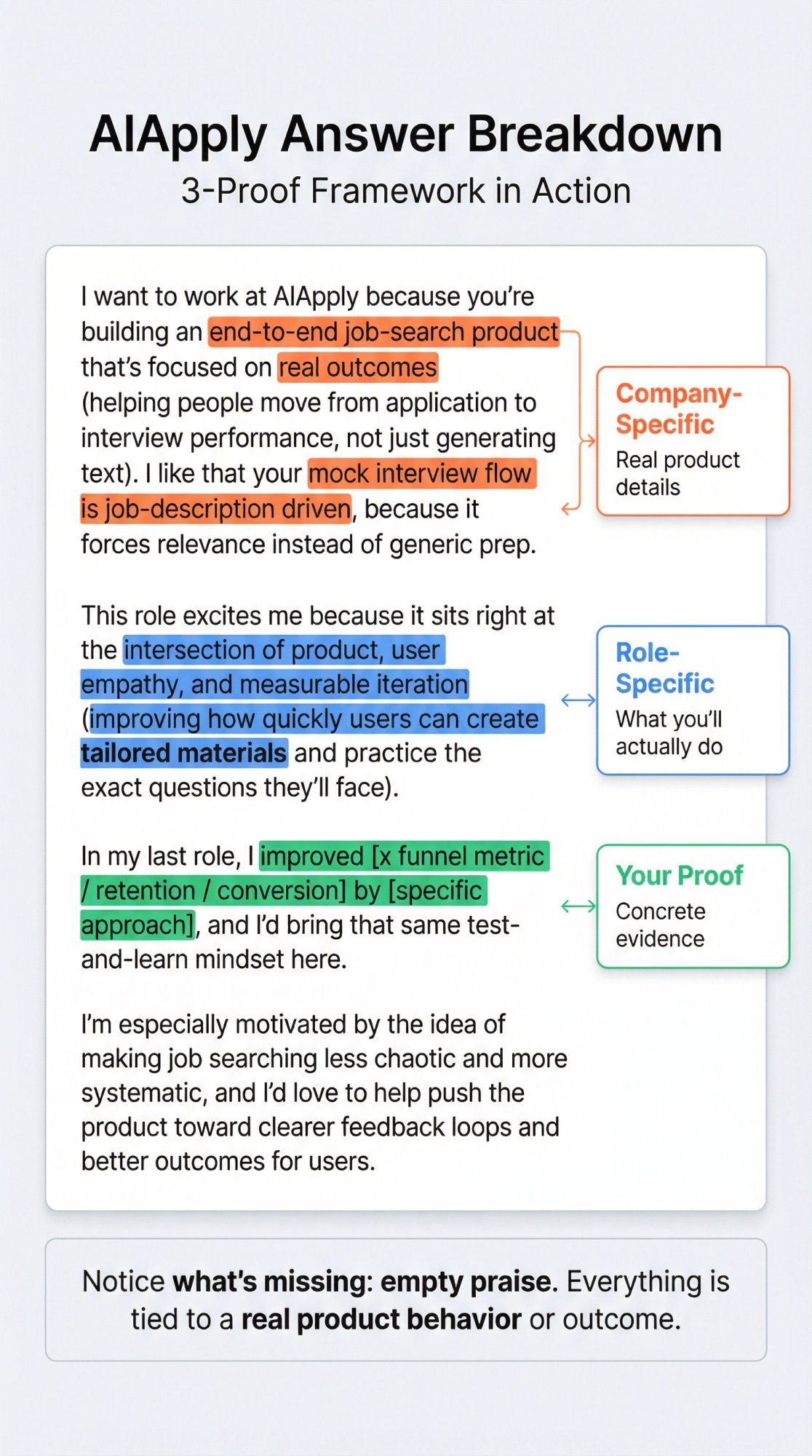
A "Why Do You Want to Work Here" Example for AIApply (So You Can See What "Specific" Looks Like)
Imagine you're interviewing for a product manager role at AIApply. You want your answer to reflect what AIApply actually does: job-search tools like mock interviews and resume building.
Sample answer:
"I want to work at AIApply because you're building an end-to-end job-search product that's focused on real outcomes (helping people move from application to interview performance, not just generating text). I like that your mock interview flow is job-description driven, because it forces relevance instead of generic prep. This role excites me because it sits right at the intersection of product, user empathy, and measurable iteration (improving how quickly users can create tailored materials and practice the exact questions they'll face). In my last role, I improved [x funnel metric / retention / conversion] by [specific approach], and I'd bring that same test-and-learn mindset here. I'm especially motivated by the idea of making job searching less chaotic and more systematic, and I'd love to help push the product toward clearer feedback loops and better outcomes for users."
Notice what's missing: empty praise. Everything is tied to a real product behavior or outcome.
Quick Self-Check: Score Your Answer in 30 Seconds
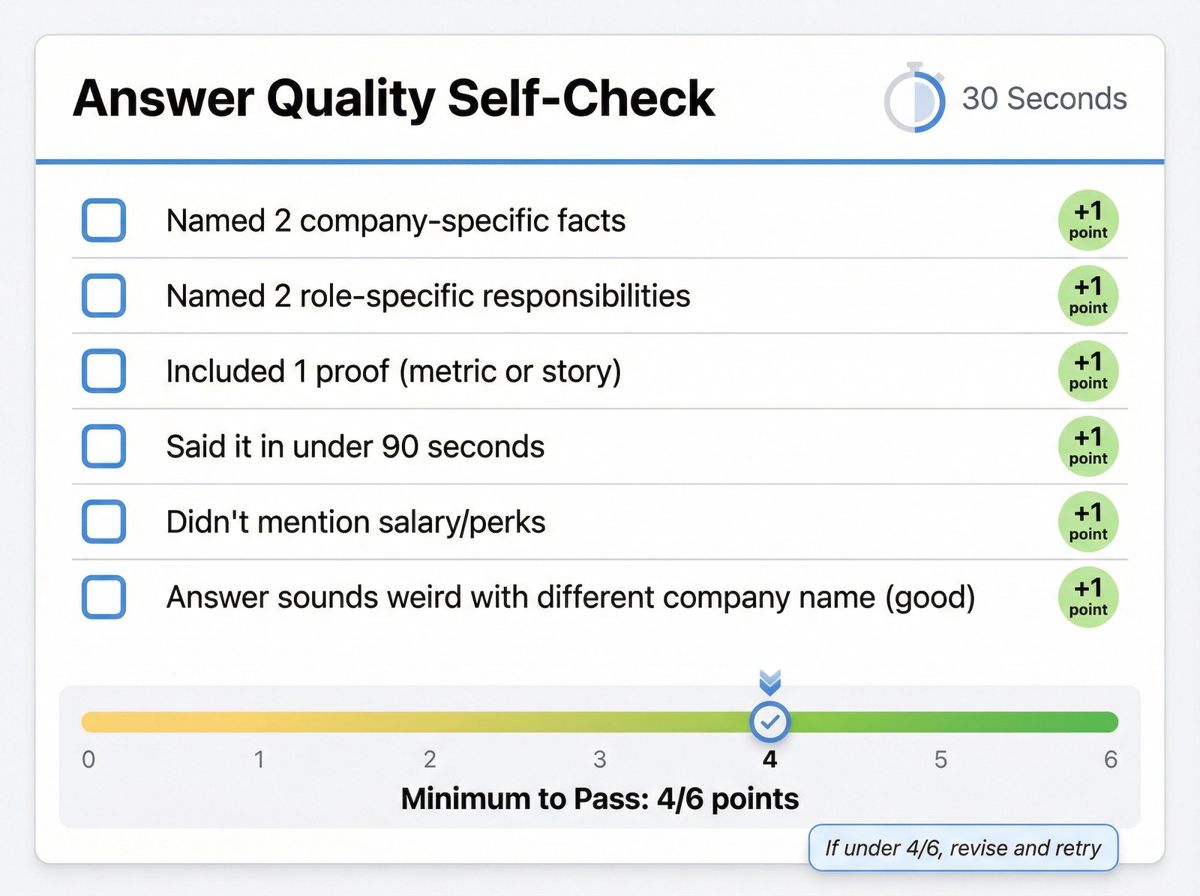
Give yourself 1 point each:
- I named 2 company-specific facts
- I named 2 role-specific responsibilities
- I included 1 proof (metric or story)
- I said it in under 90 seconds
- I didn't mention salary/perks as a motivator
- My answer would sound weird if you swapped in a different company name (good)
If you got under 4/6, it's not ready yet.
Frequently Asked Questions
"What if I can't find much info about the company?"
Then you use what you do have: the job description, the product page, and the company's public posts. Even one concrete detail beats vague praise. Career guides explicitly recommend starting with the company website and getting familiar with products/services.
"Can I mention I like the benefits / remote work?"
Yes, but never as the main reason. Make it the third thing you mention, not the first.
"What if I'm applying to a bunch of places?"
Normal. Just don't say it. Career advisors literally list "I've been applying to many places" as something to avoid.
Use AIApply's Auto Apply feature to streamline your application process while still maintaining personalized, thoughtful answers for each interview.
"How long should my answer really be?"
45-90 seconds for most situations. If it's a complex role, up to 2 minutes. Never longer than 2-3 minutes.
"Should I memorize my answer word-for-word?"
No. Memorize the 4-part structure (company/role/proof/future). Let the specific words flow naturally.
"Is it okay to use AI tools to prepare?"
Yes, but be smart about it. Use AIApply's tools to practice and refine your thinking. Just make sure you're following the company's interview rules. If they expect unaided responses, use AI for prep only (not during the live interview).
"What if the company is small and there's not much online?"
Focus on what you can find. Read their LinkedIn, check recent posts, look at the job description carefully. Small companies appreciate when candidates show curiosity and ask thoughtful questions during the interview.
"How do I research company culture effectively?"
Look beyond the careers page. Check employee reviews, recent company news, LinkedIn posts from current employees, and social media presence. For specific industries, explore career pages for tech companies, healthcare organizations, or financial services to understand industry-specific cultural norms.
You now have the 3-proof framework, the 10-minute prep system, and templates for any situation. Practice with AIApply's mock interview tool, avoid the common mistakes, and your answer will feel authentic while hitting every point interviewers care about.
In 2026, demonstrating that you're up-to-date and have done recent research is crucial. Mentioning a current project, a piece of recent news about the company, or any 2025 accomplishments can really strengthen your answer. Use resources from company blogs to social media to stay informed.
The best answers ultimately tell a story about fit: a fit between what excites you and what the company offers, and between what the company needs and what you can contribute. When you can tell that story convincingly, you turn this question from a stumbling block into a golden opportunity to shine.
Ready to ace your next interview? Use AIApply's comprehensive suite of tools to prepare your resume, practice with AI-powered mock interviews, and get real-time interview support. From resume scanning to automated job applications, we've got your entire job search covered.