How Many References Should You Have on a Resume (and for a Job)?
How many references do you need for a job? Find the right number for your situation with practical defaults, reference sheet templates, and ask scripts.


Most job seekers either list references on the resume or scramble to find three names the day a recruiter asks. Here's the number to prepare, where it goes, and how to make each reference count.
Key takeaways
- Prepare three to five references for most jobs. Three is the safe default when a posting doesn't specify.
- References don't belong on your resume. Put them on a separate one-page reference sheet.
- If a job posting asks for a specific number of references, submit exactly that number.
- Entry-level candidates can use two or three references, including professors, internship supervisors, and volunteer coordinators.
- Employers usually check references near the end of hiring, so a reference request means you're a finalist.
You should have three to five references ready for most jobs, but none of them belong on your resume. List them on a separate reference sheet and send it only when an employer asks, which usually happens after the final interview.
That's the answer for most people. The part that trips candidates up is everything around it: picking three people who will actually help, formatting the list so it matches the rest of your application, and briefing those people before a recruiter calls. A reference who doesn't pick up, or can't remember your best project, shows up at the worst possible moment: after you've done the hard work of reaching the final round.
How Many References Do You Need? (Quick Answer)
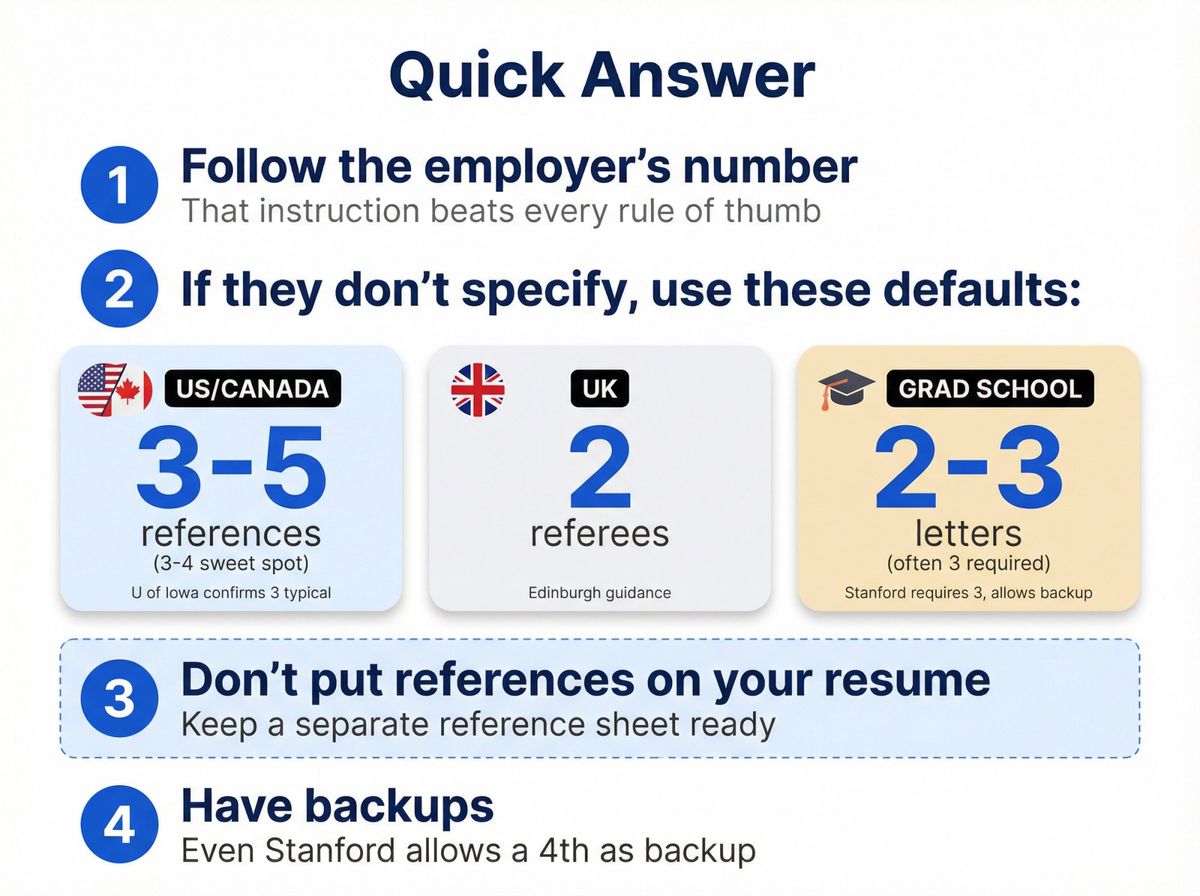
None of your references belong on the resume itself. Keep three to five on a separate one-page reference sheet instead.
The University of Iowa's Pomerantz Career Center recommends lining up three to five people, then giving each employer the three to five who are most relevant to that specific role. That list lives on its own page, not at the bottom of your resume.
There are two reasons. Your resume's only job is to earn an interview, and every line spent on a reference's phone number is a line not spent proving you fit the role. If you're fighting for space, AIApply's guide to how long a resume should be covers what else to cut. The second reason is privacy. Resumes get uploaded to job boards and forwarded between recruiters, and your references never agreed to have their contact details travel that far.
The one exception is a posting that explicitly asks for references with the application. Follow the instruction, and still use a separate page unless the application form forces a different format.
One more thing worth saying plainly: if nobody is asking for your references, your reference list isn't the problem. Your resume is, because it isn't getting you to the final round. AIApply's AI Resume Scanner checks that resume for the ATS, keyword, and formatting issues that stop applications long before anyone asks who can vouch for you.
How Many References Should You Have on a Resume?
None of your references belong on the resume itself. Keep three to five on a separate one-page reference sheet instead.
The University of Iowa's Pomerantz Career Center recommends lining up three to five people, then giving each employer the three to five who are most relevant to that specific role. That list lives on its own page, not at the bottom of your resume.
There are two reasons. Your resume's only job is to earn an interview, and every line spent on a reference's phone number is a line not spent proving you fit the role. If you're fighting for space, AIApply's guide to how long a resume should be covers what else to cut. The second reason is privacy. Resumes get uploaded to job boards and forwarded between recruiters, and your references never agreed to have their contact details travel that far.
The one exception is a posting that explicitly asks for references with the application. Follow the instruction, and still use a separate page unless the application form forces a different format.
One more thing worth saying plainly: if nobody is asking for your references, your reference list isn't the problem. Your resume is, because it isn't getting you to the final round. AIApply's AI Resume Scanner checks that resume for the ATS, keyword, and formatting issues that stop applications long before anyone asks who can vouch for you.
How Many Professional References Should You Have?
Three professional references is the standard for most jobs, ideally two people who managed your work and one senior colleague, client, or cross-functional partner.
A professional reference is someone who has seen you work: a manager, supervisor, colleague, client, professor, or internship coordinator. A personal or character reference knows you outside of work. The University of Iowa classes parents, friends, family, and partners as personal references, not professional ones, so leave them off unless an employer specifically asks for a character reference.
Three works because it gives a hiring manager enough voices to spot a pattern. The University of Wisconsin-Madison's HR guidance makes the same point to its own hiring managers: checking multiple references lets them look for consistency across what each person says. One glowing reference could be a friend. Three that describe the same strengths are evidence.
When Do Employers Ask for References?
Most employers ask for references near the end of the hiring process, after the field has been narrowed to a few finalists.
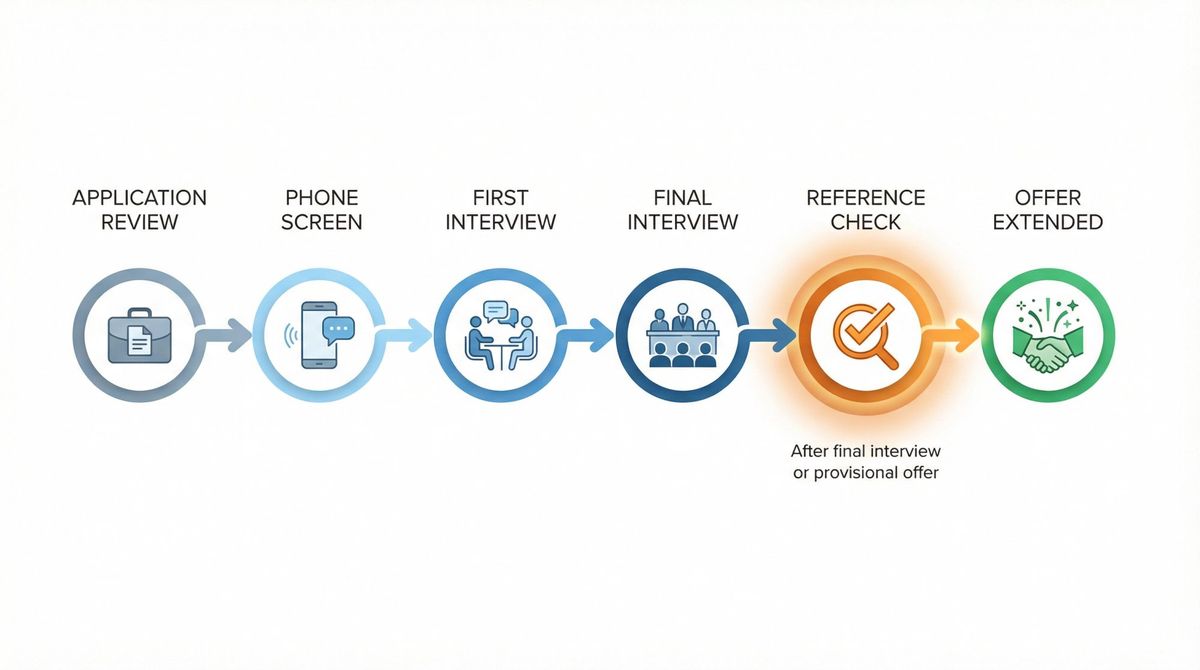
The U.S. Office of Personnel Management describes reference checking as a step usually done near the end of selection, once the applicant pool is down to a few competitors, and mostly by phone. The University of Wisconsin-Madison goes further and warns its hiring managers that asking for references at the application stage can put candidates off, since many aren't comfortable sharing them until they're a finalist or have a verbal offer.
So a reference request is good news. AIApply's guide to signs your interview went well treats it as one of the hard signals, alongside availability checks and salary talks. Employers use this step to confirm what you've told them, and they do find gaps: in HireRight's 2025 Global Benchmark Report, more than three-quarters of businesses said they had found candidate discrepancies during screening in the previous 12 months.
Because references are checked right after the final round, what your references say has to match the stories you told in that round. AIApply's AI Mock Interview lets you rehearse final-round answers until the examples you give line up with the projects your references are going to describe.
How Many References Do You Need by Job Type and Career Stage?
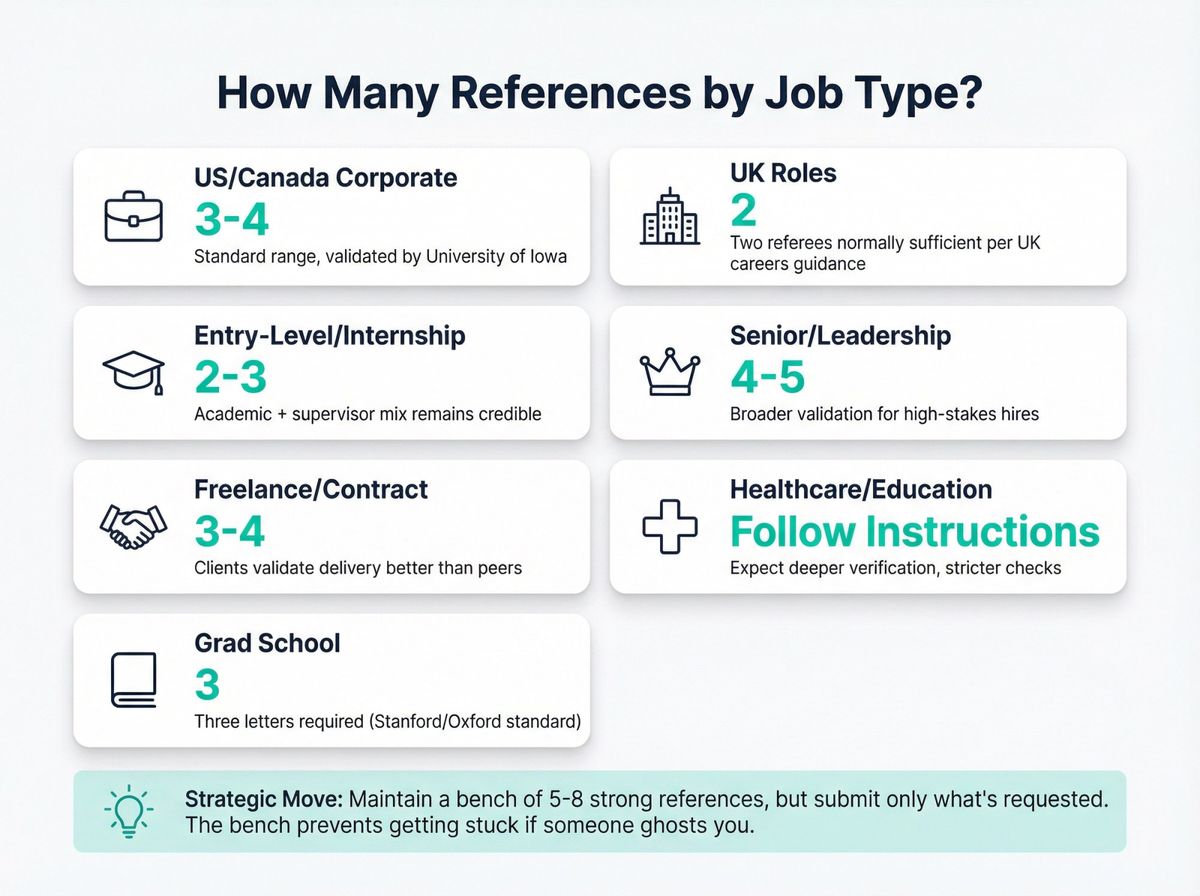
Entry-level candidates typically need two or three references, most mid-level roles call for three or four, and senior or leadership roles often ask for four or five.
| Scenario | What to Submit | Why This Works |
|---|---|---|
| The posting names a number | Exactly that number | The employer's instruction beats any rule of thumb. |
| Typical US/Canada corporate role | 3 to 4 | Inside the three-to-five range career centers recommend, without padding. |
| Internship or entry-level | 2 to 3 | Professors, internship supervisors, and part-time managers all count. |
| Senior or leadership role | 4 to 5 | Employers want validation across several roles. Some senior and government postings ask for more. |
| Freelance or contract work | 3 to 4 clients or project leads | Clients can validate delivery and reliability better than "coworkers." |
| Healthcare, education, government, and other high-trust roles | Follow the application exactly | These employers often verify more of your history and may ask for references earlier. |
| UK roles | 2 referees | Two references is the normal expectation in UK hiring. |
Keep a bench of five to eight people you trust, but submit only what's requested. The bench is what saves you when a former manager is on leave or doesn't answer for a week.
Why Do Employers Ask Your References?
Reference checks usually confirm your title, dates, and duties, then ask about your strengths, weaknesses, and whether the reference would rehire you.
OPM frames reference checking as two jobs: verifying what you claimed on your resume and in interviews, and predicting how you'll perform based on how you performed before. The UW-Madison checklist has employers confirm the relationship first, then verify job title, duties, and dates of employment.
Most calls end with some version of "Would you rehire this person?", a question that appears on Indeed's list of standard reference check questions. That question is the real test for everyone on your list. Only include people who would answer yes without a pause.
Who Should You Use as a Reference?
Your strongest references are people who supervised your work recently and can speak to the skills named in the job description.
AIApply's guide on how to ask someone to be a reference scores each candidate on three things: relevance (can they speak to skills this job needs?), recency (did they work with you recently enough to be credible?), and relationship (is the connection professional?). Pick the highest-scoring mix. Former supervisors should anchor it; UW-Madison's HR guidance notes the most useful references generally come from former supervisors.
| Reference type | What they prove | When to include |
|---|---|---|
| Former Manager or supervisor | Your performance and reliability | Almost always, one or two |
| Senior peer or cross-functional partner | How you collaborate and deliver | Team-heavy roles |
| Client/Stakeholder | Delivery and results | Sales, consulting, freelance |
| Professor or academic advisor | Ability to learn and potential | Entry-level and career changers |
Put your strongest reference first. The University of Iowa recommends listing references in order of importance for the specific role, so reorder the list for each application. Include your current manager only if they already know you're looking.
Should You Write "References Available Upon Request" on Your Resume?
No. Hiring managers already assume you have references, and the line takes space your resume needs for evidence that you fit the role.
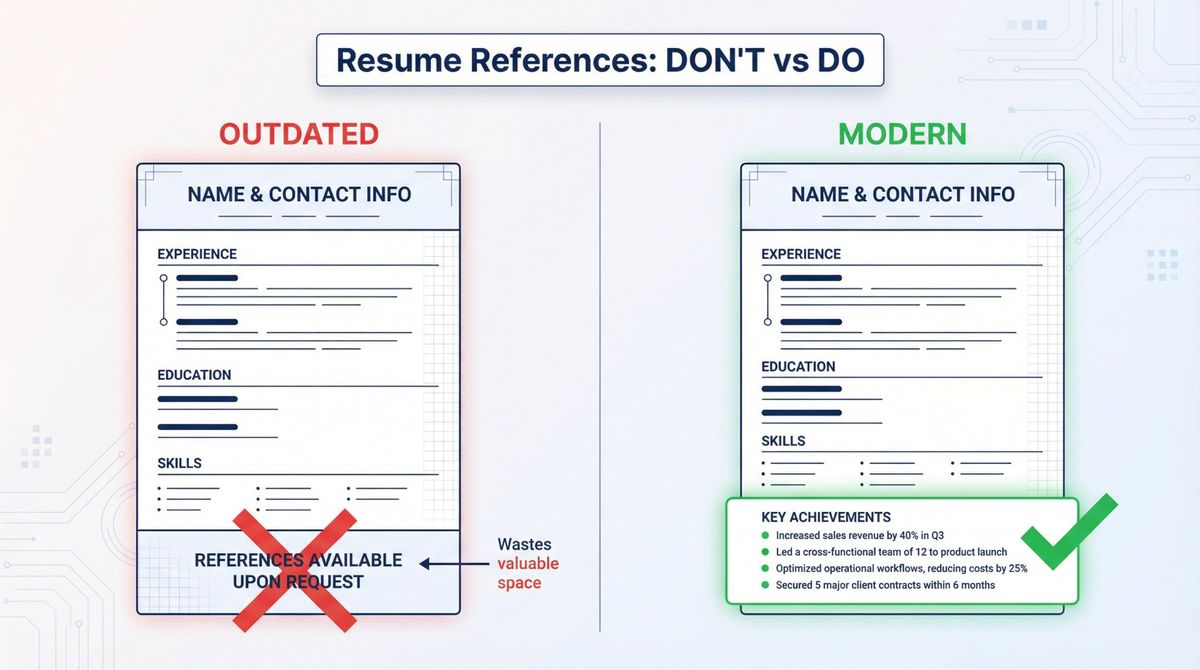
The habit is still everywhere. Monster's State of the Resume 2026 report found that 49% of job seekers still include "References available upon request." Common doesn't mean useful. Deleting the line is one of the easiest edits you can make, and it's on the list of outdated habits in AIApply's bad resume examples guide.
How to Format a Reference Sheet
A reference sheet is a one-page document that uses your resume's header, followed by each reference's name, title, organization, phone, email, and relationship to you.
The University of Iowa advises matching the header exactly to your resume, titling the section "References," and listing each person's name, title, work address, phone, email, and relationship to you. Save it as a PDF unless the employer asks for another format.
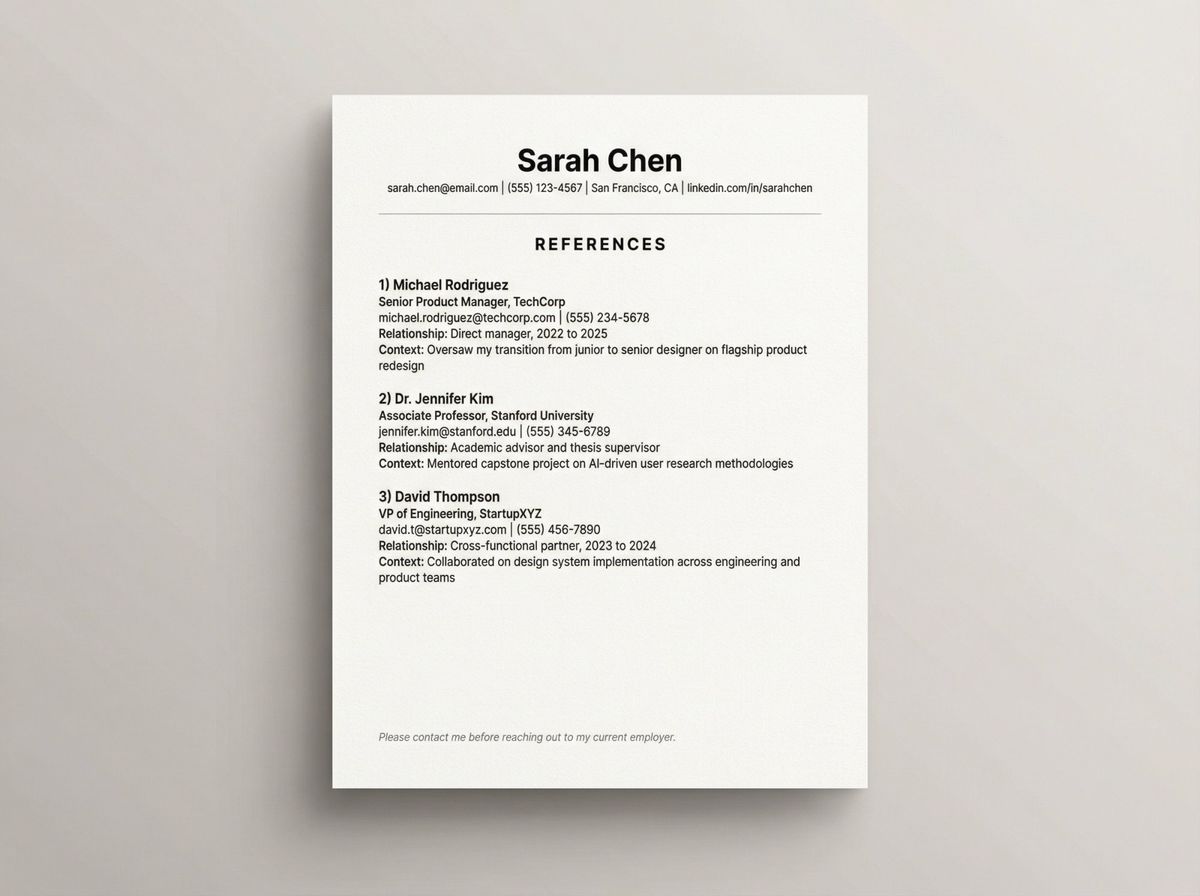
Reference Sheet Template (Copy/Paste)
How to Ask Someone to Be a Reference and Prepare Them
Ask each reference before you start applying, then send them the job description, your resume, and two or three points you'd like them to confirm.
The University of Iowa recommends a short meeting or call rather than a cold request, talking through the role you want, confirming the contact details they prefer, and letting them know each time you apply or interview so a call doesn't catch them off guard.
Once someone agrees, send them a reference brief, a short email with everything they need to back you up:
• The job description or a link to it
• Your current resume
• Two or three specific projects or results you'd like them to mention
• When the employer is likely to call, and who will call
If months have passed since they agreed, check in again before you hand over their details. People change jobs and phone numbers. After the process ends, whether you get the offer or not, thank them.
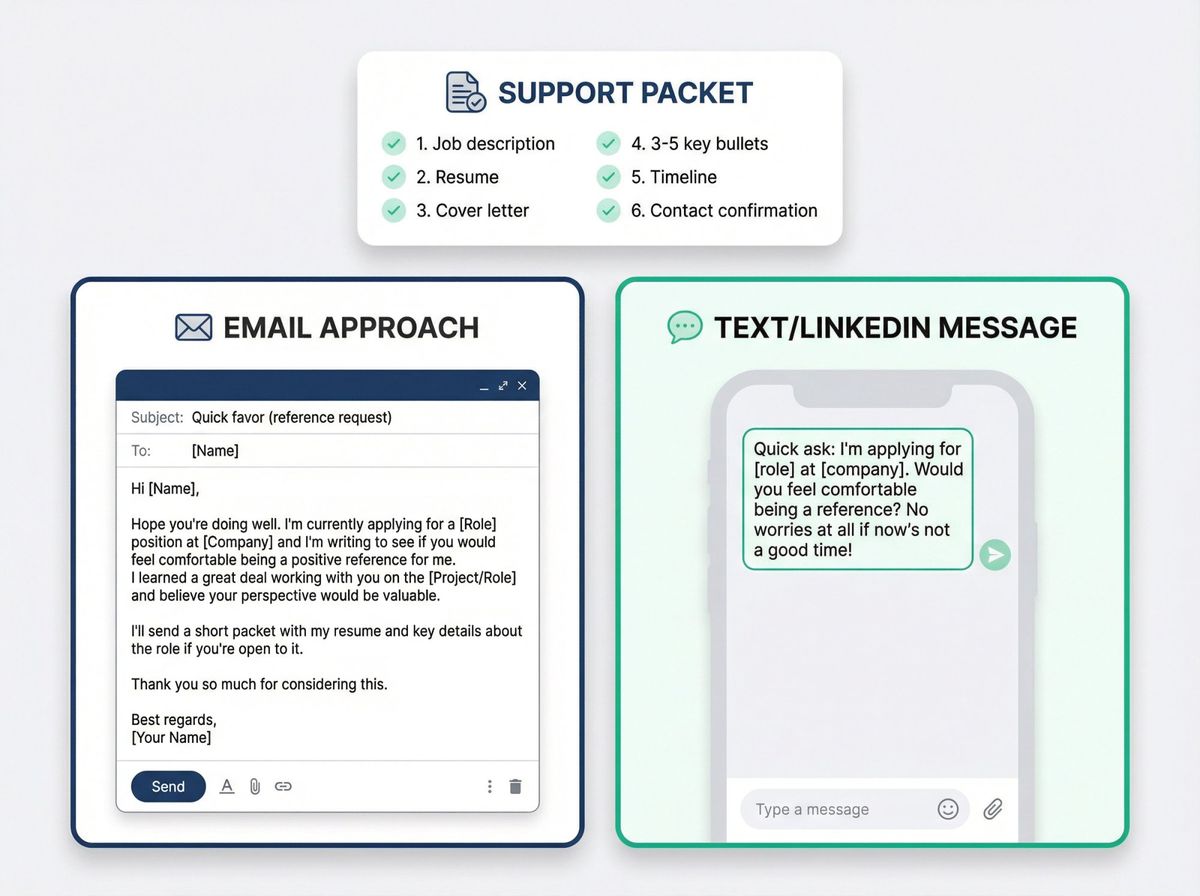
Email Script: Asking Someone to Be Your Reference
Text/LinkedIn Message: Asking for a Reference (Short Version)
What If an Application Asks for References Before the Interview?
Give the minimum number the form requires, and ask that your current employer not be contacted until you have an offer.
This is a normal request, and hiring teams expect it. OPM's reference checking guide tells federal hiring managers that candidates often ask this, and suggests contacting the current supervisor only once a tentative offer has been made. Lead with former managers so the early request doesn't expose your search.
What If You Don't Have Work References?
Professors, internship supervisors, volunteer coordinators, and mentors are accepted professional references when you have little work history.
The University of Iowa lists all of these, plus part-time supervisors and academic advisors, as valid professional references. Career changers should pick people who can speak to transferable work: a manager who saw you run a project, even if the job title was different.
How Many References Do You Need for Graduate School?
Most graduate programs require three letters of recommendation, which is a different process from job references.
Stanford Graduate Admissions requires three letters. Oxford asks applicants to register three referees but treats an application as ready for assessment once two references have arrived. Academic letters are written documents submitted through a portal, not phone calls, so keep them on a separate tracker. AIApply's letter of recommendation guide covers how those letters are written.
The Reference List Is the Last Step, Not the First
References confirm a hiring decision the employer has mostly made already, so the most valuable thing you can do is reach the reference stage more often.
Prepare three to five people, brief them before they're called, and keep the list on one page with the same header as your resume. That part takes an afternoon.
The waiting is harder. A reference check can hold up a single process while your search goes quiet. AIApply's Auto-Apply keeps tailored applications going out while you wait, so one final round is never your only option.
Frequently Asked Questions
Is 2 References Enough on a Resume or CV?
Two references are enough only if the employer asked for two or you're applying for an entry-level role; otherwise, provide three. In the UK, two referees is the normal expectation.
Is 5 References Too Many on a Resume?
Five references is the upper end of normal and fits senior roles, but three or four strong references beat five mixed ones. Only add a fifth if every name on the list would give a confident recommendation.
Can I Use a Friend as a Reference on My Resume?
You can use a friend only when an employer specifically asks for a personal or character reference. Career centers classify friends and family as personal references, not professional ones.
Do References Need to Be from My Current Job?
No, most candidates use former managers and colleagues, especially when their current employer doesn't know they're looking. Choose people who worked with you recently enough to remember specifics.
Should I Put My References' Contact Details Anywhere Public?
No, keep references' contact details off any public resume or profile and share them only with an employer who asks. AIApply's guide to LinkedIn on your resume explains why public resume uploads can be downloaded by anyone.
What If a Reference Says No?
Thank them and ask the next person on your list. A reluctant reference is more likely to give a lukewarm answer than a strong one.
How AIApply Can Help (Without Making This Weird)
References don't exist in a vacuum. They're strongest when your story is consistent across:
• Resume
• What your references say about you
AIApply tools that map directly to that:
AI Resume Builder to generate a tailored resume fast (then you keep the same header for your reference sheet).
AI Resume Scanner to catch ATS, keyword, and formatting issues before you start asking people to vouch for you.
AI Cover Letter Generator so your references see the same narrative you're selling.
Interview Answer Buddy so your live interview answers match the strengths your references will confirm.
And if you want the reference-asking playbook: AIApply's guide on how to ask someone to be a reference includes a support-packet checklist and the relevance/recency/relationship framework.
Final Thoughts
Your references are only as good as the foundation you've built. Do great work, maintain relationships, and leave positive impressions everywhere. That's how you earn glowing references.
Getting your references sorted might feel like a minor checkbox, but it's the final filter between you and an offer. Employers contact references when they're ready to say yes but want one last confirmation.
Have at least 3 strong references ready. Pick people who actually know your work and will speak enthusiastically. Format your reference sheet cleanly. Ask people early and give them what they need to help you.
And remember: your references are only as good as the foundation you've built. Do great work, maintain relationships, and leave positive impressions everywhere. That's how you earn glowing references.
With a strong resume, compelling cover letter, and well-curated reference list, you're giving employers a consistent story about who you are. Manage each piece well, and you'll move through the hiring process faster and with more confidence.