How Many Pages Should a CV Be? Complete Guide
The right CV length isn't one size fits all. Learn exactly how many pages work for your career stage, industry, and location with data-backed guidance.


If you're googling "how many pages should a CV be?", you're not really asking about paper.
You're asking: "Will I get rejected because my CV is too long (or too short), and what should I do about it?"
This is the question keeping you up at night.
You've got experience to showcase, but you're terrified of losing a recruiter's attention with a document that's either too packed or suspiciously sparse.
We get it. And most career advisors won't tell you this upfront: the answer genuinely depends on where you're applying, how much experience you have, and what type of role you want. But that doesn't mean you're stuck guessing.
This guide gives you:
• The correct page count by country, job type, and career stage (with actual data from 2026)
• When 1 page wins, when 2 pages is expected, and when 3+ pages is actually appropriate
• A proven method to cut your CV down without deleting your strongest achievements
• The "make it scannable in seconds" framework recruiters actually use
Let's cut through the noise and get you answers you can act on today.
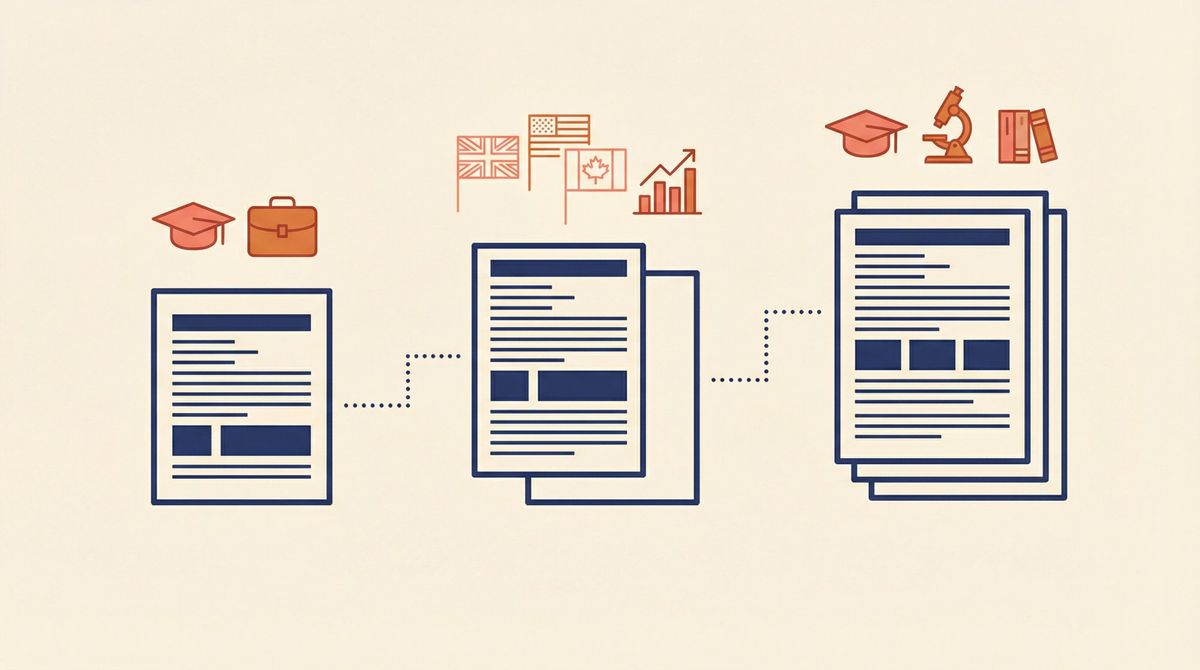
How Many Pages Should Your CV Be? Quick Answer
For most job seekers applying to standard (non-academic) roles, here's what works:
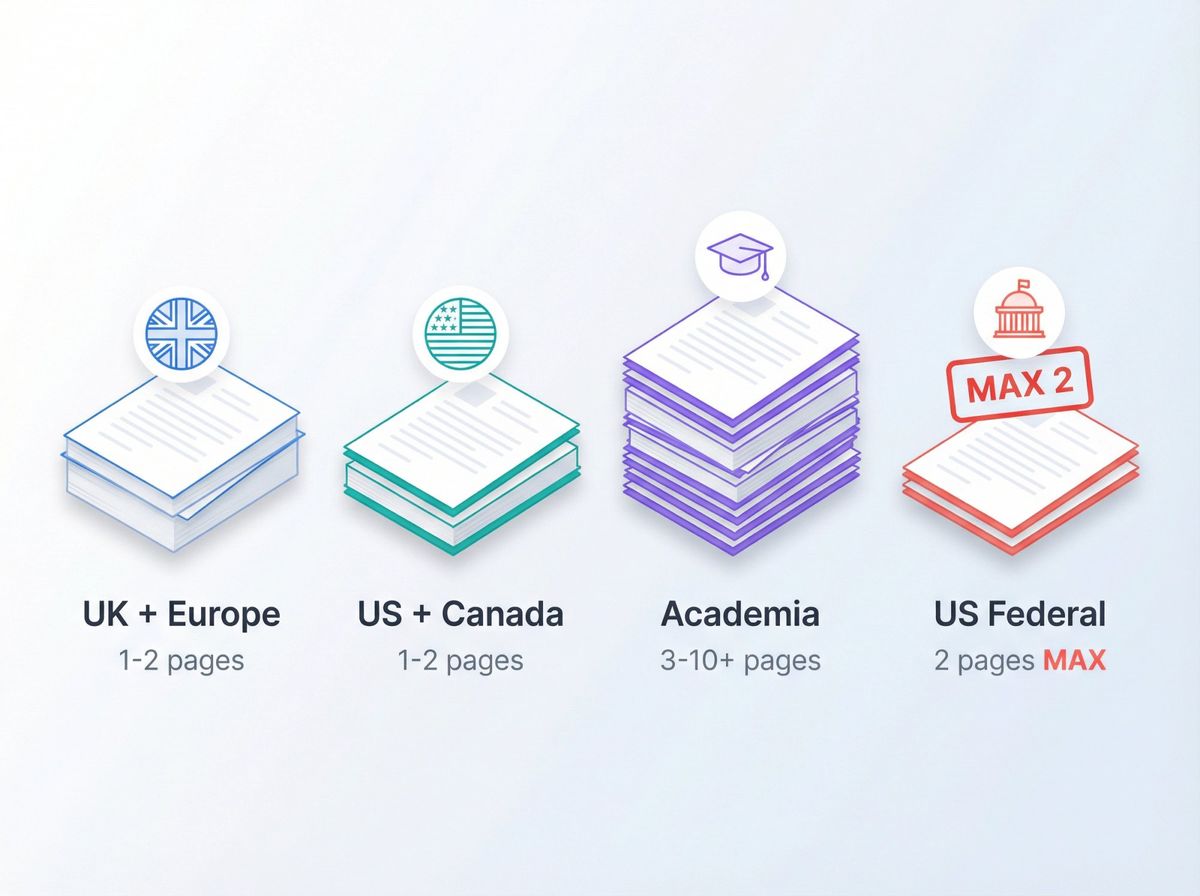
| Where You're Applying | Expected Length | What You Need to Know |
|---|---|---|
| UK + Most of Europe | 1-2 pages (typically max 2 A4) | Two pages is normal once you have experience. One page is fine for students or part-time roles. University careers services recommend this standard. |
| US + Canada (Private Sector) | 1-2 pages | One page is common for students and early-career pros. Two pages becomes standard once you have 5+ years of genuinely relevant experience. Career experts confirm this range. |
| Academia / Research / Medical | 3-10+ pages (no real limit) | An academic CV is a different document genre. It lists publications, grants, teaching, conferences, and can run very long. Georgetown's career center notes 2-4 pages for new professionals, up to 10 pages for seasoned academics. |
| US Federal Jobs | 2 pages max (NEW rule) | Starting September 27, 2025, USAJOBS restricts all resumes to two pages. If the only resume you submit exceeds this, you can be ruled ineligible. |
The rule that never changes:
Your CV should be as long as needed to prove you're qualified, and as short as possible to stay effortless to scan.
That's it. Length is a tool, not a rigid law.
Why CV Page Count Matters for Job Applications
A recruiter isn't "reading" your CV like a novel.
They're doing a fast pattern-match:
• Can you do the job?
• Can I prove it quickly?
• Is the risk low enough to bring you in?
Research from Oxford's careers service is blunt about this: employers may scan your CV in a few seconds, so it must surface relevant points instantly.
So when people obsess over page count, what they're really worried about is two things:
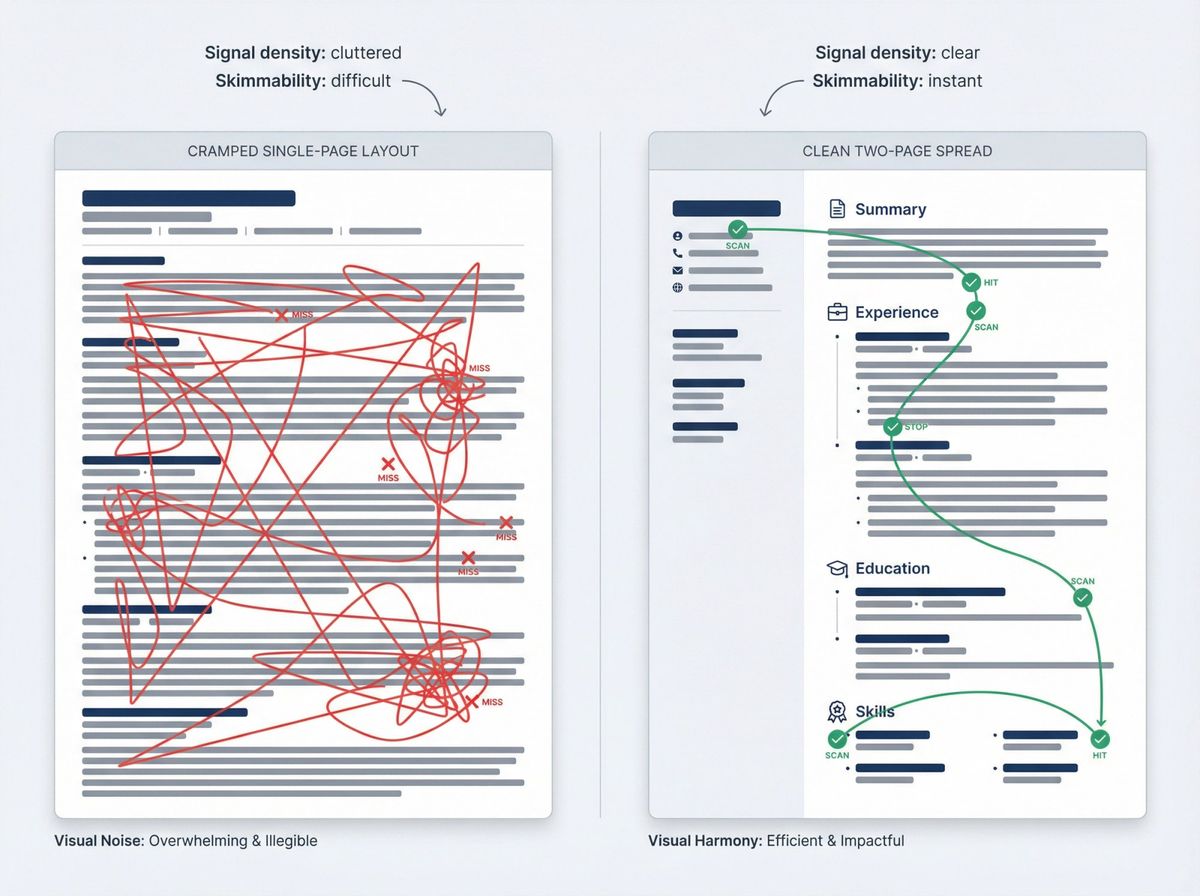
1. Signal density (how much proof per line)
2. Skimmability (how fast they can find the proof)
Nobody tells you this: a cramped 1-page CV with tiny fonts and zero white space is worse than a clean, well-organized 2-page CV. Research explicitly says readability and content quality beat arbitrary page counts, recommending readable fonts (10-12 point) rather than squeezing everything onto one page.
Translation? Length matters, but only if you sacrifice clarity to achieve it.
CV vs Resume: What's the Difference?
This trips people up constantly, especially if you're applying internationally.
Outside the US: The terms "CV" and "resume" are often used interchangeably. Most career guidance services confirm this.
In the US: "CV" usually means an academic or research document that can run much longer than a standard resume.
So if you see a US job ad asking for a "CV" but it looks like a normal corporate role, they probably mean a resume-style CV (1-2 pages, tailored). If it's a university posting or research lab, they likely want a true academic CV (comprehensive, often 3-10+ pages).
Always read the context of the job posting. When in doubt, check if the application explicitly requests publication lists, teaching experience, or grant history. If yes, academic CV. If not, standard resume format.
What's the Right CV Length for Your Experience Level?
This is where generic advice falls apart. Your optimal CV length depends on two critical factors: where you're applying and how much experience you actually have.
By Country and System
| Location/System | Standard Length | Key Considerations |
|---|---|---|
| UK (most roles) | 1-2 pages, typically max 2 A4 | Default to 2 pages if you have real experience. One page is fine for students or part-time roles. Prospects recommends this standard. |
| US/Canada private sector | 1-2 pages | One page for students/new grads; 2 pages when you truly have enough relevant proof. Career coaches suggest this breakdown. |
| US academia/research | Multi-page CV (3-10+) | Use an academic CV format with sections for publications, teaching, grants. Georgetown's center provides detailed guidance. |
| US federal (USAJOBS) | 2 pages max | Do NOT exceed 2 pages starting Sept 27, 2025. OPM guidance states agencies should only review compliant resumes. |
By Career Stage
Your experience level dramatically changes what's expected:
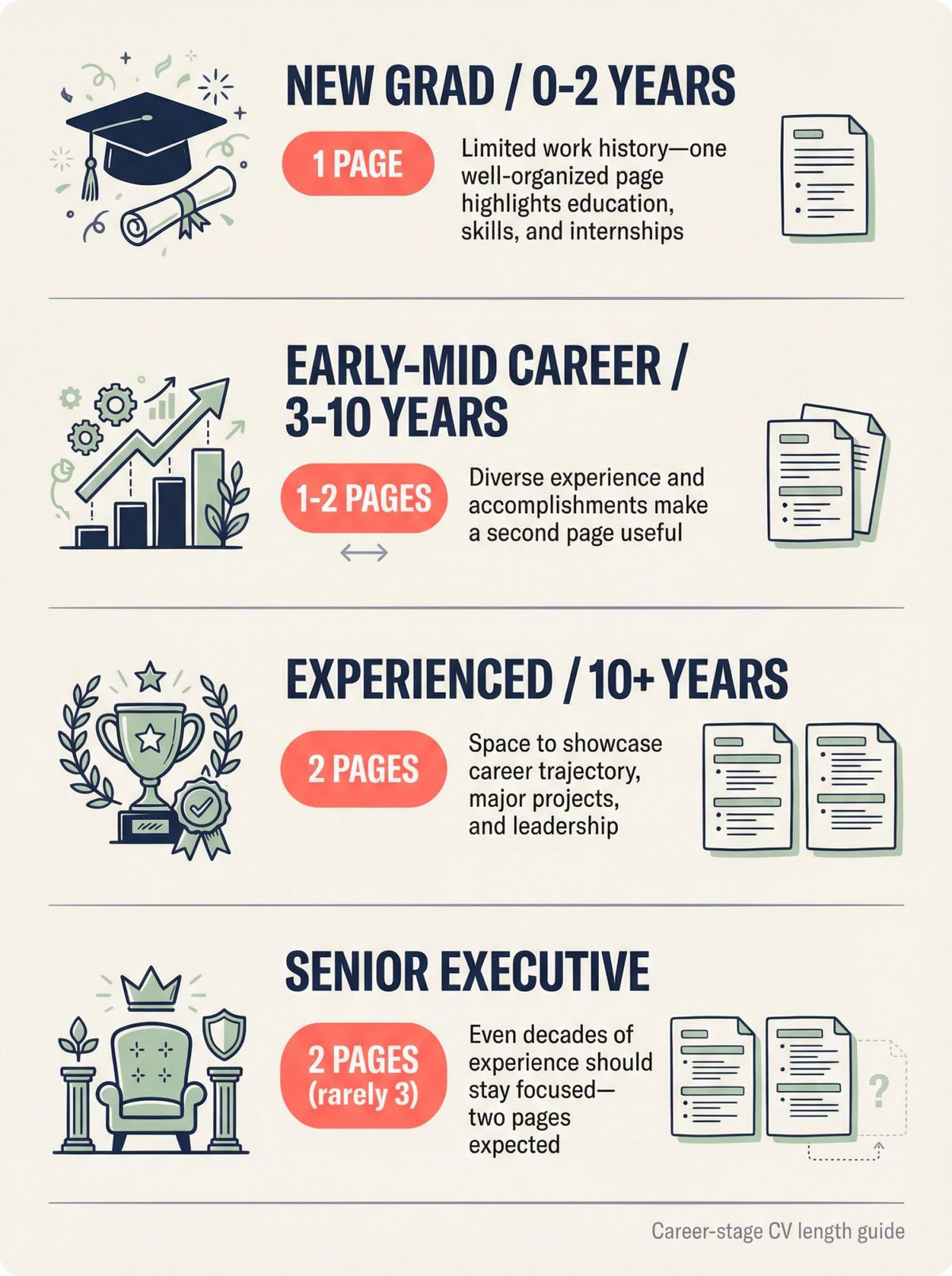
| Career Stage | Typical Length | Why |
|---|---|---|
| New grad / 0-2 years | 1 page | You likely have limited work history. One well-organized page highlights your education, skills, and any internships or projects. Research confirms this. |
| Early-mid career / 3-10 years | 1-2 pages | If you have diverse experience or important accomplishments, a second page becomes useful. Career surveys show 1-2 pages is standard for this range. |
| Experienced / 10+ years | 2 pages (usually) | Seasoned candidates with extensive experience typically use 2 pages. This allows space to showcase career trajectory, major projects, and leadership. Research confirms this is the norm. |
| Senior executive | 2 pages (rarely 3) | Even C-suite executives are advised to keep it to 2 pages. You might have decades of experience, but recruiters still value focus. Only in exceptional cases (highly technical roles, extensive board experience) might 3 pages be warranted. |
Bottom line: Early career? Default to 1 page. Mid-career? You're in the 1-2 page zone. Experienced professional? Two pages is expected and accepted.
Looking for resume examples by career stage? Browse our collection of professional resume examples tailored to different experience levels and industries.
When Is a 3+ Page CV Appropriate?
Before you panic about going beyond two pages, understand this: there are legitimate scenarios where longer CVs are not just accepted but expected.
1) Academic and Research CVs (Especially in the US)
An academic CV is fundamentally different from a job resume.
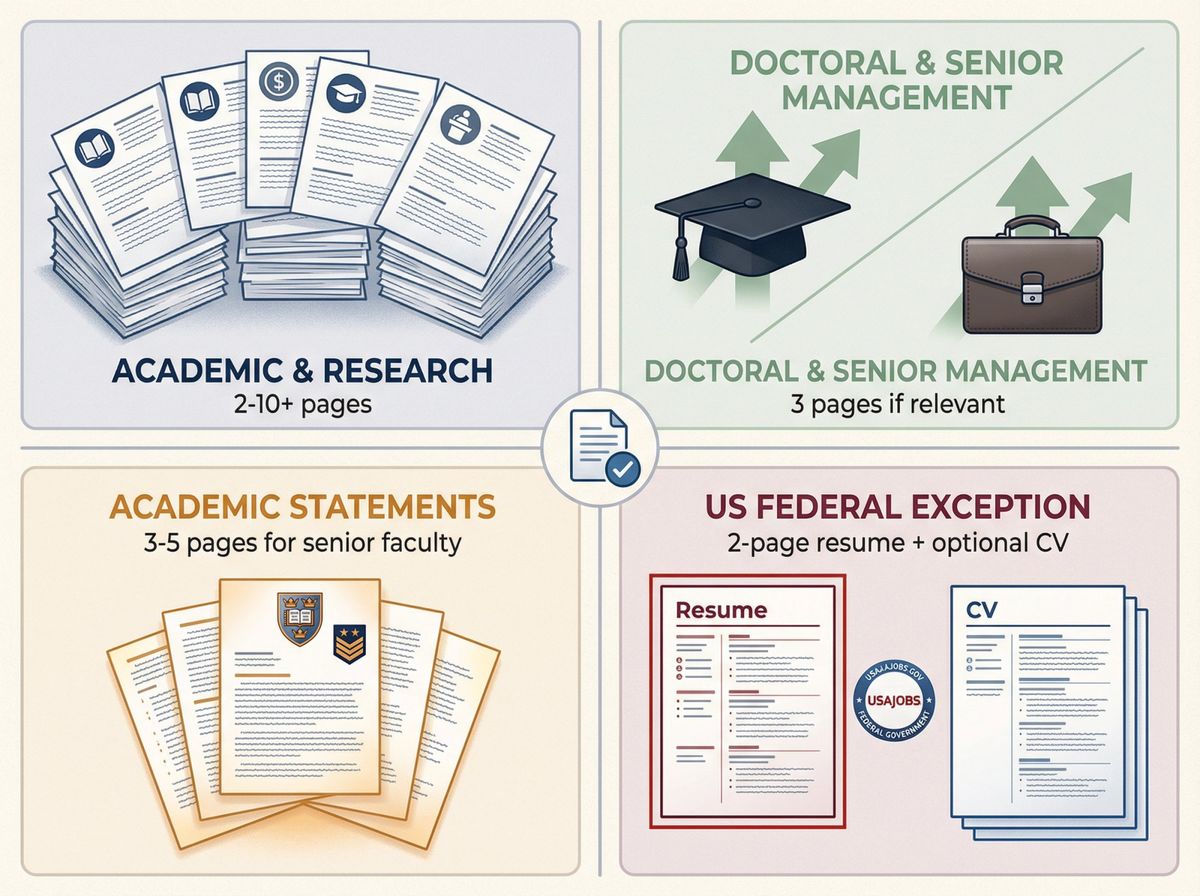
Georgetown's career guidance is explicit: academic CVs are typically 2-4 pages for a new professional, with a recommended max of 10 pages for seasoned professionals.
That sounds long because the purpose is documentation, not just selling yourself. You're expected to list:
• All publications and presentations
• Teaching experience and courses
• Grants and research funding
• Conference participation
• Professional service and committees
This can easily run 5-10 pages for an established professor or researcher, and that's completely normal in academia.
2) Doctoral Programmes and Senior Management (Some UK Contexts)
Career guidance notes that for a doctoral programme applicant or a senior management role, a three-page CV can be appropriate if the content is truly relevant.
The key phrase? If the content is truly relevant. Don't add a third page just because you can.
3) Certain Academic Supporting Statements
Oxford's academic applications guidance specifies that supporting statements often should be max 2 pages, but for associate professor and above they can extend to 3-5 pages.
4) US Federal Roles Requiring a CV (Exception Within the New 2-Page Rule)
This one's nuanced.
OPM guidance clarifies: for positions that require a curriculum vitae (often medical or research roles), agencies may ask you to submit the CV as an "other document" while still enforcing the 2-page resume requirement.
Translation: you may need two files:
• A strict 2-page resume (required for USAJOBS)
• A longer CV (as an additional document), if the announcement allows/asks
Should You Cut Your CV Down? Two Questions to Ask First
Before you cut a single word or try to stretch content, answer these two questions honestly:
Question 1: Is the Employer Expecting a Specific Norm?
Some industries and employers have strong preferences.
Oxford careers service explicitly calls out that certain employers (example: investment banks) expect one page. You should check before submitting.
If you're applying to a firm with a known one-page norm, compress ruthlessly. If you're unsure, two pages for an experienced candidate is the safe default.
For finance roles like Investment Banker or Financial Analyst, research the firm's specific preferences.
Question 2: Can You Fill Page 2 With Real Proof (Not Filler)?
Be brutally honest here.
If your second page is just:
• Duplicated responsibilities from page 1
• Old jobs with zero relevance to this role
• A giant skills dump with no context
• Random hobbies added to "pad" the document
Then you don't have 2 pages of signal. You have 1 page of signal and 1 page of noise.
The fix isn't to squeeze it all onto one page. The fix is to cut the noise and keep the proof.
How to Shorten Your CV Without Losing Your Best Achievements
This is where most advice completely fails you. Everyone says "cut it down" or "expand your bullets," but nobody tells you how to do that without losing your strongest achievements.
Here's the actual method.
Step 0: Build a Master CV First (Yes, Longer Is Fine Here)
Your master CV is everything:
• Every role you've ever had
• Every project that went well
• Every measurable win
• Every certification and skill
• Portfolio links and examples
Then each application gets a targeted output (1 page, 2 pages, whatever fits the norm).
This is how you avoid the classic mistake: deleting something great from your CV, then forgetting it existed six months later when it would have been perfect for a different role.
Build the master once. Export targeted versions forever.
Use AIApply's Resume Builder to create your master CV and generate tailored versions for each application in minutes.
Step 1: Enforce a Bullet Budget Per Role
Career experts recommend 3-5 bullet points per role to avoid bloat.
Career research recommends 2-3 quantified achievement bullets rather than listing every duty.
Start with 3 bullets per role. Earn extra bullets only if they're:
• Directly tied to the job description you're applying for
• Genuinely different proof (not reworded repeats of the same achievement)
If you're struggling to fill 3 bullets, that's a sign the role might not be as relevant as you think.
Step 2: Transform "What I Did" Into "What Changed Because I Did It"
This shrinks text while increasing impact.
Bloated bullet (long, low signal): "Responsible for managing social media accounts and creating content to increase engagement across multiple platforms."
Tight bullet (shorter, higher signal): "Grew Instagram engagement 42% in 90 days by testing 12 content formats and weekly A/B hooks."
Same story. Half the words. 10x clearer about results.
Need help rewriting your bullets for maximum impact? Try AIApply's Resume Rewriter to transform weak descriptions into achievement-focused statements.
Step 3: Use the "Past Decade" Compression Rule
Career guidance suggests a common trim tactic: include only work experience from the past decade in detail.
You don't have to delete older work completely. You can do:
• "Earlier experience" section (one line per role)
• Keep dates and titles, drop bullets
• List company names without extensive descriptions
This keeps your career timeline intact while freeing up massive space for your recent, relevant wins.
Step 4: Stop Wasting Space on Low-Value Sections
Easy removals in most UK/US CVs:
• "References available upon request" (often unnecessary; employers ask later if needed)
• Long personal profiles (keep it tight; think trailer, not memoir)
• Full address (often not needed unless location is critical) Oxford guidance supports this
• Coursework lists that don't map to the job (replace with 1-2 standout projects)
These sections take up prime real estate and deliver zero hiring signal.
Step 5: Don't "Cheat-Fit" With Tiny Fonts
Research is clear: keep font size readable (10-12 point), and don't cram.
Oxford also recommends clear, readable font sizes and spacing for scan-ability.
If you desperately need page 2 to fit important content, take page 2. A cramped 1-pager often reads like panic. A clean, well-structured 2-page CV signals confidence and substance.
Want to ensure your CV is perfectly formatted? Use AIApply's Resume Templates for professional, ATS-friendly layouts that maintain readability at any length.
How AIApply's Tools Help You Nail the Perfect Length
If you want to nail the "right length" without spending hours rewriting:
1. Build a strong base CV fast
Use AIApply's Resume Builder to generate a clean starting draft you can tailor. The AI pulls your experience and formats it professionally in minutes, giving you a solid foundation to customize.
2. Create two strategic versions (1-page and 2-page)
This is the pro move:
• 1-page version for strict-norm industries and referral situations
• 2-page version for online applications where you need room for keywords and proof
Having both versions ready means you're never scrambling to cut or expand at the last minute.
3. Tighten bullets without losing meaning
AIApply's Resume Rewriter can help condense bullets and align wording to the job description without changing the facts. It's like having an editor who knows exactly what recruiters want to see.
4. Sanity-check for ATS compatibility
Run your draft through AIApply's Resume Scanner to spot parsing issues, keyword gaps, and formatting problems. This ensures your CV (whether 1 or 2 pages) actually gets through the digital gatekeepers.
Our Resume Checker also analyzes your resume against job descriptions to ensure maximum relevance and impact.
5. If you're applying internationally
Use AIApply's Resume Translator to create locale-appropriate language versions. This is especially helpful when CV norms differ by country.
6. Pair your perfect CV with a matching cover letter
Once your CV length is dialed in, create a compelling cover letter with AIApply's Cover Letter Generator. A strong cover letter paired with a well-structured CV dramatically increases your chances.
Should Your CV Be Exactly 1 or 2 Pages (Not 1.5)?
This sounds petty, but it matters aesthetically.
University of Salford's guidance (UK-focused) is blunt:
• Aim for 1 full page or 2 full pages of A4
• Avoid half pages
Real-world rule: If you spill onto a second page with only a few lines, either:
• Cut to a clean 1 page, or
• Add genuinely relevant proof (a project, certification, measurable achievement) to make page 2 "real"
Don't add fluff just to fill space. Add proof.
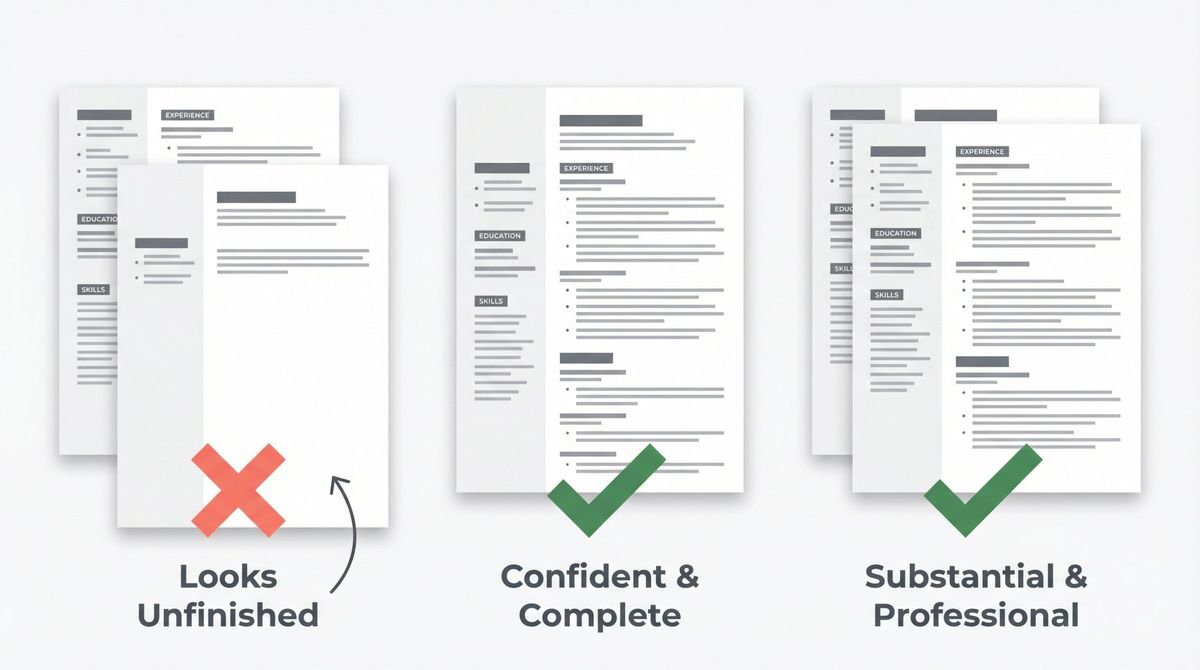
A half-page spill looks unfinished. A full second page with substance looks confident.
How to Structure a 2-Page CV for Maximum Impact
A good 2-page CV still reads like a 1-page CV, because page 1 carries the decision.
Use this layout logic:
Page 1 = "Hire Me" Proof
• Headline/summary (2-3 lines, laser-targeted to the role)
• Key skills (only those directly relevant to this job)
• Most relevant experience first (and your strongest bullets at the top)
• 1-2 standout wins with numbers (results recruiters can't ignore)
Oxford careers service even suggests a brutal test: scan down the left side quickly and see if your strongest responsibilities and achievements jump out.
If page 1 doesn't make someone think "I need to interview this person," your structure is wrong.
Need help crafting a compelling professional summary? Our Resume Summary Generator creates targeted summaries that hook recruiters from line one.
Page 2 = Supporting Proof
• Additional relevant roles
• Earlier experience (compressed to 1-2 lines if needed)
• Certifications and publications (if relevant)
• Optional extras that strengthen fit (languages, specialized tools, leadership roles)
If your best content is hiding on page 2, you've structured it backwards.
US Federal Resume Rules (Updated for 2026)
If you apply to US federal roles through USAJOBS, this is critical:
• Resumes may not exceed two pages
• Starting September 27, 2025, USAJOBS restricts all resumes to two pages
• OPM guidance says agencies should only review resumes that meet the 2-page limit, and if the only resume you submit is longer than two pages, you can be found ineligible
This is a huge deal because federal resumes historically ran long (often 4-5 pages with detailed duty descriptions).
If you're converting a long federal resume into 2 pages:
• Keep only the most role-relevant experience
• Collapse older roles into one-line entries
• Make every bullet competency-aligned (use the same language as the job announcement)
Don't take chances here. The 2-page limit is non-negotiable for federal applications starting late 2025.
Applying for federal positions? Check our guide for Policy Analyst roles.
What Most CV Length Advice Gets Wrong
Let's kill some myths that keep circulating.
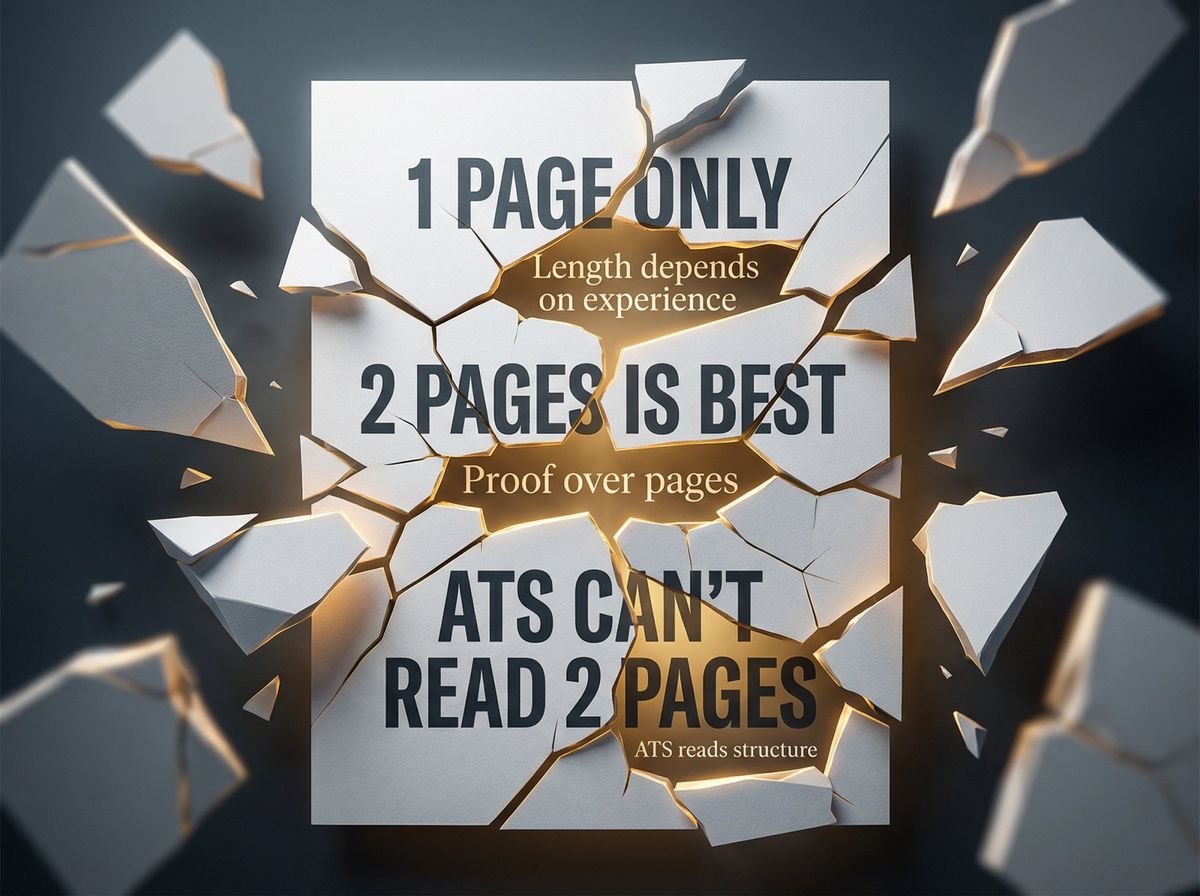
Myth 1: "A CV Must Be 1 Page"
False. Research explicitly says length depends on experience and role.
This myth came from an era of paper resumes and ultra-short attention spans. It's outdated for anyone with substantial experience.
Myth 2: "2 Pages Is Always Better"
Also false. If you can't fill the second page with relevant proof, you've just added noise.
The goal isn't to hit a page count. The goal is to provide exactly enough evidence to prove you're the right candidate. Sometimes that's 1 page. Often it's 2. Rarely it's 3.
Myth 3: "ATS Can't Read 2-Page CVs"
Completely false. ATS systems can parse multi-page documents just fine.
The real risks are:
• Messy formatting (tables within tables, weird columns)
• Text in image boxes
• Unclear section headings
Oxford guidance literally recommends designing for both humans and ATS because ATS use is increasing. Page count isn't the problem. Bad structure is.
Make sure your resume passes ATS screening with AIApply's Resume Scanner. It identifies formatting issues, keyword gaps, and parsing problems before you apply.
What Recruiters Actually Prefer in 2026 (The Data)
If you're worried about what hiring managers want to see, take comfort in recent data.
The Shift Toward 2 Pages
Multiple surveys from 2024-2026 show recruiters are fine with (and often prefer) two-page resumes:
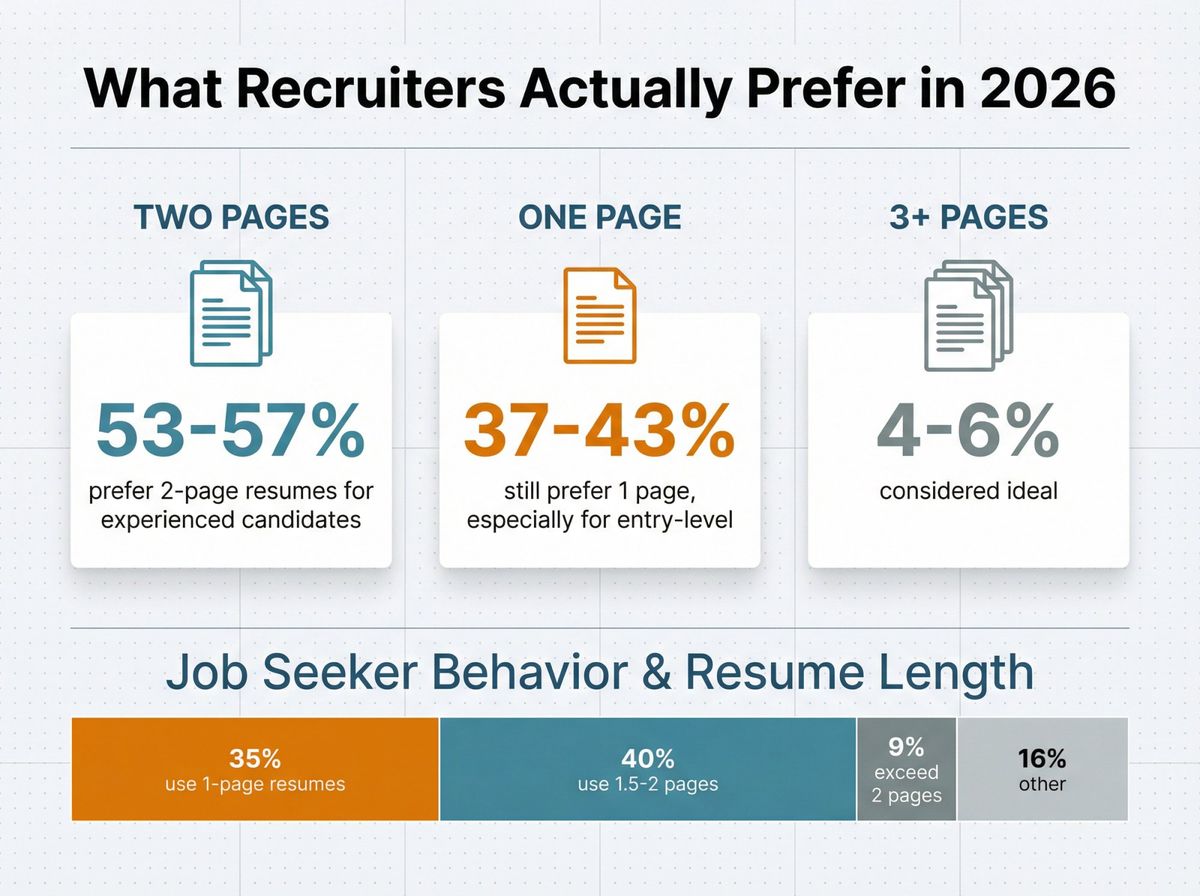
• A 2024 survey found 53% of recruiters now expect a resume to be two pages long, versus 43% who still prefer one page. Only 4% wanted more than two pages.
• Another industry survey reported 57% of recruiters prefer two-page resumes for experienced candidates, compared to 37% who favor one page. Just 6% considered more than two pages ideal.
• Fortune called it the "new normal" in the era of AI-assisted hiring. Two-page resumes have become standard because ATS systems and digital reading make longer submissions easier to handle.
What Job Seekers Are Actually Doing
Recent survey data revealed:
• Only 35% of job seekers now use a single-page resume
• The majority (65%) use longer formats
• Roughly 40% have resumes around 1.5 to 2 pages
• About 9% exceed two pages (still relatively rare)
Translation? The strict one-page rule is dead for most candidates. If you're mid-career or experienced, a 2-page CV is not just acceptable, it's expected by the majority of recruiters.
But Brevity Still Matters
Importantly, a large minority (37-43% depending on the survey) still prefer one page, especially for less experienced applicants.
So the safest approach is:
• If you have relevant content that truly warrants a second page, use it.
• If not, one page is perfectly fine (and will please the recruiters who value brevity).
Tailor length to substance, not to an arbitrary rule.
CV Length FAQs: Your Questions Answered
Is a 2-page CV too long?
Not in the UK for most candidates, and not in the US once you're beyond entry-level, as long as it's all relevant.
UK guidance commonly recommends max 2 pages. Recruiter surveys show 53-57% now expect 2 pages for experienced hires.
The key phrase: as long as it's all relevant. Two pages of strong proof beats one page of cramped text any day.
Should I delete older jobs?
Usually you should compress them, not delete them blindly.
Career guidance suggests dropping detailed work experience older than roughly 10 years to keep the CV concise. You can list older roles in an "Earlier Experience" section with just company name, title, and dates (no bullets).
This keeps your timeline intact without burning space on ancient details.
I'm a student and can't fill a full page. What now?
Don't pad with fluff. Add proof:
• Projects with measurable outcomes
• Internships or volunteer work
• Leadership roles (clubs, student government, organizing events)
• Relevant skills with context (not just a list)
And remember, in the US, undergrads are generally expected to keep it to one page anyway. Boston College career guidance confirms this norm.
One focused page with substance beats a padded page with filler.
For students and recent graduates, check our guides for Entry Level Business Analyst and Graduate Software Developer positions.
Is 1.5 pages okay?
It won't auto-reject you, but it can look unfinished.
A UK-focused career guide recommends 1 or 2 full pages and avoiding half pages.
If you spill onto page 2 with only a few lines, either:
• Trim to a clean 1 page, or
• Add genuinely relevant proof (a project, certification, measurable win) to fill page 2 properly
Don't add fluff to fill space. Add value.
If I go to 2 pages, what must be on page 1?
Your match. Your strongest proof. Your most relevant experience.
Because recruiter data shows page 1 gets the most attention, pack it with your hiring-decision ammunition:
• Headline or summary directly aligned to the role
• Key skills the job description demands
• Your most impressive, relevant roles
• Quantified achievements that prove impact
If someone only reads page 1, they should still think "I need to talk to this person."
What if I genuinely need 3 pages?
First, double-check that assumption. It's rarely true outside of academia or very specific cases.
3 pages might be justified if:
• You're applying for an academic position where publication and teaching lists are expected (Georgetown guidance confirms academic CVs can be 2-10+ pages)
• You're a senior executive with extensive board experience, global roles, and every line on page 3 directly strengthens your candidacy for this specific role
• You're applying to a doctoral programme or senior management role where UK norms explicitly state 3 pages can be appropriate
In all other cases, you can probably trim to 2 pages by compressing older or less relevant details. Many executives manage to distill decades of experience into 2 pages by focusing on the most recent and impactful achievements.
Only go to 3 if you're confident every extra detail strengthens your case and the employer will value it.
For executive-level positions, explore our guides for Chief Financial Officer, Chief Operating Officer, and Chief Marketing Officer roles.
Do different industries have different expectations?
Yes, absolutely.
Tech and finance often lean toward succinct, results-focused resumes (1-2 pages max, often preferring 1 for early-career).
Academic or scientific roles expect comprehensive CVs that can run much longer (publications, grants, teaching history).
Creative industries (design, marketing, writing) might prioritize portfolios over CV length, but still typically stick to 1-2 pages for the CV itself.
Federal government in the US now has a strict 2-page limit for resumes.
When in doubt, research norms for your specific field or ask mentors and recruiters in that industry. But for general corporate applications, 1-2 pages is the universal safe zone.
Browse industry-specific resume guidance:
How do I know if my CV is too long?
Ask yourself these questions:
• Can I summarize my value proposition in the first half of page 1? If not, your structure might be the issue, not length.
• Does every bullet point directly support why I'm right for this role? If some bullets are generic or outdated, cut them.
• Would a recruiter scanning this in 10 seconds see my strongest proof immediately? If important achievements are buried, reorganize.
• Am I listing duties or demonstrating results? Duties take space. Results take less space and deliver more impact.
If you're genuinely unsure, tools like AIApply's Resume Scanner can analyze your CV for relevance, keyword alignment, and formatting issues. Sometimes an outside perspective (even an AI one) spots what you're too close to see.
For additional help, try our Resume Editor to refine content and structure for maximum impact.
CV Length Checklist: Before You Send Your Application
Before you export that PDF, run through this:
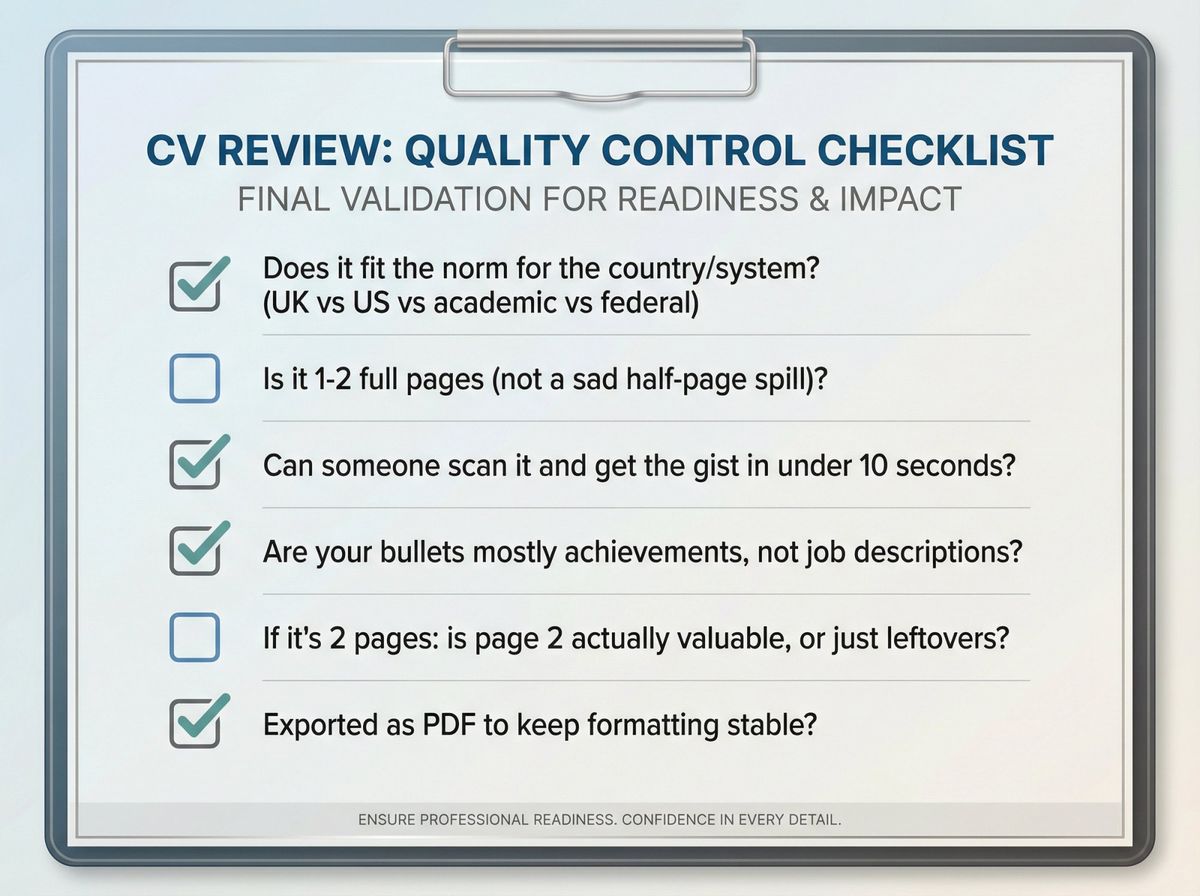
✓ Does it fit the norm for the country/system? (UK vs US vs academic vs federal)
✓ Is it 1-2 full pages (not a sad half-page spill)? If 1.5, either trim to 1 or expand to 2 with real proof.
✓ Can someone scan it and get the gist in under 10 seconds? Oxford recommends aggressive scan-ability testing.
✓ Are your bullets mostly achievements, not job descriptions? Results > duties every time.
✓ If it's 2 pages: is page 2 actually valuable, or just "leftovers"? No filler allowed.
✓ Exported as PDF to keep formatting stable? This is standard practice to prevent formatting disasters when opened by recruiters.
If you can tick all these boxes, your CV length is exactly what it should be: long enough to prove you're qualified, short enough to respect a recruiter's time.
Build Your Perfect-Length CV in Minutes
Stop overthinking page count and start building a resume that actually gets you interviews.
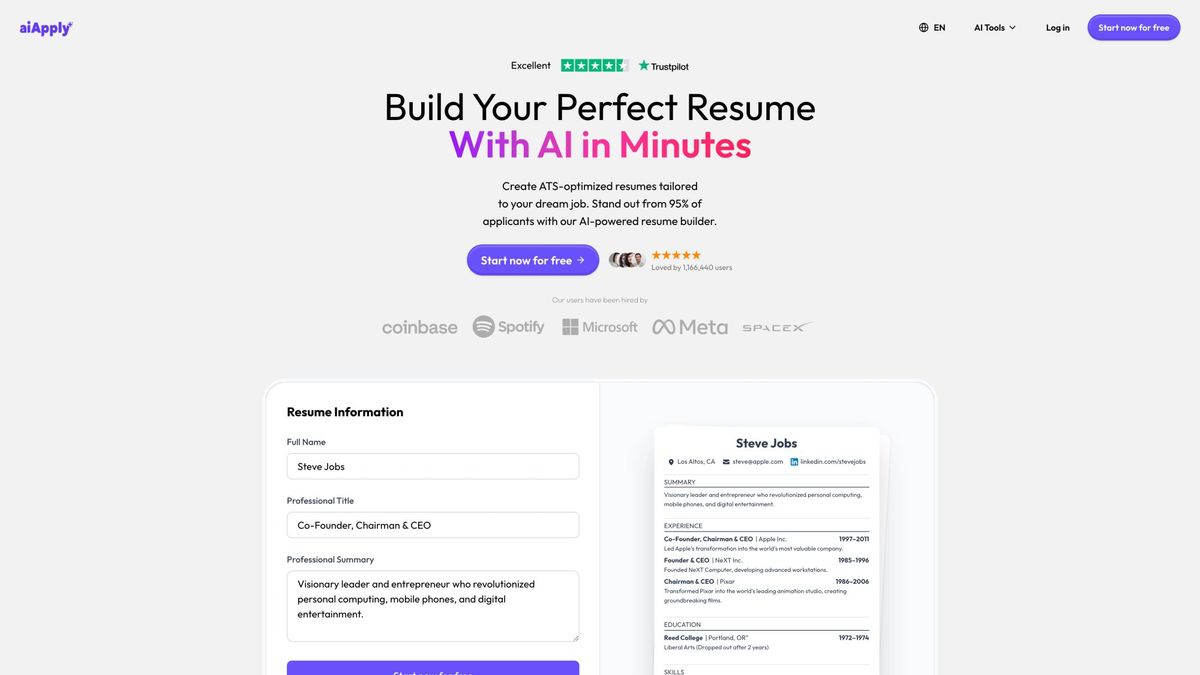
The AIApply Resume Builder handles the heavy lifting - you answer a few questions, and it generates a perfectly formatted CV in under 2 minutes. The interface shows you exactly what recruiters will see, with built-in ATS scoring so you know it'll make it through applicant tracking systems.
Get started with AIApply's complete toolkit:
• Resume Builder - Generate a professional CV in under 2 minutes
• Resume Scanner - Check ATS compatibility and keyword alignment
• Cover Letter Generator - Pair your CV with a compelling cover letter
• Auto Apply - Let AI apply to hundreds of jobs on your behalf
And when you land that interview? Use Interview Buddy to get real-time answer suggestions during video calls.