Should I Apply to Multiple Jobs at the Same Company?
Should you apply to multiple jobs at the same company? Yes, when the roles are related and tailored. Here is the safe range and how to do it right.


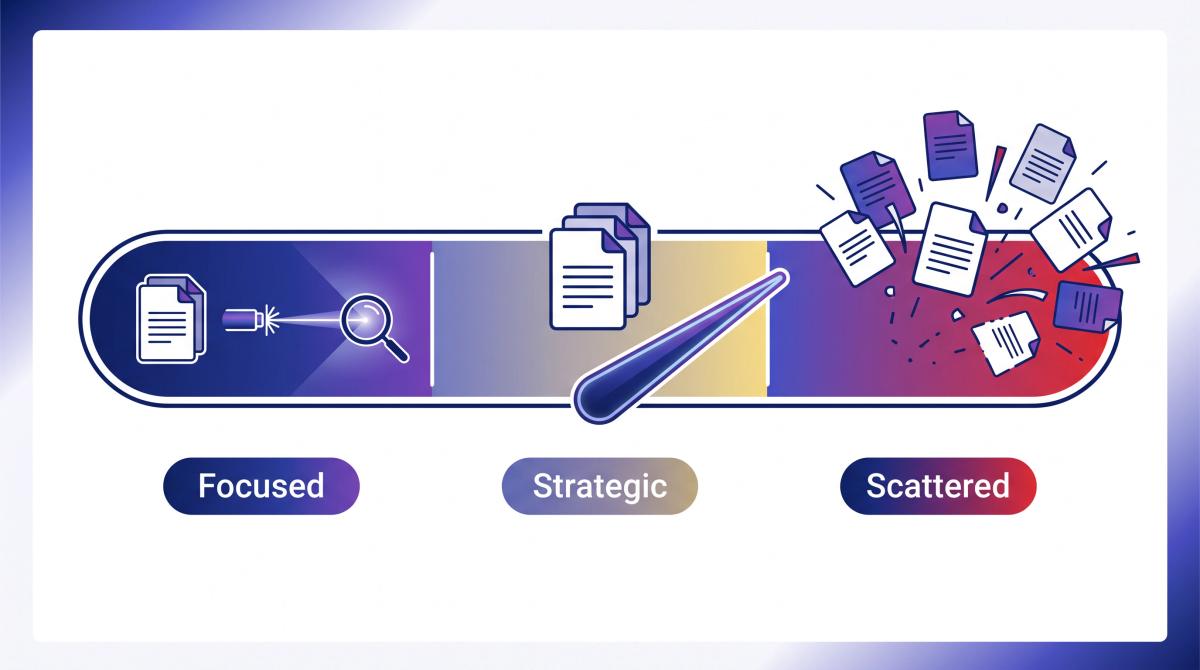
Applying to multiple jobs at the same company is fine, as long as the roles are related and you tailor each application. When the roles have nothing in common, it signals you're unfocused or applying indiscriminately, and that can hurt your chances across every role you submitted.
The part most job seekers miss is that this is never invisible. When you apply to more than one role at the same employer, modern applicant tracking systems often surface that information to the recruiters and hiring managers reviewing your file. Your application history isn't siloed. It's centralized. And that changes what "applying to multiple roles" actually means in practice, especially now that the average job draws 244 applications, up from 116 in 2022, a 111% jump that Greenhouse documented across more than 6,000 companies in its 2026 hiring benchmarks report. When that many people are competing for one opening, a scattered application pattern stands out for the wrong reasons.
At AIApply, we've helped over 800,000 job seekers navigate exactly this kind of decision, including the question of how many applications you actually need to send. The question we see most often isn't really "is it okay to apply to multiple jobs at the same company?" The more useful question is: "If a recruiter looked at every application I submitted here side by side, would my story hold up?"
If the answer is yes, applying to more than one role can actually help your candidacy. If the answer is no, it can make you look scattered, unprepared, or desperate.
This guide covers exactly when it helps, when it backfires, how many roles is too many, and how to do it strategically.
Can Recruiters See Multiple Applications You Submitted?
Don't assume each application goes into a separate, isolated box.
Applicant tracking systems are purpose-built to centralize candidate data. Understanding how online job applications actually work helps clarify what employers can see: your applications don't live in separate folders. They often live in one profile.
Here's what that looks like in practice across the three most common systems:
→ Greenhouse: Its candidate profile centralizes information across all roles. According to Greenhouse's support documentation, hiring teams can view all jobs a candidate is attached to, including applications you may not realize are visible to people outside the original hiring team.
→ Workable: Workable's help documentation explains that when the same email address appears across applications, the system detects them as connected and lists other candidacies (including roles where the viewer isn't part of the hiring team).
→ Greenhouse (duplicate detection): Greenhouse also flags possible duplicate profiles when details like email address, phone number, or LinkedIn profile match, noting this creates extra work and confusion.
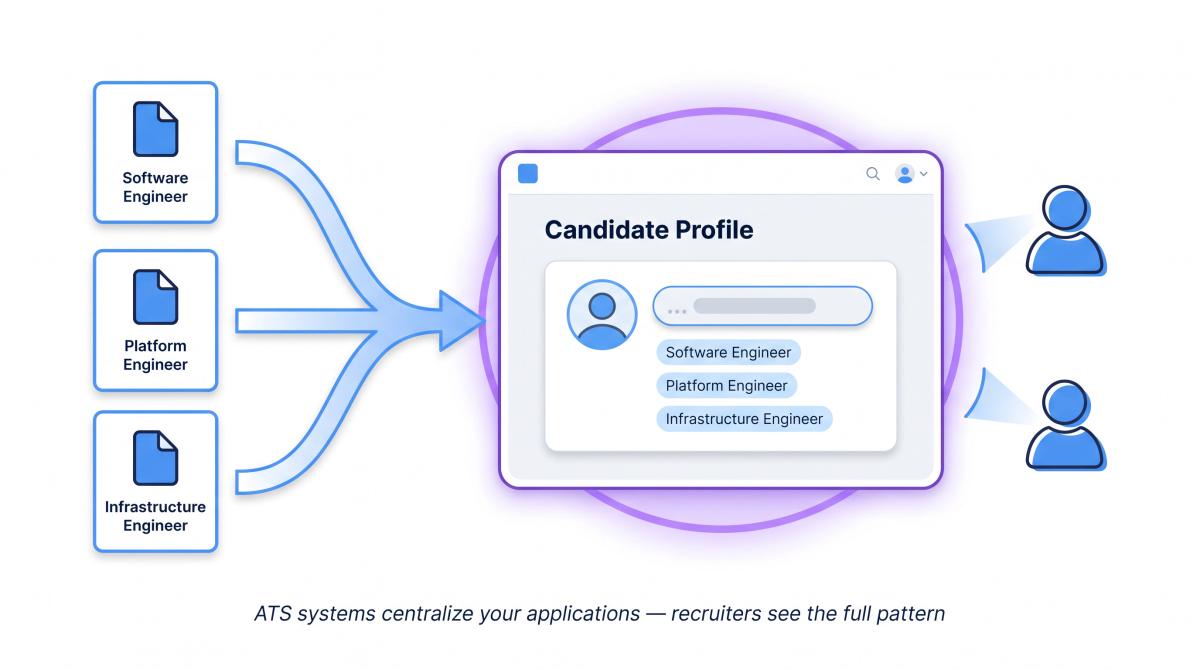
None of this means multiple applications are bad. It means you should apply as if someone will see the full pattern, because they often can.
When Should You Apply to Multiple Jobs at the Same Company?
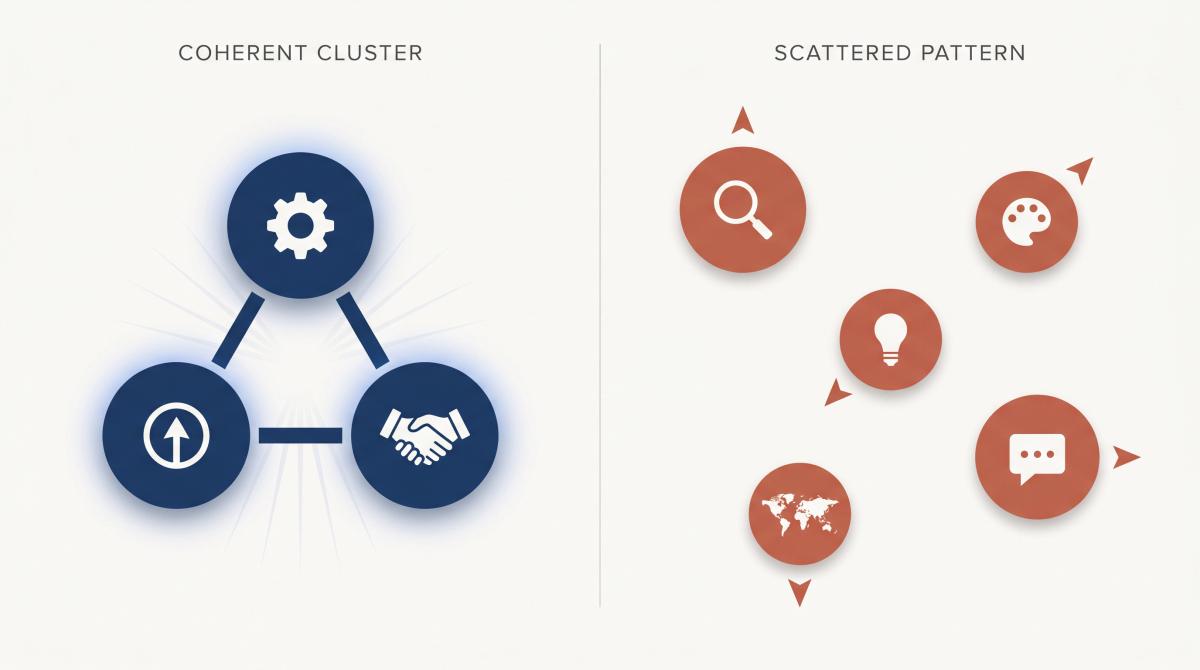
You should apply to multiple jobs at the same company when the roles tell a coherent story about where you want to go. That's when extra applications help rather than hurt.
Good examples of related role clusters:
- A backend engineer applying to backend engineer, platform engineer, and infrastructure engineer roles
- A customer success manager applying to customer success manager and implementation consultant roles
- A data analyst applying to business intelligence analyst and product analyst roles
- A marketing analyst applying to growth analyst and lifecycle marketing analyst roles
- A financial analyst applying to FP&A analyst and revenue operations analyst roles
In each case, the underlying skill set overlaps. A recruiter can see the pattern in about five seconds: "This person is targeting analytical roles in their business/product org" or "This person is a customer-facing SaaS operator who could fit either success or implementation."
That's fine. Harvard's career services FAQ gives the same guidance: applying to more than one division or position is acceptable, but it's in your best interest to tailor materials to each opportunity and demonstrate genuine fit rather than applying indiscriminately.
The key variable is coherence. Not quantity. When you focus on a tight, coherent cluster, your application pattern tells a story, and targeted resume examples show exactly what that looks like in practice.
When Does Applying to Multiple Roles Backfire?
Multiple applications hurt when the roles make you look random.
Consider these examples of what not to do:
- Software engineer, HR coordinator, sales development rep, and office manager
- Junior analyst and director of strategy
- Social media intern and senior product manager
- Five different roles submitted with the exact same generic resume
The problem isn't ambition. It's incoherence. A recruiter doesn't want to guess what you're good at. They want a clear match.
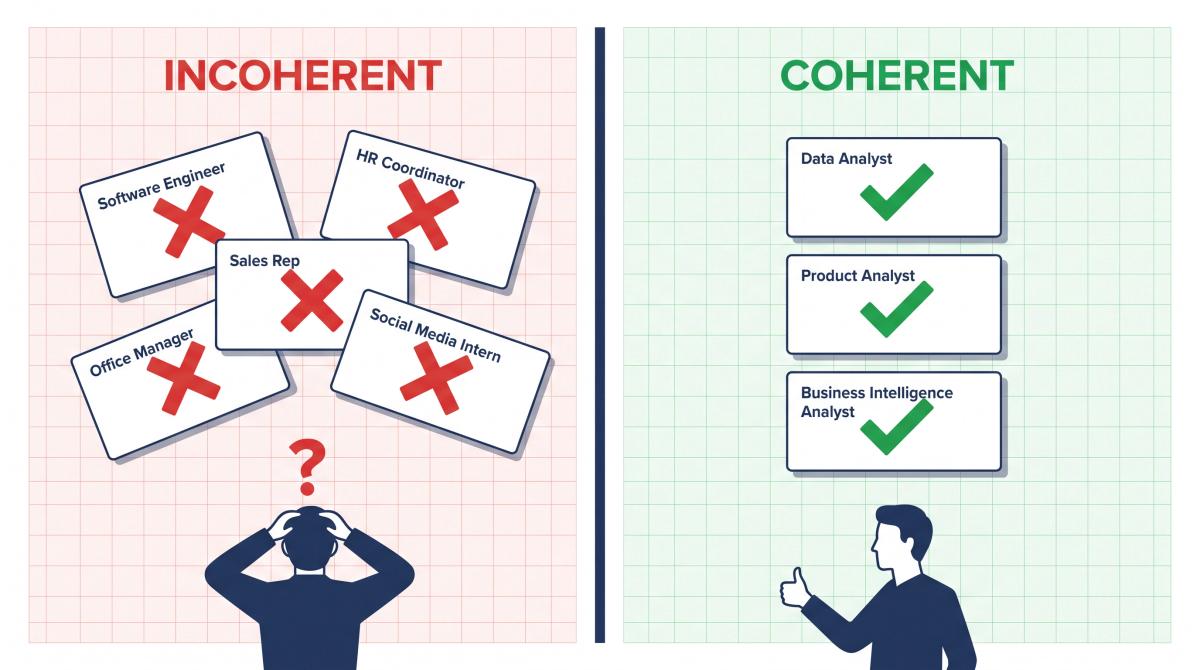
Scattered applications create three problems at once:
1. You look unfocused. The recruiter may conclude you're applying to anything with the company logo on it, not because you're excited about specific roles.
2. You look underprepared. If the roles require different skills and your materials don't adapt, it signals you didn't actually read the job descriptions. The fastest fix is using an AI resume rewriter to adapt each version before you submit.
3. You weaken your strongest application. A well-crafted application to one role can be undermined by weak applications to four others. If a hiring manager asks a colleague "have you heard of this candidate?" and their colleague saw a generic, mismatched application, that's now part of your reputation. Candidates who focus on quality over volume consistently get hired faster.
Career experts make this point directly: applying to roles with a wide range of responsibilities can confuse the hiring manager, and applying to jobs you're not qualified for may actually hurt your chances for the role where you genuinely are qualified.
How to Know If Your Applications Tell a Coherent Story
Before applying to a second or third role at the same company, ask yourself one question:
If a recruiter asked, "why did you apply to all three?" could I answer in one sentence?
If you can't answer cleanly, don't apply yet.
Strong answers:
"I applied to both roles because they sit in customer operations, use the same SaaS implementation background, and both match my experience improving onboarding workflows."
"I applied to the product analyst and business intelligence analyst roles because both use SQL, experimentation, dashboarding, and stakeholder communication. That's exactly what I've been doing for the last three years."
"I applied to two engineering roles because both are backend-heavy and focused on distributed systems. The platform role is my first choice, but the backend product role fits my experience just as well."
Weak answers:
"I just really want to work here."
"I thought applying to more jobs would improve my odds."
"I'm open to anything."
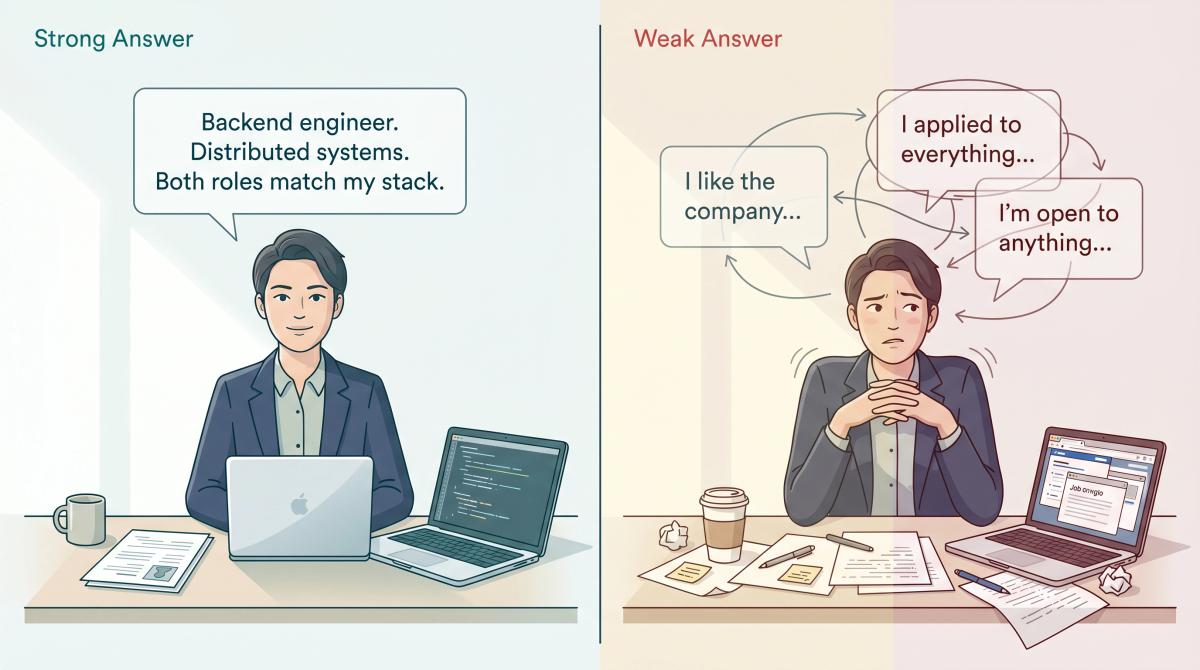
Wanting to work at the company is great. It's just not enough. You still need to show why each specific role fits. A deeper company research process before you apply gives you the specifics to make that case compellingly.
How Many Jobs Should You Apply to at One Company?
For most job seekers, two or three active applications at one company is the practical safe range. There's a reason to keep that number tight: in Greenhouse's 2025 AI in Hiring Report, 34% of recruiters said they spend up to half their week filtering out spam and junk applications. A pile of loosely related submissions from one person is exactly the kind of pattern that gets you sorted into that bucket.
| Number of Roles | How It Typically Reads |
|---|---|
| 1 | Focused |
| 2 | Normal if related |
| 3 | Acceptable if clearly aligned |
| 4 | Needs a strong, specific explanation |
| 5+ | Often reads as unfocused |
| 8+ | Almost always reads as spray-and-pray |
Career experts generally advise that applying to two positions is not a concern, but warn against applying to every available job just to get in somewhere. It also helps to limit stated interest to two or three openings if you're speaking with a hiring manager. For a broader look at application volume strategy, see how many jobs you should apply to per day.
Some companies set explicit limits. Google's careers FAQ states candidates can apply to up to three jobs within a rolling 30-day window and must wait 90 days before reapplying for the same role. Other major employers have similar guidance: applying to multiple roles simultaneously is generally accepted, but their advice consistently points toward roles closely aligned with your skill set.
The guiding principle: apply to the fewest roles needed to maximize your fit. Understanding the best way to apply for jobs will help you appreciate why selectivity consistently beats volume.
How to Choose Which Roles to Apply to at the Same Company
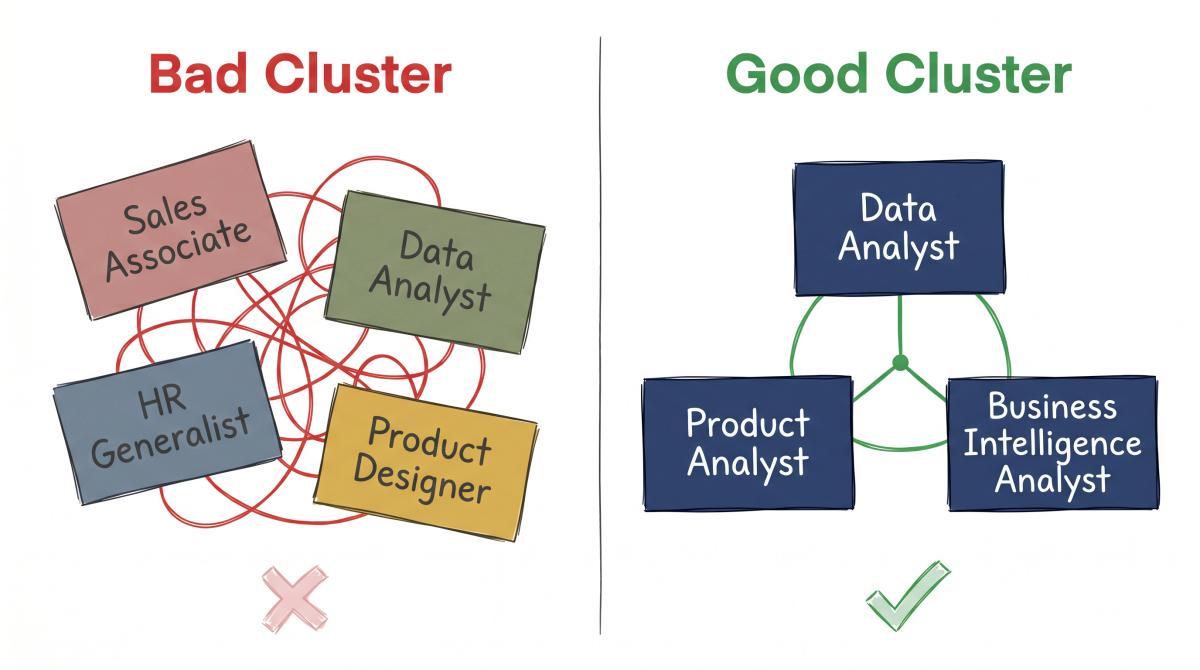
To choose which roles to apply to at the same company, focus on one tight cluster of two or three positions that share the same core skills, career direction, and seniority level. Instead of thinking about individual job titles, think in clusters.
A role cluster is a small group of jobs that share the same core skills, career direction, and seniority level. The goal is to apply to one tight cluster per company.
Here's what that looks like:
Bad cluster (no shared story):
- Sales associate
- Data analyst
- HR generalist
- Product designer
Good cluster (clear story):
- Data analyst
- Product analyst
- Business intelligence analyst
Good cluster (clear story):
- Account executive
- Business development manager
- Partnerships manager
Good cluster (clear story):
- Frontend engineer
- Full stack engineer
- Design systems engineer
If you have multiple possible clusters at the same company, pick the one where your odds are highest. If you're genuinely a strong fit for two different clusters (say, you've done both engineering and product work), pick one for this application cycle. Apply to the other cluster another time, or at a different company first.
To decide which roles within your cluster are worth applying to, score each one before submitting. A role that scores positively across most of these questions is worth submitting; a negative total means it will likely dilute your stronger applications. A job search tracker gives you a structured way to record your scores, compare options, and keep your decisions visible across multiple applications at the same company:
| Question | Yes | No |
|---|---|---|
| Do I meet the must-have requirements? | +2 | -3 |
| Do I meet at least 70-80% of listed qualifications? | +2 | -2 |
| Is this role in the same job family as my target? | +2 | -2 |
| Can I explain why I applied in one sentence? | +2 | -3 |
| Can I tailor my resume with real evidence, not fluff? | +2 | -2 |
| Would I actually accept this role? | +2 | -4 |
| Is it at a sensible seniority level? | +1 | -2 |
A role that scores strongly is worth applying to. A role you're only "kind of interested in" rarely becomes something you're glad you applied to. Reviewing targeted resume examples for each cluster type can help you quickly gauge whether you have the right material to make a credible application.
How to Tailor Your Resume and Cover Letter for Each Role
Using the same resume for every application at the same company is one of the fastest ways to undermine yourself.
Your master resume stays the same, but each version you submit should be calibrated to a specific role. Take this example: you're applying to both a customer success manager role and an implementation consultant role.
Original bullet: "Worked with customers to improve onboarding and reduce support issues."
Better for customer success manager: "Managed onboarding and adoption for 45 B2B accounts, reducing early churn risk by improving customer health tracking and stakeholder follow-up."
Better for implementation consultant: "Led onboarding workflows for 45 B2B customers, translating requirements into launch plans and reducing support escalations through clearer implementation documentation."
Same experience. Different emphasis. That's what tailored actually means. AIApply's AI Resume Rewriter handles exactly this: paste in a job description, and it adapts your bullet points to match the specific role's language and priorities.
AIApply's Resume Builder is built for exactly this. It generates ATS-friendly resumes tailored to each job description, and you can duplicate, tweak, and save multiple versions for different roles in the same company. A practical workflow:
① Build one master resume
② Identify the two or three roles you're targeting
③ Paste each job description into your tailoring workflow
④ Create one version per role, keeping the career story consistent but changing the emphasis
⑤ Run each version through the AI Resume Scanner for ATS keyword gaps
⑥ Save each version with a clear file name (e.g., yourname-product-analyst-may-2026.pdf)
The same principle applies to cover letters. A cover letter for each role should answer: why this company, why this specific role, and why your background. The company-level answer stays consistent. The role-level answer changes.
AIApply's cover letter generator analyzes the job description and your background to create a personalized letter you can edit or regenerate by section. That matters because the worst version of applying to multiple roles is submitting the same cover letter with only the job title swapped. Recruiters catch that quickly.
If you want to see what these role-specific variations look like in practice, ATS-friendly resume templates give you a useful visual reference for each format.
Should You Apply to Multiple Roles at a Small Company?
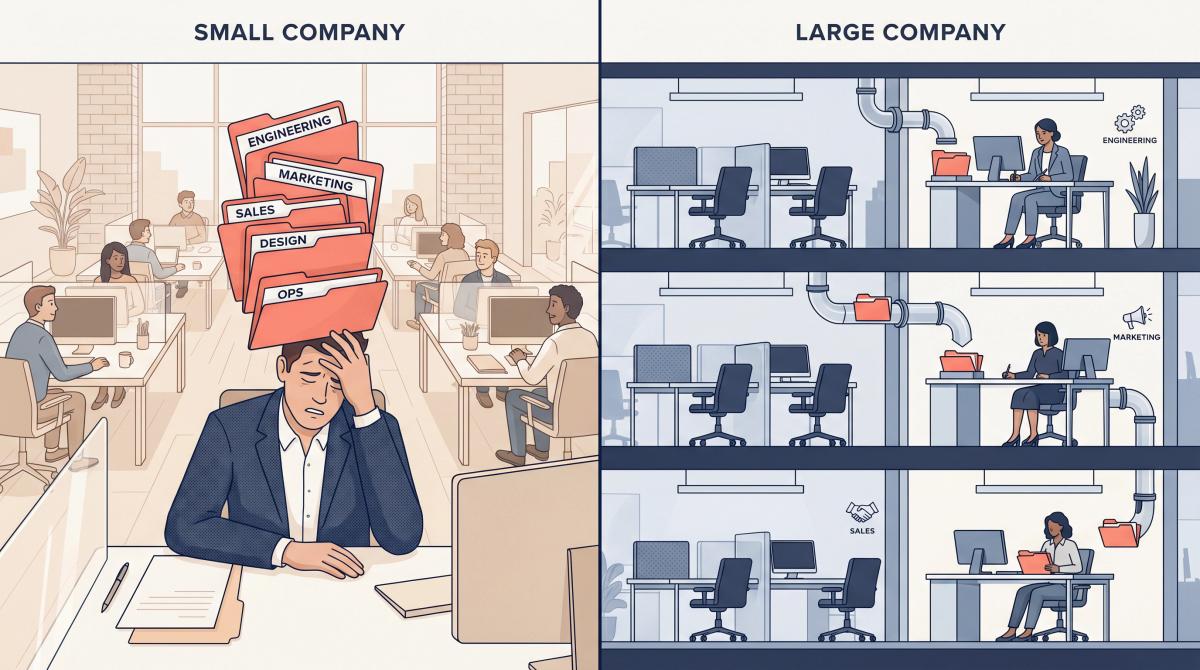
At a small company, be more selective: one or two closely related roles is the ceiling. At a 50-person startup, the same founder, head of talent, or department lead may see every application. Applying to five roles at a small company looks far more chaotic than the same behavior at a 50,000-person enterprise.
| Applications | How It Reads at a Small Company |
|---|---|
| 1 role | Best approach |
| 2 closely related roles | Acceptable |
| 3 roles | Pushing it |
| 4+ roles | Almost always reads as desperate |
A focused message to the hiring manager or a connection at the company often works better than multiple applications at small firms. Here's how to send that message to a hiring manager in a way that lands well.
Should You Apply to Multiple Roles at a Large Company?
Yes, applying to two to four related roles at a large company is usually fine. Large companies often have different recruiters, divisions, and hiring managers, and job titles frequently overlap across teams.
But "big company" doesn't mean "nobody will notice." Greenhouse, Workday, and Workable are all designed to centralize candidate data and support cross-team hiring. Your safe range is just wider:
- 1-3 is normal
- 4 is okay if clearly related
- 5+ only makes sense for the same job family across different teams or locations
Can You Reapply to Another Role After a Rejection at the Same Company?
Yes, a rejection from one role doesn't automatically block you from another, but the right move depends on how far you got and why you were rejected:
| Rejection Type | What to Do |
|---|---|
| Resume rejection for one role | Can apply to a better-fit role |
| Rejected after recruiter screen | Wait unless the new role is clearly different |
| Rejected after final interview | Ask recruiter about future fit before reapplying |
| Failed assessment | Wait and build the relevant skill before applying to similar roles |
| Company-specific cooldown | Follow the company rule. Google requires 90 days before reapplying for the same position |
If you're unsure whether to apply after a rejection, a short, respectful message to the recruiter works: "Thanks again for considering me for the product analyst role. I noticed the business intelligence analyst opening and believe it may be an even closer match to my SQL and reporting experience. Would you recommend applying, or should I wait before pursuing another role with the team?"
Read our guide on how to handle job rejection for a full framework on turning a "no" into a productive next step.
Should a Career Changer Apply to Multiple Roles at the Same Company?
Career changers need to be more careful, not less. When you apply to multiple roles, the recruiter is already working to understand your transition. If your applications point in different directions, you make that harder.
Pick one transition story and stay disciplined.
Harder to justify: a teacher applying to customer success, marketing, HR, operations, and sales
Easier to justify: a teacher applying to customer success, implementation specialist, and training specialist
The second cluster makes sense because teaching experience transfers to onboarding, communication, training, and customer education. That's a coherent story. Transferable skills are what make that story possible, and understanding which ones you have (and how to name them) is the first step for any career changer applying to multiple roles.
For a concrete starting point, sample resumes for career change show how other career changers have framed their transitions across similar role clusters.
Can You Apply to the Same Job in Multiple Locations?
Yes, applying to the same role in different locations (London, Manchester, remote) is generally low-risk, especially when companies require separate applications per requisition. Just be honest: only apply to locations where you can actually work or relocate, and make your location situation clear.
What to Do If You Already Applied to Too Many Jobs There
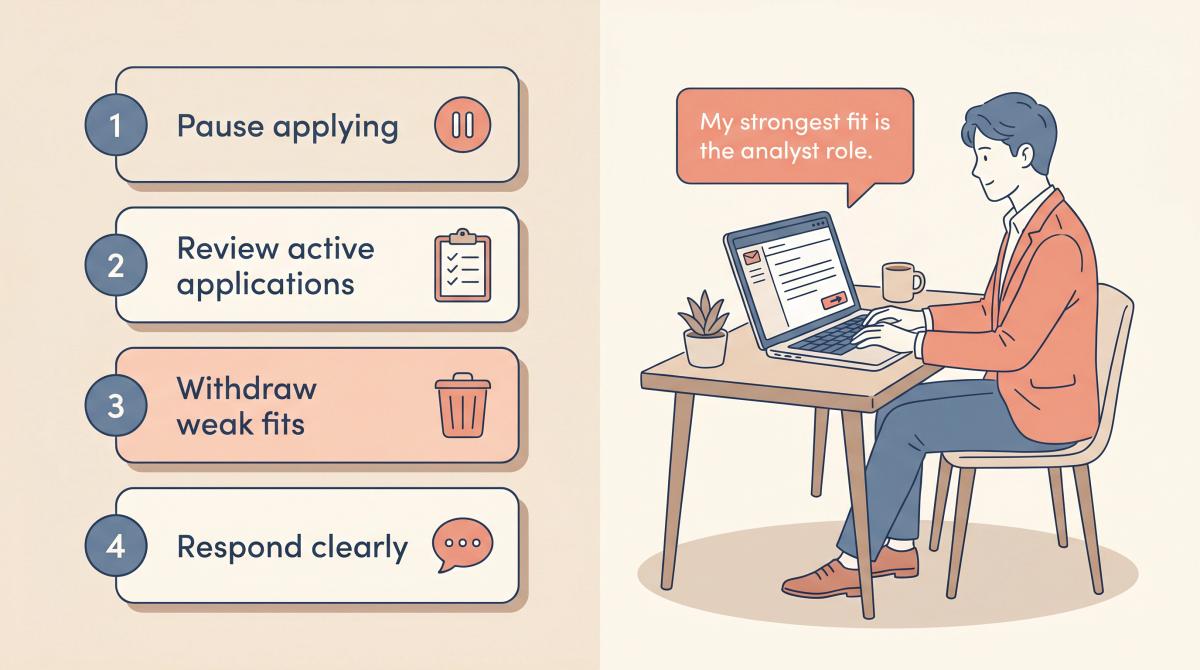
Don't panic. Fix the pattern.
Step 1: Pause applying to that company.
Step 2: Review every active application you have there and assess which ones are genuinely credible.
Step 3: If you applied to something you clearly wouldn't accept, consider withdrawing if the portal allows it.
Step 4: If a recruiter contacts you, be direct. Use something like:
"After reviewing the openings more carefully, my strongest fit is the product analyst role. I'd also submitted interest in a couple of adjacent roles, but product analytics is where my experience and interests are most aligned."
That's honest, and it turns a messy pattern into a clearer one. What doesn't help: "I applied everywhere because I really need a job." Even if that's true, it doesn't move your candidacy forward. A clear job search strategy going forward will prevent this situation from happening at the next company.
Common Mistakes When Applying to Multiple Jobs at a Company
Applying to every open position. Wanting to work at the company doesn't mean you're qualified for everything they're hiring for. Applying broadly signals desperation, not enthusiasm.
Submitting the same resume everywhere. If three hiring managers compare notes and see the same generic document with no role-specific tailoring, you lose credibility across all three. The discipline required here is exactly what resume optimization techniques are designed to build.
Using different email addresses to disguise applications. This is a bad idea. Greenhouse specifically notes that duplicate applications create confusion and extra work for hiring teams. If it's discovered, it looks worse than the underlying pattern you were trying to hide.
→ Applying across very different seniority levels. A one-level spread (senior analyst and analytics manager) is fine. A three-level spread signals you don't understand your own level. Applying to associate, manager, and director roles at the same company is the kind of pattern that quietly closes doors.
→ Not knowing your first-choice role. If a recruiter asks which role you prefer, "I'd be happy with anything" doesn't land well. It sounds like flexibility, but it reads as unfocused. Know your first choice and be able to say why.
→ Ignoring job IDs and posting details. Large companies often have multiple requisitions for titles that sound identical. A job search tracker lets you save the job ID, full job description, application date, and recruiter name for every submission. Postings disappear fast, and you'll need that information if you're contacted.
Skipping the careers FAQ. Some companies have explicit limits or cooldown rules. Google's three-in-30-days rule is a well-known example. Violating it doesn't help.
Step-by-Step Plan for Applying to Multiple Roles
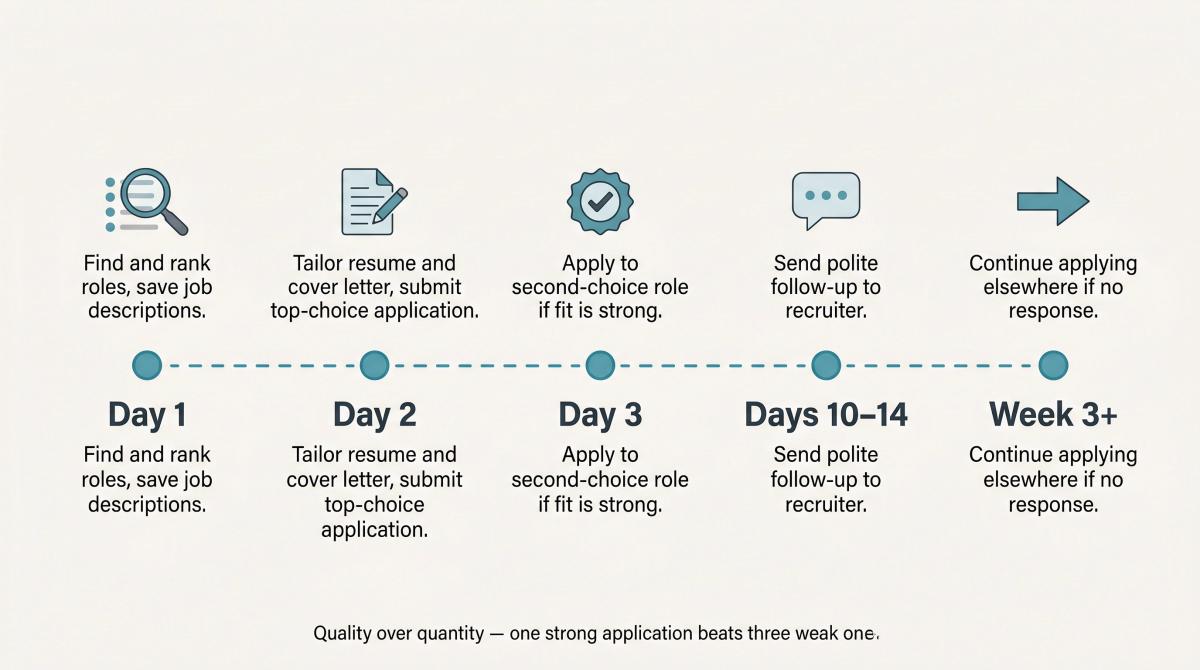
If you're about to apply to multiple roles at the same company, here's a clean framework:
Day 1 Find all relevant roles. Save the full job descriptions. Check the company's careers FAQ for any application limits or rules. Rank the roles by fit using the scoring criteria above.
Day 2 Tailor your resume for your top-choice role. Write or generate a tailored cover letter. Apply. Don't rush the second application yet.
Day 3 Tailor your resume for your second-choice role (if it genuinely scored well). Apply only if the fit is strong enough to justify the submission.
Days 4-5 If you have a contact, connection, or referral opportunity at the company, reach out with a focused message. Don't ask them to "look at all my applications." Ask about the best-fit role specifically.
Days 10-14 Follow up if you have a recruiter thread or contact. Many candidates who do hear back hear within one to two weeks. A polite follow-up around day 10-14 is appropriate. Review follow-up email templates so your message reads as professional and confident, not anxious.
Week 3+ If there's no response, keep applying to other companies. Don't pause your entire job search for one employer.
Throughout all of this, track everything: company, role title, job ID, application date, resume version, cover letter version, recruiter name, status, and follow-up date. When you're applying to multiple roles at the same company, organization prevents embarrassing mistakes (like referencing the wrong role in an interview). The job search tracker we recommend keeps all of this in one place.
AIApply's Auto Apply can automate applications at volume, but for a company you deeply care about, set narrow preferences. For targeted companies, the strategic approach beats the shotgun approach. Recall the numbers from earlier: according to Greenhouse's 2026 hiring benchmarks, applications per job rose from 116 in 2022 to 244 in 2025 (a 111% increase), while the average number of recruiters per organization fell from 10.43 in 2022 to 4.62 in 2025 (a 56% decline). Fewer recruiters are reviewing more applications, so in Greenhouse's 2025 AI in Hiring Report, 34% of them said they spend up to half their week filtering out spam and junk applications. Quality has never mattered more relative to volume.
Greenhouse's co-founder noted that candidates are generally shown in the order they come in, which means applying early still helps. But quality matters more than speed. The best day to apply for jobs matters less than the quality of what you submit, but early timing within a strong application still gives you an edge.
The priority order is: strong fit, tailored materials, early enough to be reviewed, not so many submissions that you look random.
Applying to Multiple Jobs at the Same Company: What Actually Works
Applying to multiple jobs at the same company is not bad when the roles are connected, your qualifications are genuine, and your applications are tailored. It becomes a problem when you apply randomly, ignore company limits, use the same materials everywhere, or can't explain your choices.
The recruiter looking at your applications should be able to think: "This person knows exactly where they fit." Not: "This person clicked apply on everything."
At AIApply, we've seen this pattern thousands of times. The job seekers who do this well share two habits: they're intentional about which roles they target, and they customize every application rather than hoping volume alone will work. Our Resume Builder and Cover Letter Generator are built for exactly this kind of multi-role strategy, and Auto Apply can handle the volume once you've identified your strongest targets.
Apply with intention. Tailor everything. Know your first choice. And trust that a smaller number of credible, targeted applications almost always outperforms a larger pile of generic ones.
Frequently Asked Questions
Is It Bad to Apply to Two Jobs at the Same Company?
No, applying to two jobs at the same company is generally fine. If both roles are related to your background and you've tailored your materials for each role, it can even strengthen your candidacy by showing flexibility across connected skill sets. The key is coherence: a recruiter should be able to see why both roles make sense for someone with your background.
Is Applying to Three Jobs at the Same Company Too Many?
Three applications can be fine at a large company if all three roles are clearly connected. For example, a data analyst applying to data analyst, product analyst, and business intelligence analyst roles at the same company makes sense. Three unrelated roles (say, software engineer, HR coordinator, and sales associate) is a different situation entirely and usually backfires.
Can Recruiters Actually See That I Applied to Multiple Jobs?
Often, yes. Many ATS platforms centralize candidate information. Greenhouse's documentation shows that hiring teams can view all jobs attached to a candidate profile. Workable detects multiple applications from the same email address and lists other candidacies. Exact visibility depends on the company's ATS configuration, but the safest assumption is that your full application pattern can be seen. Using AIApply's AI Resume Scanner to optimize each version ensures that when recruiters do see your applications, every one is as strong as possible.
Should I Tell the Recruiter I Applied to Multiple Roles?
You don't need to announce it upfront, but don't hide it if asked. Mention it when the roles are very similar, when the same recruiter is likely handling both, or when your cover letter needs context to avoid confusion. A useful approach: briefly acknowledge the overlap and clarify your first choice, for example: "I also applied to the implementation consultant role because both positions sit at the intersection of customer onboarding and process improvement, but customer success is my strongest match."
Should I Use the Same Resume for Different Roles at the Same Company?
No. Use the same master resume as a foundation, but tailor each version to the specific role. The job descriptions will have different language, priorities, and proof points. If one role emphasizes stakeholder management and another emphasizes SQL, your resume should reflect those differences. AIApply's Resume Builder lets you duplicate a master resume, customize it for each role, and run each version against the job description in minutes. Submitting identical materials to multiple roles at the same company is one of the most common ways candidates undermine their own applications.
Should I Apply to the Same Job Again After Being Rejected?
Generally not right away. Many companies have specific cooldown rules: Google requires candidates to wait 90 days before reapplying for the same position. For different roles after a rejection, it depends on why you were rejected. A resume rejection for a slightly wrong role doesn't preclude applying to a better-fit one. A rejection after a failed technical assessment usually means waiting and building the relevant skill first.
Does Applying Early Matter When I'm Applying to Multiple Roles?
Yes, but it's not the main thing. Greenhouse's co-founder has noted that candidates are generally shown in the order they come in, so early applications get reviewed before later ones. See our guide on the best day to apply for jobs for a breakdown of timing patterns that actually move the needle. A poorly tailored application submitted early won't outperform a well-tailored one submitted a day later. The priority order is: strong fit first, tailored materials second, early submission third.
What If I Don't Know Which Role Fits Me Best?
Don't apply yet. Compare the job descriptions side by side, score them against your background using criteria like must-haves met, qualification overlap, and role seniority alignment. If you still can't rank them, that's often a signal you need more information, either from someone in your network at the company or from a closer read of each job description. Applying before you can articulate your fit rarely produces good outcomes.
What If the Company Is Very Small?
Be more selective. At a startup or small company, the same person may be reviewing every application. Two closely related applications might be fine; three or more usually looks chaotic. At a small company, a focused message to the founder or hiring manager explaining exactly why you're interested in one specific role often works better than submitting multiple applications through the careers portal.
Can AI Help Me Apply to Multiple Roles Without Looking Generic?
Yes, if you use it for tailoring rather than for blasting. AI tools can help you adapt your resume and cover letter to each specific job description, identify keyword gaps against ATS requirements, and prepare you for recruiter questions about why you applied to multiple roles. AIApply does exactly that: the Resume Builder, Cover Letter Generator, and Auto Apply work together to let you apply at volume without sacrificing the personalization that actually gets responses. The goal isn't more submissions. It's more credible submissions. Transferable skills also play a key role when you're applying across slightly different roles, and understanding yours is what makes each application ring true.