How Many Jobs Is Too Many on a Resume? (2026 Guide)
Wondering how many jobs to list on your resume? Learn practical cut-off rules, ATS-safe compression tactics, and when to summarize older roles.


If you're googling this question right now, you're probably dealing with one of these problems:
You've had a lot of roles (short stints, contracts, layoffs, internships, side gigs) and you don't want your resume to scream "unstable."
Or maybe your resume is turning into an autobiography, running out of space, and you're not sure what to cut.
Or you're worried that deleting older jobs will hurt you in Applicant Tracking Systems (ATS) because, yes, software screens you before humans do.
This guide gives you clear rules, a decision framework, and plug-and-play formatting so you can keep the signal and delete the noise.
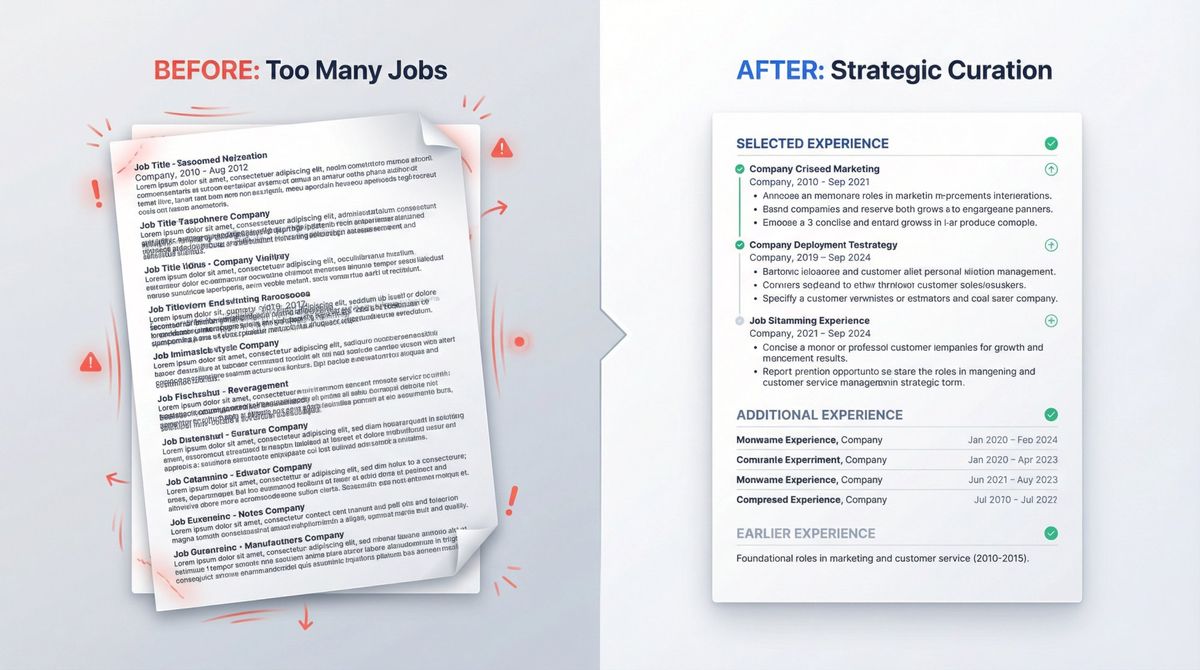
What Makes a Resume Look Like Too Many Jobs?
Too many jobs on a resume isn't a number. It's when one of these things happens:
Your resume stops being skimmable. The good stuff gets buried under repetitive or irrelevant roles, and recruiters can't quickly see why you're qualified.
Your job history creates an unwanted story. For example, repeated short stints with no context makes people assume you can't hold a job, even if every exit was involuntary.
You can't fit the relevant proof into the expected length. You start shrinking fonts, cramming margins, and cutting important achievements just to fit everything on two pages.
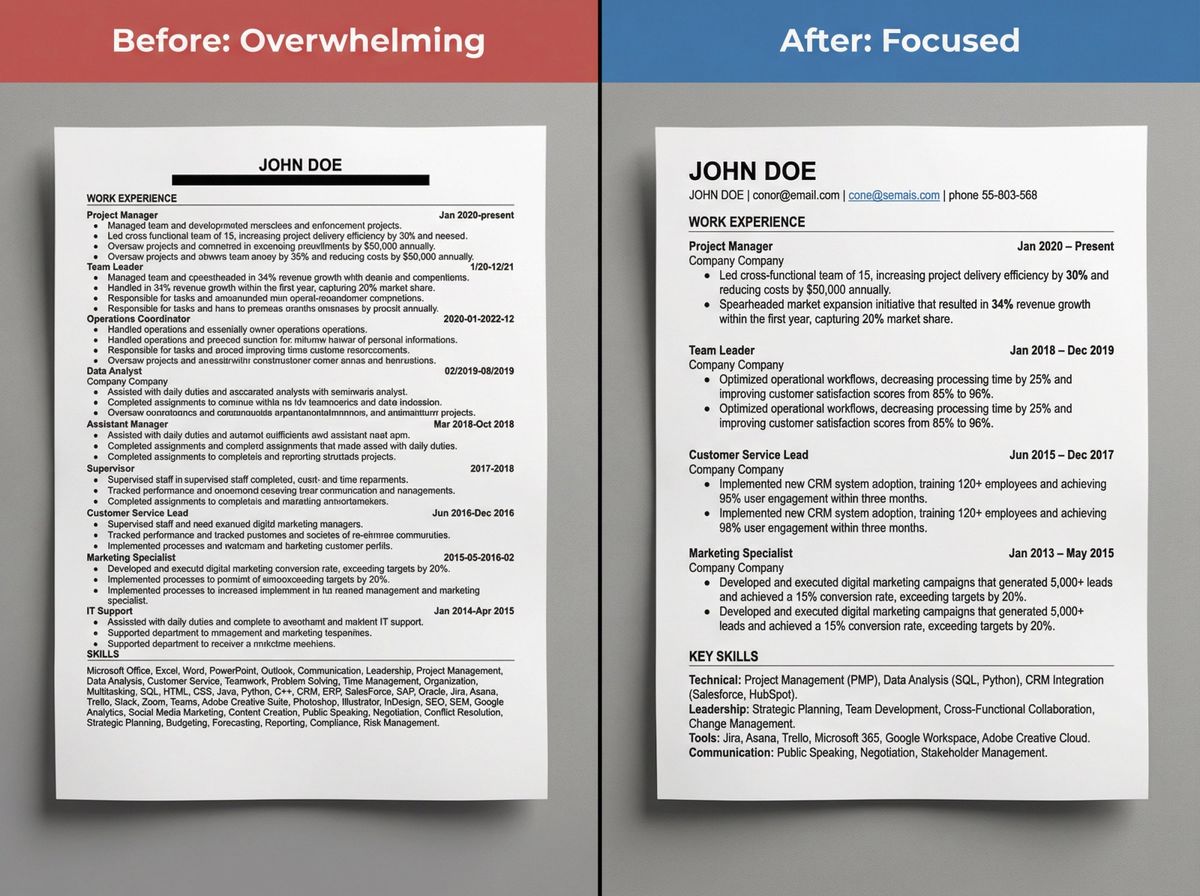
The resume isn't your complete employment record. It's a targeted sales page for one specific job. That mindset shift changes everything.
What Determines How Many Jobs You Can List on a Resume?
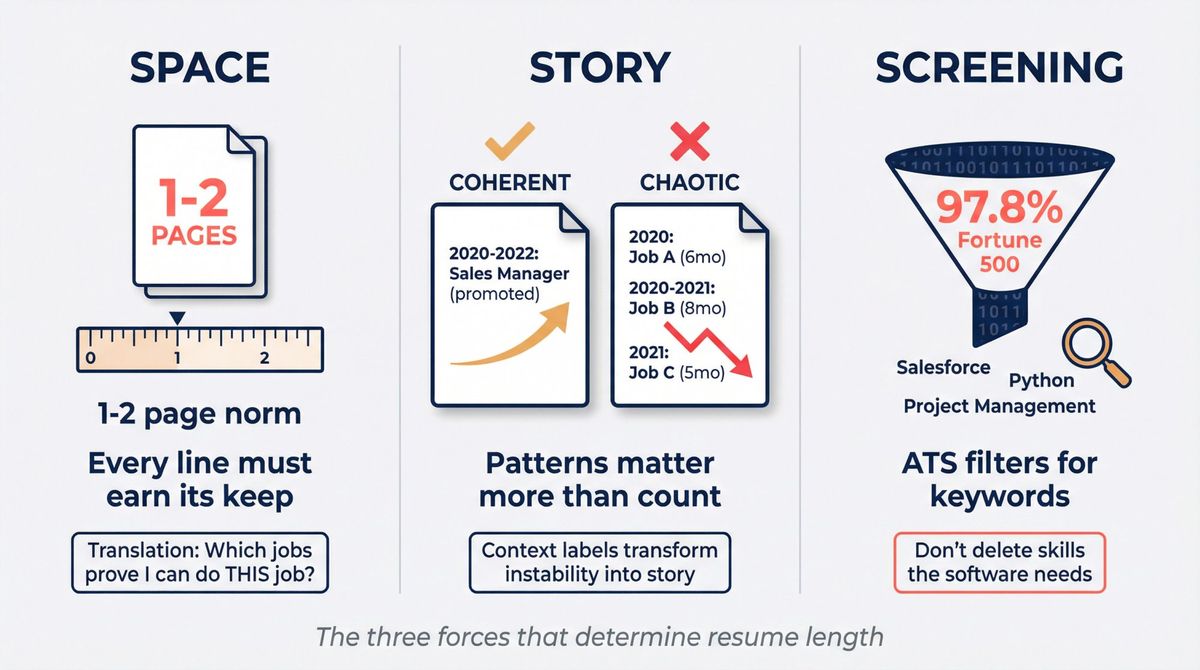
Space: Length Expectations Still Exist in 2026
For most roles, 1-2 pages is still the practical norm. Once you go longer, every extra line needs to earn its keep.
Research from Indeed emphasizes keeping resumes to 1-2 pages and trimming older or less relevant roles. In the UK, CV expectations are often framed as no longer than two A4 pages (with exceptions like academic CVs), according to guidance from Prospects.
Translation: If you have 12 jobs but only space for 6, the question isn't "is 12 bad?" It's "which 6 prove I can do this job?"
Story: Patterns Matter More Than Count
Two resumes can both list 9 jobs. One reads like steady growth plus intentional moves. The other reads like repeat exits with no explanation.
Same number. Totally different signal.
The pattern you create matters more than the raw count. Context labels like "contract," "laid off," or "company shutdown" can turn what looks like instability into a coherent story.
Screening: ATS Is Real, So Don't Delete Your Keywords Accidentally
Industry analysis shows an ATS was detected for 97.8% of Fortune 500 companies in 2025.
Translation: You can't "just keep it short" if short means you removed the exact skills the software is filtering for. If your target job requires experience with Salesforce and your Salesforce Administrator role is the one you cut, you might not make it past the first screen.
How Far Back Should a Resume Go in 2026?
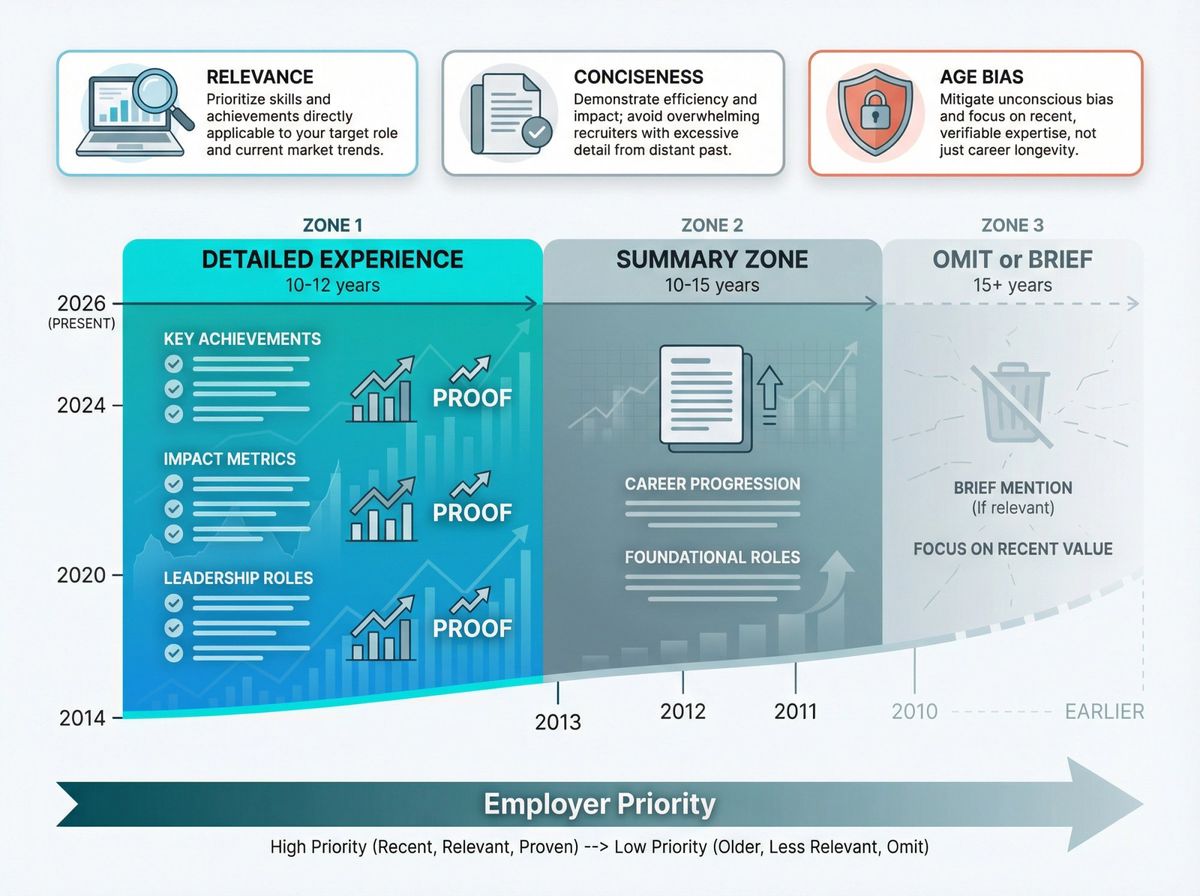
Most candidates should anchor their resume to a 10-15 year window, with older roles either summarized or omitted unless they're uniquely relevant.
Updated guidance from Indeed states to include no more than about 15 years of experience in many cases. Career experts note the common guideline is 10-15 years, with executives and specialists sometimes stretching farther (often by summarizing early career).
Why this window exists:
Relevance matters most. Generally, experience from more than 15 years ago starts to lose relevance in fast-moving industries. Skills, technologies, or practices from decades past might be outdated. Employers care most about what you've done recently that applies to their needs.
Conciseness keeps you competitive. Sticking to about 15 years helps keep your resume concise and focused. Every additional job uses up precious space, and recruiters only spend seconds scanning. You want every entry to count.
Age bias is real. Unfortunately, age discrimination exists in hiring. Detailing a 30+ year career can inadvertently reveal your age and possibly trigger bias. By focusing on the last decade or so, you emphasize your most current value without dating yourself.
The simple filter:
Last 10-12 years: Detailed bullets with proof, numbers, and outcomes
Older than that: "Earlier experience" summary or delete, unless it's directly job-critical
How Many Jobs Should You List by Career Stage?
Here are ranges that work in practice because they fit the constraints above, not because the universe has a magic number.
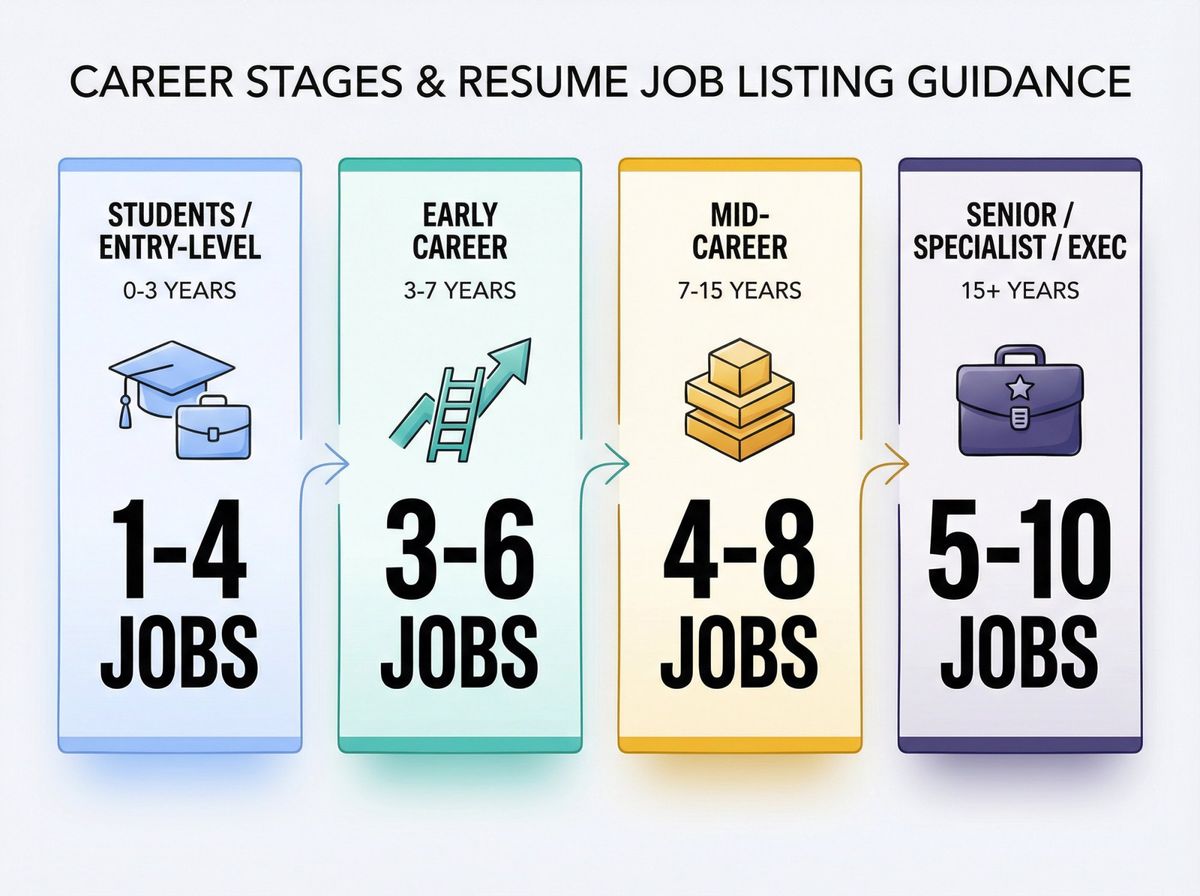
| Career Stage | Years of Experience | Typical Number of Jobs | Notes |
|---|---|---|---|
| Students / Entry-Level | 0-3 years | 1-4 entries | Include internships, projects, part-time work only if it proves relevant skills. Keep it tight. |
| Early Career | 3-7 years | 3-6 entries | If you switched jobs a lot early, you're normal. Focus on making it look intentional. |
| Mid-Career | 7-15 years | 4-8 entries, but only 3-5 high-detail | The rest get compressed to title/company/dates. |
| Senior / Specialist / Exec | 15+ years | 5-10 entries with "selected" + "earlier leadership" summary | Senior professionals may show a longer arc (sometimes up to about 20 years) but should taper detail for older roles. |
Bottom line: If your resume is 2 pages and you've got 8 roles with strong proof, that can be perfect. If your resume is 2 pages and you've got 8 roles of pure tasks, that's too many.
Data point: Recent analysis found the average resume, across career levels, listed about 5 jobs total. One-page resumes typically showed around 4 jobs, while two-page executive CVs had about 6 jobs listed on average.
More experience doesn't automatically mean more jobs listed. It means choosing the right ones.
Why Job Hopping Is More Common Now
You're not imagining it. Tenure is shorter than it used to be.
The U.S. Bureau of Labor Statistics reported that median tenure was 3.9 years in January 2024, and 22.2% of wage and salary workers had 12 months or less with their current employer.
The CIPD (UK) published data showing average UK turnover from January 2022 to December 2023 was 34%, and they note the pre-pandemic level of employees with tenure under 12 months was around 16%.
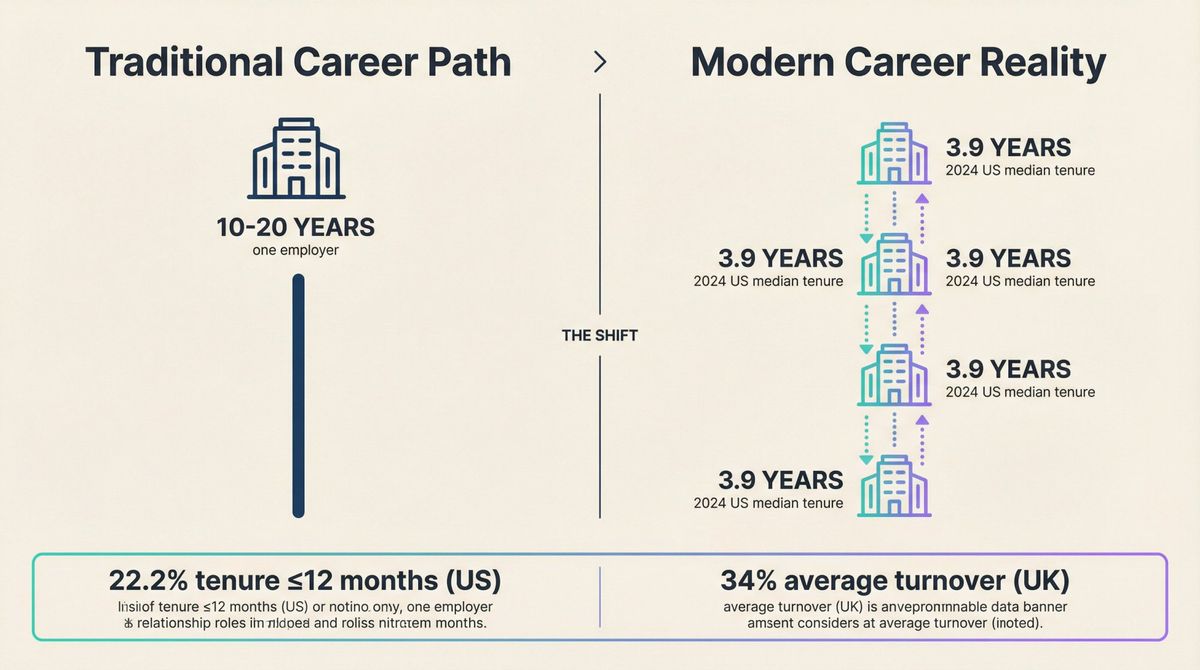
Short stints exist everywhere. Your job is to present them as coherent and low-risk, not to pretend they never happened.
5 Common Situations That Create Too Many Jobs on a Resume
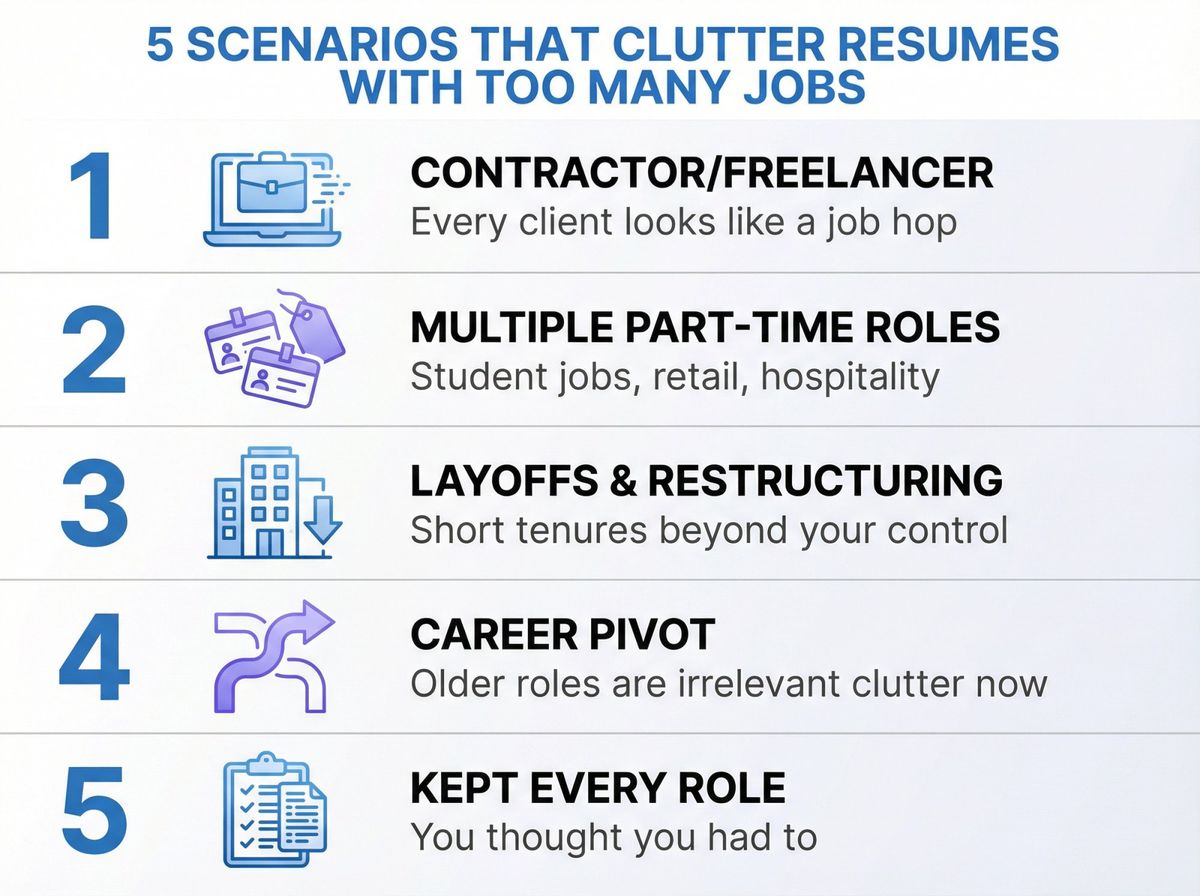
→ You're a contractor or freelancer and every client looks like a job hop
→ You worked multiple part-time roles (student jobs, retail, hospitality)
→ Layoffs or restructuring created short tenures beyond your control
→ You had a career pivot and older roles are irrelevant clutter now
→ You kept every role because you thought you "had to"
The fix depends on which bucket you're in. Let's get into the solutions.
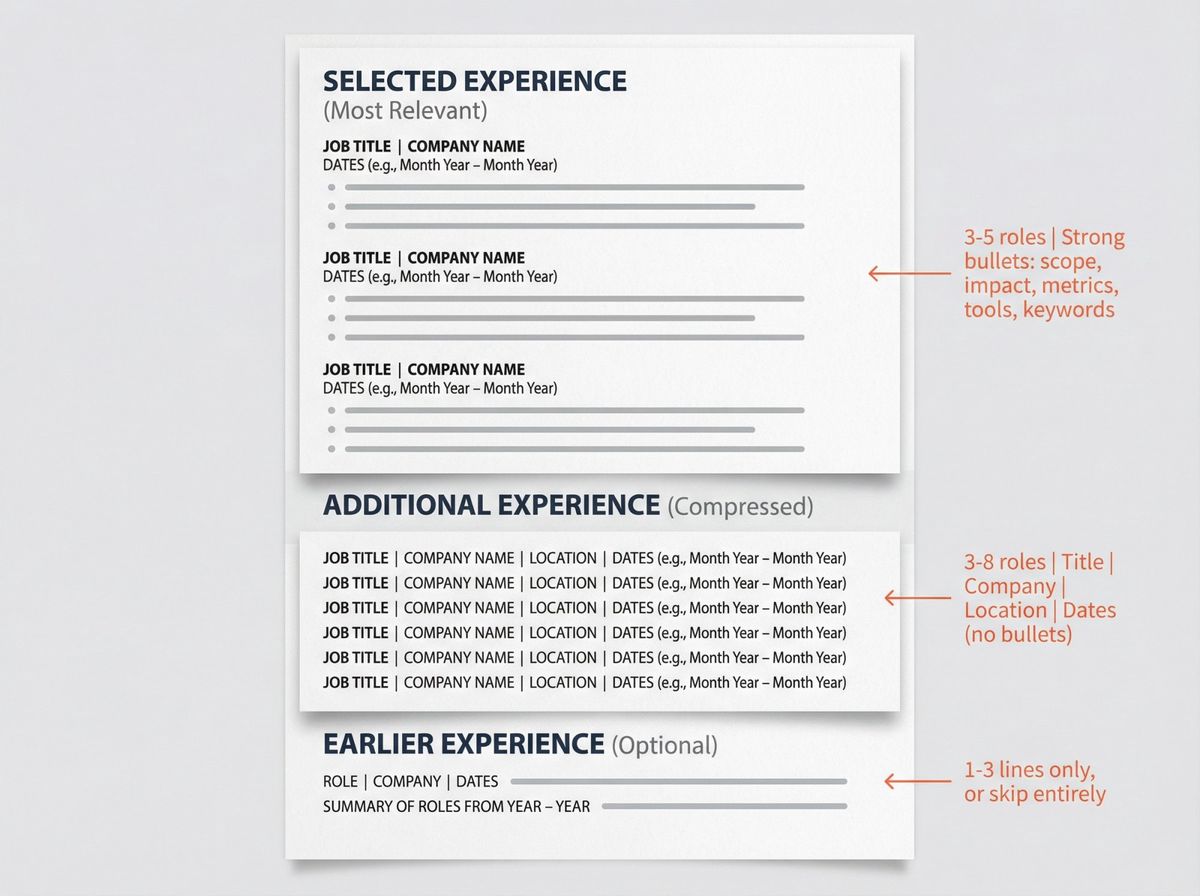
Best Resume Format for Multiple Jobs: Selected Experience Method
This is the single highest-leverage structure if you have lots of jobs.
Structure
SELECTED EXPERIENCE (Most Relevant)
• 3-5 roles
• Strong bullets: scope, impact, metrics, tools, keywords
ADDITIONAL EXPERIENCE (Compressed)
• 3-8 roles
• Title | Company | Location | Dates (no bullets)
EARLIER EXPERIENCE (Optional)
• 1-3 lines only, or skip entirely
Why This Works
Humans see your best proof first. ATS still sees the job titles, companies, and dates (and any keywords you keep in "selected"). You stop wasting space on low-value roles.
This format lets you show a complete timeline without drowning the reader in details about every position you've ever held.
How to List Short Job Stints on a Resume: 9 Strategies
1) Label the Nature of the Role (Contract / Temp / Seasonal)
Short stints look risky when they look like failed full-time jobs.
Do this:
• Product Designer (contract)
• Warehouse Associate (seasonal)
• Marketing Analyst (fixed-term)
This one-word clarification changes the entire perception.
2) Add Micro-Context Only Where Needed
You don't need a paragraph. You need a two-word explanation when the pattern could be misread.
Examples (keep it neutral):
• "Laid off"
• "Contract ended"
• "Company shutdown"
• "Relocated"
Common recommendations from LinkedIn suggest adding brief context near short tenures so the reviewer doesn't invent their own story.
3) Group Multiple Roles at the Same Company
This turns "3 jobs" into "progression."
Format:
Company Name (City)
• Senior Analyst | 2023-2025
• Analyst | 2021-2023
• Associate Analyst | 2020-2021
This approach shows loyalty and growth, not instability.
4) Turn "Many Gigs" Into One Consulting Entry
If you freelanced, don't list 14 clients like 14 employers.
Better:
Independent Consultant | 2022-Present
Selected engagements: Client A (SaaS), Client B (Fintech), Client C (Healthcare)
• Delivered X
• Built Y
• Improved Z
Now it reads like a business, not a job-hopping problem.
5) Stop Writing Responsibilities; Write Proof
Short tenures hurt most when each entry is just "responsible for..." Proof makes the stint feel successful, not suspicious.
Bullet formula: Action + scope + result
Example: "Rebuilt onboarding emails for 12-step funnel; lifted activation by 9% in 6 weeks."
Even a short role can show impact if you frame it right.
6) Remove Repetition Across Roles
If you did the same task in 3 jobs, say it once in the strongest job and compress the others.
No need to list "managed email campaigns" five times.
7) Prioritize Relevance Over Chronology Perfection
If you pivoted careers, your early roles might be irrelevant. Cut hard.
The "10-15 years" idea is framed as a relevance window and suggests summarizing older roles to avoid clutter.
Your resume doesn't need to be a complete timeline. It needs to prove you can do the target job.
8) Don't Hide Gaps With Weird Formatting
Own gaps cleanly, then fill the space with projects, certifications, volunteering, or consulting (if true).
Trying to hide gaps usually backfires. Recruiters notice, and it raises more questions than it answers.
9) If You Must Use a Non-Chronological Format, Do It With Guardrails
A functional resume can help career changers, but it can also make recruiters skeptical and can be harder for ATS to parse.
AIApply's own resume format guide calls this out directly: "ATS struggles" with functional formats, and recruiters may be skeptical.
Safe compromise: Use a combination format with a skills summary up top and clean reverse-chronology underneath.
Always include at least a basic timeline somewhere. Removing dates entirely can backfire because recruiters do want to see when and where you worked.
Which Jobs to Keep on Your Resume and Which to Cut
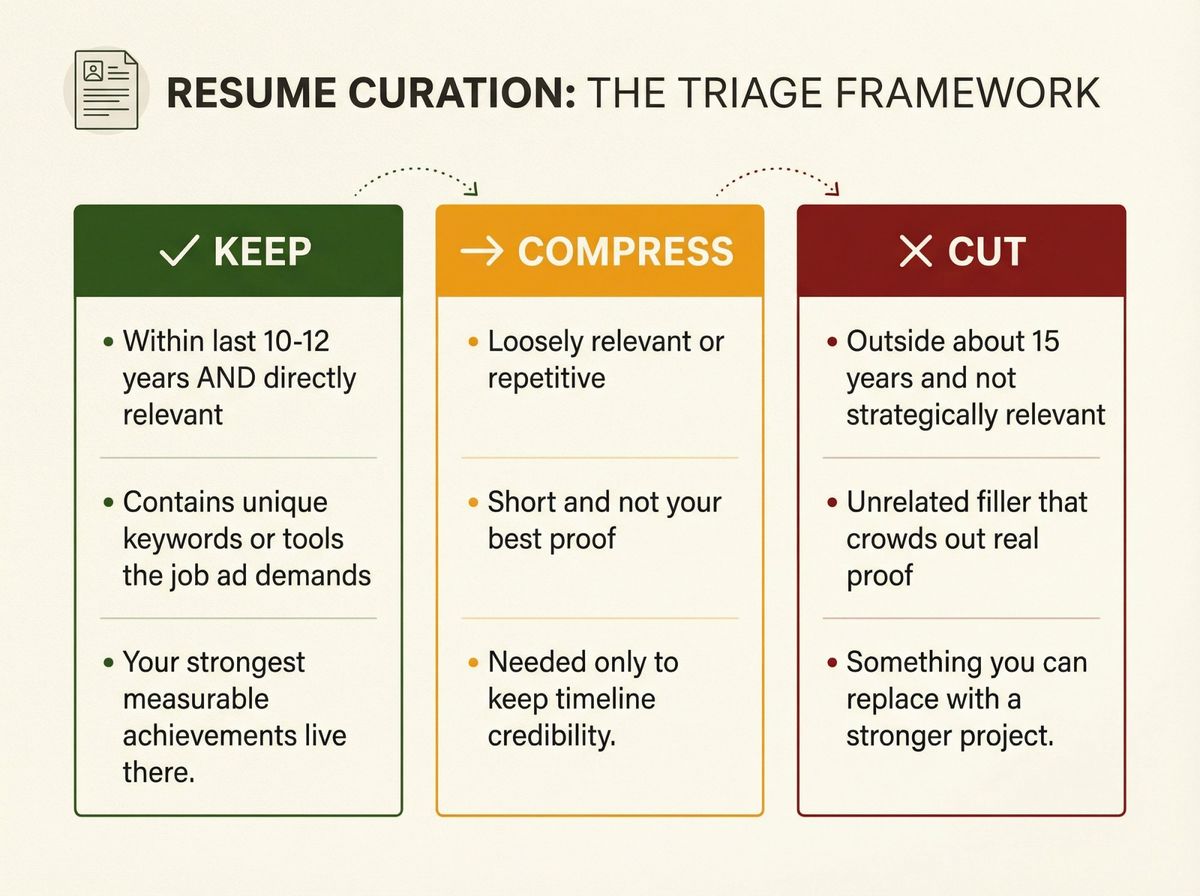
Keep (Full Bullets) If the Job Is:
✓ Within the last 10-12 years AND
✓ Directly relevant to the target role AND/OR
✓ Contains unique keywords or tools the job ad demands AND/OR
✓ Your strongest measurable achievements live there
Compress (Title/Company/Dates Only) If the Job Is:
→ Loosely relevant or repetitive
→ Short and not your best proof
→ Needed only to keep timeline credibility
Cut Completely If the Job Is:
✗ Outside about 15 years and not strategically relevant
✗ Unrelated filler that crowds out real proof
✗ Something you can replace with a stronger project, certification, or portfolio item
Job-count guidance basically reduces to this: keep it relevant, keep it readable, and trim older or less relevant roles to maintain a tight resume.
Resume Examples: Too Many Jobs Done Right
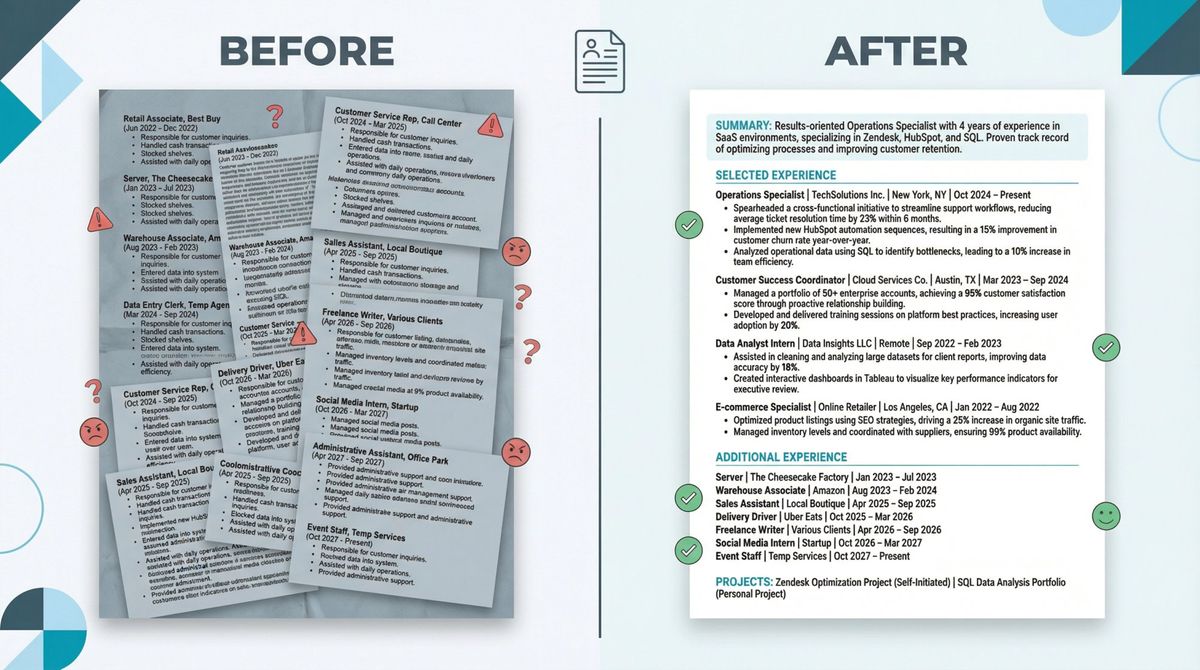
Example 1: 11 Jobs in 6 Years (Realistic Early-Career Chaos)
Before:
11 separate entries, all with 3-5 weak bullets. Looks unstable and unfocused.
After (2 pages, coherent):
• Summary: "Operations specialist; 4 years SaaS; Zendesk, HubSpot, SQL basics; reduced tickets and churn."
• Selected Experience (4 roles): SaaS roles with metrics and keywords
• Additional Experience (7 roles): Retail and seasonal listed with titles and dates only
• Projects: "Automation: Built macros and templates; cut response time by X%"
What changed? Not the truth. The signal.
Example 2: Contractor With 18 Clients
Before:
18 "jobs" with 2-month stints. Instant red flag to any recruiter scanning quickly.
After:
• Independent Consultant (Contract) | 2021-Present
• "Selected clients" list plus 3-5 proof bullets
• Optional appendix or portfolio link outside the resume (if asked)
Now it reads like a business, not a job hop.
Resume Self-Check: Do You Have Too Many Jobs Listed?
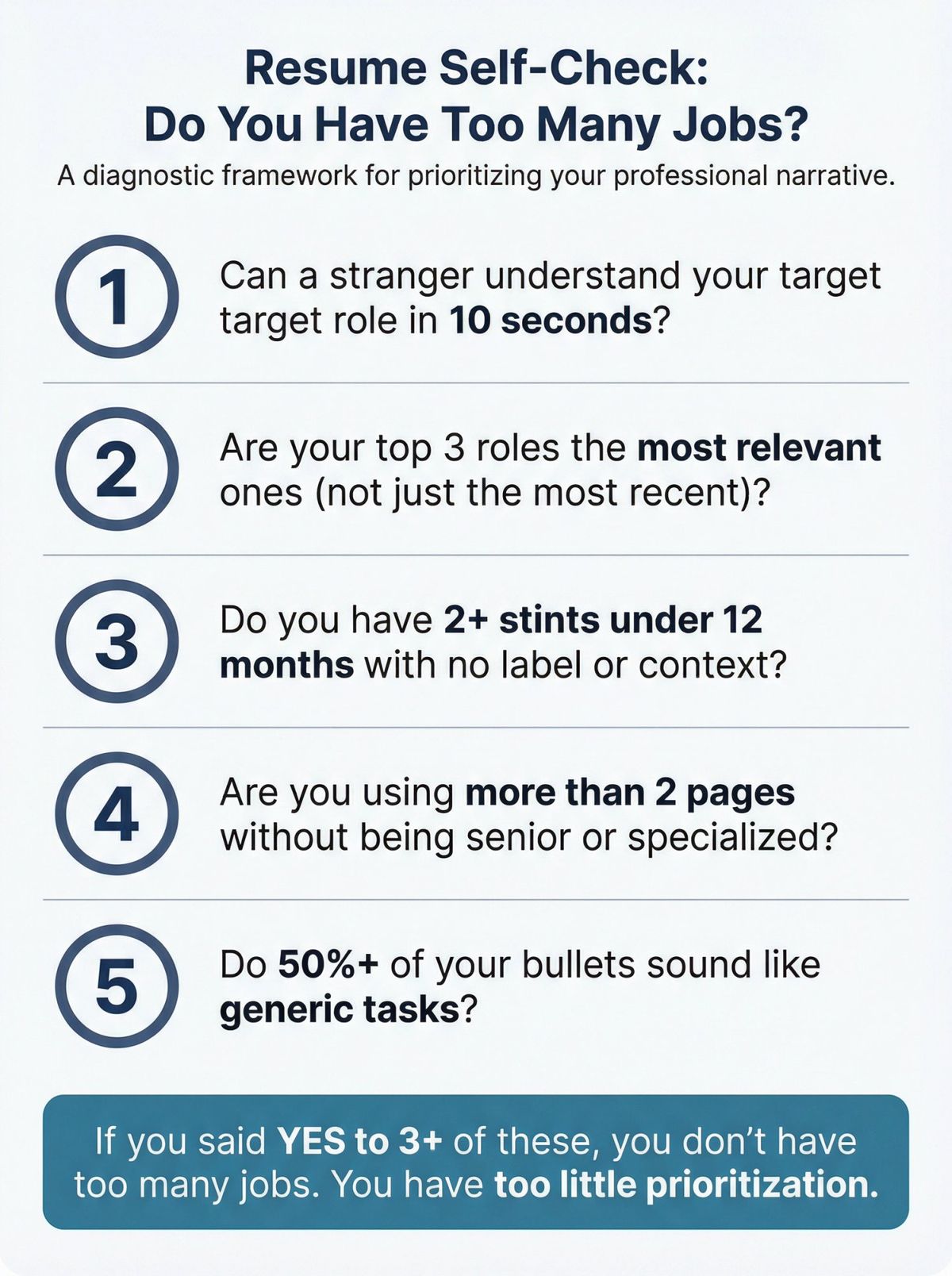
Answer these fast:
① Can a stranger understand your target role in 10 seconds?
② Are your top 3 roles the most relevant ones (not just the most recent)?
③ Do you have 2+ stints under 12 months with no label or context?
④ Are you using more than 2 pages without being senior or specialized?
⑤ Do 50%+ of your bullets sound like generic tasks?
If you said "yes" to 3+ of these, you don't have "too many jobs." You have too little prioritization. That's fixable with formatting and curation, not by magically erasing your work history.
How AIApply Fits (Genuinely Useful)
If you want to fix this quickly without losing ATS keywords:
Create targeted versions fast. Use AIApply's Resume Builder to create a master resume (everything) and then generate targeted versions per role so "selected experience" changes by job ad. This saves hours of manual reformatting.
Explain short stints cleanly. Pair your tailored resume with a job-specific cover letter when you need to explain a short stint or pivot in one clean sentence. AIApply's Cover Letter Generator can help you draft these quickly. Check out examples for specific roles like Account Executive, Marketing Manager, or Software Engineer.
Apply at volume without sacrificing quality. If you're applying at scale, AIApply's Auto Apply workflow is designed to pair tailored docs with faster submissions, so you don't have to choose between customization and velocity.
Choose the right format. If you're unsure which resume format best fits your situation (chronological vs functional vs combination), AIApply's resume format guide is a solid quick read.
Get role-specific resume examples. Browse targeted templates for positions like Project Manager, Data Analyst, Sales Manager, or Human Resources Manager to see how successful resumes handle multiple jobs.
Understand salary expectations. When deciding which roles to emphasize, research what they typically pay. Check salary data for roles like Business Analyst, Accountant, Product Manager, or Operations Manager.
Build relevant skills. Focus your resume on skills that matter most for your target role. Explore skill guides for positions like Digital Marketing Manager, Financial Analyst, Customer Success Manager, or UX Designer.
We built AIApply specifically for people dealing with complex work histories. The tools handle the technical optimization so you can focus on telling your story.
Frequently Asked Questions
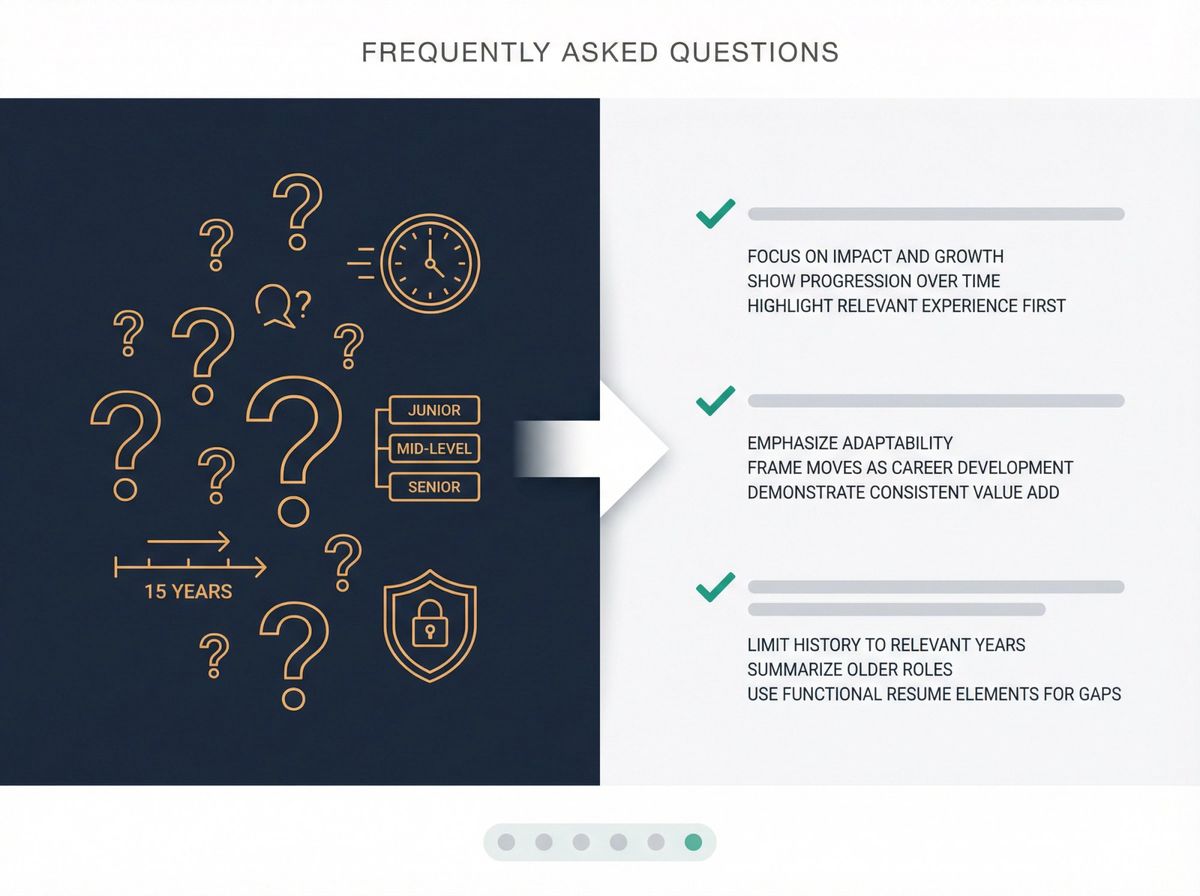
Is it bad to have 10 jobs on a resume?
Not automatically. It's bad if the reader can't quickly see your fit or if the pattern looks like uncontrolled churn. Compress and prioritize. Use the "Selected Experience" + "Additional Experience" structure to show the full timeline without overwhelming the reader.
Should I go back more than 15 years?
Only if it's strategically relevant (senior exec story, rare specialization, or a pivot where older experience is the proof). Otherwise, summarize or cut. Senior professionals may show a longer arc but should taper detail for older roles.
What if I'm worried cutting jobs looks like I'm hiding something?
You're not required to include every job on a resume. Just don't lie, and keep a master log for forms and background checks. Your resume is a marketing document, not a legal deposition. Curation is expected.
What if I have lots of layoffs?
Label the layoff once per relevant stint ("laid off") and make your bullets outcome-heavy. Layoffs are common, especially in tech and startups. Ambiguity is what hurts. Clear context plus strong results equals credibility.
Will employers think I'm a job hopper?
What actually raises red flags isn't the number of jobs, it's the pattern of very short tenures (consistently 6-12 months) with no explanation. If you label roles correctly (contract, seasonal, laid off) and show impact in each, most employers won't see you as a flight risk.
Do I need to list every job on LinkedIn too?
Not necessarily. Your resume should be curated and targeted. LinkedIn can be closer to a complete history if you want, but consistency helps. If you have a short role on LinkedIn that's not on your resume, be ready to explain it if asked. Some candidates keep their LinkedIn more comprehensive and their resume laser-focused.
Final Thoughts
How many jobs are too many on a resume? Include as many jobs as needed to prove you're qualified, and no more.
For most people, that means focusing on a handful of recent positions that best highlight your skills and achievements for the job you want. Whether that's 3 jobs or 6 jobs will depend on your experience, but if you find yourself listing upwards of 7, 8, 9 positions, that's a sign to tighten up.
Quality beats quantity on a resume. It's far better to have 10 years of solid, relevant experience presented clearly than 20 years of mixed experience presented haphazardly.
By curating your work history to emphasize the most pertinent roles, you demonstrate professional judgment. You show that you understand what's important to employers, and that's a critical insight that will reflect well on you as a candidate.
Keep your resume fresh as you progress. Continuously update it: drop off older entries, add new accomplishments, and tailor it for each opportunity. The guidelines here are based on current best practices as of 2026, but always stay attuned to your industry's norms.
In the end, the ideal number of jobs to list is the number that best showcases you as the perfect candidate. That could be three jobs or five jobs. What matters is that after reading your resume, the employer has no doubt about your capabilities and fit.
AIApply is here to make that process faster and smarter. From building targeted resumes to automating applications to prepping for interviews, we've designed every tool to help you get from "too many jobs" to "hired" as quickly as possible.