Functional vs Chronological Resume: Which Gets Interviews?
Career changers: pick the right resume format to showcase skills without looking evasive. Compare chronological, functional, and hybrid options.


If you're searching for "functional vs chronological resume," you're not really asking about layout. You're asking: "How do I get past ATS screening and recruiter skepticism?"
Maybe you have career gaps. Maybe you're switching industries. Maybe your experience doesn't fit neatly into a timeline. Whatever your situation, picking the wrong resume format can bury your qualifications before a human even sees them.
This guide cuts through the fluff. We'll cover clear definitions, a practical decision framework, ATS rules that actually matter, and real templates you can use today.
What Makes a Resume Format Successful?
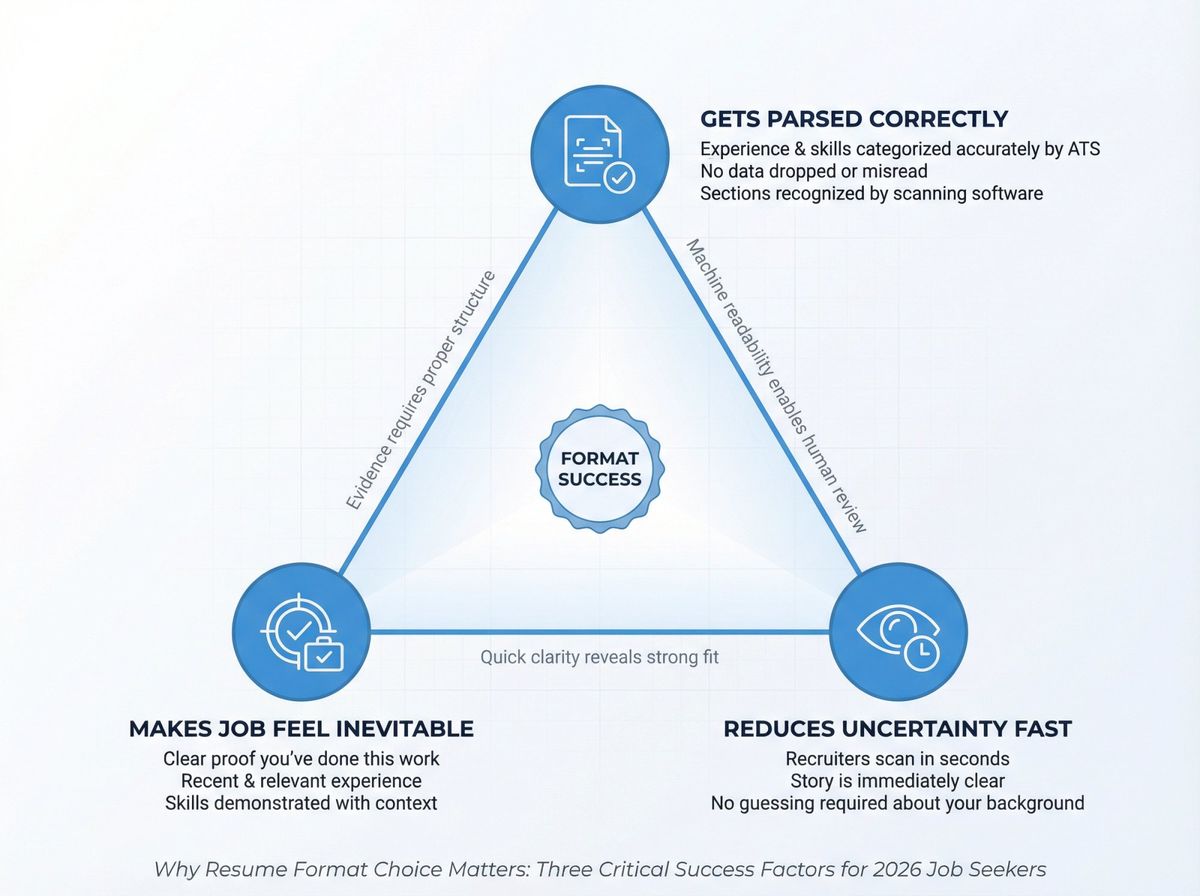
A resume format works when it does three things at once:
Gets parsed correctly by ATS software. Your experience and skills show up exactly where they should, not misread or dropped entirely. ATS categorizes your resume into sections (work experience, skills, education). If it can't understand your format, you're out.
Reduces recruiter uncertainty fast. Recruiters decide quickly who to interview. They shouldn't have to guess about your story. Career guidance emphasizes that clarity matters because hiring managers scan resumes in seconds, not minutes.
Makes the job feel inevitable. The format should make it crystal clear: "This person has done the work we need, recently enough, with proof."
That's why format matters. Not aesthetics. Not trends. Clarity and evidence.
Why Your Resume Is Evidence, Not Autobiography
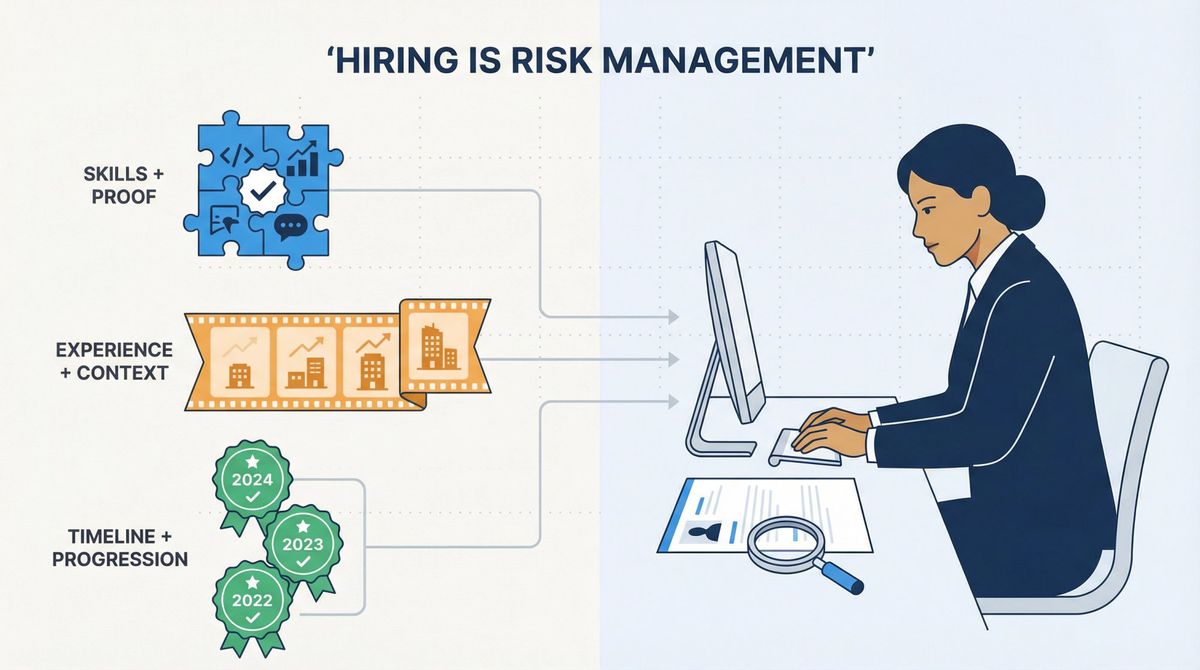
Hiring is risk management.
A recruiter (and often an ATS first) is trying to answer:
• Can you do the work? (skills + proof)
• Have you done similar work before? (experience + context)
• How recently, how consistently, and at what level? (timeline + progression)
Your resume format is the order you present evidence to reduce uncertainty.
Chronological reduces uncertainty about timeline and progression. Functional tries to reduce uncertainty about skill fit but can increase uncertainty about timeline. Hybrid gives you both.
That's the real tradeoff.
What Is a Chronological Resume? (Reverse-Chronological)
This format lists your work experience by dates, most recent first. It's the standard format and widely used because it's easy to follow and shows progression clearly.
Career guidance confirms this is the preferred method for many job candidates and employers. About 90% of recruiters prefer reverse-chronological format for its simplicity and clarity.
Why recruiters love chronological:
They can quickly verify what you did most recently, how long you did it, whether your responsibility level increased, and whether your skills are current. Multiple career guidance sources call it the most common format.
Chronological structure (ATS-friendly):
① Name + contact
② Summary or objective
③ Skills (optional but recommended for ATS keywords)
④ Work experience (most recent first)
⑤ Education
⑥ Optional sections (certifications, projects, volunteering)
What Is a Functional Resume? (Skills-Based)
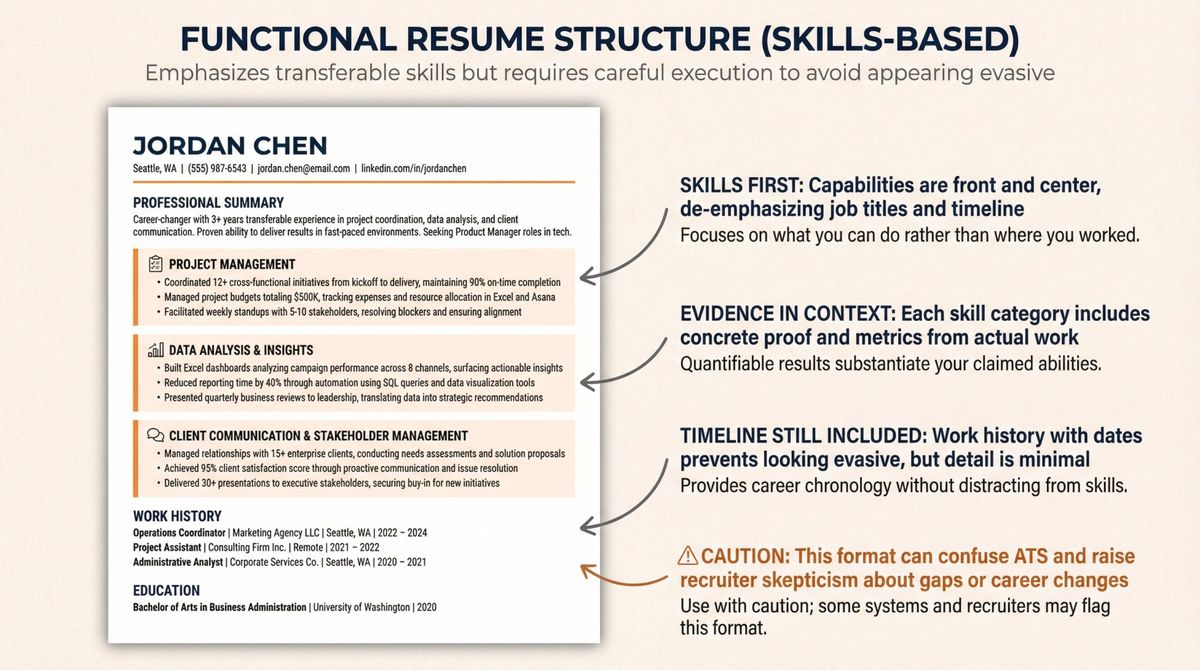
A functional resume organizes around skill categories (like "Project Management," "Data Analysis," "Client Communication") rather than leading with a dated job-by-job timeline. It de-emphasizes titles and dates up top and highlights transferable skills.
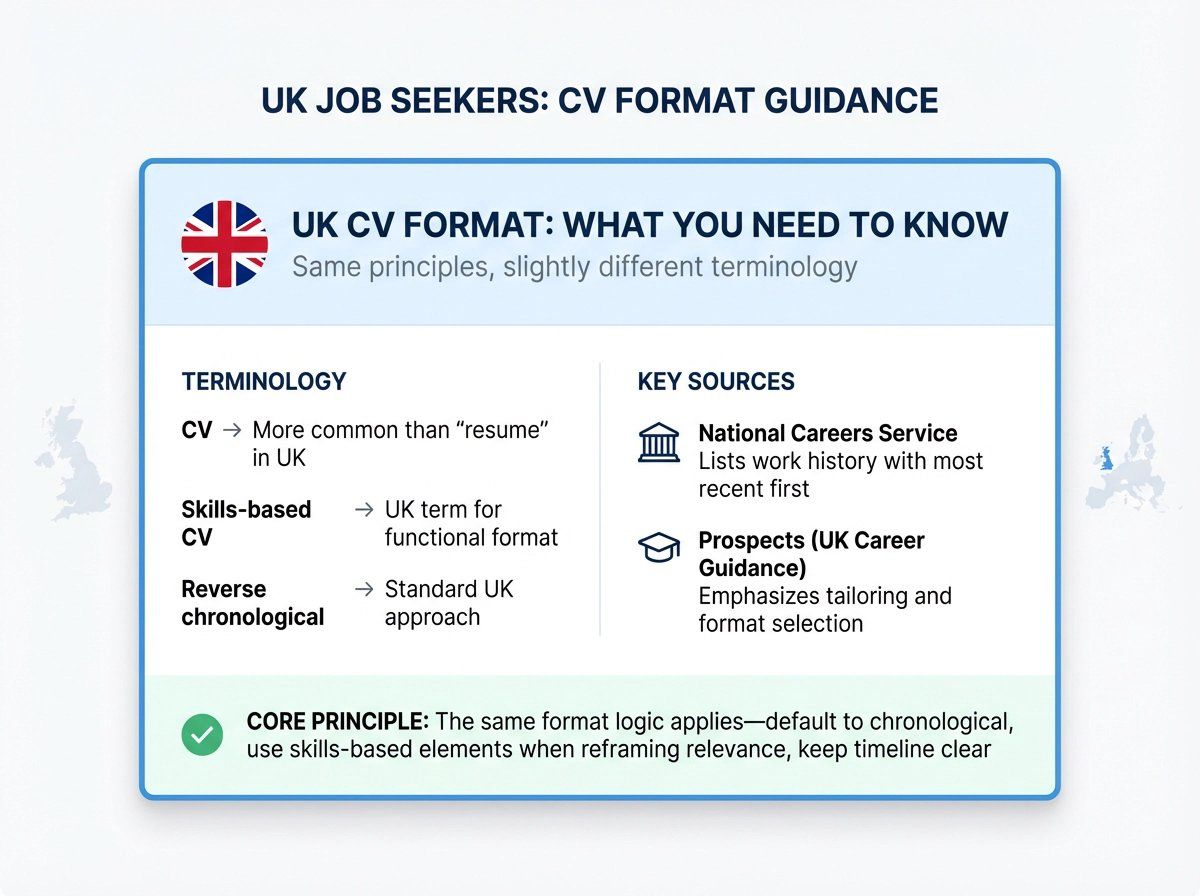
In the UK, this is often called a skills-based CV according to Prospects.
The upside: Reframing relevance. It lets you say, "Ignore my titles for a second. Here are the capabilities you actually need, with evidence."
The two big risks:
Some hiring managers see functional resumes as evasive because they obscure the timeline. Modern guidance frequently warns that functional formats aren't recommended in many cases. Recruiters might assume you're hiding something.
ATS systems can struggle with functional resumes. If your structure or headings are unusual, you can get mis-parsed. Research notes that ATS expects conventional sections like work experience with dates.
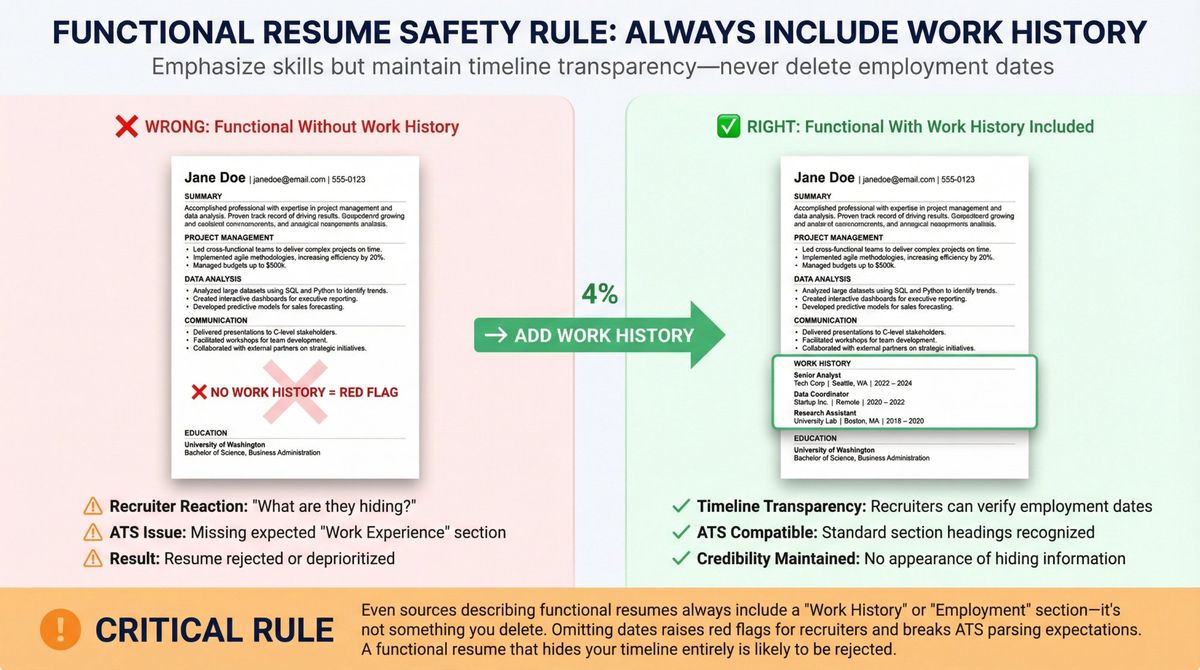
Critical rule: If you use functional, you still need a clear Work History section with employers, titles, and dates. Even sources describing functional resumes include "work experience" as a section, not something you delete.
What Is a Combination Resume? (Hybrid Format)
A hybrid resume blends both approaches. You lead with a skills summary (like functional), then include a chronological work history (like chronological).
Many career guidance sources recommend it when you need to highlight skills but still want timeline clarity. Industry research makes a strong case for hybrid as the "best" format in many situations because it balances what recruiters want (timeline) with what career changers need (skills).
Hybrid structure:
① Name + contact
② Summary
③ Core skills (keyword matched)
④ Selected achievements (optional but powerful)
⑤ Work experience (reverse chronological)
⑥ Education, certifications
How to Choose the Right Resume Format in 30 Seconds
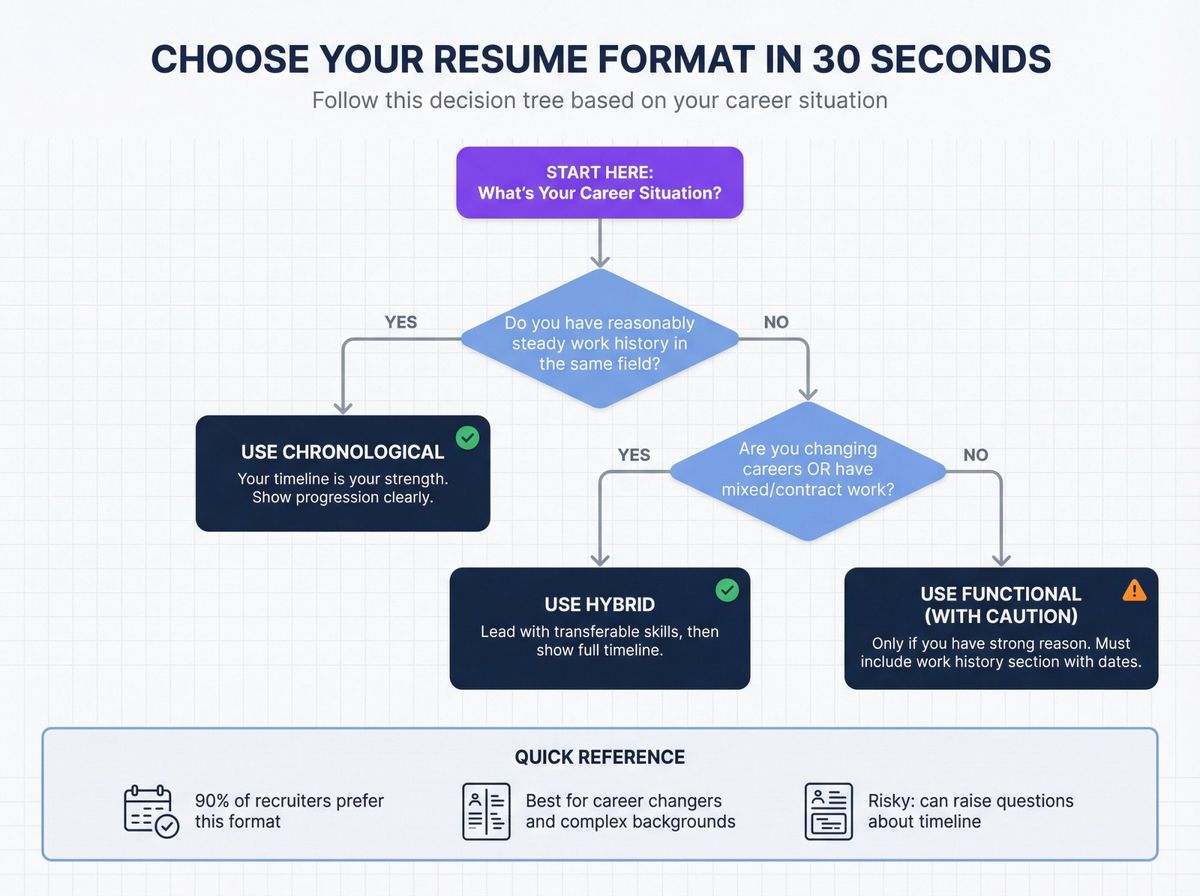
If you want the simplest rule that works for most people in 2026: Use chronological if you have a reasonably steady work history in the same field (even if it's not perfect). This applies to most job seekers.
Use hybrid if you're changing roles or industries, returning after a break, or your most relevant experience is spread across different jobs or projects.
Use functional only if you have a strong reason and you can still include a clear work history section with dates. Functional resumes are widely described as risky and often discouraged because they can look like you're hiding something.
When Should You Use Each Resume Format?
When to use chronological resume format
| Your Situation | Why Chronological Works |
|---|---|
| Standard career path | Your recent experience is relevant to the job |
| Clear progression | Your career shows advancement or stability |
| Same industry | Employers can easily connect your background to the role |
James Madison University career guidance notes that many employers prefer chronological because it's the expected format.
When to use hybrid resume format
You're making a career transition, and your relevant skills exist but your job titles don't obviously match. You have a "messy" background (contracts, projects, mixed roles) and need to control the narrative without looking evasive.
When to use functional resume format
You're entering the workforce, re-entering after a long break, or making a major pivot and you need to pull skill evidence from coursework, volunteering, projects, and varied experience.
But remember: functional is commonly described as less preferred and rarely recommended today because it can raise doubts and reduce scannability.
Why Chronological Resume Format Usually Wins
Chronological makes it easy to verify what you did most recently, how long you did it, whether your responsibility level increased, and whether your skills are current.
Standard chronological template:
[NAME][City, Country] | [Phone] | [Email] | [LinkedIn] | [Portfolio]SUMMARY2-4 lines: role identity + specialization + proof of impact + target direction.SKILLS8-14 skills that match the job description (tools + domain skills).WORK EXPERIENCEJob Title | Company | Location | Month Year – Month Year• Action + what you built/did + tool + outcome• Action + scope + measurable result• Action + collaboration + outcome(repeat for each role)EDUCATIONDegree | School | YearCERTIFICATIONS / PROJECTS (optional)
Make chronological "skills-forward" without going functional:
A common mistake is picking chronological, then failing to spotlight skills early. Fix that by using a Skills section with keywords from the job post. Research emphasizes that ATS and recruiters dislike keyword-only lists. Write bullets that prove skills in context.
How to Write a Functional Resume That Works
The functional resume rule that keeps you safe
If you use functional, you still need a clear Work History section with employers, titles, and dates. Don't delete it. This keeps recruiters from assuming you're hiding gaps or lack of progression.
ATS-safe functional structure:
① Name + contact
② Summary
③ Skills-based sections with proof
④ Work history (titles, companies, dates)
⑤ Education
⑥ Certifications/projects
Functional template (with work history included):
[NAME][City, Country] | [Phone] | [Email] | [LinkedIn]SUMMARY1-2 sentences: who you are + where you're going.1 sentence: proof (results, metrics, credible scope).RELEVANT SKILLS AND IMPACTSkill Area 1: [Example: Project Management]• Delivered [deliverable] using [tool/process], resulting in [outcome].• Led [scope], improving [metric] by [result].Skill Area 2: [Example: Data Analysis]• Built [analysis/dashboard/model] in [tools], enabling [decision/outcome].• Reduced [time/errors/cost] by [result] through [method].Skill Area 3: [Example: Stakeholder Communication]• Presented [insights/strategy] to [audience], influencing [outcome].WORK HISTORYJob Title | Company | Location | Month Year – Month YearJob Title | Company | Location | Month Year – Month YearEDUCATIONDegree | School | Year
Keep the work history clean and chronological, most recent first. UK career guidance emphasizes this structure.
When functional resume format can work
Functional can be reasonable when your strongest evidence comes from projects, volunteering, coursework, or mixed experience. You're changing fields and need transferable skills to be seen immediately.
But if your goal is "hide gaps," that's risky. A clearer strategy is to address gaps directly and focus on what you did during them. Career guidance notes that gaps are normal and employers decide quickly based on clarity, not mystery.
Hybrid Resume Format: What Most People Actually Need
Most people don't need a pure functional resume. They need a skills-first summary plus a chronological proof trail. That's the hybrid.
Career guidance explicitly lists combination resumes as a blend that lets you emphasize both skills and work experience. You can choose whether skills or experience comes first based on what matters most for the role.
Hybrid template:
[NAME][City, Country] | [Phone] | [Email] | [LinkedIn] | [Portfolio]SUMMARYRole identity + niche + years/scope + proof + target.CORE SKILLSSkill 1, Skill 2, Skill 3, Skill 4, Skill 5, Skill 6SELECTED IMPACT (optional but recommended)• [Outcome] by [action] using [tool] (tie to target job)• [Outcome] by [action] (tie to target job)WORK EXPERIENCEJob Title | Company | Location | Month Year – Month Year• Proof bullets (results, scope, tools, outcomes)EDUCATIONDegree | School | YearCERTIFICATIONS / PROJECTS (optional)
Hybrid resume example: career changer
Say you're moving from Operations Manager to Product Operations.
Weak approach: List "Product Strategy" as a skill with no evidence.
Strong hybrid approach: Put a "Selected Impact" bullet like:
"Partnered with Product and Engineering to redesign onboarding workflow, reducing support tickets by 18% and improving activation."
Then your Work Experience section proves where and when you did it. This is how you get the benefit of functional without triggering the "what are they hiding?" reaction.
ATS Resume Format Requirements in 2026
How ATS reads your resume
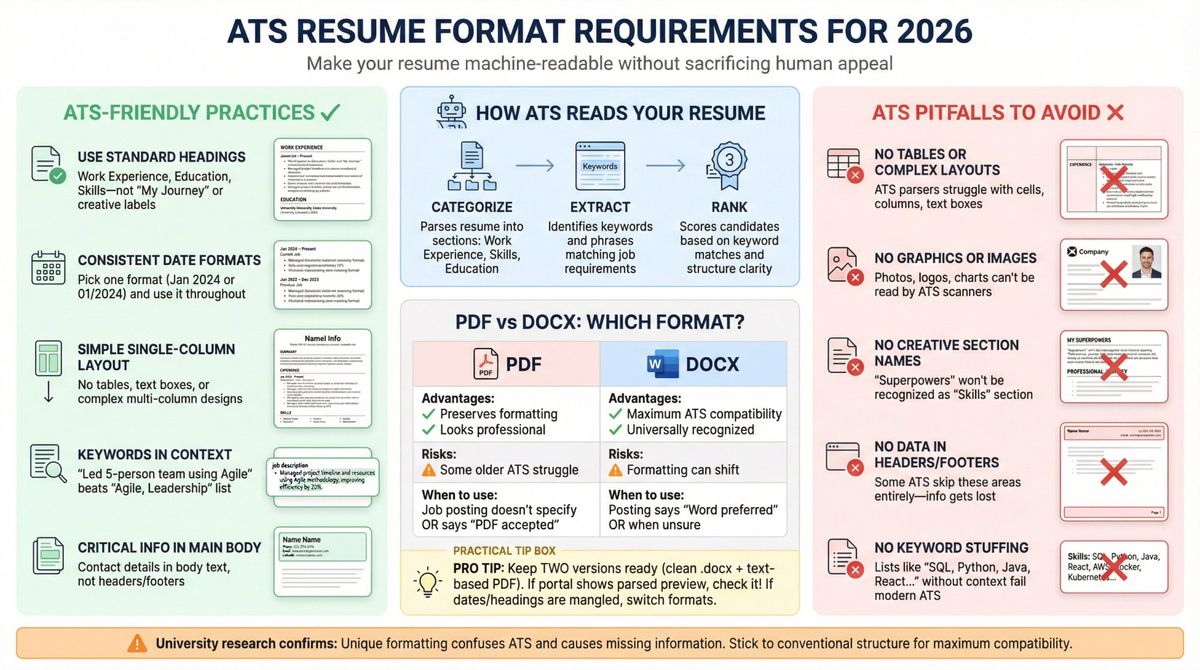
ATS categorizes your resume into sections (work experience, skills, education) and searches for keywords and phrases relevant to the job.
Your resume must be easy to categorize and keyword rich in context, not just a list.
ATS-friendly resume formatting rules
| Rule | Why It Matters | What To Do |
|---|---|---|
| Use conventional headings | ATS parses by expected section names | Stick to "Work Experience," "Education," "Skills" (not "My Journey") |
| Keep dates consistent | ATS calculates employment duration | Use same format throughout (e.g., "Jan 2024" or "01/2024") |
| Avoid tables, columns, graphics | Complex layouts confuse parsers | Use simple, single-column format with clear sections |
| No critical info in headers/footers | Some ATS skip these areas | Put contact details in main body, not margins |
| Put keywords in context | ATS prefers skills with evidence | "Led 5-person team using Agile" beats "Agile, Leadership" |
University research warns that unique formatting can confuse ATS and cause missing information.
PDF vs DOCX: Which resume file format works best?
| Format | Advantages | Risks | When To Use |
|---|---|---|---|
| Preserves formatting, looks professional | Some older ATS struggle with PDFs | When job posting doesn't specify, or says "PDF accepted" | |
| DOCX | Maximum ATS compatibility | Formatting can shift between systems | When posting says "Word doc preferred" or you're unsure |
The practical move:
Follow the application instructions first. Keep two versions ready: a clean .docx and a text-based PDF. If the portal shows a "parsed preview," check it. If it mangles dates or headings, switch formats.
Santa Clara University's career guidance notes that different systems prefer different formats.
Resume Format Mistakes to Avoid
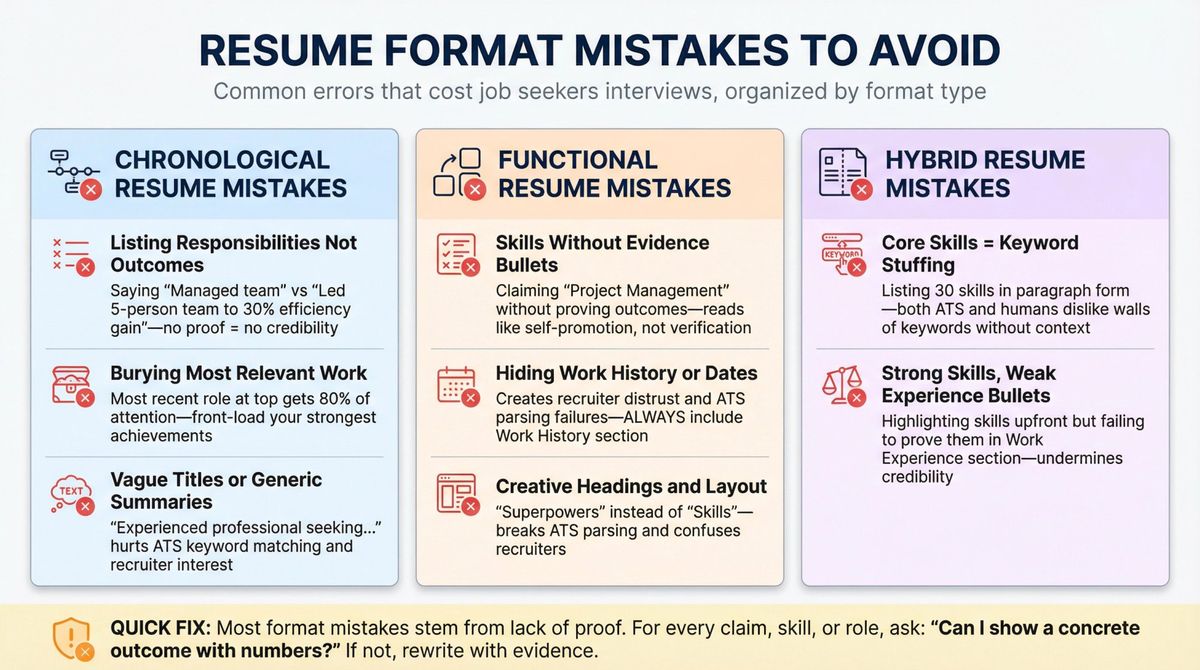
Chronological resume mistakes
→ Listing responsibilities instead of outcomes
No proof means no credibility.
→ Burying the most relevant work in older roles
Front-load your strongest achievements.
→ Using vague titles or generic summaries
This hurts ATS keyword matching.
Functional resume mistakes
→ Listing skills without evidence bullets
Reads like self-claiming.
→ Hiding the Work History section or removing dates
Creates distrust and parsing issues according to research.
→ Using creative headings and layout
Breaks ATS parsing.
Hybrid resume mistakes
→ Turning the "Core Skills" section into keyword stuffing
ATS and humans dislike it.
→ Writing a strong skills section but weak experience bullets
You still need proof in the timeline.
UK CV Format: What You Need to Know
If you're applying in the UK, the National Careers Service describes a CV as a summary of skills, achievements, and experience. They recommend listing work history with the most recent experience first.
UK-focused guidance also emphasizes tailoring to the job and selecting an appropriate CV format, with chronological and skills-based options depending on situation.
The same format logic applies: default to chronological (reverse chronological), use skills-based elements when you need to reframe relevance, and keep your timeline clear.
How AIApply Helps You Pick the Right Resume Format
If you want to stop debating formats and just test what works:
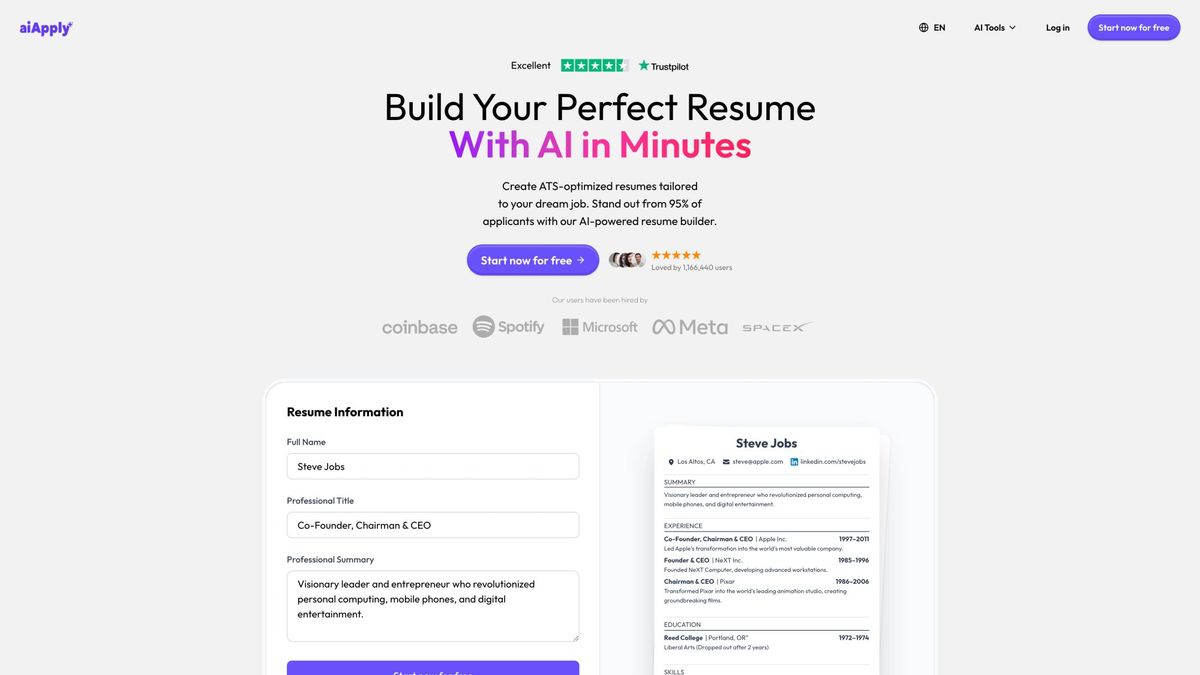
Generate both versions (chronological and hybrid) from the same content using AIApply's Resume Builder. Our AI-powered tool creates tailored resume content using GPT-4 technology.
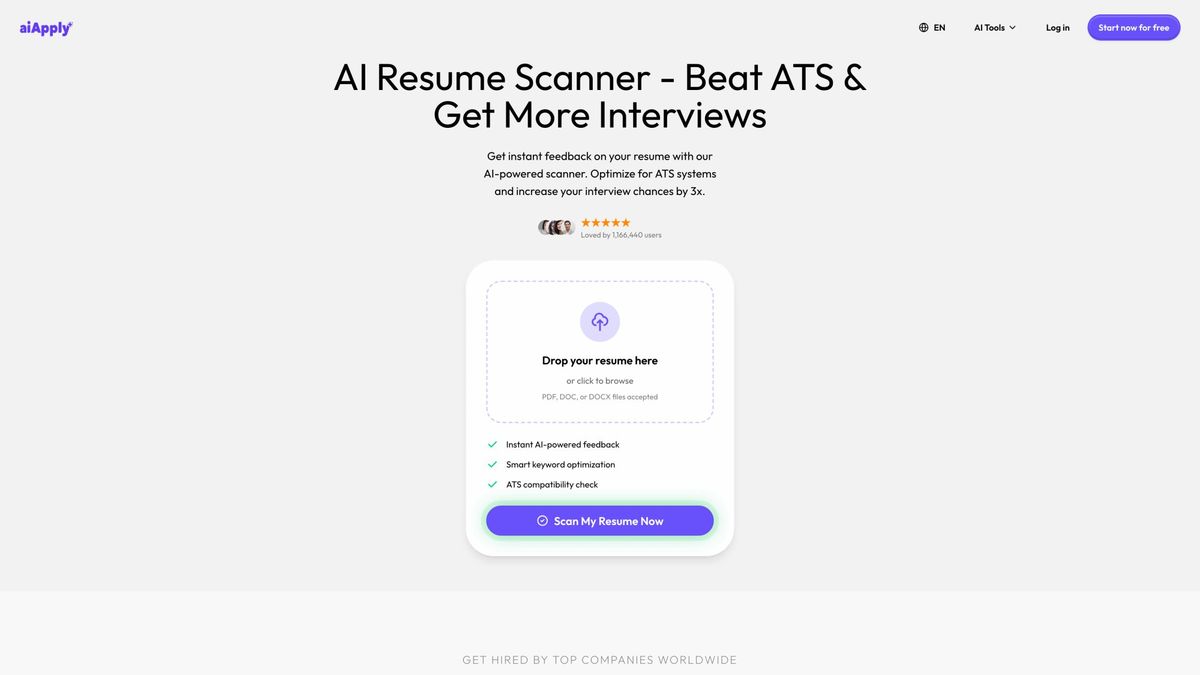
Run an ATS check to catch formatting and keyword issues before you submit. AIApply's Resume Scanner is designed for ATS feedback loops.
Use ATS-friendly templates so you're not fighting layout problems that break parsing. Our templates are designed with professional formatting and ATS compatibility in mind.
If your career is contract-heavy or project-based, our contract work guide includes modern formatting patterns (published Jan 10, 2026).
That workflow matters more than arguing "functional vs chronological" in the abstract. With AIApply, you can experiment with multiple formats quickly, scan for ATS compatibility, and submit with confidence.
AIApply Resume Builder generates both chronological and hybrid versions from your experience, letting you test different formats without manual rewriting:
Once you've created your resume, AIApply Resume Scanner analyzes it for ATS compatibility, checking format, keywords, and parsing issues before you submit:
Choose from AIApply's ATS-friendly templates designed to pass parsing while maintaining professional formatting:
Functional vs Chronological Resume: FAQs
Is a functional resume ATS-friendly?
It can be, but it's easier to mess up. ATS categorizes content into sections, so unusual headings, missing dates, tables, or a skill-only structure can cause parsing errors. Use standard headings and include a clear Work History section with dates. Research confirms this approach.
Want to test your resume's ATS compatibility? Try AIApply's Resume Scanner.
Should I use a functional resume to hide employment gaps?
A safer approach is to keep your timeline readable and use hybrid to spotlight skills. UK career guidance explicitly treats gaps as normal and focuses on clarity and tailoring rather than hiding.
Gaps happen. Caregiving, illness, layoffs, education, personal projects. Employers in 2026 understand this. A transparent chronological resume with a brief explanation often works better than a functional resume that obscures your timeline and raises questions.
What resume format do employers prefer?
Many guidance sources explicitly say chronological is the most common and often preferred, largely because it's easy to follow and verify.
Research shows about 90% of recruiters prefer reverse-chronological format. It's the expected format, and deviating from it can sometimes work against you unless you have a compelling reason.
What resume format is best for career changers?
Hybrid usually wins. Lead with the transferable skills you want them to notice, then prove them in your work history. Career guidance even calls out combination resumes as useful for career transitions where relevancy may not be immediately clear.
Career changers often feel pressure to hide their past, but the better approach is strategic framing. A hybrid resume lets you say: "Here's why I'm qualified (skills section), and here's proof I can deliver (work history)."
Can I use different resume formats for different jobs?
Absolutely. You should tailor your resume format (and content) to each application. Some roles might benefit from a chronological approach that emphasizes your steady progression. Others might need a hybrid that highlights specific skills.
The key is matching your format to what the employer values most. AIApply's Resume Builder makes this easy. Generate multiple versions, test what works, and adjust based on the role.
How long should my resume be?
One page if you're early in your career (under 5 years of experience).
Two pages if you're mid-career or senior with substantial experience to showcase.
Never go beyond two pages unless you're in academia or a field that explicitly requires it.
Format choice affects length. Functional resumes can be shorter because they de-emphasize work history. Hybrid resumes can run longer because you're including both skills and full work history. But length should never come from fluff. Every line should prove your qualifications.
Should I include a summary or objective on my resume?
Use a summary, not an objective. Objectives ("Seeking a challenging role...") are outdated and focus on what you want. Summaries focus on what you offer.
A strong summary is 2-4 lines that establish your role identity, specialization, proof of impact, and target direction. For example:
*"Product Manager with 5 years driving SaaS growth through data-informed roadmap decisions. Led 3 feature launches that increased user retention by 22%. Now targeting senior PM roles in B2B tech."*
That's specific, evidence-based, and forward-looking. Need help crafting the perfect summary? Check out our resume summary examples.
Does resume format matter more than content?
No. Content always wins. But format determines whether your content gets seen. A brilliant resume in a format that ATS can't parse might never reach a human. A well-formatted but generic resume won't get you interviews either.
The ideal resume has strong content in the right format. That's why we recommend using AIApply's tools to handle both. Our AI Resume Builder generates relevant content while our templates ensure proper formatting. You get the best of both worlds.
How do I know if my resume format is working?
Track your metrics. If you're applying to 50 jobs and getting zero interviews, something is wrong. Could be content, could be format, could be both.
Test different approaches: try chronological for 10 applications, hybrid for 10, and compare results. Use AIApply's Resume Scanner to check ATS compatibility. If your resume scores poorly, the format might be the problem.
Remember: The best format is the one that gets you interviews. Everything else is theory.
Looking for specific examples? Browse our resume examples for hundreds of roles, or check out role-specific examples like Software Engineer, Project Manager, Data Analyst, and Marketing Manager.
Related resources
- Effective Resume Formats: How to Choose the Right Format (2026)
- 7 Resume Format Tips to Stand Out (With Examples)
- How to Write a Technical Resume That Gets Interviews (2026)
- Compelling Good Titles for Resumes: Top Picks 2025
- Why Resumes Still Matter : The Data-Backed Guide to Standing Out and Getting Hired