Is It Safe to Use AI Auto-Apply Bots? What Recruiters Actually See
AI auto-apply is safe when applications are targeted, tailored, and visible to you. Here is exactly what raises risk, what recruiters notice, and where the line sits.


Auto-apply tools promise to delete the worst part of the job hunt. Some of them do. Others quietly damage the search they were bought to fix. This is where the line sits, according to recruiters, platform policy, and hiring data.
Using AI to find, tailor, and submit job applications is safe when every application goes to a role you genuinely fit and you can see exactly what was sent on your behalf. It becomes risky when a tool fires one generic resume at hundreds of unfiltered roles, invents details to force a keyword match, or automates activity a platform explicitly prohibits. Auto-applying does not hurt your chances because it is automated. It hurts your chances when the output is indistinguishable from spam.
That distinction matters more than it used to, because recruiters are no longer guessing about this. They are drowning in the evidence. And the thing they are filtering out is not "AI." It is applications with no signal in them, which is a category most auto-apply tools produce by design and a small number of them are built to avoid.
So the useful version of your question is not "will I get caught." Nobody is running a bot detector on your resume. The useful version is: does the pattern of applications leaving my name look like a person who read the job, or like a machine that did not?
What an Auto-Apply Tool Actually Does on Your Behalf
An auto-apply tool scans job listings, matches them against a profile you set up, generates application documents, and submits them without you clicking through each form. That is the whole mechanism. Everything people argue about downstream comes from four choices the tool makes inside that loop: how tightly it filters, how much it tailors each submission, whether it shows you what it sent, and whether it fabricates anything to improve the match.
Those four choices are what separate an assistant from a cannon, and they vary enormously between products. A tool that submits one identical resume to every listing containing your job title is doing something categorically different from a tool that scores fit, writes to the posting, and logs each submission for you to review. Both get marketed as "auto-apply." Only one of them is defensible in an interview.
AIApply built Auto Apply around the second model. You set the roles, locations, and companies to target or exclude, the system matches listings against your actual experience, generates a tailored resume and cover letter for each role, and records every submission in a dashboard including which version of your resume went out. You can change the filters at any time and the change applies to everything sent afterward. That last part matters more than it sounds, and the rest of this article explains why.
Why Recruiters Are Hostile to Auto-Apply (and What They Are Actually Reacting To)
Recruiters are not offended by automation in the abstract. They are reacting to a workload problem that automation created. Greenhouse analyzed more than 640 million applications across over 6,000 companies for its The Hire Standard benchmark report and found the average job opening now draws 244 applications, up from roughly 115 in 2022. Over the same period, annual applications handled per recruiter rose by more than 400% while recruiting teams shrank by more than half.
The follow-on cost is the part job seekers rarely see. In Greenhouse's 2025 AI in Hiring Report, a survey of 4,136 job seekers, recruiters, and hiring managers, 34% of recruiters said they spend up to half their working week filtering spam and junk applications. Ninety-one percent said they had spotted candidate deception. Thirty-nine percent of hiring managers said they had moved to more in-person interviews specifically to verify that candidates are who they claim to be.
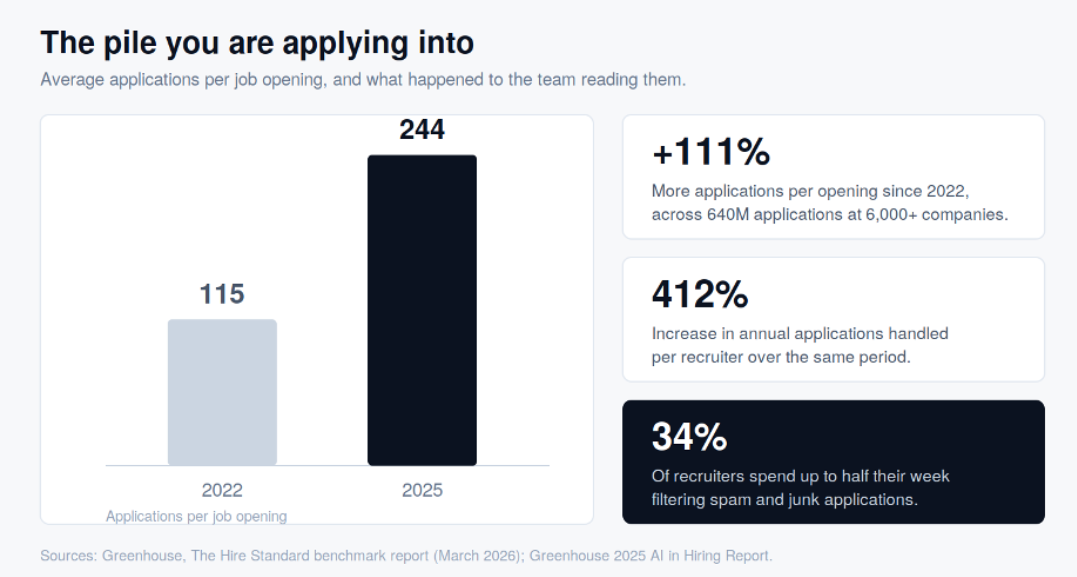
And the bot share is no longer marginal. In a separate Greenhouse survey of active job seekers reported by HR Dive, 67% of U.S. candidates said they were using AI in the job hunt and 22% said they were using automated bots to submit applications outright.
Read those numbers together and the recruiter reaction stops looking like snobbery. A third of their week is spent throwing away applications that should never have been submitted. When someone says they "hate auto-apply tools," what they mean is that they hate being the disposal system for other people's untargeted volume. That is a fair complaint, and it is one you can avoid triggering.
Does Auto-Applying Hurt Your Chances? The Honest Answer
Auto-applying hurts your chances when it increases volume without increasing fit, and helps when it removes form-filling time from applications you would have sent anyway. The variable is targeting, not automation.
The case against untargeted blasting is strong. Writing in Forbes, career counselor Robin Ryan cites studies putting the per-application success rate of auto-apply blasting at roughly 0.01%, or one interview per 10,000 submissions, against 4% to 6% for applications tailored to the specific posting. She does not name the underlying studies, so treat the exact figure as directional rather than precise. The direction, though, is consistent with everything else in the data: volume without fit converts at close to zero.
The recruiter view in the same piece is more concrete. Suzanne Crettol, a head of talent acquisition with fifteen years in the seat, says most resumes her team receives for an opening are unqualified, and that this is especially true of AI-generated resumes, which she describes as generic and prone to embellishing things that are not true. Notice which half of that sentence is the real problem. Generic is a fixable formatting issue. Embellishment is a credibility problem you carry into every interview you do manage to land. Our breakdown of when AI helps and hurts a resume goes deeper on that distinction.
The flip side is equally true and less often said. If you have already decided a role is worth applying to, the twenty minutes you spend retyping your work history into a fifth applicant tracking system adds nothing to your candidacy. Nobody has ever been hired for form-filling stamina. Automating that step costs you nothing and buys back time for the parts that do move the needle: research, referrals, follow-up, and interview preparation.
The Four Real Risks and the One That Is Not
1. Platform restrictions on automated activity
This is the risk most people underrate. LinkedIn's policy on prohibited software and extensions states plainly that it does not permit third-party software, crawlers, bots, browser plug-ins, or extensions that scrape, modify the appearance of, or automate activity on its site, and that members using such tools risk having their accounts restricted or shut down. That is Section 8.2 of the User Agreement, not a gray area.
Two things follow. First, browser extensions that drive clicks inside your logged-in LinkedIn session are the highest-risk category of auto-apply tool, whatever their marketing says. Second, tools that apply through employer career sites and applicant tracking systems rather than by automating a social platform's interface are in a different position entirely. Before you buy anything, find out which of those two things you are buying.
2. Duplicate and mismatched applications inside a single employer
Applicant tracking systems centralize your history with an employer. If a tool submits you to four unrelated roles at the same company inside two minutes, a recruiter opening your file sees all four at once, and the pattern reads as indiscriminate rather than enthusiastic. We covered the mechanics of this in our guide to applying to multiple jobs at the same company. Automation makes the failure mode faster and more likely, which is exactly why exclusion filters and duplicate detection are worth checking for before you turn a tool on.
3. Applications you cannot see and cannot defend
This is the objection job seekers raise most often in their own words. On a Glassdoor forum thread about whether these tools work, one developer's summary was that auto-appliers create a mess, will distort details to match, and leave you unable to see what was actually submitted. Whether or not that is true of a specific product, the underlying worry is correct and it is the single best test to apply.
If you cannot open a dashboard and see which roles were applied to, on what date, and with which version of your resume, you have handed your professional reputation to a process you cannot audit. You will also walk into interviews unable to answer basic questions about your own application. Visibility is not a nice-to-have feature here. It is the safety mechanism.
4. Your personal data
An auto-apply tool holds your full work history, contact details, and often your identity documents. Before uploading, read what the provider stores, how long it keeps it, whether it is used to train models, and which jurisdictions the data moves through. This is dull and most people skip it. It is also the one risk on this list that persists long after your job search ends.
The risk that is not real: an ATS detecting that AI wrote your resume
Applicant tracking systems parse structure and match relevance. They are not built to detect AI writing, and general-purpose AI detectors are unreliable enough that treating their scores as a target is a waste of effort. What a human notices is far simpler: a letter that never names the actual role, a resume with no specifics in it, phrasing identical to the last forty applications they read. Our piece on whether employers can tell you used AI walks through what recruiters actually pick up on. Optimize for substance, not for evading a detector nobody is running.
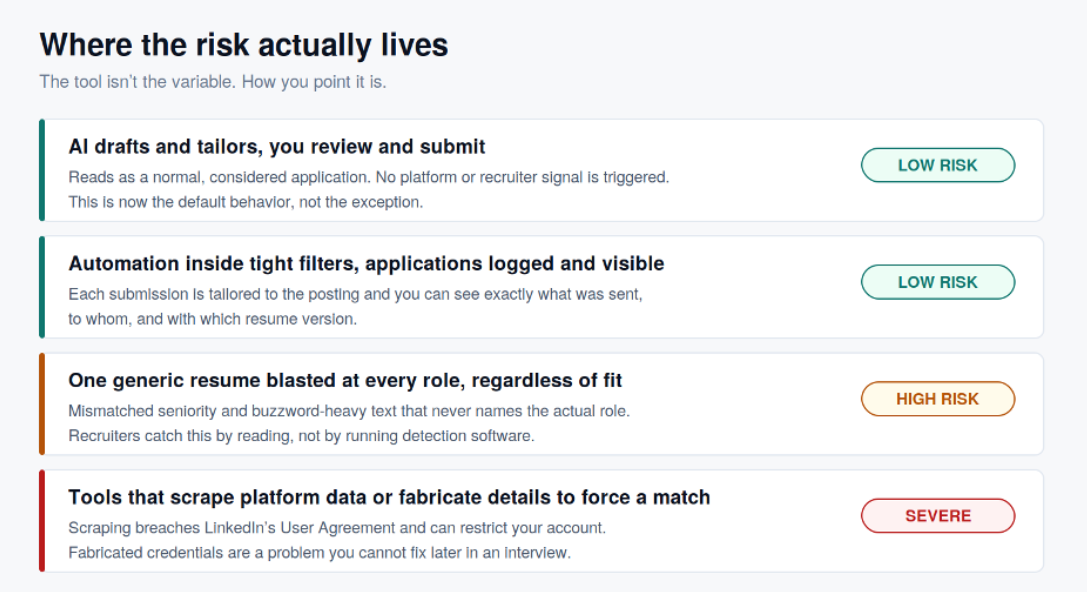
Assistant or Autopilot: Where the Line Sits
Most of the disagreement about auto-apply safety disappears once you separate the behavior from the technology. Here is the same tool used two ways, and what each version produces on the employer's side.
| Behavior | What the employer sees | Risk level |
|---|---|---|
| AI drafts and tailors, you approve every submission | A normal, considered application. Nothing distinguishes it from a manual one. | Low |
| Automation inside tight filters, each application tailored and logged | Role-relevant applications arriving at a human pace with specifics in them. | Low |
| One generic resume sent to every listing matching a job title | Buzzword-heavy text that never mentions the role. Rejected on reading, not by software. | High |
| Multiple applications to one employer within minutes | A centralized file showing scattershot targeting. Often flagged as spam. | High |
| A tool that scrapes platform data or automates a logged-in social session | Activity the platform prohibits outright, with account restriction as the stated consequence. | Severe |
| Anything that overstates or invents experience to force a match | A claim you cannot support in the interview, which ends the process later and worse. | Severe |
How to Use Auto-Apply Without Damaging Your Search
The workable rule is to score the role before you decide who submits it. Fit determines the method, not your energy level on a given Tuesday.
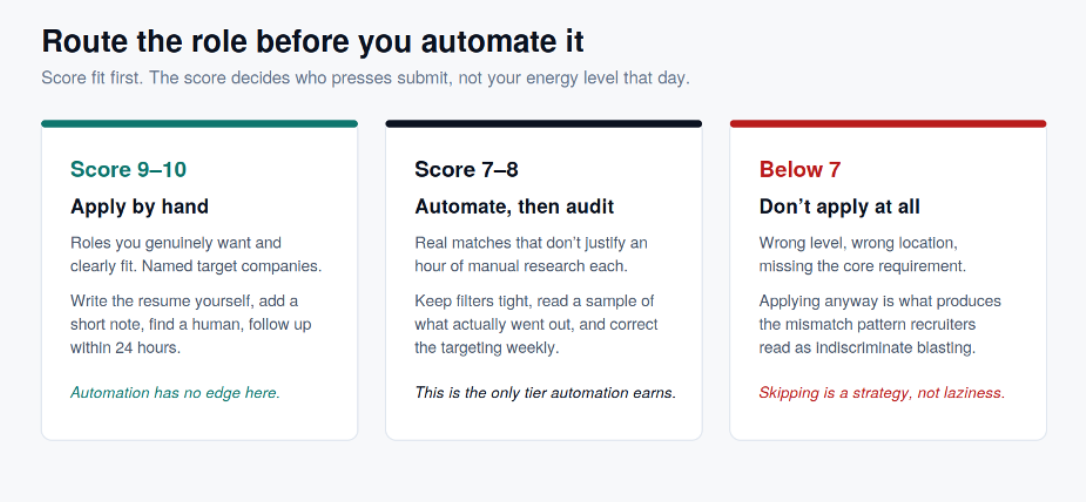
Our guide to getting hired fast lays out a 0-to-10 fit score in full, but the routing rule is simple enough to use immediately. Roles scoring 9 or 10, and anything at a company you specifically want to work for, get applied to by hand with a tailored resume and a short note to a human. Roles scoring 7 or 8 are real matches that do not justify an hour of research each, and that is the tier automation earns. Anything below 7 does not get an application at all, from you or from a tool.
Beyond the routing rule, five habits keep automated applications on the safe side of the line:
- Set exclusion filters before you set inclusion filters. Naming the companies, locations, and seniority levels you never want applied to prevents more damage than any amount of targeting refinement afterward.
- Read a sample of what actually went out each week. Open five submitted applications at random and check that a person could tell which job each was written for. If they read interchangeably, tighten the filters.
- Keep your base resume accurate and specific. Automation multiplies whatever you feed it. A vague base resume becomes 200 vague applications.
- Calibrate volume to your situation, not to the tool's capacity. Most active searches convert better at 15 to 25 targeted applications a week than at ten times that number, and our breakdown of how many jobs to apply to per week explains why the ceiling is lower than people expect.
- Never let a tool make a claim you cannot defend. If an interviewer asks about a line on your resume and you have to think about whether it is accurate, that line should not have been submitted.
The same logic runs through the rest of the process. Tailoring is what separates a real application from a submitted one, which is why tailoring your resume to the job description is worth doing properly on the roles that matter, and why the full application system puts fit ahead of volume at every step. Automation belongs inside that system, not in place of it.
Where AIApply fits is at the specific gaps this creates. Auto Apply handles the tier-two volume with per-role tailoring, exclusion filters, and a dashboard showing every submission and the resume version used, so nothing leaves your name that you cannot see. The Resume Scanner checks the base resume for parsing and keyword gaps before it gets multiplied across hundreds of applications. And Interview Buddy exists for the part automation cannot touch, which is the conversation where you have to be the person the application described. More than two million job seekers use AIApply, and the ones who get results treat it as an operating layer rather than an autopilot.
The Ethical Line
There is one rule that resolves almost every edge case: never submit anything you could not confidently defend in an interview. That covers fabricated experience, inflated titles, skills you have read about but not used, and any claim a tool generated on your behalf that you have not read.
AIApply's position on this is not a marketing line. Automation is appropriate for the repetitive, mechanical parts of applying. It is not appropriate for misrepresenting who you are, and no efficiency gain is worth the outcome when that unravels in a final round. The same applies to real-time interview assistance, which is a legitimate preparation and support tool used responsibly, and something else entirely when used to pretend to knowledge you do not have.
The Bottom Line
Auto-apply is not a shortcut around a bad job search and it is not the reason your applications are going unanswered. It is a way to remove the mechanical part of applying from roles you had already decided were worth your time. Used that way, with tight filters and full visibility of what leaves your name, it is safe and it saves hours a week. Used as a volume machine pointed at everything, it produces exactly the applications recruiters spend a third of their week deleting.
If you want to test that in practice, start narrow. Score your next twenty target roles, hand only the sevens and eights to Auto Apply, keep the nines and tens for yourself, and read a sample of what went out at the end of the first week. If the applications read like they were written for those specific jobs, you are on the safe side of the line. If they do not, tighten the filters before you send another one.
Frequently Asked Questions
Is it safe to let AI apply to jobs for you?
Yes, when the tool applies only to roles you fit, tailors each submission to the posting, and shows you exactly what was sent. It stops being safe when applications go out untargeted, when you cannot review them, or when the tool automates activity a platform prohibits. The safety question is about configuration and visibility, not about whether AI is involved.
Can recruiters tell if you used an auto-apply bot?
Often yes, but not through detection software. What gives it away is a resume that never mentions the actual role, several applications to one employer within minutes, and seniority that clearly does not match the posting. Recruiters catch these by reading, which is why tailored automated applications are indistinguishable from manual ones and untailored ones are obvious.
Can auto-applying get your LinkedIn account restricted?
It can, if the tool automates activity inside LinkedIn itself. LinkedIn's User Agreement prohibits third-party software, bots, crawlers, and browser extensions that scrape or automate activity on the platform, and states that members using them risk having accounts restricted or shut down. Tools that submit through employer career sites and applicant tracking systems rather than by driving your LinkedIn session are not in that category.
Does using AI to apply hurt your chances of getting hired?
It hurts your chances only when it raises volume without raising fit. Applications tailored to the posting convert at a far higher rate than generic ones regardless of how they were produced, so automation that preserves tailoring is neutral to positive and automation that discards it is actively harmful.
How many jobs should you auto-apply to per day?
Fewer than most tools encourage. For most active searches, 15 to 25 well-targeted applications per week outperforms several hundred untargeted ones, and applications spread across the day at a human pace avoid the velocity patterns platforms flag. Capacity is not the constraint that matters; fit is.
Will an ATS reject my application because AI wrote it?
No. Applicant tracking systems parse structure and match keywords to the job description; they are not built to detect AI writing. Applications get filtered out for missing required skills, poor alignment with the posting, or formatting that does not parse, none of which are about AI authorship.
What should you check before using any auto-apply tool?
Check four things: whether you can see every application it submitted and with which resume version, whether it tailors per posting or reuses one document, whether it automates a platform that prohibits automation, and what it does with your personal data. A tool that fails the visibility test should be ruled out regardless of how it performs on the others.