When to Capitalize Job Titles (and When Not To)
Master when to capitalize job titles with clear rules and real examples. Transform your professional writing with expert guidance on proper capitalization.

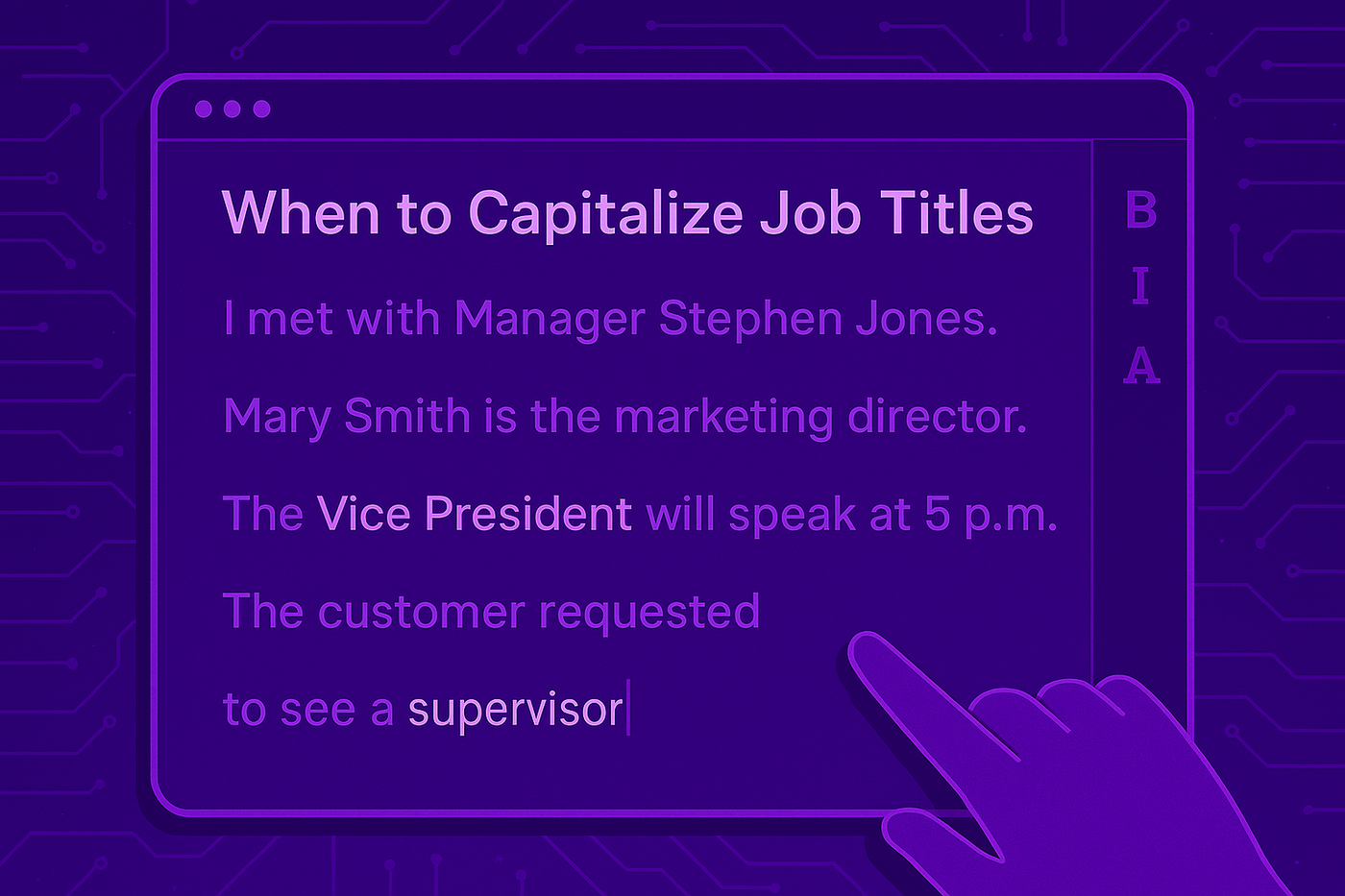
Capitalization is the cheapest signal of care in professional writing, and the easiest to get wrong in a document that took hours to build. This guide gives you the rule, the exceptions, and the three places in a job search where the decision actually shows up.
Key takeaways
- Capitalize a job title when it comes directly before a person's name and works as part of that name, as in Chief Executive Officer Sam Jones.
- Lowercase the same title when it follows the name, stands alone, or is introduced by "the," as in Sam Jones, the chief executive officer.
- On a resume, a LinkedIn headline, or an email signature, capitalize the title, because there it functions as a label rather than as running text.
- AP and Chicago disagree on specific cases, including academic titles, so pick one style guide per document and apply it consistently instead of switching mid-page.
- On a job application, the wording of your title matters far more than its capitalization: Jobscan found that candidates whose resumes carry the job title from the posting are 10.6 times more likely to get an interview.
Capitalize a job title when it appears directly before a person's name and is used as part of that name, as in Chief Executive Officer Sam Jones. Lowercase it when it follows the name, stands alone, or is introduced by "the," as in Sam Jones, the chief executive officer. On a resume, a LinkedIn headline, or an email signature, capitalize the title, because in those places it is a label rather than a sentence.
Most people looking this up are not editing a press release. They are staring at a resume, a headline, or a note to a recruiter, and they do not want a stray capital letter to be the first thing a hiring manager notices. The core rule is settled and easy. The reason you keep finding advice that contradicts itself is that the two style guides most American writing follows disagree at the edges, and almost nobody writing about this says which one they are using.
Capitalize the title when it sits directly before a name
The rule that covers most cases is about position. When a title comes immediately before someone's name and stands in for part of that name, capitalize it. When it does anything else, lowercase it.
Both major American style guides start here. AP style says to capitalize formal titles when they appear before a person's name, and to lowercase them when they are informal, appear without a name, follow the name, or are set off before the name by commas. Chicago says the same thing in its own terms: professional titles are capitalized when they immediately precede a personal name and are used as part of the name, traditionally replacing the holder's first name.
- Correct: The quarterly report was signed by Chief Executive Officer Sam Jones.
- Correct: Sam Jones, the chief executive officer, signed the quarterly report.
- Incorrect: Sam Jones, the Chief Executive Officer, signed the quarterly report.
The commas are the tell. If the title is fenced off by commas, it is extra information about the person rather than part of their name, and it drops to lowercase.
The placement rule most guides skip
AP adds a second instruction that gets left out of nearly every article on this topic: if a title is long, place it after the person's name, or set it off with commas before the name. So "Vice President of Operations Maria Garcia" is capitalized correctly and still worth rewriting. "Maria Garcia, vice president of operations" is the version AP would ask for, and it reads better in an email too.
Lowercase it when the title describes rather than names
Overcapitalizing is the more common mistake, and it reads as trying too hard rather than as respect. Lowercase the title in each of these situations.
- After the name: Sarah Chen, the project manager, will lead the meeting.
- Standing alone: The chief executive officer approved the budget.
- As a general role: We need to hire a software engineer for the development team.
- Introduced by "the" before the name: the chief financial officer, David Miller.
That last case is the one people miss. Chicago treats a title preceded by "the" or by a modifier as a descriptive phrase in apposition rather than a title, so it stays lowercase even though it sits before the name. There is also a category distinction worth holding onto: AP separates formal titles, which denote a scope of authority, from job descriptions, which do not. Astronaut, editor, and technician are descriptions, and they stay lowercase wherever they appear.
Where this actually matters in a job search: the resume, the headline, and the signature
Everything above governs running text. A resume is not running text, and applying sentence rules to it is why people end up with a lowercase job title sitting above a work-history entry, looking like a typo.
The convention is that a title used as a heading gets capitalized. Chicago lowercases titles in running prose but allows them capitalized on a resume, a business card, a diploma, or a door plaque, because in those places the title is a label. That gives you a clean split inside a single document.
- Work-history heading: Senior Account Executive, Innovate Corp.
- Inside a bullet describing that role: promoted to senior account executive within six months.
- LinkedIn headline: Senior Account Executive, capitalized, because the headline is a label.
- Email signature: Jane Doe, Chief Financial Officer.
If you want the wording of that heading to do more work, our guides on resume title examples and choosing a strong resume title cover the phrasing side, and the resume bullet formulas guide covers the lines underneath it.
Capitalization is the smallest decision on that line
Here is the part worth more than the grammar. Jobscan's analysis found that candidates who include the job title from the posting on their resume are 10.6 times more likely to get an interview, and its State of the Job Search report found that 99.7% of recruiters use filters in their ATS to build a shortlist. Those filters match on the words, not the capital letters. If your last role was internally called Growth Partner and the posting says Account Executive, no capitalization decision closes that gap. AIApply's Resume Scanner compares your resume against the specific posting and shows you where your title wording diverges from the one the ATS is filtering on, which is the version of this problem that actually costs interviews.
Where AP and Chicago disagree, and why the advice you find contradicts itself
Most articles on this topic present one style guide's rule as if it were the rule. It is not, and the disagreements land on cases you will hit. Here is how the same sentence resolves under each.
| Case | AP style | Chicago style | What to do |
|---|---|---|---|
| Academic title before a name (Professor Alistair Finch) | Lowercase. AP does not treat professor as a formal title | Capitalize as an academic title before the name | Follow the house style of wherever you are sending it |
| Long title before a name (Vice President of Operations Maria Garcia) | Move it after the name or set it off with commas | Capitalized before the name is acceptable | Move it after the name. It reads better either way |
| Title introduced by "the" before a name (the chief executive officer, Sam Jones) | Lowercase | Lowercase, treated as apposition | Lowercase. Both agree |
| Occupational description (astronaut Sally Ride) | Lowercase. It is a job description, not a formal title | Lowercase. Generic role titles are normally lowercased | Lowercase. Both agree |
| Title standing alone (the president spoke) | Lowercase | Lowercase | Lowercase. Both agree |
The academic case is the sharpest split, and it is where a lot of published advice is quietly wrong. AP does not capitalize or abbreviate "professor" before a name, while Chicago does. Neither is a mistake. Writing "Professor Alistair Finch" and calling it the universal rule is.
The practical version: use AP if you are writing anything journalistic, PR-adjacent, or destined for a press release. Use Chicago for books, academic work, and most long-form corporate writing. For a resume, neither guide governs, and the heading convention wins. What matters more than the choice is that you do not switch guides halfway through a document.
Email, LinkedIn messages, and writing to a recruiter
A single email can call for both treatments, which is why this trips people up. The signature block is a nameplate and gets capitalized. The body of the message is running text and follows the sentence rules.
- Signature: Raj Patel, Lead Software Engineer.
- Body, describing a role: I will ask our lead software engineer for input.
- Body, naming a posted position: I am writing about the Senior Account Executive role you posted.
That third line is the one worth memorizing. When you name a specific advertised position you are referring to the title of that posting, so it is capitalized, the same way you would capitalize the name of a document. Our professional email templates show the pattern in full messages.
This is also where a cover letter quietly breaks. The role title appears in your first line, and it has to change for every application, alongside the company name and the requirements you are answering. Doing that by hand across forty applications is where mismatches creep in and where most people start copying the last version. AIApply's AI Cover Letter Generator pulls the exact role title and requirements from the posting you are applying to, so the title in your opening line matches the one the hiring team actually wrote rather than the one you typed three applications ago.
Quick reference
| Context | Write it this way | Why |
|---|---|---|
| Resume work-history heading | Senior Account Executive | Heading, so it takes label capitalization |
| Inside a resume bullet | promoted to senior account executive | Running text inside a sentence |
| LinkedIn headline | Product Marketing Manager | Label, not a sentence |
| Email signature | Jane Doe, Chief Financial Officer | Nameplate convention |
| Naming a posted role in an email | the Marketing Manager position | Refers to the title of a specific posting |
| Describing your own role in prose | I work as a marketing manager | Descriptive, not a formal title |
| Title directly before a name | Chief Technology Officer Amelia Chen | Title used as part of the name |
| Title after a name | Amelia Chen, chief technology officer | Descriptive phrase set off by commas |
Get the title line right, then get the wording right
The rule is small enough to hold in your head: capitalize a job title directly before a name, lowercase it everywhere else in a sentence, and capitalize it in any heading, headline, or signature. That is the whole thing. Once it is settled you can stop re-litigating it on every draft and spend the attention on the line that changes outcomes, which is whether your title matches the role you are applying for. Our guide to applying for jobs online covers the rest of that workflow.
You will rewrite that title line more times than any other line in your search. AIApply's AI Resume Builder holds the heading formatting consistent across every version you generate, so by version fourteen you are deciding the wording and not re-checking capital letters.
Frequently asked questions
Do you capitalize job titles on a resume?
Yes, capitalize job titles used as headings on a resume, because there the title works as a label rather than as part of a sentence. Write "Senior Account Executive" as the heading for that role. Inside a bullet point describing the work, drop it to lowercase: "promoted to senior account executive within six months."
Should I capitalize my job title in an email signature?
Yes, capitalize your job title in an email signature. The signature block functions as a nameplate, so "Jane Doe, Chief Financial Officer" is correct. In the body of the same email, lowercase the title when you are describing a role rather than naming a specific posted position.
Do you capitalize job titles in a cover letter?
Capitalize the job title when you are naming the specific position you are applying for, and lowercase it when you are describing a role generally. "I am applying for the Marketing Manager position" is correct, and so is "I have spent six years as a marketing manager."
Do you capitalize job titles on LinkedIn?
Yes, capitalize your job title in your LinkedIn headline and in the title field of each role, because both are labels rather than sentences. In your About section, which is running prose, follow the standard rule and lowercase the title unless it sits directly before someone's name.
Does capitalizing a job title affect ATS parsing?
There is no evidence that capitalization affects how an applicant tracking system parses or scores your resume. What does affect it is the wording: Jobscan found that resumes carrying the job title from the posting are 10.6 times more likely to get an interview. Match the words in the posting and let the capital letters follow the heading convention.
When do you capitalize president, CEO, or director?
Capitalize these titles only when they come directly before a person's name and are used as part of that name, as in President Lincoln or Director Amara Osei. Lowercase them when they stand alone or follow the name, as in "the president issued a statement."