Best AI Mock Interview Tool With Real-Time Feedback (2026)
The best AI mock interview tool with real-time feedback in 2026, compared on the feedback each one actually returns, not the features it advertises.


Job searching in 2026 means competing against candidates who are all using the same tools, in front of employers who are actively watching for it. This guide separates the interview practice tools that make you better from the ones that just make you sound better for an hour.
The best AI mock interview tool with real-time feedback for most job seekers in 2026 is AIApply's AI Mock Interview, which builds questions from the job description you paste in and returns instant feedback on every answer, in a session that takes 15 to 30 minutes. If your weak spot is how you sound rather than what you say, Yoodli is the sharper choice. If you are a student, check whether your school or library already licenses Big Interview before you pay for anything at all.
Most people shopping for one of these tools have already done the reading. You know the STAR format, you have your stories, and you can write a strong answer on paper. Then the interview starts and the answer comes out twice as long and half as clear as it sounded in your head. That is a delivery problem, and more advice will not fix it. Spoken repetitions with honest feedback will.
There is a second problem in this category, and it has cost people offers. Two very different products are being sold under nearly identical language, and the phrase "real-time" is doing the work in both. Knowing which one you are buying is the most important decision here, so that is where this guide starts.
Two Different Products Are Being Sold as "Real-Time Feedback"
An AI mock interview tool gives you feedback before the interview. It asks a question, you answer out loud, and it tells you what was weak. An AI interview copilot gives you answers during the interview. It listens to the live call and displays a suggested response on your screen while the interviewer talks. Both categories advertise "real-time." Only the first one leaves you better at interviewing than you were yesterday.
That distinction matters more in 2026 than it did a year ago, because employers have started designing against the second one. SHRM's December 2025 reporting describes hiring as an escalating automation standoff in which an estimated 40% to 80% of applicants now use AI somewhere in the process, and employers are responding by putting friction back in: longer applications, more human screening, and more skills assessments. Nichol Bradford, executive in residence for AI+HI at SHRM, is quoted in that piece saying in-person interviews are coming back, and that humans need to assess other humans on the durable skills machines cannot verify.
Candidate behavior has shifted too, and the split is instructive. Resume Genius surveyed 1,000 active US job seekers in March 2026 and found that 22% had used AI to answer questions during a live interview, while 34% had used it to prepare beforehand. Preparation is the bigger use case, and it is the one that carries no downside.
The detection side is harder to measure cleanly, but it points the same direction. Fabric, a company that sells interview-integrity software, analyzed 19,368 interviews run on its platform between July 2025 and January 2026 and flagged 38.5% of candidates for suspected AI assistance. Read that figure with the obvious caveat that a vendor selling detection has an incentive to report a large problem. The mechanism still holds, and it is the part worth internalizing: the tells Fabric describes are a fixed three-to-five-second pause before every answer regardless of how hard the question is, and eyes moving in flat horizontal lines instead of drifting while you think. Those are exactly what reading from a copilot overlay produces.
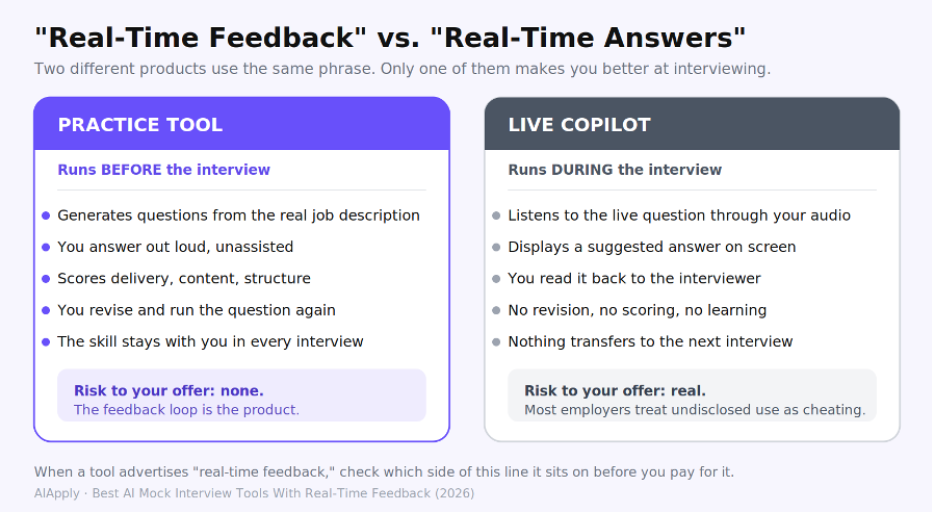
AIApply builds tools on both sides of that line and is explicit about the difference. AI Mock Interview is the practice product. Interview Buddy provides on-screen coaching during live video calls, and AIApply's own position is that it should be used responsibly, as support for someone who has already prepared, never as a way to claim skills or experience you do not have. If you are buying one thing this month, buy the practice tool. Our broader guide to interview practice online covers where peer-led and human formats fit around it.
A Score Is Not Feedback: The Four Layers That Separate Tools
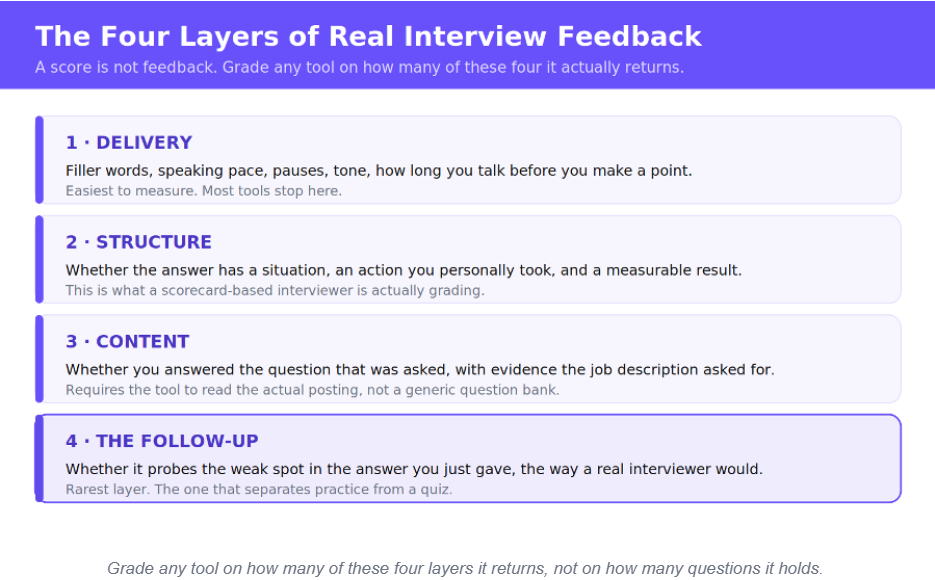
Nearly every tool in this category claims to give feedback. Very few define what they mean, and the gap between the best and worst is not the number of questions in the bank. It is how many of the following four layers the tool can actually return.
1. Delivery
Filler words, speaking pace, pauses, tone, and how long you talk before you make a point. This is the easiest layer to measure automatically, which is why almost every tool offers it and why a delivery-only tool can feel more impressive than it is.
2. Structure
Whether your answer contains a situation, an action you personally took, and a result someone could verify. This is closer to what a scorecard-based interviewer is grading, and it is the layer most candidates lose points on without ever being told. Our library of STAR method interview examples gives you the shape to aim for before you start recording anything.
3. Content
Whether you answered the question that was asked, using the evidence the job description actually asked for. A tool can only grade this if it has read the specific posting. Generic question banks cannot do it, which is why the ability to paste in a real job description is a functional requirement rather than a nice extra.
4. The follow-up
Whether the tool probes the weak spot in the answer you just gave, the way a real interviewer does when something sounds rehearsed. This is the rarest layer and the one that turns a quiz into practice. A tool that asks ten questions and never reacts to a single answer is a question bank with a timer.
The Best AI Mock Interview Tools With Real-Time Feedback in 2026
Pricing below was verified against FavTutor's hands-on testing of 12 mock interview tools in June 2026. Prices in this category change often, so confirm on each site before you buy.
| Tool | Type | Best for | Feedback it returns | Starting price |
|---|---|---|---|---|
| AIApply AI Mock Interview | Practice | Role-specific practice from a real job description | Instant per-answer feedback on what to fix and how to say it better | Free to start |
| Yoodli | Practice | Fixing how you sound | Filler words, pace, clarity, tone, plus a natural follow-up question | Free tier; $8/mo annual |
| Big Interview | Practice + course | Students and career changers | Delivery scoring plus a guided STAR answer builder | $39/month; often free via schools |
| Huru | Practice (mobile) | Practising on your phone | Content, pacing, filler words, tone, plus a model answer | $24.99/month |
| Final Round AI (practice mode) | Copilot + practice | Realistic simulated interview flow | Post-answer analytics and speech feedback | Free plan; paid tiers vary |
| Pramp by Exponent | Peer practice | Free live reps with a human | Whatever your matched peer gives you | Free to start |
| interviewing.io | Human mock | Engineers close to a big offer | Detailed written feedback from a working interviewer | ~$179/session |
AIApply AI Mock Interview: best overall for role-specific practice
Paste a job description and AIApply generates a tailored set of questions from it, then gives instant feedback on each answer showing what to improve and how to phrase it more clearly. A full session including feedback runs 15 to 30 minutes, repeats are unlimited, and it is free to start. The strength is that the questions come from the actual posting rather than a generic bank, which means the practice matches the interview you are walking into. The limitation is that it grades what you say more closely than how you look on camera, so pair it with a delivery tool if video presence is your specific problem.
Yoodli: best for fixing how you sound
Yoodli came out of public speaking coaching, and it shows. It grades filler words, pace, clarity, and tone, transcribes your spoken answer, asks a natural follow-up, and hands back a clean report. FavTutor's testing found a free tier covering five lifetime sessions and Pro at $8 per month billed annually. A verified G2 reviewer quoted in that roundup names the tradeoff directly: it evaluates how you deliver an answer, not whether the answer was strategically the right one. If you ramble when you are nervous, start here.
Big Interview: best for students and career changers
Big Interview pairs video lessons from career coaches with an AI mock simulator, a filterable question bank, and an answer builder that walks you through STAR step by step. FavTutor lists $39 for one month, $99 for three, and $299 for lifetime access, with a 30-day money-back window, and notes it is frequently free through a partnered school, library, or workforce agency. Check that before you pay, because a large number of people can access the full product at no cost.
Huru: best for practicing on your phone
Huru imports a real listing from LinkedIn or Indeed, or takes a pasted description, and builds a mock interview from it. You record video answers and get feedback on content, pacing, filler words, and tone, plus a model answer to compare against. FavTutor's June 2026 check put it at $24.99 per month or roughly $99 per year. Reliability is the caveat: its Trustpilot rating sits around 3.4 from a small sample, and reviewers report mocks that fail to generate questions. Use the free trial before committing.
Final Round AI: strong practice mode, wrapped around a copilot
The mock interview and analytics side of Final Round AI is genuinely good. An independent reviewer who tested five tools while preparing for a senior engineering loop at Amazon rated its mock flow highest of the group for realism, for the interviewer avatars, and for building questions off his actual background rather than a template. It is also a live copilot, and FavTutor documents repeated billing and refund complaints alongside a Trustpilot score that has drifted to around 3.5. If you use it, use the practice mode and set a calendar reminder before the renewal date.
Pramp by Exponent and interviewing.io: when you want a human
Neither of these is an AI tool, and both are worth knowing. Pramp, which now runs inside Exponent, matches you with another candidate to take turns interviewing each other over video, free to start with a capped number of monthly sessions. The feedback quality depends entirely on who you get matched with, and the same reviewer above found the flow confusing when what he wanted was a solo AI session. interviewing.io pairs engineers anonymously with working interviewers from large tech companies at around $179 per session, with a free AI interviewer for warming up first. It is expensive and technical-roles only, and it earns its cost when you are already close to ready rather than starting out.
What happened to Google Interview Warmup
If you came here looking for Google's free tool, it is gone. Google retired Interview Warmup in April 2026, and the original address now redirects to a Grow with Google interview tips article that points users toward Gemini Live for conversational practice instead. Gemini Live will hold a voice conversation and play an interviewer if you ask it to, which is a reasonable free warm-up. What it will not do is score you or tell you which layer of your answer failed.
How to Pick the One That Matches Your Actual Gap
Work through these in order rather than comparing feature lists. First, decide practice or copilot, and decide it honestly. Second, name your gap. If people say your answers are hard to follow, that is delivery, and Yoodli or Huru is the fit. If interviewers keep asking "can you give me a specific example," that is structure and content, and a tool that reads the real job description is the fit. Third, check the free tier before you pay, because most of these have one and one evening of use tells you more than any review. Fourth, if you are weighing an AI tool against a human coach, our comparison of interview preparation services lays out where paid coaching is still worth the money.
One thing to check that almost nobody does: what happens to your recordings. You are uploading a resume and recording your voice and sometimes your face. Look for whether sessions are stored and whether your data trains the model, and note that opting out is often a paid-tier feature.
The Practice Loop That Actually Moves Your Answers
Buying the right tool is roughly a quarter of the outcome. The other three quarters are running the loop more than once, which is where most people stop. One pass through a mock interview is a warm-up. The improvement happens on the second and third pass through the same question.
Paste the job description so the questions come from the real posting. Answer out loud with no notes, because silent rehearsal creates false confidence by skipping the hard part. Read the feedback and pick the single weakest layer instead of trying to fix everything. Rerun the same question the same day and compare the two transcripts. Then bank the structure of the answer, not the script, so it transfers to the next role. AIApply's own guidance is that users who complete at least three practice sessions report feeling meaningfully more confident, which matches the shape of the loop rather than any single session.
The formula: interview readiness = role-specific questions + spoken reps + scored feedback + revision + repetition. Remove any one term and the practice stops compounding. If you want a shorter version for the day itself, our 15-minute interview warmup routine covers what to do in the hour before the call, and our list of 50 common interview questions gives you the raw material to drill against between sessions.
Practice Only Pays Off If You Have Interviews Booked
This is the part the tool comparisons skip. A mock interview tool is worth nothing if nothing is reaching a human, and for most people stuck in this position the interview is not the broken part of the funnel. If you are sending applications and hearing nothing back, the fix sits upstream: AIApply's Resume Scanner checks your resume against the job description before an applicant tracking system filters it out, and Auto-Apply keeps volume moving while you spend your evenings practicing rather than filling in forms. Then AI Mock Interview handles readiness, and Interview Buddy sits behind you during the live call if you want it. The point of running them together is that each one closes a different gap, and a candidate who fixes only one of them stays stuck for a different reason.
Once interviews start landing, the practice gets more specific. Our guide to preparing for a final interview covers the last-round research and question prep that mock sessions do not, and our breakdown of the signs your interview went well helps you read the room afterward instead of refreshing your inbox.
Start Tonight, Not the Morning Of
Pick the tool that matches your gap, paste in the description for the role you are actually interviewing for, and run the same three questions twice tonight. That is a 45-minute commitment and it is the highest-return block of time in your entire job search, because it is the only part of the process where you get to be bad at something privately before it counts. Start a free AI Mock Interview with AIApply, and if the applications feeding those interviews have dried up, fix that upstream first.
Frequently Asked Questions
What is the best AI mock interview tool with real-time feedback?
AIApply's AI Mock Interview is the best fit for most job seekers, because it builds questions from the specific job description you paste in and gives instant feedback on each answer. Yoodli is stronger if your problem is delivery rather than substance, and Big Interview is the better pick for students who can access it free through a school or library.
Is there a free AI mock interview tool with instant feedback?
Yes. AIApply's AI Mock Interview is free to start, Yoodli includes a free tier, and Pramp by Exponent offers free peer-to-peer mock interviews. Gemini Live will also hold a conversational mock for free, though it does not score your answers or flag which part was weak.
What is the difference between an AI mock interview and an interview copilot?
An AI mock interview runs before the interview and gives you feedback so you improve; an interview copilot runs during the live interview and feeds you answers to read. The first builds a skill you keep. The second produces a performance that ends when the call does, and most employers treat undisclosed use of it as dishonest.
Is it cheating to use AI during a job interview?
Using AI to prepare for an interview is not cheating and is widely accepted; using it to generate your answers during a live interview without disclosure is treated as dishonest by most employers. A growing number of companies now ban real-time assistance outright or run detection on it, so the safe rule is to use AI heavily before the interview and follow the employer's stated rules during it.
Do AI mock interviews actually improve interview performance?
The strongest case for them is mechanical rather than statistical: speaking your answer out loud and getting told specifically what was unclear is the only way to catch problems that silent rehearsal hides. AIApply reports that users who complete at least three practice sessions feel meaningfully more prepared, and the improvement comes from repeating and revising the same question rather than from running through a long question list once.
What happened to Google Interview Warmup?
Google retired Interview Warmup in April 2026, and its original address now redirects to a Grow with Google article on interview preparation. Google points users toward Gemini Live in the Gemini app for conversational practice, which holds a voice conversation but does not return scored feedback on your answers.
How many mock interviews should I do before a real interview?
Three passes through the same set of role-specific questions beats ten passes through different ones. Because a full AIApply session including feedback takes 15 to 30 minutes, three passes fits in a single evening, which is usually enough to turn a rambling answer into a structured one.
Can an AI mock interview tool prepare me for a technical interview?
Partly. AI tools handle the behavioral and role-specific rounds well, but for coding and system design the strongest feedback still comes from a human. Free peer practice on Pramp covers a lot of ground, and interviewing.io's paid sessions with working engineers are worth the cost when you are already close to ready for a competitive loop.