Best Alternatives to LoopCV in 2026 (Ranked by What Your Search Actually Needs)
The best LoopCV alternatives in 2026, ranked by the stage of your job search each one fixes: AIApply, JobCopilot, Simplify, Jobright, Teal and LazyApply compared.

Job searching in 2026 means competing with an application flood that AI created and recruiters cannot keep up with. This guide ranks the best LoopCV alternatives by the problem each one actually solves.
Key Takeaways
- The best LoopCV alternatives in 2026 are AIApply for the full pipeline, JobCopilot for hands-off volume on company career pages, Simplify for free autofill you control, Jobright AI for US matching and referrals, Teal for a deliberate manual search, and LazyApply for raw volume with the heaviest caveats.
- Pick a replacement by the stage where your search is stuck: targeting, packaging, distribution, conversion or interview, not by how many applications a plan allows per month.
- Application volume now works against you. Huntr's Q1 2026 data shows job seekers sending 11-20 applications interviewed at 9.25% per application, against 2.58% for those sending 100 or more.
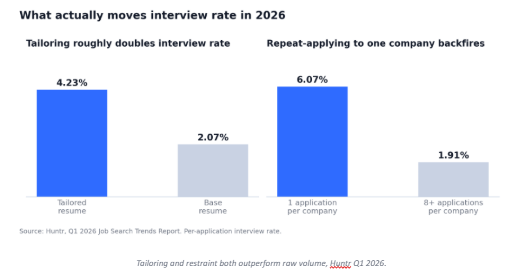
- Tailoring is the single biggest lever in the data: tailored resumes converted at 4.23% versus 2.07% for base resumes, roughly double.
- Apply once per company and move on. Eight or more applications at one employer cut the per-application interview rate to 1.91%, against 6.07% for a single application.
- The reason people leave LoopCV is usually the gap between jobs matched and jobs actually submitted, so verify real submissions inside its seven-day refund window, which voids once you use 10% of your quota.
- G2 and Capterra are no help here. Both have LoopCV filed as employer-side software, so their alternatives lists return job boards and applicant tracking systems.
- Never let AI invent experience. Hallucinated skills are the most-reported failure mode across every tool in this category, and you own that line in the interview.
The best LoopCV alternatives in 2026 are AIApply for running the whole job-search pipeline with non-expiring auto-apply credits, JobCopilot for hands-off volume on company career pages, Simplify for free autofill where you press Submit yourself, Jobright AI for US-focused matching and referral discovery, Teal for a deliberate manual search, and LazyApply for raw volume at the lowest sticker price. Which one fits depends on where your search is stuck, not on how many applications a plan allows per month.
Most people who go looking for a LoopCV replacement are not shopping for features. They have a dashboard full of matched jobs, a much smaller number of applications that actually went out, and an inbox with nothing in it. So they assume the fix is a tool that applies to more jobs, faster, for less money.
That assumption is the expensive part. In 2026, sending more applications is the single most reliable way to lower your interview rate. The tool you pick matters, but only after you have worked out which stage of your search is broken.
Why job seekers start looking for a LoopCV alternative
LoopCV is a real product with a real user base. It has run since the late 2010s, it applies across 30-plus job boards, and its pricing page offers a free plan with no credit card, with paid tiers starting from EUR 9.99 per month. If your loops are reliably submitting applications and replies are coming back, there is no reason to switch.
Four things push people to look elsewhere, and only one of them is price.
- The gap between matched and applied. This is the complaint that dominates third-party reviews of LoopCV: a dashboard reporting large numbers of matched roles alongside a far smaller number of confirmed submissions. Whatever the cause, board coverage, forms the bot can't complete, or queue priority, a matches counter is not evidence that anything reached an employer.
- Monthly caps rather than usage-based capacity. LoopCV meters applications and recruiter emails by the month, and unused capacity does not roll forward. If you search in bursts, which most people do, you pay for throughput in the months you don't use it.
- Recruiter email outreach is a sharp instrument. Cold-emailing recruiters is genuinely differentiated and can outperform portal applications in relationship-driven roles. It also fails publicly, under your name, when the targeting is off.
- A short, conditional refund window. LoopCV's own FAQ sets the refund window at seven days and voids it once you have used more than 10% of your application quota. That is a narrow window in which to prove the tool works, so test submissions on day one, not day six.
In short: none of this makes LoopCV a bad product. It makes it a distribution tool, and distribution is only one of the five things that have to work before you get hired. For a full head-to-head on how its looping engine compares with a pipeline approach, see AIApply vs LoopCV, which breaks down both pricing models tier by tier.
The mistake almost every LoopCV alternatives list makes
Nearly every competing roundup ranks tools by throughput: 100 applications a month here, 300 there, 1,500 a day somewhere else. Read a few and you would conclude the winner is whichever tool fires the most applications per dollar.
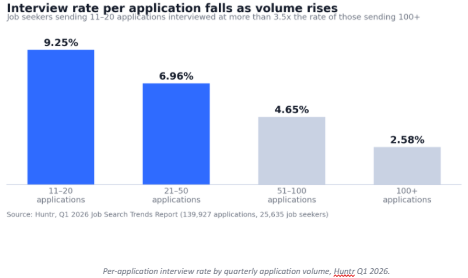
The 2026 data points the other way. Huntr's Q1 2026 Job Search Trends Report, built on 139,927 applications from 25,635 job seekers, found that people who sent 11 to 20 applications in the quarter interviewed at 9.25% per application, while those who sent 100 or more interviewed at 2.58%. That is more than a 3.5x gap running in the opposite direction to the marketing.
The same report found two-thirds of successful searches ended within 50 applications, and that applying eight or more times at a single company cut the per-application interview rate to 1.91%, against 6.07% for people who applied once and moved on. Volume is not neutral. Past a point it is actively negative signal, which is why our guide on how many jobs to apply to per week argues for a tiered target rather than a maximum.
Two forces explain it. First, the flood: Greenhouse reports that application volume jumped 111% between 2022 and 2025 while recruiter headcount fell 56% over the same period, and that 74% of candidates now use AI in their search. Second, quality still separates. Huntr found tailored resumes converting at 4.23% against 2.07% for base resumes, roughly double, and called it the most consistent finding in the report.
So the question to ask of a LoopCV alternative is not how many applications it will send. It is whether it improves what goes out, and whether you can verify that anything went out at all. That is the frame the rest of this guide uses, and it is the same logic behind our system for applying to jobs.
The best LoopCV alternatives in 2026, at a glance
Pricing and features in this category change often, and several vendors publish no public price at all. Treat the models below as durable and confirm current numbers on each vendor's own site before you pay.
| Tool | How the automation works | Best for | Watch out for |
|---|---|---|---|
| AIApply | Server-side Auto Apply metered by credits, plus resume, cover letter, ATS scanning and interview tools in one workflow | Job seekers whose search is failing at more than one stage, and bursty searches where unused capacity shouldn't expire | Auto Apply credits are bought separately from the subscription, so price the whole stack before you commit |
| JobCopilot | Server-side agent that applies directly on company career pages, with an optional review-before-submit mode | Sustained hands-off volume where the applications go to employers' own careers sites rather than board reposts | No free tier, and reviewers report weak filtering of scam and ghost listings; run it supervised at first |
| Simplify | Browser-extension autofill; the tool fills the form and you press Submit | Selective searches where you want speed on forms but refuse to let anything go out unseen | This is not auto-apply, so your own time stays the ceiling on volume |
| Jobright AI | AI matching across a large US posting index, with an auto-apply agent and referral discovery | US-only searches where the bottleneck is finding roles you can actually win, plus warm intros | US coverage only, no public pricing page, and reviewers report AI-tailored resumes inventing skills |
| Teal | No automation at all: a tracker, a resume builder and per-job match scoring | Senior or niche searches where every application deserves human judgment anyway | Solves organization, not throughput; every application is submitted by hand |
| LazyApply | Browser extension that bulk-submits on major boards while your browser runs | Raw advertised volume at the lowest sticker price per application | Annual-only billing with no trial, LinkedIn's terms prohibit automation, and the review record is the weakest here |
1. AIApply: best for job seekers whose search is broken at more than one stage
AIApply is the strongest LoopCV alternative for anyone who cannot confidently name which stage of their search is failing, because it covers packaging, distribution and interview performance in a single workflow rather than fixing one and leaving the rest.
The practical difference from LoopCV is what happens before an application goes out. AIApply's AI Resume Builder generates a resume against the specific job description, the Resume Scanner runs an ATS check across 50-plus systems and flags keyword gaps before you submit, and the Cover Letter Generator drafts a role-specific letter you edit rather than a template you reuse. Auto Apply then scans over a million postings, tailors materials per posting, and submits on your behalf.
The pricing model is the second real difference. AIApply prices the tools and the throughput separately: a free tier covering cover letters, the Resume Scanner and the job board, a Pro subscription at roughly $29 a month or about $12 a month billed annually, and Auto Apply capacity bought as credit packs where one credit equals one application and unused credits never expire. Against LoopCV's monthly caps, that suits bursty searching, which is how most people actually search. Both models are laid out tier by tier on the AIApply vs LoopCV comparison.
The stage most tools ignore entirely is the last one. Getting interviews you then lose is an interview-performance problem, and no amount of application volume fixes it. AIApply's AI Mock Interview generates questions from a pasted job description and scores your answers, and Interview Buddy runs as a desktop app on Windows and macOS providing on-screen support during live calls. Use Interview Buddy only where you would be comfortable telling the employer you were using it; if the honest answer is no, stay in Mock Interview practice mode. Our guide to how long it takes to hear back after applying covers what to do with the waiting time in between.
Note: auto-apply capacity is bought on top of the subscription, so add up the whole stack before committing rather than budgeting from the headline price. And AIApply's own Terms of Service are explicit that AI output can be wrong and that some platforms restrict automation, which is a fair warning to read anything going out under your name.
2. JobCopilot: best for hands-off volume on company career pages
JobCopilot is the closest like-for-like replacement for LoopCV's core mechanic, because it runs server-side and keeps applying whether or not your browser is open. Its differentiator is destination: it targets official company career pages rather than job-board reposts, which means applications land in the employer's own ATS rather than a syndicated copy of the posting.
It bundles a resume builder, cover letters, mock interviews and a tracker into the subscription, and offers a save-for-review mode if you would rather approve each application before it goes out. For someone whose only genuine bottleneck is throughput, and who has already validated that their materials convert, it does the job LoopCV was hired for.
Note: There is no free tier or trial, so you pay before you can test whether it works for your role and region. Reviewers also report applications being submitted to scam and ghost listings, which matters more than it sounds given that 93% of Huntr's Q1 2026 survey respondents said they had applied to a posting they believed was fake. Run it in review mode for the first batch and read what it is targeting.
3. Simplify: best free option if you want to press Submit yourself
Simplify is the philosophical opposite of LoopCV, and for people burned by applications they never saw, that is the entire appeal. Its browser extension autofills each application while you watch, and you click Submit. Nothing goes out unreviewed.
The free tier is genuinely usable rather than a trial: unlimited autofill, application tracking that logs what you sent, and AI matching. Accuracy is strongest on the startup and tech ATS platforms most people encounter, and weaker on older enterprise systems, so expect to finish some forms by hand.
Note: This is not auto-apply, whatever the marketing says. Your own hours remain the ceiling on volume, which is fine if you have accepted that 15 to 25 careful applications a week beats 200 careless ones. If you want to work out what your own number should be, our breakdown of how many jobs to apply to per day sets realistic targets by situation.
4. Jobright AI: best for US matching and referral discovery
Jobright attacks the targeting stage rather than the distribution stage, and targeting is where more searches fail than most people admit. It scores your profile against a large index of US postings, filters for things like remote work and visa sponsorship, and surfaces alumni and employee contacts who could refer you.
That referral angle is worth more than it looks. Huntr found that 85% of job seekers spend most of their search time on online applications, while 38% of people who landed an interview got there through a referral, a recruiter reaching out, or networking. Applying is where the time goes; relationships are where a disproportionate share of the interviews come from.
Note: Coverage is US-only, which makes it a poor swap if you are searching in Europe, LoopCV's strongest market. There is no public pricing page. And multiple reviewers report the resume AI inserting skills and metrics the candidate does not have, which is a problem you own in the interview, not the tool. Read every generated document before it ships.
5. Teal: best for a deliberate search with no automation at all
Some people leaving LoopCV do not want a better robot. They want control back, usually because they are senior enough or niche enough that every application deserves judgment. Teal is the strongest option for that: a genuinely good application tracker, a resume builder with per-job match scoring, and a free tier that is unlimited on the things that matter.
It is worth being clear that Teal solves organization, not throughput. There is no auto-apply and no form autofill, so every submission is manual. Given the volume data above, that constraint is not obviously a weakness. If tailoring is the part you want help with, our guide on how to tailor your resume to a job description covers the mechanics regardless of which tool you use.
Note: reviewers consistently describe the AI-generated output as generic and in need of editing, and the weekly billing option annualizes to a number most people would not agree to up front. Check which billing cadence you selected.
6. LazyApply: highest advertised volume, and the largest caveats on this list
LazyApply earns a place here on volume economics alone. Its extension bulk-submits on major boards while your browser runs, and its advertised daily caps are the highest in the category, which on paper produces the cheapest cost per application anywhere.
It is last for a reason. Billing is annual only with no free tier and no trial, so you commit before you can test it. Its public review record is the weakest of any tool here, dominated by reports of the software failing to fill fields correctly, including sensitive ones like salary expectations and visa-sponsorship answers. And it operates inside LinkedIn, whose terms prohibit automation; your LinkedIn account is considerably harder to replace than a subscription.
Note: If you use it at all, use it on boards outside LinkedIn, check the first 20 applications field by field, and treat the advertised daily caps as a marketing number rather than a plan.
Why G2 and Capterra will not help you choose here
If you have already tried the big software review sites, you were not imagining the problem. Both have categorized LoopCV as employer-side hiring software rather than a job seeker tool, and their alternatives lists reflect that.
G2's LoopCV page carries three reviews and recommends ZipRecruiter, Paycom, Indeed Hiring Platform and Naukri as the closest alternatives, which are job boards and payroll systems. Capterra's LoopCV listing carries a single review and suggests CEIPAL ATS, Workable and Zoho Recruit, all applicant tracking systems built for the people receiving your application, not sending it.
This is a category mapping artifact, not a judgment on LoopCV. But it means the review sites most buyers trust for software decisions have no useful signal in this category, which is worth knowing before you weigh a three-review average as evidence of anything.
How to pick your LoopCV alternative in one question
Ask where your search is actually stuck. Landing a job is a five-stage pipeline, and each stage fails differently. A tool that fixes distribution will do nothing for a packaging problem, and buying more throughput to solve a targeting problem just accelerates the wrong thing.

Read the diagnosis off your own numbers rather than your instincts.
- Applications go out and nothing comes back at all. That is packaging or targeting. Fix materials and fit before you buy any throughput; more volume makes it worse.
- Recruiter screens happen but stop there. That is packaging holding up and conversion failing. Look at follow-up discipline and role fit, not application count.
- You get interviews and lose them. That is interview performance. Application tooling is irrelevant to this problem; mock interviews and prep are the only lever.
- You genuinely cannot get enough good applications out. Only now is throughput your problem, and only for roles you have already scored as worth applying to.
Our complete guide to getting hired fast works through each of these in sequence, including a scoring framework for deciding which roles deserve a tailored application and which are fine to automate.
How to run any auto-apply tool without damaging your search
Every tool on this list can hurt you if you point it at the wrong roles. These rules apply regardless of which one you pick.
- Validate submissions inside the refund window. Run 10 applications, then confirm they arrived, by confirmation emails, screenshots or the employer's own portal. A matches counter is not proof.
- Start supervised, always. Use review-before-submit mode until you have read a full batch of generated documents and agree with every line.
- Cap volume deliberately. The data supports 15 to 25 targeted applications a week over hundreds. Set the cap yourself rather than letting the plan set it.
- Apply once per company. Pick the best-fitting role and move on. Repeat applications to the same employer measurably reduce your odds.
- Never let AI invent experience. Huntr found 42% of survey respondents would use AI to misrepresent part of their resume. Every line you cannot defend in an interview is a liability, and hallucinated skills are the most-reported failure mode across these tools.
- Keep human follow-up in the loop. Automation handles the form. It does not handle the message to a hiring manager, which is where a disproportionate share of interviews originate.
If you would rather test the category before paying for any of it, our roundup of free AI tools for job seekers covers what each free tier genuinely includes.
Frequently Asked Questions
What is the best alternative to LoopCV?
AIApply is the best overall LoopCV alternative for most job seekers, because it covers document quality, automated applying and interview preparation in one system rather than fixing distribution alone. If your only bottleneck is genuinely throughput, JobCopilot is the closest like-for-like swap; if you want control back, Simplify or Teal fit better.
Is LoopCV still worth using in 2026?
LoopCV is still worth using if its loops are reliably submitting applications for you and replies are coming back. It has a free plan, applies across 30-plus job boards, and its recruiter email outreach is genuinely differentiated. The risks to check early are the gap between matched and submitted jobs, monthly caps that do not roll over, and a seven-day refund window that voids once you use 10% of your quota.
Are there free LoopCV alternatives?
Yes, with different trade-offs. Simplify's free tier gives you unlimited autofill and tracking, though you submit each application yourself. Teal's free tier covers unlimited application tracking and resume versions with no automation. AIApply's free tier includes cover letters, the Resume Scanner and the job board. LoopCV's own free plan allows a limited number of applications per month.
Why does LoopCV match thousands of jobs but apply to far fewer?
The gap comes from several compounding causes: monthly application quotas that are far smaller than match volume, free-tier accounts sitting in a lower-priority queue, and matched postings whose application forms the automation cannot complete. "Matched" only means a job passed your filters, not that an application was attempted. Judge any tool by confirmed submissions and recruiter replies rather than the matches counter.
Does auto-apply actually hurt your chances?
Untargeted auto-apply measurably lowers your interview rate. Huntr's Q1 2026 data shows job seekers sending 100 or more applications in a quarter interviewed at 2.58% per application against 9.25% for those sending 11 to 20. Auto-apply helps when it is pointed at roles you have already decided are worth applying to and each application is tailored; it hurts when it substitutes volume for fit.
Do these tools automate LinkedIn Easy Apply?
Most deliberately do not, because LinkedIn's terms prohibit automation and mass-apply plugins have appeared on blacklists that put accounts at risk. Tools like AIApply and JobCopilot target employer ATS platforms and company career pages instead. LazyApply operates inside LinkedIn, which is the main reason it carries the most account-level risk on this list.
How do I know which LoopCV alternative I need?
Identify which stage of your pipeline is failing before you compare tools. If applications get no response at all, your problem is targeting or packaging and no amount of throughput will fix it. If you get interviews but no offers, the problem is interview performance. Only buy application volume when you have confirmed that your materials already convert.
Where to go from here
Pick the tool that fixes your bottleneck, not the one with the biggest number on its pricing page. Then prove it works before your refund window closes: run 10 to 15 applications, confirm every one of them actually reached an employer, and read what went out under your name.
If your search is failing at more than one stage, which is the common case, AIApply covers packaging, distribution and interview performance in one workflow. Start on the free tier, run your resume through the Resume Scanner, and only buy Auto Apply credits once you are happy with what the tailored materials look like. The credits do not expire, so there is no pressure to spend them on roles you would not accept.