Why Am I Not Getting Interviews? 10 Reasons (2026 Diagnosis Guide)
Not getting interviews? Your application funnel has a fixable leak. Pinpoint exactly where you are losing and what to do about it in 2026.


Updated: June 8, 2026
You've sent dozens of applications. Some roles you were genuinely qualified for. The silence is starting to feel personal.
It probably isn't. What looks like "not good enough" is almost always a funnel problem. Something broke before the interview stage, and you don't know where.
At AIApply, we work with over a million job seekers every year. The single most common pattern we see: qualified candidates getting zero responses not because they're unqualified, but because their applications are failing at a specific, fixable point. Greenhouse's 2025 Workforce & Hiring Report found that only 7% of candidates believe the job market currently favors them, and 22% of applicants are now using bots to apply automatically, rising to 31% among Gen Z. You're competing in a crowded, automated, low-trust system.
The good news? Funnel problems have funnel solutions. Below are the 10 reasons qualified people stop hearing back, each with the specific fix. Work through them in order and you'll find exactly where you're losing.
Why You're Not Getting Interviews: The Short Answer
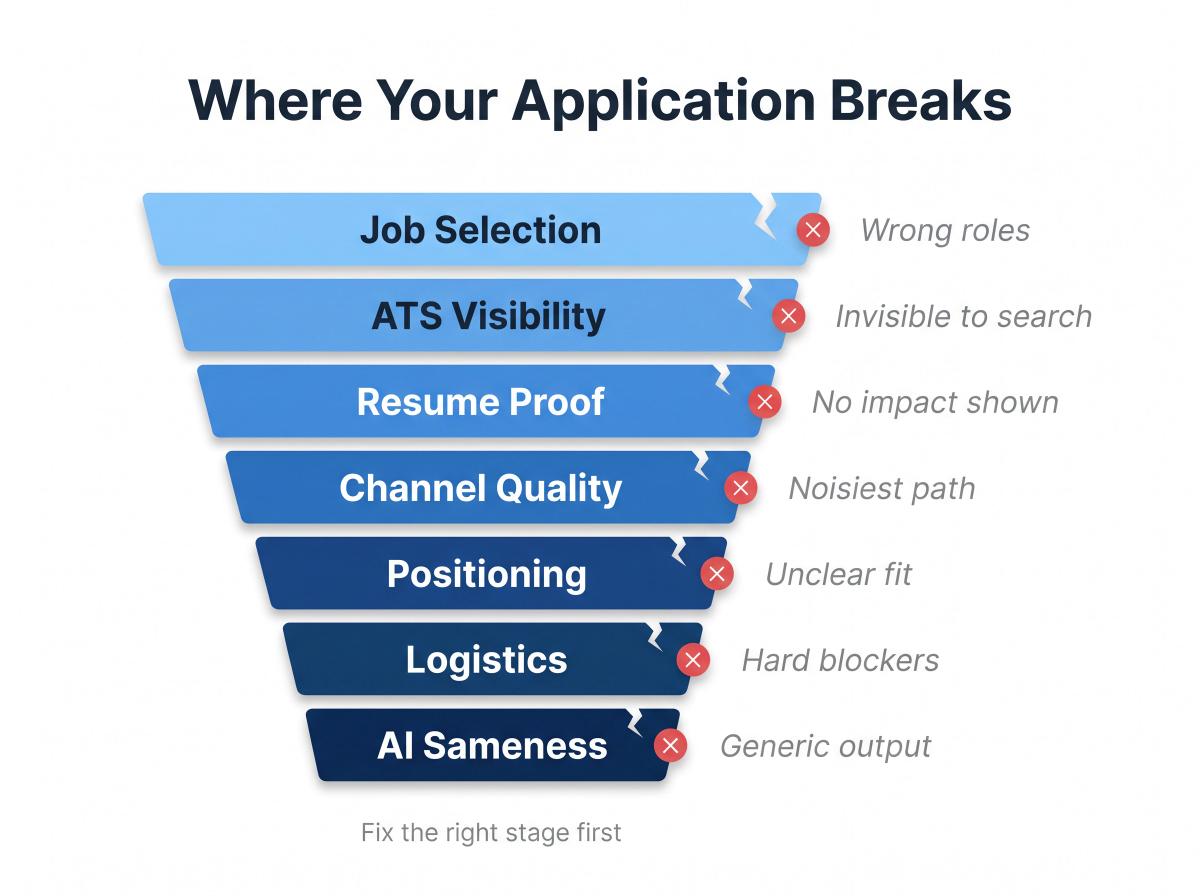
If you want the short version: you're probably not getting interviews because your application is failing at one of these points.
| Where the funnel breaks | What it looks like | What to fix first |
|---|---|---|
| Job selection | You're applying to many roles but most are stretches, stale postings, or vague | Narrow your target, apply to higher-match active jobs only |
| ATS visibility | Fast rejections from roles you seem qualified for | Add exact, truthful role keywords and use ATS-safe formatting |
| Resume proof | Your resume lists duties but doesn't show impact | Rewrite bullets around outcomes, metrics, scope, and tools |
| Channel quality | You mostly use job boards or Easy Apply | Add referrals, company career pages, and direct outreach |
| Positioning | You look too broad, too senior, too junior, or like a career changer with no bridge | Create a focused target narrative |
| Logistics | You're filtered by location, visa, salary, degree, or a required certification | Make eligibility obvious, avoid hard blockers |
| AI sameness | Your resume sounds polished but generic | Use AI to clarify real experience, not to fabricate or soften it |
The mistake most job seekers make is rewriting their resume over and over without figuring out which specific problem they have. Knowing where the leak is changes everything about what you do next.
What Recruiters Are Really Looking For in Applicants
Most job seekers assume recruiters are asking: "Is this a good person?"
They're not. They're asking: "Can I confidently put this person in front of the hiring manager for this exact role?"
A "good candidate" is vague. A low-risk match is specific. Here's what that looks like from the recruiter's perspective:
- They've done similar work (or close enough that the learning curve is obvious)
- They use the same tools, or demonstrably equivalent ones
- They understand the industry
- They fit the level, not significantly over or under
- They can start under the employer's constraints (timeline, location, authorization, salary)
- Their resume makes the match obvious in 30 seconds or less
- Some trusted signal (referral, prior relationship, specific data) reduces doubt
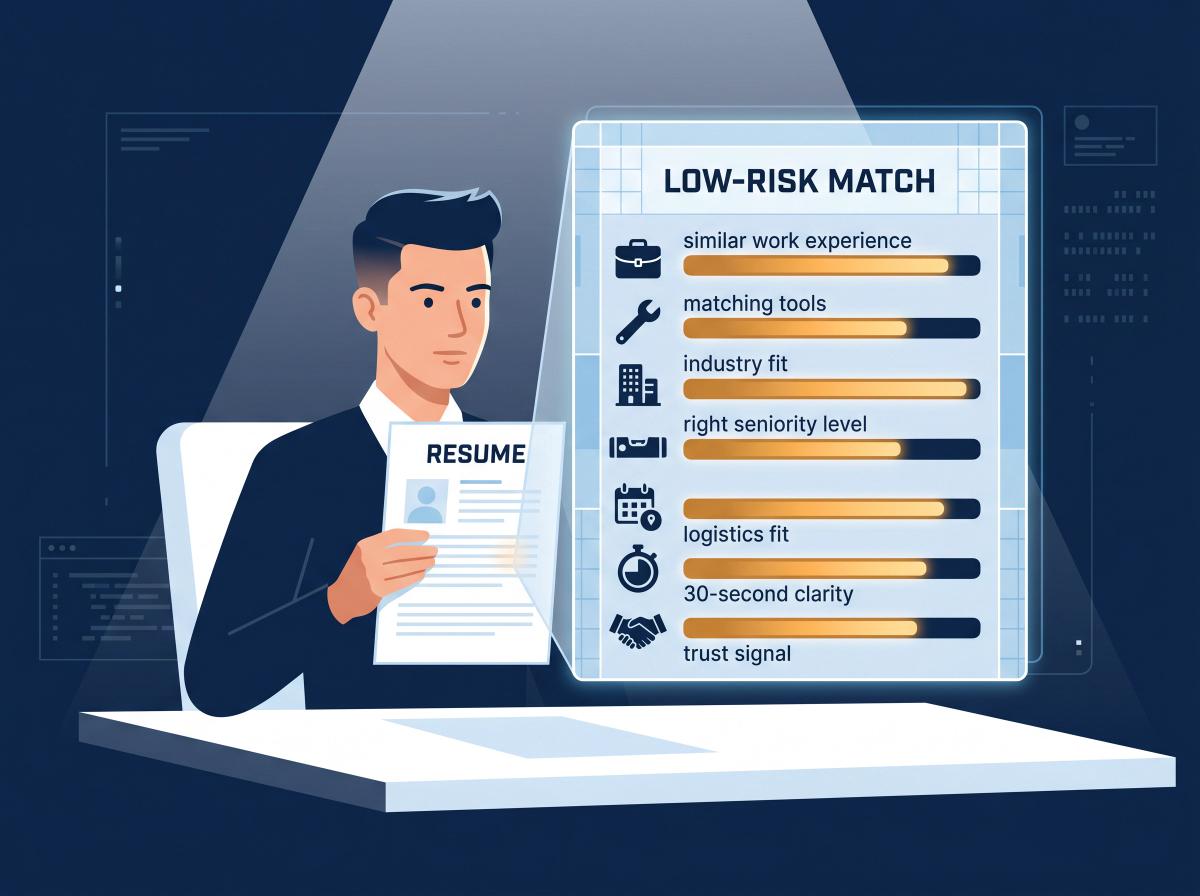
That's the game your application is playing. Your resume isn't your biography. It's a matching document. Your application isn't a plea. It's a proof packet.
Everything else in this guide flows from this one shift in framing.
The 10 Real Reasons You're Not Getting Interviews
If you're getting zero interviews, the leak is almost always at the top of the funnel: visibility and targeting, not your final-round answers. So don't start by asking "Is my resume good?" Start by asking where you're losing. Each of the 10 reasons below is a specific failure point with a specific fix. Find the ones that match your situation and start there.
1. You're Applying to the Wrong Jobs
Most people don't have an effort problem. They have a targeting problem.
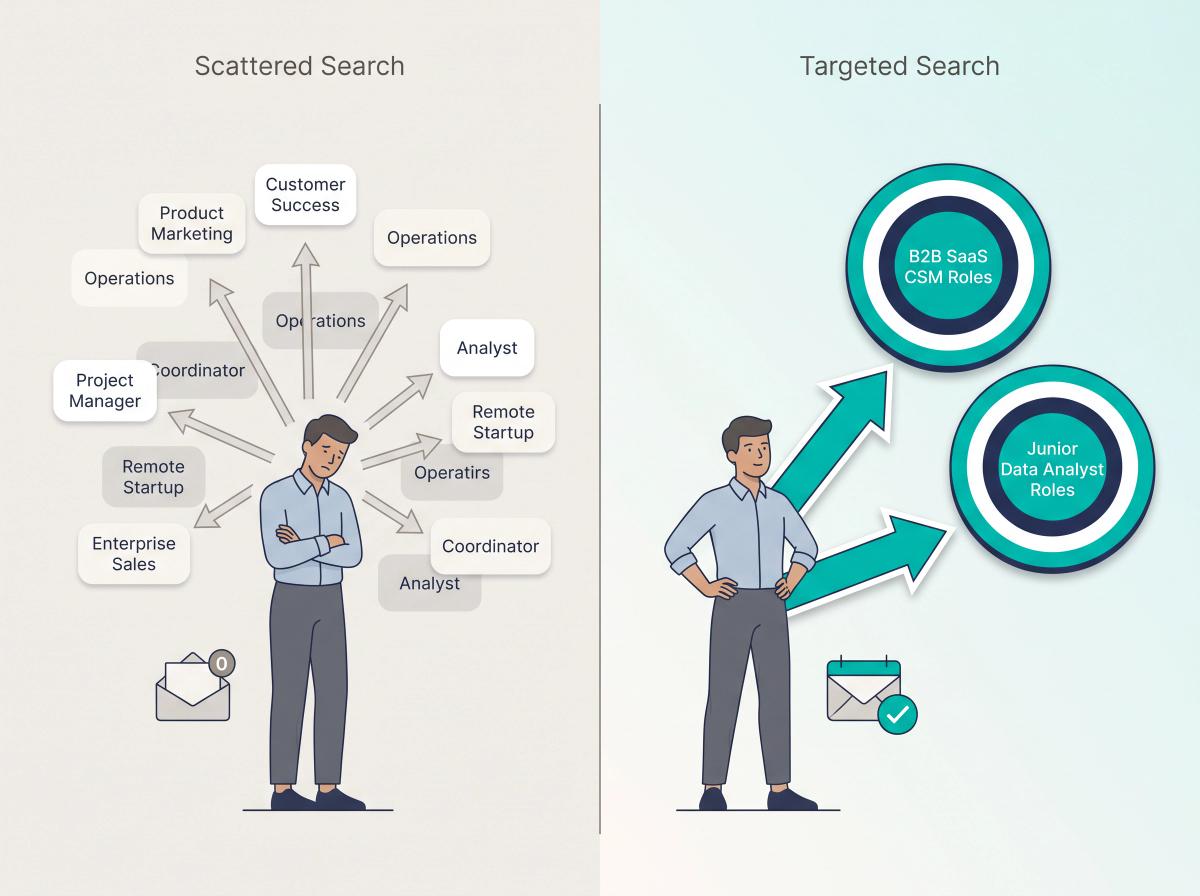
They apply to product marketing, customer success, operations, project management, analyst roles, remote roles, startup roles, enterprise roles, all with roughly the same resume. That doesn't signal flexibility. It signals you're not sure what you want. Recruiters are filling specific roles. If your resume says "I can do many things," you lose to the person who looks built for exactly this one.
The fix: choose 1-2 target lanes.
A target lane isn't "marketing." That's too broad. Here's what a real target lane sounds like:
- "B2B SaaS customer success associate roles at companies with 50-500 employees"
- "Junior data analyst roles using SQL, Excel, Tableau, and stakeholder reporting"
- "Operations coordinator roles in logistics, supply chain, or marketplace startups"
- "Entry-level SDR roles selling software to mid-market companies"
For each lane, build a dedicated resume version. Not a totally different identity, just a different emphasis.
Use this scorecard before applying cold. Only send an application if the role scores at least 8 out of 12:
| Fit factor | Points |
|---|---|
| You meet the required experience level | 0-2 |
| You have the key tools (or can prove equivalent) | 0-2 |
| Your recent work maps to the job's main responsibility | 0-2 |
| The role is active, not stale | 0-2 |
| You can satisfy location, salary, visa, and start-date constraints | 0-2 |
| You have a human path: referral, recruiter, alumni, or hiring manager | 0-2 |
A 6/12 role might still be worth pursuing if you have a strong referral. But a week of 6/12 cold applications won't move your search forward, no matter how many you send.
2. Your Resume Isn't Showing Up in Recruiter Searches
ATS systems aren't magic robots judging your soul. They're databases, parsers, and search tools.
Research from Jobscan's 2025 ATS Usage Report found that 76.4% of recruiters search and rank candidates by skills from the job description. That means your resume can be genuinely strong in human terms while being invisible in search terms.
Here's the gap in action:
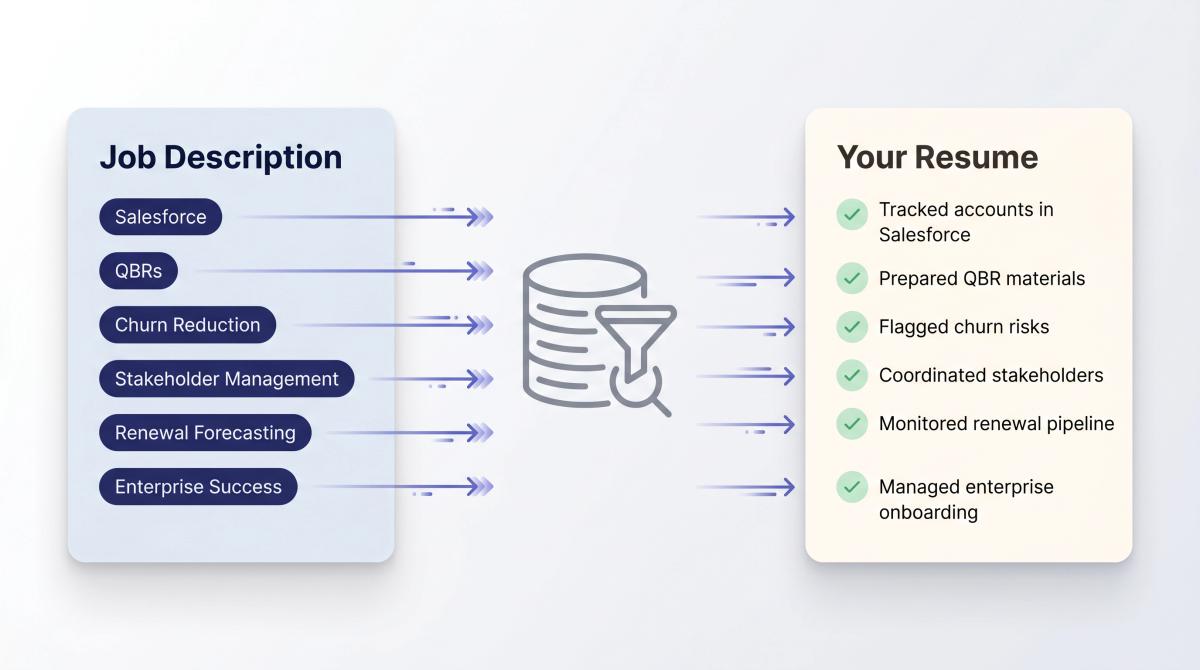
The job description says: Salesforce, renewal forecasting, enterprise customer success, QBRs, churn reduction, stakeholder management
Your resume says: managed client relationships, helped customers succeed, supported accounts, worked with CRM, improved retention
You may be describing the exact same work. The system just doesn't see the match.
The fix: build a keyword bridge, not a keyword dump. Don't stuff random words into your resume. Translate your real experience into the employer's language.
| Job description language | Your honest matching language |
|---|---|
| "Salesforce" | "Tracked renewal risk, pipeline notes, and account activity in Salesforce" |
| "QBRs" | "Prepared quarterly business review materials for enterprise accounts" |
| "Churn reduction" | "Flagged adoption risks and helped reduce preventable churn across assigned accounts" |
| "Stakeholder management" | "Coordinated executive, technical, and end-user stakeholders during onboarding" |
| "SQL" | "Used SQL joins and filters to pull weekly performance reports" |
The goal isn't to trick anyone. The goal is to make the real match visible. If you're unsure which key skills for Customer Success roles are appearing most in job descriptions, reviewing what employers are actually asking for helps you close that gap deliberately.
Our free ATS Resume Checker is built for exactly this step: upload your resume, get an ATS compatibility score, keyword gap analysis, and formatting fixes checked against 50+ ATS systems, in seconds.
3. Your Resume Lists Duties Instead of Achievements
Most resumes say what the person was responsible for. Hiring teams care what changed because you were there.
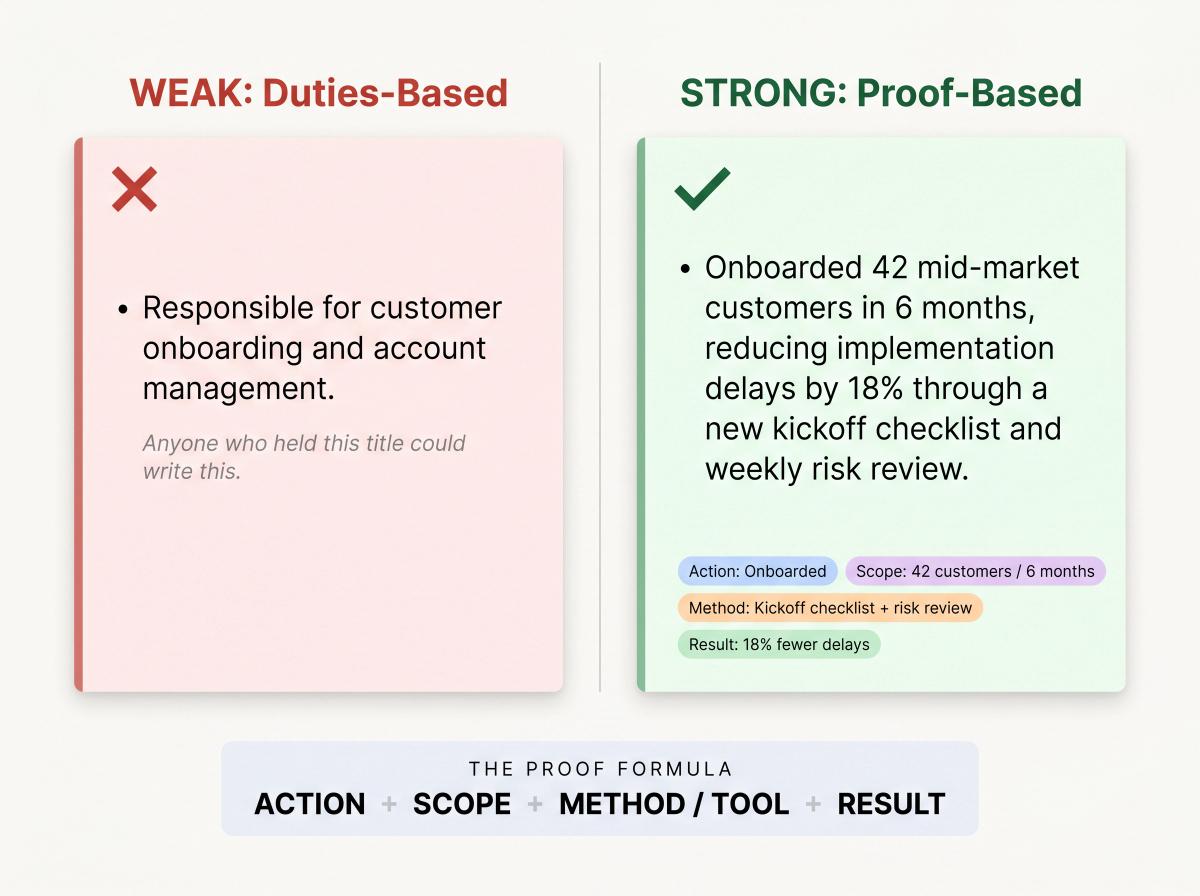
Before: "Responsible for customer onboarding and account management."
After: "Onboarded 42 mid-market customers in 6 months, reducing average implementation delays by 18% through a new kickoff checklist and weekly risk review."
The second version gives scope, action, method, and result. The recruiter can see impact. The first version could describe anyone who ever had that job title.
The proof formula: Action + object + scope + tool/method + result
Some examples of what this looks like in practice:
- "Built a weekly Excel dashboard tracking 14 operational KPIs, cutting manual reporting time from 3 hours to 45 minutes"
- "Resolved 60-80 customer tickets per week in Zendesk while maintaining a 94% CSAT score"
- "Created onboarding documentation for 120 new users, reducing repeat support questions by 30%"
- "Analyzed 18 months of sales data in SQL to identify underperforming segments and support a revised outreach strategy"
If you're targeting customer-facing roles and want to see the proof formula applied to a full document, our Customer Success Manager resume examples show what quantified impact bullets look like in context. If you're targeting analytics roles, our data analyst resume example demonstrates how to frame technical projects as evidence.
If you don't have hard metrics, use proxies: How many customers? How often? What scope? What tools? What was better afterward? Your resume should never say "trust me." It should say "here's the evidence."
4. Your Resume Isn't Easy to Scan in 30 Seconds
A recruiter doesn't read your resume like a novel. They scan for fit.
Research on recruiter behavior found that 30 seconds is a realistic initial CV review time, with many recruiters spending even less in a first pass. That doesn't mean your resume needs to be ugly. It means the most important signals need to be obvious.
The top third of your resume should answer five things immediately:
① What role are you targeting?
② What level and experience do you have?
③ What industries or functions do you know?
④ What tools or skills matter for this role?
⑤ What's your strongest proof?
Weak summary: "Motivated professional seeking an opportunity to grow in a dynamic organization."
Strong summary: "Customer Success Associate with 2 years of SaaS support and onboarding experience. Managed 60+ weekly Zendesk tickets, supported Salesforce account updates, and helped create onboarding docs that reduced repeat customer questions by 30%. Strong fit for CSM roles requiring client communication, adoption tracking, and cross-functional coordination."
The second version tells the recruiter exactly where to place you.
Formatting that still matters: Use clear section headings, reverse chronological order, simple bullet points, and a skills section grouped by category. Avoid text boxes, heavy graphics, two-column layouts that parse badly, and keyword-stuffed footers.
Our AI Resume Scanner can compare your resume against a specific job description and flag missing keywords, weak action verbs, ATS issues, and formatting problems before you send.
5. You're Relying on Job Boards Alone
Cold online applications still matter. But if job boards are your only strategy, you're choosing the noisiest channel.
Research from CareerPlug's April 2025 Recruiting Metrics Report (based on 2024 hiring data) found that:
- Job boards produced 61% of applications but only 42% of hires
- Company career pages produced 13% of applications but 26% of hires
- Referrals produced just 2% of applicants but 11% of hires
- Referrals were 10 times more likely to be hired than applicants from job boards
Ashby's talent trends data tells the same story: 40% of referred candidates went from application to interview, and 16% of those reached offer stage.
This is why "I applied to 300 jobs" can still produce nothing. Volume through the weakest channel isn't a strategy.
The fix: use a 4-channel approach. For every serious role, try to create at least one human signal.
| Channel | What to do |
|---|---|
| Company career page | Apply directly. It often signals more intent than job-board quick apply. |
| Referral | Ask someone at the company to route your resume or add context. |
| Recruiter | Send a short message after applying: role title + 2-3 fit points. |
| Hiring manager or team member | Ask a thoughtful role-specific question, not "can you get me a job?" |
For serious applications, consider also using Auto Apply, which submits tailored applications across matched roles so you're not choosing between quality and volume. You can focus your personal outreach energy on the top-priority roles while the platform handles the broader search.
Referral message template:
Subject: Quick question about [Company] / [Role]
Hi [Name], I saw [Company] is hiring for [Role]. I'm applying because my background lines up with [specific requirement 1] and [specific requirement 2]. Quick snapshot: I've [one measurable proof point], and I've worked with [tool/process match]. Would you be open to sharing whether this role is still active, and if it makes sense, pointing me toward the right recruiter? Happy to send a short summary.
Don't ask strangers for a referral in the first message. Ask for context first. If the fit is real, the referral becomes natural.
6. You're Wasting Time on Ghost Jobs
Some job postings aren't urgent. Some are paused. Some are posted for compliance or pipeline-building. Some are already effectively filled.
Greenhouse's 2024 State of Job Hunting report found that 61% of job seekers had been ghosted after an interview, recruiter workload had increased by 26% in the prior quarter, and 18-22% of jobs posted on the Greenhouse platform in any given quarter were classified as ghost jobs. Their 2025 AI in Hiring Report found that 69% of U.S. job seekers had encountered fake job postings.
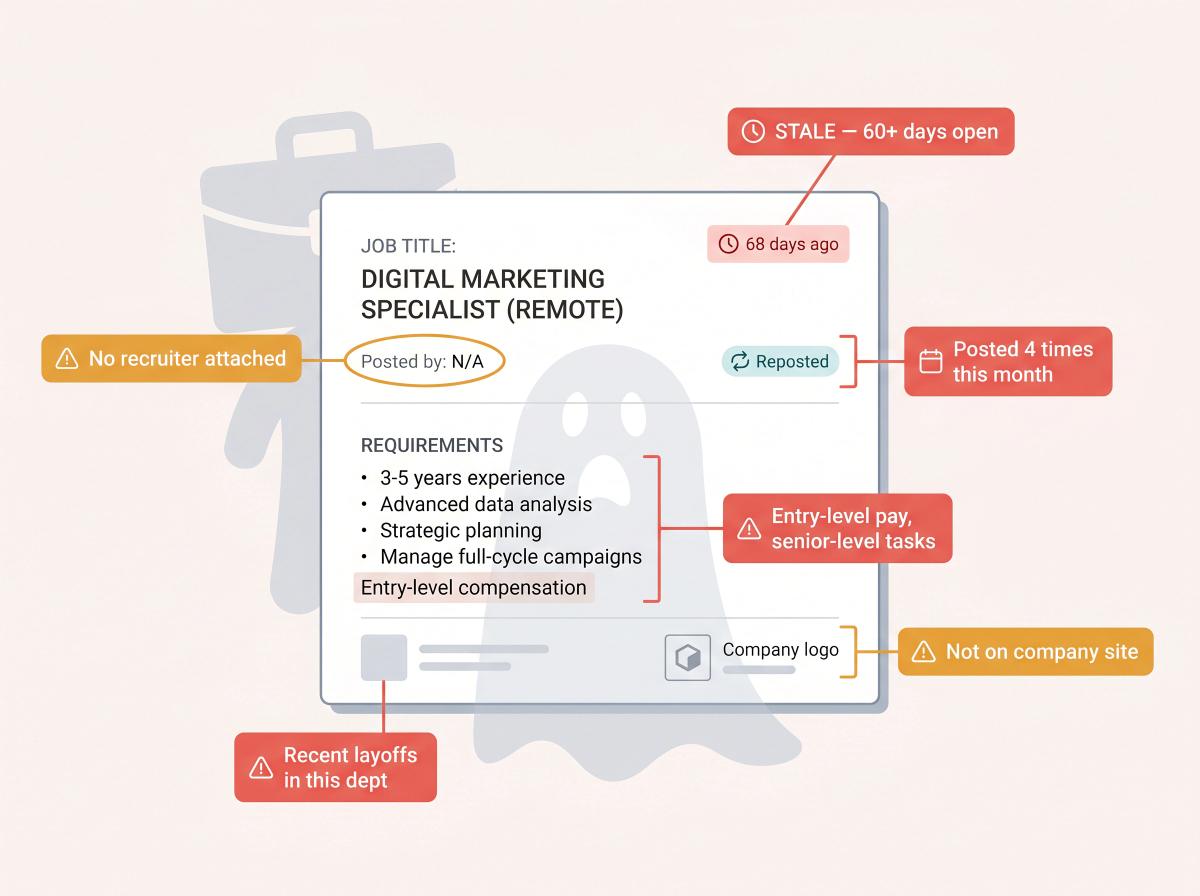
Be cautious if a posting:
- Has been open for 60+ days with no update
- Is reposted every few weeks with minor changes
- Isn't listed on the company's own career page
- Has no recruiter, department, or hiring manager attached
- Asks for contradictory requirements (entry-level salary, senior-level experience)
- Has recent layoffs in the same function
Before applying, confirm the role is live. Check whether it appears on the company career page, whether it was posted or refreshed in the last 7-14 days, whether a recruiter is listed, and whether anyone at the company has posted about it. Don't spend an hour tailoring a resume for a role that may not exist.
7. Your Resume Looks Too Broad (or the Wrong Level)
Sometimes your resume isn't "bad." It's sending the wrong level signal.
A broad resume feels safe. It's usually weak.
This:
"Experienced professional skilled in operations, marketing, customer service, data analysis, project management, leadership, communication, and strategy."
Says everything and nothing. Recruiters screen by pattern recognition. They want to know what bucket you fit into. If your resume makes them work to figure that out, they move on.
Create a role-specific headline. Instead of "Business Professional," use "Operations Coordinator | Vendor Management, Scheduling, Process Improvement." Instead of "Data Analyst," use "Junior Data Analyst | SQL, Excel, Tableau, Revenue Reporting" and explore what the full data analyst career path looks like so you're positioning at the right level.
Your resume can show range in the experience section. The top should show direction.
If you look underqualified: Add proof outside your job titles. NACE's April 2026 research found that employers reviewing entry-level resumes want evidence of teamwork, problem-solving, and communication, not just lists of skills. Projects, freelance work, coursework, and case studies all count.
If you look overqualified: Employers worry you'll get bored, leave quickly, or expect more salary than they can offer. Fix it by making your motivation clear. A single line like "After 6 years in regional retail management, I'm intentionally moving into an operations manager role where I can use my store-level process experience in a more data-focused role" tells the employer this is deliberate, not a panic application.
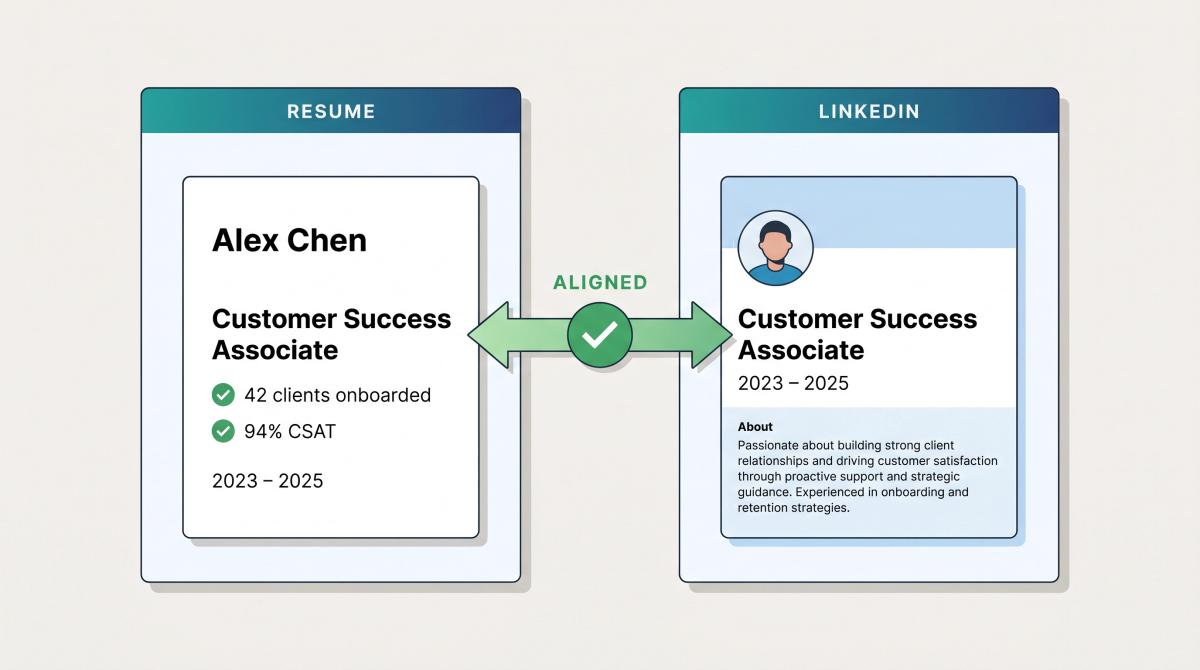
8. Your LinkedIn and Resume Don't Match
A recruiter often sees your resume first, then checks your LinkedIn. If the two tell different stories, you create doubt.
Common problems:
- Vague LinkedIn headline that doesn't match the target role
- Job titles that differ from the resume with no explanation
- Dates that don't match
- Skills section unrelated to target roles
- "Open to work" targeting scattered across many different functions
- No recent activity, no portfolio links, no detail in experience bullets
The fix: Make LinkedIn a second proof layer for the same target lane. Match your headline to your target role, write an About section that summarizes the same fit your resume summary communicates, and keep experience bullets consistent with resume bullets (shorter versions are fine). The goal isn't duplication. It's confirmation. Every recruiter who visits your LinkedIn should leave more confident, not confused.
9. Your AI-Assisted Resume Sounds Generic
AI can genuinely help your job search. But used carelessly, it buries you.
The problem isn't using AI. The problem is using AI to create resumes that sound like every other AI resume:
"Results-driven professional with a proven track record of leveraging cross-functional collaboration to deliver scalable solutions in fast-paced environments."
That sentence says nothing. Recruiters are reading hundreds of versions of it.
Research from LinkedIn's 2025 Future of Recruiting found that 37% of recruiting organizations were actively integrating generative AI tools, up from 27% a year earlier, which means they're also getting better at recognizing AI-generated sameness. And Greenhouse's 2025 AI in Hiring Report showed that 91% of recruiters had spotted candidate deception, with 65% of hiring managers having caught applicants using AI to fake qualifications, hide prompt injections, or read from AI scripts live.
The standard is simple: use AI to communicate your real experience better. Don't use it to invent experience.
| Good AI use | Bad AI use |
|---|---|
| Compare your resume to a job description | Fabricate metrics you didn't achieve |
| Find missing keywords you honestly have | Claim tools you can't actually use |
| Rewrite bullets more clearly | Create a resume you can't defend in a conversation |
| Tighten long summaries | Generate generic language without personalizing it |
| Draft tailored cover letters | Answer live interviews with invented experience |
| Prepare interview stories | Add fake work samples |
At AIApply, we're designed to be a job-search co-pilot, not a replacement for honesty. The platform can tailor resumes and cover letters to job descriptions, scan for ATS gaps, and help you prepare for interviews. But the strongest applications still come from your real achievements, articulated clearly. Our AI Resume Rewriter helps you translate your genuine experience into language that matches what employers are actually searching for, without inventing anything.
10. Your Application Raises Red Flags Recruiters Notice
Recruiters aren't only checking qualifications. They're checking risk. A long list of unspoken questions includes:
- Can this person legally work here?
- Are they local, or willing to relocate?
- Are they expecting a salary far above range?
- Are they actually interested in this role, or just applying everywhere?
- Are there unexplained gaps?
- Are they too senior to stay engaged with this work?
If your resume leaves too many of these unanswered, you may be passed over even if you're capable.
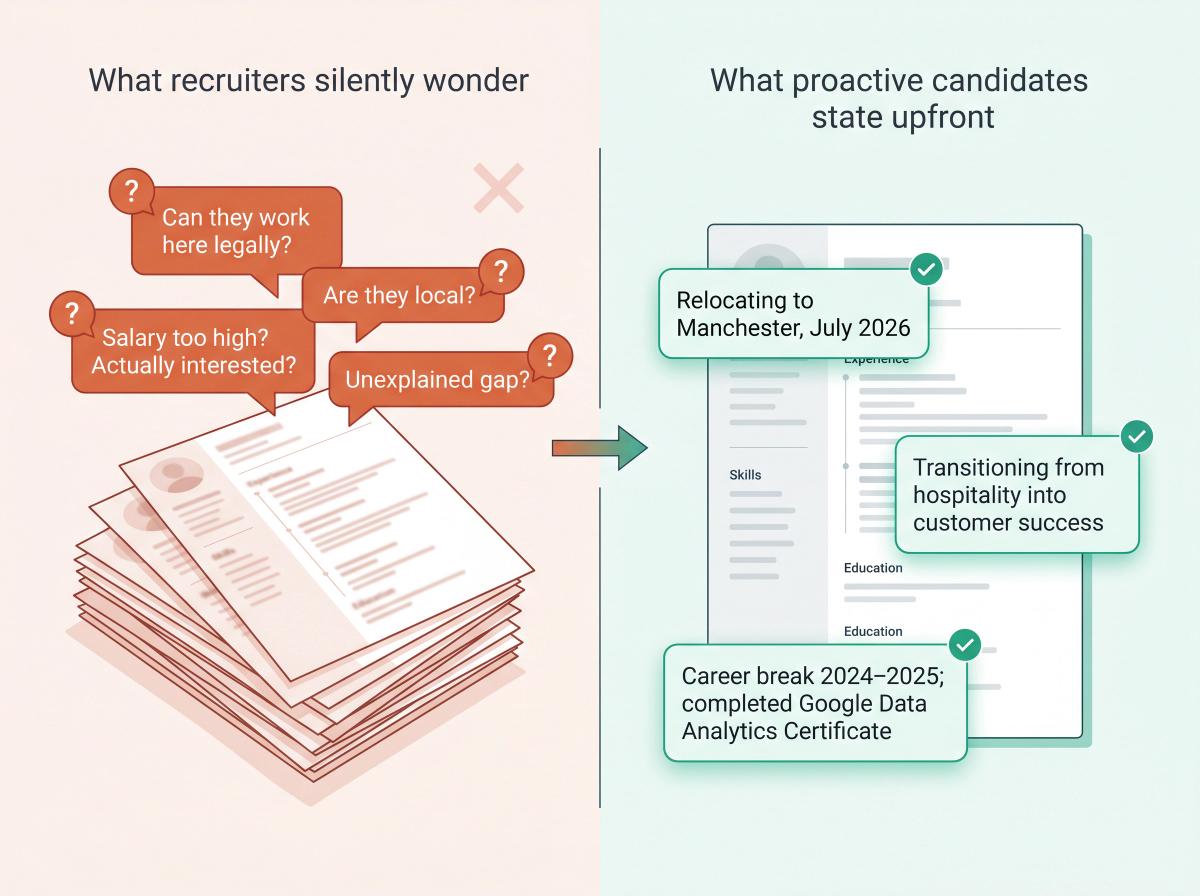
Fix it before the doubt appears. Examples:
If relocating: "Relocating to Manchester in July 2026; available for hybrid roles."
If switching careers: "Transitioning from hospitality operations into customer success after 4 years managing guest escalations, scheduling, and service recovery."
If returning after a gap: "Career break for caregiving, 2024-2025; completed Google Data Analytics Certificate and built SQL/Tableau portfolio projects during return-to-work period."
You don't need to over-explain. You need to prevent wrong assumptions from eliminating you before a human ever reads your work.
On cover letters: they matter more than people think in specific situations. Use one when you're switching careers, when you were referred, when you have a specific reason for wanting the company, or when your resume doesn't fully explain the match. If salary expectations are a concern, knowing the Customer Success Manager salary range for your target market lets you address compensation proactively and avoid being filtered out before a conversation starts.
Don't write this: "I am excited to apply for this opportunity at your esteemed organization." That's filler that no one reads.
Write this instead, in three short paragraphs: paragraph 1 states your exact role fit, paragraph 2 gives proof (specific numbers and tools), paragraph 3 explains why this company. Our Cover Letter Generator can create tailored drafts, but the key is adding specifics only you would know.
What to Do When the Job Market Is Genuinely Tough
Some sectors are genuinely harder right now. The BLS April 2026 report showed job gains in health care, transportation, and retail trade, while information employment was down 11.0% from its November 2022 peak. Indeed Hiring Lab noted in May 2026 that layoffs were rising in information and professional/business services specifically.
If you're applying in tech, media, recruiting, HR, or design functions that have seen heavier competition, you need a stronger strategy than someone applying in a growing health care segment. That doesn't mean give up. It means adjust.
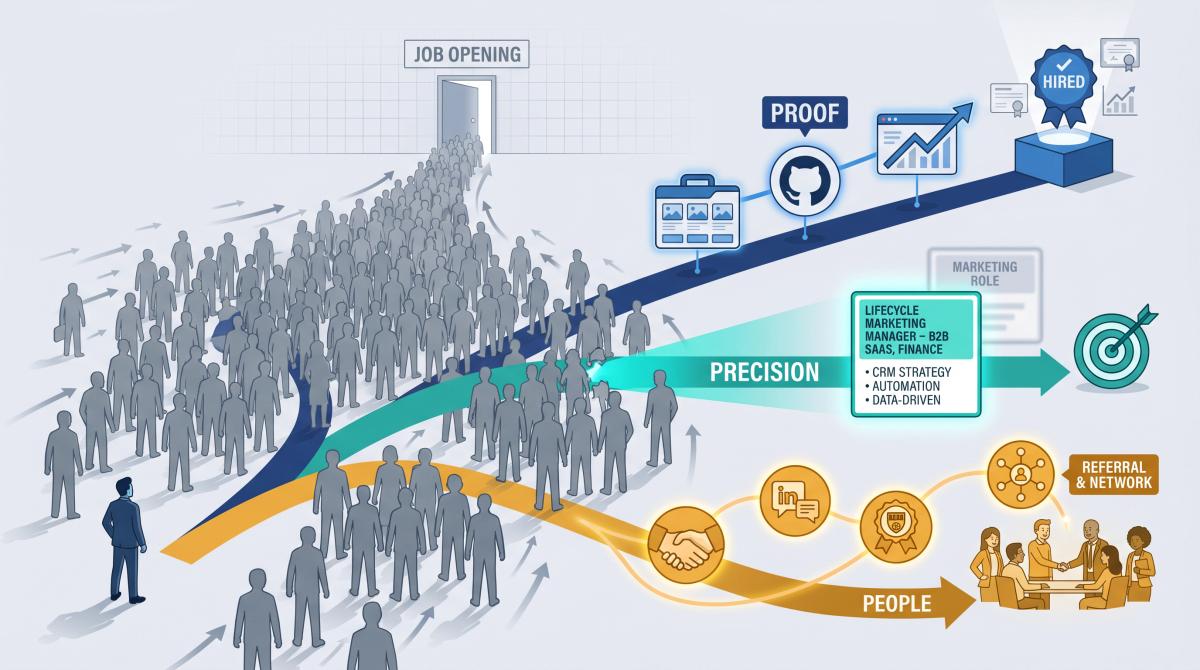
Three things that help in a crowded market:
① Add proof outside your resume. Build a portfolio, case study, GitHub repo, writing sample, dashboard, or project. Real evidence beats claims in any market; in a competitive one, it's often the difference.
② Use narrower targeting. "Marketing roles" is too broad. "Lifecycle marketing manager roles for B2B SaaS tools serving finance teams" is a real position with a real hiring manager who knows exactly whether you fit.
③ Create human visibility. Crowded markets punish pure cold applications. You need referrals, recruiter messages, alumni conversations, and hiring manager contact. Volume through job boards alone won't get you there.
How to Show Current Skills on Your Resume in 2026
This matters especially for students, recent grads, and career changers.
NACE's April 2026 Job Outlook Spring Update found that employers plan to hire 5.6% more new college graduates from the Class of 2026. But gains are uneven and concentrated in certain industries and larger companies. And critically: NACE also reported that more than one-third of entry-level jobs now require AI skills, nearly triple the share from fall 2025, and 28% of employers say they're actively seeking early-career talent who can use AI in their work.
If your resume looks like it belongs in 2021, you may be losing to candidates who show they can operate in the 2026 environment.
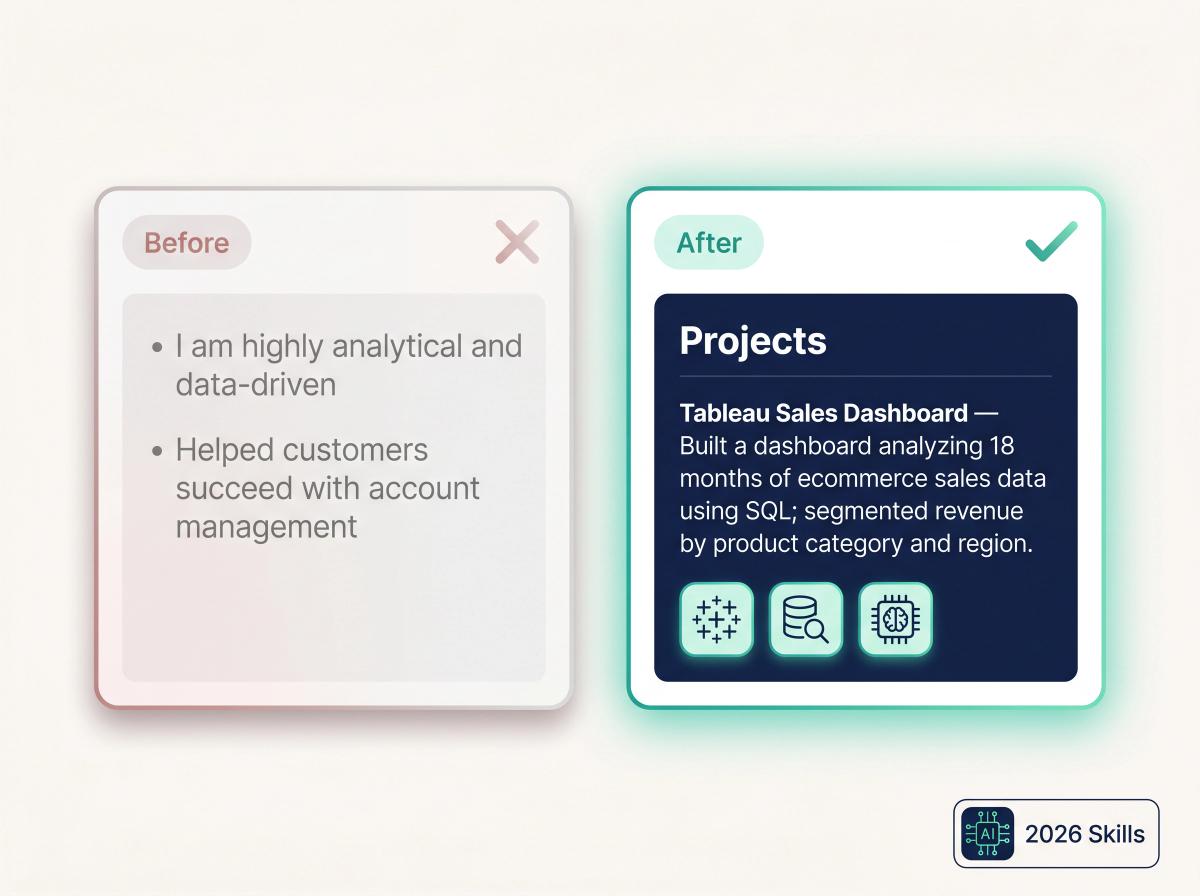
Add a Projects section if your work history is thin. Projects beat claims. Saying "I'm analytical" is a claim. Showing a dashboard with real data is evidence. Understanding the data analyst skills employers look for in 2026, including AI tooling and data visualization, gives you a current benchmark.
Examples of what this looks like:
Data analyst project: "Built a Tableau dashboard analyzing 18 months of ecommerce sales data; used SQL to segment revenue by product category, region, and customer cohort." See the data analyst resume example for how to present this kind of project alongside real work history.
Marketing project: "Created a 4-email lifecycle campaign for a mock SaaS onboarding flow; wrote copy, mapped user triggers, and built performance projections."
Operations project: "Designed a scheduling and inventory tracker in Google Sheets using formulas, conditional formatting, and weekly reporting views."
AI workflow project: "Built a prompt workflow to summarize customer feedback, categorize themes, and produce weekly product insights for a mock support team."
Use our AI Resume Builder to present your projects in a format that ATS systems can parse and that hiring managers can scan in 30 seconds, even when your formal work history is still early-career.
A 30-Day Plan to Start Getting Job Interviews
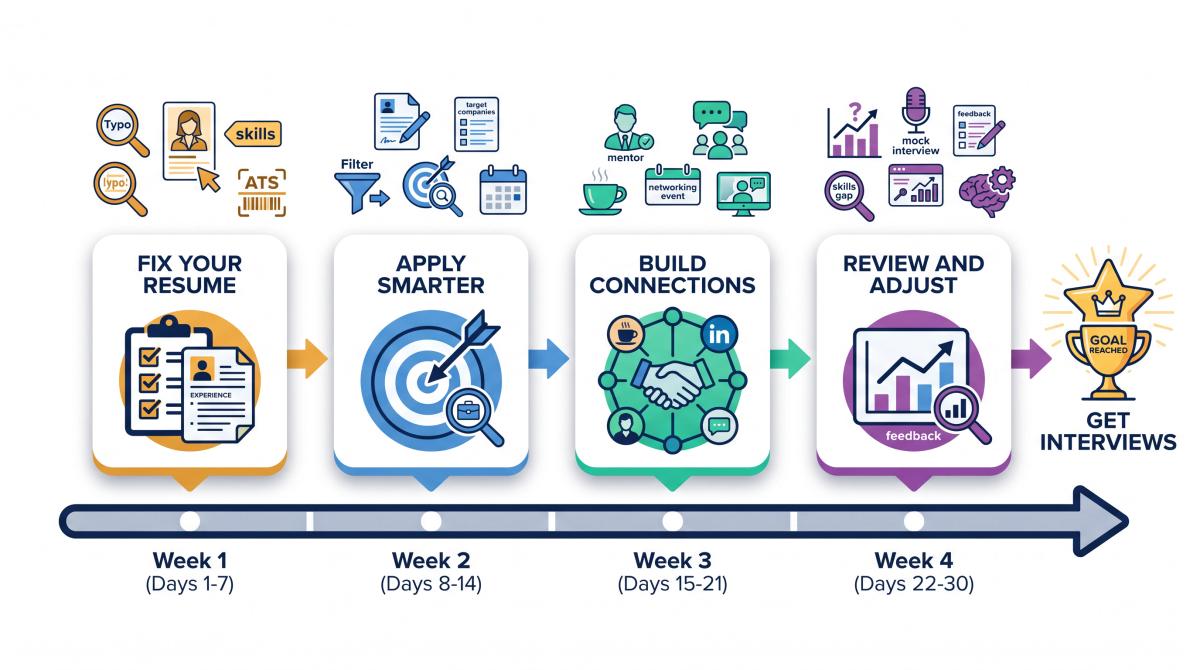
Week 1: Fix Your Target and Rebuild Your Resume
Day 1: Choose your target lane. One primary target, one backup target. Not five.
Day 2: Collect 10 real job descriptions. Find 10 roles you'd genuinely apply to and paste their requirements into one document. Highlight the tools, titles, skills, and terms that appear repeatedly. These are your target-language keywords.
Day 3: Rewrite your resume summary and skills. Your summary should match the target lane. Your skills section should include only the tools and capabilities from those 10 JDs that you honestly have.
Day 4: Rewrite your top 8-12 bullets using the proof formula (Action + scope + method/tool + result). Focus on recent, relevant achievements.
Day 5: Run an ATS and keyword check. Use our ATS Resume Checker to catch parsing issues, missing keywords, formatting problems, and weak action verbs.
Day 6: Update LinkedIn. Match your headline and About section to the same target lane.
Day 7: Build one proof asset. A portfolio page, project write-up, GitHub repo, dashboard screenshot, case study, or certification summary. This is especially powerful for career changers and recent grads.
Week 2: Apply Smarter, Not More
Target 20-30 applications, but don't spray.
For each role: confirm it's active, score it out of 12, tailor the headline and summary, apply through the company career page when possible, and send one follow-up to a recruiter, employee, or hiring manager. Track every result.
If you need to build multiple tailored resume versions quickly, AIApply's AI Resume Builder can help you generate ATS-optimized resumes tailored to specific job descriptions so you're not starting from scratch each time.
Week 3: Build Real Connections and Get Referrals
This week, aim for 15-20 genuine conversations or warm touches. Message alumni, former coworkers, recruiters, people in your target role, and employees at companies that are hiring.
Don't start with "please refer me." Start with relevance.
Networking message template:
Hi [Name], I'm targeting [role type] roles and saw you've worked in [function/company/industry]. I'm trying to understand what teams are actually looking for right now, especially around [specific topic]. Would you be open to a quick 10-minute chat or a few written pointers? I'd really appreciate your perspective.
After the conversation, if the fit is strong:
"Thanks again, this was helpful. I noticed your team is hiring for [Role]. Based on what you shared, I think my background in [specific proof] could be a fit. Would you be comfortable if I sent over my resume for a possible referral or recruiter introduction?"
That's far more effective than asking cold. And if you want to move faster, Auto Apply submits tailored applications to matched roles continuously, so your outreach energy goes toward relationship-building rather than form-filling.
Week 4: Review What's Working and Change Course
At the end of 30 days, look at the data.
| Result | What to do |
|---|---|
| No responses at all | Resume, target fit, or application channel needs major work |
| Responses only from referrals | Cold resume may be weak; improve ATS alignment while keeping referral strategy |
| Recruiter screens but no hiring manager interviews | Your pitch or level fit is unclear |
| Hiring manager interviews but no final rounds | Build stronger examples, depth, and role-specific proof |
| Strong response from one job type | Double down on that lane |
| Rejections from old postings | Focus on fresh, verified roles only |
Don't change everything at once. Change one variable per week.
Resume Checklist: What to Check Before You Apply
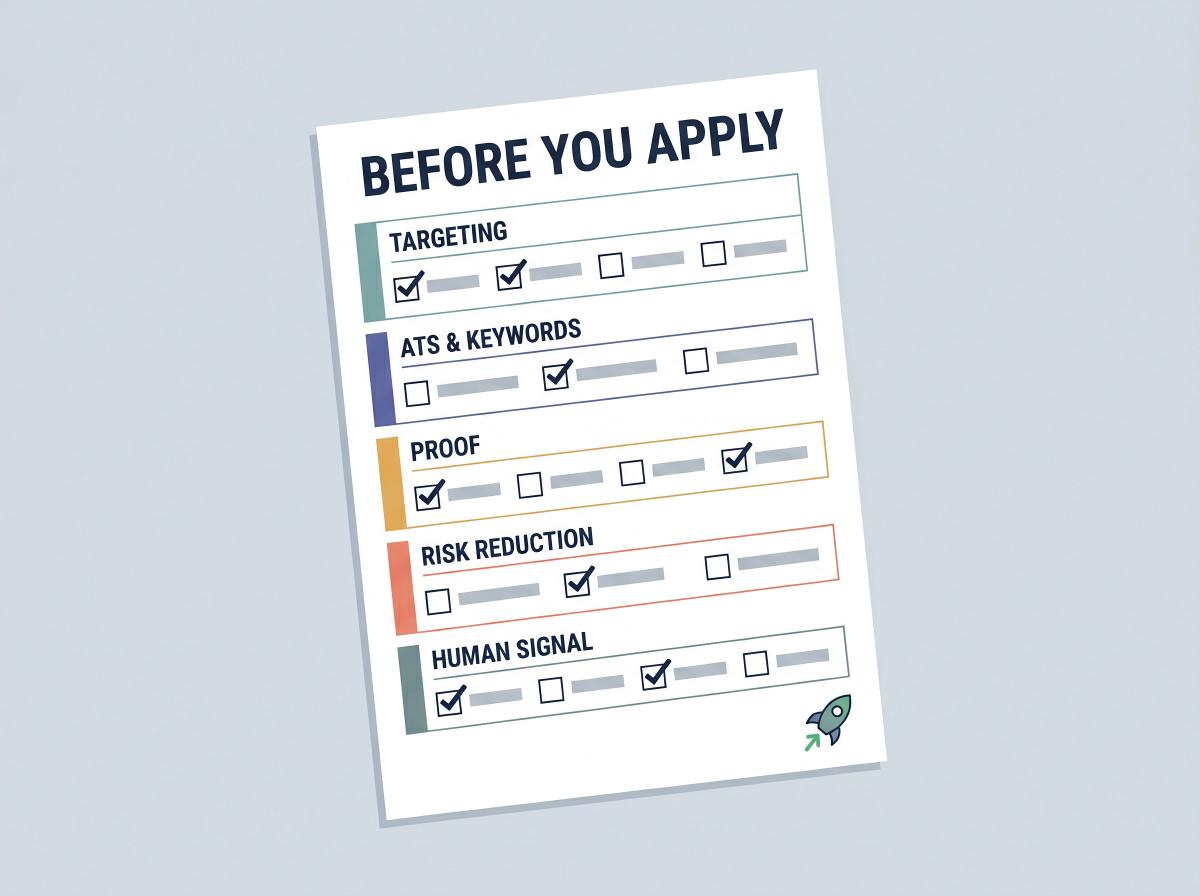
Before sending any resume, check every item in this list.
Targeting
- [ ] Built for one role family, not five
- [ ] Headline matches the target role
- [ ] Summary includes relevant experience, tools, and proof
- [ ] Top bullets match the job's main responsibilities
ATS and keywords
- [ ] Uses exact, truthful job-description language
- [ ] Key tools and certifications written plainly
- [ ] Formatting is simple and parseable
- [ ] No text boxes, graphics, or hidden text
- [ ] Skills grouped clearly
Run a final pass with our free AI Resume Checker before sending to confirm ATS compatibility, keyword alignment, and formatting.
Proof
- [ ] Most bullets include numbers, scope, tools, or outcomes
- [ ] Shows achievements, not just responsibilities
- [ ] Recent experience prioritized
- [ ] Older irrelevant work is shortened
Risk reduction
- [ ] Location, work authorization, or relocation is clear (if relevant)
- [ ] Career gaps briefly explained (if needed)
- [ ] Career change logic is clear
- [ ] Salary or seniority mismatch isn't implied
- [ ] Contact info is correct and current
Human signal
- [ ] Applied through the strongest available channel
- [ ] Identified a recruiter, employee, alumni, or hiring manager
- [ ] Sent a short, specific follow-up
- [ ] Tracked the result in your log
Not Getting Interviews? Solutions for Special Cases
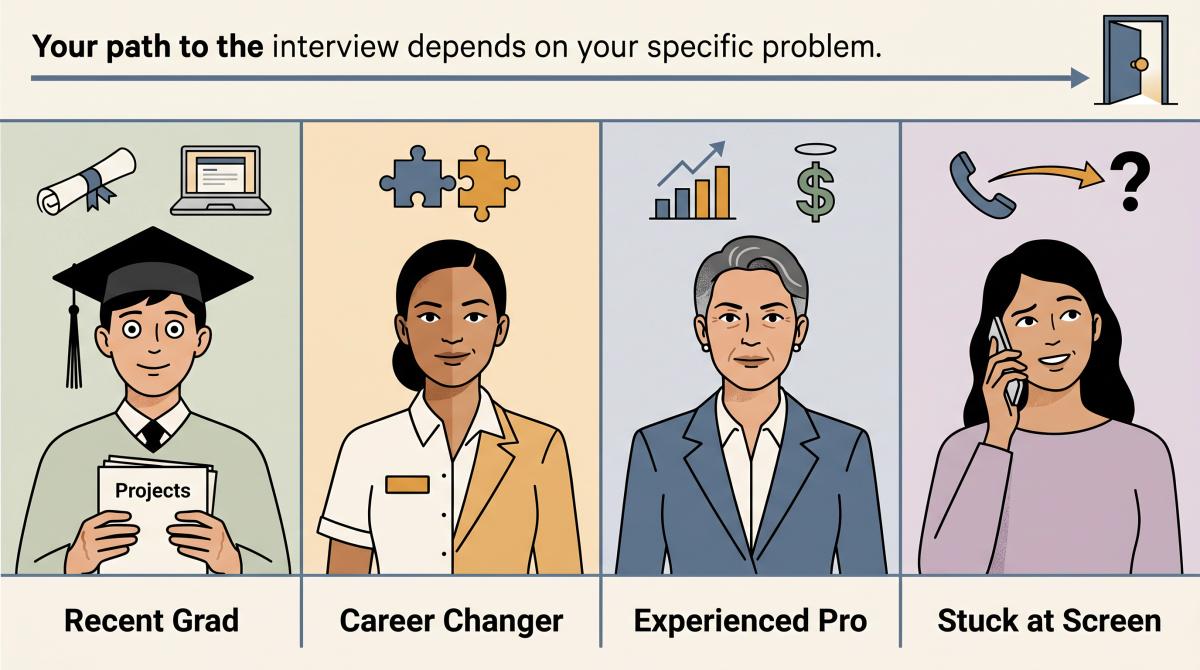
Recent Grad Not Getting Interviews? Here's Why
For recent grads, the issue usually isn't "no experience." It's "no evidence."
Employers know you're early-career. They're not expecting 10 years of work history. They're looking for signs you can learn, communicate, solve problems, and work with a team. NACE's 2026 research found employers want examples of teamwork, problem-solving, and communication, not just lists of skills.
Add sections like:
- Relevant Projects
- Internship Experience
- Campus Leadership
- Technical Skills
- Research, Certifications, or Freelance Work
Weak bullet: "Worked on group project for marketing class."
Strong bullet: "Led a 4-person class project analyzing TikTok ad strategy for a local cafe; created customer personas, wrote campaign copy, and presented recommendations projecting a 22% lower cost per lead than the cafe's previous Instagram campaign."
Even academic projects carry real proof if you describe them with specificity. Our entry-level data analyst resume examples show how recent grads with minimal work experience can frame academic projects and coursework as evidence hiring managers actually trust.
Career Change Not Getting Interviews? How to Fix It
Career changers often fail because the resume makes the hiring manager do translation work. They're thinking: "Interesting background, but have they actually done this job?" Your job is to build the bridge.
Career-change summary formula:
[Current background] transitioning into [target role] with transferable experience in [skill 1], [skill 2], and [skill 3]. Recently completed/built [proof asset] to strengthen [target skill]. Seeking roles where [old domain advantage] helps solve [new role problem].
Example:
"Hospitality operations manager transitioning into Customer Success, with 5 years of experience handling escalations, training staff, improving service workflows, and managing high-pressure client interactions. Recently completed SaaS onboarding and CRM projects using HubSpot and Zendesk. Seeking customer success roles where service recovery and process improvement experience can improve adoption and retention."
That's far stronger than pretending your previous career didn't happen. To see what a complete career-change application looks like for this exact transition, our Customer Success Manager cover letter examples include career-changer positioning that's worked for candidates making similar moves. Our AI Cover Letter Generator can draft your bridge narrative from your background and target role, then you customize it with your specific proof.
Why Experienced Candidates Get Passed Over Too
Experienced candidates often have the opposite problem: too much information, not enough focus.
If your resume lists every role, every tool, and every leadership responsibility from the past 20 years, it's dense and unfocused. Cut harder.
Focus on the last 10-15 years unless older experience is highly relevant. Remove outdated tools. Shorten early roles to 2-3 lines. Lead with senior-level outcomes: revenue, budget, headcount, regions, accounts, or systems you owned. Make it clear whether you want leadership, individual contributor work, or a pivot. If you're applying below your previous level, explain why. Otherwise, employers may assume you're not serious.
Getting Recruiter Calls but No Hiring Manager Interviews?
Your resume is good enough to start a conversation, but your positioning in the screen may not be strong enough to move forward.
Common causes: you can't explain why this role, your salary expectations are off, you sound too broad, or your examples lack detail.
Fix your recruiter pitch. Use this structure:
- "I'm targeting [role] because..."
- "My closest experience is..."
- "The strongest example is..."
- "This company stood out because..."
- "I'm available / local / authorized / open to hybrid..."
Keep it conversational, specific, and short. Recruiters like clear.
Getting Interviews but No Offers? What's Going Wrong
That's a different problem entirely. Your application is working. Your interview performance needs attention.
Greenhouse's 2026 Candidate AI Interview Report found that 63% of active job seekers had faced an AI interview, and among those who completed one, only 28% moved forward, 13% were formally rejected, and 51% never heard back. Interview prep in 2026 includes human interviews, recruiter screens, asynchronous video interviews, assessments, and sometimes AI-led screening.
Focus on:
- Better STAR stories with specific numbers
- Stronger "why this company" (show you've researched them)
- Clearer, more concise answers
- Better follow-up emails after each round
- Mock practice before every interview
Our AI Mock Interview simulates role-specific questions and gives feedback on your answers before the real conversation. And for live interviews, Interview Buddy provides real-time on-screen coaching so you're never caught without a response.
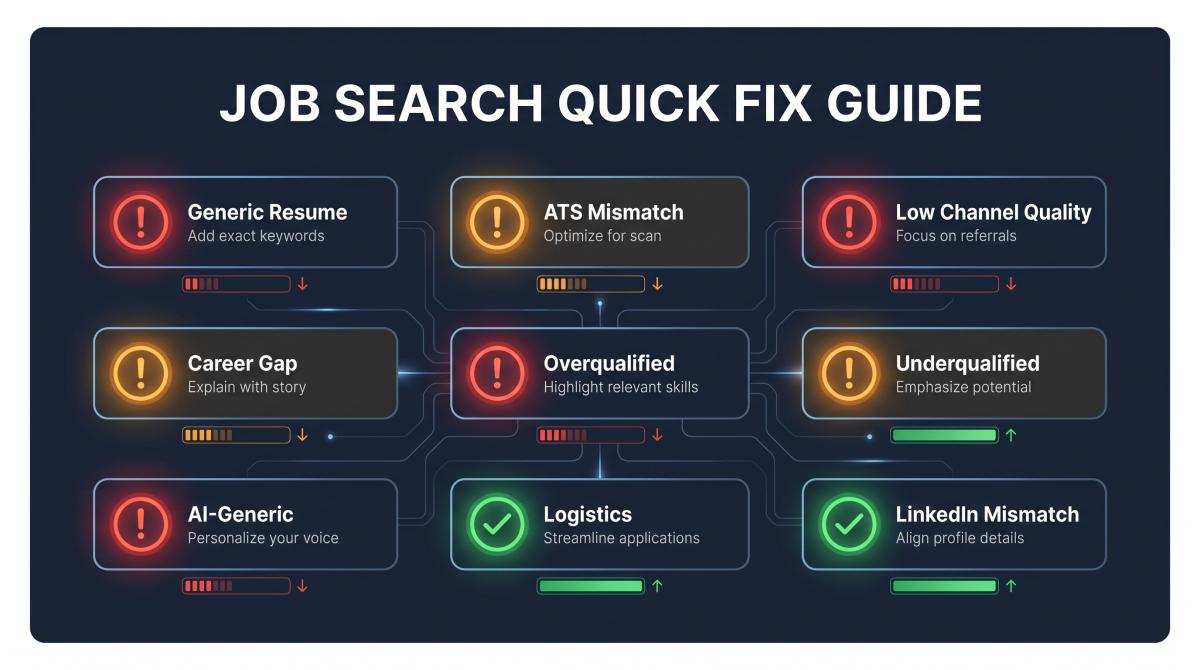
Job Search Troubleshooting: Quick Fix Guide
| Problem | Signal | Fix |
|---|---|---|
| Generic resume | No callbacks across many roles | Build one resume per target lane |
| ATS mismatch | Fast rejections from roles you match | Add exact keywords, tools, titles, certifications |
| Weak proof | Resume sounds like a job description | Rewrite bullets with numbers, scope, and outcomes |
| Stale jobs | No response from old postings | Focus on fresh, verified roles only |
| Low channel quality | Mostly Easy Apply, no outreach | Use referrals, career pages, recruiter messages |
| Career change gap | Recruiters don't understand your fit | Add bridge summary and projects |
| Overqualified signal | Rejected from lower-level roles | Explain intentional move, de-emphasize seniority |
| Underqualified signal | Missing must-haves | Build projects, certifications, or apply one level lower |
| AI-generic language | Resume sounds polished but empty | Add specific tools, metrics, customer types, projects |
| Hidden logistics issue | Instant rejection after knockout questions | Check location, visa, salary, degree, certification requirements |
| LinkedIn mismatch | Resume and profile tell different stories | Align headline, About, skills, and experience |
What to Do Next If You're Still Not Getting Interviews
Not getting interviews doesn't mean you're unqualified. It means something in your application funnel is broken. And broken funnels have specific fixes.
The 10 culprits, in the same order we covered them:
- Applying to the wrong jobs
- A resume that isn't searchable (ATS/keyword mismatch)
- Proof too vague (duties instead of outcomes)
- A resume that can't be scanned in 30 seconds
- Relying on job boards alone
- Wasting time on ghost jobs
- Positioning that's too broad or the wrong level
- A LinkedIn profile that contradicts your resume
- AI-assisted materials that sound generic
- Application red flags that go unanswered
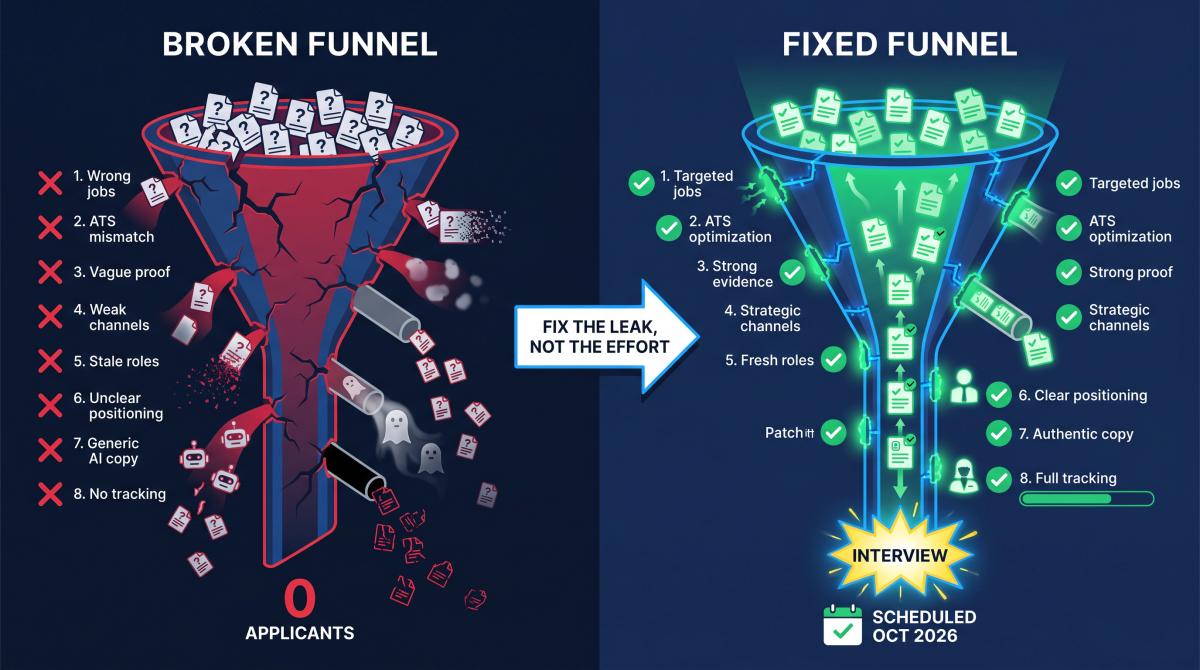
Don't just "try harder." Fix the funnel.
Start with the highest-impact move: take one job description you genuinely want, tailor your resume to it, scan it for ATS and keyword gaps, rewrite the top bullets around proof, and apply through the strongest available channel. That's one focused effort that covers most of the reasons on this list.
AIApply can help you do that faster: build a tailored resume, check ATS compatibility with our ATS Resume Checker, optimize against the job description, generate a role-specific cover letter, and apply to matched roles, all from one workflow. Users who run this full pipeline are 80% more likely to land interviews within the first month.
The goal isn't more applications. The goal is more visible fit. That's what gets interviews.
Frequently Asked Questions About Getting Interviews
How many applications does it take to get an interview?
There's no universal number. It depends on your field, level, location, resume quality, and the channels you're using. Ten applications isn't enough data to draw conclusions. If you've sent 50+ targeted applications with no recruiter screens, something is probably wrong with your targeting, resume, ATS visibility, or application channels. At that point, diagnosing the specific problem is more valuable than sending more applications.
Is my resume being rejected by ATS?
Maybe, but "ATS rejection" is often misunderstood. Most systems don't auto-reject resumes outright. They parse, rank, filter, and let recruiters search by skills, titles, certifications, and keywords. Your resume may not be rejected; it may simply never surface in the recruiter's search. Research from Jobscan's 2025 ATS Usage Report found that 76.4% of recruiters search and rank candidates by job-description skills, which is why truthful keyword alignment matters so much. Use our AI Resume Scanner to see exactly which keywords you're missing and how your resume parses against a specific job description.
Should I use AI to write my resume?
Yes, but carefully. AI is genuinely useful for tailoring, rewriting, keyword matching, and clarity. The problem is using AI to invent achievements, claim skills you don't have, or produce generic language you haven't edited. Employers are increasingly alert to this. Use AI to communicate your real experience better. That's where it actually helps your chances. Our AI Resume Rewriter is built for exactly this: it reshapes your actual experience into clearer, stronger language without fabricating anything.
Should I apply if I don't meet every requirement?
Yes, if you meet the core requirements and can prove adjacent experience. No, if you're missing hard blockers like required licensing, work authorization, location, security clearance, or a non-negotiable technical skill. A good rule: apply if you meet most must-haves and can honestly explain the gaps. Don't apply just because the title sounds interesting.
Are cover letters worth it?
Sometimes. They're worth it when they explain a referral, a career change, a relocation, an unusual background, or a strong company-specific reason you want the role. A short, specific cover letter beats a long formal one almost every time. A generic cover letter adds nothing and can hurt by making you look like you copy-paste.
Why do I get rejected so quickly?
Fast rejection (within 24-48 hours) usually means one of these: the role is already filled, you failed a knockout question, you have a hard requirement mismatch, your resume doesn't match the search criteria, or the employer is filtering aggressively due to high volume. Check the application's screening questions, the job's hard requirements, and your resume keyword match first.
Should I apply on LinkedIn or the company website?
Use the company website for serious applications whenever possible. Job boards are convenient but noisy. Research from CareerPlug's 2025 data found that company career pages produced a significantly higher share of hires relative to applications compared to job boards. Applying on the company site signals intent and often routes your application more directly. For high-volume search across company career pages, Auto Apply submits directly to matched roles so you get the quality signal of company-site applications at scale.
How do I know if a job is a ghost job?
You can't know for certain, but warning signs include: old posting dates, repeated reposts, vague descriptions that don't name a department or team, no company career page listing, no recruiter activity, and recent layoffs in the same function. Focus on fresh postings with a clear department, an active recruiter, and a company-site listing. If you can't verify the role is active through any of those signals, allocate less tailoring time to it.
What's the fastest way to improve my interview rate?
Pick one specific target role, tailor your resume to that exact role, run an ATS check, apply to fresh high-fit jobs through the strongest available channel (career page over job board), and add human outreach for every serious application. The fastest improvement almost always comes from narrowing your target and improving match visibility, not from sending more applications.
How long should a resume be?
One page for candidates with fewer than 5-7 years of experience; two pages for experienced professionals. The honest rule: as long as it needs to be, and no longer. If you're padding to fill a page, cut. If you're compressing important proof onto one page at the expense of relevance, use two. Length matters much less than clarity, targeting, and proof. Use our AI Resume Builder to see how your content looks across different lengths and templates before you commit.
What does a recruiter look for in the first 30 seconds?
A recruiter scanning your resume in 30 seconds is looking for: target role clarity (do I know what job this person wants?), level match (does experience match what we need?), relevant tools and industry terms, one or two standout proof points, and no red flags (unexplained gaps, mismatched dates, vague titles). The top third of your resume should answer all of these without making the recruiter work for it.