What to Do When You Can't Find a Job for Months (2026)
Can't find a job after months? Find which stage of your search is failing, fix it with a 30-day plan, and get your applications in front of a real person.


Searching for months in 2026 means competing with hundreds of applicants per role and an AI screening layer most candidates never see. This guide shows how to find the stage that is failing and fix it with a 30-day plan.
Key takeaways
- When you can't find a job for months, find the one stage of your search that is failing (targeting, packaging, distribution, or conversion) before you send another application.
- Months-long searches are normal: in August 2026 the average U.S. jobless spell was 26.3 weeks, and 27.0% of unemployed Americans had been out of work for 27 weeks or longer, according to the Bureau of Labor Statistics.
- Competition is the structural problem: Ashby's May 2026 analysis found open roles now average more than 300 applications, and candidates are about 50% less likely to reach an interview than five years ago.
- A tailored application plus a message to a real person at the company gives a recruiter a reason to open your resume that most of the other applicants do not provide.
- If 30 days of tracked, well-targeted effort still produces near-zero interviews, change the role level, take a wedge role, or add proof you can show instead of applying harder.
When you can't find a job for months, the fix is almost never more applications. Find the one stage of your search that is failing, whether that is targeting, packaging, distribution, or conversion, fix that stage for 30 days, and measure the result.
You've rewritten your resume, scrolled hundreds of listings, and sent more applications than you can count. The silence feels personal, but a months-long search is a pipeline problem you can diagnose. It is not a verdict on your worth. Hiring is a risk-reduction exercise: employers pick the candidate who sends the clearest, most credible signal that they will succeed in the role, and a search stalls when that signal is weak, unseen, or fails to convert.
The whole system fits in one line: getting hired = strong-fit roles + tailored proof + early applications + a human contact + interview readiness. If one term is missing, the result drops. The sections below show how to find the missing term and fix it.

How Do You Find Out Which Stage of Your Job Search Is Broken?
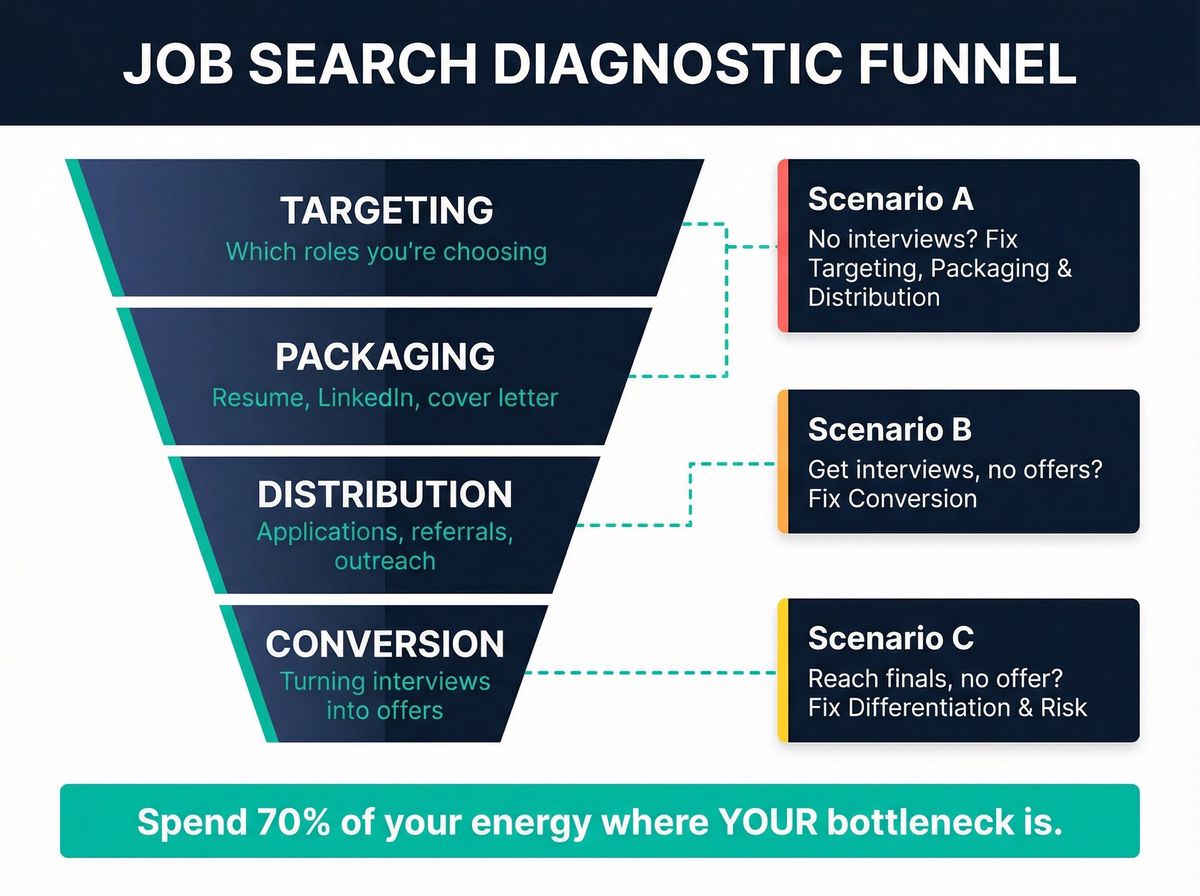
Your job search is a four-stage funnel of targeting, packaging, distribution, and conversion, and the stage with the weakest pass-through rate is the one to fix first.
Count your last 30 days: roles applied to, responses of any kind, recruiter screens, interviews, final rounds, and offers. The point where the numbers fall off a cliff shows where the search is breaking. Most people skip this step and spend months fixing the wrong stage.
| What you see | Stage that is broken | Fix this first |
|---|---|---|
| Almost no responses to applications | Targeting or packaging | Narrow to one role. Rewrite the resume around proof for that role. |
| Some responses, few interviews | Packaging or distribution | Tailor each application and add a human contact at the company. |
| Interviews, but you stall before finals | Conversion | Build a story bank and practice answers out loud. |
| Final rounds, but no offers | Conversion (risk, differentiation, references) | Address likely risk objections, line up references, and sharpen what sets you apart. |
If you sit in the first two rows, test the packaging stage with evidence instead of a guess. AIApply's Resume Scanner scores a resume against a specific job description and flags the keyword gaps and formatting problems that stop an applicant tracking system from reading it, so you can see whether the resume is the bottleneck before you rewrite it. Put most of your effort into the weakest stage and leave the others alone until the numbers move.
How Long Does a Job Search Usually Take?
A months-long job search is normal in 2026: the Bureau of Labor Statistics reported a seasonally adjusted average unemployment spell of 26.3 weeks and a median of 11.4 weeks in its August 2026 duration data.
The gap between the average and the median shows a long tail. About 27.0% of unemployed Americans, roughly 1.9 million people, had been jobless for 27 weeks or longer, and the national unemployment rate was 4.1%, according to the BLS Employment Situation summary. The BLS measures how long people have been unemployed, not how long every job search takes, so employed job seekers and people who stopped looking are not counted. Use these numbers as context for what is normal, not as a deadline.
Why Is It So Hard to Get Hired Right Now?
Hiring is harder because application volume has outrun recruiting capacity: Ashby's May 2026 analysis found open roles now average more than 300 applications, and candidates are about 50% less likely to reach an interview than five years ago.
Greenhouse's March 2026 benchmark report points the same way. Across more than 6,000 companies and 640 million applications in its North American data, applications per job rose 111% from 116 in 2022 to 244 in 2025, while recruiters per organization fell 56%, from 10.43 to 4.62. Average time to fill grew from 43.64 to 59.67 days over the same period.
When every applicant can generate a polished resume in seconds, a polished resume stops being a differentiator. What separates candidates now is fit, timing, proof, and a human contact, and those are the four things the rest of this guide builds.
What Can You Actually Control in a Tough Hiring Market?
You control two things: how clearly your resume and profile signal fit for one specific role, and how many of your applications reach a human. Market conditions, internal hires, and budget freezes sit outside your control, so measure your effort against your own conversion rates instead of against the headlines.
What Are the Most Common Reasons You Can't Find a Job?
The most common reasons are applying to roles you don't fit, sending an untailored resume, listing duties instead of results, and relying on cold online applications alone. Career guides from Indeed and The Muse name the same patterns, plus several that candidates overlook.
What Should You Do in the First 48 Hours to Restart a Stalled Job Search?
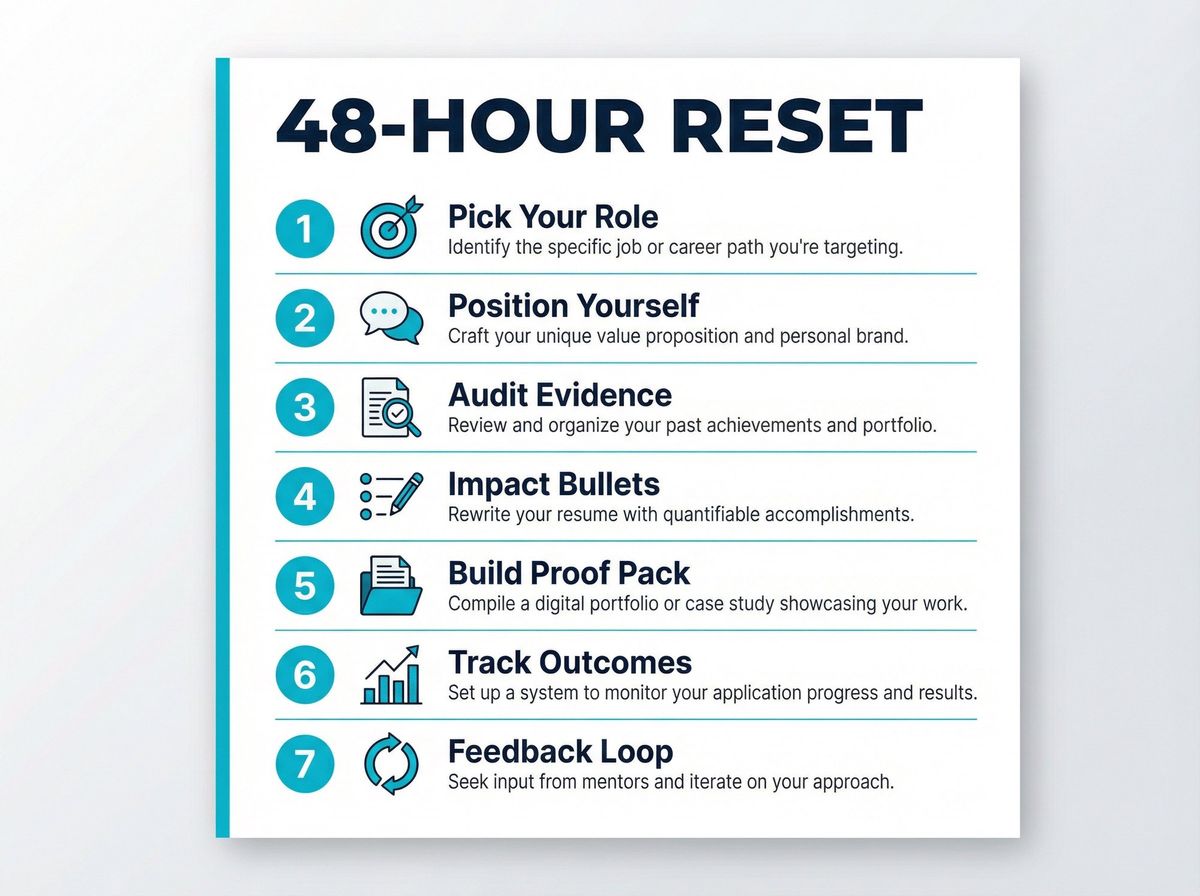
In the first 48 hours, pick one target role, write a one-sentence positioning statement, rewrite your top ten resume bullets as results, and set up a tracker that counts outcomes instead of effort. Each step below takes less than a morning.
How Do You Pick One Target Role?
Pick one role title in one hiring market for the next 30 days, such as Customer Success Manager at mid-market B2B SaaS companies. A specific target lets you tailor faster, reuse proof across applications, and look like an obvious hire instead of a risk. "Anything remote in tech" and "marketing or project management or maybe operations" are not targets.
How Do You Write a Positioning Statement?
A positioning statement is one sentence that names the team you help, the outcome you deliver, your three core strengths, and your proof. It becomes the spine of your resume summary, LinkedIn headline, and every outreach message.
Template
I help [type of team] achieve [outcome] by doing [3 core strengths], backed by [proof].
Illustrative example
I help revenue teams improve conversion by building clean CRM pipelines, automating reporting, and running experiment-driven outreach, backed by three years in B2B SaaS and a 22% lift in pipeline-to-close.
How Do You Turn Resume Duties Into Impact Bullets?
Write each bullet as Action + Scope + Tool or Method + Result, with a metric when you have one and a scale marker when you don't. For every bullet, ask what changed because of you, how anyone knows, and where the number or artifact is.
Illustrative example
Built a weekly churn dashboard in Looker from product event data, surfacing onboarding drop-off points and cutting 30-day churn from 8.4% to 6.9%.
No metric? Use scale instead:
- for a 12-person team
- across 3 regions
- in a 6-week sprint
- for 80+ accounts
How Do You Build a Proof Pack for Job Applications?
A proof pack is one folder or web page that holds a one-page case study and one to three sanitized work samples, which you attach to applications and outreach messages. It gives a recruiter something concrete to evaluate, and it separates you from candidates who send only a resume. A simple portfolio page or shared drive folder is enough.
What Should You Track Each Week in a Job Search?
Track outcomes, not effort: high-fit applications sent, warm outreach messages sent, conversations booked, interviews, final rounds, and offers. Most job seekers count applications sent and nothing else, which is like a sales team counting emails and ignoring closed deals.
| What to track | Why it matters |
|---|---|
| High-fit applications sent | Shows volume at the right quality level |
| Warm outreach messages sent | Measures your human-contact pipeline |
| Conversations booked | Early signal of pipeline health |
| Interviews | Confirms your packaging works |
| Final rounds | Shows conversion depth |
| Offers | The only number that ultimately matters |
Set a first feedback loop of 20 high-fit applications and 20 direct outreach messages in seven days. Then compare response rates by channel and adjust. You need data, not guesses.
How Do You Position Yourself as the Obvious Hire for One Role?
Make one resume, one LinkedIn headline, and one set of stories point at the same role, and put your strongest evidence in the top third of the page. Being open to anything feels flexible, but a resume that speaks to six roles speaks clearly to none of them.
How Many Resume Versions Should You Have?
Keep two resume versions at most: Version A for your primary target role and Version B for a realistic backup role. More than two usually turns into version-control chaos and slower tailoring.
What Should the Top Third of Your Resume Say?
The top third should state your target role, your strongest evidence, and the skills that map directly to the posting. A reliable pattern is a headline with your target role and niche, a three-line summary of outcomes, domain, and strengths, a skills block limited to relevant skills, and experience written as impact bullets.
How Do You Map a Job Description to Your Own Proof?
Extract the top eight to 12 requirements from the posting and match each one to a specific result from your experience. If you can't match about 60% of them, the role sits outside your fit zone and your time is better spent elsewhere. That threshold follows the 60/20/20 guidance The Muse quotes from career coach Yolanda Owens.
How Should Your LinkedIn Profile Match Your Resume?
Your LinkedIn headline, About section, top roles, and Featured section should repeat the positioning of your target resume. A mismatch between the two raises questions you don't get to answer. Use the target role in your headline instead of an old title if you are changing direction, put quantified bullets under your top roles, and feature your proof pack.
How Do You Get Your Applications Seen by a Human?
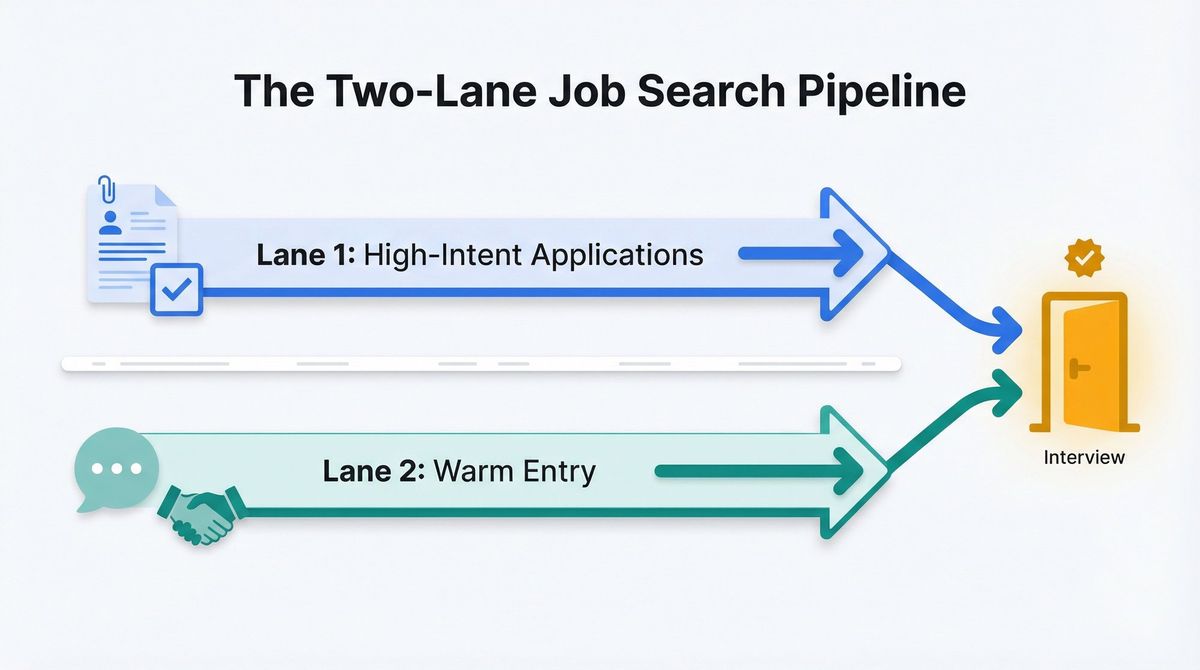
Run a two-lane pipeline: send tailored applications to high-fit roles in lane one, and build warm contact with employees and hiring managers in lane two. A pipeline built only on online applications bets your search on the most crowded channel there is.
What Makes a Lane-One Application Worth Sending?
A lane-one application targets a role where you match most requirements, gets tailored in about 20 minutes, goes in early, and carries proof such as a case study or portfolio link. If you can't tailor an application in 20 minutes, the system is broken, not you.
The hard part is volume. At the application counts above, tailoring and submitting by hand eats the hours you need for lane two. AIApply's Auto Apply submits tailored applications for roles that match your profile and preferences, which removes the form-filling and frees that time for outreach. Keep the filters tight, because automation multiplies whatever targeting rules you give it. Scale should mean applying to more of the right roles, not to every role.
How Do You Run a Warm Entry Lane?
Warm entry means contacting a real person at the company before or right after you apply. It gives a recruiter a reason to open your application, adds social proof that lowers the employer's perceived risk, and lets you test fit before you invest. You don't need a friend inside the company, only a warm context. If you have no contacts at all, this guide to getting a job with no connections covers where to start.
What Should You Say When You Message an Employee at a Target Company?
Send a short message that gives your context, one line of credibility, and a small ask. A small ask works because it is easy to answer and respects the person's time.
Script 1: Context, credibility, small ask (for employees at target companies)
Hi [Name],
I'm exploring [target role] opportunities and noticed you're at [Company]. I've done [relevant proof, one line] and I'm looking at [role or team] there.
If you're open to it, could I ask you two quick questions about what great candidates do well on that team? No worries if the timing is bad.
Thanks,
[Your name]
What Should You Send a Hiring Manager Along With Your Application?
Send a one-page case study that is relevant to the team's work, and lead with it. This lowers the manager's evaluation effort because the proof arrives before the ask.
Script 2: Proof pack first (for hiring managers)
Hi [Name],
I'm applying for [role] and wanted to share a one-page case study relevant to the team's work: [short description].
If it's useful, I'd love to be considered for the role. Either way, thanks for building [product or team outcome].
[Your name]
How Do You Ask for a Referral After You Apply?
Send the request the day after you apply, state two specific reasons you match, and make declining easy. A specific, low-pressure request removes the awkwardness for the person you ask.
Script 3: Referral request (after you have applied)
Hi [Name],
I applied to [role] yesterday and I'm a strong match on [two specifics].
If you'd be comfortable referring me, I can send a three-bullet summary and my resume. If not, totally fine.
[Your name]
How Many Applications Should You Send Each Week?
Send 10 to 15 well-matched applications a week as a baseline and 20 to 30 if you are unemployed, then adjust using your own interview rate, as this breakdown of how many jobs to apply to per week explains. Your target depends on conversion, so use the math instead of picking a number.
Weekly applications needed equal your target interviews per week divided by your interview rate. If you sent 50 applications and got 3 interviews, your rate is 6%, and one interview a week takes about 17 applications. If you have sent 30 to 50 applications and heard nothing, don't add volume. Fix targeting and packaging first.
How Do You Turn Interviews Into Offers?
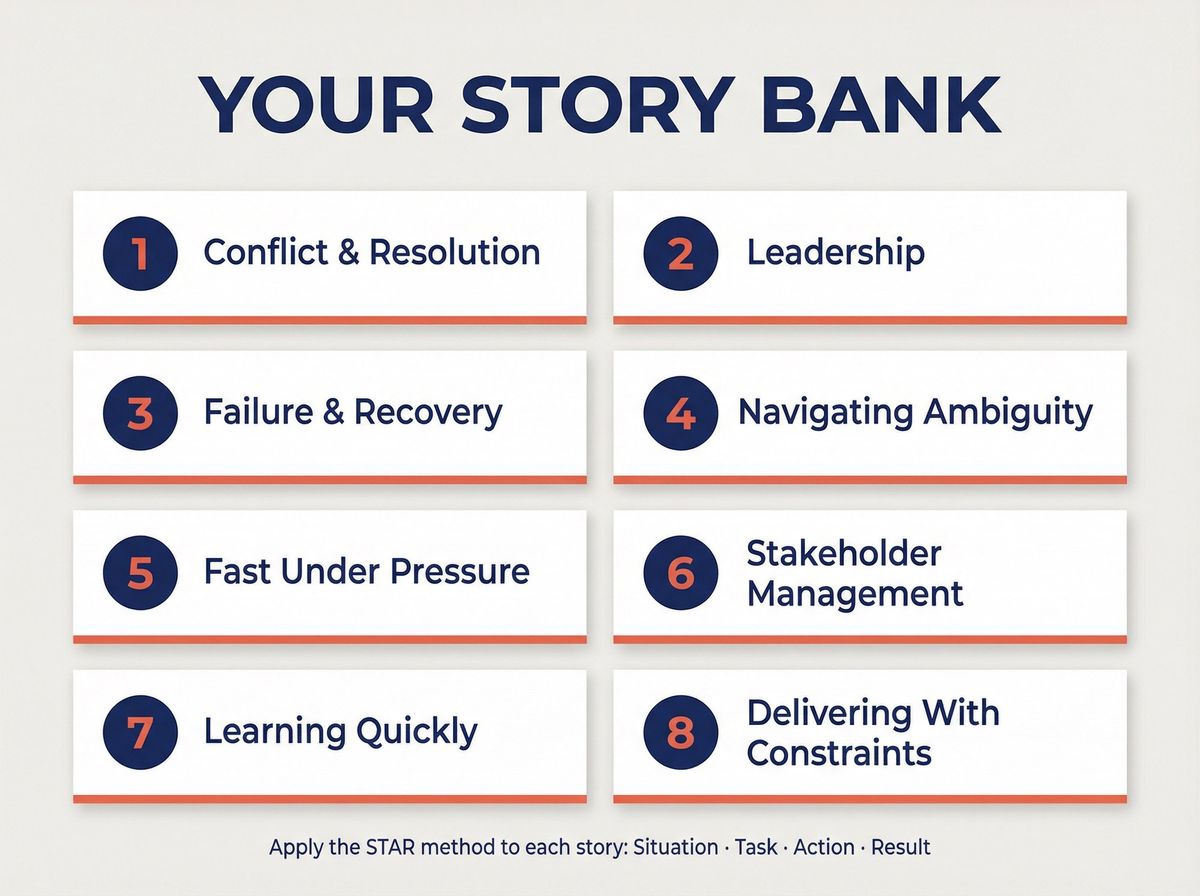
Turn interviews into offers by preparing eight to ten career stories in a fixed structure and practicing them out loud. Interviews test four things: evidence that you can do the work, clear structure under pressure, the risks an employer sees, and whether you understand the job's reality.
How Do You Build a Story Bank for Interviews?
A story bank is eight to ten real examples from your career, each written once and reused across behavioral questions. Cover these themes:
- Conflict and resolution
- Leadership without the formal title
- Failure and recovery
- Navigating ambiguity
- Moving fast under pressure
- Stakeholder management
- Learning a new skill quickly
- Delivering results under serious constraints
Write each story in STAR form: the situation in one sentence, the task in one sentence, the action in three to five sentences with your decisions and trade-offs, and the result with numbers and what changed.
Is It OK to Use AI During a Job Interview?
Use AI to prepare for interviews, not to deceive an interviewer, and follow any AI policy the employer states. If a company says "no AI" in a live interview, treat it like any other instruction. Preparation is where AI helps most: rehearsing answers, tightening stories, and spotting weak examples before they cost you an offer.
What Does a 30-Day Plan to Restart Your Job Search Look Like?
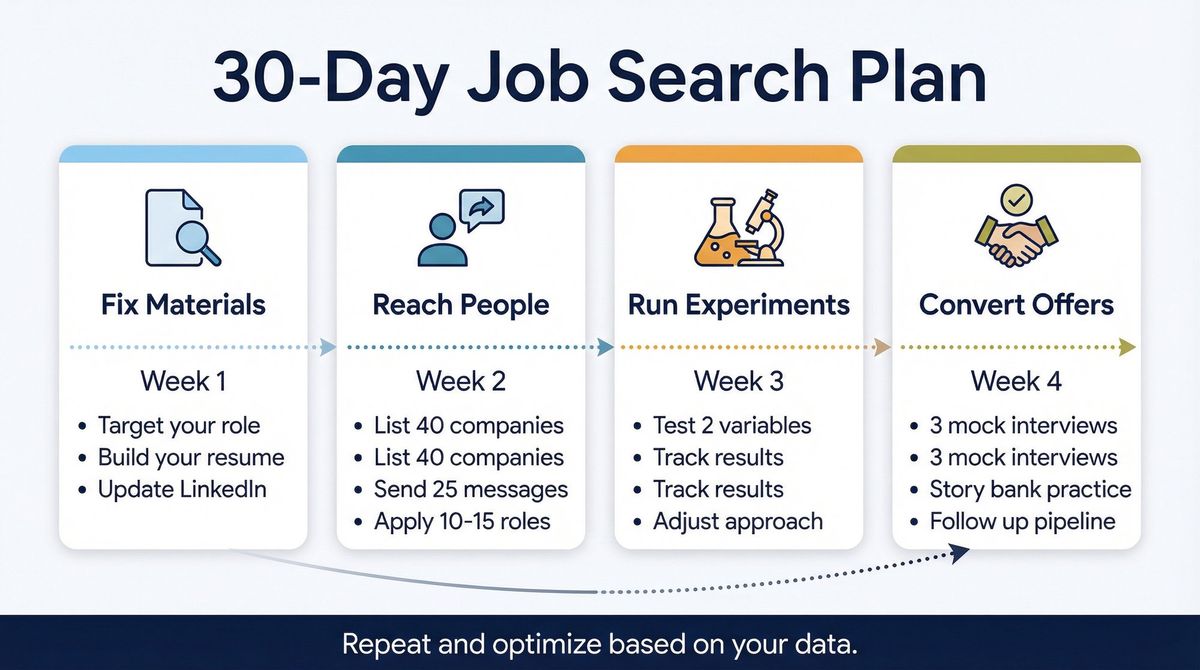
A 30-day restart plan runs four one-week phases: fix your materials, reach real people, test two variables, and practice for interviews. By day 30 you have your own conversion rates instead of opinions. If you need income faster, a 14-day job search sprint compresses the same moves.
| Week | Goal | What to do | Check at the end |
|---|---|---|---|
| 1 | Fix your materials | Choose a target and backup role. Write the positioning statement. Build Resume A and B. Update LinkedIn. Build a one-page proof pack. | Resume maps to about 60% of five sample postings |
| 2 | Reach real people | List 40 target companies (20 realistic, 20 reach). Find two people at each. Send 25 small-ask messages. Apply to 10 to 15 high-fit roles with proof attached. | Conversations booked |
| 3 | Test two variables | Pick two experiments and hold everything else constant: apply within 24 hours of posting, add a two-line impact summary, attach the proof pack to every message, or shift 30% of effort to warm outreach. | Response rate per experiment |
| 4 | Practice and convert | Run three mock interviews. Practice one story every two days. Follow up on stalled applications. Keep the pipeline moving. | Interviews to finals |
When Should You Pivot Your Job Search Strategy?
Pivot when 30 days of tracked, well-targeted effort still produces close to zero interviews, because at that point changing the approach beats applying harder. There are three pivots, and they work in this order.
How Do You Adjust Your Role Level Without Changing Careers?
Apply for the same role one level lower, at a smaller company, on a contract-to-hire basis, or in an adjacent industry where your skills transfer. Aiming one level too high can make you invisible to hiring managers, and adjusting the level is faster than changing careers.
What Is a Wedge Role in a Job Search?
A wedge role is an adjacent or entry position that puts you inside the team or domain you want, such as product operations or customer success on the way to product management. Take one when your target role keeps rejecting you for missing context, and use it to build proof inside the environment.
Should You Get a Certificate or Build a Project?
Build a project when you lack a skill, because a project you can show reduces an employer's risk more than a certificate that only says you studied the topic. A course that doesn't produce an artifact you can put in your proof pack rarely changes a hiring decision.
How Do You Pay the Bills While You Keep Looking?
File for unemployment insurance with your state's agency as soon as you lose a job, and use the free help at an American Job Center while you search. Eligibility rules and benefit length vary by state, so check your state's requirements before you assume anything. UK readers should use the UK edition of this guide.
American Job Centers offer free resume-writing tools, job search help, career counseling, job training services, and unemployment insurance information. For bridge income, temp work, part-time work, and short contracts in your field cover bills without leaving a gap on your resume, as long as you cap the hours so the main search keeps its weekly targets.
How Do You Protect Your Mental Health During a Long Job Search?
Put structure around the search: set daily hours, move your body, talk to at least one person each day, and take one full day off each week. Burnout kills consistency, and consistency is what wins a long search.
The research supports taking this seriously. A 2009 meta-analysis of 237 cross-sectional and 87 longitudinal studies concluded that unemployment impairs mental health and is a cause of distress, not just a correlate. A 2005 meta-analysis of 104 studies found that coping resources, including social support, financial resources, and time structure, related more strongly to mental health among unemployed people than demographic factors did. Feeling anxious, ashamed, or stuck is a predictable response to uncertainty, not a weakness.
A sustainable daily routine looks like this:
- 3 to 4 hours of deep work on applications, outreach, and interview practice
- 1 hour of exercise or a walk
- 1 social touchpoint, such as a friend, former coworker, or community member
- 1 full day per week completely off from the search
If you are in the U.S. and feel overwhelmed or unsafe, call or text 988 to reach the Suicide & Crisis Lifeline at any time. Outside the U.S., contact your local emergency number or crisis line.
How Do You Avoid Job Search Scams?
Treat any employer that asks you to pay for equipment, training, or processing, or that interviews you entirely by text, as a scam, because legitimate employers don't charge you to start a job. Scammers target people who are desperate, and the data shows it.
The Federal Trade Commission reported that job and employment agency scam losses rose from $90 million in 2020 to $501 million in 2024, and that the number of reports tripled over the same period. Run this checklist before you share any personal information:
- Verify the company's domain and check that real employees appear on LinkedIn.
- Never pay to get paid. Real employers don't charge for equipment, training, or processing fees.
- Walk away from check-overpayment and "buy equipment from our vendor" schemes.
- Be suspicious of interviews conducted entirely over text or chat.
What Else Do Job Seekers Ask When They Can't Find a Job?
How Long Is Too Long to Be Unemployed?
There is no cutoff after which your chances disappear, and long searches are common: the BLS reported that 27.0% of unemployed Americans had been jobless for 27 weeks or longer in August 2026. The better test is whether your approach has changed in the last 30 days, because repeating the same search for another month usually repeats the same result.
Should I Apply to Jobs I'm Not Fully Qualified For?
Yes, if you can do about 60% of the requirements today and the rest is learnable. Below that, you are buying lottery tickets and spending time that belongs on roles where you are a real contender. Use the requirement-mapping table above to check your fit in 10 minutes.
Why Am I Not Getting Any Interviews at All?
It almost always points to a targeting, packaging, or distribution problem: you are applying where your fit is below about 60%, your resume doesn't show results for the target role, or you rely only on online applications with no human contact. Go back to the diagnosis table at the top of this guide to find your stage. If you are applying and hearing nothing back, This guide to how long it takes to hear back after applying shows what silence usually means.
Is Networking Necessary When You Can't Find a Job?
Networking isn't mandatory, but with more than 300 applications per role it is one of the few moves that takes you out of the queue and into a conversation. You don't need to be outgoing. You need a system, and the three scripts above give you one.
Should I Use AI Tools in My Job Search?
Yes, to tailor faster and prepare better, and no for deception or for sending identical applications at scale. Edit everything so it sounds like you, and follow any employer AI policy. A roundup of the best AI job search tools compares what each type of tool does well.
Can I Really Find a Job in 30 Days With This Plan?
It is possible but not typical: Ashby reported that employers take about eight weeks to make a first hire for business roles, so a 30-day goal should be interviews and clean conversion data, not a signed offer. The plan guarantees that you learn which stage is failing and fix it, which is what shortens the rest of the search.
What Is the Biggest Mistake People Make in a Long Job Search?
The biggest mistake is doing the same thing louder, which means sending more of the same resume to the same roles through the same channels. Diagnose the failing stage, fix only that stage, and measure whether the numbers move.
What Should You Do Next?
Run the 48-hour restart this week, track your outcomes for 30 days, and change only the stage your numbers show is failing. Start with one decision today: choose the single role you will target for the next 30 days.
If you are already landing interviews but not offers, the last gap in the system is practice. AIApply's AI Mock Interview generates role-specific questions and gives feedback on your answers, so you can rehearse your story bank out loud before a real interviewer hears it.