How to Negotiate Salary After a Job Offer (2026)
Master salary negotiation with proven scripts and strategies. 78% who negotiate get better offers. Learn the 7-step system that protects your job offer.


You got the job offer. Congratulations! Now comes the part most people skip completely: negotiating your salary.
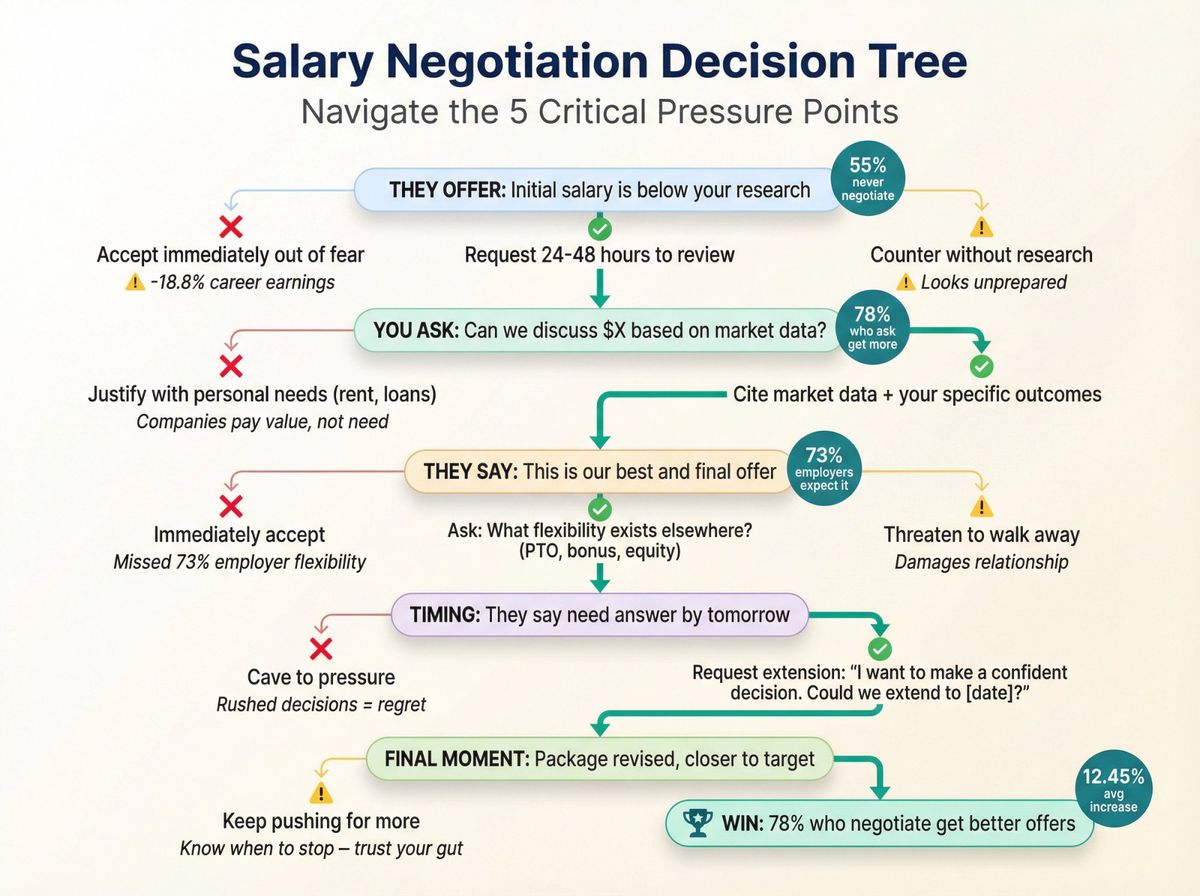
If you're feeling nervous about asking for more money, you're in good company. More than half of job seekers (55%) never negotiate at all, even though research shows 73% of employers actually expect you to negotiate on the initial offer. That hesitation is expensive. Data from 2024-2025 shows people who negotiate end up with starting salaries that are 18.8% higher on average, and some negotiators even doubled their offers.
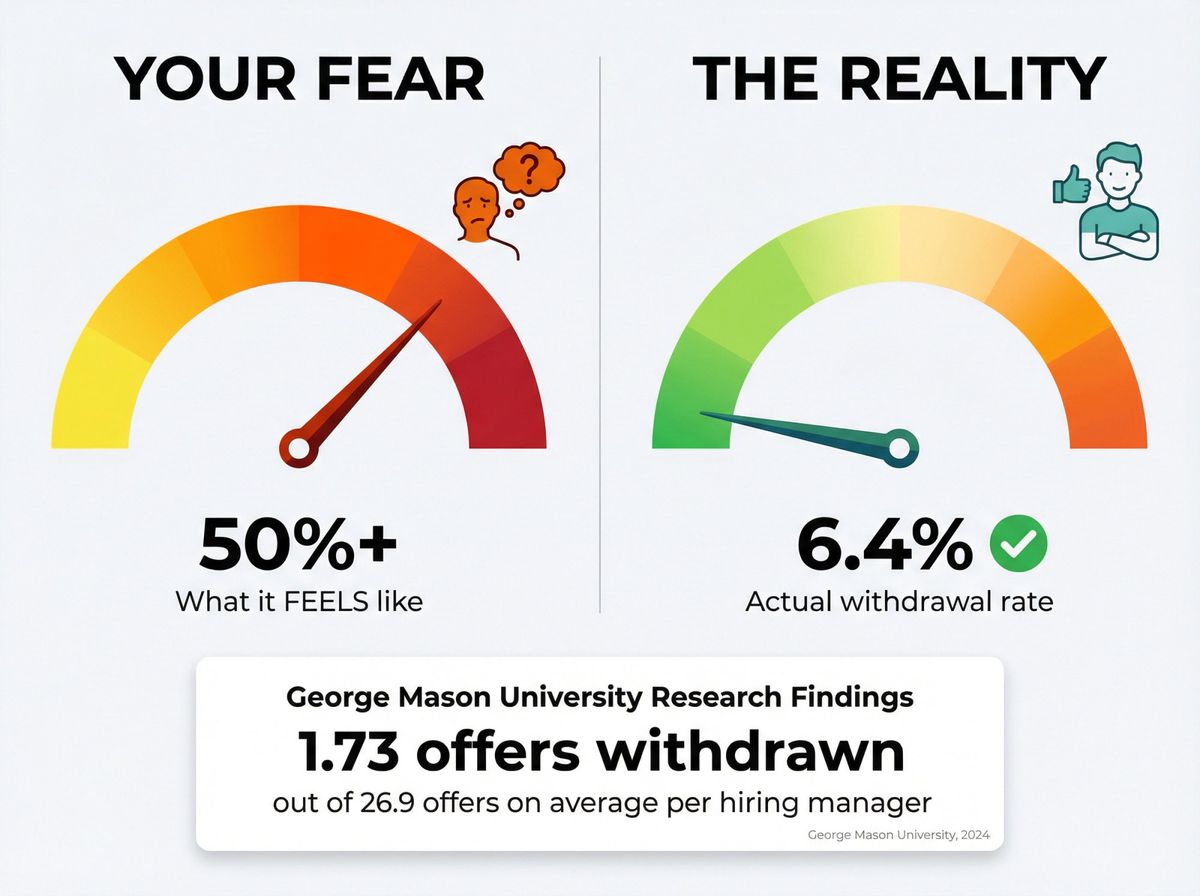
The fear holding you back? It's mostly in your head. Research from George Mason University found that hiring managers reported withdrawing only about 1.73 offers out of roughly 26.9 on average across their careers after a candidate negotiated. Yes, it can happen, but it's rare when you negotiate professionally.
This guide gives you everything you need to negotiate with confidence: exact scripts you can copy, a proven 7-step system, and the data to back up your ask. By the end, you'll know exactly what to say, when to say it, and how to handle every common pushback scenario.
Let's get you paid what you're actually worth.

Why Negotiating Your Job Offer Is Smart (Not Greedy)
Negotiating your salary isn't about being difficult or ungrateful. It's about making sure you and your employer are aligned on your value.
Here's what the data tells us:
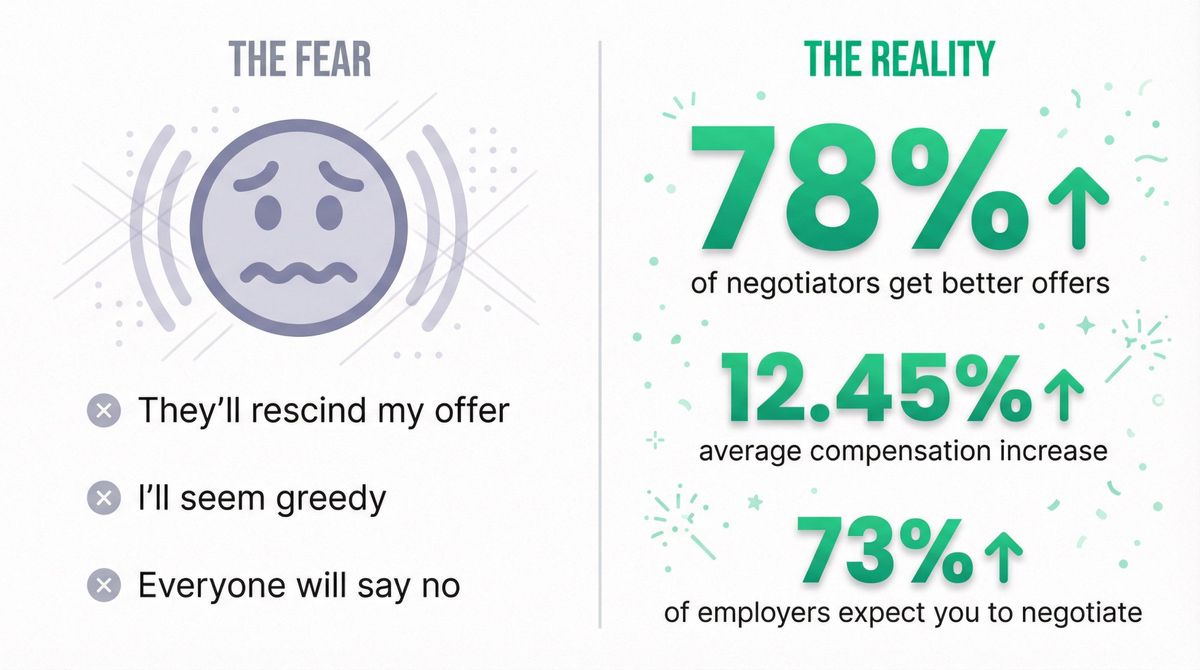
In a survey of 1,000 American workers, research found that 45% negotiated their salary and 78% of those negotiators received a better offer. Think about that. Eight out of ten people who asked got more.
A 2025 field study from UCLA Anderson Review involving tech job seekers showed that candidates who countered saw an average compensation increase of approximately 12.45%. That's not pocket change. On a $75,000 offer, that's an extra $9,337 in your first year alone.
And it compounds. A salary $5,000 higher today isn't just $5,000 more this year. According to analysis from entry-level salary experts, that small increase can translate into hundreds of thousands of dollars over your career as raises and bonuses stack on top of that higher base.
Most importantly, employers expect you to negotiate. They often make offers with built-in room to move. Industry data shows that 73% of employers are prepared to negotiate, yet 55% of candidates never ask. You're leaving money on the table by assuming the first number is final.
When you negotiate professionally, you're not signaling that you're difficult. You're showing that you:
• Understand your market value
• Can advocate for yourself (a business skill)
• Are confident in what you bring to the role
Research indicates many employers actually see smart negotiation as a sign of confidence and business acumen, especially for roles that require persuasion or strategic thinking.
The bottom line? Not negotiating is often riskier than negotiating. You risk undervaluing yourself, setting a low anchor for future raises, and potentially signaling to your employer that you don't understand what the role is worth.
When to Negotiate Your Salary (Timing Is Everything)
Timing matters in salary negotiations. Ask too early and you don't have leverage. Wait too long and you've already committed. Here's when to make your move.
Wait for the Written Offer
Don't negotiate until you have a firm job offer, ideally in writing. Before that point, the company is still deciding between candidates. You don't have real leverage until they've chosen you and made a formal offer.
When you receive the offer (whether verbal or by email), your immediate job is simple:
① Express genuine enthusiasm
② Request the full offer package in writing
③ Ask for time to review everything carefully
Here's a script you can use:
Thank you so much for the offer! I'm really excited about the opportunity to join the team. Could you send me the complete offer details in writing so I can review the full package? I'd like to take until [specific day/date] to look everything over carefully, and then I'll get back to you with any questions.
This approach does three things. It shows you're serious and professional. It gives you breathing room to prepare. And it frames any future negotiation as "questions" rather than demands, which keeps the tone collaborative.
The Best Window: Between Offer and Acceptance
The best time to negotiate is after you've received the written offer but before you've formally accepted. This is your window. Once you say "yes" and sign the paperwork, the negotiation is over.
Most employers expect you to take 24-48 hours to consider an offer. Some may give you up to a week. Don't feel pressured to respond immediately. Taking time to think signals that you're making a thoughtful decision, not just grabbing whatever comes your way.
If they press for a faster answer, you can say:
I understand the timeline is important. I'm taking this seriously and want to make a confident decision. Could we extend the deadline to [date] so I can review everything thoroughly and come back with a yes I'm excited about?
Choose the Right Communication Channel
When it's time to actually negotiate, request a phone or video call rather than handling everything over email. Career experts recommend that live conversations work better for negotiation because:
• Tone and enthusiasm come through clearly
• You can respond to questions in real time
• It's harder for anyone to misinterpret your intentions
• The conversation feels collaborative, not adversarial
After the call, follow up with an email summarizing what you discussed. This creates a paper trail while keeping the human connection.
To request the call, send something like:
I'm really excited about the offer and want to make sure we're aligned on the compensation package. Do you have 15 minutes tomorrow or the next day for a quick call to discuss a few details?
The 7-Step Salary Negotiation System That Works
Here's the proven system that works whether you're negotiating $50K or $250K.
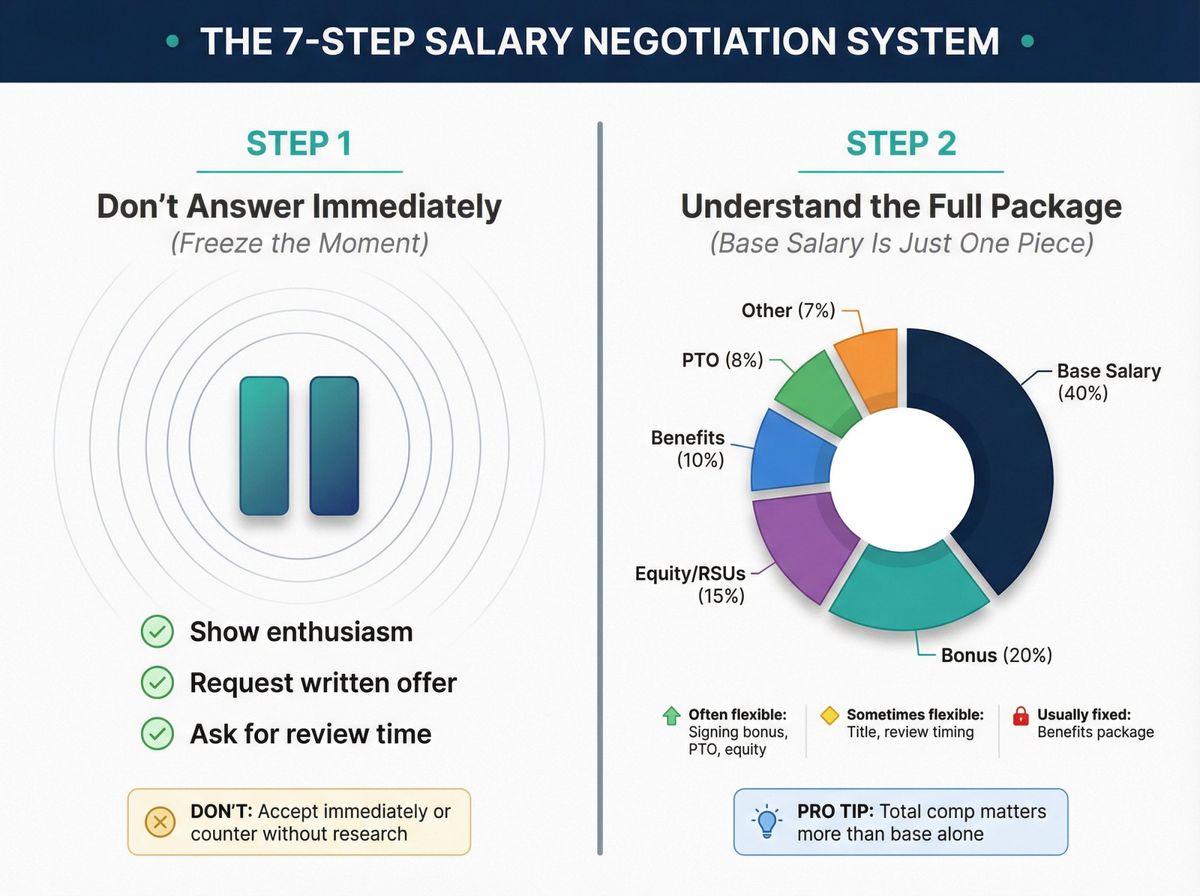
Step 1: Don't Answer Immediately (Freeze the Moment)
When you receive the offer, resist the urge to accept right away. Even if the number looks good. Even if you're excited. Even if you've been job searching for months.
Pause and get everything in writing.
Most people make one of two mistakes here. They either:
→ Accept immediately out of excitement or fear of losing the offer
→ Counter immediately without doing any research
Both are bad moves. The first leaves money on the table. The second makes you look unprepared.
Instead, use this response framework:
Thank you so much for the offer. I'm genuinely excited about joining [Company] and working with the team. Could you send me the complete offer details in writing, including base salary, bonus structure, equity, benefits, start date, and any other components? I want to make sure I understand the full package. If it works on your end, I'd like to take until [specific day/date] to review everything carefully, and then I'll come back with any questions I have.
This script accomplishes everything you need. You show enthusiasm (critical for keeping the relationship positive). You get the full package documented (so you're comparing apples to apples). And you buy yourself time to prepare properly.
What "the full package" means:
When you ask for the written offer, make sure it includes:
• Base salary (your annual pay)
• Bonus structure (signing bonus, annual bonus, performance bonus)
• Equity or stock options (vesting schedule, refresh grants)
• Title and level designation
• Location policy (remote, hybrid, in-office requirements)
• Paid time off and holidays
• Health, dental, vision insurance details
• Retirement matching (401k, pension, etc.)
• Learning budget or professional development allowances
• Home office stipend or equipment
• Relocation assistance (if applicable)
• Visa sponsorship (if applicable)
• Performance review cycle and salary review timing
Most companies won't volunteer all this information up front. You need to ask for it explicitly. If something isn't included in the written offer, follow up and request those details before negotiating.
Step 2: Understand the Full Compensation Package
Base salary gets all the attention, but it's only one piece of your total compensation. Smart negotiators think about the complete picture.
Why this matters: A company might be firm on base salary but flexible on everything else. If you only focus on base, you miss opportunities to increase your total value.
Here's what to evaluate:
| Component | What to Consider | Negotiation Potential |
|---|---|---|
| Base Salary | Your annual pay, sets anchor for future raises | Often negotiable, 5-15% room typical |
| Signing Bonus | One-time cash payment | Easier to negotiate than permanent base increase |
| Annual Bonus | Performance-based yearly payout | Sometimes tied to title/level |
| Equity/RSUs | Stock grants, vesting schedule | Negotiable, especially at senior levels |
| PTO | Vacation days, sick days, holidays | Surprisingly flexible for many companies |
| Remote Flexibility | Work from home days | Low cost to company, high value to you |
| Title/Level | Your official designation | Affects future compensation ceiling |
| Review Timing | When you're eligible for raise | Can negotiate earlier review (6 months vs 12) |
| Learning Budget | Courses, conferences, certifications | Often available but not advertised |
| Relocation | Moving costs, temporary housing | Negotiable if you're relocating |
Total compensation is what actually matters. An offer with $80K base, $10K signing bonus, and strong equity might be worth more than $85K base with nothing else.
If you want to compare offers side-by-side and see the real total value, tools like AIApply's Job Offer Comparison Calculator let you input all components and get an apples-to-apples comparison. This prevents you from getting hypnotized by base salary alone.
Step 3: Research What You're Actually Worth
Before you can negotiate effectively, you need to know what the role is actually worth. This isn't about what you want to make. It's about what the market pays for your skills, experience, and location.
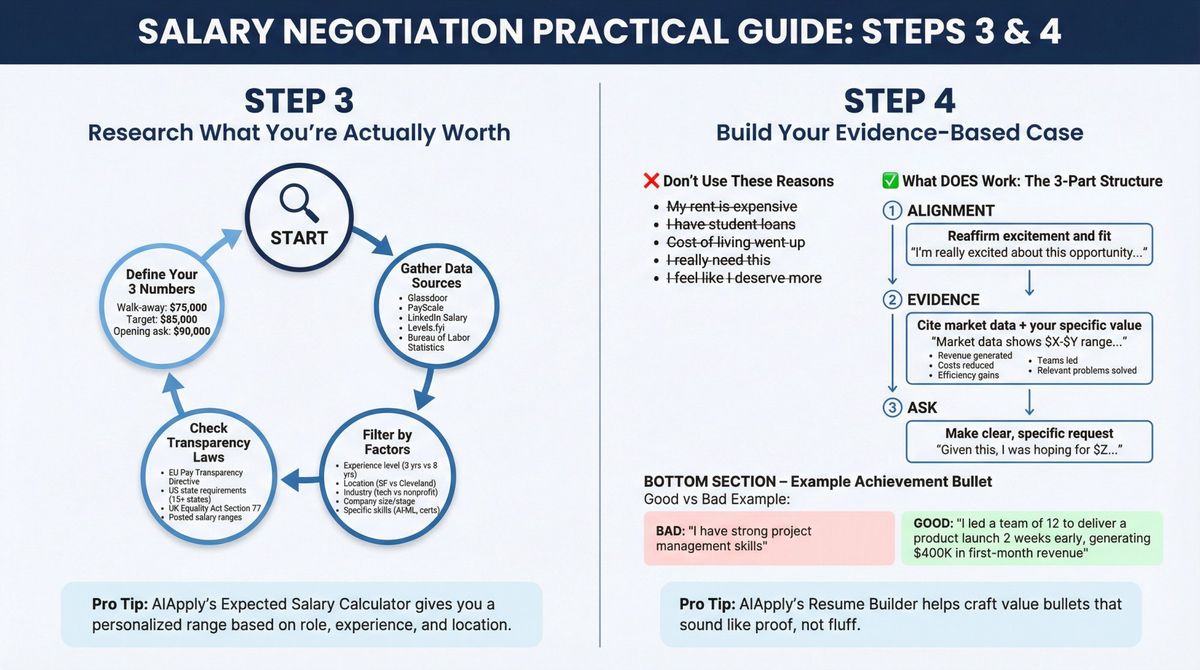
Start with salary databases and research platforms:
• Glassdoor works well for showing salary ranges by role, company, and location
• PayScale lets you filter by years of experience and specific skills
• LinkedIn Salary provides peer-based salary insights
• Salary.com offers industry-specific compensation data
• Levels.fyi is excellent for tech roles with specific level breakdowns
• Bureau of Labor Statistics gives government data on occupational wages
For example, if you're looking at a Marketing Manager role in Austin, you'd search for that exact combination. Look for the median pay and the range from 25th to 75th percentile. This gives you a realistic window.
Pay attention to these factors:
① Your experience level since 3 years of experience typically pays less than 8 years, even in the same role
② Your specific skills because rare or in-demand skills (AI/ML expertise, specific certifications) command premium pay
③ Your location since San Francisco pays more than Cleveland for the same job title due to cost of living
④ The industry because tech and finance typically pay more than nonprofits or education
⑤ Company size and stage since startups might offer lower base but higher equity, while enterprises offer stability and higher base
If you want a quick sanity check on what you should be targeting, AIApply's Expected Salary Calculator can give you a personalized range based on your role, experience, and location. It's designed specifically for negotiation prep.
2026 legal advantage: Pay transparency laws
More jurisdictions now require employers to disclose salary ranges, which gives you massive leverage. As of 2026:
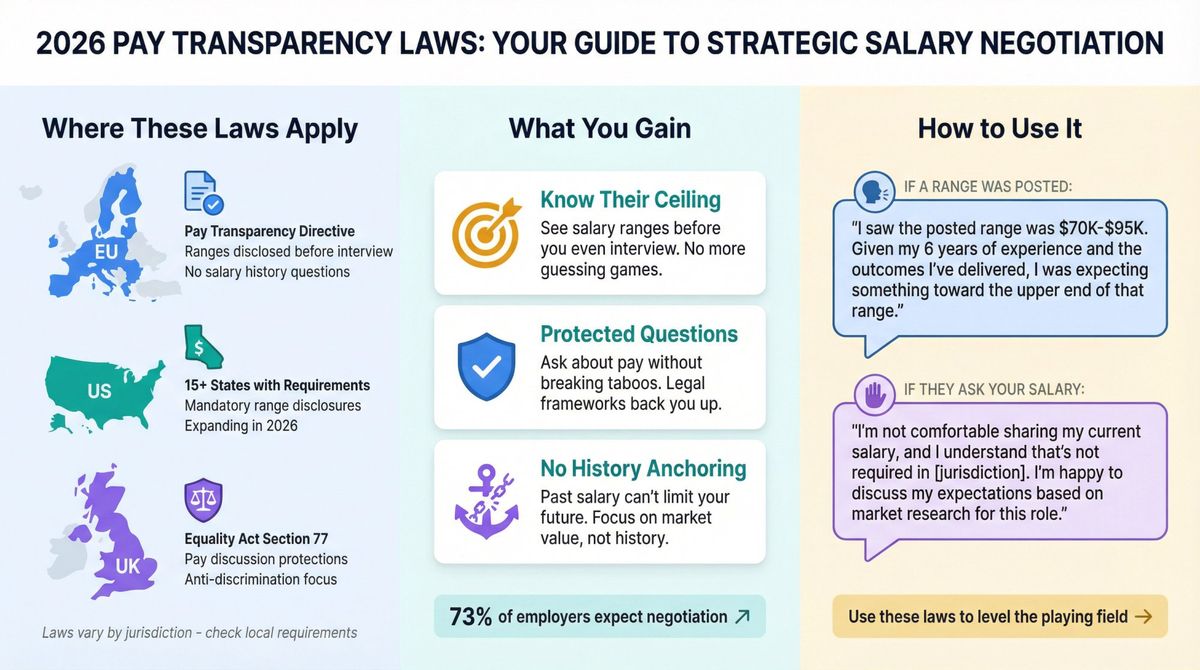
• In the EU, the Pay Transparency Directive requires employers to provide pay range information to applicants before interviews and restricts salary history questions
• In the US, multiple states now mandate salary range disclosures in job postings. Industry analysis shows about 15 states had requirements by late 2025, with more adding them in 2026
• In the UK, while there's no mandatory disclosure like some US states, Section 77 of the Equality Act 2010 protects employees' right to discuss pay for the purpose of finding discrimination
If the company posted a salary range, check where their offer falls. If you're at the bottom of their stated range and you have strong qualifications, that's your opening to negotiate toward the middle or top.
Determine your three numbers:
After your research, you should define:
→ Your walk-away minimum (the lowest you'll accept, be honest with yourself)
→ Your target (what you'd feel great about)
→ Your opening ask (slightly above your target to give room for negotiation)
For example:
• Walk-away: $75,000
• Target: $85,000
• Opening ask: $90,000
This framework ensures you don't accept less than you're comfortable with while giving you negotiation room.
Step 4: Build Your Evidence-Based Case
Now we get to the critical part most people miss. You can't just ask for more money because you want it or need it. You need to justify why you're worth it.
What doesn't work (don't use these reasons):
• "My rent is expensive"
• "I have student loans"
• "Cost of living went up"
• "I really need this"
• "I feel like I deserve more"
These are real concerns for you personally, but they don't help the employer justify paying you more. Companies pay for value, not need.
What does work: The 3-part structure
① Alignment because you reaffirm your excitement and fit
② Evidence where you cite market data and your specific value
③ Ask by making a clear, specific request
Here's the framework in action:
I'm really excited about this opportunity and I can see myself making a strong impact in this role. Based on my research of similar positions in [location] and considering my 7 years of experience in [field], market data suggests roles like this typically range from $X to $Y. Plus, I've delivered results that directly translate to this work: I reduced customer churn from 6.2% to 4.1% by rebuilding our onboarding process, and I managed a team of 5 that delivered 3 consecutive projects ahead of schedule. Given this, I was hoping we could discuss a base salary of $Z. Is there flexibility to move closer to that number?
Building strong evidence bullets:
Your "proof of value" should be specific, measurable outcomes that you can repeat for this employer. Think about:
• Revenue you generated or grew
• Costs you reduced or saved
• Efficiency improvements you created
• Teams you led or projects you managed
• Problems you solved that are relevant to this role
Bad example: "I have strong project management skills"
Good example: "I led a cross-functional team of 12 to deliver a product launch 2 weeks early, which resulted in $400K in first-month revenue"
If you're struggling to turn your experience into compelling value statements, AIApply's Resume Builder is designed specifically for this kind of "value packaging." It helps you craft achievement bullets that sound like proof, not fluff.
Let the data speak:
One effective tactic is to cite market data in a way that invites them to confirm or correct:
"Correct me if I'm wrong, but I've seen that roles like this typically pay around $85K to $95K in our city. Given my experience, I'd feel comfortable at the higher end of that range."
This phrasing is hard to push back against because you're framing it as alignment with known benchmarks, not just a random ask.
Step 5: Choose Your Communication Strategy
You've done your research. You know your number. You have your evidence ready. Now you need to decide how to have the conversation.
The best default: Phone or video call first, then email confirmation
Here's why live conversations work better for negotiation:
• Tone matters because you can convey enthusiasm and collaboration in your voice
• Real-time clarification means if they have questions, you can address them immediately
• Harder to misinterpret since email can sound demanding even when you're trying to be polite
• Builds rapport because it's harder for someone to say no to a person they just talked to
Career negotiation experts recommend requesting a brief call to "discuss the offer details" rather than negotiating entirely through email.
How to request the conversation:
I'm really excited about the offer and want to make sure we're aligned on the full package. Do you have 10-15 minutes tomorrow or the next day for a quick call to talk through a couple of details?
This is low-pressure and positions you as collaborative, not adversarial.
After the call, confirm in writing:
Always follow up with an email summarizing what you discussed. This creates a record and ensures everyone is on the same page.
Thanks so much for taking the time to talk today. Just to confirm our discussion: we agreed on a base salary of $X, with [other details]. I'll look forward to receiving the updated offer letter. I'm excited to get started!
When email makes sense:
If scheduling is genuinely difficult, or if you feel much more confident in writing than speaking, you can negotiate via email. Just be extra careful with tone. Keep it warm, professional, and collaborative. Avoid sounding like you're issuing demands.
Step 6: Copy-Paste Salary Negotiation Scripts
Now we get to the exact words to use. These are battle-tested scripts that work whether you're negotiating $60K or $160K.
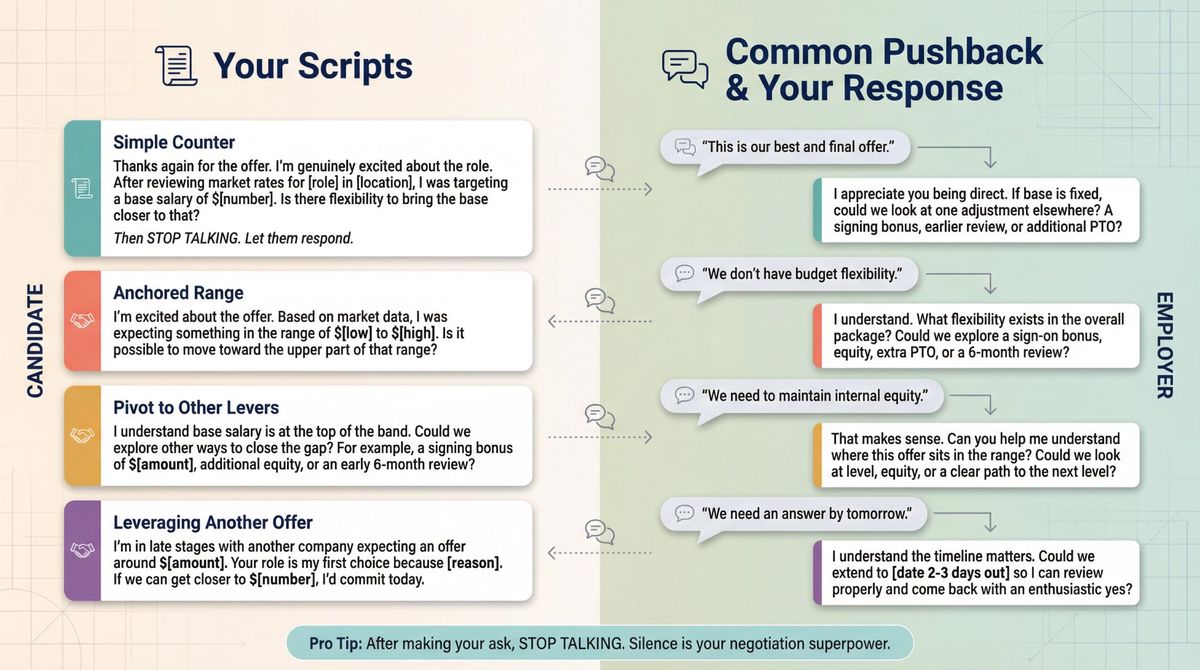
Script A: Simple Salary Counter (Clean and Professional)
Use this when you just need to ask for more and you have solid market research backing you up.
Thanks again for the offer. I'm genuinely excited about the role and the chance to work with the team. After reviewing the scope of the position and researching market rates for [role title] in [location], I was targeting a base salary of $[your number]. Is there flexibility to bring the base closer to $[your number]?
Then stop talking. The silence will feel uncomfortable, but resist the urge to fill it. Let them respond.
Script B: Anchored Range (When You Want Room, Not a Single Point)
Use this when you want to give them a range but still anchor high.
I'm excited about the offer and want to find a package that works for both of us. Based on market data and the scope we discussed, I was expecting something in the range of $[low end] to $[high end], depending on the full compensation structure. Is it possible to move the base toward the upper part of that range?
Pro tip: Make sure your "low end" is actually your target, so the whole range skews in your favor.
Script C: Pivot to Other Levers (When Base Salary is Capped)
Use this when they tell you base salary is fixed but you still want to improve the package.
I understand the base salary is at the top of the band for this level. That makes sense. Given that, could we explore other ways to close the gap? For example, would a signing bonus of $[amount] be possible? Or could we look at an additional equity grant, or perhaps an early compensation review at 6 months tied to clear performance goals?
This shows you're flexible and solution-oriented, not just fixated on one number.
Script D: Leveraging Another Offer (If You Actually Have One)
Only use this if it's true. Don't bluff. If you do have a competing offer, here's how to mention it without sounding like you're threatening them.
I want to be transparent with you. I'm in late stages with another company and expect to receive an offer in the $[amount] range. Your role is genuinely my first choice because [specific reason tied to the role, team, or mission, be authentic here]. If we can get closer to $[your number] on base or total compensation, I'd be ready to commit today.
This signals that you're in demand (social proof) while still showing genuine interest in their company specifically.
The power of silence:
After you make your ask with any of these scripts, stop talking and wait. This is one of the hardest parts for most people. The silence will feel awkward. You'll want to explain more, justify, or backtrack.
Don't.
Let them process and respond. Negotiation isn't about who talks more. It's about who can stay calm and let the other person make the next move.
Step 7: How to Handle Pushback and Negotiate Other Levers
You've made your ask. Now they respond. Here's how to handle the most common types of pushback you'll encounter.
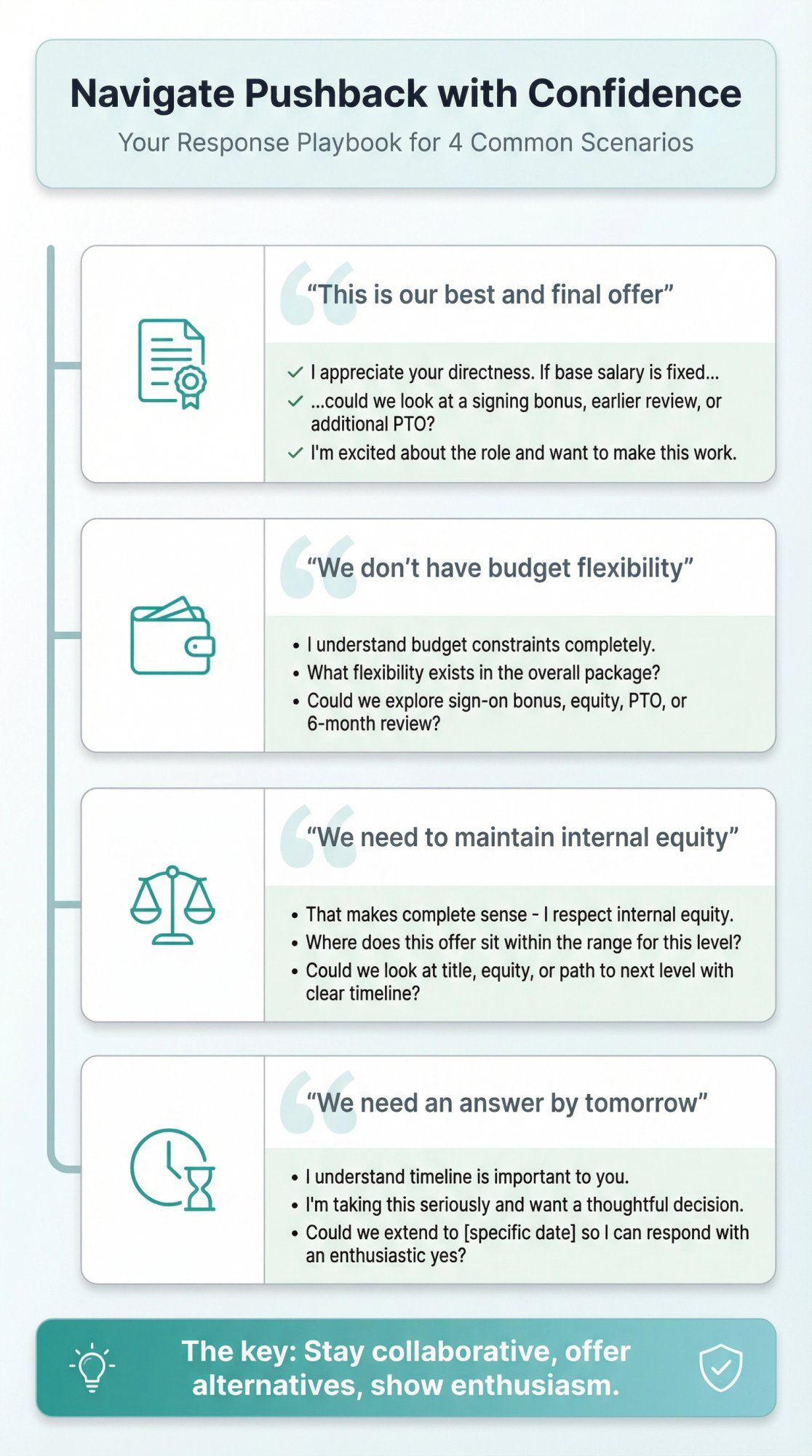
Pushback 1: "This is our best and final offer"
This is more common in tighter job markets. UCLA Anderson Review research notes that some employers used "best and final" language more frequently in 2025.
Your response:
I appreciate you being direct about that. If base salary is truly fixed, could we look at one adjustment elsewhere to help close the gap? For example, a signing bonus, an earlier performance review, or additional PTO? I'm excited about the role and want to see if there's any way we can make this work.
Pushback 2: "We don't have budget flexibility"
Your response:
I understand budget constraints. What flexibility do we have in the overall package? For instance, could we explore a sign-on bonus, additional equity, extra PTO days, or setting up a 6-month salary review?
Pushback 3: "We need to maintain internal equity"
Translation: We can't pay you more than people already doing this job.
Your response:
That makes complete sense, and I respect internal equity. Can you help me understand where this offer sits within the range for this level? If we can't adjust base right now, could we look at level or title, equity compensation, or a clear path to the next level with a defined review timeline?
Pushback 4: "We need an answer by tomorrow"
This is often a pressure tactic. Stand your ground politely.
Your response:
I understand the timeline is important to you. I'm taking this seriously and want to make a thoughtful, confident decision. Could we extend the deadline to [specific date 2-3 days out] so I can review everything properly and come back with an enthusiastic yes?
When base salary is truly capped: Get creative with other levers
Sometimes the base salary really is fixed due to pay bands, internal equity, or budget constraints. That doesn't mean the negotiation is over.
Here are high-value alternatives to base salary that many companies can offer:
| Lever | Value to You | Why It's Easier for Employer |
|---|---|---|
| Signing bonus | Immediate cash | One-time payment, doesn't affect ongoing budget |
| Earlier performance review | Path to raise sooner | Ties compensation to proven performance |
| Additional equity | Long-term value | Especially valuable at growth-stage companies |
| Extra PTO days | Work-life balance | Low cash cost, high perceived value |
| Remote work flexibility | Saves commute time | Reduces office space costs |
| Learning budget | Career development | Benefits company through upskilling |
| Title or level upgrade | Future compensation ceiling | Affects your market value |
| Relocation assistance | Moving support | One-time cost, helps with transition |
Negotiation research indicates that these alternative levers are often easier for companies to approve than permanent base salary increases, especially when they're working within rigid pay structures.
Example of creative negotiation:
I understand the base salary is set at $75K for this level, and I respect that structure. Would it be possible to do a combination of: • A $10K signing bonus to help with my relocation • An earlier performance review at 6 months (instead of 12) with clear goals we agree on now • One additional week of PTO given my years of experience That would make the total package work for me, and I'd be excited to accept.
This shows you're flexible, strategic, and solution-oriented. You're not just asking for more. You're offering a specific package that could work for both sides.
Will They Rescind My Offer? (What the Data Actually Shows)
Let's address the elephant in the room. You're probably worried that if you negotiate, the company will pull the offer completely. This fear stops more people from negotiating than anything else.
Here's what the data actually shows:
Research published by George Mason University found that hiring managers reported withdrawing approximately 1.73 offers out of roughly 26.9 on average across their careers after a candidate negotiated. Yes, it happens. But it's relatively rare.
The same research indicates that candidates significantly overestimate the risk of losing an offer due to negotiation. The reality is that when you negotiate professionally and reasonably, most employers respect it.
What actually causes offer rescission?
According to analysis of job offer withdrawals, offers get pulled for reasons like:
• Negotiating in bad faith (making up competing offers, lying about qualifications)
• Making extreme demands with no rationale ("I want double your offer")
• Acting entitled or aggressive
• Revealing major red flags during reference checks
• Budget cuts or hiring freezes (not related to negotiation at all)
What keeps you in the safe zone:
• Be collaborative, not combative
• Make specific, data-backed requests
• Show genuine enthusiasm for the role
• Negotiate on value, not personal needs
• Be willing to find creative solutions
• Know when to stop pushing
Red flags that suggest the company isn't worth working for anyway:
If an employer reacts poorly to a professional, reasonable negotiation attempt, that tells you something important about their culture. Career advisors note that any company that punishes you for respectfully advocating for fair pay is likely to have other cultural problems.
You probably don't want to work somewhere that:
• Gets offended when you ask reasonable questions
• Pressures you to accept without time to think
• Refuses to put offers in writing
• Reacts defensively to market data
• Penalizes you for knowing your worth
Bottom line: The fear of offer rescission is real, but the risk is much lower than your brain is telling you. As long as you're professional, specific, and collaborative, you're operating well within normal hiring norms.
How to Negotiate Like a Pro (Win-Win Thinking)
Most candidates think about negotiation as a zero-sum game. You win, they lose. You get more money, it costs them more. This mindset creates unnecessary tension and limits your options.
Here's what changes when you think differently:
According to research from George Mason University, hiring managers often see trade-offs where candidates see only costs. Different compensation levers have different costs to the company, which means some are easier to give than others.
Win-win levers that benefit both sides:
| Lever | Value to You | Why It's Easier for Employer |
|---|---|---|
| Remote work days | Saves commute time, flexibility | Reduces office space costs |
| Sign-on bonus | Immediate cash | Doesn't increase permanent base (budget-friendly) |
| Later start date | More time to transition | Helps them plan onboarding better |
| Extra PTO | Work-life balance | Low cash cost, high perceived value |
| Learning budget | Career development | Benefits company through upskilling |
| Early review cycle | Path to raise sooner | Ties compensation to proven performance |
When you propose solutions that make sense for both parties, you stop being "a cost" and start being "a problem solver." This is exactly the kind of thinking they want in the role anyway.
Example of win-win negotiation:
I understand base salary has some constraints. I'm wondering if we could structure it differently to work for both of us: • If we keep base at $80K, could we add a $15K signing bonus? That helps me with relocation costs and doesn't impact your ongoing budget the same way. • I'd also love to start with 3 weeks PTO instead of 2, given I'm coming in with 8 years of experience. • And could we set a 6-month performance review with clear goals we agree on now? That way, if I'm delivering value quickly, we can revisit compensation sooner. This package would make me feel valued while staying within your structure. Does that work?
This approach shows maturity, strategic thinking, and genuine interest in making it work. You're not just demanding more. You're partnering to find a solution.

When to use this:
Win-win framing works especially well when:
• You're negotiating with a company that has tight budgets (startups, nonprofits)
• The hiring manager seems sympathetic but constrained by policy
• You genuinely want the role and can be flexible on structure
• You're looking to build goodwill for future negotiations (raises, promotions)
How to Use 2026 Pay Transparency Laws to Your Advantage
The negotiation landscape has shifted significantly in the last few years, mostly in your favor. Pay transparency laws are giving candidates more leverage than ever before.
European Union
The EU Pay Transparency Directive requires (among other things) that applicants receive information about starting salary or pay range either in the job posting or before the interview. It also restricts employers from asking about your pay history.
What this means for you: If you're applying in the EU, you should know the salary range before you even interview. Use that information to anchor your expectations and know where the offer falls within their band.
United States
Pay transparency is a state-by-state patchwork, but it's expanding rapidly. Industry analysis from WTW notes multiple additional states added requirements in 2025, with even more coverage in 2026.
States with pay transparency laws typically require salary ranges to be included in job postings. This gives you a massive advantage in negotiation because you know their ceiling before they make an offer.
Salary history bans are also spreading. Many state and local restrictions exist as of 2025. This means employers in these areas can't ask what you currently make, which prevents them from anchoring your offer to your past pay.
United Kingdom
The UK doesn't have the same mandatory disclosure regime as some US states or the EU directive, but there's a key protection many candidates miss.
Under Section 77 of the Equality Act 2010, contract terms that prevent employees from discussing pay are unenforceable when the discussion is for the purpose of finding pay discrimination.
What this means: Even if you can't force a company to disclose ranges, you can ask smarter questions without feeling like you're breaking a taboo. And if you're already employed, you can discuss pay with coworkers to understand market norms.
How to use transparency laws in negotiation:
→ If a range was posted: "I saw the posted range was $70K-$95K. Given my 6 years of experience and the outcomes I've delivered, I was expecting something toward the upper end of that range."
→ If they ask your current salary (and it's banned): "I'm not comfortable sharing my current salary, and I understand that's not required in [jurisdiction]. I'm happy to discuss my expectations based on market research for this role."
→ If you're researching: Use transparency-required postings from other companies in the same market to triangulate what your offer should be.
The more information you have, the stronger your negotiating position. These laws are designed to level the playing field. Use them.
Salary Negotiation Checklist (Your Complete Prep Sheet)
Before you make that call or send that email, fill out this checklist. It ensures you've done the work and know exactly what you're asking for.
Research & Numbers
□ Researched market salary range for my role, location, and experience level
□ Identified salary ranges from at least 3 sources (Glassdoor, PayScale, LinkedIn, etc.)
□ Checked if company or similar roles posted salary ranges (transparency laws)
□ Determined my three numbers:
- Walk-away minimum: $______
- Target (what I'd feel great about): $______
- Opening ask (slightly above target): $______
□ Know where I fall in market range based on my experience and skills
□ Have specific data points ready to cite (sources plus dates)
Full Package Understanding
□ Received complete written offer with all components
□ Understand base salary structure
□ Understand bonus structure (signing, annual, performance)
□ Understand equity/stock details (vesting, refresh)
□ Understand benefits (health, PTO, 401k match, etc.)
□ Know title and level designation
□ Know location policy (remote/hybrid/office)
□ Know review cycle timing
□ Identified 2-3 alternative levers I can negotiate if base is capped
Evidence & Value
□ Listed 3-5 specific, quantified achievements relevant to this role
□ Prepared my value bullets (outcomes I can repeat for them)
□ Ready to explain why I'm worth the ask (market data plus my value)
□ Have my talking points written down
□ Practiced saying my ask out loud at least 3 times
□ Can deliver my ask confidently in under 2 minutes
Communication Strategy
□ Decided on channel (phone/video call preferred, email as backup)
□ Requested time to review offer (bought 24-48 hours minimum)
□ Scheduled or requested negotiation conversation
□ Prepared my opening script (chose from Script A/B/C/D above)
□ Ready to stay silent after making my ask
□ Prepared responses to common pushback scenarios
Decision Framework
□ Know my "yes conditions" (what needs to be true to accept)
□ Know my BATNA (best alternative if I walk away)
□ Know when I'll stop negotiating and accept
□ Know what would make me walk away
□ Ready to get final offer in writing before accepting
□ Ready to ask for time to consider if needed
Mindset & Tone
□ Remember: negotiation is normal and expected
□ Remember: 78% who negotiate get a better offer
□ Remember: offer rescission is rare when done professionally
□ Will express enthusiasm and excitement throughout
□ Will stay collaborative, not combative
□ Will focus on value and market data, not personal needs
AIApply Tools to Speed Up Your Negotiation Prep
Preparation is the difference between confident negotiation and anxious fumbling. But research and prep can take hours. If you want to shortcut the process without sacrificing quality, these tools can help.
Salary Negotiation Template Generator
Input your current offer, target salary, and key achievements. The tool generates a customized negotiation script with your opening, value points, and specific ask already structured. You still need to personalize it and practice delivery, but it gives you a solid starting template in minutes instead of hours.
Expected Salary Calculator
Enter your role, experience level, and location. The calculator pulls market data and gives you a personalized salary range with reasoning. It's designed specifically for negotiation prep, so you can cite the range with confidence.
Job Offer Comparison Calculator
Got multiple offers or just want to see the total value? Input base salary, bonus, equity, PTO, and other components for each offer. The calculator shows you total compensation side-by-side so you're comparing actual value, not just base numbers.
How to Answer Salary Expectations Guide
If you're still early in the process and getting hit with "what are your salary expectations?" questions, this guide walks through timing and phrasing strategies to avoid lowballing yourself before you even get an offer.
Resume Builder (for value packaging)
When you need to turn your experience into compelling achievement bullets that justify your ask, AIApply's Resume Builder helps you craft quantified, outcome-focused statements. The same bullets that make your resume strong are exactly what you need for salary negotiation evidence.
Interview Buddy (for confidence building)
If you're nervous about the negotiation call, practice with Interview Buddy. It's designed for interview prep, but the confidence you build translating thoughts into clear, compelling speech transfers directly to negotiation conversations.
These tools make preparation faster, but remember: you still need to customize everything to your voice and situation. Use them as starting points, not final scripts.
Salary Negotiation FAQ (Common Questions Answered)
How much should I counter?
Start with market data to find the range for your role. A common employer flexibility window is around 5-10% according to university career center research, but this varies by company, level, and market conditions. Pick a number you can defend with data and your specific qualifications. If you're currently at the low end of a posted range and you have strong experience, asking to move toward the middle or upper range is completely reasonable.
Should I negotiate if the salary range was posted and the offer is within it?
Yes, if you're not at the top of the posted range and you can justify why you should be higher. If the range is $70K-$95K and they offer you $75K, you have room to negotiate toward $85K+ if your experience warrants it. The range exists for a reason. More experienced or skilled candidates should be toward the top.
Is negotiating over email okay?
A phone or video call is usually better because tone and enthusiasm come through more clearly. But email negotiation can work if:
• Scheduling is genuinely difficult
• You're much more confident in writing
• The company culture is very email-heavy
If you email, be extra careful with tone. Stay warm, professional, and collaborative. Follow the same script structures, just in written form.
When should I stop negotiating?
Stop when:
• They've given you a firm "no" twice and you have no new lever to offer
• The relationship tone is starting to degrade
• You've reached your walk-away point and they won't budge
• You've gotten a fair improvement and additional pushing feels greedy
Trust your gut. If you feel like you're being unreasonable or if they're clearly frustrated, it's time to make a decision: accept or walk.
What if they say yes to salary but cut something else?
This is why you always review the complete written offer before accepting. If they raise base but reduce equity or cut PTO, compare the total compensation value. Sometimes it's still a win, sometimes it's a net loss dressed up as a win. Ask for the full revised package in writing and evaluate everything together.
What if I don't have another offer to leverage?
Don't invent one. If you don't have a competing offer, focus your negotiation on:
• Market data showing what the role typically pays
• Your specific qualifications and value
• The scope and responsibilities of the work
You can say: "I don't have another offer in hand, but my research and conversations with others in the field indicate this role can command around $X given my experience level."
How do I know if my ask is too high?
If your ask is based on solid market research from multiple sources and you can articulate why your experience justifies it, it's not too high. It's data-backed. The company might not be able to meet it, but that's different from your ask being unreasonable.
If you're asking 30-40% above market with no justification, that's too high. If you're asking for the 75th percentile of the market range and you have 75th percentile qualifications, that's reasonable.
Can I negotiate after accepting?
Technically you can try, but it's much harder and looks unprofessional. The negotiation window closes once you've formally accepted and signed. If you realize you made a mistake after accepting, you can reach out and explain, but don't expect success. This is why taking time to review before accepting is so important.
Should I tell them about my current salary?
In jurisdictions with salary history bans (many US states and EU countries), employers legally can't ask or can't use that information to set your offer. Even where it's legal, you're not obligated to share.
If asked, you can:
• Deflect: "I'd prefer to focus on the value I can bring to this role rather than what I'm currently making."
• Cite the law: "I understand that's not required in [state/country], so I'd rather discuss market rates for this position."
• Redirect: "I'm happy to discuss my expectations. Based on research, I was targeting $X for this role."
Your current salary is nobody's business and has nothing to do with what this role should pay.
What if they seem offended I'm negotiating?
If they react negatively to a professional, reasonable negotiation, that's a red flag about company culture. Any decent employer expects candidates to negotiate and respects it as a sign of business savvy.
Stay calm, stay professional, and stand your ground politely. If they continue to push back in an unreasonable way, consider whether you want to work somewhere that penalizes you for advocating for fair pay.
How long should I take to consider the offer?
Most companies expect 24-48 hours. Some will give you up to a week, especially for senior roles. Ask for what you need, but don't drag it out unnecessarily.
If you need more time to wait for another offer to come through, be honest: "I have another process wrapping up in the next few days. Would it be possible to extend the deadline to [date] so I can make a fully informed decision?"
Is it okay to negotiate everything at once?
You can, but it's often more effective to prioritize. Make your main ask (usually base salary), and if they can't move on that, then pivot to other levers. Negotiating 6 things simultaneously can feel overwhelming and reduce your chances of success on any of them.
Better strategy: Lead with your top priority, then negotiate alternatives if needed.
What if this is my first job out of college?
You can absolutely still negotiate, even at entry level. Research shows many employers respect early-career candidates who negotiate professionally. It signals confidence.
Focus on:
• Market data for entry-level roles in your field and location
• Relevant internships, projects, or skills you bring
• Alternative levers like start date, PTO, learning budget, or remote days
If the offer is at market rate, you might have less room, but you can still ask and negotiate non-salary items.
Should I negotiate benefits first or salary first?
Salary first. Base salary sets the anchor for future raises and total compensation. Once you've optimized salary, then look at other components. If salary won't budge, then pivot to benefits and other levers.
How do I follow up after they say they'll "think about it"?
Give them the time they asked for. If they said "I'll get back to you in 2 days," wait 2 days. If they didn't give a timeline, wait 2-3 business days, then send a polite follow-up:
Just wanted to check in on the compensation discussion we had. I'm still very excited about the opportunity and looking forward to hearing back. Please let me know if you need any additional information from me.
Conclusion

Negotiating your salary after a job offer isn't about being greedy or difficult. It's about making sure you're paid fairly for the value you bring.
The data is clear: most people who negotiate get a better offer, and the risk of losing the offer is much lower than your fear is telling you. When you approach negotiation professionally, with data to back up your ask and genuine enthusiasm for the role, you're operating exactly as employers expect.
Here's what we covered:
• Why you should negotiate (financial impact, it's expected, shows confidence)
• When to negotiate (after written offer, before acceptance)
• The 7-step system (pause, understand package, research value, build evidence, choose channel, make the ask, handle pushback)
• How to overcome the fear of offer rescission (data shows it's rare when done professionally)
• Win-win negotiation strategies (levers that benefit both sides)
• 2026 pay transparency laws (and how to use them)
• Complete checklist and preparation tools
Your next steps:
① Use the checklist above to prepare your numbers and evidence
② Choose the script that fits your situation
③ Practice your ask out loud until it feels natural
④ Request the negotiation conversation
⑤ Make your ask confidently and then stay quiet
⑥ Handle pushback with the response frameworks above
⑦ Get the final offer in writing before accepting
You've got this. You did the hard work of getting the offer. Now finish strong by negotiating the compensation you actually deserve.
If you want to speed up your preparation, tools like AIApply's Salary Negotiation Template Generator, Expected Salary Calculator, and Job Offer Comparison Calculator can help you build your case in minutes instead of hours. But whether you use tools or do it manually, the most important thing is that you actually negotiate.
Most people don't. That's why you'll stand out. That's why you'll earn more. And that's why, years from now, you'll look back at this moment as the time you learned to advocate for yourself.
Now go get paid what you're worth.