How to Explain a Career Gap in a Cover Letter (2026)
Turn your career gap into a strength. Learn how to explain employment gaps in cover letters with expert-approved examples that win interviews.


Career gaps are more common than you think. Nearly half of workers have taken a career break according to recent surveys, and two-thirds of professionals have some employment gap on their résumé. Whether you stepped away to raise children, care for family, recover from health issues, pursue education, or simply found yourself between jobs after a layoff, you're far from alone.
Good news: 44% of people say employers are more understanding of gaps now compared to before the pandemic. But the reality? About 30% of job seekers still feel employers view gaps negatively. Research shows that recruiters view an unexplained gap as a red flag.
The difference between a gap that hurts your chances and one that doesn't? A brief, confident explanation that removes uncertainty.
This guide will show you exactly how to address a career gap in your cover letter in a way that reassures employers, demonstrates your readiness, and keeps the focus on what you bring to the role.
Why Do Career Gaps Make Employers Nervous?
From an employer's perspective, hiring is about predicting future performance with limited information. Your CV, cover letter, and maybe a portfolio are the only signals they have. When there's a gap in that timeline, it creates an information vacuum.
If you leave that vacuum unfilled, hiring managers might silently wonder:
• Are your skills still current?
• Were there performance or reliability issues?
• Will you leave again soon?
• Are there scheduling constraints we should know about?
The gap itself isn't automatically "bad." The risk is an unexplained gap, because it lets the worst-case story fill the blank. As the UK National Careers Service points out, gaps are "not a problem" but something you may be asked about. Being open and focusing on transferable skills gained during that time is the recommended approach.
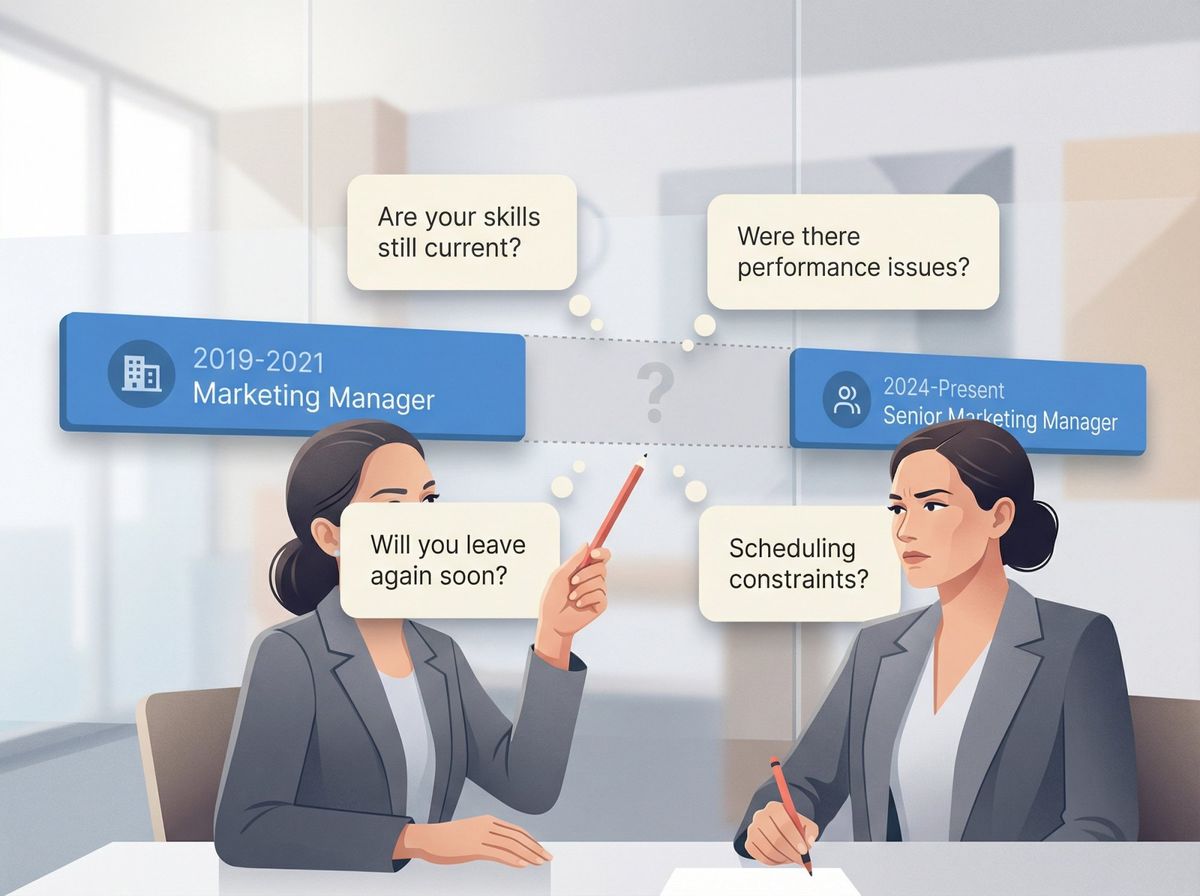
Your cover letter's job isn't to confess your life story. It's to remove uncertainty fast and redirect attention to why you're a strong match.
When Should You Mention a Career Gap?
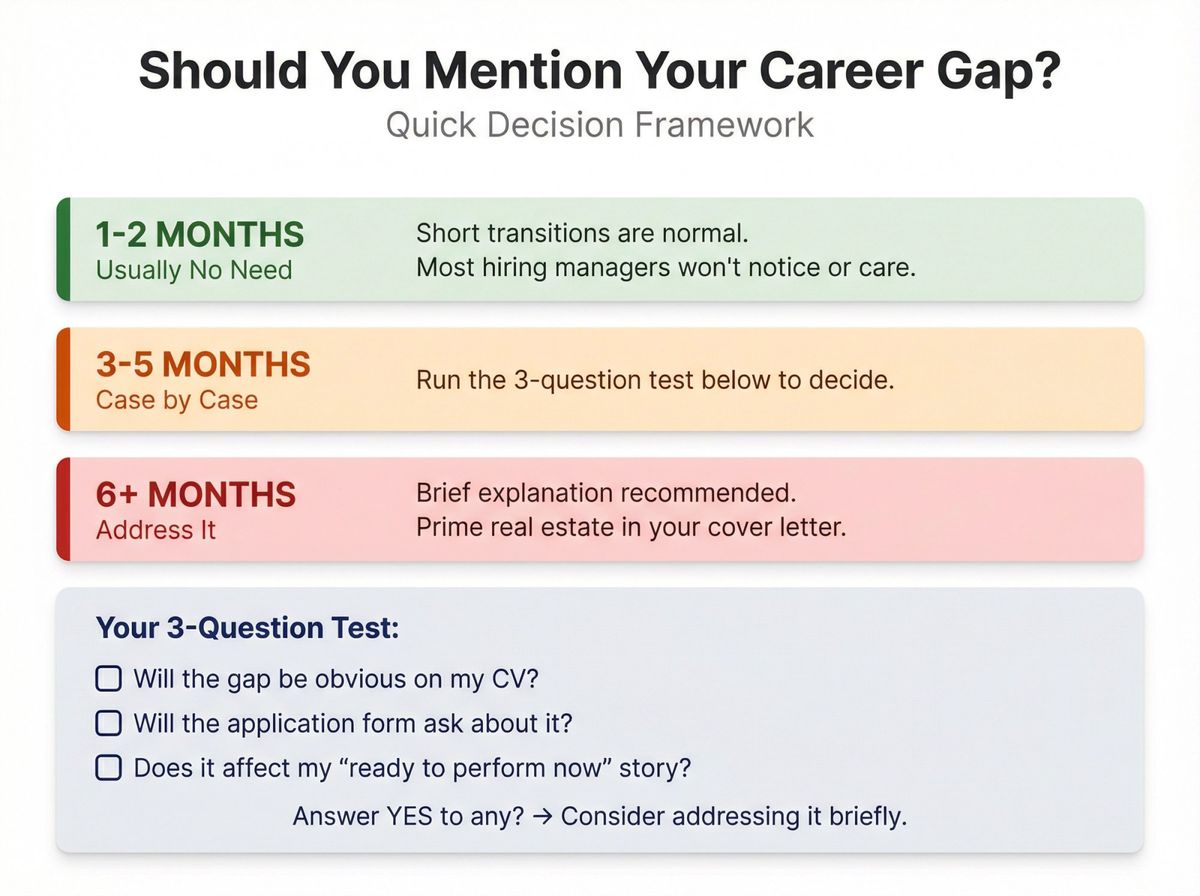
Not always. The answer depends on length and visibility.
Short Gaps (1-2 Months)
If your gap is brief, you likely don't need to spotlight it. Many people have short transitions between roles. Indeed suggests that gaps of "less than one or two months" can often go unaddressed. Hiring managers might not even notice, and if they do, it's usually not a concern.
Longer Gaps (6+ Months)
For significant gaps, it's wise to address it briefly in your cover letter or resume. Research shows that when cover letters are provided, a high percentage of recruiters read them, and many have even rejected candidates based on what's written there. Clearly, your cover letter is prime real estate for explaining your career break on your own terms.
How to Decide If You Should Mention Your Gap
Use this simple test:
1. Will the gap be obvious on my CV?
If yes, consider addressing it.
2. Will the application form ask about it?
If yes, address it consistently.
3. Does the gap affect my "ready to perform now" story?
If yes (career change, return after caregiving, health break), address it because it's part of your current narrative.
If you answer yes to any of these, you usually want a clean, confident, minimal explanation.
How Long Should Your Career Gap Explanation Be?
Multiple experts converge on the same guidance: keep it short and sweet.
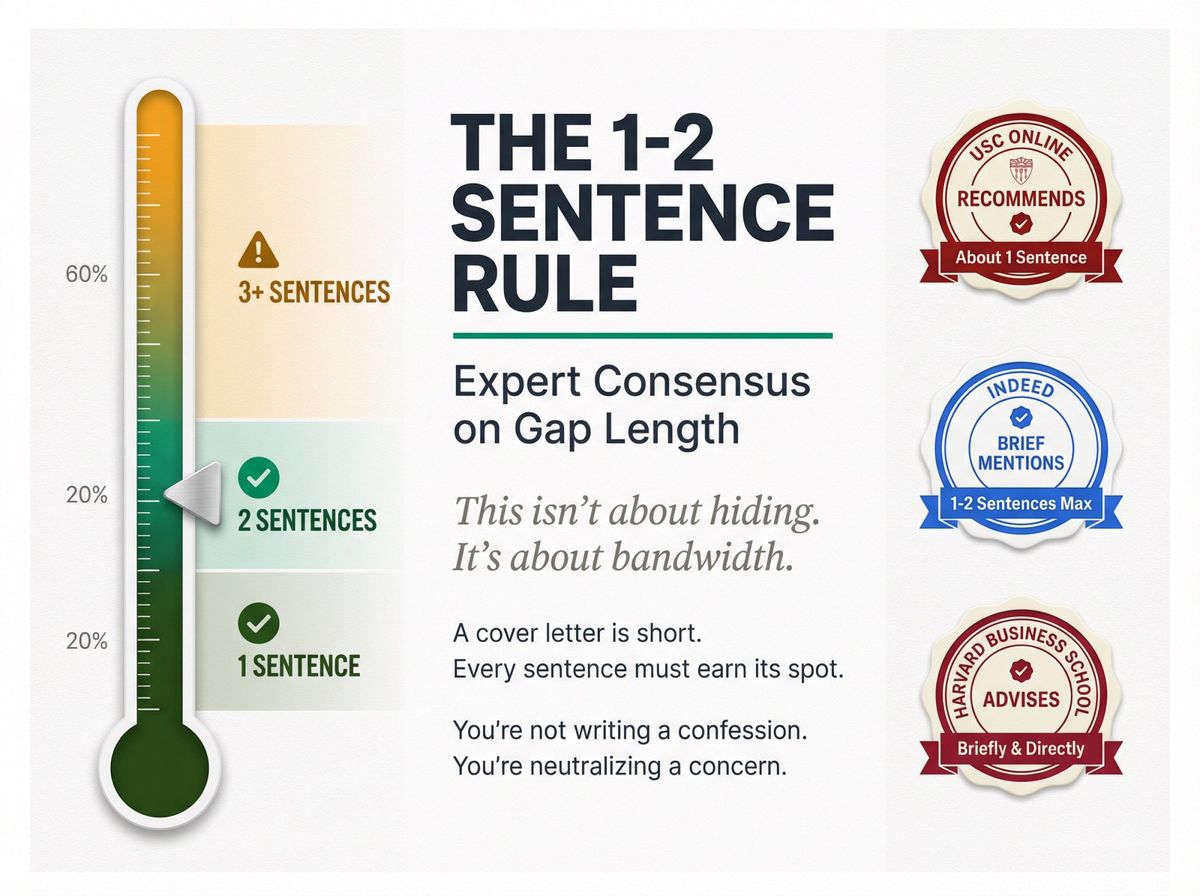
USC Online recommends about one sentence for the gap. Indeed says to keep mentions brief, explaining the absence in "one or two sentences" while avoiding irrelevant details. Harvard Business School advises addressing gaps "briefly and directly" before shifting to strengths and preparedness.
This isn't about hiding. It's about bandwidth. A cover letter is short, and every sentence has to earn its spot.
Think of it this way: you're not writing a confession. You're neutralizing a potential concern so the reader can focus on your qualifications.
The Best Way to Explain a Career Gap (4-Part Formula)
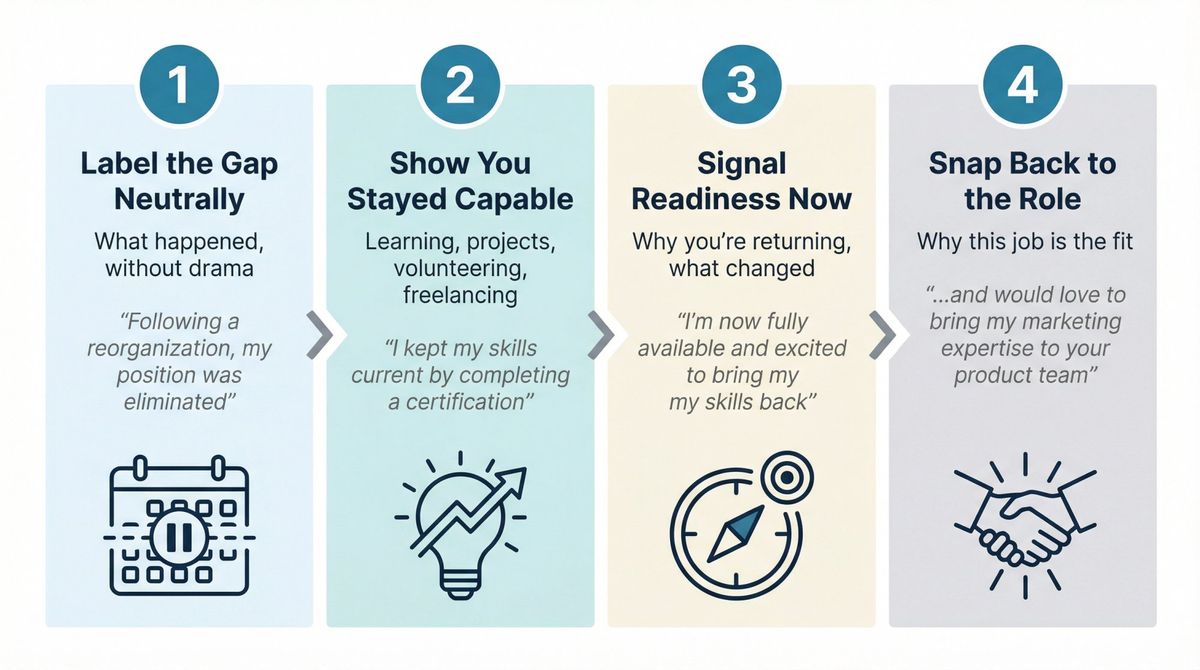
Here's the structure that wins interviews:
1. Label the gap neutrally (what happened, without drama)
2. Show you stayed capable (learning, projects, volunteering, freelancing, caregiving responsibilities)
3. Signal readiness now (why you're returning, what changed)
4. Snap back to the role (why this job is the fit)
Quick-Copy Template
After [neutral reason], I used that time to [1 concrete thing that kept skills current]. I'm now ready to [return/pivot] and would love to bring [role-relevant strength] to [Company] as a [Role].
One sentence is often enough. Two is fine if the second adds evidence.
Where Should You Explain Your Career Gap in a Cover Letter?
Placement matters because attention is scarce.
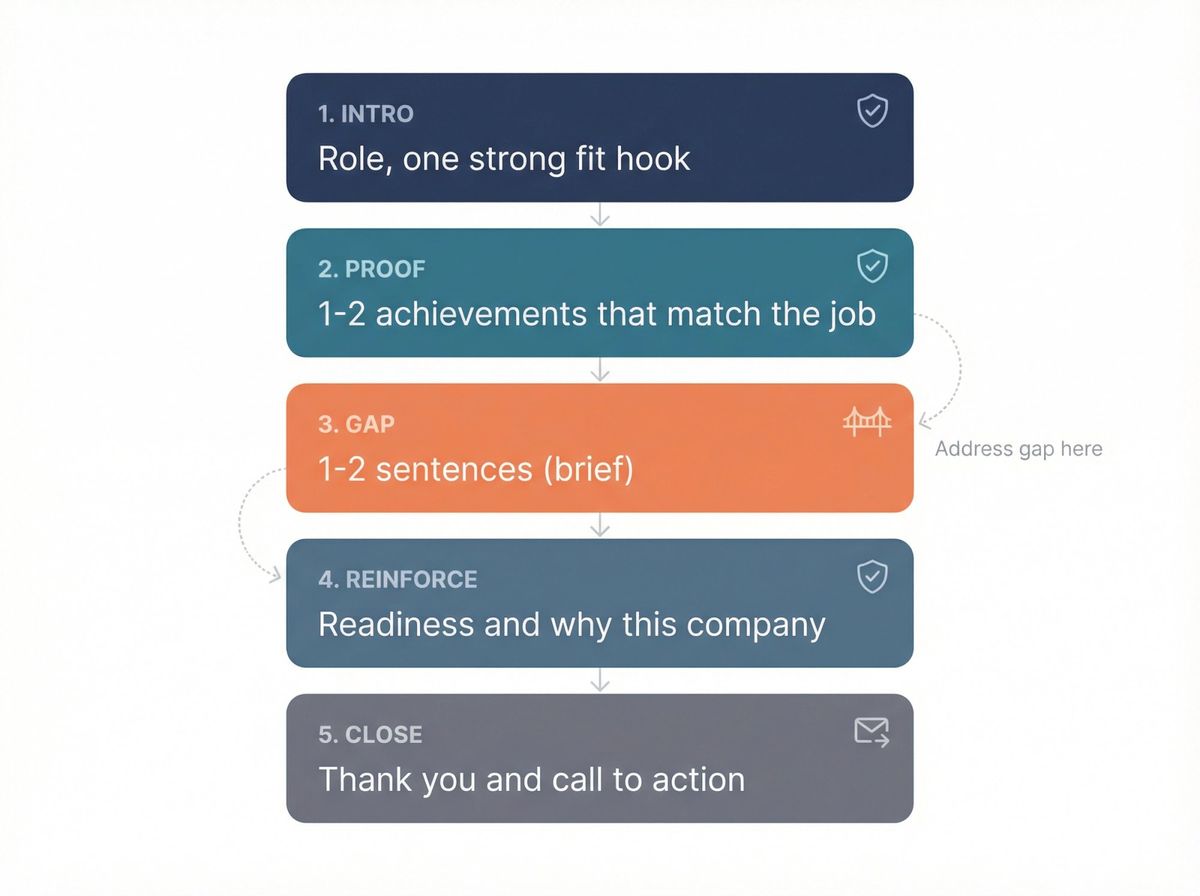
A practical cover letter structure that works:
| Section | Content |
|---|---|
| 1. Intro | Role, one strong fit hook |
| 2. Proof | 1-2 achievements that match the job |
| 3. Gap | 1-2 sentences (brief) |
| 4. Reinforce | Readiness and why this company |
| 5. Close | Thank you and call to action |
Indeed's template even places "Explain the gap in unemployment in two sentences or less" as the third paragraph, after you've already shown qualifications.
The logic is simple: lead with value, handle the objection, return to value.
What Not to Say When Explaining a Career Gap
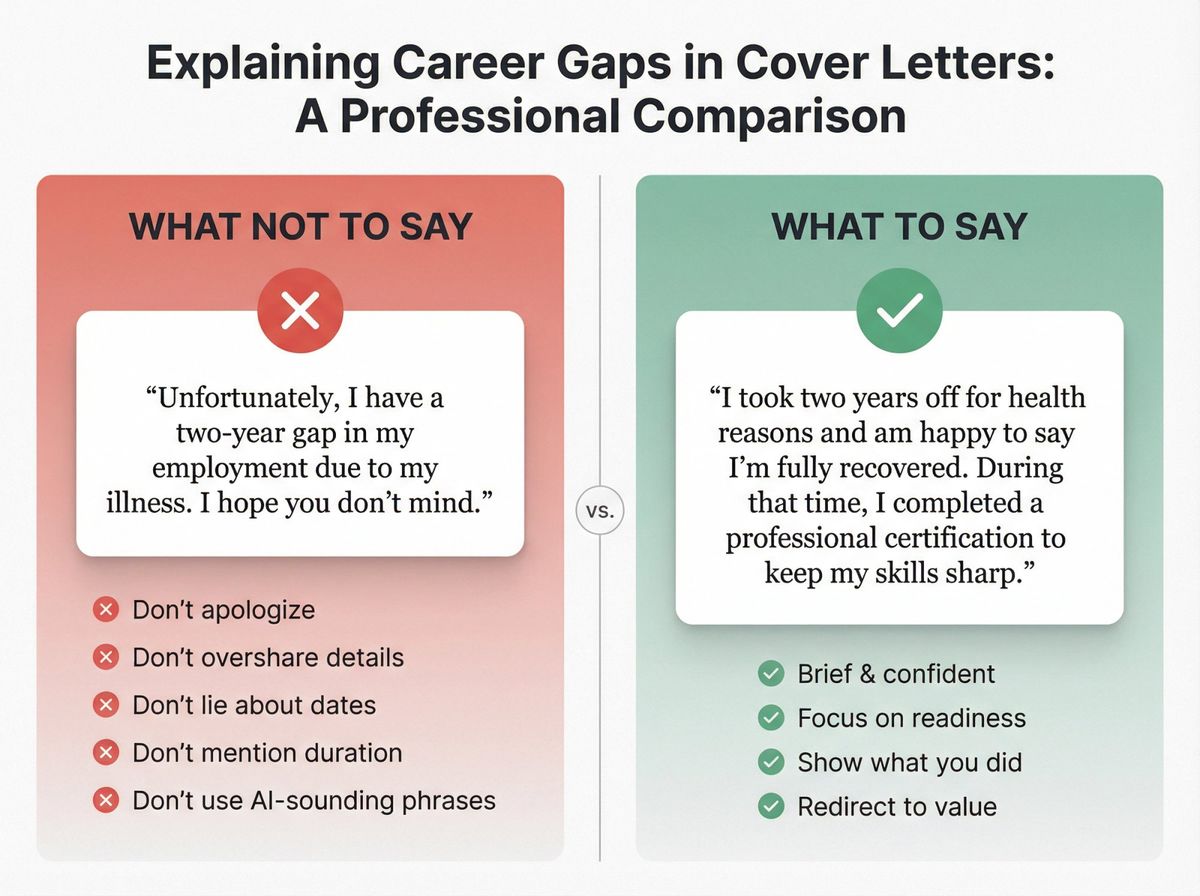
Don't Apologize for the Gap
Apologies make the gap feel like an offense. USC explicitly frames the cover letter as persuasive and says career breaks are "minor," so don't overweight them.
Compare these approaches:
| Weak/Apologetic | Confident/Forward-Looking |
|---|---|
| "Unfortunately, I have a two-year gap in my employment due to my illness. I hope you don't mind." | "I took two years off for health reasons and am happy to say I'm fully recovered. During that time, I completed a professional certification to keep my skills sharp." |
| "I know my resume has a big gap because of family care." | "I took time away from full-time work to provide family care. I'm now fully available and eager to bring my skills back into a role where I can make an immediate impact." |
Notice how the confident versions own the reason, show positive resolution, and steer right back to the value you offer.
Don't Overshare Personal Details
USC warns against giving too much personal information that could trigger unconscious bias. Keep explanations general and professional.
For health-related gaps, "for health reasons" is sufficient. You don't need to divulge diagnoses. For family matters, "to care for a family member" works fine. Protect your privacy while being honest.
Don't Lie or Stretch Dates
Indeed UK explicitly says it's always better to be honest and avoid fabricating job history or adding false dates. Research shows that a significant percentage of recruiters would reject a candidate for dishonesty in their application.
Getting caught in a lie is far worse than explaining the truth.
Don't Mention the Gap Duration
Indeed says to avoid mentioning the length because employers already have that information from your CV or application. Focus on the reason and what you did, not the duration.
Don't Sound Like AI Wrote It
In 2026, reviewers are increasingly sensitive to generic AI phrasing. Research has captured recruiter frustration with cookie-cutter "I'm excited to apply..." openings. The Financial Times highlighted recruiters being flooded with AI-generated CVs, reinforcing why "samey" language is a disadvantage.
Replace generic enthusiasm with specific proof and specific motivation. AIApply's cover letter generator is specifically designed to create authentic, human-sounding cover letters that avoid detection.
What Can You Legally Share About Health and Disability?
This matters because many candidates accidentally over-disclose.
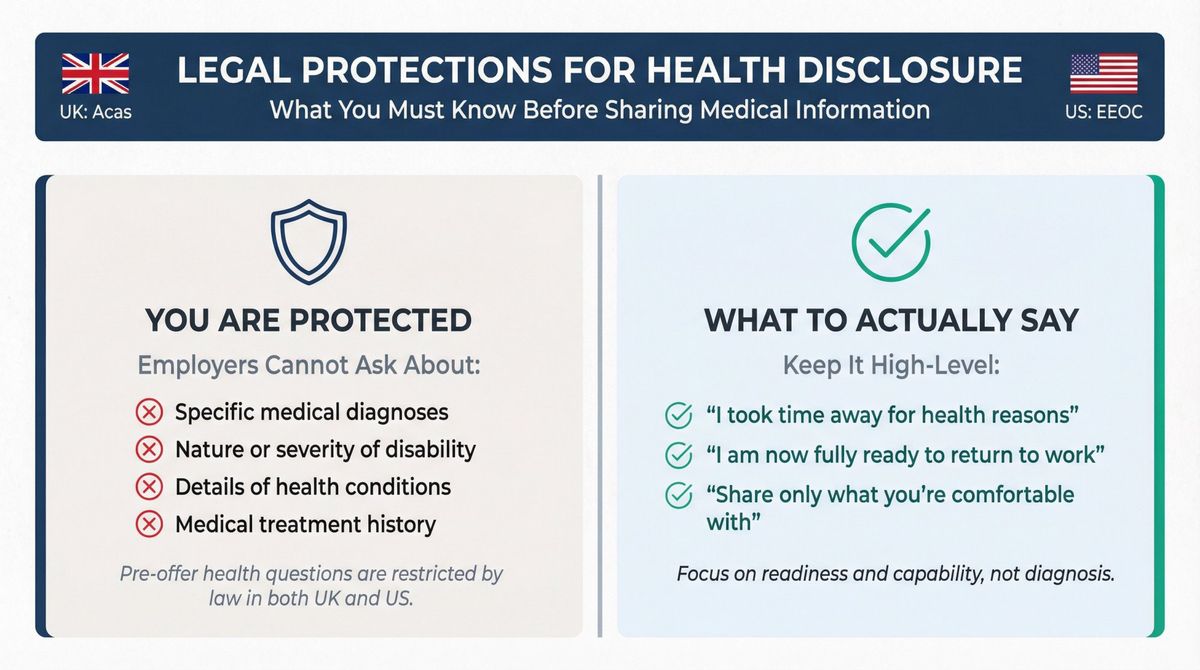
UK: Health Questions Are Restricted
Acas guidance says employers must not ask about health or disability at any stage of the application or interview process unless an exception applies.
US: EEOC Protection Rules
The US EEOC explains that employers generally cannot ask disability-related questions or require medical exams until after a conditional job offer, and they cannot ask about the nature or severity of a disability pre-offer.
What This Means for Your Cover Letter
You're usually better off keeping health-related gaps high level, focusing on readiness and current capability, not diagnosis details.
The UK National Careers Service explicitly says: share only what you're comfortable with, and you do not need to share everything.
How to Explain Common Career Gap Situations
Before diving into scenarios: Each situation below includes honest, brief, forward-looking language you can adapt. Pick the one that matches your situation and customize the details.
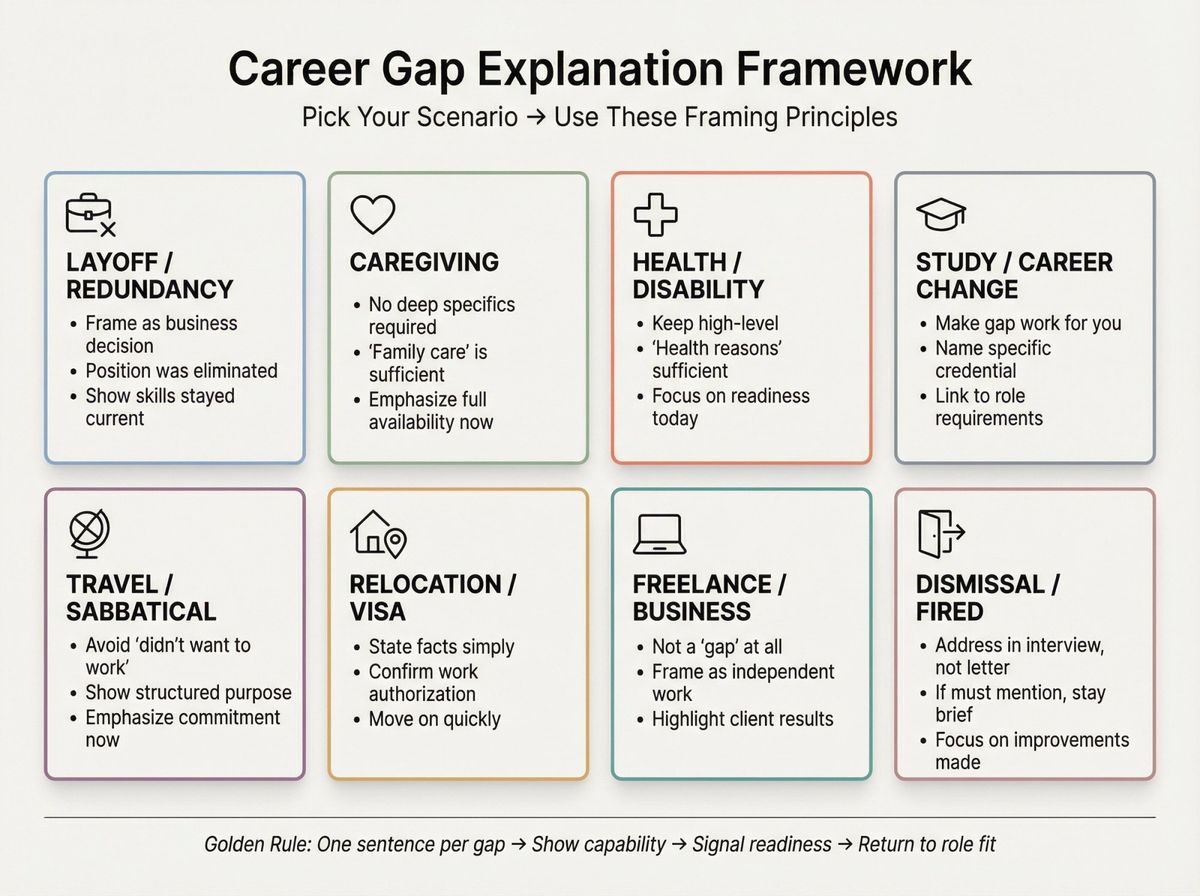
Below are options that are honest, brief, and forward-looking. Pick the one that matches your situation.
Layoff, Redundancy, or Reorganization
Why this works: It frames it as a business decision, not a performance issue.
"Following a reorganization, my position was eliminated, and I'm excited to bring my [skill] to the [Role] position at [Company]."
(Adapted from USC Online)
Upgrade it with proof:
"Following a reorganization, my position was eliminated. Since then I've kept my skills current by [project/course], and I'm ready to apply that momentum in this role."
Caregiving (Children, Elderly Parent, Ill Family Member)
Why this works: It's common, and you're not required to give deep specifics.
"I took time away from full-time work to provide family care. I'm now fully available and eager to bring my [skill] back into a [Role] position."
"After a planned period of caregiving, I stayed sharp by [course/volunteer/freelance], and I'm excited to re-enter the workforce in a role where [specific job need]."
Indeed UK notes you're not necessarily obliged to address caregiving gaps in great detail, and suggests focusing on your motivation to return and framing it positively.
Health, Disability, or Mental Health
Goal: Communicate readiness without handing over private details.
"I took time away for health reasons and am now fully ready to return to work. During that time, I kept my skills current through [lightweight evidence], and I'm excited to contribute in this role."
(Based on Indeed)
"After resolving a personal health matter, I'm ready to re-enter the workforce and apply my experience in [area] to [Company]'s work on [specific thing]."
Legal and comfort note: You can keep this high level, and in many situations employers should not be probing for details during recruitment.
Studying, Certifications, or Career Change
Make the gap do work for you:
"I stepped away to complete [credential/program] focused on [skills]. I'm now targeting [Role] roles where I can apply [job requirement] immediately, as shown by [project/result]."
(Adapted from USC Online)
If you're changing careers at 40 or considering a midlife career change, framing your gap as intentional reskilling can be particularly powerful.
Travel, Volunteering, or Sabbatical
Avoid sounding like "I didn't want to work."
"I took a planned sabbatical that included [volunteering/course/project]. I'm now fully committed to returning to full-time work and excited about this role because [specific match]."
"I used a planned break to broaden my experience through [structured travel/volunteering] and strengthen [transferable skill]. I'm now ready to apply that in a fast-moving team like yours."
The National Careers Service explicitly encourages focusing on transferable skills gained during gaps.
Relocation or Immigration/Visa Constraints
"In 2024 I relocated to [City/Country] due to family circumstances. I'm now settled and fully authorized to work, and I'm excited about this role because [match]."
Keep it factual, then move on.
Freelance, Contracting, or Building a Business
This is often not a "gap" at all. Frame it as work:
"During this period I worked independently with clients on [type of work], delivering [result]. I'm now excited to bring that end-to-end ownership into a full-time [Role] position."
Dismissal or Being Fired
The UK National Careers Service advises it's better to talk about a dismissal at the interview rather than at the application stage, and if asked, be brief about circumstances, what you learned, and how you improved.
Cover letter guidance:
If you can avoid mentioning dismissal and still be truthful, do that.
If you must address it, keep it minimal and future-focused:
"After leaving my previous role, I took time to strengthen [skill/process] and I'm ready to apply those improvements in this position."
Cover Letter Examples: How to Explain Career Gaps
These are intentionally short and evidence-heavy. Swap details to match your role and job description. You can also browse our cover letter examples by job title for more inspiration.
Example 1: Product Marketer Returning After Caregiving Gap
Subject: Application for Product Marketing Manager
Dear [Hiring Manager Name],
I'm applying for the Product Marketing Manager role at [Company]. Your focus on [specific initiative from job description] is exactly where my background in positioning, lifecycle messaging, and launch strategy has delivered strong outcomes.
In my last full-time role at [Previous Company], I led [launch/campaign] that resulted in [metric], partnering closely with Product and Sales to translate customer insight into messaging that actually moved pipeline. I'm particularly confident in the parts of this role that require [2 skills from job ad], because I've executed them repeatedly in high-ambiguity environments.
I took a planned break from full-time work to provide family care. During that time, I stayed current by [course/project] and continued hands-on work through [freelance/volunteer/portfolio]. I'm now fully available and excited to bring that momentum back into a full-time role.
If it's helpful, I'd love to walk you through a recent messaging teardown I did on [relevant product category] and how I would apply that thinking to [Company]'s [product].
Thank you for your time, [Your Name]
(Notice: 1 sentence for the gap, 1 sentence of proof, then straight back to value. That matches USC's expert guidance to keep it concise.)
Example 2: Project Manager Laid Off in a Reorg
Subject: Application for Project Manager
Dear [Hiring Manager Name],
I'm reaching out about the Project Manager role at [Company]. I've spent [X years] leading cross-functional delivery across [domains], and your need for someone who can [job requirement] stood out immediately.
At [Previous Company], I managed [program/project] across [teams], improving delivery predictability by [metric] through tighter scope control, clearer RAID tracking, and stronger stakeholder communication. I'm comfortable operating in fast-changing environments and translating uncertainty into execution plans.
Following a reorganization, my position was eliminated. Since then, I've kept my skills current by [tool/cert/project], and I'm ready to bring that experience to [Company] to help deliver [specific outcome in job description].
I'd welcome the chance to discuss how I would approach the first 30 days in this role, particularly around [one high-priority area from the job ad].
Sincerely, [Your Name]
Example 3: Customer Support Specialist with a Health-Related Gap
Subject: Application for Customer Support Specialist
Dear [Hiring Manager Name],
I'm applying for the Customer Support Specialist role at [Company]. I'm drawn to your product because [specific reason], and I'm confident I can contribute immediately in a team that values clear communication and calm problem-solving.
In my previous role at [Company], I supported [volume] tickets/week across [channels], maintained a [CSAT metric], and helped reduce repeat tickets by improving help-center articles for common issues.
I took time away for health reasons and am now ready to return to work full-time. During that time, I kept my skills active by [learning/tooling/volunteer], and I'm excited to bring my support experience to a product-driven team like yours.
Thank you for considering my application. I'd love to speak about how I handle escalations, tricky customers, and fast-moving priorities.
Best, [Your Name]
(Based on Indeed's recommendation to keep health gaps high-level)
How to Keep Your Gap Explanation Consistent Across All Materials
Critical consistency principle: Your gap explanation should be identical across all application materials and your interview answer. Inconsistency raises red flags.
Here's the trap: even a great cover letter doesn't help if your CV and interview story disagree.
Not everyone reads cover letters. Research from HR professionals reports that a significant percentage do not read cover letters at all, and many read them only after the resume. Meanwhile, other research reports that most hiring managers read cover letters and say cover letters influence interview decisions.
Both can be true: different samples, different roles, different workflows.
The takeaway:
• Put the clean explanation in your CV too (one line), so you're covered even if the cover letter is ignored
• Use the cover letter for the slightly more human version (still short)
• Prepare a 20-second interview answer that matches both
The National Careers Service even advises that breaks can be stated on your CV, application form, or cover letter, and that employers can ask for more info in the interview.
How to Answer "Tell Me About Your Career Gap" in Interviews
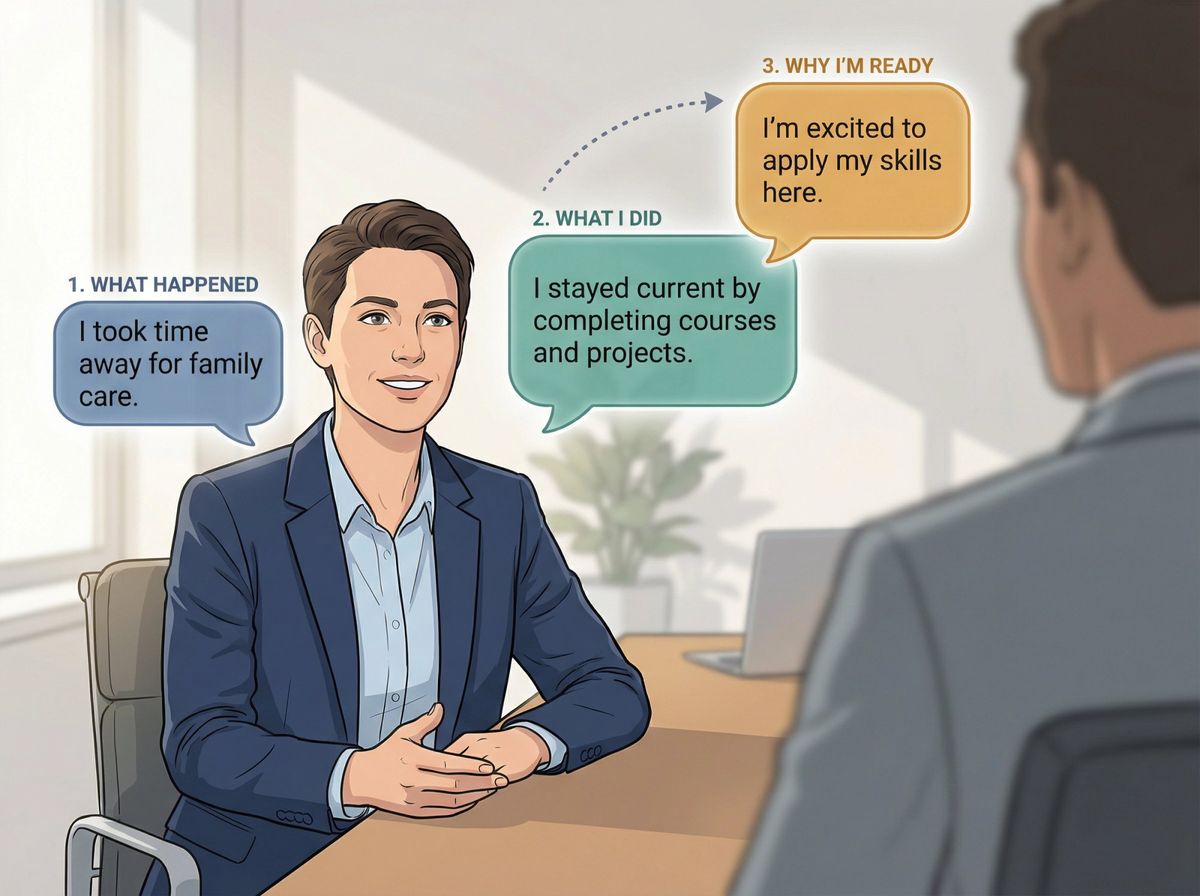
Use this formula:
1. One sentence: what happened
2. One sentence: what you did/learned
3. One sentence: why you're ready now + why this role
Example:
"I took 12 months away to provide family care. I stayed current by completing [course] and doing [project]. I'm now fully available and excited about this role because it lets me apply [skill] to [company priority]."
That's it. Then stop talking and let them ask follow-ups. For more interview preparation, check out our guides on answering behavioral interview questions and being confident in interviews.
How AIApply Helps You Explain Career Gaps Naturally
We understand that explaining a career gap with the right balance of honesty, brevity, and positivity is challenging. That's where our tools come in.
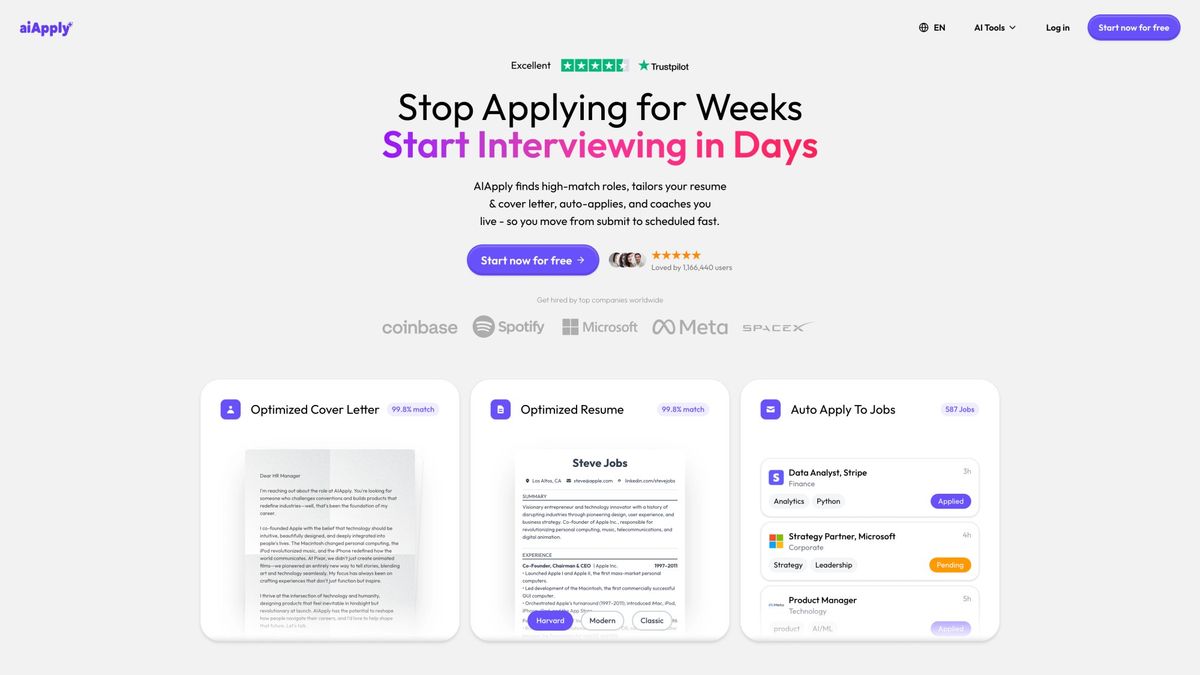
AIApply's AI Cover Letter Generator
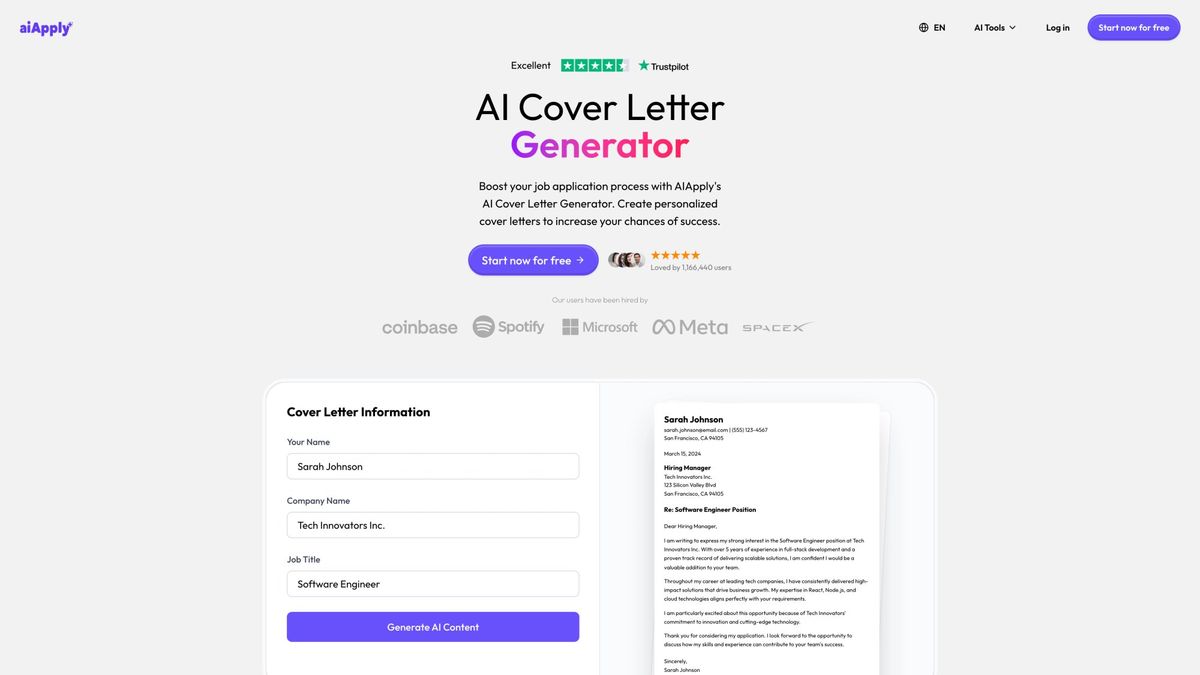
Our Cover Letter Builder doesn't just write generic letters. It helps you:
→ Create role-specific cover letters that sound genuinely human. Just input the job description and your information, and the AI drafts a letter that integrates your employment gap explanation naturally into the narrative.
→ Maintain a positive, forward-looking tone throughout. The AI is tuned to emphasize your strengths and future value, helping you rephrase any negative or apologetic wording into confident language.
→ Focus on what you did during the gap. The tool prompts you to include any courses, volunteering, or projects from your time off, and ensures those are highlighted appropriately.
→ Experiment with multiple drafts quickly. Not sure if you should mention the gap, or exactly how to word it? AIApply lets you create unlimited drafts of your cover letter. Generate one version that addresses the gap head-on and another that downplays it, then compare which presents you better.
→ Save time and stress. Our tools deliver a polished first draft in under two minutes, which you can then tweak and personalize. It's a huge confidence booster to see a solid draft that treats your career break as just a normal part of your story.
Complementary Tools for a Complete Application
AI Resume Builder: Intelligently formats your work history to account for gaps. It can suggest using a functional or combination resume format if that will downplay gaps, and even generate a one-line placeholder for your career break (e.g., "Career Sabbatical, 2022-2023").
Resume Scanner: Checks that your gap explanations won't confuse Applicant Tracking Systems (ATS), ensuring both your resume and cover letter tell a consistent, gap-positive story. Our ATS-friendly resume templates are specifically designed to pass screening systems.
Auto Apply: Once your materials are dialed in, our Auto Apply feature can help you apply to hundreds of relevant positions quickly, using your optimized resume and cover letter for each application.
Interview Buddy: When you land interviews, our Interview Buddy Chrome extension provides real-time answer suggestions during video interviews, helping you prepare for entry-level interviews or handle tough questions with confidence.
Using AIApply, you essentially have an expert editor on demand (one that knows recruiter preferences). The result? A cover letter that turns what many see as a weakness into a well-handled, even empowering part of your application.
Your Career Gap Doesn't Have to Hold You Back

A career gap might feel like a blemish on your record, but it doesn't have to be. With the right explanation and perspective, you can neutralize the issue and even highlight positive aspects of your time away.
The key takeaways:
✓ Be upfront and honest about your gap. Nearly half of workers have them, and employers are increasingly understanding.
✓ Keep it brief and positive, without going into unnecessary detail or sounding apologetic.
✓ Emphasize any constructive activities during the gap to show you stayed proactive.
✓ Reassure the employer you're ready to contribute now, with enthusiasm and confidence.
✓ Focus most of your cover letter on your qualifications and fit for the job. The gap explanation is just one component, not the main event.
Remember, an employment gap is often a chapter of your life that helped shape who you are. Perhaps it made you more resilient, gave you a fresh outlook, or fueled your determination to return to work and excel.
When you explain your career break in a clear and confident way, you demonstrate qualities like transparency, self-assurance, and problem-solving (all traits employers value).
Many job seekers with gaps land great jobs. The key is that they addressed it and then shifted the spotlight to their strengths. By following the strategies in this guide, you'll reassure employers that any gap in your past is no obstacle to your future.
You're coming back stronger, with added perspective, and ready to contribute 100%.
FAQ
Should I mention a gap if it was a layoff and everyone knows the market is bad?
If the gap is short, you often don't need to spotlight it. If it's long enough to raise questions, a one-liner helps: "Following a reorganization, my position was eliminated. I'm now ready to bring my skills to [Company]." (USC Online)
What if I did nothing during the gap?
Don't invent productivity. You can still tell a truthful story: you addressed a personal situation, and you're ready now. Then anchor readiness with something current, even if small (recent course, recent project, recent volunteer shift).
Do I have to disclose health details?
Generally, no. Keep it high level and focus on readiness. UK and US guidance both restrict disability-related questioning pre-offer, and the National Careers Service explicitly says you don't need to share everything.
Should I explain the gap on my CV or only in the cover letter?
Do both lightly. Cover letters are an appropriate place to address it, but not everyone reads them. Put a clean one-line explanation on your CV too (e.g., "Family Caregiving, 2023-2024" or "Professional Development, 2025").
Where exactly should the gap go in the letter?
After you've shown fit. Indeed's template places it after the qualifications section and keeps it to two sentences or less.
Will employers judge me negatively for a career gap?
It depends on how you handle it. Research shows that recruiters view an unexplained gap as a red flag, but an honest, brief, forward-looking explanation can neutralize concerns. Many employers respect candidates who handle gaps proactively (it demonstrates resilience and self-awareness).
Can I use AI tools like AIApply without it being obvious?
Yes. Using AIApply is like getting help from a career coach or using spell-check, but faster. The end product is still your story, and our letters are crafted to sound genuinely human with no AI detection flags.
How long is too long for a career gap explanation?
1-2 sentences maximum. USC Online recommends about one sentence, and Indeed says "two sentences or less." Your cover letter also needs to highlight your qualifications and enthusiasm (those should take most of the space).
What if I have multiple gaps throughout my career?
You don't need to explain each break in detail. You might mention the general fact that you've taken planned breaks or had transitions, and emphasize that whenever you were "off," you stayed productive in some way. The key is demonstrating that you weren't idle and that you're committed to your career now. Our career development plan examples can help you frame this narrative positively.