Can Employers Tell If You Used AI on Your Resume? 2026 Test
We ran 3 AI detectors on 168 resume texts and checked 741 job postings. Here's what employers can really detect, and how to edit AI drafts to sound human.


Usually not. In our 2026 test, the newest open-source AI detector caught 75% of AI-written resume summaries but also flagged 24% of human summaries written before ChatGPT existed, and it flagged none of the AI summaries after a quick edit. The ATS documentation we reviewed describes no AI-writing check. Recruiters notice generic phrasing, invented metrics and claims you can't defend.
That's the short version. Below are the three original tests behind it: a detector test on 168 resume texts, an analysis of 741 live job postings from 76 employers, and a phrase-by-phrase comparison of AI-written and pre-ChatGPT human resumes. After that comes the edit process that made AI drafts read as human.
Key takeaways
- Detectors are unreliable on resumes. In our test, the newest detector flagged 18 of 24 AI summaries and 17 of 72 human summaries written before 2022. In a pool where a quarter of the candidates used AI, about half of all flags would land on people who never touched it.
- ATS platforms check who applied, not who wrote the text. Greenhouse and Ashby document fraud checks on phone, email, IP and device signals, not authorship. Employers can bolt on a separate detector, but that is an add-on, not a default.
- Employers police interviews more than resumes. Of 76 companies we checked, 13% set rules on candidate AI use and 5% ban it outright, almost always during interviews and assessments. None said they run resumes through an AI detector.
- The real giveaways are style and made-up numbers. "Skilled in" appeared in 92% of AI summaries and 6% of human ones. Every AI bullet block contained a percentage figure the model had invented.
- Edit for specifics and the problem goes away. None of the 12 AI summaries we rewrote with concrete scope and plain verbs was flagged by the 2025 detector.
The Short Answer: Can Employers Tell If You Used AI on Your Resume?
An employer can't reliably prove you used AI on your resume, and most don't try. There are three ways they might find out, and each has a weakness:
- An AI text detector. Detectors exist, but resumes are short, formulaic and full of proper nouns, which is exactly where they're least reliable. Our test below shows high false-positive rates on human resumes.
- Their applicant tracking system (ATS). The big ATS platforms parse and rank resumes against a job, and screen for fraud. None of the vendor documentation we reviewed describes a native check for AI-written text.
- A human reader. This is the one that matters. A recruiter who reads hundreds of resumes a week recognizes the same AI phrasing showing up again and again, and an interviewer will notice quickly if you can't explain a number on your own resume.
So the useful question isn't "can they tell?" but "does my resume read like a generic AI draft, and can I defend every line?" You control both.
Why We Ran Our Own Tests
I'm Aidan Cramer, founder of AiApply. We build software that helps people write resumes and cover letters and apply to jobs with AI, so job seekers ask us this question constantly. Most of the articles that rank for it repeat survey results about what hiring managers believe they can spot. Belief and detection are different things, so we measured three things directly:
- what happens when you run real AI detectors on real resumes
- what employers actually write about AI in their job postings and application forms
- which phrases separate AI-written resumes from human ones
Every number below comes from those analyses or from a cited source. The full methodology is at the end.
Test 1: We Ran Three AI Detectors on 168 Resume Texts
We took 72 resume summaries and 72 experience-bullet blocks written by real job seekers before ChatGPT launched. They came from 2,484 LiveCareer resume examples published as a public dataset in August 2021. We then had a general-purpose AI model write 24 summaries and 24 bullet blocks for the same kinds of roles, from accountant to chef to IT support. We also had it rewrite 12 of those summaries using the edit pass described later in this guide.
We ran every text through three free, open-source detectors: the 2019 OpenAI GPT-2 output detector, a 2023 detector trained specifically on ChatGPT answers, and a 2025 detector from Fakespot (Mozilla). A text counted as "flagged" if its AI score was 0.5 or higher.
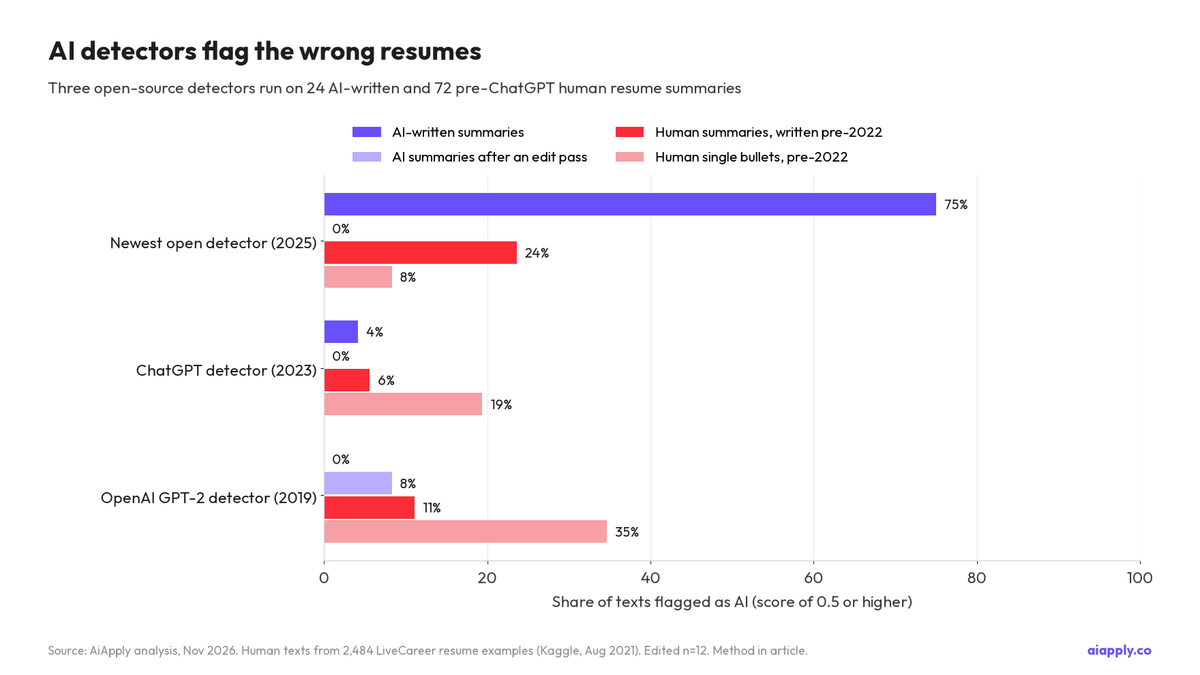
| Text tested | 2025 detector | 2023 ChatGPT detector | 2019 GPT-2 detector |
|---|---|---|---|
| AI-written summaries (24) | 75% flagged | 4% flagged | 0% flagged |
| AI summaries after edit pass (12) | 0% | 0% | 8% |
| AI bullet blocks, 3 bullets (24) | 54% | 0% | 0% |
| Human summaries, pre-2022 (72) | 24% | 6% | 11% |
| Human bullet blocks, pre-2022 (72) | 10% | 6% | 4% |
| Human single bullets, pre-2022 (72) | 8% | 19% | 35% |
What the detector results mean
- Older detectors are close to useless on resumes. The 2019 and 2023 models caught almost none of the AI text. They flagged a human-written single bullet more often than an AI-written summary, because short, clipped resume lines look "machine-like" to them.
- The newest detector catches unedited AI, but at a cost. It flagged three-quarters of raw AI summaries, and nearly one in four genuine human summaries too. In our sample that meant 17 human writers flagged alongside 18 AI drafts. A recruiter acting on those flags would wrongly reject about as many people as they caught.
- Shorter text is harder to judge. The 2025 detector's hit rate on AI dropped from 75% on summaries to 25% on single bullets. Most of a resume is single bullets.
- A light edit beat the best detector. None of the 12 edited AI summaries was flagged by the 2025 detector. The edit didn't make the text more human-written: the same AI model did the rewrite. It changed the style, and style is what detectors measure.
This matches published research. A Stanford study found that popular GPT detectors misclassified more than half of non-native English writing samples as AI-generated, while classifying native speakers' writing accurately. For a hiring team, that kind of bias is a legal and fairness problem, not just an accuracy problem.
Can ATS Detect AI-Written Resumes?
Not natively, based on vendor documentation. Applicant tracking systems are built to parse your resume into fields, match it to the job's requirements, and help recruiters manage candidates. When they check anything about authenticity, they check whether the person is real, not who wrote the words.
Here's what happens to a resume inside an applicant tracking system, based on what vendors publish about their own products:
- Parsing. The system pulls your contact details, job titles, dates, skills and education into structured fields so recruiters can search and filter them.
- Screening and matching. Knockout questions (work authorization, location, required licenses) filter applications, and some platforms add an AI match against the job. Greenhouse says its Real Talent AI compares your resume with criteria the employer sets and "does not automatically advance or reject candidates."
- Fraud checks, where the employer turns them on. These look at identity signals. Greenhouse's fraud detection returns 26 risk signals based on your phone number, email address, IP address and location. Ashby's checks device, IP address, email and phone, and runs when the application is submitted.
- Human review. A recruiter or hiring manager reads the applications that make it through.
Neither vendor's documentation describes a step that judges who wrote the text. An authorship check only appears when an employer adds a separate detector:
| Tool | What its public documentation describes | Checks who wrote the text? |
|---|---|---|
| Greenhouse Real Talent | AI resume-to-criteria matching; fraud detection on phone, email, IP and location signals; no automatic rejections | Not described |
| Ashby Candidate Fraud Detection | Device, IP, email and phone signals checked at submission; flagged applications go to manual review | Not described |
| Pangram (third-party add-on) | Connects to Ashby and scans application materials for AI-generated text as candidates apply; results shown to recruiters | Yes, if the employer installs it |
Sources: Greenhouse Real Talent, Ashby's fraud detection documentation and Pangram's Ashby integration page, all read November 2026.
Two things follow from this:
- Fraud checks look at identity, not prose. If you apply from the same email, phone and location you list on your resume, these signals don't care whether AI helped you write it. They're designed to catch fake candidates, impersonation and bot farms.
- AI detection is an opt-in add-on. Some employers connect a dedicated detector such as Pangram to their ATS. Pangram's own help center describes its Ashby integration as automatically scanning "candidate application materials for AI as candidates apply." Where an employer adds one, it works best on longer free-text fields such as cover letters and written answers, for the length reasons shown in Test 1.
If you're worried about how ATS ranking works in general, this guide on what an ATS is and how to get past it covers parsing and keywords in detail.
What Employers Actually Say About AI: 741 Job Postings
Surveys tell you what hiring managers think. Job postings tell you what companies actually enforce. On 9 November 2026 we pulled up to 10 random live postings from each of 76 well-known companies that hire through Greenhouse's public job boards: 741 postings in total. We read every posting's description and application questions for anything about AI.
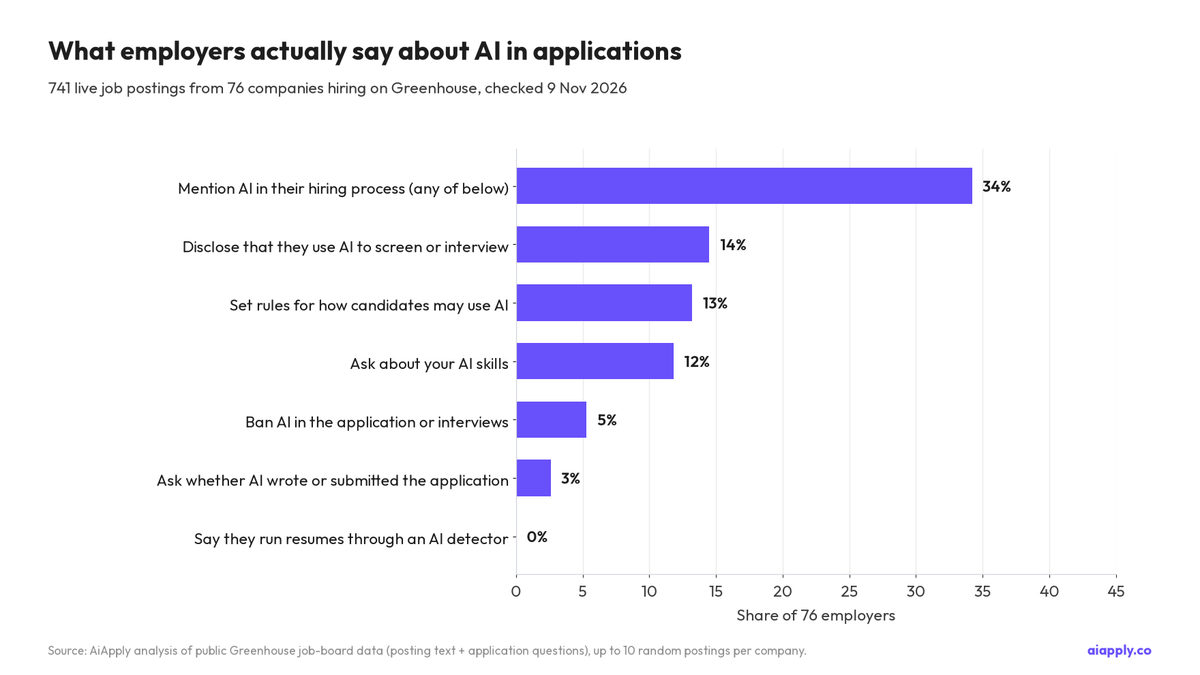
Here's what we found:
- Most employers say nothing at all. Two-thirds of the companies (66%) had no AI-related statement or question in any sampled posting.
- 14% disclose their own AI use. Examples include Betterment's note that it uses Greenhouse's AI-powered Talent Matching, AI interview notetakers at Intercom and Riot Games, and Okta's notice that it "may use AI with this application."
- 13% set rules for candidate AI use. The restrictions mostly target interviews. Airbnb asks applicants to agree that generative AI tools are "strictly prohibited during the interview process" unless Airbnb permits them. Samsara asks candidates not to use AI tools "during any part of the interview process." Waymo prohibits AI tools during the interview process unless the hiring team authorizes them. Peloton goes furthest: applicants confirm they won't use AI tools during the application or interview process.
- Some employers explicitly allow it. Anthropic asks candidates to read its AI guidelines and says it wants people who "collaborate thoughtfully with Claude." Carta tells candidates they're "free to choose any LLM tool" during AI-assisted evaluations. Twilio asks you to affirm that your materials "reflect my own work and experience," which is about honesty, not tools.
- A new kind of question is appearing. Calendly asks whether the application was "prepared or submitted in whole or in part by an AI system." Attentive asks AI agents applying on a candidate's behalf to identify themselves.
- None mentioned running resumes through an AI detector.
The takeaway: when employers draw a line, it's around live assessments and truthfulness, not around getting help drafting a resume. If a posting or application form has an AI policy, read it and follow it. It's a contractual statement you're signing.
How Recruiters Actually Spot an AI-Written Resume
If software can't reliably tell, people can still notice the patterns. We compared how often common resume phrases appear in the 24 AI-written summaries and in 999 human summaries written before 2022.
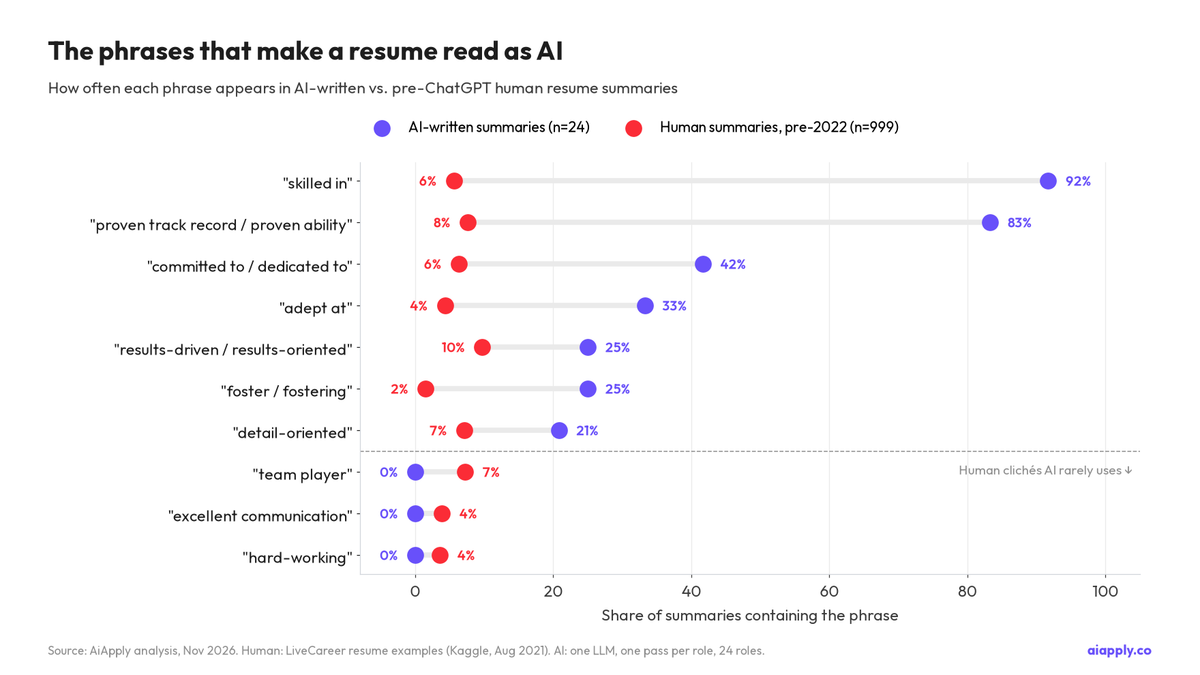
| Phrase | AI summaries | Human summaries (pre-2022) |
|---|---|---|
| "skilled in" | 92% | 6% |
| "proven track record" / "proven ability" | 83% | 8% |
| "committed to" / "dedicated to" | 42% | 6% |
| "adept at" | 33% | 4% |
| "results-driven" / "results-oriented" | 25% | 10% |
| "foster" / "fostering" | 25% | 2% |
| "team player" | 0% | 7% |
| "hard-working" | 0% | 4% |
Every one of the 24 AI summaries used at least one of the five most common AI phrases. Only 28% of the human summaries did. Humans have clichés too ("team player", "hard-working", "responsible for"), but they're different clichés. That's why a recruiter who has read a few hundred AI-drafted resumes starts to recognize them.
The patterns that give an AI resume away, in rough order of how much they hurt you:
- Invented metrics. All 24 AI bullet blocks contained a percentage, such as "reduced close time by 30%". Only 4% of human bullet blocks did. The model made up every one of those numbers. A suspiciously precise metric you can't explain is the fastest way to lose an interviewer's trust.
- Interchangeable summaries. "Results-driven professional with a proven track record of delivering actionable insights" could describe anyone. Recruiters see the same sentence from many applicants for the same role.
- Self-praise instead of evidence. Adjectives like "dynamic", "detail-oriented" and "passionate" claim qualities instead of showing them.
- Mismatch with everything else. A polished resume that doesn't match your LinkedIn, your cover letter or how you speak in the interview raises more questions than any detector score.
Does Using AI on Your Resume Hurt Your Chances?
Using AI doesn't hurt you. Sending a generic or inaccurate resume does. Employers are using AI heavily themselves: a 2026 Resume Genius survey of US hiring managers found 58% use AI to screen resumes and job applications. Attitudes to candidates doing the same are mixed. In a May 2025 TopResume survey of 600 hiring managers, 19.6% said they would reject a candidate with an AI-generated resume or cover letter. Only 33.5% correctly spotted the AI-written resumes in their test.
Read together with our data, the risk isn't being "caught." It's that an unedited AI draft looks like everyone else's, contains claims you didn't make, and gives a skeptical reader a reason to pass. If you want the broader pros and cons, see our reality check on whether you should use AI to write your resume.
How to Use AI on Your Resume Without It Reading as AI
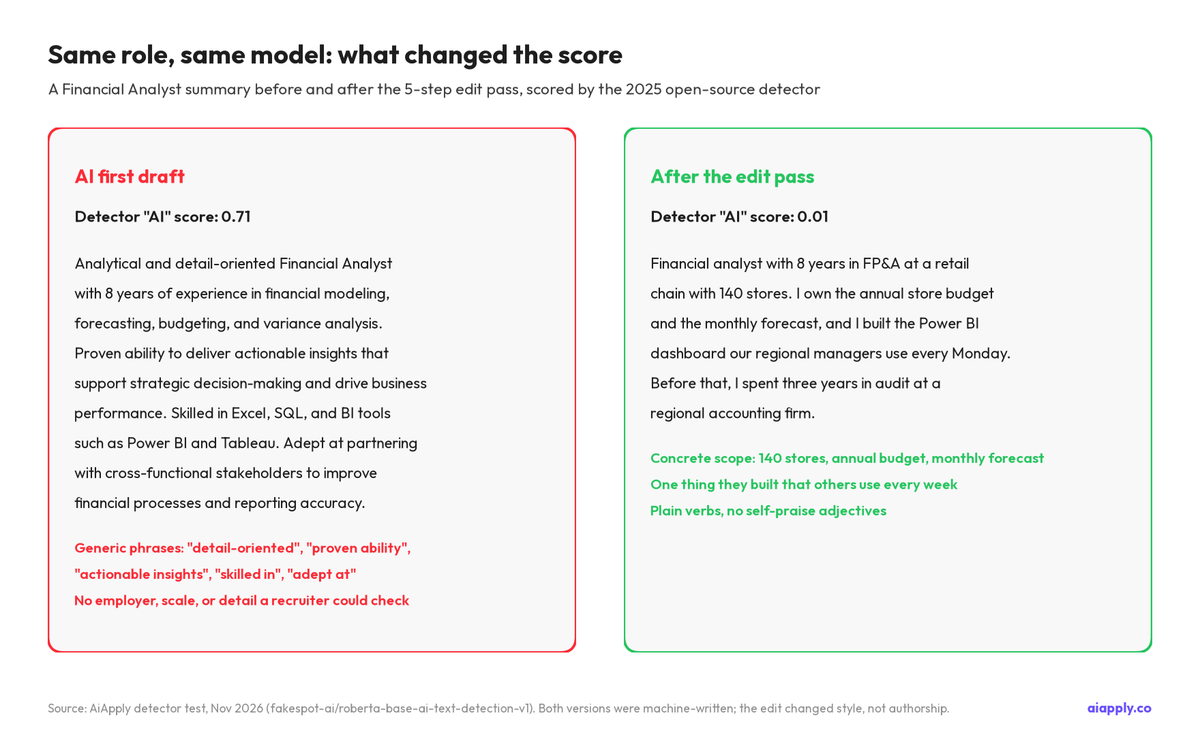
This is the edit pass we used in Test 1. Applied to 12 AI-written summaries, it took the 2025 detector's flag rate from 75% to 0%. More importantly, it turns a generic draft into a resume a recruiter can actually evaluate.
Step 1: Delete the self-description adjectives
Cut "detail-oriented," "results-driven," "dynamic," "passionate," and "dedicated." If a quality matters, prove it with the next steps instead of claiming it.
Step 2: Replace "skilled in" with what you actually did
"Skilled in Excel, SQL and Power BI" becomes "built the Power BI dashboard our regional managers use every Monday." A tool list belongs in your skills section, and the summary should show you using the tools.
Step 3: Add scope a stranger could verify
Name the size of the team, budget, customer base or operation: "a retail chain with 140 stores," "a 120-seat bistro," "three primary-care sites and 40 staff." Scope is concrete, hard to fake, and easy to talk about in an interview.
Step 4: Check every number the AI wrote
Treat any percentage or dollar figure in an AI draft as invented until you've confirmed it. Keep the real ones, replace the guesses with figures you can source, and delete the rest. A bullet without a number is better than a bullet with a fake one.
Step 5: Read it out loud in your own voice
Swap formal filler for plain verbs, such as "I run," "I built," and "I started." If a sentence sounds like something you'd never say to an interviewer, rewrite it until it does. Stronger, more specific verbs help here; this list of Harvard resume action verbs is a good starting point.
Here's the full before and after for one role from our test:
AI first draft (detector score 0.71): Analytical and detail-oriented Financial Analyst with 8 years of experience in financial modeling, forecasting, budgeting, and variance analysis. Proven ability to deliver actionable insights that support strategic decision-making and drive business performance. Skilled in Excel, SQL, and BI tools such as Power BI and Tableau.
After the edit pass (detector score 0.01): Financial analyst with 8 years in FP&A at a retail chain with 140 stores. I own the annual store budget and the monthly forecast, and I built the Power BI dashboard our regional managers use every Monday. Before that, I spent three years in audit at a regional accounting firm.
The details in the edited version are illustrative. Use your own employers, numbers and tools.
Should You Tell Employers You Used AI on Your Resume?
You don't need to announce that AI helped draft your resume, any more than you'd mention a spell-checker or a friend who proofread it. There are three exceptions:
- The application asks. If a form asks whether AI was used, as Calendly's does, answer honestly. A false answer is a much bigger problem than the AI use.
- There's a stated AI policy. Follow it exactly, especially rules about interviews, take-home tasks and assessments.
- An interviewer asks you directly. Say what you did: "I used AI to draft and tighten the wording, and every achievement and number is mine." That's a normal, defensible answer in 2026.
The same logic applies to cover letters, which get more scrutiny because they're longer free text. Our guide on whether employers can tell if you use AI for a cover letter covers that side. If you're using an auto-apply tool, read what recruiters actually see when bots apply for you as well.
Methodology
Detector test (Test 1).
- Human texts: 2,484 resume examples scraped from LiveCareer, published as the Kaggle Resume Dataset and last updated August 2021, 15 months before ChatGPT's release.
- We extracted the summary section from each resume (35 to 140 words, no template placeholders, no dates after 2021), which gave 999 summaries. We also took the first three qualifying sentences of each experience section as a "bullet block."
- We drew a stratified random sample of 72 summaries and 72 bullet blocks across all 24 job categories, plus the first bullet of each block as a "single bullet."
- Some of these examples may have been written with resume-builder phrase suggestions. None were written by a large language model.
- AI texts: one general-purpose large language model wrote one summary and one three-bullet block for each of 24 roles matching the dataset's categories, in a single pass with no cherry-picking.
- Summary prompt: "Write a 3-4 sentence professional summary for the resume of a [role] with about 8 years of experience."
- Bullet prompt: "Write 3 achievement-focused resume bullet points for a [role]."
- For 12 roles, the same model then rewrote the summary following the five-step edit pass above.
- Detectors: fakespot-ai/roberta-base-ai-text-detection-v1 (2025), Hello-SimpleAI/chatgpt-detector-roberta (2023) and openai-community/roberta-base-openai-detector (2019), run locally with default settings. Scores of 0.5 or higher counted as flagged.
- Limitations:
- These are open-source detectors, not the commercial tools some employers license.
- The AI sample is small (24 roles) and comes from one model.
- The human sample comes from one resume site.
- Treat the results as directional evidence, not a benchmark.
Phrase analysis. We counted the share of texts containing each phrase (case-insensitive, word-boundary matching) in the 999 human summaries, 1,732 human bullet blocks and the 24 AI summaries and bullet blocks.
Job-posting analysis. On 9 November 2026 we queried the public Greenhouse job-board API for 76 companies with at least three open roles. We sampled up to 10 random postings per company (741 postings) and pulled each posting's description, application questions and Greenhouse's AI-disclosure field.
- We sorted every AI-related question or statement into one of these groups: candidate rules (restrictions, guidelines, attestations, AI-disclosure questions), employer AI-use disclosures, and AI-skills questions. Unrelated mentions, such as AI in a company or job title, were excluded.
- The sample leans toward US tech and consumer brands, so it shows what well-known employers do, not every employer.
Our data and code. All texts, scores and classification rules are stored with this article's research files. Every figure in this article traces back to them or to the cited source.
Make Your Resume Specific, Not Just Polished
The pattern in all three tests is the same: what gets flagged, by software or by people, is generic writing and claims you can't support. AiApply's Resume Builder starts from your real experience and the job description you paste in, so the draft is built from your details rather than stock phrases. Then apply the five-step edit pass above before you hit submit.
FAQs
Can employers tell if you used ChatGPT on your resume?
Not reliably. There's no standard tool that proves a resume was written with ChatGPT. In our test, free AI detectors either missed most AI-written resume text or flagged many human-written resumes too. Employers are more likely to notice generic phrasing or numbers you can't explain.
Do companies use AI detectors on resumes?
Some do, but it's not standard. ATS vendors such as Greenhouse and Ashby publicly document fraud checks on identity signals rather than AI-writing detection. Employers can add a separate detector, usually for cover letters and written answers. None of the 76 employers in our job-posting analysis said they scan resumes for AI.
Can an ATS detect an AI-generated resume?
Not natively, based on vendor documentation. An ATS parses your resume and ranks it against the job. Fraud features check things like your email, phone, IP address and device to confirm you're a real candidate, not who wrote the text.
Will I be rejected for using AI on my resume?
Rarely for the AI itself. In a 2025 TopResume survey, about one in five hiring managers said they'd reject a candidate with an AI-generated resume or cover letter. The bigger risk is a generic or inaccurate resume, which is easy to avoid by editing the draft and checking every claim.
How do I make an AI-written resume sound human?
Remove self-praise adjectives, replace "skilled in" with things you actually did, add verifiable scope (team size, budget, customers), confirm or delete every AI-generated number, and read it aloud in your own voice. In our test, that edit pass took detector flags on AI summaries from 75% to 0%.
Is it dishonest to use AI to write a resume?
No, as long as everything on it is true and you follow any AI policy the employer sets. Using AI for wording is like using a template or a career coach. Inventing achievements, metrics or skills is dishonest whether a person or a model wrote them.