Best Teal Alternatives in 2026
The best Teal alternatives in 2026, ranked by the part of your job search they actually fix. Verified pricing, honest trade-offs, and how to choose.


Teal is one of the best job search tools on the market, so deciding to replace it is a genuinely hard one. This guide ranks the six top alternatives by the specific problem each one solves, with pricing pulled from every vendor's own pages in August 2026.
Key takeaways
- The best Teal alternative depends on which stage of your search is broken, not on which tool has the longest feature list.
- Teal's free plan is one of the most generous in the category. It is free forever with no card required, and Teal publishes a library of more than 50 career tools that anyone can use without paying.
- Teal still does not submit applications for you and offers no live interview support, which is the real reason people look for an alternative. Cost is rarely the trigger.
- Teal+ costs $13 per week, $29 per month, or $79 per quarter with no annual plan, so the weekly tier annualizes to roughly $676 if you forget to cancel.
- Applications per job more than doubled between 2022 and 2025 while recruiting teams were cut in half, so sending more copies of the same application is not the fix.
- AIApply is the strongest replacement for job seekers whose bottleneck is execution: finding, tailoring, submitting, and interviewing. Huntr, Jobscan, LoopCV, and Rezi each solve one slice.
The best Teal alternative in 2026 depends on which part of your job search has stalled. AIApply is the strongest overall replacement because it covers finding, tailoring, submitting, and interview support in one system, while Huntr is the better pick for pure pipeline tracking, Jobscan for ATS keyword optimization, LoopCV for high-volume automated applying, and Rezi for ATS-first resume building. Teal itself is a good product, and most people who leave it are not leaving because it does its job badly.
They leave because of where its job ends, not because of what it costs. Teal runs a free forever plan and a library of more than 50 career tools, so price is rarely the trigger. What Teal will do is help you build a keyword-matched resume and organize every role you have saved, and then hand the application back to you to submit by hand, one portal at a time. If you are applying to five roles a week, that is fine. If you are applying to fifty, the tailoring is no longer the bottleneck. The submission is.
That distinction is the one this guide is built around. Most Teal alternative roundups compare resume builders against each other and quietly ignore the stage where the work actually piles up. Ranking tools by the stage of the funnel they cover gives you a far more useful answer than ranking them by template count.
What Teal gives you free, and exactly where it stops
Any honest Teal alternatives guide has to start by admitting that Teal gives away a lot. Teal's tool library publishes more than 50 free career tools, and its free plan is marketed as free forever with no credit card required at any point. Teal Labs reports over 4 million users. This is not a stripped-back trial designed to push you into a subscription within a week.
What sits inside that free layer is genuinely broad. The core workspace covers an AI resume builder, a job application tracker, a job search CRM with contacts and companies, a networking CRM, an interview tracker, an ATS resume checker, a resume-to-job-description match score, and a Chrome extension that saves roles from more than 40 job boards. Teal also runs its own job board and an application autofill tool.
The generator tools go further than most competitors bother with: resume bullet points, professional summaries, headlines, skills, a resume rewriter, reviewer, parser, fixer and grammar checker, a cover letter generator and checker, LinkedIn summary and headline generators, a LinkedIn-to-resume builder, a resignation letter generator, AI interview practice, and a set of career quizzes. On top of that sits a reference library: 2,000+ resume examples, 1,500+ cover letter examples, 1,500+ CV examples, 100+ cover letter templates, 900+ resume synonyms, and career guides for over 500 roles.
The limits are real but narrower than the sheer tool count suggests. Per Teal's own knowledge base, updated in July 2026, the free plan gives you unlimited resume creation and unlimited job tracking but caps keyword matching at the top 5 keywords from a job description, allows one email template per job stage, and meters the AI: 5 resume bullet credits, 2 professional summary credits, 2 cover letter credits, and 2 AI interview practice sessions. Those are trial credits rather than a working allowance, and an active search burns through them quickly. Teal+ removes those caps and adds advanced resume analysis, unlimited keywords, unlimited email templates, advanced design mode, and premium templates.
One inconsistency worth knowing before you sign up: Teal's pricing panel lists unlimited resume templates on the free plan, its knowledge base says free users get 10 templates with full library access reserved for Teal+, and its templates page advertises 100+ free templates. Those three claims cannot all be true at once, so check what your account actually shows rather than trusting the marketing copy.
Teal+ costs $13 per week, $29 per month, or $79 per quarter. There is no annual plan, and that structure matters more than it first appears. It is covered in detail further down.
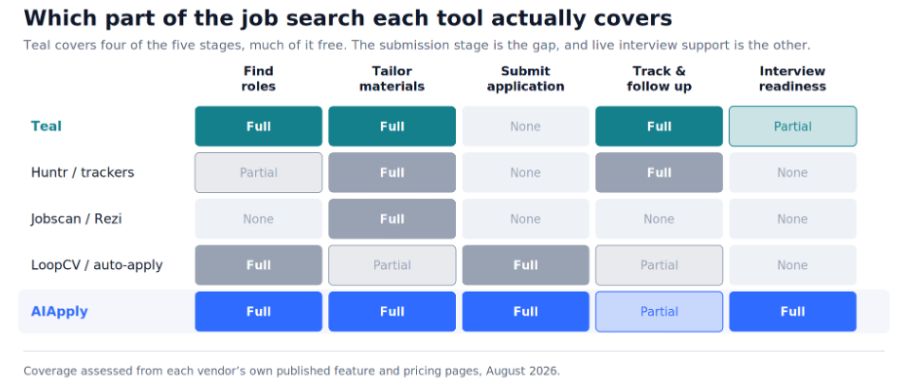
Now the part all of that does not cover. Across more than 50 tools, not one of them submits an application. Teal's autofill populates fields on a form you have already navigated to, which saves typing but not decisions. You still find the posting, open it, trigger the extension, review what it filled in, and click submit yourself. Fifty tools that each shave a minute off preparation do not add up to a tool that removes the hour.
The same holds at the other end of the funnel. Teal's AI Interview Practice, interview tracker, and interview checklist are all preparation tools, useful before the call and absent during it. If you are freezing in live interviews rather than failing to get them, nothing in the library reaches that moment.
Those two gaps are where AIApply is built. Resume Scanner reads your resume against 50+ real ATS systems and returns the specific keyword and formatting gaps rather than a single opaque score, free and with no scan limit, so you find out what a parser drops before a recruiter never sees it. Auto Apply then closes the stage Teal leaves open: it finds matching roles, tailors the resume and cover letter to each one, and submits on your behalf at one credit per application, with credits that do not expire. If your search has stalled at "I know what to fix and I do not have forty hours to fix it fifty times," that is the specific gap being closed.
Why sending more applications stopped working
Before choosing a replacement, it is worth understanding what changed in the market, because it explains why volume-only tools disappoint people. Greenhouse's The Hire Standard benchmark report, published in March 2026 and drawn from more than 6,000 companies and over 640 million applications between 2022 and 2025, found that applications per job climbed from 116 to 244, a 111% increase. Over the same period, the number of recruiters per organization fell from 10.43 to 4.62, a 56% cut.
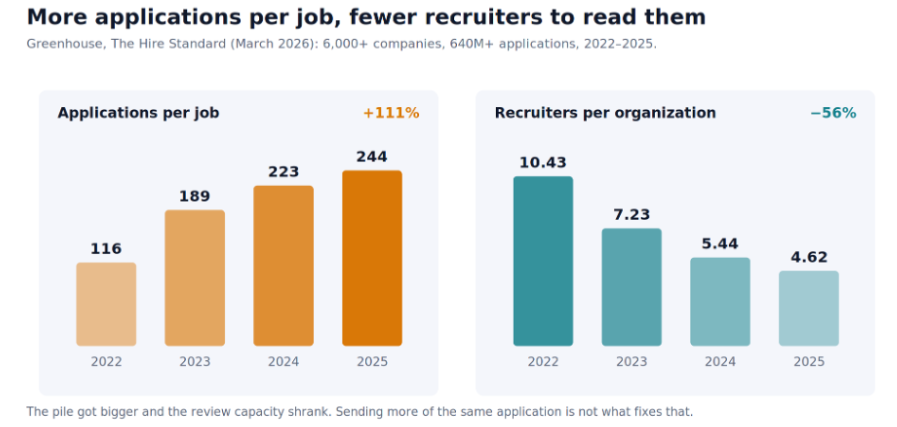
Read those two numbers together. Each posting now attracts roughly twice as many applications, and roughly half as many people are available to read them. Annual applications per recruiter rose 412%, from 146 to 746. Time to fill stretched 37%, from about 44 days to about 60.
The wider market is not absorbing that pressure either. The most recent Job Openings and Labor Turnover Survey from the U.S. Bureau of Labor Statistics, covering June 2026, put job openings at 7.4 million and hires at 5.3 million, with quits at 3.2 million. That is the low-hire, low-fire pattern that has defined the market since early 2025: employers are neither shedding staff quickly nor backfilling quickly.
This is the part that changes how you should shop for a Teal alternative. In a market where a recruiter has half the time and twice the pile, an application that looks like every other application is not slow to get read. It is unlikely to get read at all. Volume without differentiation adds to the noise you are trying to escape. Volume plus per-role tailoring plus applying early is a different proposition, and it is the combination almost no single-purpose tool delivers on its own.
Where you apply turns out to matter too. Huntr's 2025 Annual Job Search Trends Report analyzed 598,627 applications tracked by its users and found interview-stage response rates varying sharply by source: about 11.3% through Google Jobs, 8.7% through GovernmentJobs, 6.0% through Wellfound, and 5.5% through Glassdoor, against 4.5% for Indeed, 3.1% for LinkedIn, and 2.8% for ZipRecruiter. This is platform data from one vendor rather than a neutral industry benchmark, so treat the exact figures with some caution. The spread is still wide enough to be worth acting on, and it is a useful reminder to track your own response rate by source rather than assuming every channel performs the same.
The 6 best Teal alternatives in 2026, ranked by what they fix
These are ordered by how much of the job search each one covers, not by popularity. Pricing was checked against each vendor's own pages in August 2026 and can change, so confirm before you subscribe.
1. AIApply: best overall for job seekers stuck on execution
AIApply is the strongest Teal alternative for anyone whose problem is getting applications out the door and performing well once they land an interview. Where Teal stops at tailoring and tracking, AIApply covers the full sequence: the AI Resume Builder and AI Cover Letter Generator produce a version matched to each posting, Resume Scanner checks it against 50+ ATS systems with unlimited free scans, and Auto Apply finds and submits matching roles at one credit per application, up to 500 per month.
The feature with no Teal equivalent is Interview Buddy, which runs during a live interview on Zoom, Google Meet, or Teams and surfaces suggested framing on your screen while the call is happening. AIApply's own positioning is explicit that this is a tool to be used responsibly, and that framing matters: it is there to steady your recall under pressure, not to answer for you or to represent experience you do not have. Teal's interview tooling is practice-only, which is genuinely useful but stops at the door.
Pricing is $29 per month billed monthly, or roughly $12 per month billed annually, with a free plan at $0 that includes unlimited AI cover letters, the resume scanner, and full job board access. Students get 40% off. Auto Apply credits are purchased separately and never expire. AIApply reports more than 2 million users and holds a 4.0 TrustScore across 1,096 Trustpilot reviews.
Trade-offs, honestly: AIApply's tracking is basic next to Teal's pipeline CRM, and if organizing a complex, contact-heavy search is genuinely your main pain, Teal does that better. The full AIApply vs Teal comparison breaks the differences down feature by feature.
2. Huntr: best if you only wanted the tracker
Huntr is the closest like-for-like replacement for the half of Teal that people love most. It is a Kanban board built for job searches, with a browser extension that clips postings from most major boards into columns like Saved, Applied, Interviewing, and Offer. It has been refined since 2017 and the extension is one of the better-reviewed tools in the category.
Per Huntr's own pricing documentation, the free plan covers up to 100 tracked jobs, unlimited base resumes, free PDF export, and the Chrome clipper. Pro runs $40 per month, $90 quarterly, or $160 every six months, and adds unlimited AI resume generation, job-tailored resumes, unlimited AI cover letters, and unlimited tracking.
Choose Huntr if the pipeline is your pain point and the free tier covers your search, which for most people it will. The harder question is Pro: $40 per month is the steepest price in this category, and it buys unlimited tailoring for applications you are still submitting by hand. Like Teal, Huntr does not apply to jobs for you.
3. Jobscan: best for ATS keyword optimization
Jobscan is a specialist rather than a workspace. You paste in a resume and a job description and it returns a match rate with the specific keywords, skills, and formatting issues standing between you and a clean parse. If your working theory is that your resume is being filtered before a human sees it, this is the tool built to test that theory directly.
Jobscan's own comparison content lists Premium at $49.95 per month, with roughly $30 per month equivalent on a quarterly plan, plus a free tier centered on scans and a resume builder and a 7-day Premium trial. See Jobscan's published comparison for the current breakdown.
It is the most expensive monthly option on this list, and it deliberately solves one problem. Pair it with a free tracker rather than treating it as a Teal replacement on its own.
4. LoopCV: best for high-volume automated applying
LoopCV sits at the opposite end of the funnel from Teal. You upload a CV, set filters, and it applies to matching roles across a wide set of job boards and company career pages, with tracking and email outreach built in. Its entry paid plan starts around $9.99 with higher tiers above that, and there is a free plan for testing.
The trade-off is tailoring depth. Volume tools tend to optimize for submissions rather than fit, and in a market with 244 applications per posting, undifferentiated volume is exactly what recruiters have learned to filter past. If you go this route, use tight filters. Our breakdown of LoopCV alternatives covers where that model works and where it does not, and the same analysis applies to LazyApply-style mass-apply tools.
5. Rezi: best ATS-first resume builder
Rezi is a resume builder with ATS mechanics as its organizing principle: real-time scoring, keyword optimization against a target posting, and AI bullet rewriting. If you liked Teal's resume builder specifically and had no use for the tracker, Rezi is the cleaner version of that one job.
It does not track applications, submit them, or help with interviews. Pricing has been reported in the region of $29 per month with a lifetime option, but Rezi has changed its plan structure more than once, so check the current pricing page before committing. Treat it as a component, not a system.
6. Kickresume and Enhancv: best when presentation is the priority
These two belong in a different lane from everything above. Both are design-forward resume builders: Enhancv for modern visual templates with content-quality feedback, Kickresume for AI writing assistance plus the option to publish a hosted personal page. Neither tracks a pipeline, submits applications, or prepares you for interviews.
They are the right answer for designers, marketers, and creative professionals applying through channels where a human opens the file directly. They are the wrong answer if you are pushing volume through corporate ATS portals, where heavy layouts are a parsing liability. If cost is the deciding factor, our roundup of free resume builders covers the options worth starting with.
Teal alternatives compared on price and coverage
| Tool | Best for | Submits for you? | Free plan | Paid price |
|---|---|---|---|---|
| AIApply | Full-funnel execution | Yes, Auto Apply | Yes, generous | $29/mo or ~$12/mo annual |
| Teal | Tailoring and tracking | No, autofill only | Free forever, 50+ tools | $13/wk, $29/mo, $79/qtr |
| Huntr | Pipeline tracking | No | Yes, 100 jobs | $40/mo, $90/qtr |
| Jobscan | ATS optimization | No | Limited scans | $49.95/mo |
| LoopCV | High-volume applying | Yes | Yes, limited | From ~$9.99/mo |
| Rezi | ATS resume building | No | Limited | Check current pricing |
| Kickresume / Enhancv | Visual resumes | No | Yes, export gated | Check current pricing |
The pricing detail worth pausing on is Teal's billing structure, because it is the single most common complaint about the product and it is not really about the headline number.
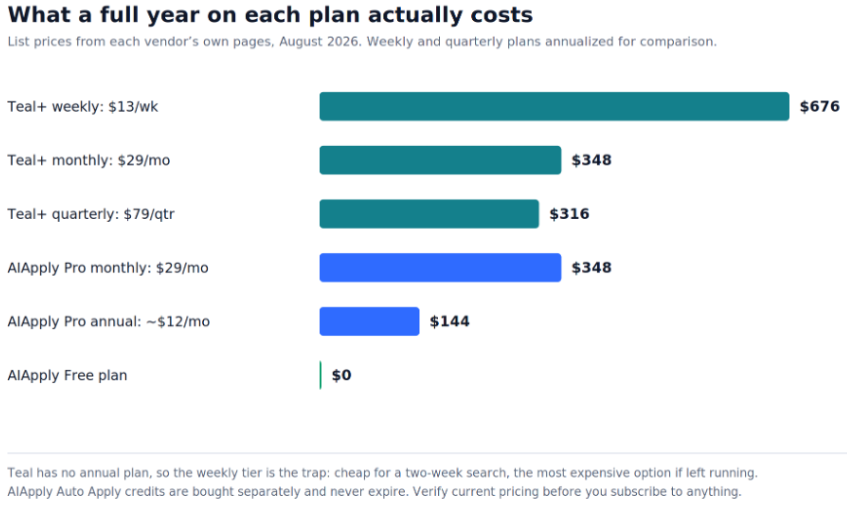
Teal has no annual plan. That means the $13 weekly tier, which looks like the cheapest way in, is the most expensive way to run a full search: 52 weeks at $13 is roughly $676. A month contains about 4.3 weeks, so the weekly plan works out near $56 per month against a $29 monthly plan. It is genuinely good value for a candidate who expects to land inside two or three weeks. Left running through a search that stretches past a month, it quietly becomes the priciest subscription in the category.
If you stay on Teal, the quarterly plan at $79 is the honest choice at roughly $26 per month. If you leave, set a cancellation reminder rather than relying on memory, because auto-renewal on a weekly cadence is unforgiving.
How to choose without paying for three tools at once
The trap in every alternatives roundup is ending up subscribed to a tracker, an optimizer, and an auto-applier, which together cost more than any single platform and still leave you switching between three dashboards. A more practical approach is to name your bottleneck first and buy for that.
Ask which of these is actually true of your search right now:
- You are losing track of what you applied to and when to follow up. Your bottleneck is organization, and you almost certainly should not pay anyone. Teal's free forever plan and Huntr's free tier both solve this properly at no cost.
- You are applying steadily and hearing nothing at all. Your bottleneck is likely parsing or relevance. Run a free ATS scan before you spend anything, and fix the resume before you scale the volume.
- Your resume is strong and you simply cannot get enough applications out. Your bottleneck is execution, and this is the case where a tracker will not help you no matter how good it is.
- You are getting interviews and not converting them. Your bottleneck is interview performance, which is the stage almost every tool in this category ignores entirely.
Most people who churn off Teal fall into the third and fourth buckets, which is the argument for a system rather than a stack. AIApply's free plan costs nothing and covers unlimited cover letters, unlimited ATS scans, and full job board access, which is enough to diagnose whether your problem is the document or the throughput before you pay for anything. If it turns out to be throughput, Auto Apply and Interview Buddy sit in the same account rather than in a fourth tab.
Whichever tool you land on, the operating pattern matters more than the logo on it. Apply early rather than broadly, tailor the top third of the resume to each posting, go through the company's own careers page where you can, and follow up with a human within a couple of days. Our complete guide to getting hired fast walks through that sequence in full, and a simple application tracker is enough to run it, paid or not.
Choosing your next tool
Teal earned its reputation on tailoring and tracking, and if those are the parts of your search that are broken, staying put on the free plan is a defensible answer. The reason people go looking for alternatives is that a tailored resume sitting in a tracker is not an application, and in a market where each posting draws more than 240 candidates and recruiters have half the headcount they had three years ago, the distance between those two things is where searches stall.
If your bottleneck is organization, take Huntr's free tier. If it is parsing, run a free ATS scan and fix the document. If it is execution, which is the most common case among people leaving Teal, AIApply is built for exactly that stage: Resume Scanner tells you what the parser drops, Auto Apply submits tailored applications at scale on credits that never expire, and Interview Buddy supports you in the conversation that decides the offer. The free plan costs nothing and covers unlimited cover letters and unlimited scans, so you can find out which of those you actually need before paying for any of them.
Start with the AIApply vs Teal comparison if you want the feature-by-feature detail before you decide.
Frequently Asked Questions
What is the best Teal alternative in 2026?
AIApply is the best overall Teal alternative for job seekers whose bottleneck is execution rather than organization, because it covers finding, tailoring, submitting, and live interview support in one platform. Huntr is the better choice if you only want a job tracker, Jobscan if you want ATS keyword optimization, and LoopCV if you want high-volume automated applying. Match the tool to the stage of your search that has actually stalled.
Is Teal free?
Yes, Teal has a free forever plan that requires no credit card, and it is one of the most generous free tiers in this category. It includes unlimited resume creation, unlimited job tracking, the Chrome extension across 40+ job boards, a job search CRM, an ATS resume checker, and access to a published library of more than 50 free career tools. The paid Teal+ tier mainly removes caps on AI credits, keyword matching, and email templates rather than adding whole new tools.
Is Teal+ worth paying for in 2026?
Teal+ is worth paying for if your search is short and you are actively hitting the free plan's AI credit and keyword caps. Because the free plan already covers unlimited resumes and unlimited tracking, the upgrade is really buying unlimited AI generations, the full surfaced keyword list, unlimited email templates, and premium templates. If your search is likely to run past a month, take the quarterly plan at $79 rather than the weekly one.
How much does Teal cost?
Teal+ costs $13 per week, $29 per month, or $79 per quarter, according to Teal's own knowledge base as of July 2026. There is no annual plan and no student discount published. The weekly plan annualizes to roughly $676, which makes it the most expensive option for anything longer than a short search.
Does Teal apply to jobs for you?
No, Teal does not apply to jobs for you. Its Chrome extension autofills fields on application forms you have already opened, but you still find each posting, navigate to it, review the filled fields, and submit manually. Tools like AIApply's Auto Apply and LoopCV are built for automated submission, which is a different product category from autofill.
Is there a free alternative to Teal?
Yes, though Teal's own free plan is the strongest starting point in the category, so switching purely to save money rarely makes sense. Huntr's free plan tracks up to 100 jobs with unlimited base resumes and PDF export, and AIApply's free plan includes unlimited AI cover letters, unlimited ATS resume scans, and full job board access at $0. The reason to move is a capability Teal does not have, such as automated submission, not the price.
Which is better, Teal or Huntr?
Teal and Huntr are close competitors that solve the same problem slightly differently, and neither submits applications for you. Huntr is board-first with the cleaner Kanban pipeline and a free tier covering 100 tracked jobs; Teal integrates tracking more tightly with its resume builder and keyword matching. Huntr Pro at $40 per month is the more expensive paid tier, so compare their free plans first because most searches never need either upgrade.
Do AI job application tools hurt your chances with recruiters?
Using AI to tailor and submit applications does not hurt your chances by itself, but sending undifferentiated volume does. Greenhouse data shows applications per job more than doubled between 2022 and 2025 while recruiting teams halved, so recruiters have grown efficient at filtering past applications that read as mass-produced. Use automation to apply early and tailor per role rather than to send the same document more times, and never use it to represent experience you do not have.