How Many Applications Does It Take to Get a Job? (2026)
How many applications does it take to get a job in 2026? See realistic targets by industry, weekly benchmarks, and ways to get more interviews.


Job searching in 2026 means competing with dozens of applicants per role and an ATS layer most candidates never see directly. Here’s the real number, why it moves, and what to do if it’s not working.
Most job seekers need between 75 and 150 targeted applications to get one offer, based on SmartRecruiters’ 2025 benchmark of nearly 90 million applications analyzed across 95 countries. That range moves a lot depending on your industry, your search situation, and how tailored your applications actually are.
If you’ve sent 60 applications and you’re wondering whether the number itself is the problem, it usually isn’t. The math of hiring in 2026 is simply harsher than it looks from the outside, and the fix isn’t always “send more.”
How Many Applications Does It
Take to Get a Job?
The global average is 73 applicants competing for every role, with about 3 candidates interviewed and 1 offer made. Here’s how that plays out by situation:
| Your situation | Realistic application target | Weekly pace |
|---|---|---|
| Strong fit + referral-heavy search | 25–60 applications | 5–10/week |
| Normal targeted job search | 75–150 applications | 10–20/week |
| Unemployed and searching full-time | 100–200 applications | 20–30/week |
| Remote, tech, entry-level, or career switch | 150–300+ applications | 25–50/week |
| Senior, executive, or niche specialist role | 40–120 + heavy networking | 5–15/week |
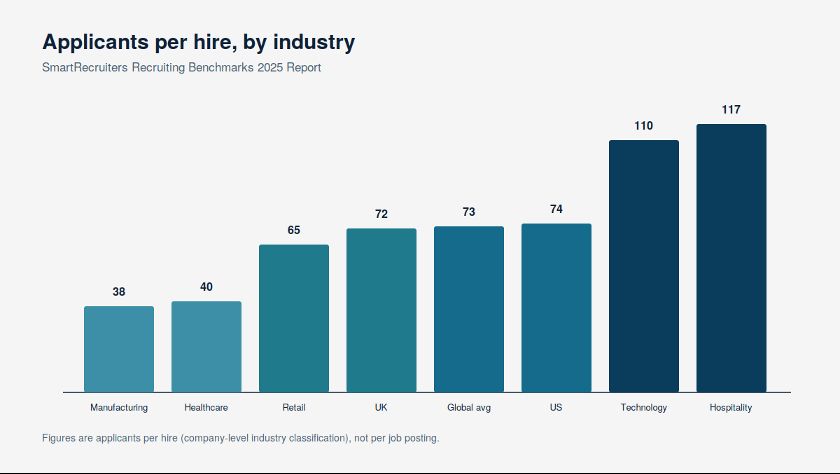
In the US, the average is 74 applicants per hire. In the UK, it’s 72. Both are close to the global figure, so US and UK job seekers are facing roughly the same odds per application.
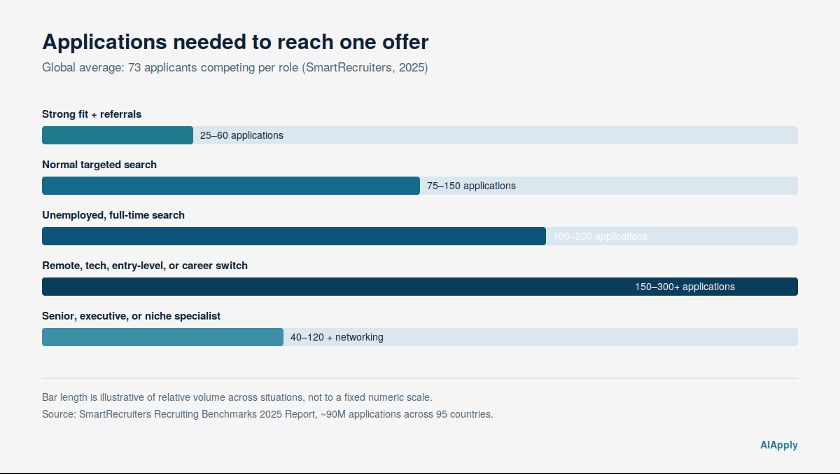
100 applications is normal in this market. That doesn’t make the process easier to sit through, but it means you’re not doing anything wrong by needing that many. What matters more is whether those 100 are targeted or generic, because that’s the variable that actually moves your odds.
Why the Number Varies by Industry
Application volume needed varies sharply by field. Technology roles average 110 applicants per hire, roughly double the 40 applicants per hire in healthcare, which is why the same person can need very different volumes depending on where they’re applying.
Breakdown by industry:
| Market | Applicants per hire | Offer rate | Median time to hire |
|---|---|---|---|
| Global average | 73 | 1.4% | 38 days |
| US | 74 | 1.5% | 35 days |
| UK | 72 | 1.1% | 40 days |
| Technology | 110 | 0.7% | 48 days |
| Healthcare | 40 | 2.0% | 41 days |
| Manufacturing | 38 | 1.4% | 55 days |
| Retail | 65 | 1.5% | 25 days |
| Hospitality | 117 | 0.6% | 39 days |
Tech is the toughest market on this list: the most applicants per hire, the lowest offer rate, and the longest hiring timeline. If you’re targeting software engineering, data, product, or an adjacent tech function, plan for the higher end of the situational table above — 150 to 300 applications.
Healthcare and manufacturing sit at the other end. Fewer applicants per role, faster offer rates, though ATS screening still applies regardless of industry. Hospitality is a special case: high volume (117 applicants per hire) but also the fastest hiring cycles on the list, so the wait between applying and hearing back tends to be shorter even though the odds per application are worse.
If you’re applying across multiple platforms and want to know which ones actually convert for your industry, that’s a separate variable worth tracking. AIApply’s guide to weekly application targets breaks down channel mix and response rates by platform in more depth.
How Many Applications Should You Send Per Week?
Most job seekers should target 10 to 20 applications per week, with the right number depending on whether you’re employed, unemployed, or searching in a high-competition market, based on the situational benchmarks in
The weekly pace maps onto the situational targets above:
● Employed, part-time search: 10–20 applications per week
● Unemployed, full-time search: 20–30 applications per week
● High-competition markets (tech, remote, entry-level): 30–50 applications per week
Daily pace is simply the weekly target divided by five working days, so a 15-per-week target is roughly 3 applications a day if you spread it evenly rather than batching everything into one sitting.
Most searches work best split across two lanes: a smaller number of high-intent applications you tailor carefully, and a larger volume of fast-but-relevant applications for roles that fit your background without warranting a deep customization pass. AIApply’s weekly application guide walks through how to split your time between the two lanes and includes a day-by-day schedule.
What If You’re Getting No Interviews?
If you’ve sent 50 or more applications without an interview, the problem is almost always your resume, targeting, or timing, not your total application count.
Run through this check before sending another 50:
- Are you applying to roles where you meet at least 70% of the real requirements, not the wish-list version?
- Does your resume title match the exact job title you’re targeting?
- Is your resume formatted so an ATS can parse it cleanly?
- Are you applying within 24 to 72 hours of a posting going live?
- Are you relying almost entirely on Easy Apply or Quick Apply buttons?
Here’s how to read your results at each checkpoint:
| Result after 100 applications | Likely problem | What to fix |
|---|---|---|
| 0 interviews | Resume, targeting, or ATS formatting | Rebuild resume; narrow target roles; run an ATS check |
| 1–3 interviews | Weak response rate | Improve tailoring; add referral outreach |
| 4–8 interviews | Decent search in a competitive market | Keep applying; upgrade interview prep |
| 8+ interviews, no offer | Interview performance, not applications | Practice answers; tighten compensation expectations |
If you’re consistently landing in the 0-interview row, run your resume through AIApply’s Resume Scanner against an actual job description before sending more applications. It checks ATS readiness, keyword gaps, and formatting issues against the specific role you’re targeting, which tells you what a recruiter’s screening system sees before you find out the hard way.
5 Ways to Need Fewer Applications
The fastest way to reduce how many applications you need is to improve your conversion rate at each stage, not add more volume.
That’s not just a framing choice. Jobscan’s analysis of over 2.5 million job applications found that candidates whose resume included the exact job title from the posting had an interview rate 10.6 times higher than those who didn’t, which is a bigger swing than most people get from simply applying more.
1. Apply to narrower job titles
A resume trying to match five different role types at once is weaker than one built for a single, specific title. Narrow targeting makes tailoring easier and makes your resume easier for both recruiters and ATS software to match correctly.
2. Tailor the top third of your resume
Recruiters scan resumes in seconds, and the top third (headline, summary, top skills, first few bullet points) is what actually gets read. Adjusting that section to mirror the job description’s language is a smaller lift than rewriting the whole document, and it’s the highest-leverage edit available. AIApply’s Resume Builder generates ATS-optimized resumes tailored to a specific job description, which keeps this step fast even when you’re applying at volume.
3. Show proof, not adjectives
“Hardworking team player with strong communication skills” gives a recruiter nothing to evaluate. “Handled 45+ weekly customer tickets with a 92% satisfaction score” does. Go through your resume and challenge every claim: if you can’t attach a number, percentage, or specific example to it, the line is doing less work than you think.
4. Stop relying only on Quick Apply
Quick Apply and Easy Apply features are fine for volume, but they’re also the most crowded channel, since every other applicant is using the same low-friction path. Reserve Quick Apply for your lower-priority applications and apply directly through company career pages for roles you genuinely want.
5. Add referral outreach to your routine
SmartRecruiters’ 2025 benchmark found that 15% of hires globally came from referrals and internal candidates, a disproportionate share for a relatively low-effort channel. You don’t need to ask a stranger for a favor: a short, specific message referencing something real about their team gets a response far more often than a generic connection request.
If you want a structured way to combine tailoring with volume, AIApply’s Auto-Apply matches your profile to relevant roles and generates a tailored resume and cover letter for each one before submitting, so scaling volume doesn’t automatically mean scaling generic applications. Track what you send and where using a job application tracker, so you can see which channels and resume versions are actually converting.
Frequently Asked Questions
Is 100 applications a lot in 2026?
No. 100 applications is within the normal range for a competitive market. SmartRecruiters’ 2025 benchmark found an average of 73 applicants per role globally, and needing 100 or more applications for one offer is common, especially in tech, hospitality, and remote-heavy searches.
Is 200 applications too many?
Not necessarily. For remote roles, tech roles, entry-level positions, and career changes, 200 applications is often realistic given the competition in those markets. If you’ve sent 200 with almost no interviews, the issue is more likely targeting, resume fit, or ATS compatibility than raw volume.
How many applications should I send per week?
Most job seekers should aim for 10 to 20 targeted applications per week if employed and searching on the side, 20 to 30 per week if unemployed and searching full-time, and up to 30 to 50 per week in highly competitive markets, provided quality stays high.
Should I apply to jobs where I don’t meet every requirement?
Yes, within reason. Apply if you meet the core requirements and the gaps are in the “nice to have” list, not the central skill the role depends on. A reasonable rule of thumb is applying when you meet roughly 70% of the real requirements and strongly match the main responsibilities.
Do tailored resumes really make a difference?
Yes. Huntr’s 2025 Job Search Trends Report, based on more than 59,000 resumes, found tailored resumes converted to interviews at a 5.75% rate compared with 2.68% for generic resumes, a 115% improvement.
Does applying early to a job posting actually matter?
Yes. Most companies review applications on a rolling basis and often begin interviewing before the official close date, so early applicants get reviewed while recruiters still have time and openings in the process. Setting alerts for new postings and applying within 24 to 48 hours gives you a real edge over applicants who find the role a week later.
Where This Leaves You
The number of applications you need depends on your industry, your situation, and how tailored your materials actually are, but the range for most job seekers is 75 to 150. If you’re inside that range with no interviews, the fix is almost always the funnel, not the volume: tighter targeting, a resume tuned to the top third, and fewer applications riding entirely on Quick Apply. AIApply exists to make that fix faster to execute at scale, whether that’s tailoring resumes for each role, scanning for ATS gaps before you submit, or handling the volume lane through Auto-Apply so your time goes toward interview prep instead of form-filling.