The Best AI Auto-Apply Tools in 2026
The best AI auto-apply tools in 2026, ranked: AIApply, JobCopilot, LoopCV, Simplify, LazyApply and Jobright. Real pricing, honest tradeoffs, and how to choose.


Job searching in 2026 means competing with hundreds of applicants per role, most of them now AI-assisted. This guide breaks down which auto-apply tools hold up under that pressure and which ones make the problem worse.
The best AI auto-apply tool in 2026 is AIApply for job seekers who want matching, per-posting tailoring, submission and interview prep running as one system. JobCopilot is the strongest pick for raw daily volume across job boards, LoopCV for European markets and direct outreach to employers, and Simplify for a free autofill layer if you would rather click Submit yourself. The deciding factor is not price. It is whether the tool tailors each application or fires one stored resume at everything.
That distinction matters more in 2026 than it did a year ago, because the thing auto-apply was invented to solve has changed shape. When applications were scarce, sending more of them worked. Now everyone has a bot, recruiters are drowning, and a high-volume tool with no tailoring layer is a fast way to become part of the noise your resume needs to escape.
This guide ranks the six auto-apply tools worth your money, explains the three product categories hiding behind one label, and gives you the five-part test that predicts whether automation will earn you interviews or quietly cost you them.
"Auto-apply" describes three different products, and only one of them tailors
Three product categories currently share the auto-apply label, and they solve different problems at wildly different prices. Sorting a tool into the right tier before you compare cost is the single most useful thing you can do while shopping.
Autofill assistants fill the form fields on an application you found and opened yourself. You still review and click Submit on every role. They save typing, not searching or deciding.
Volume bots submit on your behalf using one stored profile for every posting. They save real hours, and they cost you relevance, because the same resume goes to a mid-level ops role and a senior analyst role without changing a word.
System layers match roles to your profile, tailor the resume and cover letter to each specific posting, submit, track what went where, and prepare you for the interviews that follow. AIApply sits in this tier, which is why comparing its cost to a browser extension is comparing two different jobs.
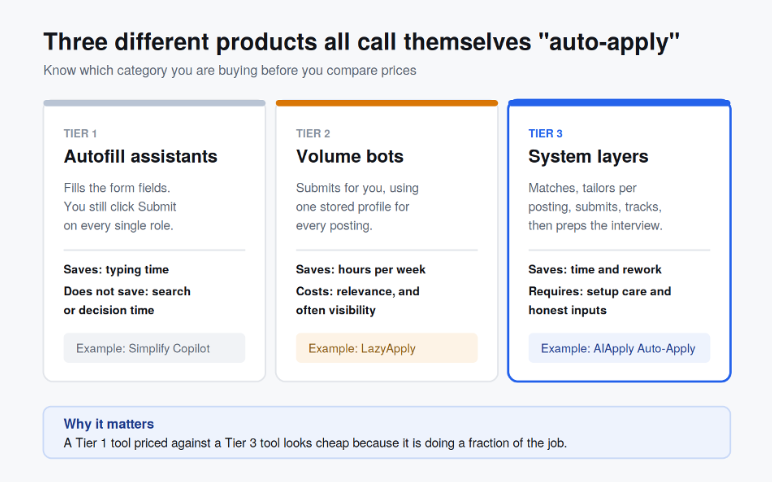
The trap is that Tier 1 and Tier 2 tools look cheap next to Tier 3 tools. They are cheap because they are doing a fraction of the work. If you buy an autofill extension expecting hands-off applying, you will find yourself doing the same volume of manual clicking with a subscription attached. For the wider set of free options worth stacking around whichever tool you pick, see our roundup of the best free AI tools for job seekers.
Why volume alone stopped working, in numbers
Applications per job opening rose 111% between 2022 and 2025, from roughly 115 to 244, according to Greenhouse's Hire Standard benchmark report, which analyzed more than 640 million applications across over 6,000 companies. Over the same period recruiting teams shrank by 56% while monthly hires per recruiter rose 122%. More applications, fewer humans reading them, each one reading faster.
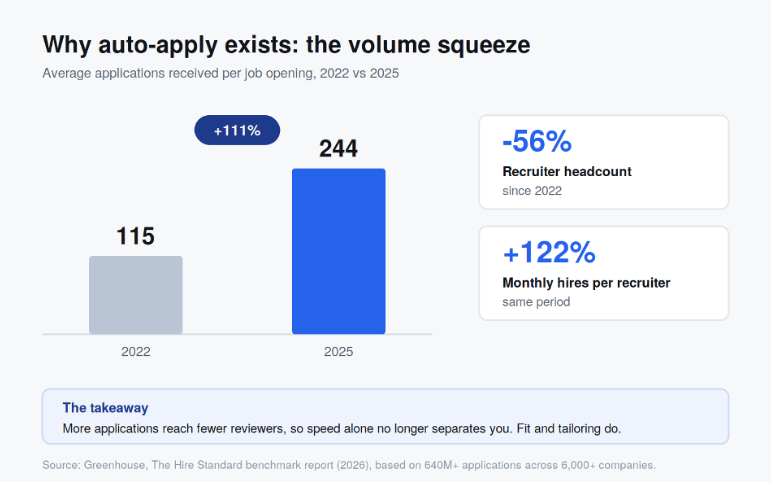
That squeeze is what auto-apply tools were built for, and it is also why the crude ones stopped working. Greenhouse found that 22% of candidates now use automated bots to submit applications, rising to 31% among Gen Z. On the other side of the desk, 91% of recruiters say they have spotted candidate deception and 34% report spending up to half their week filtering spam and junk applications, per Greenhouse's 2025 AI in Hiring report of 4,136 respondents.
There is a second number worth sitting with. Greenhouse's benchmark data shows job boards drive nearly 75% of applications but produce less than half of hires, while a company's own career site and owned channels account for 39% of volume at meaningfully better conversion. Where your application lands changes your odds. A tool that routes everything through aggregator listings is optimizing the channel that converts worst.
What this means for you: Automation is no longer an edge on its own. It is table stakes. The edge in 2026 comes from automating the applying while keeping the tailoring and the channel quality intact, which is exactly where most tools in this category cut corners.
If you are still calibrating how much volume you actually need, our breakdown of how many jobs to apply to per week gives you a target to automate toward, rather than treating "more" as the goal.
How we ranked these tools
Six criteria, weighted in this order:
- Tailoring depth. Does it rewrite for each posting, or reuse one profile?
- Submission transparency. Can you see exactly what was sent, to whom, and when?
- Where it applies. Direct-to-employer career pages beat aggregator re-posts.
- Honest total cost. Headline price versus what you actually pay to send 100 applications.
- Platform-rule risk. Whether the method puts your accounts at risk.
- What happens after the click. Tracking, follow-up and interview prep, or nothing.
Pricing below reflects each vendor's public pages as of July 2026. Several tools in this category change plans and caps frequently, so treat figures as a starting point and check the live page before you buy.
The 6 best AI auto-apply tools in 2026, compared
| Tool | Best for | Tailors per job? | Pricing model | Main tradeoff |
|---|---|---|---|---|
| AIApply | The full system: match, tailor, apply, interview | Yes | Premium subscription + Auto-Apply credits; 1 credit = 1 application, and credits never expire | Two-part cost, price the subscription and a credit pack together |
| JobCopilot | Highest sustained daily volume | On the higher tier | From $0.93/day (Premium) and $1.05/day (Elite); weekly, monthly or quarterly | Per-job tailoring only on Elite |
| LoopCV | European roles and direct employer email outreach | Limited | Free tier; paid plans capped by monthly applications | Uses one stored CV across applications |
| Simplify | Free help without handing over control | On the paid tier | Core autofill free; Simplify+ adds AI tailoring | Not true auto-apply, you click Submit |
| LazyApply | Cheapest raw throughput | No | Tiered plans with hard daily caps | Generic applications at scale |
| Jobright AI | Match scoring before you commit | Partially | Freemium with a paid Turbo tier | US-only listings; the agent is newer than the matching |
1. AIApply, best overall auto-apply system
AIApply is the strongest pick if you want one tool to run the whole funnel instead of stitching four together. Auto-Apply finds matching roles, tailors your resume and cover letter to each posting, submits, and logs everything in a dashboard you can audit. Around it sit the AI Resume Builder, the Resume Scanner for ATS gaps, a job board, and Interview Buddy for the interviews the volume is supposed to produce. AIApply reports more than 2 million users and over 372,000 roles applied to through the platform.
Why it ranks first: it is the only tool in this set where tailoring is not an upsell bolted onto a bulk sender. The applications go out different from each other, which is the variable that actually moves callback rates. Our guide to tailoring a resume to a job description explains the mechanics AIApply automates.
How the pricing works, in plain terms: AIApply splits the cost in two on purpose. The Premium subscription covers the resume builder, cover letter generator, interview prep, job board, resume scanner and translator. Auto-Apply is bought separately as credit packs, where one credit equals one application, and per AIApply's Auto-Apply page, those credits never expire. You buy them as you need them and use them whenever.
That structure is worth understanding rather than glossing over, because it is genuinely better for most job searches than a flat monthly fee. Searches are rarely evenly paced. Most people apply in bursts: a heavy fortnight after a layoff, a quiet month while three interview processes run, another burst if none convert. On a credit model, the quiet month costs you nothing extra and your unused applications are still sitting there when the search restarts. On a monthly cap, they simply expire.
Who it favors, honestly: candidates who apply in bursts, run seasonal searches, or expect to land within a couple of months come out ahead on credits, because they never pay for volume they did not use. Candidates planning high, steady output every month across a long search may do better on a higher-volume bundle. AIApply sells both, so price the two against your realistic monthly application count before you commit.
Do this before you buy any tool here: Take the number of applications you will realistically send in a month, and price every tool in this list against that number rather than its headline figure. A flat monthly fee with a daily cap looks simpler, but if you use half the cap you have paid double per application, and unlike credits, the unused half does not roll forward.
Best for: mid-career and early-career candidates who have already sent 50+ applications without traction and need the quality problem solved, not just the speed problem.
2. JobCopilot, best for sustained daily volume
JobCopilot runs "copilots" that apply on your behalf across a wide set of company career pages and boards, with the option to save applications for review before they go out. Its public pricing starts from $0.93 per day on Premium, which covers one copilot and up to 20 job matches daily. The Elite tier, from $1.05 per day, adds three copilots, up to 50 matches daily, per-application resume tailoring, and credits for contacting hiring managers. Weekly, monthly and quarterly billing are all available.
Why it ranks second: the daily-match model produces a steadier flow than credit packs, and the review-before-send option is a genuine safety valve. Pricing is transparent and the cheapest entry point in the serious tier.
The tradeoff: per-job resume tailoring lives on Elite, so the entry plan is closer to a volume bot than a system layer. If you buy Premium expecting tailored applications, you will not get them.
3. LoopCV, best for European markets and employer outreach
LoopCV works on "loops": saved job-title searches that scan 30+ boards daily and apply to matches on your behalf. Its distinguishing feature is automated outreach. When contact details are available, LoopCV can email the employer directly with your CV and a short introduction, which reaches people that form submissions never do. Its pricing includes a permanently free Basic tier limited to 10 applications, with paid plans capped by monthly application volume (100 on Standard, 300 on Premium) and entry pricing from EUR 9.99 per month.
Why it makes the list: European job-board coverage is better than most US-built competitors, the free tier is real rather than a trial, and the email outreach layer is genuinely differentiated.
The tradeoff: LoopCV applies using the CV and details stored in your profile rather than rewriting per posting, so tailoring is on you. Application credits are also consumed by mismatched roles, which makes precise loop configuration essential.
4. Simplify, best free option, if you accept what it is
Simplify's Copilot browser extension autofills application forms across 100+ applicant tracking systems, including Workday, Greenhouse, Lever and Ashby, and logs each submission to a built-in tracker. The core autofill is free and uncapped. A Simplify+ upgrade adds AI-tailored resumes, generated cover letters and stronger help with open-ended essay questions.
Why it makes the list: it is the best free time-saver in the category and it keeps you in control of every submission, which sidesteps the platform-rule and relevance problems that come with hands-off bots.
The tradeoff, stated plainly: Simplify is not auto-apply. You find each job, open it, review the filled fields and click Submit yourself. Independent 2026 testing puts autofill accuracy near 90% on Greenhouse and Lever, around 70% on Workday, and far lower on iCIMS, Taleo and government forms, so review before you submit rather than trusting the fill.
5. LazyApply, cheapest throughput, with the biggest caveat
LazyApply is a Chrome extension that mass-applies across LinkedIn, Indeed and ZipRecruiter using a stored profile and a set of default screening answers. It sells tiered plans with hard daily application caps, and third-party 2026 reviews report tiers in the $99 to $999 range. Note that reviewers disagree on whether these are annual or one-time licenses, and the model appears to have shifted from lifetime deals to annual billing, so check the live pricing page before purchasing.
Why it makes the list: if your only goal is maximum applications per dollar and you are targeting roles where initial screening is light, nothing here is cheaper per submission.
The tradeoff: every application goes out identical, which is precisely the behavior recruiters are now filtering hardest against. There is a platform-risk dimension too. LinkedIn's prohibited software and extensions policy explicitly bars browser extensions that automate activity on the site, and states that members using them risk having their accounts restricted or shut down. Losing your LinkedIn account mid-search is a worse outcome than a slow week of applications.
6. Jobright AI, best match scoring before you apply
Jobright matches your resume against a large listings database and assigns a compatibility score per role, which is the strongest filtering layer in this comparison. Its autofill extension speeds up manual submissions, an H1B filter surfaces roles that fit your work authorization, and a newer AI Agent adds supervised or hands-off applying on paid plans. It runs a freemium model with a paid Turbo tier; reported pricing has moved between roughly $29 and $39.99 per month across 2026 reviews.
Why it makes the list: the match scoring is genuinely good at cutting the "should I even apply to this" decision, which is the step most volume tools skip entirely.
The tradeoff: listings are US-only, and the auto-apply agent is newer and narrower in scope than the matching engine that made the product's reputation. Test it on lower-stakes roles first.
Tools we left off, and why
- Sonara. Ownership and availability have changed more than once since 2024 and credible 2026 sources still disagree on whether the current product is the same service. Do not build a job search on a tool whose status you cannot confirm.
- Teal, Huntr and Careerflow. Strong application trackers and resume tools, but they do not submit applications for you. Different category.
- Open-source LinkedIn Easy Apply scripts. Free, and the fastest route to an account restriction under the policy linked above. Not worth it.
The five-part test that decides whether auto-apply helps or hurts you
Auto-apply is a multiplier, not a strategy. It multiplies whatever your application quality already is. Run any tool you are considering against these five requirements, and treat a missing one as disqualifying.
- Roles you actually fit. A bot applying to roles you are not qualified for does not increase your odds, it increases the number of rejections you will never hear about. Set filters tighter than feels comfortable.
- Tailoring per posting. This is the variable that separates the tools in this list. If every application goes out identical, you are competing on volume in a market that has stopped rewarding volume.
- Submission you can see and verify. You need a record of what was sent, where, and when. Without it you cannot follow up, you cannot avoid duplicate applications to the same employer, and you will be caught flat-footed when a recruiter calls about a role you do not remember applying to.
- Platform rules kept. Some job boards prohibit third-party automated submission outright. Applying through official flows, as our guide to applying on Indeed covers, keeps your accounts intact.
- Interview readiness. The whole point of automating applications is to free up the hours you should be spending preparing. If a tool gets you 40 interviews and you walk into them cold, it has cost you 40 opportunities rather than creating them.
The formula: Auto-apply that works = Roles you actually fit + Tailoring per posting + Submission you can verify + Platform rules kept + Interview readiness.
How to run auto-apply for two weeks without wrecking your search
Whichever tool you pick, the setup matters more than the brand. Here is the sequence that keeps automation working for you.
- Fix the base resume first. Automation copies whatever you give it. Run your resume through an ATS scanner and close the keyword gaps before you switch anything on.
- Set filters narrower than feels right. Title, seniority, location and salary floor. You can widen later. Widening after a week of wasted credits is expensive.
- Run 20 applications in review mode. Read what the tool is actually sending on your behalf before you let it run unsupervised. This catches wrong-seniority matches and awkward AI phrasing early.
- Turn it loose, but keep a target. Pick a weekly number and hold to it rather than maximizing. More is not better past the point where you can manage the responses.
- Follow up on the top 10% by hand. Automation handles the pipeline. A short human message to a hiring manager handles the ones you actually want.
- Track your callback rate, not your application count. If you have sent 200 applications with two callbacks, the problem is fit or materials, not volume. Our guide to how long to hear back after applying gives you realistic timing so you know when a silence is actually a signal.
One ethical line worth naming: automation is fine, misrepresentation is not. Every claim your tool puts on a resume is a claim you will have to defend in an interview. Let AIApply or any other tool reframe and sharpen what you have done. Do not let it invent experience you do not have. For the full manual system that automation should be accelerating rather than replacing, read the best way to apply for jobs in 2026.
Frequently Asked Questions
What is the best AI auto-apply tool in 2026?
AIApply is the best overall AI auto-apply tool in 2026 because it combines role matching, per-posting resume and cover letter tailoring, submission and interview preparation in one system rather than a single point tool. JobCopilot is the better pick for sustained daily volume at a low entry price, LoopCV for European roles and direct employer outreach, and Simplify for a free autofill layer if you prefer to submit each application yourself.
Does auto-applying hurt your chances of getting hired?
Auto-applying hurts your chances only when the tool sends untailored applications to roles you do not fit. Greenhouse found that 34% of recruiters spend up to half their week filtering spam and junk applications, so a generic bot puts you in the pile they are actively trying to remove. Auto-apply tools that tailor each submission and target well-matched roles avoid that problem.
Is it safe to use AI auto-apply bots?
It is safe to use AI auto-apply tools that submit through official application flows and let you see exactly what was sent. The risk comes from browser extensions that automate activity on platforms that prohibit it. LinkedIn's prohibited software policy states that members who use such tools risk having their accounts restricted or shut down, so check a tool's submission method before you install it.
How many jobs should I auto-apply to per week?
Aim for 10 to 15 well-matched applications per week if you are employed, and 20 to 30 if you are searching full time. Automation should let you hit the upper end of that range without cutting quality, not push you to 300 applications a week. Callback rate, not application count, is the number to optimize.
Can employers tell if you used an auto-apply tool?
Employers generally cannot tell that a submission came through an auto-apply tool, because applications are sent under your name with your own materials. What they can spot is the symptom: a resume that does not match the posting, or an application to a role you are clearly unqualified for. Tailoring is what makes automation invisible, not the tool itself.
How does AIApply's Auto-Apply pricing work?
AIApply prices Auto-Apply as credit packs on top of the Premium subscription, where one credit equals one application and credits never expire. The Premium subscription covers the resume builder, cover letter generator, interview prep tools, job board, resume scanner and translator. Because credits carry over indefinitely, you pay only for applications you actually send, and unused volume is still there when your search picks back up rather than expiring with a billing cycle. Price the subscription plus a realistic credit pack together when comparing AIApply against flat-fee tools with monthly caps.
Are free auto-apply tools worth using?
Free tools are worth using for what they genuinely do, which is usually autofill rather than automated submission. Simplify's Copilot extension is free and uncapped for form filling, and LoopCV offers a permanently free tier capped at 10 applications. Neither replaces a paid system layer if your problem is volume plus tailoring rather than typing speed.
The bottom line
Pick your tool by category, not by price. If you want the applying, the tailoring and the interview prep handled as one system, AIApply is the strongest option in this set. Its cost comes in two parts, the Premium toolkit plus non-expiring Auto-Apply credits, which suits anyone whose search runs in bursts rather than at a flat monthly pace. If you want maximum daily volume at the lowest transparent entry price, JobCopilot Elite is the better buy. If you are searching in Europe or want to reach employers by email rather than form, LoopCV. If you want help without giving up control, Simplify's free extension.
Whatever you choose, the five-part test above is what determines your result. Automation multiplies your application quality. Fix the quality first, then multiply it. Start by scanning your current resume against a role you want with the AIApply Resume Scanner, then decide how much of the rest you want to hand over. If you need results fast, our 14-day plan for finding a job quickly shows what to run alongside the automation.