Panel Interview Tips: Complete Guide (2026)
Ace your panel interview with confidence. Learn proven tips, sample answers, and strategies to impress multiple interviewers in 2026


Walking into a room (or joining a video call) where three, four, or five people are waiting to interview you at once feels like stepping into an inquisition. Instead of one pair of eyes evaluating you, there's a whole committee. Your heart races. Your palms sweat. And you're thinking: "How do I impress all of these people at the same time?"
Panel interviews can feel brutal, but here's something you should know: they're actually an opportunity. When you nail a panel interview, you've just impressed multiple decision-makers in one shot. No more repeating yourself across three separate meetings. No more wondering if different interviewers are getting conflicting impressions of you. It's efficient, it's powerful, and with the right preparation, it's completely manageable.
This guide shows you exactly how to prep for, perform in, and follow up after panel interviews. We'll cover what panels are really testing, tactical frameworks you can use, and how to turn what feels like a firing squad into a conversation where you shine.
Quick stat: Around 34% of organizations now use panel interviews, especially for roles that require cross-functional collaboration or leadership positions. You're not alone in facing this format.
What Is a Panel Interview and Why Is It Harder?
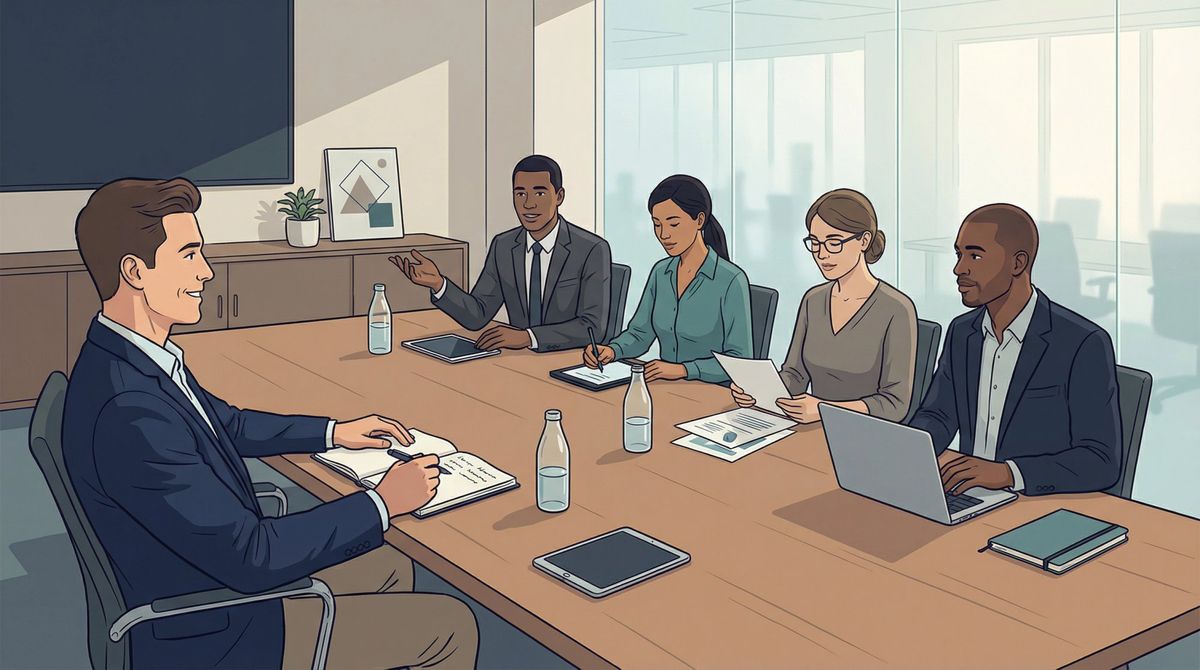
First things first: what a panel interview actually is. A panel interview means one candidate (you) meets with multiple interviewers at the same time. This is different from a group interview where multiple candidates interview together.
Why Do Companies Use Panel Interviews?
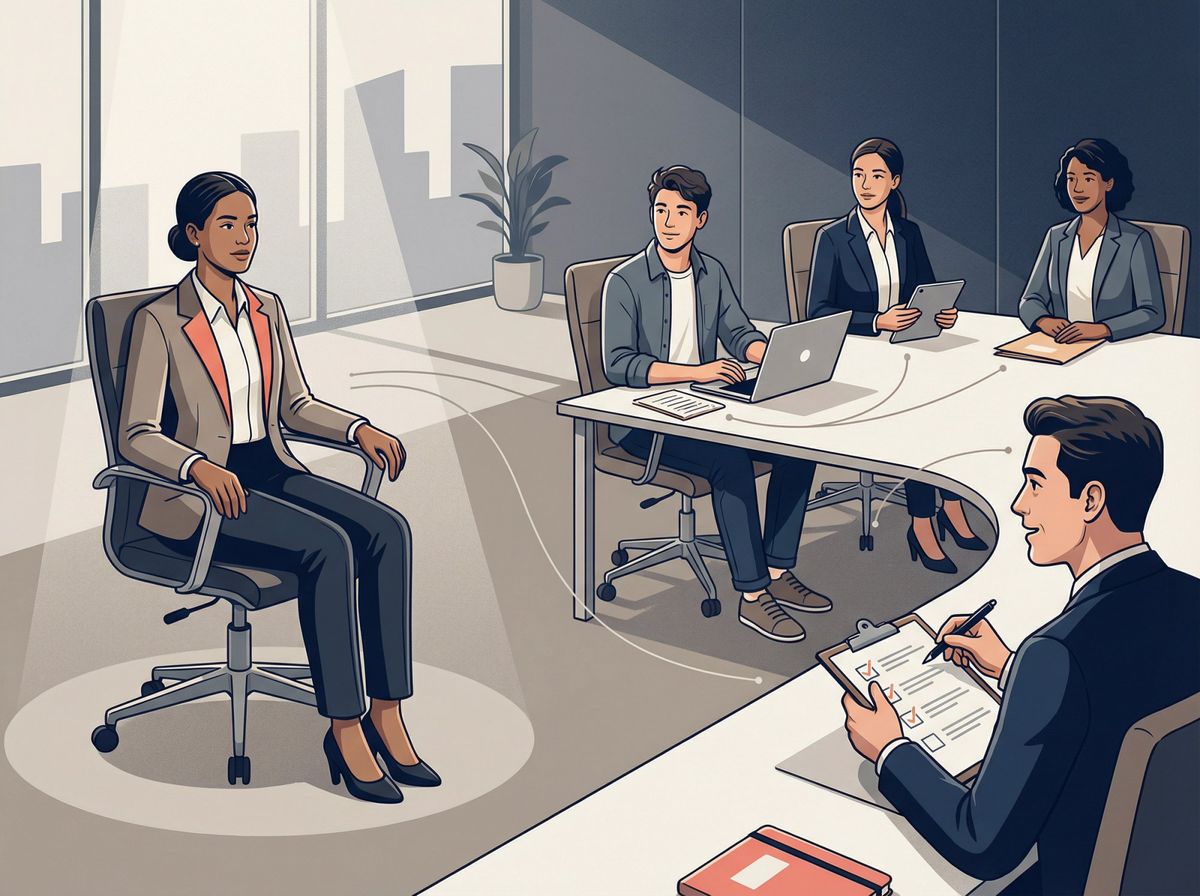
Companies aren't trying to torture you (usually). They use panels for three strategic reasons:
1. Efficiency and speed
Instead of scheduling separate interviews with the hiring manager, two team members, a cross-functional partner, and an HR rep (that's four different meetings), a panel consolidates everything into one conversation. This compresses what could be days of back-and-forth into a single meeting, which speeds up hiring decisions dramatically.
2. Multiple perspectives in one conversation
Each panelist brings a different lens. The engineering manager wants to probe your technical problem-solving. The potential teammate cares about collaboration. The cross-functional partner needs to know you can manage stakeholder complexity. HR is evaluating cultural fit. Getting all these perspectives at once helps companies make better, more balanced hiring decisions.
3. Testing how you handle group dynamics
What most candidates miss: the format itself is a test. Panels don't just want to know what you know. They want to see how you perform when facing multiple people with different agendas, how you distribute attention, how you stay composed under multi-directional pressure. The panel format is essentially a live simulation of stakeholder management.
What Are Panels Really Testing You On?
Think of a panel interview as a stress test of three core abilities:
| Ability | What They're Looking For | Why It Matters |
|---|---|---|
| Reduce cognitive load | Can you make your answers easy to capture and score? | Panelists are listening, taking notes, and scoring. Rambling forces them to guess your point. |
| Manage stakeholders | Can you address multiple perspectives simultaneously? | After you're hired, you'll work with multiple people. This is practice. |
| Stay consistent under pressure | Do you contradict yourself? Lose composure? | With more observers, inconsistencies show up fast. |
Critical insight: Most candidates treat panels like "regular interview, but more people." That's a mistake. The best approach is to think of it as real-time stakeholder management with an audience scoring your performance.
How to Prepare for a Panel Interview in 48 Hours
If you do only one thing before your panel interview, do this: build a "panel-ready packet" you can reference in 10 seconds. Here's the complete system.
Step 1: Get the Cast List and Logistics
Reach out to your recruiter or hiring manager and confirm:
→ Names and roles of panelists (so you can prepare specific proof points for each)
→ Format: In-person or video? Location/link? Start time? Expected length?
→ Special components: Will there be a presentation, case study, or skills test?
Why this matters: when you know who's in the room, you can predict what each person cares about and prepare proof that will land for their perspective.
Reality check: Sometimes employers don't tell candidates it's a panel until you show up. If they say "interview with the team," assume panel and prep accordingly.
Step 2: Build Your Panelist Map (15 Minutes)
Create a one-page table that maps each interviewer to what they'll care about and what proof you should bring. This is your strategic planning document.
Panelist Mapping Template:
Name | Role | What They Care About | Proof I'll Bring | One Smart Question-----|------|---------------------|-----------------|-------------------Maria | Hiring Manager | Outcomes, priorities, risk management | My #1 impact story with metrics | "What does great look like in the first 90 days?"Jamal | Potential Teammate | Collaboration, communication, daily work | Conflict resolution + teamwork story | "What do you wish new hires knew earlier?"Alex | Cross-Functional Partner | Handoffs, process, stakeholder mgmt | Cross-team coordination story | "Where do projects usually stall?"Sofia | HR/Recruiter | Values, consistency, motivation fit | Values alignment + career progression | "What's the timeline and next steps?"
You're doing two things here:
① Pre-loading the angles you'll get questions from
② Preparing specific proof that will resonate with each perspective
Step 3: Assume It's Structured and Prep for Competencies
Many organizations use panels with defined criteria and scoring rubrics. That means your prep should be competency-based.
How to do this:
- Pull 6-10 key competencies from the job description (ownership, stakeholder management, analytical thinking, etc.)
- Attach one proof story to each competency
- Attach one metric or result to each story (even if small)
Competency Matrix Template:
| Competency | Proof Story Title | Metric/Result | What I Learned | Likely Follow-Up |
|---|---|---|---|---|
| Ownership | "Rescued stalled project" | Shipped 2 weeks early | Better upfront planning | "What would you do differently?" |
| Stakeholder mgmt | "Aligned sales + engineering" | Cut rework by 30% | Set clearer specs earlier | "How did you handle pushback?" |
| Problem-solving | "Identified data quality issue" | Improved accuracy 40% | Root cause before solutions | "What was your approach?" |
Step 4: Build Your Story Bank (STAR/SOAR)
Panel interviews heavily favor behavioral questions because they allow all interviewers to hear comparable evidence. Your goal: have 8-10 stories you can remix.
Use the STAR framework (Situation, Task, Action, Result) or SOAR framework (Situation, Objective/Obstacle, Action, Result). Structured storytelling keeps answers organized.
Quick STAR example:
• Situation: Our team was behind on a product launch by three weeks.
• Task: As the PM, I needed to get us back on track without cutting features.
• Action: I reorganized sprint priorities, identified two bottlenecks in the QA process, and negotiated an extra week with stakeholders while we parallelized work.
• Result: We launched one week later than originally planned (better than three), kept all core features, and the product hit 150% of first-month revenue targets.
Pro tip: Practice your stories out loud. In a panel, you'll have multiple pairs of eyes watching you, which amps up pressure. Rehearsing helps you deliver smoothly even when nervous.
Need help practicing? Our Mock Interview Simulator can generate role-specific questions so you can rehearse your STAR answers until they feel natural.
Step 5: Craft Your Opening Statement (30-60 Seconds)
Panels often start with "tell us about yourself." This is your moment to set the tone.
Opening Formula:
"I'm a [role] who does [thing] for [type of company/team].My track record includes [2 proof bullets with metrics].I'm here because [role need], and that's exactly my lane."
Example:
"I'm a product analyst who turns messy customer data into decisions teams actually ship. In my last role, I reduced churn in one segment by 18% by surfacing a hidden onboarding failure, and I built a dashboard that cut weekly reporting time by 6 hours. I'm excited about this role because you're scaling the product and need tighter insight loops, which is exactly what I've been doing for three years."
Memorize this. Practice it until it sounds conversational, not scripted.
Step 6: Prepare Your Closing Pitch (20 Seconds)
Most candidates just... stop talking at the end. Don't do that. Close like someone who can run meetings.
Closing Formula:
"Before we wrap, quick recap:Based on what you've shared, the role needs (1) ___, (2) ___, (3) ___.My strongest matches are (1) proof, (2) proof, (3) proof.I'm excited about the impact I can have. What are the next steps?"
This shows you were listening, you can synthesize, and you're decisive about fit.
Step 7: Prep Questions for Each Panelist
You'll get "do you have questions for us?" Treat this seriously. Panels evaluate you during the question phase too.
Prepare 5-7 questions you can aim at different panelists based on their roles. We'll cover the full question bank later, but here's the principle: tailor questions to each person's domain.
Step 8: Practice Timing
Some panels use tight timing, like 5-6 minutes per question. Even in less formal panels, you should timebox yourself to avoid hijacking the room.
Your rules:
• Default answer: ~90 seconds
• Complex or two-part questions: 2 minutes
• Only go longer if they explicitly ask for more depth
Step 9: Know Accessibility Options
Some organizations provide questions in advance or allow accommodations (extra time, questions in writing) to support neurodivergent candidates. If you need an accommodation, asking is professional and increasingly normal.
What to Do During a Panel Interview: Proven Strategies
You've prepped. Now here's how to perform when you're in the room (or on the call).
Make Strong First Impressions on Each Person
In a panel, you're making multiple first impressions simultaneously. Start strong.
Greet everyone individually. If in-person, shake hands with each panelist. Say their name: "Hi Maria, nice to meet you." On video, acknowledge each person when introductions happen: "Nice to meet you, Jamal... and Alex..."
This simple act establishes you as someone who sees people as individuals, not a faceless committee.
Your body language matters more. Sit up straight. Keep your body open (no crossed arms). Project confidence even if you're nervous inside. When there are multiple interviewers, appearing engaging and approachable to all of them is crucial.
Show enthusiasm immediately. "I've been really looking forward to this conversation. Thank you all for taking the time today." Delivered with a smile, this sets a positive tone.
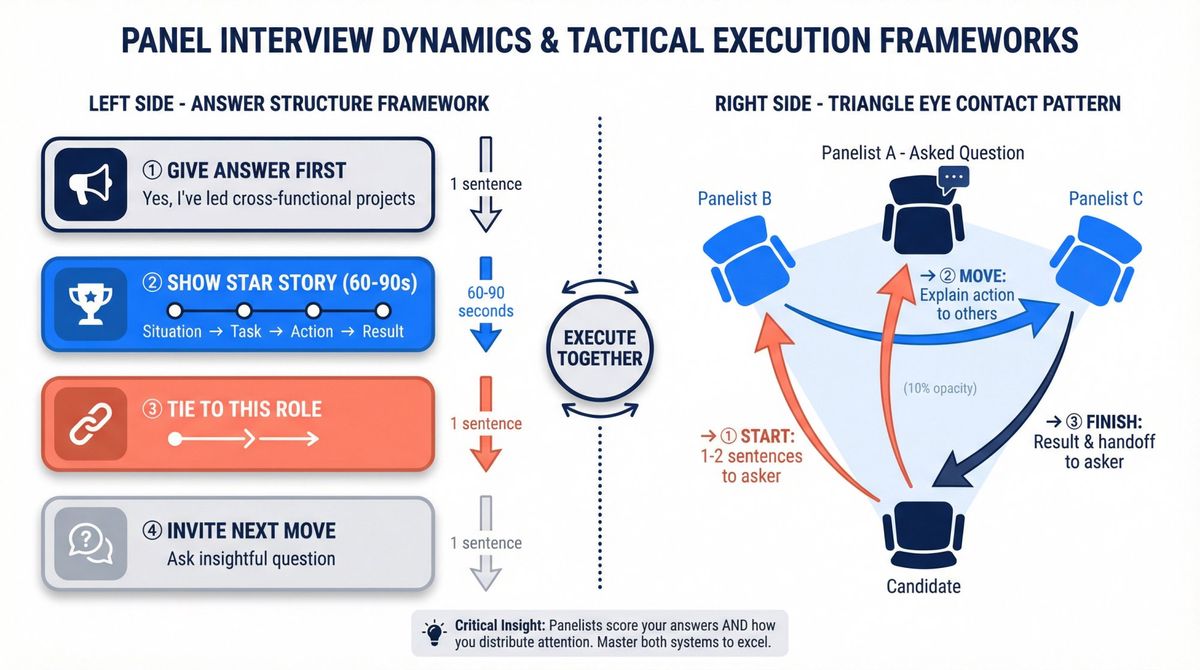
The "Headline → Proof → Relevance → Handoff" Answer Framework
This is the highest-leverage tactic you'll learn. Panelists are trying to score you and write justification. Make it easy for them.
① Headline (1 sentence): Give the answer first.
"Yes, I've led cross-functional projects under tight deadlines."
② Proof (STAR story, 60-90 seconds): Show you've done it.
"At my last company, we had a product launch that got compressed from 12 weeks to 8. I coordinated engineering, design, and marketing by..."
③ Relevance (1 sentence): Tie it to this role.
"That's similar to what you described about your Q2 roadmap compression."
④ Handoff (1 sentence): Invite the next move.
"Want the technical details, or the stakeholder coordination side?"
This structure turns your answer into something panelists can capture cleanly in their notes.
Master the Triangle Eye Contact Pattern
The biggest mistake candidates make: only talking to the person who asked the question.
Do this instead:
① Start on the person who asked (1-2 sentences)
② Move to 1-2 other panelists while you explain the "action" part of your story
③ Finish on the original asker for the result and handoff
Why this works: it feels natural, and it makes each person feel included without you looking like a ping-pong ball bouncing between faces.
Take Notes (Yes, Really)
Panel interviews have more moving parts: multi-part questions, follow-ups, names, context. Taking notes reduces mistakes.
What to write down:
- Panelists' names and seating/screen positions (so you can reference them by name)
- Multi-part questions (so you don't forget to address all parts)
- Follow-up topics you want to circle back to
This also gives you a moment to think if you need it.
Use "I" and "We" Strategically
The rule:
• Use "I" for decisions and actions you owned
• Use "we" for team execution and outcomes
• Then back to "I learned..." or "I changed..."
Example: "I decided to reorganize our sprint priorities (I). We then parallelized QA and dev work (we). I learned that earlier stakeholder alignment prevents these crunches (I)."
Pace Yourself and Pause When Needed
Panel interviews can feel rapid-fire. Don't let that rush you into half-baked answers.
It's okay to pause. When you get a complex question, take a breath. "That's a great question. Let me think about that for a second." This shows poise, not confusion.
Listen until the end. With multiple people, sometimes questions overlap or have multiple parts. Discipline yourself to hear the full question before answering.
Paraphrase if needed. "If I understand correctly, you're asking about how I've handled project deadlines and what I learned. Is that right?" This buys you a moment and prevents miscommunication.
Structure your answers. "I'll answer this in two parts: first... second..." This organizes your response and slows you into a clear cadence.
Critical insight: Panelists value quality over speed. A structured, insightful answer after a 5-second pause beats a rambling mess you blurt immediately.
How to Handle Difficult Panel Interview Scenarios
What to do when things get messy.
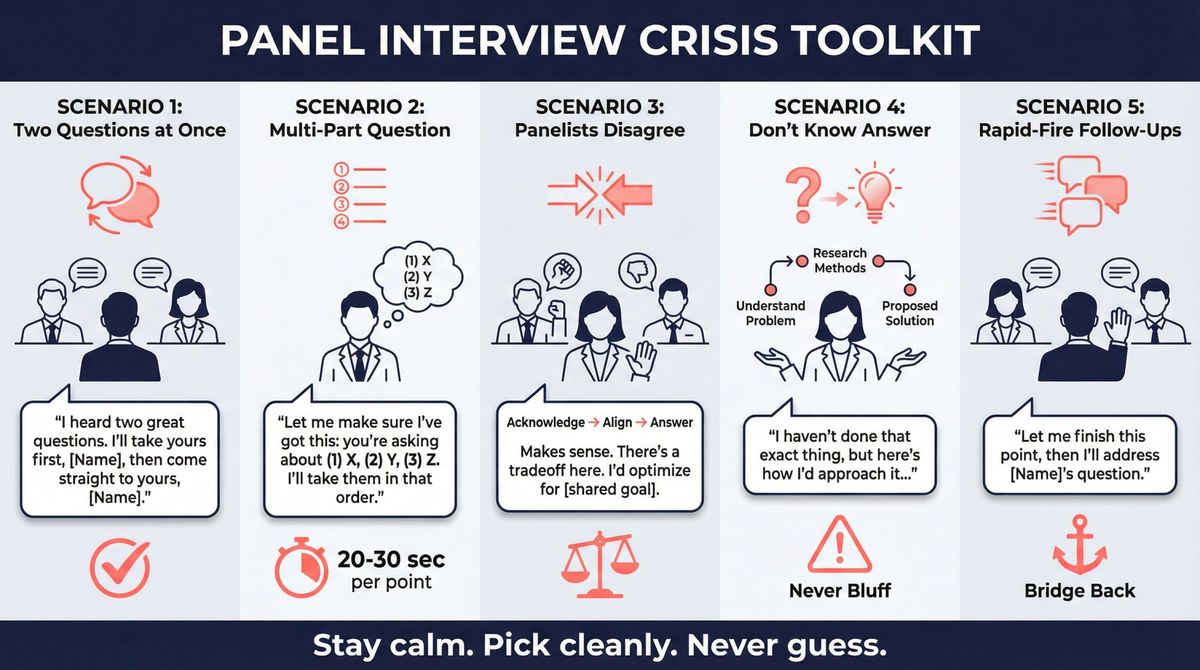
Scenario 1: Two People Ask Questions at Once
Don't guess which to answer. Pick cleanly.
Script: "I heard two great questions. I'll take yours first, [Name], then come straight to yours, [Name]."
Then actually do it.
Scenario 2: Multi-Part Question with 4 Sub-Questions
This is where candidates spiral.
Script: "Let me make sure I've got this: you're asking about (1) X, (2) Y, (3) Z. I'll take them in that order."
Then answer each in 20-30 seconds, or say: "The short version is [summary]. I can go deeper on whichever matters most to you."
Scenario 3: Panelists Disagree in Front of You
This is actually a gift. They're showing you real internal dynamics.
Your move: Acknowledge → Align → Answer
• Acknowledge: "Makes sense. There's a tradeoff here."
• Align: "I'd optimize for [shared goal: customer impact, risk, timeline]."
• Answer: "Here's how I'd decide..."
Scenario 4: You Don't Know the Answer
Don't bluff. In panels, someone in the room usually knows the answer, and they'll catch you.
Say: "I haven't done that exact thing, but here's how I'd approach it..." Then give a structured approach with assumptions and what you'd check first.
Scenario 5: Rapid-Fire Follow-Ups from Different People
This means they're interested. Lean into it.
Stay calm. Answer one follow-up at a time. If they pile up, politely say: "Let me finish this point, then I'll address [Name]'s question."
Bridge back to your key message. If follow-ups drift far, bring it back: "That connects to what I mentioned earlier about [your strength]."
Best Questions to Ask in a Panel Interview
When they say "do you have questions for us?" this is your moment to shine just as much as answering their questions.
Why Your Questions Matter in Panels
Asking smart questions shows you understand the work, you're vetting fit (not just begging for an offer), and you can think strategically. Plus, when you get each panelist talking, the interaction starts to feel like a team discussion rather than an interrogation.
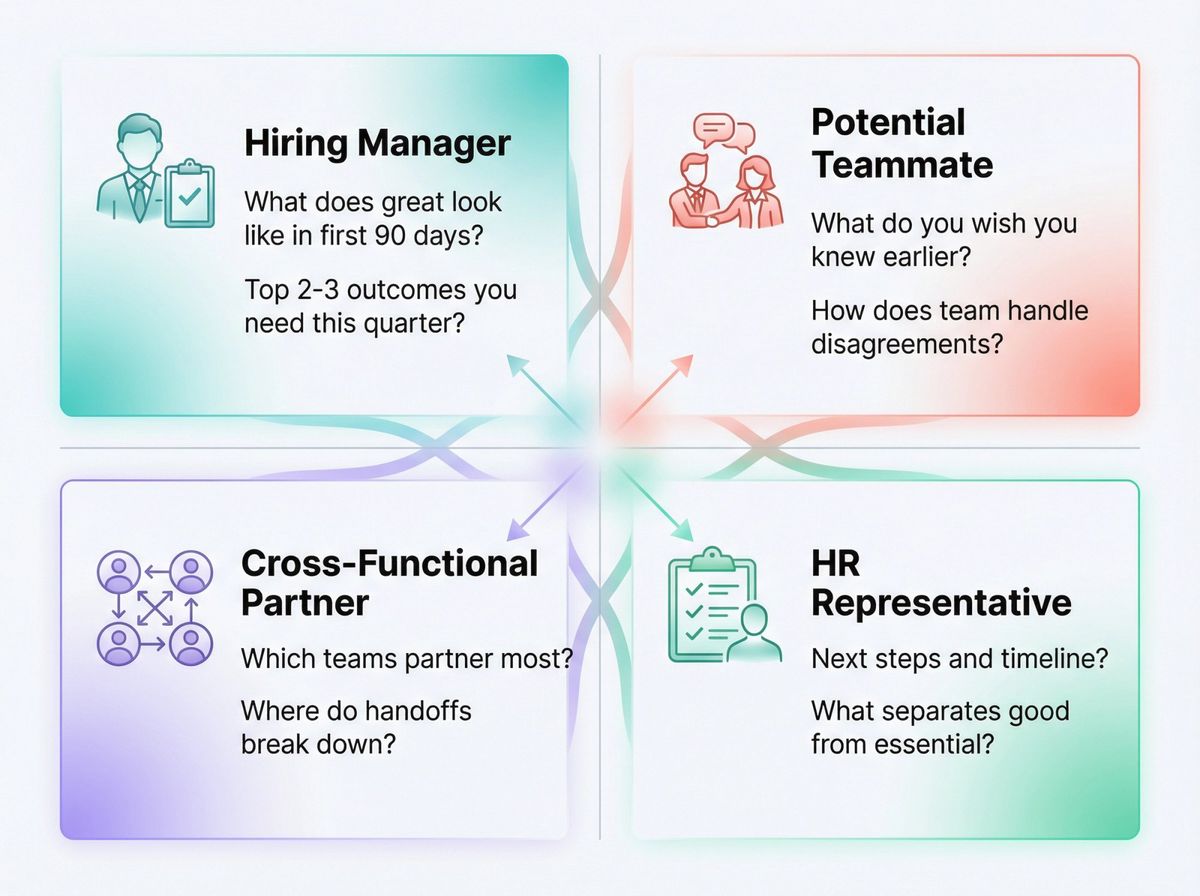
Tailor Questions to Each Panelist's Domain
Aim questions at different people based on their roles:
For the hiring manager:
• "What does 'great' look like in the first 90 days?"
• "What are the top 2-3 outcomes you need this hire to drive this quarter?"
For potential teammates:
• "What do you wish you knew earlier when you started?"
• "How does the team typically handle disagreements or competing priorities?"
For cross-functional partners:
• "Which teams does this role partner with most, and where do handoffs usually break down?"
• "What's a current tradeoff the team is dealing with (speed vs quality, growth vs stability)?"
For HR:
• "What are the next steps and timeline from here?"
• "What separates someone who's 'good' in this role from someone who becomes essential?"
Pro tip: If time allows, ask one question that invites everyone to answer: "What do each of you think is the most challenging aspect of this role right now?"
End on a Forward-Looking Note
Always ask: "What are the next steps, and when should I expect to hear back?"
This shows you're eager and helps you manage your follow-up timing.
How to Follow Up After a Panel Interview
The interview doesn't end when you leave the room. Follow-up can make or break your chances.
The Golden Rule: Individual Thank-You Notes
Send a personalized thank-you note to each panel member within 24-48 hours.
Not a group email. Individual emails to each person.
Why? Because they'll likely compare notes. If Maria got a personalized email and Jamal got generic copy-paste, that's awkward.
Template for Panel Thank-You Emails
Subject: Thank you - [Role] panel interviewHi [Name],Thank you for taking the time today. I appreciated the conversation, especially around [specific topic they raised or discussed].Based on what you shared about [team goal/challenge], I'm excited because I've handled something similar:• [1 line proof + metric]• [1 line how you'd apply it here]If helpful, I can share [portfolio link/example doc] that relates to [their topic].Thanks again,[Your name]
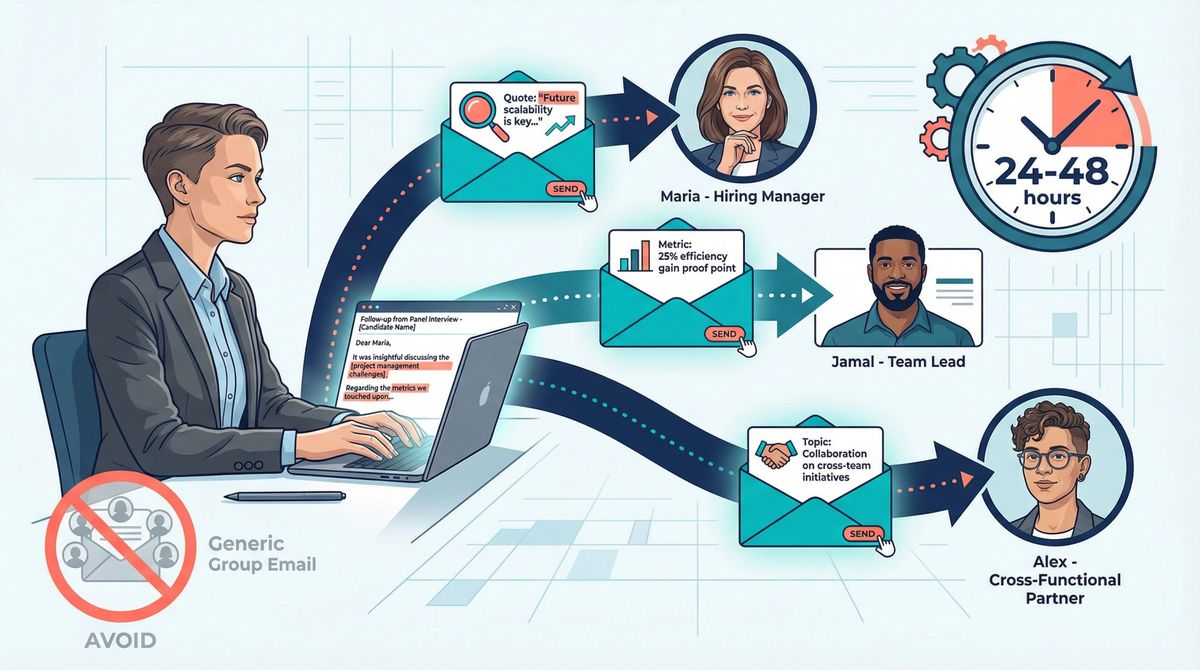
Key elements:
• Specific reference to something that person said
• Reconnect your experience to their needs
• Keep it brief (couple of short paragraphs)
• Proofread before sending (typo in a name = bad)
Timing Matters
Send thank-you notes within 24-48 hours. Not immediately (too desperate-looking), but not a week later (they've probably made a decision).
What If You Only Have the Recruiter's Email?
Ask the recruiter for each panelist's contact info. Most will provide it. If they won't, send one email to the recruiter asking them to forward to the panel, but mention you'd love to thank each person individually if possible.
How We Help You Prep Faster
Panel interview prep is mostly repetition: map the job, map competencies, rehearse stories, refine delivery, follow up. We've built tools to compress that loop.
Mock Interview Simulator
Paste the job description, and our Mock Interview Simulator generates targeted questions for you to practice. You can rehearse your STAR answers until they're sharp and timed correctly.
Why this helps: Panel interviews reward consistency. When you've practiced answering the same question type multiple ways, you won't freeze under pressure.
Interview Buddy (Real-Time Support)
Our Interview Buddy Chrome extension listens to interview questions in real-time (Zoom, Google Meet, Teams) and suggests talking points based on your resume and the job description.
Use it responsibly: Don't read from it word-for-word (interviewers notice). Use it as a safety net for key points or if you blank on a question. Stay truthful. Follow employer rules about assistance.
Resume Scanner
Before the interview, make sure your resume language matches the role. Our Resume Scanner aligns your resume keywords with the job description, so your interview stories match what's on paper.
Why this matters: Panels often have your resume in front of them. When your answers echo language from your resume, it reinforces consistency.
Auto Apply for Building Your Pipeline
Panel interviews are intense, but the best way to get good at them is practice (and the best way to practice is to have more interviews). Our Auto Apply tool can apply to hundreds of roles automatically, filling your pipeline so you get more opportunities.
The mindset shift: When you have multiple interviews lined up, each one feels less like "my only shot" and more like "good practice." That confidence shows.
Full Interview Prep Resources
Our complete interview preparation guide covers everything from pre-interview research to negotiation. It's a solid baseline if you need the whole system.
Printable Panel Interview Cheat Sheet
Save this checklist for quick reference before your next panel.
Before the Interview:
□ Confirm format, time, and panelist names/roles
□ Create panelist map (what they care about + question for each)
□ Build competency matrix (6-10 competencies + proof stories)
□ Prep 8-10 STAR/SOAR stories with metrics
□ Memorize opening statement (30-60 seconds)
□ Prepare closing pitch
□ Draft 5-7 questions tailored to panelists
□ Practice timing (90-second default answers)
□ Request accessibility support if needed
During the Interview:
□ Greet each person individually by name
□ Write down names and seating/screen positions
□ Answer using: Headline → Proof → Relevance → Handoff
□ Rotate eye contact (triangle pattern: asker → others → asker)
□ Take notes on multi-part questions
□ Pause before answering complex questions
□ Use "I" for decisions, "we" for team execution
□ Close with recap + next steps
After the Interview:
□ Send individual thank-you notes within 24-48 hours
□ Reference specific moment from each person's questions
□ Reattach one proof point relevant to their domain
□ Proofread before sending (check names and titles)
□ If no response by their timeline, send polite check-in
Panel Interview Questions: Common FAQs Answered
What's the difference between a panel interview and a group interview?
A panel interview has one candidate meeting with multiple interviewers simultaneously. A group interview has multiple candidates interviewing together at the same time. Panels test how you handle multiple perspectives. Group interviews test how you stand out in a competitive setting.
How many people are typically in a panel interview?
Most panels have 3-5 interviewers, though they can be larger. It's recommended to keep panels between 2 and 5 members to avoid overwhelming candidates.
What if I don't know who'll be in the panel beforehand?
Ask your recruiter for the list of panelists (names, titles, roles). This is a professional question they expect. If they won't tell you, prepare for common roles: hiring manager, potential teammates, cross-functional partners, and HR. That covers most panel compositions.
How do I handle eye contact with multiple people?
Use the triangle pattern: Start on the person who asked the question, shift to 1-2 other panelists while explaining your story, then finish on the original asker for your conclusion. This makes everyone feel included without looking robotic.
What if two panelists ask questions at the same time?
Politely acknowledge both: "I heard two great questions. I'll answer [Name]'s first, then come straight to yours, [Name]." Then actually do it. This shows you can manage competing priorities.
Should I send a thank-you note to every panelist?
Yes. Send individual emails to each panelist within 24-48 hours. Personalize each one by referencing something specific that person said or asked. Generic group emails feel lazy in a panel context.
How long should my answers be in a panel interview?
Default: 90 seconds. For complex or multi-part questions: 2 minutes. Only go longer if they explicitly ask for more depth. Panels can have tight timing, so respecting their time shows professionalism.
What if I don't know the answer to a question?
Be honest. "I haven't done that exact thing, but here's how I'd approach it..." Then give a structured approach with assumptions. Panels have subject experts who'll catch bluffing. Showing your problem-solving process is better than faking knowledge.
How do I address panelists if I forget their names?
This is why you write down a seating chart at the start. Glance at your notes if needed. If you truly blank, it's okay to say "To answer your question..." without using their name once or twice. But try to use names when you can (it builds connection).
Can I ask questions directed at specific panelists?
Absolutely. In fact, you should. Ask the hiring manager about priorities, ask teammates about culture, ask cross-functional partners about collaboration challenges, ask HR about timeline. Tailoring questions shows you understand different perspectives.
What if panelists disagree with each other during my interview?
Stay neutral and acknowledge the tradeoff. "I can see both perspectives. I'd optimize for [shared goal], and here's how I'd balance [both concerns]." This shows you can navigate conflicting priorities, which is exactly what they're testing.
Should I bring copies of my resume?
Yes. Bring one for each panelist plus 1-2 extras. Someone might not have theirs handy. Handing them a fresh copy at the start shows preparedness.
What if the panel interview is on video?
Same principles apply. Make sure you can see all panelists (if possible, use gallery view). Look at your camera when speaking (not just the screen) to simulate eye contact. Test your tech 15 minutes early. Have a clean background and good lighting.
How formal should I be in a panel interview?
Match the company culture. If it's a startup with casual dress, don't wear a three-piece suit (unless it's finance). If it's corporate, dress professionally. When in doubt, go one notch more formal than the company's day-to-day dress code.
What if I get a question I already answered earlier in the interview?
This happens in panels where people join late or aren't fully listening. Don't say "I already answered that." Instead, briefly summarize your earlier answer, then add one new detail or angle. "I touched on this earlier, but to expand..."
Conclusion: You've Got This
Panel interviews feel intimidating because you're doing stakeholder management in real time with multiple decision-makers watching. But that's also why they're powerful. Nail the panel, and you've just impressed everyone who matters in one conversation.
Here's your action plan:
• 48 hours before: Build your panelist map, prep your story bank, practice your opening and closing
• During the interview: Use the headline-proof-relevance-handoff answer framework, rotate eye contact, stay calm when things get messy
• 24 hours after: Send individual thank-you notes that reference specific moments from each person's questions
Panel interviews aren't about being perfect. They're about showing you can handle complexity, stay composed under pressure, and make multiple people feel heard. When you do that, you're not just answering questions. You're demonstrating exactly the skills they need in the role.
Start preparing with our Mock Interview Simulator to practice your answers, or use our Interview Buddy for real-time support during the actual interview. Either way, you've got the system. Now go execute it.
Good luck. You're going to do great.