How to Explain Being Fired in an Interview (2026)
Being fired doesn't end your career. Learn how to explain it professionally in interviews with real examples and actionable strategies that work.


Audio and video are AI narrations of this article.
How to Explain Being Fired in an Interview (2026)
Narrated version · 7 min
Getting fired stings. There's no way around that.
But here's something that might surprise you: being fired doesn't have to derail your career. Plenty of successful professionals have been terminated at some point. What separates those who bounce back from those who don't? Knowing how to talk about it in interviews.
When you're sitting across from a hiring manager and they ask "Why did you leave your last job?" your answer needs to do three things at once:
• Acknowledge the truth without oversharing
• Show you've learned and grown from the experience
• Redirect the conversation back to why you're the right fit for this role
That's a lot to accomplish in 30 seconds. And that's exactly why this guide exists.
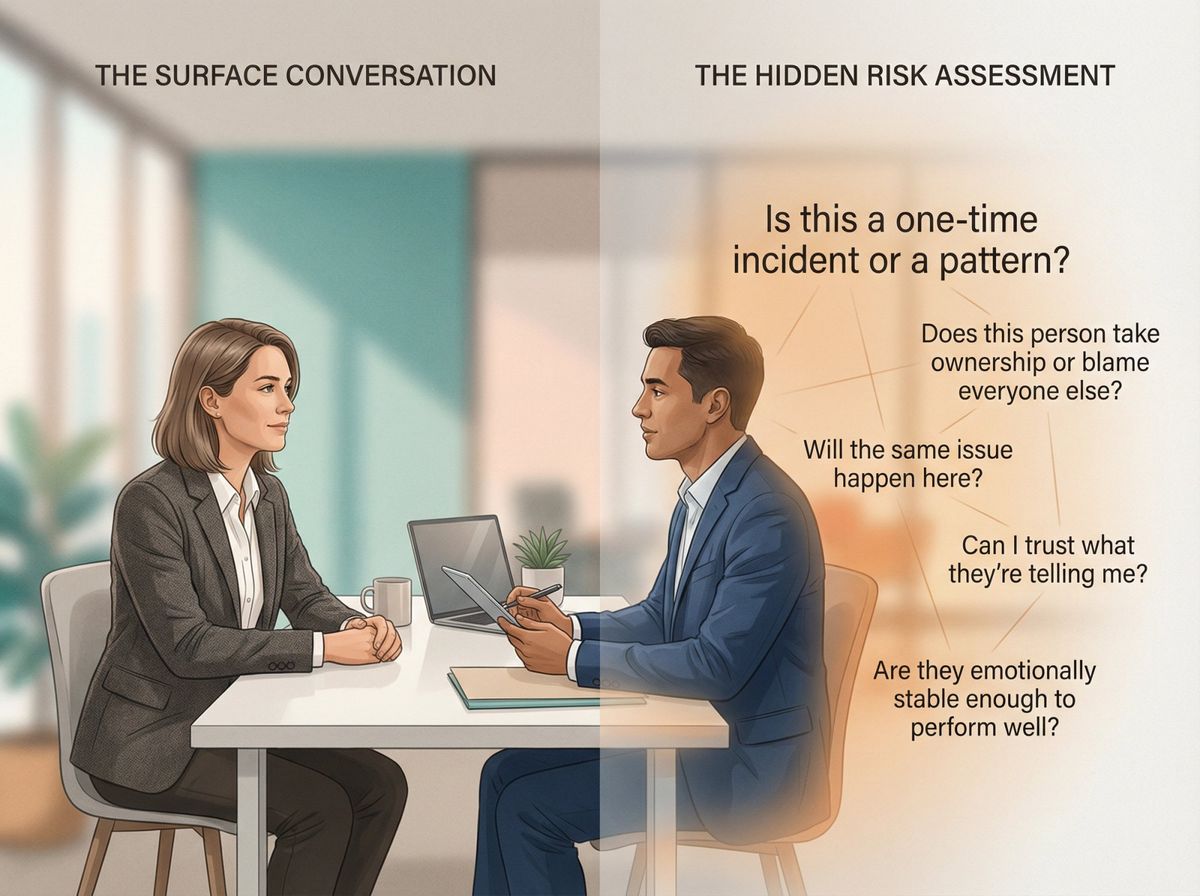
What Do Interviewers Want to Know About Being Fired?
When an interviewer asks about being fired, they're not hunting for drama or trying to embarrass you.
They're doing risk assessment.
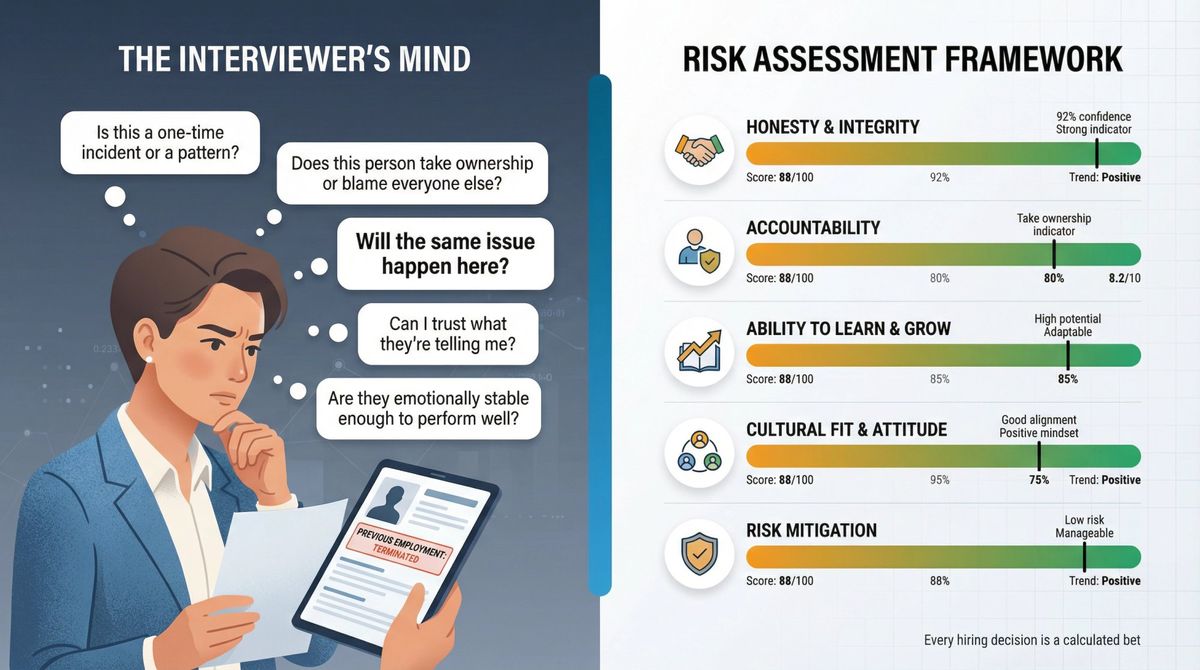
Every hiring decision is a bet. They're investing time, money, and team resources into bringing you on board. When they know you were terminated, five questions run through their mind:
1. Is this a one-time incident or a pattern?
2. Does this person take ownership or blame everyone else?
3. Will the same issue happen here?
4. Can I trust what they're telling you?
5. Are they emotionally stable enough to perform well?
Your job is to answer these unspoken questions while keeping your response brief, honest, and forward-looking.
The biggest trust-killer isn't the firing itself. It's inconsistency. When your story doesn't match what comes up in reference checks, hiring managers get nervous. Understanding how employers verify employment history shows why consistency is critical.
Here's what they're actually evaluating:
Honesty and integrity: They want to see if you'll be transparent about difficult situations. Evasiveness or inconsistency raises massive red flags. Being upfront (without oversharing) demonstrates character.
Accountability: Employers look for people who take responsibility rather than pointing fingers. How you handle setbacks reveals your maturity and professionalism.
Ability to learn and grow: A firing indicates something went wrong in your last role. The interviewer wants evidence that you've addressed the issue. Demonstrating that you turned the situation into a learning opportunity can actually impress them.
Cultural fit and attitude: How you talk about a previous employer speaks volumes. If you bad-mouth your former company or boss, the interviewer will worry you'll bring that negativity to their team.
Risk mitigation: Ultimately, they need assurance that hiring you won't backfire. A great answer shows that any past issue has been resolved and won't affect your future performance.
The goal: Answer the question, watch them nod, and have the conversation immediately shift back to your skills and qualifications.
How to Answer 'Why Were You Fired?' in 3 Sentences
Don't freestyle your answer. Don't ramble. Don't turn this into a therapy session.
Instead, memorize this structure:
Sentence 1 (The Fact): "My employment ended because ___." Sentence 2 (Ownership + Growth): "I take responsibility for ___, and since then I've ___." Sentence 3 (Proof + Pivot): "What I'm looking for now is ___, and this role fits perfectly because ___."
That's it.
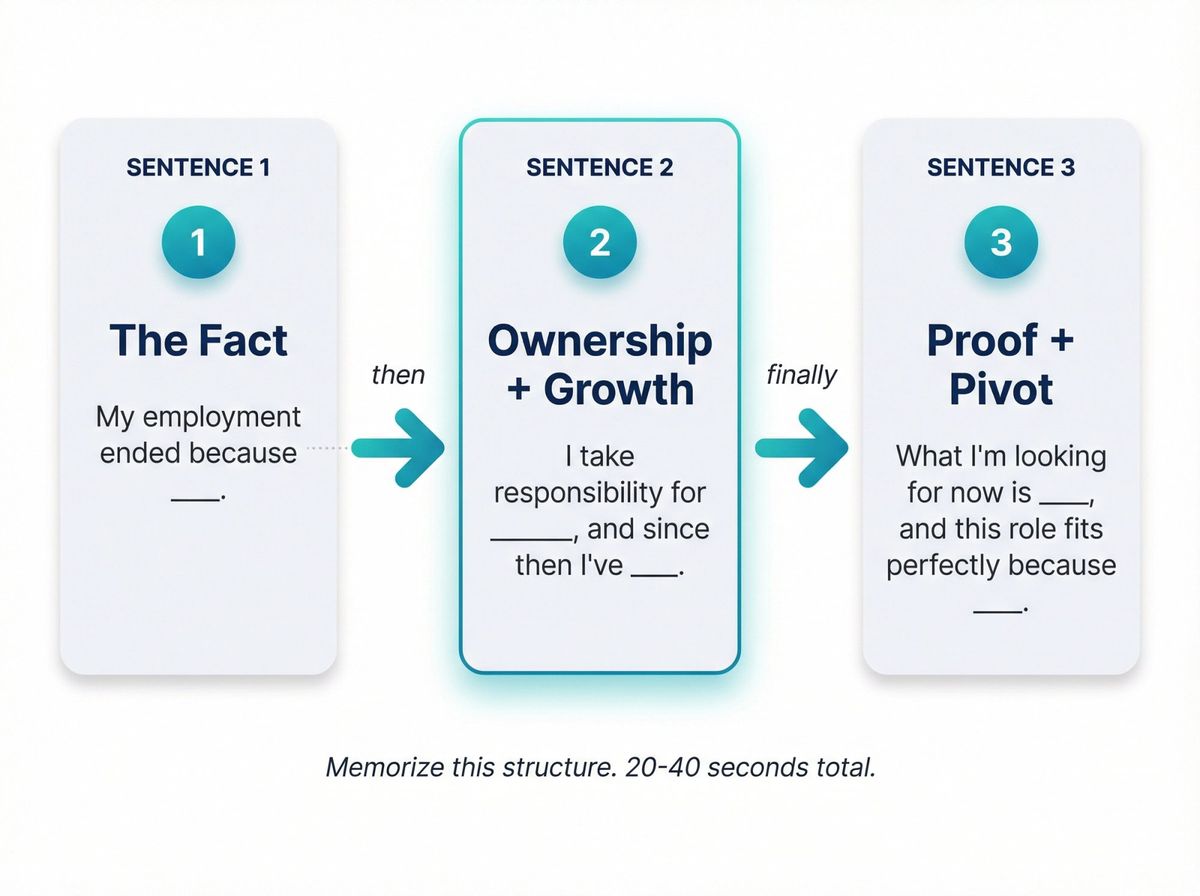
No backstory. No villain origin story. No courtroom defense.
The beauty of this framework is that it forces you to be concise, honest, and forward-looking all at once. You acknowledge what happened, show you've grown, and immediately redirect to why you're a strong candidate for their open position.
Should You Tell Interviewers You Were Fired?
This depends entirely on how the question is phrased.
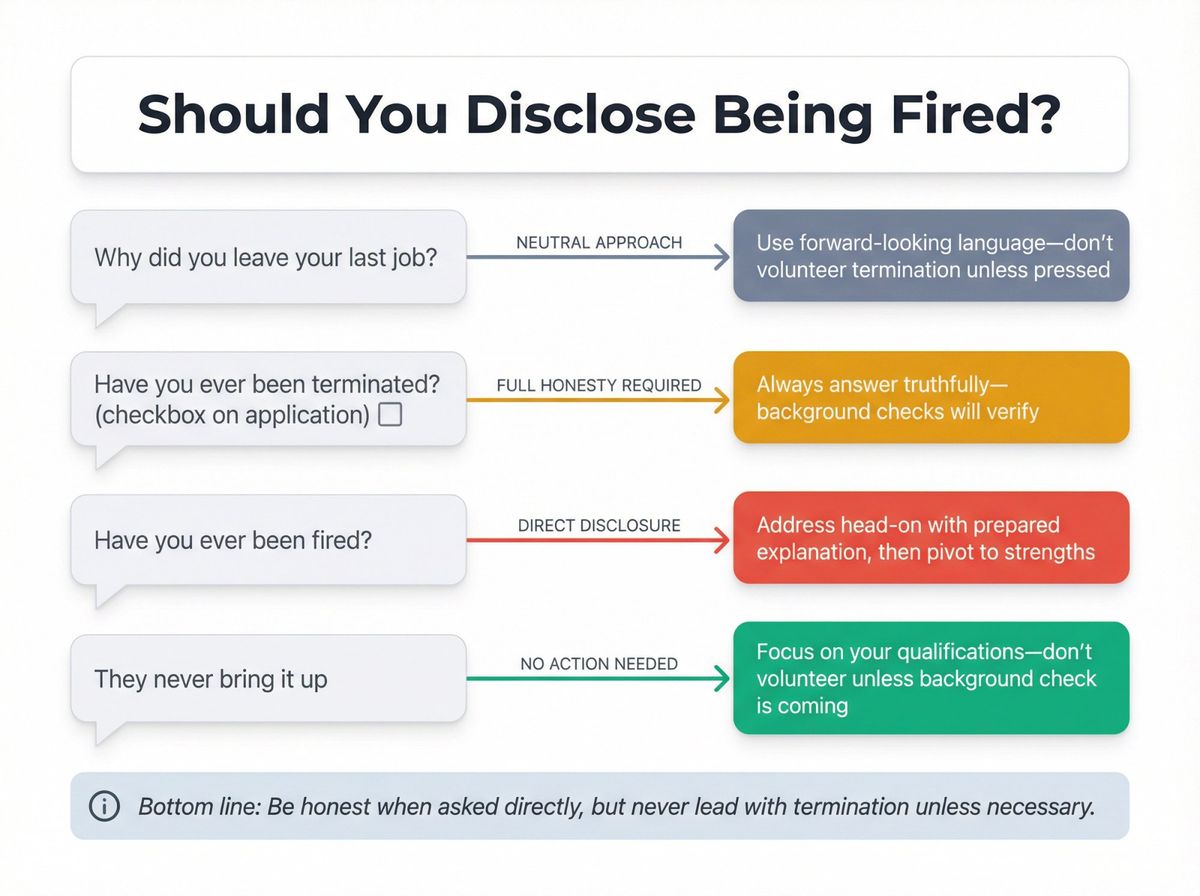
If they ask "Why did you leave your last job?"
You don't need to volunteer "I was fired" in your opening sentence. But you absolutely can't claim you resigned if you didn't. Many candidates choose a neutral, forward-looking answer like:
"I had to move on from my last role and I'm now looking for a better fit where I can grow."
This is honest without broadcasting the termination. Keep it brief and only expand if they press for specifics.
If the application form asks directly
Some job applications include a checkbox: "Have you ever been terminated?"
Always answer truthfully. Companies verify employment history during background checks, and any discrepancy can cost you the offer. Better they know upfront from you than discover it through screening.
If they ask explicitly "Have you ever been fired?"
Now you need to address it head-on. Don't panic. This is your chance to deliver a prepared, confident explanation. Be honest and concise about the reason, then quickly pivot to what you learned and why you're a strong candidate now.
If they never bring it up
Should you volunteer the information? Generally, no. Focus on shining in the interview. If they don't ask, you don't owe an unsolicited confession.
But if you get to the offer stage and a background check is coming, some experts suggest proactively mentioning the termination to show transparency before they discover it. Use your judgment.
Bottom line: Don't lead with the fact that you were fired unless necessary, but never lie about it when asked directly.
7 Rules for Explaining Being Fired Without Red Flags
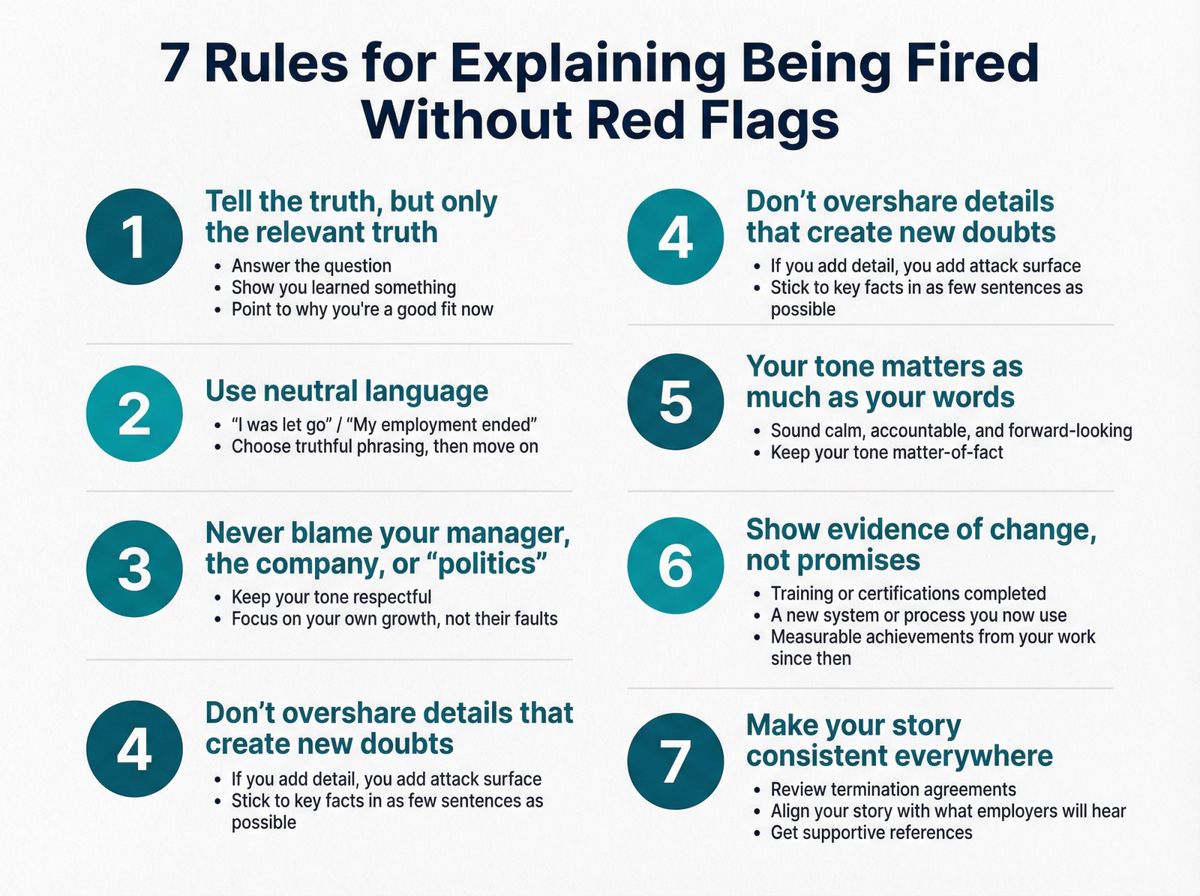
Rule #1: Tell the truth, but only the relevant truth
Interviews reward relevance, not full disclosure.
Your goal is the smallest truthful explanation that:
• Answers the question
• Shows you learned something
• Points to why you're a good fit now
You don't need to provide a minute-by-minute account of what went wrong. Give them what they need to move forward, nothing more.
Rule #2: Use neutral language
"Fired" can sound explosive. Consider these alternatives when they're accurate:
- "I was let go"
- "My employment ended"
- "I was terminated"
- "The role wasn't the right fit"
Choose whichever is truthful, then move on immediately.
Rule #3: Never blame your manager, the company, or "politics"
Even if you're 100% right, blaming signals: "This person will do this again, and they won't own their part."
No matter how unjust the firing felt, never trash your former employer in an interview. Comments like "My boss was a jerk" or "The whole place was toxic" will only make you look unprofessional. The interviewer will wonder if you're difficult to work with.
Keep your tone respectful and focus on your own growth, not their faults.
Rule #4: Don't overshare details that create new doubts
If you add detail, you add attack surface.
The interviewer doesn't need a play-by-play of everything that went wrong. Avoid lengthy stories or excessive details. It comes across as making excuses or still being caught up in the drama.
Stick to the key facts in as few sentences as possible. If they want more information, they'll ask.
Rule #5: Your tone matters as much as your words
The goal is to sound:
① Calm
② Accountable
③ Forward-looking
If your voice tightens or wavers when you practice, you need more reps.
Getting fired is emotionally tough. It's normal to feel embarrassed, angry, or upset. But an interview is not the place to re-litigate those feelings. Before you even step into the interview, process what happened. Vent to a friend. Journal. Whatever helps you get the raw emotions out.
By interview day, you want to discuss the topic calmly and professionally. Keep your tone matter-of-fact. If you sound bitter or start tearing up, the interviewer may doubt your readiness to move on.
Rule #6: Show evidence of change, not promises
Saying "I learned a lot" is cheap. Show receipts.
Real evidence looks like:
→ Training or certifications completed
→ A new system or process you now use
→ A project that demonstrates the improved skill
→ Measurable achievements from your work since then
Offer concrete examples of your improvement. If you've had another job since the firing, mention a success or positive reference from that role as proof. If not, you can cite freelance projects, volunteer work, courses, or certifications that illustrate your progress.
The idea is to convince the interviewer that being fired was a turning point that propelled you to grow, not a permanent black mark.
Rule #7: Make your story consistent everywhere
Most "got caught lying" stories come from inconsistencies, not investigations.
Before any interview, review the circumstances of your termination and any agreements you signed. Were you given a severance package with a non-disparagement clause? Are there any NDAs or HR policies about what can be disclosed? Make sure you won't accidentally violate an agreement.
Also, find out what your former employer will say if contacted for a reference. Some companies only confirm dates and titles, while others might mention you're not eligible for rehire. Ideally, you want your story to align with what the employer will hear independently.
| Consistency Check | Action Required |
|---|---|
| Review termination agreements | Check for NDAs, non-disparagement clauses |
| Contact former HR | Confirm what they'll share in references |
| Align your story | Ensure your version matches their records |
| Get supportive references | Find colleagues who can speak positively |
Pro tip: If possible, get a reference from a manager or colleague at your old job who can speak positively about you despite the firing. A supportive recommendation can counteract concerns. Just ensure that person is aware of how you're framing the termination so they don't contradict your story.
How to Prepare Your Firing Explanation in 30 Minutes
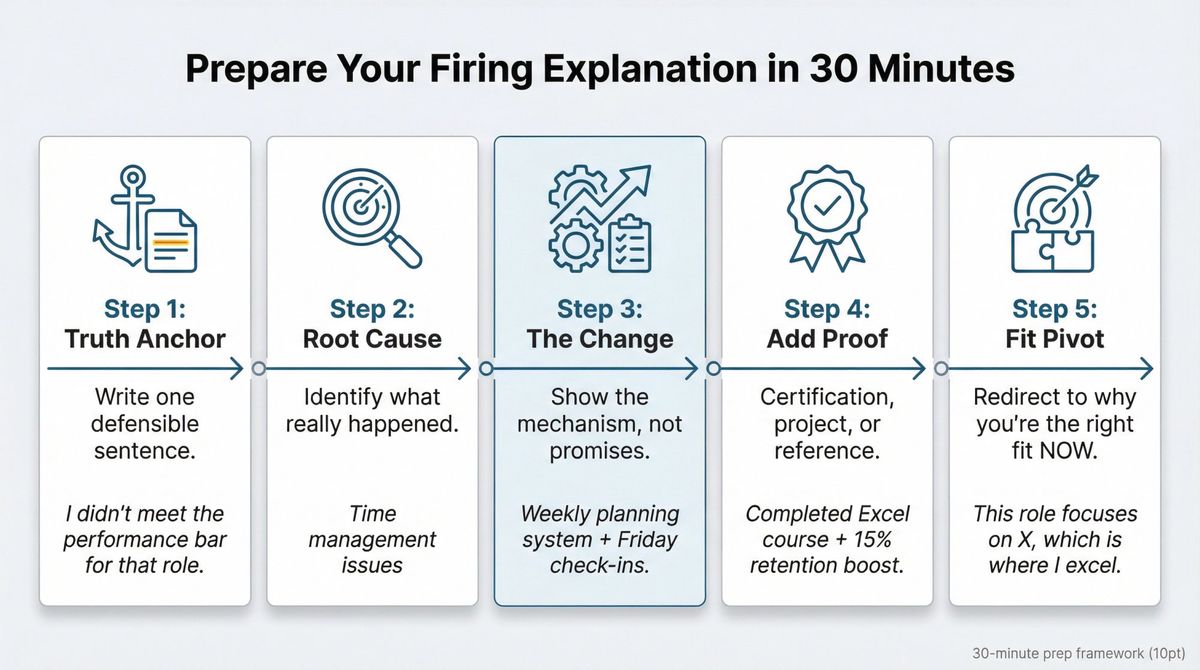
Step 1: Write your truth anchor in one line
This is the sentence you can defend without sweating.
Examples:
• "I didn't meet the performance bar for that role."
• "I violated a policy and was terminated."
• "The company restructured and my position was eliminated."
• "There was a mismatch between what the role needed and my strengths."
Step 2: Identify the root cause
Root causes that interviewers understand:
• Unclear expectations (and you didn't clarify)
• Time management or prioritization issues
• Skill gap in tools or domain knowledge
• Communication style mismatch
• Wrong environment (too chaotic, too sales-heavy, too unstructured)
Avoid saying "toxic culture" unless you can describe it neutrally and briefly.
Step 3: Write the change you made
A real change has a mechanism. It's not just a vague promise to "do better."
Bad: "I'm better now."
Good: "I use a weekly planning system and a daily top-3 list, and I review priorities with my manager every Friday."
Think about the core reason for the termination and ask: What did I learn, and what have I done to ensure this won't happen again?
| Reason | How to Address It |
|---|---|
| Skill or knowledge gap | Highlight that you've worked to fill that gap through professional development. "I realized my Excel skills weren't up to par, so I enrolled in an advanced Excel course. Now I'm proficient in data analysis and automation, which has made me much more effective." |
| Performance or productivity issue | Explain how you've addressed the underlying issue. "I sought out a mentor and adjusted my approach to time management. In my next job, I consistently met all deadlines." |
| Communication or culture mismatch | Describe how you've developed your soft skills. "I took a workshop on handling team conflicts and I've become much more adaptable in different team dynamics." Or: "I realized I perform best in a collaborative culture. That helped me choose to apply to companies like this one, where teamwork is valued." |
| Policy violation or mistake | Show what safeguards you've put in place. "I was let go for a lapse in judgment. I've since implemented a personal checklist system so I double-check compliance on everything. I also took an ethics training on my own time." Understanding employment termination records can help you prepare your explanation. |
Step 4: Add proof
Proof is anything that makes your change believable:
- Certification
- Portfolio project
- Results from a new role
- References from other managers or clients
Step 5: Add the fit pivot
After briefly explaining the reason and what you learned, steer the conversation back to why you're a great candidate for this job.
The firing should not be the final note of your answer. The final note should be a confident statement of your skills, strengths, and enthusiasm for the role you're interviewing for.
Career coaches recommend this "Four-Part Response Framework" (learn more about employment verification and references):
① One sentence explaining what happened (truthfully and without drama)
② What you learned or how you've changed
③ Evidence or proof that you're a better candidate now
④ Why you're excited and a great fit for this job
Putting it together:
"I was let go from my last job because I wasn't meeting some of the new sales targets after a reorganization (①). That experience pushed me to level up my skills. I worked with a sales coach afterward to improve my pitching technique and time management (②). In my last project at that company I applied those lessons and boosted my client retention rate by 15% before I left (③). I'm confident that with those improved skills, I can hit the ground running and be a top contributor on your sales team, especially since I thrive in the collaborative, client-focused environment you have here (④)."
Notice how the focus shifts to positive improvements and future contributions. By the end of your explanation, the interviewer should be thinking about how you've turned things around and how you will add value to their company.
What to Say When Fired: Scripts for 8 Common Scenarios
Use these as starting points, then customize them to fit your situation.
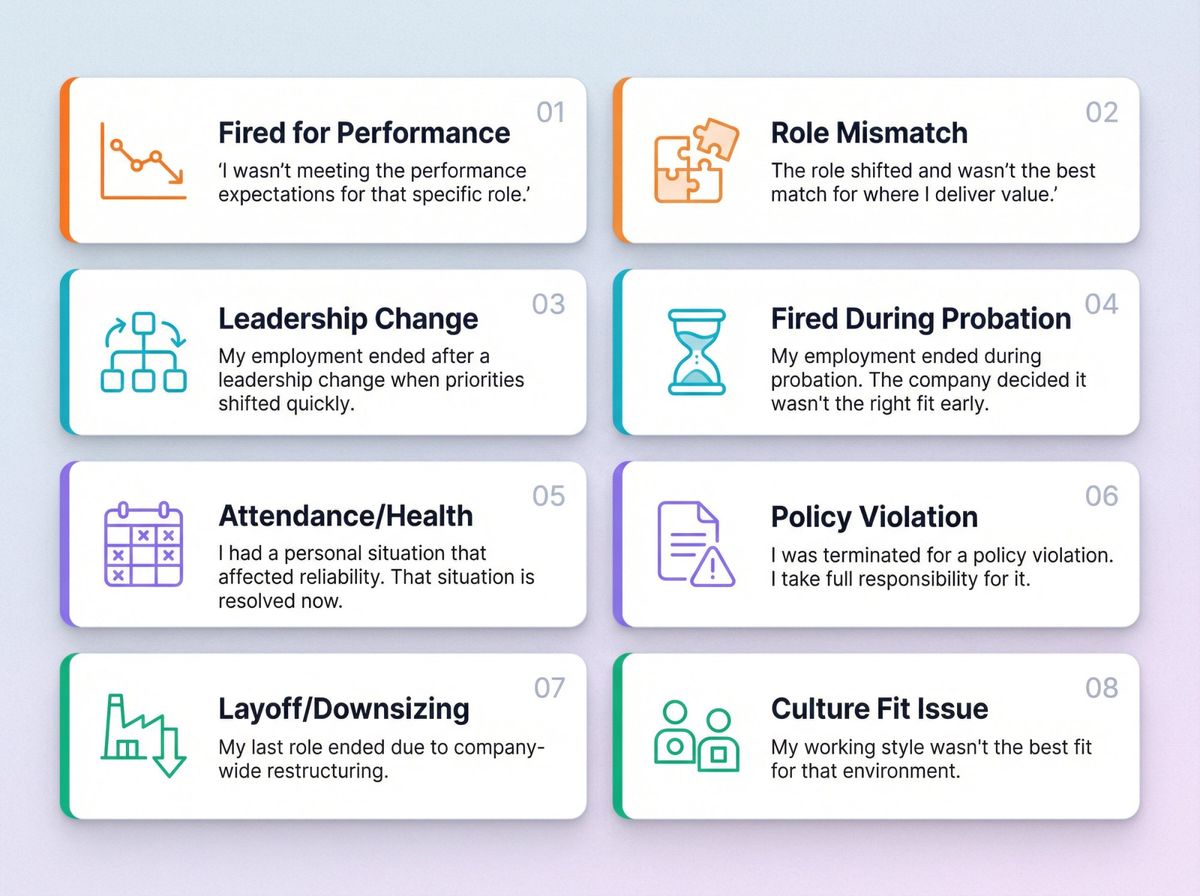
Scenario 1: Fired for Performance
Script: "My employment ended because I wasn't meeting the performance expectations for that specific role. I take responsibility for that, especially around how I prioritized work and escalated risks early. Since then, I've tightened my workflow, built stronger review checkpoints, and I've been applying those habits in my recent projects. What I'm looking for now is a role with clear goals and measurable outcomes, like this one, where I can apply my strengths in ___."
Scenario 2: Role Mismatch
Script: "My employment ended because the role shifted into ___, and that wasn't the best match for where I deliver the most value. I learned I'm strongest in ___, and I've been focusing my work and training in that direction. This role fits because it's centered on ___, which is exactly where I do my best work."
Scenario 3: Leadership Change or Reorganization
Script: "My employment ended after a leadership change when expectations and priorities changed quickly. I could have adapted faster by aligning earlier and getting clarity sooner. I've taken that lesson seriously and now I proactively set expectations and confirm success metrics early. I'm excited about this role because the goals are clear and align with my experience in ___."
Scenario 4: Fired During Probation
Script: "My employment ended during probation. The company decided it wasn't the right fit early. It was a useful reset because it showed me I need a role with ___ to succeed. Since then I've been focusing on roles like this one, and I can point to ___ as proof of the fit."
Scenario 5: Attendance, Health, or Personal Instability
You don't owe medical details. Keep it tight.
Script: "My employment ended during a period where I had a personal situation that affected reliability. That situation is resolved now, and I'm fully able to commit to the role. I've put structure in place to make sure it doesn't repeat, and I'm excited about this position because ___."
If you need accommodations, handle that separately and strategically.
Scenario 6: Policy Violation (Not Criminal)
This is harder, but still survivable if you own it.
Script: "I was terminated for a policy violation. I take responsibility for it. I understood the rule after the fact and it was a serious lesson in judgment. Since then, I've been very deliberate about compliance and asking for clarification when something is even slightly unclear. I'm focused on roles where I can apply my strengths in ___ and operate with clear standards."
Don't say "I didn't know" unless it's genuinely credible and you can explain what you now do differently.
Scenario 7: Layoff or Company Downsizing
"My last role ended due to a company-wide restructuring. The company eliminated several teams, including mine, so it wasn't performance-related. I was disappointed to leave, but I used the downtime to earn a certification in Project Management and deepen my skills in agile methodology. Now I'm excited to bring those new skills to a growing company like this. In fact, I noticed your job description emphasizes agile project leadership. I'm ready to contribute on day one."
This answer makes it clear the separation was beyond your control, and quickly pivots to your proactive development and eagerness to contribute.
Scenario 8: Conflict or Culture Fit Issue
"I did part ways with my last employer because I realized my working style wasn't the best fit for that environment. It was a very competitive, go-it-alone culture, and I thrive much more in a collaborative team setting. I absolutely accept my share of that. I could have adapted better. The experience motivated me to work on my teamwork and communication. I even took a professional development workshop on conflict resolution and learned a ton. What I'm looking for now is a team-oriented culture, which is what excited me about this opportunity. I've seen firsthand how I excel when I can bounce ideas off colleagues, and from everything I know about your company, collaboration is key. I'm really eager to contribute in that environment."
How to Answer Follow-Up Questions About Being Fired
After you give your initial explanation, be ready for these common follow-ups.
| Question | Effective Response Approach |
|---|---|
| "What exactly happened?" | Keep it brief. One detail max. Good: "It was performance related, specifically ___." Bad: A five-minute timeline. |
| "What did your manager say?" | Good: "The feedback was ___, and I agree that I needed to improve that." Better: "They wanted ___, and I didn't deliver consistently." |
| "Were you put on a performance plan?" | You can answer without sounding defensive. Example: "Yes, we had a performance improvement period. I made progress, but not enough within their timeline." |
| "Would they rehire you?" | Don't guess. Safer options: • If yes: "Yes, based on policy and my exit conversation." • If you don't know: "I'm not sure what their rehire policy is, but HR can confirm dates and title, and I can provide references from ___." • If no and you know it: "No, I wouldn't be eligible under their policy. I understand why, and I can explain what changed since then." Don't lie. It's not worth it. |
Can Employers Find Out You Were Fired?
This matters because it changes how you phrase things.
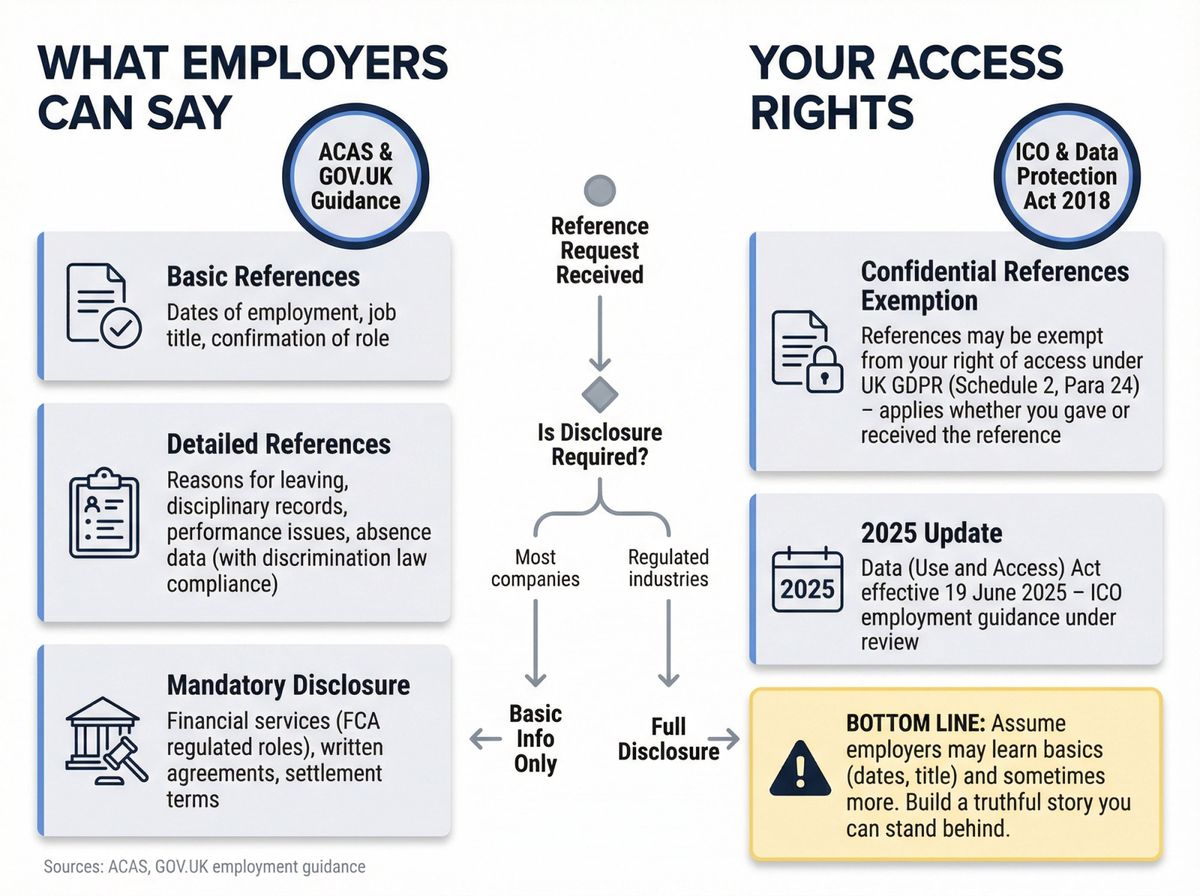
In the UK: References Can Be Basic or Detailed
ACAS explains that if an employer gives a reference, it should be fair and accurate. A detailed reference can include things like reasons for leaving and relevant disciplinary records. It can also include sickness or absence information in some cases, but employers must follow discrimination law.
In the UK: Employers Don't Usually Have to Give a Reference
GOV.UK states employers don't usually have to provide a reference, but if they do it must be fair and accurate. In some situations they must provide one (for example, where there's a written agreement or in regulated industries like financial services).
ACAS also notes references may be required in writing (like a contract), for certain regulated financial services roles, or as part of a settlement agreement.
Confidential References and Access Requests
If you're thinking "Can I just request the reference and see what they said?" it's complicated.
| UK Reference Rules | What It Means |
|---|---|
| Confidential references exemption | The ICO explains there is a "confidential references" exemption, meaning the information in a confidential reference can be exempt from the right of access in certain circumstances. This applies whether you gave or received the reference. |
| Legal backing | The Data Protection Act 2018 includes a specific confidentiality references provision (Schedule 2, Paragraph 24). |
| 2025 Update | The ICO notes its employment information guidance is under review due to the Data (Use and Access) Act coming into law on 19 June 2025. |
Bottom line: Assume a future employer may learn at least the basics, and sometimes more. Build a story you can stand behind.
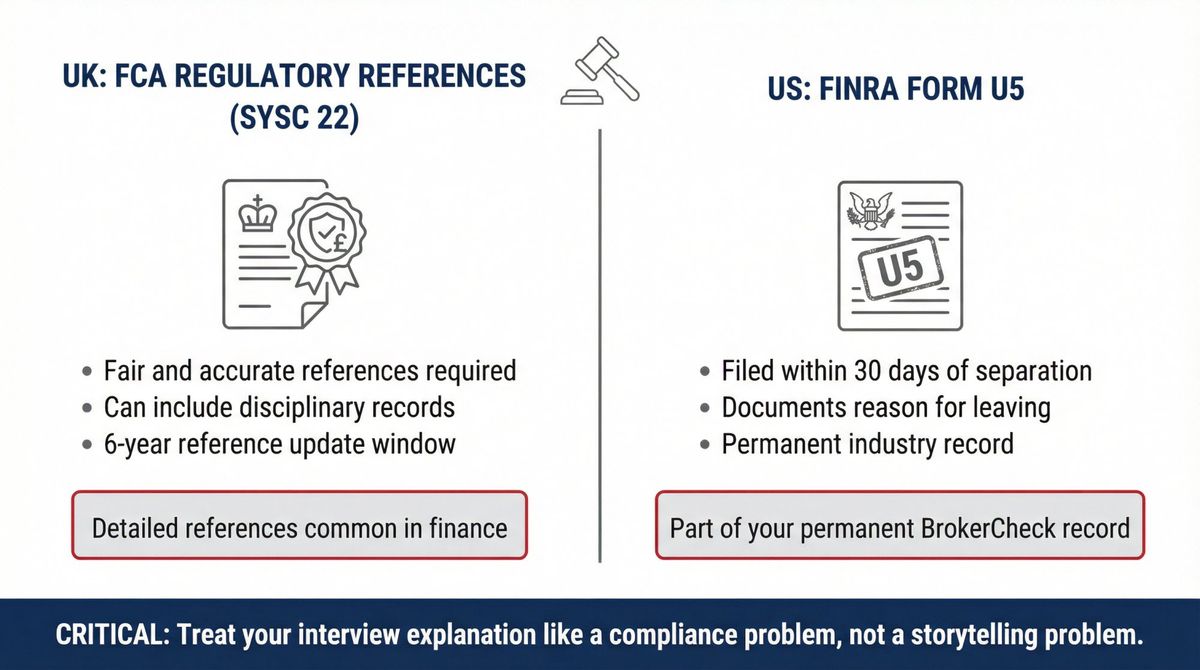
Special Case: Regulated Finance Roles (FCA UK, FINRA US)
If you work in finance, "just keep it vague" can backfire.
UK: FCA Regulatory References (SYSC 22)
The FCA Handbook section on regulatory references includes rules and guidance about getting, giving, and updating references, including time limits like the six-year window for updating references.
US: FINRA Form U5
In the US, FINRA requires that a Form U5 must be filed when an individual leaves a firm, and it must be submitted within 30 days of the employment end date. This form documents the reason for separation and is part of your permanent industry record.
If this applies to you, treat your interview explanation like a compliance problem, not a storytelling problem. Consistency matters a lot.
Should You Put 'Fired' on Your Resume or Cover Letter?
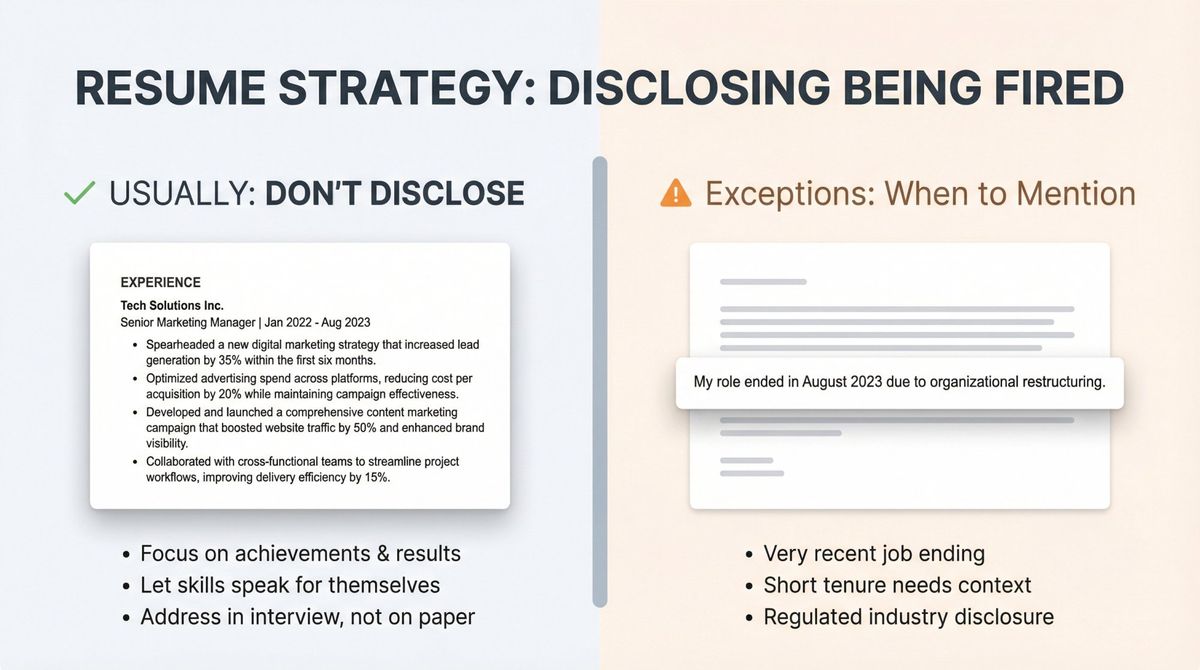
Usually: no.
Your resume and cover letter are marketing documents. They should sell your skills and results, not volunteer negative context.
You bring it up only if:
• The job ended very recently and it will obviously come up
• The tenure is short and looks confusing without context
• You're in a regulated environment where the paper trail is unavoidable
If you do address it in writing, keep it to one sentence, then pivot hard to fit.
How to Practice Your Firing Explanation Without Nerves

The Five-Round Drill
Round 1: Write your three-sentence answer.
Round 2: Say it out loud and time it. Target 20 to 40 seconds.
Round 3: Remove adjectives until it sounds plain.
Round 4: Record yourself once. Notice where your voice changes.
Round 5: Practice follow-ups (the "Would they rehire you?" question matters).
If your answer still sounds emotional after 10 reps, the issue isn't wording. It's unresolved anger or shame. Shorten and neutralize more.
Boost Your Confidence Before the Interview
→ Practice your firing explanation out loud until it feels natural and you can say it without hesitation. Consider doing a mock interview with a friend or using AIApply's Mock Interview simulator to rehearse your answer and get feedback. The more you practice, the more your nerves will subside.
→ Focus on your strengths. Remind yourself of everything you're good at and what you've accomplished in your career. A firing is just one chapter. It doesn't define your whole story. Make a list of wins and positive feedback you've received. This will help you walk into the interview with your head high.
→ Reset your perspective: Instead of viewing the firing as a shameful secret, frame it as a learning experience that made you better. Genuinely adopt the narrative that "Yes, I had a setback, and here's how I grew from it." This will reflect in your tone and body language. Practice your response and get the negativity out of your system. Then go into the interview seeing the termination as nothing more than a bump in the road. That attitude will shine through.
→ Stay future-focused: Throughout the process, keep your eyes on the prize. The new opportunity in front of you. Visualize yourself succeeding in the new role. When you're excited about what's ahead, it's easier to talk about the past without dwelling. Employers will sense your forward-looking energy and appreciate it.
AI Tools to Help You Answer Tough Interview Questions
At AIApply, we've built tools specifically for high-pressure interview moments like this one. When you need structure instead of improvisation, we've got you covered.
Here's what each tool looks like in action:
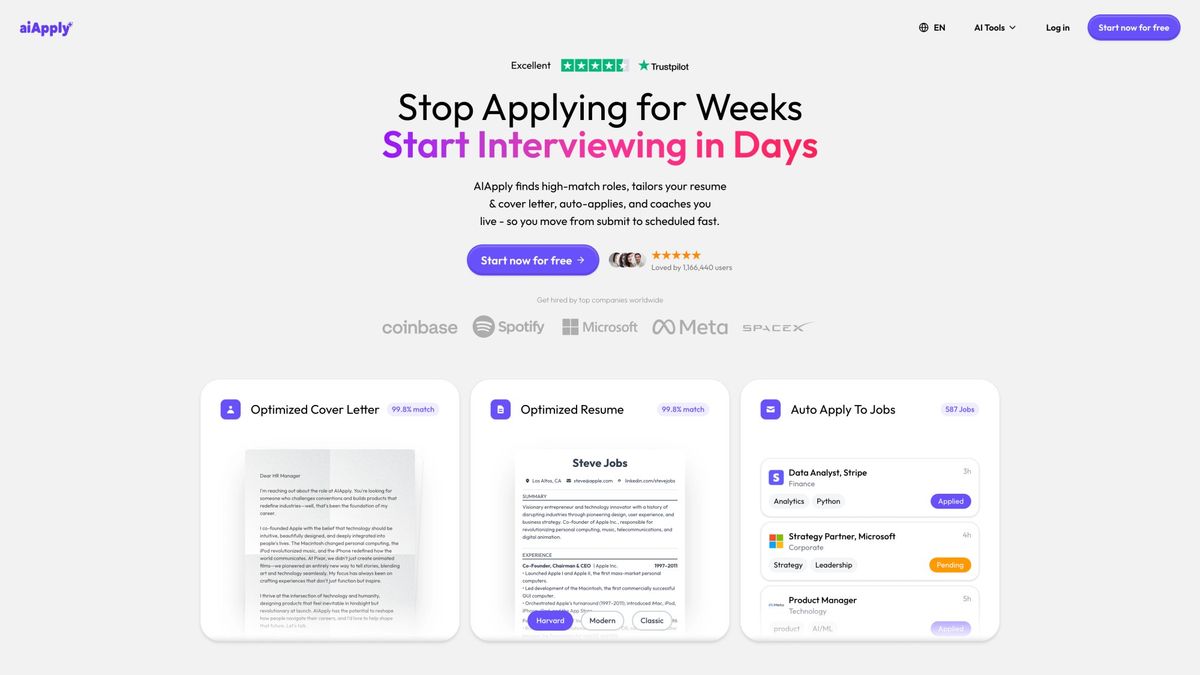
1) Generate a Clean, Role-Aligned Story
→ Use our AI Cover Letter Generator to craft a future-focused narrative and keep your tone consistent across applications.
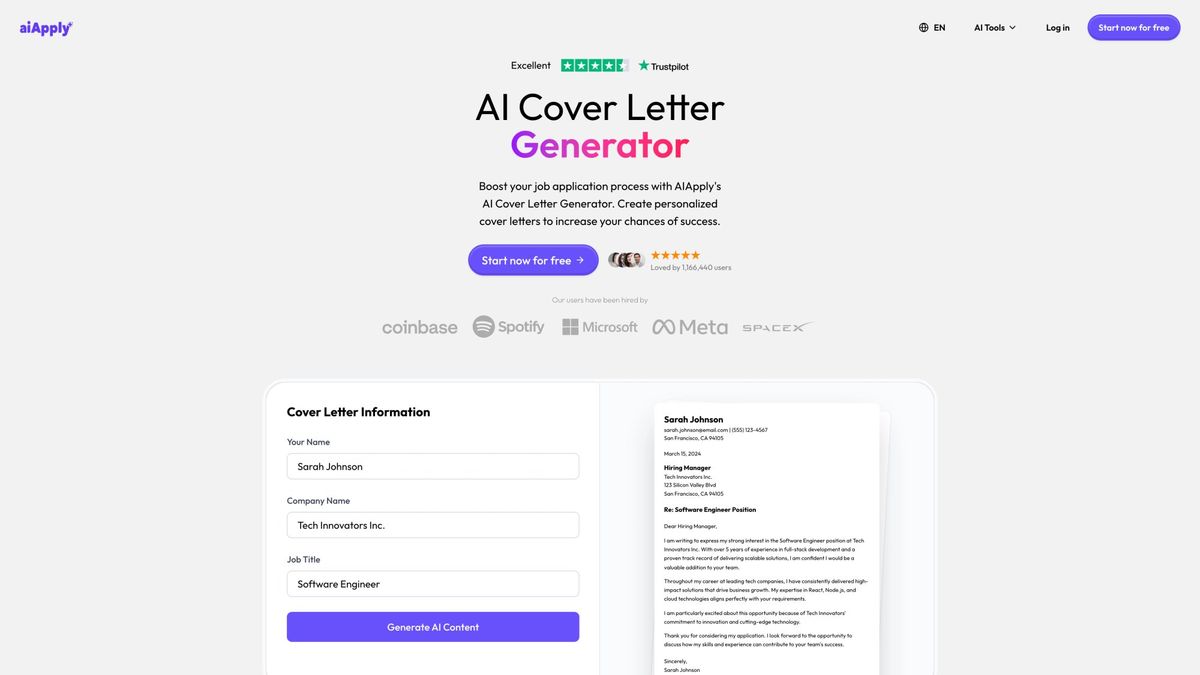
→ Use the AI Resume Builder to keep your resume focused on outcomes, not setbacks.
2) Practice the Question the Right Way
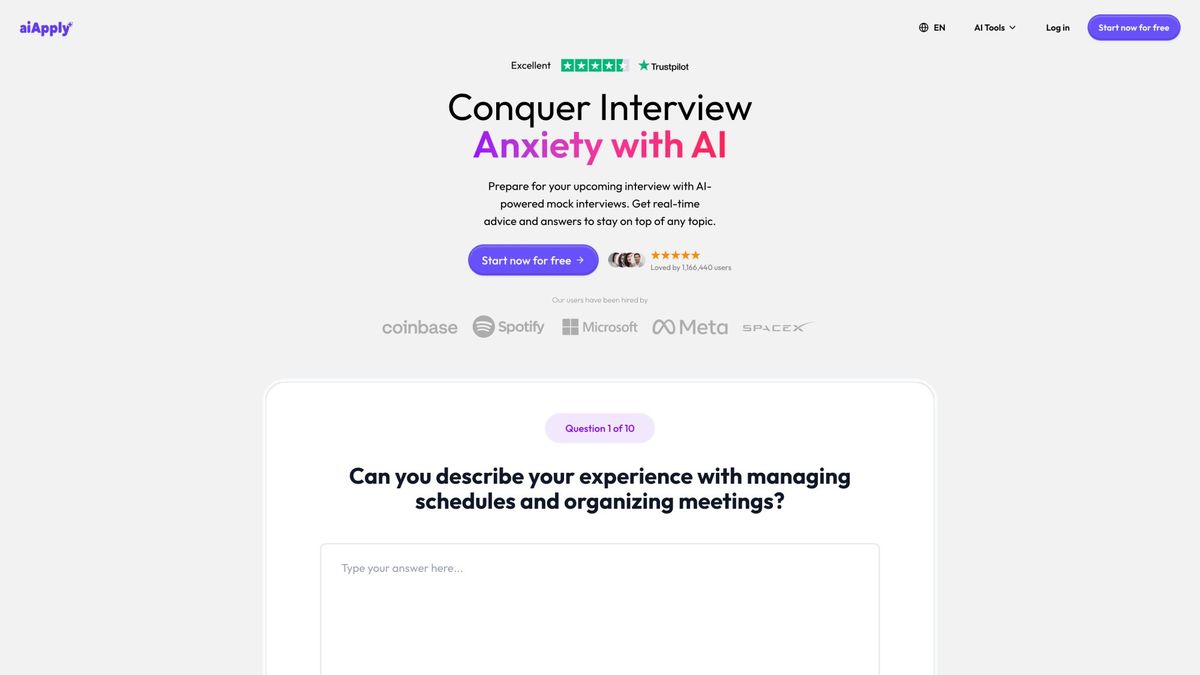
→ Use AIApply's Mock Job Interview tool to rehearse "Why did you leave?" and "Were you fired?" with questions tailored to a real job description.
3) Get Support During the Real Interview
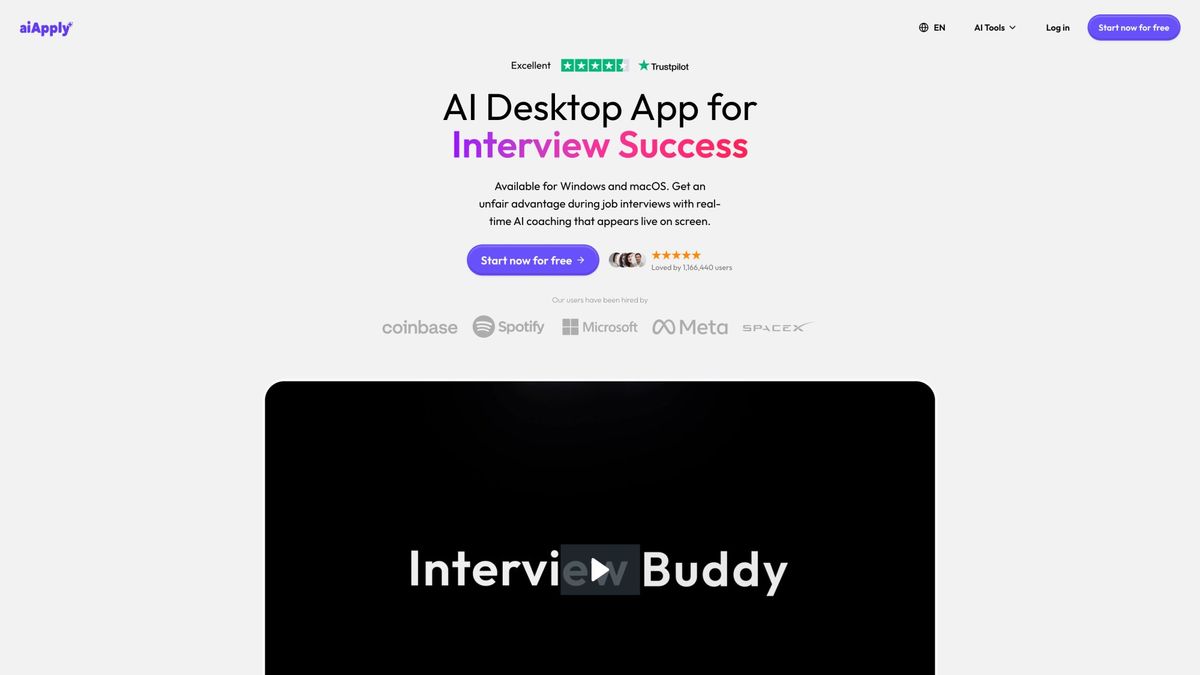
→ AIApply's Interview Answer Buddy is designed for real-time guidance when questions come unexpectedly. Use it to stay structured, not to invent facts.
4) Keep Momentum in Your Job Search
→ If you're applying at volume, AIApply Auto Apply helps you scale applications while keeping them tailored, so you can focus your energy on interview prep and story work.
If you want extra interview practice resources, we've also created a roundup of the best sites for interview practice online.
Next Steps After Crafting Your Explanation
Once you've crafted your explanation, do a few practice runs. You might use AIApply's Interview Buddy to simulate tough questions and get real-time feedback, or work with a mentor to role-play the scenario.
Also, double-check that your resume and LinkedIn are framed appropriately. Dates should be accurate and you shouldn't be misrepresenting the reason for leaving. Consistency between your documents and your interview answer is key to maintaining trust. Learn how employers verify employment history.
Can You Get Hired After Being Fired? Yes, Here's How
Remember: One tough chapter does not cancel out your skills, education, and the contributions you can make.
If you handle the topic with grace and confidence, many interviewers will not hold a firing against you. In fact, they may respect your maturity in handling it.
Getting fired or laid off is not the end of the world or your career. If you stay positive, don't bad-mouth your previous employer, and respond truthfully, you will get hired again.
Millions of people have bounced back from being fired. You can too.
Each interview is a fresh chance to show who you are now, not who you were in that past moment. By following the strategies in this guide, you'll be able to explain a firing in a professional way that eases the employer's concerns and lets your true strengths shine through.
Many people, from entry-level workers to CEOs, have been fired at some point and later found great success. Use that as encouragement that you're not alone. If you're changing careers after being fired, you're in good company.
The fact that you scored an interview means the employer already sees potential in you. They're giving you a chance. And if you've read this far, you're taking the right steps to ensure you make the most of it.
Finally, take a deep breath.
You've prepared. You know your plan. And you're more than just a person who got fired. You're a talented professional with experiences (even painful ones) that have taught you something valuable.
Go into that interview with confidence in the value you offer now. If you do that, you'll come across as honest, accountable, and resilient. Exactly the kind of person people want to hire.
Good luck!
Common Questions About Explaining Being Fired
How do I explain being fired in an interview without sounding defensive?
The key is to stay calm, brief, and forward-looking. Use neutral language ("my employment ended" rather than getting emotional), take ownership of what happened, and immediately pivot to what you learned and why you're a great fit for this role.
Practice your answer until it sounds matter-of-fact, not emotional. If you're still sounding defensive after multiple practice runs, you may need to shorten your explanation even more.
Should I mention being fired on my resume or cover letter?
Generally, no. Your AI Resume Builder and cover letter are marketing documents designed to showcase your skills and achievements. You don't need to volunteer negative information.
Only mention it in writing if:
• The job ended very recently and will obviously come up
• The short tenure looks confusing without context
• You're in a regulated environment where disclosure is unavoidable
Even then, limit it to one sentence and immediately pivot to your qualifications.
What if I was fired for performance issues?
Own it briefly, then show evidence of improvement.
Example: "I wasn't meeting the performance expectations in that role. I take responsibility for that, especially around how I prioritized work. Since then, I've completed training in [specific skill], tightened my workflow, and built stronger review checkpoints. In my recent projects, I've been applying those habits with measurable success."
The key is demonstrating concrete changes, not just promising to "do better."
Can my future employer find out I was fired even if I don't tell them?
Yes, they can. In the UK, if an employer provides a reference, it must be fair and accurate, and it can include reasons for leaving and disciplinary records. Some companies only confirm dates and titles, but others provide detailed references.
Background checks and reference checks can reveal terminations. That's why honesty is critical. A mismatch between your story and what shows up in a reference check will kill your chances faster than the firing itself.
How do I handle it if I was fired for cause (policy violation, misconduct)?
This is harder but not impossible. Be honest but concise:
"I was terminated for a policy violation. I take full responsibility for it. It was a serious lesson in judgment and compliance. Since then, I've been very deliberate about following procedures and asking for clarification when needed. I also completed [ethics training/compliance course] on my own time to ensure this won't happen again."
Avoid minimizing it or making excuses. Show genuine accountability and concrete steps you've taken.
What if the interviewer asks if my former employer would rehire me?
Don't guess.
• If you know the answer is yes based on your exit conversation, say so.
• If you're unsure, say: "I'm not certain what their rehire policy is, but HR can confirm my dates and title, and I can provide references from [other managers or colleagues]."
• If you know the answer is no, be honest: "No, I wouldn't be eligible under their policy. I understand why, and I can explain what's changed since then."
Never lie about this. They can verify it.
Should I bring up being fired if the interviewer doesn't ask about it?
No, not usually. If they don't ask, focus on selling your skills and experience. You don't owe an unsolicited confession.
But if you make it to the offer stage and a background check is imminent, some experts suggest proactively mentioning it to show transparency before they discover it independently. Use your judgment, but never volunteer the information early in the process unless directly asked.
How can I practice explaining being fired without getting emotional?
Use the five-round drill:
① Write your answer
② Say it out loud and time it (aim for 20 to 40 seconds)
③ Remove emotional adjectives until it sounds neutral
④ Record yourself and notice where your voice changes
⑤ Practice follow-up questions
If you still sound emotional after 10 practice reps, the issue isn't your wording. It's unresolved feelings. Consider talking it through with a friend or counselor before the interview.
You can also use tools like AIApply's Mock Interview to practice in a realistic setting.
What's the best way to pivot from explaining the firing to showing I'm a good fit?
End your explanation by explicitly connecting your growth to the job you're interviewing for.
Example: "Since then, I've developed strong skills in [relevant area], as shown by [specific achievement]. I'm excited about this role because it focuses on [job requirement], which is exactly where I excel now."
Make it clear you're not just explaining the past. You're demonstrating why you're the right person for their future.
How long should my answer about being fired be?
Aim for 20 to 40 seconds. Three sentences max.
Any longer and you risk oversharing or sounding like you're making excuses. The interviewer doesn't need your life story. They need enough information to assess whether you've learned, grown, and won't repeat the same issues.
If they want more details, they'll ask follow-up questions.
What if I was fired but it was really unfair or the result of office politics?
Even if the firing was genuinely unjust, never blame others in the interview. Saying "my boss had it out for me" or "the company was toxic" makes you look unprofessional and difficult to work with.
Instead, frame it neutrally: "There was a mismatch between what the role needed and my strengths" or "The environment wasn't the right fit for how I work best."
Focus on what you learned about yourself and what kind of environment helps you thrive. This keeps you in control of the narrative without sounding bitter.
Can I use AIApply tools to prepare for this question?
Absolutely. We built AIApply specifically for high-pressure interview moments.
→ Use our Mock Interview tool to practice "Why did you leave?" and "Were you fired?" with realistic scenarios.
→ Use Interview Answer Buddy for real-time guidance during the actual interview.
→ Use our AI Resume Builder and Cover Letter Generator to keep your application materials focused on your strengths, not your setbacks.